If you can run in woods all day, and not come once when called, If you can eat the kinds of things that leave owners appalled, If you can leave your fur in places that you’ve never been, And be to blame for countless crimes which you commit unseen, If you can chomp your masters things into a thousand bits, And still ensure he feeds you first when for his lunch he sits If you can pester picnickers that you’ve not met before And be a pain whilst fast asleep as noisily you snore, And if, e’en so, you’re loved by those that you drive round the bend, It’s plain to see, for folks like me, you’ll be a Lab my friend!
Recently, despite its sometimes bad language, I’ve been enjoying the Apple TV+ series ‘Slow Horses’. Based on the books by Mick Herron it stars the excellent Gary Oldman, and tells the story of a bunch of failed MI5 agents who, as a result of their inadequacies, are sent to Slough House, a fictional dead end department of the British secret service where they are expected to spend the rest of their working life engaged in dull administrative tasks.
But despite their unpromising circumstances, and their ongoing incompetence, they still manage to find themselves involved in a series of vital missions which they proceed to carry out with varying degrees of success under the watchful eye of the appalling yet brilliant Jackson Lamb, the acerbic head of the organisation who, despite his apparent callous disregard for those under his charge, does actually seem to care for them and frequently intervenes so as to ensure that things ultimately work out in at least a reasonably satisfactory manner.
With some very important caveats, the show reminds me of the true church, a similarly quirky body of people, one into which all manner of failed men and women are warmly welcomed. These flawed folk, despite their frequent ongoing incompetence, also become involved in all manner of vital activities that they too carry out with varying degrees of success under the watchful eye of their far from appalling and perfectly holy Heavenly Father.
And his love for them is one that is never in doubt as he too intervenes, albeit sometimes mysteriously, to ensure that all things work together for the good of his people and in complete accordance with the counsel of his will.
The program is, for me at least, a small reminder that our worth as Christians is not determined by our actions, but by the love in which we are held by Almighty God. And that, irrespective of what terrible things we may have done wrong in the past, not only can we be forgiven through the atoning sacrifice of Jesus’ death on the cross, but our lives can continue to have great purpose, as we are sent out into the world in the power of the Holy Spirit to both live and work to the praise of God’s glorious grace.
Or, as it is described through the always beautiful language of the Bible, though we all like lost sheep have gone astray, the Lord is our Shepherd who, having lovingly lain down his life for us, will bring home all who recognise and listen to his voice.
However slow we might sometimes have been!
‘Slow Horses’ Theme Tune
Related blogs:
To read ‘Foolishness – Law and Gospel’, click here
To read ‘What becomes of the broken hearted? Sorrowful yet always rejoicing on Palm Sunday’, click here
To read ‘Why do bad things happen to good people? Sorrowful yet always rejoicing on Good Friday’, click here
To read ‘Was it not necessary that the Christ should suffer these things? Rejoicing, though temporarily sorrowful, on Easter Day’, click here.
To read ‘Something to feast your eyes on’, click here.
‘There is a time to weep, and a time to laugh, a time to mourn, and a time to dance’ [Ecclesiastes 3:4]
A while back I wrote about a wedding I’d recently attended. But given my own advancing years, these days, in any given week, I’m far more likely to find myself at a funeral. As was the case yesterday.
The man who had died was not somebody I can claim to have known well but, because of the few occasions when our paths had crossed and he had shown me great kindness, I consider myself blessed to have known him. And I was blessed by attending his funeral too.
But this was not because the service was in anyway a happy occasion – the very real tears of those who loved him most were testimony enough to that. And as the congregation that filled the parish church were reminded, death is not something we celebrate – it is a horrible intruder into God’s good creation, one whose unwelcome appearance rightly leads us to weep and mourn.
Even so, I was encouraged to hear again what I have long known to be true as the minister, taking 1 Thessalonians 4: 13-18 as his text, spoke of how the Bible often refers to those who have died as those who have fallen asleep. And I learnt that the word ‘cemetery’ comes from a Greek word meaning ‘sleeping place’ which, as was pointed out, is all highly significant – because sleep is something you wake up from.
That, to me, is a lovely thought.
But unlike so many other lovely thoughts, this is one that is so much more than wishful thinking. Because this ‘lovely thought’ is also a guaranteed reality, one that we can believe, not just because we want to, but because waking up from death has historical precedence.
By which I mean, it’s happened before.
Two thousand years ago Jesus rose from the dead and, because of this well attested fact, we can have absolute confidence that those who die ‘in Christ’ will also rise from the dead when he returns to earth, a day that, alongside those of his birth, death and resurrection, will surely complete the four most significant days in history.
As the service drew to an end, it was good to be able to recite the beautiful answer to the opening question of the Heidelberg Catechism – a question that asks us what is our comfort in life and death?
‘That I am not my own, but belong – body and soul, both in life and in death – to my faithful Saviour, Jesus Christ.
He has fully paid for all my sins with his precious blood, and has set me free from the tyranny of the devil.
He also watches over me in such a way that not a hair can fall from my head without the will of my Father in heaven; in fact, all things must work together for my salvation.
Because I belong to him, Christ, by his Holy Spirit, assures me of eternal life and makes me wholeheartedly willing form now on to live for him’
On leaving the church we walked through the graveyard – or should I say, dormitory – passing the grave where the one we had come to remember had been buried earlier in the day. A fellow mourner whispered ‘God bless you’, but I doubt his words would have been heard beneath the six feet of freshly dug earth where my erstwhile friend now lay. Even so, as I was walked on by, I thought of the day to come when he will here his name spoken and, as surely as a sleeping child wakes when called by a loving Father, he will rise again to life.
And this is my hope too – my sure and certain hope – that though the wages of sin is death, with my sin paid for on the cross, death has lost its sting. It has been swallowed up in victory and so the free gift of God is now eternal life in Christ Jesus my Lord.
And so, like D.L. Moody before me, let me say this – if one day you hear it announced that I have died – don’t believe a word of it – for I shall be more alive then, than I have ever been before.
The news of my death will have been greatly exaggerated.
Related blogs:
To read ‘A Time to Dance – Reflections on a Marriage’, click here
To read ‘On death – my first and last’, click here
‘You have made your people see hard things; you have given us wine to drink that made us stagger.’ [Psalm 60:3]
‘You have fed [your people] with the bread of tears and given them tears to drink in full measure.’ [Psalm 80:5]
‘Will you not revive us again, that your people may rejoice in you?’ [Psalm 85:6]
Sometimes, when we imagine that all is well with the world, it is easy to praise God and rejoice in all that he is and all that he has done. But sometimes, when the world is seen to be what scripture declares to be a ‘vale of tears’, it’s hard. Very hard. Sometimes, therefore, it’s right that we weep with those who weep.
What can we say on days when the anguish is intense? What words might bring a degree of comfort when there seems to be nothing but sorrow? And how do we answer the question that inevitably arises. Why? Why does God allow some to suffer as he does? Why does he allow bad things to happen?
This is mysterious ground and we should step carefully. The answer may never be ours to know and the wisest counsel may be to keep silent when asked to give a reason for such circumstances – there is certainly no easy, concise, one size fits all answer. God’s answer, from out of the whirlwind, to the questions Job asked of his suffering was
“I will question you” [Job 38:3]
G.K. Chesterton writes:
‘…God comforts Job with indecipherable mystery, and for the first time Job is comforted…Job flings at God one riddle, God flings back at Job a hundred riddles, and Job is at peace. He is comforted with conundrums. The riddles of God, Chesterton writes, are more satisfying than the solutions of men’
In the prologue to the book of Job, we see that Job was tormented, not because he was the worst of men, but because he was the best. There is a sense, therefore, in which Job points us towards Jesus. Job is not told that his misfortunes were due to his sins, or part of any plan for his self improvement – but we are, none the less, told that he was allowed to suffer under God’s sovereign care. That a good man should suffer at the hands of a loving God is a paradox. Chesterton calls it ‘the very darkest and strangest of … paradoxes‘ which is, nonetheless, ‘by all human testimony the most reassuring‘. Because the infinite mystery of God is enough to inspire our trust in his sovereign goodness, even when the specific reasons to why we suffer remain a mystery.
As the words of the psalms that I quoted earlier confirm, the Bible is honest about the reality of suffering. If we are to find any comfort, if we are to be revived that we might again rejoice in God, our words and our thoughts, will not be enough. We need a word that transcends our sadness, a word from outside of ourselves, a word from God that can speak truth into our sadness and in so doing bring us hope.
So what do we need to know when bad things happen? What might we find ourselves doubting when events grieve us so deeply? Of what do we need to be reassured?
Firstly we need to know that God is still in control. Nothing happens outside of his sovereign will. We may not understand why God would chose to allow things that we would not, but he is God and he is sovereign over all things – he has supreme power and ultimate authority.
Isaiah Chapter 6:1 assures us of this.
‘In the year that King Uzziah died I saw the Lord sitting upon a throne, high and lifted up; and the train of his robe filled the temple.’
Nearly 3000 years ago King Uzziah died, and the future seemed uncertain for the people of Isaiah’s day. Isaiah, however, saw behind the immediate apparent disaster, behind the current uncertainty, and saw a vision of one who was in total control, utterly in command of everything that was taking place. He saw the Lord sitting upon his throne, high and lifted up. The immense train of his robe, a symbol of his absolute authority, filled the temple. God was in control 3000 years ago. And he is still in control today.
John 9 is also helpful here. There we read about a man born blind. At the time of his birth, his parents were, no doubt, devastated at the discovery that their son could not see. But when we meet him he has grown up to be a man . Who knows how many years have gone by – twenty, thirty, maybe more – and for all that time the man has suffered, reduced to a lifetime of begging in order to stay alive.
The disciples, like, no doubt, so many others, find themselves wondering why the man had suffered in the way he had? And so they ask Jesus,
‘Who sinned, this man or his parents, that he was born blind?’.
But Jesus answers them by saying,
‘It was not that this man sinned, or his parents, but that the works of God might be displayed in him’.
And so we see that the man was born blind for a God ordained reason, one that, for decades would have been unknown to neither the man himself and his parents, nor indeed anyone else.
In seeking an explanation for the man’s blindness, they asked their question ‘Why?’, expecting an answer regarding what caused it. But Jesus answers their question of ‘Why’ in terms of what was God’s purpose. And the reason he gave for that was so that the works of God might be displayed.
It should, therefore. be of no suprise to us that God’s purpose in bringing about certain events in this world are, for the time being at least, similarly beyond our understanding. Maybe we will not see the reasons for them in our lifetime, indeed the reasons may never be ours to know. But though the sadness remains, we can, by faith, have confidence that God was and is in control of them. He does have a purpose.
But is God loving? He may be in control, but can he really love us if he allows us to suffer so? This is something that is also addressed John’s Gospel
‘Now a certain man was ill, Lazarus of Bethany, the village of Mary and her sister Martha. It was Mary who anointed the Lord with ointment and wiped his feet with her hair, whose brother Lazarus was ill. So the sisters sent to him, saying, “Lord, he whom you love is ill.” But when Jesus heard it he said, “This illness does not lead to death. It is for the glory of God, so that the Son of God may be glorified through it.” Now Jesus loved Martha and her sister and Lazarus. So, when he heard that Lazarus was ill, he stayed two days longer in the place where he was.’ [John 11;1-6]
Lazarus was ill. And his sisters call for Jesus to come in the hope that he will heal Lazarus. But Jesus doesn’t respond in the way that they want and Lazarus subsequently dies. But notice versus 5 and 6 where we read
‘Now Jesus loved Martha and her sister and Lazarus. So, when he heard that Lazarus was ill, he stayed two days longer in the place where he was.’ [John 11;1-6]
Jesus loved these people. And yet the passage tells us that Jesus delays his departure. Indeed, verse 6 begins with the word ‘So’. It is precisely because Jesus loves Mary, Martha and Lazarus that he delays his visit and allows Lazarus to die. There is the. a higher, better, more loving purpose underlying Jesus’ actions – Lazarus’ suffering is for the glory of God too, so that the Son of God may be glorified through it.
Sometimes when bad things happen, we will have been calling on God to prevent that thing from taking place. Perhaps we will have been praying for someone’s healing, for war to come to an end or someone’s life circumstances to dramatically change. But for reasons that we currently can’t comprehend, rather than answering our petitions in the way we would like, God choses to act differently to how we would have chosen. Even so, though our sorrow remains, we can, by faith, know that his actions are still loving. Jesus loved – and continues to love – those that suffer..
And we can find comfort in the rest of John chapter 11 too. In verse 35 we find Jesus himself weeping at the tomb of Lazarus. He is deeply distressed by the death of his friend – and that anguish is no less real for knowing that he will soon raise Lazarus from the dead.
Similarly. I believe Jesus is with those who are sad today. He too weeps with those who weep.
Even so. We can be sure that he won’t leave them to grieve forever.
Because Jesus, who declared himself to be the resurrection and the life, later raised Lazarus from the dead. And so, though we will sometimes have cause to mourn, we do not need to mourn as those who have no hope. For we believe in a God who saves, a God who redeems, a God who raises the dead.
Our salvation does not depend on how happy we are in this life. Our salvation depends on the grace of the God in whom we have faith, regardless of how weak that faith might sometimes be. We are not saved by virtue of how meritorious our life has been, but on account of the life of Jesus whose death on the cross paid for all our sins – those we have committed and those we are yet to commit,. We are saved by Jesus’ sinless life, his perfect righteousness being credited to us and making us acceptable to God.
We are saved by grace alone – a grace that, unlike our sometimes wavering faith, will never falter.
‘The steadfast love of the LORD never ceases, his mercies never come to an end, they are new every morning. Great is [his] faithfulness’ [Lamentations 3:22]
That is the gospel, the good news, the hope to which we cling.
God has made promises – promises he cannot fail to keep. We often find that what we experience now and what we hope for in the future stand in contradiction to each other. Our hope though is directed at what is not yet visible, and it is our faith in God’s promises that assures us that what he promises we will surely one day experience. God’s promises do not always throw light on the reality that exists today, mystery often remains, but they do illuminate the reality that will one day be.
So let’s remind ourselves again of some of those promises. Though the grief remains, there is a day coming when the Lord himself will descend from heaven with a cry of command, with the voice of an archangel, and with the sound of the trumpet of God. And the dead in Christ will rise. [1 Thessalonians 4:16]
There is a day coming when what is sown perishable, will be raised imperishable; what is sown in dishonour, will be raised in glory and what is sown in weakness will be raised in power [1 Corinthians 15:42-43].
And there is a day coming when God will wipe away every tear from our eyes, and death shall be no more, neither shall there be mourning, nor crying, nor pain anymore, for the former things will have passed away [Revelation 21:4].
What then shall we say when disaster strikes?
Is God in control? – Yes, the sadness remains, but God is in control. Is God loving? – Yes, the sorrow remains, but God is loving. Is there still hope? – Yes, the grief still remains, but there is still hope.
God remains worthy of our worship. Retuning to John 9 we read how, having said that the beggar was born blind so that the works of God might be displayed, Jesus restores his sight. And in so doing he declares himself to be God.
As he does so. Jesus makes use of some mud – mud that he himself had made which provoked controversy with the Pharisees who considered such an action unlawful on the Sabbath.
They didn’t understand that Jesus is Lord of the Sabbath. They didn’t understand that, because man was not made for the Sabbath, but the Sabbath was made for man, in order that man might rest and be restored, it was wholly appropriate for God to heal on that day.
Having anointed the mans eyes with the mud, Jesus instructed him to go and wash in the pool of Siloam which, we are told, means ‘Sent’. And there his sight was restored.
Interestingly, Jesus had just told the man that he, Jesus, has been ‘sent’ by God. Jesus, therefore, is giving us a picture – because going to the pool that is called ‘Sent’ is analogous to going to Jesus – the one who was ‘sent’ by God.
Jesus is, therefore, the place where spiritual sight is restored. And it is the restoration of spiritual sight that we then see, through a series of conversations that the beggar has, first with the Pharisees and then, finally with Jesus.
In verse 11, the beggar describes Jesus as a man, in verse 17, he describes him as a prophet, in verse 33 he acknowledges that Jesus is from God and finally, in verse 38, as well as calling him Lord, the man is seen worshiping Jesus.
First the beggar had his physical sight restored and then, a greater miracle takes place – he has his spiritual sight restored enabling him to see Jesus for who he really was.
It is no different for us. If we are to see who Jesus is, then we need to be the recipients of God’s grace. We need to have had our eyes miraculously opened as a result of the gracious act of a sovereign Lord.
An act that, as it did for the beggar, may involve years of suffering along the way – suffering which, if we do experience it, we can be sure it will have been both worth it and purposely ordained for our good by our loving Heavenly Father.
In order to be able to see, we need the Light of the World to shine in our lives. Praise God that when it does, we can see Him on even the darkest day.
And like the beggar in John 9, offer him our worship too.
Recently I have been reading through John’s Gospel and last week I came to chapter 16, and those verses where Jesus says to his disciples,
‘A little while, and you will not see me, and again a little while, and you will see me’.
As if often the case with the disciples, they are confused by Jesus’ words and so he expands on what he had said by adding,
‘Truly, truly, I say to you, you will weep and lament, but the world will rejoice. You will be sorrowful, but your sorrow will turn into joy.’
And it got me thinking as to what Jesus would want us to understand from what he said.
Jesus said these things the day before he knew he would be crucified. And so it seems pretty clear that he was referring to the sorrow his followers would feel following his death – a sorrow, he claimed, that would last only as long as the three days it would take for him to be raised back to life.
But I can’t help thinking that there is more to what Jesus was saying because, where there is a short term fulfilment to biblical prophecies, there is very often another, longer term, fulfilment too.
In which case, just as they would have been to the disciples, Jesus’ words can be a comfort to believers who hear them today – two thousand years after they were first spoken. Because, just as the disciples were sad after Jesus’ death, and subsequently rejoiced when Jesus returned from the dead, so we who currently experience sadness can also look forward to the day when we will see Jesus and our sorrow will be turned to joy when he returns to earth at his second coming.
‘But hold on a minute,’ you might saying to yourself, ‘when Jesus was speaking to his disciples, he said it would be ‘just a little while’ before they would see him again. How can his words ‘in just a little while’ have a long term fulfilment when 2000 years have already past since he first said them?
Well firstly remember this – ‘that with the Lord one day is as a thousand years, and a thousand years as one day.’ [2 Peter 3:8]
And secondly let me refer you to King David – the author of Psalm 37 – somebody else who might also perhaps, consider two millennia to be synonymous with ‘just a little while’.
I love the honesty of the psalms, I love the way they reflect the reality of how we sometimes feel, the reality of what we sometimes see around us, especially when what we feel and see around us, is not what we would want to.
Sometimes the wicked do prosper, and sometimes the righteous are oppressed and sometimes, when evil seems to have the upper hand, our sorrow is intense. If you don’t believe me, ask the people of Ukraine and those currently suffering so horribly in the Middle East.
But, says King David, all that is wrong in the world will one day come to an end – the current unsatisfactory state of affairs is but a temporary one.
And not only is it temporary, the pain and sadness associated with it will be short lived too – for, as he says in Psalm 37:10, ‘in just a little while’ order will be restored.
Soon the wicked will be no more, the meek will inherit the land and, as Revelation 21:4 later goes on to assure us, one day all our tears will be wiped away and death shall be no more.
Because in just a little while the former things will pass away.
But there will be those who might understandably say that they have already suffered for a long time. Their pain has not, as the apostle Paul describes it, been ‘light and momentary’, – rather it has been intense and prolonged. How then can David speak of all being well in just a little while, when some have had to endure hardship for decades?
Well in just the same way that Jesus can. By stepping back and considering the future – and by recognising that ‘the sufferings of this present time are not worth comparing with the glory that will one day be revealed’. [Romans 8:18]
Make no mistake, the current pain is real. Jesus likens it to that of childbirth, pointing out how the mother’s genuine anguish turns to joy with the arrival of her child. John Piper gives a powerful illustration when he asks us to imagine walking through a hospital ward and hearing someone screaming in pain. How we feel about what we are hearing depends, he says, on whether we’re on an oncology ward or a labour ward.
In referring to the pain of childbirth, Jesus is saying that the arrival of new life is a picture of our own future glory, one that, we mustn’t forget, will last for all eternity.
Furthermore, just as our future glory is immeasurably greater than our current suffering, and our future joy immeasurably greater than our current sadness, so too will our eternity be immeasurably longer than the time we now spend in this vale of tears.
So yes, weeping may tarry for the night time – but joy will come with the morning. [Psalm 30:5].
In just a little while, the sun will rise.
‘So we do not lose heart. Though our outer self is wasting away, our inner self is being renewed day by day. For this light momentary affliction is preparing for us an eternal weight of glory beyond all comparison’.
Which means that our suffering isn’t meaningless – it has a purpose, it’s doing something…
‘as we look, not to the things that are seen, but to the things that are unseen. For the things that are seen are transient, but the things that are unseen are eternal.’ [2 Corinthians 4:16-18]
Jesus himself said, ‘Surely I am coming soon.’ [Revelation 22:20] and when he returns we will see what currently we can’t
And whether that be in our life time or not until long after we have died, what we will finally see on that great and glorious day will be infinitely worth our current ‘momentary’ wait.
For the ‘little while’ we have waited will not be worth comparing with the time we have to enjoy being at home at last in the presence of our loving Heavenly Father.
Sometimes it’s a time to weep and sometimes it’s a time to laugh – sometimes it’s time to mourn and sometimes a time to dance. None of us live lives that are devoid of tears, and few of us, even in the darkest of times, are unable to find something to make us smile.
And sometimes we can be both happy and sad at the same time. We don’t have to wait until there’s nothing that makes us sad before we allow ourselves to be happy, any more than we need think we shouldn’t be sad, just because there are some things that make us smile.
So at the end of another cricket season which, because of what might have been, has, on occasions, been disappointing, here are some things that I’ve enjoyed. Because for every dropped catch there’s been a sharp run out, for every early dismissal, there’s been a spirited rearguard action.
Because whilst there are those who, on account of Somerset not having any silverware to show for their endeavours, say that this season has been a failure, there has, nonetheless, plenty that has shone brightly these last six months.
1. Craig Overton clean bowling the Nottinghamshire opener, Haseed Hameed, in the opening over of the season.
2. Tom Banton, Tom Banton and Tom Banton – somebody who has excelled this year – with a white ball, with a red ball, and with his recently acquired set of crutches. Watching him make his way to the middle to celebrate with the rest of the team after that win over Surrey, left me wondering if he needed Tom Lammonby as a runner! And seeing him hugging Craig Overton almost moved me to happy tears!
3. Archie Vaughan. Who knows if one day Michael Vaughan will be known as Archie Vaughan’s Dad, but the eighteen year old has already moved out form under his father’s shadow. We’re told he’s a better batsmen than he is a bowler, and given his maturity in a number of innings this year that may well be the case. Even so he has particularly impressed with the ball this year and I was privileged to see him take his maiden first class wicket when he trapped Durham’s Ben McKinney from the last ball of his first over in championship cricket.
4. Sean Dickson and James Rew – for that fantastic partnership in the T20 semi-final taking us from 7-3 to by which time the game was all but won. Securing that second win over Surrey in two days was perhaps the high point of the season, after which things may have dipped a little – but what a high point it was!
5. Runners up in both the T20 and 50 over competition – the latter achieved without our bigs names present. A fantastic achievement in anyone books. And with it seeming likely at the time of writing, that they’ll finish third in the county championship, it surely means that, despite not actually winning anything, Somerset can still be said to have had the best all round season of any county side this year.
6. The small things that are actually the big things. I’m thinking here particularly of the club’s support of Jacob Lunn, when he was treated so cruelly on the social media platform formally known as ‘Twitter’, and the presentation to Mary Elworthy-Coggan, for her many years of fundraising for the club and other worthy causes.
7. TKC’s interview after the T20 final where, rather than making excuses for the teams defeat, he sportingly acknowledged Gloucestershire as the better team and congratulated them as worthy winners of the competition
8. Tom Lammonby’s oh so welcome return to form. It’s been a pleasure seeing him bat this season at number 3 – even if he has, rather to often, had to walk out to the crease sooner than he or we would have liked.
9. Lewis Gregory’s captaincy. I don’t know much about cricket, but I’m pretty sure that Louie G knows plenty. And, given he always seems to be smiling, it seems to me he knows how to enjoy the game too whether the teams under pressure or cursing to victory, whether, as today, he’s hitting a straight six into the Marcus Trescothick stand on his way to a belligerent 57 or, having reduced the opposition to 2-2 off 2 balls, seeing James Vince, on his hatrick delivery, dropped dropped in the slips. He’s had a terrific first season as Somerset’s red ball skipper.
10. Making several new friends as I’ve chatted with fellow supporters and discovered, on a number of occasions, that we have more in common than just our love for Somerset.
11. The support shown on the Somerset Facebook Page. Yes there are those who only seem able to criticise, but such comments always fail to attract much support, unlike those that seek to get behind the team even after the more disappointing performances.
12. That epic game against Surrey – one that some are describing as one of the greatest of all time. Sometimes a picture paints a thousand words!
13. Other fantastic games – remember that victory over Essex inside two days, and the partnership of 134 between Matt Renshaw, and Andy Umeed to beat Kent in May – a match that saw both James Rew and Tom Banton, two of the country’s finest wicket-keeper/batsmen, score brisk centuries in a fifth wicket partnership worth more than 200 runs.
14. Whoever it was who, at the one day game against Lancashire, played ‘Crashed The Wedding’ as the most hirsute bride I ever saw was wrestled to the ground by security – the choice of being song infinitely more amusing than the stunt that inspired it.
15. The return of Jack Leach – and in T20 cricket too! It’s always a particularly warm round of applause that greats the announcement that the new bowler from the River end is the one sponsored by Joseph Casson Estate Agents. But these days it’s not just with his bowling that the slow left armer impresses – as, these days, he’s more than handy with a bat, as was shown to be the case today as he made a useful 33 not out.
16. The Second XI – winners of their T20 competition and the home of many who, if they haven’t done so already, will no doubt take their place in the first. The future really is bright with likes of Alfie Ogborne, Ned Leonard and a certain James Rew’s younger brother – because you can never have too many Toms in a Somerset team!
17. Sophie Luff being the first player to be given a professional contract with Somerset’s new women’s team – no doubt she’ll be as brilliant as she is as part of the excellent commentary team on the Somerset Livestream.
18. Learning that the news of Brian’s demise had been greatly exaggerated!
Somerset may not have won any honours this season, but it has been an honour to sit and watch them play. Thank you to the players, the coaching staff, and all the many, many others who together have once again afforded us such wonderful entertainment. It has been a joy.
Winter well everyone – until we do it all again next season!
In the preface to his book critiquing the effect of television on our culture, Neil Postman compares the concerns of George Orwell in ‘1984’ with those of Aldous Huxley in ‘Brave New World’. He writes:
‘What Orwell feared were those who would ban books. What Huxley feared was that there would be no reason to ban a book, for there would be no one who wanted to read one. Orwell feared those who would deprive us of information. Huxley feared those who would give us so much that we would be reduced to passivity and egoism. Orwell feared the truth would be concealed from us. Huxley feared the truth would be drowned in a sea of irrelevance. Orwell feared we would become a captive culture. Huxley feared we would become a trivial culture’
What is particularly astonishing is the fact that Postman’s book was written in 1985, long before the exponential rise in the number of TV channels and the dawn of Facebook and Twitter which together have only served to confirm Postman’s view that Huxley, not Orwell, was right. It is not religion, as Marx asserted in 1843, that has become the opium of the masses but rather it is entertainment that numbs us to what is real and valuable. It was for good reason that Postman’s book was entitled, ‘Amusing ourselves to Death’.
Because the truth is that, whilst we will all die as a consequence of our sin, the world seeks to distract us from that fact by filling our minds with things of negligible value compared to the infinite worth of a God who can save us from the very thing we long to forget.
Today, a week does not go by without some new ‘must see’ televisual feast being presented before us to distract and lift us from our otherwise supposedly tedious lives. Now there is nothing inherently wrong about watching the endeavours of a dozen amateur cooks but does ‘The Great British Bake Off’ really warrant the attention it generates in our newspapers each year when another new series begins. Thoroughly enjoyable though it is, our lives would not be so very diminished if we were never to see another disappointing signature bake, another plucky attempt at a technical challenge, or another triumphant showstopper.
To be entertained is in danger of becoming our ‘raison d’ete‘. But to simply be amused, a word, incidentally, that means to be devoid of thought, must not become the goal of our existence. Because, despite there being a God, one we were created to delight in, the world, doubting his presence, insists that we look elsewhere for our satisfaction.
Increasingly sportsmen have become those we should all aspire to be like. And when sport and television combine, as they did, for example, during the Olympics, we are all too easily persuaded that there is nothing more important than how fast someone can pedal a pushbike, nothing more amazing than someone doing a head over heels, and nothing more thrilling than someone jumping into a pool of water. Now don’t get me wrong, though not as much as a day at the cricket, I enjoyed watching the Olympics this year as much as the next person – but we simply mustn’t buy into the assertion that it has any ultimate importance.
What we glory in reflects what we consider most important. And so we must all ask ourselves what, or who, it is that we glory in – what, or who, it is that absorbs our attention. Because if, as I believe, it is God who is of ultimate importance, then we ought to fix our eyes on Jesus, and not the latest comings and goings on Strictly Come Dancing.
Jeremiah 9:23-24 reads:
‘Thus says the LORD: “Let not the wise man boast in his wisdom, let not the mighty man boast in his might, let not the rich man boast in his riches, but let him who boasts boast in this, that he understands and knows me, that I am the LORD who practices steadfast love, justice, and righteousness in the earth. For in these things I delight, declares the LORD.’
To ‘boast’ here does not mean to brag – it is not that we should brag about the fact we know something about God. On the contrary, if we know anything about God at all, it is down to his graciousness in revealing himself to us. In this context, to boast means ‘to value’, ‘to consider important’, ‘to take delight in’. Here, then, is a warning to us as to what we should glory in.
Let not the wise man boast in his wisdom, let not the mighty man boast in his might, let not the rich man boast in his riches.
We could go on.
Let not the tennis player boast in the accuracy of their serve, Let not the gymnast boast in their agility Let not the sprinter boast in their speed.
And less you consider that none of this refers to us, or perhaps that I am jealous of those more athletic than me, let’s bring it a little closer to home.
Let not the clinician boast in their clinical acumen Let not the craftsmen boast in the work of their hands Let not the welfare advisor boast in the sensitivity of their counsel.
And let not the Christian boast in the success of their ministry,
No, let him who boasts, boast in this. Let him who values anything, value this, delight in this, consider this important:
That he understands and knows God, that he understands and knows that He is the LORD, who practices steadfast love, justice and righteousness in the earth, and that in these things He delights.
We are to value the fact that we know God and delight in those aspects of his character that He himself delights in. To know God is the real meaning of our lives, the true purpose of our existence. And praise God that it is so – because only knowing God can satisfy the longings of our hearts.
The sporting endeavours of ourselves or others will not satisfy our souls The lightness of any Victoria Sponge ever baked will not satisfy our souls. Even the joys we may experience at work or home will never ultimately satisfy our souls.
But knowing God will.
Augustine of Hippo wrote in his Confessions;
‘Thou hast made us for thyself, O Lord, and our heart is restless until it finds its rest in thee’
Augustine was right. This is no great surprise since his words were simply echoing those of Jesus who said in John 17:3
‘…this is eternal life, that they know you the only true God, and Jesus Christ whom you have sent.’
To know God then is to live – to truly exist – to have eternal life. It is the whole point of our existence. What a privilege it is, therefore, to have been brought into the family of the triune God through the death and resurrection of Jesus Christ. What an honour it is to be called by our Heavenly Father, the sovereign creator and sustainer of the universe. And what a joy it is to have his Spirit with us, speaking to us through his word.
Oh that we might have ears to hear from Him, that we might know him better.
These days we are constantly hearing stories on the news that we would rather not have to be told. But even as we do so, let’s not forget to spend longer attending to God’s story, the one that is far bigger news than anything we’ll ever hear reported on the BBC. And let’s not allow ourselves to be distracted from all the bad news by the ‘bread and circuses’ that are continually being offered to us, but which never succeed in satisfying us at the deepest level of our souls. And rather than amusing ourselves to death with yet another boxset on Netflix, one more hour of watching random videos on YouTube, or filling one’s time by constantly scrolling through Facebook, let’s do as we ought, and seek instead to find contentment in the God who is there. Let’s not doubt his presence or his ability, not only to provide and protect us, but to truly satisfy us too.
For ‘some trust in chariots and some in horses, but we trust in the name of the LORD our God.’ [Psalm 20:7]. ‘[He] make[s] known to [us] the path of life; in [his] presence there is fullness of joy; at [his] right hand are pleasures forevermore’ [Psalm 16:11]. Therefore, let us fix, or even feast, our eyes on Jesus, ‘the founder and perfecter of our faith, who, for the joy that was set before him, endured the cross’ [Hebrews 12:2]. For he is ‘the image of the invisible God’ [Colossians 1:15]. In seeing and knowing Jesus we see and know the Father, and to know God, as already mentioned, is to experience eternal life [John 17:3].
It is not in ourselves, therefore, that we should boast, but rather we should boast in Jesus Christ, in his character and what he achieved on the cross. ‘God opposes the proud but gives grace to the humble.’ [James 4:6]. May it be, therefore, ‘far from [us] to boast except in the cross of our Lord Jesus Christ, by which the world has been crucified to [us], and [we] to the world’ [Galatians 6:14].
Because to know God really is enough. His grace is sufficient for us [2 Corinthians 12:9] and ‘godliness with contentment is great gain’. [1 Timothy 6:6].
So then, even in these days of great difficulty, may we grow in godliness. And, as we do, may we all know contentment, may we all know great gain, and may we all know his amazing grace.
Related posts:
To read ‘Still weeping with those who weep’, click here
In his short book entitled, ‘The Abolition of Man’, C.S. Lewis had some interesting things to say about how the focus of what science seeks to do has changed over time.
Whereas scientists once sought knowledge in order to understand how humankind conformed to reality, Lewis suggested that, for science, the problem had become ‘how to subdue reality to the wishes of men’. Furthermore, he contended, there were great dangers inherent in such an ambition.
Lewis believed that it would be those with power who would impose their wishes on the weak, and maintained that any attempt to subdue reality to the wishes of the powerful would require nature to be conquered in order that it conformed to their desires. That, he said, would require a reducing of all of nature to nothing but it’s component parts, denying anything beyond the merely physical, and quantifying everything only in terms of what could be measured.
Lewis concluded that, since humanity is itself a part of nature, this diminishing of the whole would ultimately diminish humanity itself, and bring about what he called the ‘abolition of man’.
And so I find myself asking if Lewis has anything to say to us regarding what we now see happening in the world of cricket.
Because if Lewis is right, and rather than contentedly taking their place in their world of cricket in order to simply enjoy it for the marvellous game that it is, there are those who now seek to subdue the sport for the benefit of a select few, we might reasonably expect there to be dangers as a result of their ambitions too.
We might, for example, see the powerful imposing their wishes on the week. We might see them losing sight of the rich complexity of the game as they reduce the game to its component parts, dumbing it down and denying its beauty whilst recognising only what they themselves want to measure – namely who won, and how much money was made.
Such a state of affairs would indeed diminish, not only those who play cricket, but also the game of cricket itself.
Because, what is all too obvious for those who have eyes to see, is that cricket is about so much more than who won what when. And as anybody who has watched the excellent TV series, ‘Freddie Flintoff’s Field of Dreams’, it’s about so much more than merely making money.
From time to time, it is, of course, nice to win. But just as a life of perpetual ease isn’t good for us, making us lazy and self satisfied whilst denying us the opportunity to suffer and so develop endurance, character and hope, winning all the time isn’t good for us either. As well as making us arrogant and proud, it denies us the benefits of defeat.
Life is stressful enough with all its constant demands on us to always have to succeed. We need cricket to be different – a place where the weak are as welcome as the strong, where hard fought defeat is applauded as warmly as exhilarating victory, and good old fashioned sportsmanship is valued above all else. These things, and not financial gain, should be our bottom line.
So I think Lewis was right when he wrote what he did back in 1943. More right, perhaps, than even he envisaged as, eighty years on, the relentless pursuit of the tangible, threatens to end with our wonderfully, ineffable game, slipping slowly through our fingers.
And what a travesty that would be – to witness the abolition of county cricket.
Other cricket blogs, with an inevitable bias towards Somerset. Those towards the top of the list particularly relate to the threat to county cricket.
To read ‘Is Cricket Amusing Itself to Death’, click here
To read ‘A Cricketing Christmas Carol’, click here
To read ‘Scooby Doo and the Mystery of the Deseted Cricket Ground’, click here
Some while ago, I went to see Renée Zellweger in ‘Judy’. It’s a remarkable performance in a film that portrays Judy Garland during the visit she made to England in 1969. This was towards the end of her short life which ended, tragically early, as a result of her taking an accidental barbiturate overdose when she was just 47 years old. It reveals the effect on her of having been driven to succeed for the benefit of others, compelled to be what she may not have chosen for herself, and controlled by some to such an extent that they even decided for her when she was allowed to eat and sleep.
The mental breakdown that followed was surely inevitable. At one point she was asked whether she had ever taken anything for her ‘depression’. She replies ‘Four husbands – it didn’t work’. It’s not all she took – alcohol and a combination of the uppers and downers she was first plied with as a child fared no better in relieving her unhappiness. Paradoxically perhaps, the only place she seemed to be happy, was the place where her success had taken her, on stage, in front of the audiences that loved her.
But such happiness was only ever short lived. After the success of her opening night’s performance at London’s ‘The Talk of the Town’, Rosalyn Wilder, her personal assistant at the time, congratulated her and tried to reassure her that she was going to be alright. Garland replied, ‘But what if I can’t do it again?’ In a life where she had been shown little love, she needed the love of her audience, but knew that this was always dependent on her constantly delivering what those who came to see her wanted.
She was right to be anxious. One night, arriving on stage late and the worse for too much alcohol, the crowd turned hostile and pelted her with bread rolls. Their love was not the unconditional love that she yearned for and needed.
The unconditional love that we all yearn for and need.
There were, however, those who did seem to truly care about her. A couple of ordinary fans might seem an unlikely pair for an international star to have been drawn to, but her fondness for them becomes wholly understandable when it is seen how their genuine affection for her allowed her to be her true self. Interestingly, it was only when she broke down on stage, revealing that true self and exposing how she was really feeling, that real compassion flowed to her from her audience. Only then, as the star became an individual, did the barrier between her and her audience finally come down.
I’m not sure that Judy Garland really knew how she ended up where she did, or that where she ended up was where she ever really wanted to be. So manipulated was she, by the world she found herself in as a child, that, once she had entered it, she ceased to be who she really was.
But it’s not just Judy Garland who has felt this way.
There are those I am aware of who, having boarded the conveyer belt of medical training at an impressionable age, have felt similarly. For much of their lives, they too have felt controlled by the system in which they work, even to the extent of being dictated to by the demands of their job as to when they can eat and sleep. Whilst many have survived this ordeal, and have found satisfaction and happiness in medicine, too many have not and, to their detriment, have been left to struggle on, disillusioned and unhappy.
And what is true for some medics is, of course, true for some working in other jobs too.
And so I wonder how we cope with not being the person others demand that we are? More importantly perhaps, how do we cope with not being the person we demand that we are ourselves? Not being able to be the person we long to be, how many of us, like Judy Garland, find ourselves asking, ‘Why, O why can’t I?’.
The answer may reveal why we respond to complaints, irrespective of how trivial such criticism might be. Might our self esteem be so easily shattered because it has become far too fragile, far too dependent, as a result of a lifetime of having to please others, a lifetime of having to please everyone?
Likewise, might not the anxiety we feel as our next appraisal approaches, result from our having constantly been driven to perform at ever greater levels? Because the need for us to each year show improvement comes with the inherent implication that last year we still weren’t good enough. We must, we are constantly told, do better.
And so we strive ever harder to satisfy those who demand more from us – driving ourselves on in the vain hope that, if we could only be the better people we are told we ought to be, all would be well.
‘The Edge’ is a film that chronicles the England cricket team’s climb to the top of the world Test rankings. What becomes apparent as one watches it, is not only how hollow the team’s success felt to many members of the squad when it was eventually achieved, but also how costly it was, in terms of the adverse effect on the mental health of a number of the players, when winning became mandatory.
We live in a world which encourages us to follow our heart and promises us that, if we want them to enough, our dreams will come true. This is a dangerous philosophy to follow since it is simply not the case. We need to wake up to the fact that our dreams will not necessarily come true and that, as for Judy Garland and a number of the England cricket team, too often those dreams become a nightmare.
The emotional well-being of medical professionals is no more important than that of their patients, but neither is it any less. Because everyone’s mental health is important. And just as none of us will be helped by being burdened with the unrealistic goal of being responsible for our dreams coming true, neither will we be helped by ever increasing demands being put upon us to be perfect.
We all need to look after each other better.
An insistence that we should merely increase our resilience to cope with what is unreasonably asked of us is tantamount to being told to ‘come on and just get happy’. The justification for this, that ‘when we’re smiling, the whole world smiles with us’ may well be true, but thinking like this results in too many of us putting up with a situation we long to escape, imprisoned by a desire to be needed and seen to succeed, whilst having to resort to medicating ourselves just so as to get ourselves through the day. And when that fails, too many of us are left crying and, what’s more, crying alone.
None of us are unaffected by our past. Many struggle as a consequence of hugely adverse circumstances in their childhood and subsequent lives. Some do not understand how they got themselves into the situation that they now find themselves and look to medicine for help to escape. Some in medicine are no different. They too need to be able to drop the facade of their professional image and be honest about who they are so that they too can receive the same compassion and understanding as their patients.
And all of us need to be shown a little kindness, a little understanding, a little grace – grace that accepts the limitations that we all need to be honest enough to acknowledge that we have, grace that does not demand from us now what we can never hope to give, and grace that frees us to grow into the people we were truly meant to become.
But does such a gracious world exist? Or is it, like the elusive pot of gold that is always just out of reach, only to be found somewhere over the rainbow?
Let’s hope not.
Two further posts which to my mind form a trilogy on the subject of burn out follow.
For some related thoughts on the film ‘Joker’, click here.
For some thoughts on when responsibility for poor outcomes lies with us, click here.
Other related posts:
To read ‘Professor Ian Aird – a time to die?’, click here
It emerged today that the ECB is secretly plotting to foil Somerset’s ambitions to win this year’s county championship. In a move that many consider consistent with the governing body’s long held desire to rid the country of the hugely popular West Country club, two shady characters, licensed to use ‘unnecessary violence’, were seen loitering outside the headquarters of the England selectors in the hope of intimidating those who were gathering there to decide who would play in the final test of the summer.
Their appearance coincides with allegations that have been made regarding a plan that is said to be afoot whereby Jack Leach’s recent 7-50 will be cynically exploited so as to have him selected, alongside teammate Shoaib Bashir, for England’s encounter with Sri Lanka scheduled to start this coming Friday. Such a move would see the pair unavailable for Somerset’s next match – a potentially championship deciding game against Surrey – and thereby hinder the team’s rejuvenated title ambitions.
Challenged to respond to claims that they had ordered groundsmen at the Kia Oval to prepare a spinning wicket ‘like Ciderabad, only more so’, a spokesman for the ECB declined to comment, saying only that ‘If it wasn’t for you meddling peasants, we would have got away with it’
Ahead of getting the team back together, Andy Hurry, Somerset’s Director of Cricket, was asked for his reaction. He appeared in confident mood. ‘We’re a hundred and thirty nine miles from Kennington, we’ve a squad full of players, and we’ve all been executing our skills’, he said’ ‘More than that, we’ve all wearing replicas of Tom Banton’s sunglasses. It’s only a matter of time before the mission these guys are on is accomplished!’
Other cricket blogs, with an inevitable bias towards Somerset.
Recently I have been watching the BBC TV Series ‘Freddie Flintoff’s Field of Dreams’, as a result of which, I have nothing but admiration for the former cricketing all-rounder Andrew ‘Freddie’ Flintoff. Because, as well as being heartening to observe, his fatherly concern has been nothing short of life changing for some whose lives, prior to meeting him, had been taking something of a downward turn.
If you haven’t seen the programme, I would strongly encourage you to give it a try. I really can’t recommend it highly enough. And don’t be put off if cricket isn’t something that interests you – because it didn’t interest the vast majority of those featured either, most of whom, despite Flintoff being one of the game’s greatest ever players, had never heard of the man who was the key member of England’s Ashes winning team of 2005.
Because ultimately, the program is not really about cricket – rather it’s about a group of young people who, because of their difficult backgrounds, never had the opportunity to play cricket in the way that Flintoff had when he too was growing up in Preston. Recognising how much he owes the game, Flintoff wants the youngsters to have the same opportunities he enjoyed, in the hope that they too would benefit as a result.
As the second series draws to a close, it’s apparent that for some the experience really has been transformative. Irrespective of whether their cricketing skills have improved, many have found a new purpose to their lives simply as a result of being appreciated as a valued member of a team One who was once unemployed and homeless, has made new friends and found work, another with poor mental health has seen improvement in his emotional well-being, and one asylum seeker from Afghanistan is now training with Lancashire and hopes to one day make it as a professional cricketer. And then there’s Flintoff himself who, struggling with anxiety after the near fatal car crash he had whilst filming an episode of ‘Top Gear,’ finds that he himself is benefitting from the support of those he is supporting.
It’s genuinely heartwarming stuff. Perhaps I’m just a sentimental old fool, but I’m not ashamed to admit that I have been unable to stop myself from crying in each and every episode that I’ve watched thus far. It’s been lovely to see the lads change as they each have become, if not perfect, unquestionably better versions of themselves.
But as well as moving me to tears, the programme has also made me think. Specifically, regarding the claims of some who point to the changed lives of those who become Christians as evidence for the truth of the gospel. Because, if it is transformed lives that prove that Christianity is true, in what way is Jesus different from Freddie Flintoff, a man who is clearly transforming lives too.
For me this is an important question. And all the more so because it’s not just cricket that has the power to change a person’s life in the way that has been demonstrated by this excellent TV documentary. I remember reading of a former drug addict who saw his life similarly turned around after he discovered the joys of gourmet cuisine and subsequently set out to become a professional chef.
So, whilst it is certainly true that Christianity can bring about positive change into an individual’s life, it is not unique in being able to do so. As such, improved circumstances in the lives of those who become Christians do not prove the truth of Christianity any more than the improved circumstances that are enjoyed by adherents of other religions, prove the truth of their own belief systems.
Furthermore, if we think God’s goodness is measured by the degree to which our life, in human terms, seems to be going well, not only will we be guilty of mistakenly believing a health, wealth and prosperity gospel, we will also reveal ourselves to be what Martin Luther called ‘theologians of glory’ – by which he meant those who imagine that God necessary wants for them, what they want for themselves. This is in contrast to those whom Luther called ‘theologians of the cross’, those who accept that God is who he reveals himself to be, that his thoughts are higher than our thoughts and that he therefore sometimes acts in ways that are very different to how we would naturally like him to.
After all, who of us would have brought salvation through the apparent foolishness of a saviour who dies on a cross. And yet, this is what God did. And if He has worked through suffering before, we must surely be open to the possibility that He might still work through suffering today.
Far then from guaranteeing that those who come to faith in Christ will see their lives necessarily getting better, the truth is that for some new Christians, their immediate circumstances remain stubbornly unchanged. Take, for example, the penitent second thief who was crucified alongside Jesus. Having asked to be remembered by Jesus, rather than subsequently escaping death, he continued to hang on a cross and, within a few short hours, suffered the same painful death that he would have, had he remained an unbeliever.
What’s more, many who become Christians find that life becomes distinctly more difficult as a result – be that as a consequence of being ostracised by their local community, discriminated against in the workplace, or suffering the far more severe persecution that leads some to flee their homes for fear of being put to death. The Bible is full of examples of those whose suffering increased as a result of their Christian faith, and Paul even goes so far as to say that, if what they believe isn’t true, Christians are to be pitied more than anyone, such is the extent of the suffering that they can subsequently expect. [1 Corinthians 15:19] And Paul’s words are born out by the fact that all but one of the disciples were eventually martyred for what that believed – the only exception fairing only slightly better by ending his days in exile on the island of Patmos.
So, if becoming a Christian doesn’t guarantee that we will all enjoy a trouble free existence, might we expect our lives to be transformed in some other way instead? Well, the answer to that question is undoubtedly ‘Yes’ – for Christians should expect to be transformed such that they gradually all become a little more like Christ.
Now don’t get me wrong. This isn’t me saying that Christians are nicer people than non-Christians. Not at all. I claim only that that Christians should be becoming nicer people than they themselves would otherwise have been.
Regrettably in me, that anticipated change has not been as great as I would have liked. Not only has it been all too slow, it has also been all too slight. But my hope nonetheless remains – that the transformation that so far has only just begun, will one day come to completion – not because of any ability of my own to bring about such change, but because God has promised that he will do all that is necessary to complete what he has already started. As such, I fully expect that one day, when, and only when, Christ returns and I see him face to face, I will be made fully like him. [Philippians 1:6, 1 Corinthians 15:52, 1 John 3:2]
In the meantime though, any transformation of our character may be brought about through the suffering that is sometimes brought into our lives by the God who only has our best interests at heart. That’s why, in our better moments at least, it is possible for us ‘to rejoice in our sufferings knowing that suffering produces endurance, and endurance produces character.’ [Romans 5:3-4]
People sometimes ask the question, ‘Why do bad things happen to good people.’ But whilst it is not for us to fully know the answer, it seems to that to me that, at least part of the reason, is so that good things can happen to bad people. For isn’t that why the worst possible thing happened to the best possible person? Isn’t that why Jesus was crucified – so that the best things, things like eternal life and our adoption into God’s family, can happen to people like us?
But whilst our being transformed into the likeness of Jesus is a distinctly Christian idea, that life circumstances can also have a positive impact on non-Christians too is not disputed. On the contrary, this is something that is wonderfully apparent in the TV series as many of the lads who make up Flintoff’s embryonic cricket team are seen becoming gradually less selfish and more respectful of others.
And whilst for the Christian, called as they are to lay down their lives for the sake of their enemies, the magnitude of the desired change may ultimately be greater, it remains the case that non-Christians are capable of great acts of self-sacrifice too. The Bible itself recognises that, though Christ was unique in being willing to die for bad people, there are nonetheless those who are prepared to lovingly lay down their lives for the sake of others. [Romans 5:6-7]
So, having acknowledged that Christians aren’t guaranteed a transformed life that is necessarily more comfortable than the one that they previously experienced, and that the transformed character expected of true Christians may be both less dramatic than the one hoped for and equalled by the personal development seen in non-Christians, is there yet another transformation possible – one that is truly unique to the Christian believer?
I believe there is. Because in becoming a Christian, the believer’s standing before a holy God has been dramatically changed. Because whilst they had once been far off, they have, ‘by the blood of Christ’ been brought near to God. So near in fact, that they are said now to be ‘in Christ’. [Ephesians 2:13]
A Christian then is one who is safe ‘in Christ’, one who, solely because of God’s grace, is viewed in the same way that God has always viewed Jesus. That is to say, he or she is counted both completely sinless and perfectly righteous. For just as ‘in Christ’ we died, so too, ‘in Christ,’ we have been raised. Clothed in his righteousness and with our sin now completely washed away, ‘there is therefore now no condemnation for those who are in Christ Jesus’ [Romans 8:1]
This momentous transformation is one that only Jesus can bring about. And it really is the change that matters most – for it is the change that guarantees all the future changes that we long to see, both in ourselves and the world around us.
None of which is meant to suggest that what Andrew Flintoff is doing isn’t hugely valuable. Far from it, what Freddie is up to is of immense worth. My point here is that Christianity is valuable too, supremely valuable – but not just as yet another self help programme. Because, far from being a system of ‘moralistic therapeutic deism’, designed to make one feel better about oneself whilst delivering one’s ’best life now’, Christianity is, at heart, the good news of what God has already done, in Christ, to guarantee the eternal future for a world where every tear will be wiped away and death will be no more. For along with the forgiveness we all so desperately need, this is what God secured at the cross – to the everlasting praise of his name, and the never ending joy of his people.
Because, whether our life is currently characterised by health, wealth and prosperity or filled with sickness, poverty and failure, whether we have seen some slight improvement in our behaviour, or are conscious only of how much more we still need to improve, the fact remains the same – that positioned ‘in Christ’, we are assured that, when we die, we will, like the penitent thief, be with Jesus in paradise.
It is then our ultimate future that has been ultimately transformed. And when our time comes and that is fully realised, whether we’ve enjoyed a good innings, or been given out without troubling the scorers, that will be something that will be well worth celebrating.
‘Freddie Flintoff’s Field of Dreams’ is available to watch on the BBC iPlayer.
There’s something about a day at the county ground in Taunton.
Today I arrive and take my seat high in the Marcus Treacothick Pavillion. The ground looks as beautiful as ever with the long shadows cast by the floodlights slowly beating their inevitable retreat as the sun continues to make its merry way towards its daily high point.
Along with my packed lunch, binoculars and Playfair cricket annual, I’ve brought with me a genuine sense of anticipation – will James Rew complete his century [of course], will maximum batting points be secured [comfortably] and will there be a brief but belligerent batting display from Craig Overton to help ensure that when the last wicket finally falls, the Somerset total will be within a Lewis Goldsworthy shoe size of 500 [most definitely]!
As the innings interval begins, and despite me being someone who can’t tell the difference between a googly and an exceedingly well known internet search engine, I fell to wondering if I might have noticed a bit of turn from Bristolian George Drissell in his penultimate over, and, if so, whether that might offer some small encouragement for a certain M.J. Leach later in the game.
My analysis seems increasingly likely to be correct when the aforementioned slow left armer bowls the sixth over of the Durham innings and first team debutante Archie Vaughn steps up to deliver the next – his off-breaks picking up what is his maiden first class wicket when he traps McKinney from the last ball of his first over in championship cricket.
Lunch affords the opportunity to visit both the Somerset cricket shop, to buy my soon to be three years old grandson his first ever cricket bat, and the Somerset cricket museum to peruse the displays there and watch, once again, TKC’s winning catch in last years T20 final – a catch every bit a part of history as those whose portraits adorn the wall where the flat screen TV is mounted, ready to play a selection of famous games at the press of a button.
Having been allowed on the pitch during the lunch interval, spectators are returning to their seats as I return to mine in time for the afternoon session to begin, I chat for a while with a fellow spectator who’s travelled up from Cornwall with his guide dog, a far better behaved black Labrador than the one I’d wisely left at home this morning – his presence pitch side, were he to once again gnaw his way through an overpriced lead, all too likely to distract the players far more than the seagulls that periodically leave their elevated perches on the Ondaatje Pavillion to stroll purposefully around the outfield seemingly oblivious to what is taking place in the middle.
The afternoon session has an atmosphere altogether different to that played out before lunch. The game hasn’t yet decided upon the direction it might take, and we who look on have to be patient and wait to see whether the runs will continue to flow freely or the not infrequent appeals might eventually persuade the up to now reluctant umpires to finally lift their finger.
It’s a period of play which allows me to ponder the mysteries of life – none more mysterious than why the Durham shirts advertise ‘Sir Ian Botham Wines’ when the stand that bears the great all-rounder’s name indicates that the former Somerset favourite is now a peer of the realm.
The game continues to the background hubbub of inconsequential conversation – the topics covered by the healthy crowd more diverse than the companies currently sponsoring the players, with subjects ranging from whether Somerset may yet have a chance of winning this years county championship competition, to how the solar panels on the roof of the Andy Caddick Pavillion have been positioned so as to spell out ‘SCCC’.
The gentle chitchat of the healthy crowd is briefly punctuated by a hearty roar of approval as Scott Borthwich is caught by Craig O off the bowling of Leachy, neither of the recipients of the home supporters’ praise being blessed with the most imaginative of nicknames.
The game meanders on as Kasey Aldridge is brought into the attack and I’m reminded to whom I should turn should I ever find myself in need of a speciality cheese or countless other high quality dairy products. But moments later, I forget such creamy comestibles as Leach and Overton combine again to remove Robinson and I’m overcome by an unaccountable desire to rent a property in a highly sought after area of Bridgwater and clean every square inch of its tastefully furnished living space!
Then all of a sudden, Durham are four down – Leach having bowled Turner for 4 – and with them still needing more than 200 more runs to avoid the follow on, the game appears, over the course of a few quick overs, to have decided to head away from Durham and, temporarily at least, in the general direction of the home of The Wurzels, Thatcher’s Cider and the Nempnett Thrubwell Kitchen Timer Kit, the latter a product that must surely one day enter the glamourous world of player sponsorship if it hopes to survive in the dog eat dog world of culinary horology.
Tea is taken and is once again marked by the familiar announcement that all pies, pasties and sausage rolls will once again being sold at half price. But, resisting such temptations, I chose instead to watch as the marvellous Mary Elworthy-Coggan is presented with a painting of the ground to mark her many years of fundraising for the club. Afterwards she’s hugged by Lewis Gregory, Craig Overton and Tom Abell, it is a moment that I find as moving as it is meaningful, speaking as it does to how Somerset remains a small club with a big heart.
Just as the afternoon session differs in atmosphere from that of the morning, so too does the feel of the evening session differ from those that have proceeded it. Even as the players walk out with two hours of play still remaining, the day already feels as though it’s drawing to a close.
But there is still time for Lewis Goldsworthy [IT Champion since you ask – no I hadn’t either] to be thrown the ball and have Lees brilliantly caught by Craig ‘cleaning bucket hands’ Overton at slip. As I’m sure they teach those who attend Taunton School, it is seldom a good idea to attempt a quick single to Tom Abell. And so it proves to be the case when de Leede is run out just a few overs later, leaving Durham 170-6, still 172 short of avoiding the follow on.
But as the sun hides between light cloud and it’s sufficiently chilly to crack open the flask of coffee that up until now I’d forgotten I had with me, so the chances that Somerset have of forcing the follow fade a little as Carse and Raine score briskly. But the fact that the last half hour of the days play begins with Durham passing 250 without having lost any further wickets doesn’t mean the game has been any less enjoyable to watch – on the contrary it’s just been a different phase of play, part of the ebb and flow of county cricket that makes it the most interesting form of cricket there is.
The last five minutes sees Somerset take the new ball, Raine follow Carse in reaching 50, and their partnership pass 100. The sun makes a reappearance and the long shadows of the morning return only this time they extend in a different direction.
Leach bowls the final over during which yet another exuberant appeal fails to excite the umpire and the day comes to its inevitable end only to continue once again tomorrow morning.
All in all it’s been one fine day.
Other cricket blogs, with an inevitable bias towards Somerset.
Let me tell you a story – a true story of a clinical encounter I had a few years ago. It was, as I recall, a cold, dark November evening – and it was raining. I had been the duty doctor at the GP practice where I used to work and, at around 5.30 in the afternoon, I had taken a call from a nursing home regarding one of their elderly residents. A man with advanced dementia had been unwell all day and the staff were now really quite concerned about him.
Talking on the phone. it soon became clear that I needed to make a home visit, so I said I’d be along, just as soon as I’d finished seeing patients at the surgery
And so it was that I arrived at the Nursing Home a little after 7pm. I confess to having been a little annoyed that, given the patient had been unwell all day, the visit hadn’t been requested earlier. Had that happened, somebody could have gone out to see him at lunchtime and I would now have been on my way home, But then, I didn’t know what pressures the staff may have been under that day and it’s not just doctors who are sometimes stressed. And in any case, it wouldn’t have done any good to complain, so I gave a cheery ‘Hello’ to the young nurse who was waiting for me, and allowed her to lead me up the stairs and along the corridors till we reached the door, through which my last consultation of the day was to take place.
I was ushered into a rather austere room, a few framed verses of scripture the only decoration breaking up the otherwise bare and cream coloured walls. I gazed at them briefly, noticing their reassuring words of a brighter tomorrow, and then allowed my eyes to be drawn to a frail elderly man that, not being my patient, I’d never met before.
Not quite 90 years of age, he looked uncomfortable as he sat, uncommunicatively, in a high backed chair. His mouth was hanging open and his eyes tightly shut making it obvious to me that he was genuinely unwell, More than that, it seemed to me that here was someone whose life was drawing to a close.
With no history available other than that of the nurse who told me how he’d not been eating well, I began my examination. But, other than his obvious frailty, I didn’t find anything specifically wrong with him. His skin was a little mottled and rather cold to the touch, and his blood pressure was on the low side, but when I listened to his chest, though his breathing was a little laboured, there was nothing I could hear that convinced me that he had a significant chest infection. And so my diagnosis was really rather vague – nothing other than that my initial impressions had been correct, which is to say that, not withstanding how difficult these things can sometimes be to judge, this man did indeed seem to me to be dying.
So what happens when we die.
Well in short, when someone dies their heart and, as a consequence, their circulation starts to fail and, as a result, the brain and other organs receive less oxygen. This in turn causes them to function less well and eventually they stop working altogether. And so the individual dies.
Sometimes this process happens quite suddenly as, for example, following a severe injury or an acute medical event – such as a heart attack or a stroke. Sometimes the process is much more gradual – with malignant disease for example, or, as in the case of my patient, advanced dementia. And sometimes, of course, it’s simply a result of old age – we just eventually wear out.
But irrespective of the cause, the end is always the same.
Many with a terminal disease will feel increasingly tired in the weeks prior to their death – they’ll sleep more, and may want to eat less, a consequence of their digestive organs not working so well. That dying relatives aren’t eating properly is often a source of great concern to those who look on, but it really needn’t be – their lack of appetite is but a normal part of the dying process, something that will inevitably lead to weight loss and, oftentimes, a thinning of the skin.
In the last few days before death, the dying person’s breathing may become erratic – sometimes it may slow, sometimes it may speed up. Fluid may accumulate in the lungs causing the breathing to sound rattly. There may be a slight cough. And as the circulation of blood slows further, the skin may become greyer and take on a blotchy appearance. Their body may also feel colder to the touch.
With reduced oxygen to the brain, the person who is dying, as well as being more sleepy, may, when awake, be somewhat vague, and sometimes rather confused – they may even hallucinate.
As the end draws ever closer, most people will spend much of their time asleep. They may not be able to communicate but we should never therefore assume that they can’t hear- instead we should always speak to them as we normally would. The skin may become still more blotchy, blood pressure may fall, and urine production will tail off. Breathing will become more laboured and there may be some restlessness.
And then, as death becomes imminent, and the blood supply to their body declines even further, the dying person will sleep even more. Their skin will become even colder to the touch, their eyes may become glassy and remain only half open, and their breathing may become very irregular. And those who have not become unconscious already, will usually do so in the hours immediately prior to death.
And so the end is, for most people, generally very peaceful.
And so back to my story.
As I left the man’s room, I conveyed to the nurse, who had stayed with me as I’d made my examination, that I believed the man to be very ill and that it seemed likely to me that he would die within the next day or two – if not even sooner. To which she responded by asking me if she should call an ambulance.
You may be asking yourself why.
Well the reason was that the man had what’s called a TEP or a ‘Treatment Escalation Plan’. This had been written some time previously. And in it was stated that, in the event of the man becoming more unwell, he wanted to be admitted for inpatient care. And so, the nurse, not unreasonably imagined, that these were wishes that I would surely want to comply with.
Which put me in something of a quandary because my feeling was that this dear man should be allowed to die peacefully in what had been, for some fifteen years, his home.
So what would you do if you were to find yourself in the position that I had now found myself? Would you go with the previously written directive, and admit the man to hospital in the hope that the clever doctors there would be able to pull off some kind of miracle? Or would you insist on ‘playing God’ and decide for yourself what you thought was best for him?
Well I’ll tell you what I did do. I decided to play God! Well, kind of at least.
The idea of ‘doctors playing God’ is generally considered to be a bad thing. But I have always felt that it rather depends on what kind of a God they’re trying to play. Because if they are trying to act in the way that a good God would, then surely that is something that they should be encouraged to do. Provided, of course, that they don’t actually think that they really are that infallible.
And so, absolutely convinced that to admit this man would serve no useful purpose, and only ensure that he would die on a busy hospital ward surrounded by people he didn’t know, I decided that I would do what I thought a good God would do and not admit him. But, recognising the possibility that I might be making a huge mistake, I sought to speak to some other people too.
First I chatted to the senior nurse manager who had been acquainted with my patient throughout his time in the home, and cared enough about him to express the view that she would be sad if he were to die in hospital. Encouraged by her response, I then picked up the phone and called the man’s younger brother, somebody who, on account of my patient never having married, was his sole relative.
When he picked up, I gently explained to him what I felt was happening – how it seemed to me that his brother was dying and that he might therefore like to pop over and see him. Unless, of course, he thought I should act on what was written in his treatment escalation plan and admit him to hospital.
To which I received the very clear message that I’d been hoping for – that he too felt that to do so would not be in his best interests and, more importantly still, that irrespective of what was contained within the TEP, it would not be something that my patient would now have wanted.
And so, together, we decided that the man should be cared for by those he knew, and in surroundings with which he was familiar.
And so to the matter of advanced care directives – by which I mean, making others aware of how you wish to be treated should a situation arise that leaves you no longer able to make those wishes known. It’s important. Because, although in practice, I have not been in too many situations when I have been faced with a difficult dilemma, they do, nonetheless, sometimes arise.
So it really is worth talking with those you love – and with those who love you – who hopefully are the same people! Let them know what’s important to you, what makes life meaningful, and what you still need to be able to do in order for you to still want all the stops to be pulled out for you. Give them an idea of what would be best, not for somebody else, but for you. And remember here that there isn’t a right or wrong place to die, nor is it written in stone quite when one should, or should not, want ongoing active treatment. In this regard, we’re all different.
And whilst it’s great if you can get these things written down and have a copy made available for our GP, it’s still hugely valuable to have your wishes firmly in the collective consciences of those who make up your nearest and dearest. Because, whilst it may not always be possible, the clinician attending you in such circumstances will, ideally, seek to speak to your loved ones, irrespective of whether any written instructions are available, and indeed, irrespective of what those instructions might be.
Because no advanced directive can cover every eventuality, sometimes what is requested may not prove possible and, as with the case we’ve been considering, things change – what might have been appropriate for a TEP written a year or two previously, may not be appropriate today.
So, difficult though the conversation may be for some, it’s not one that can happen just once and then be forgotten. On the contrary, it’s a conversation that needs to be had repeatedly as circumstances change, and one’s own wishes change with them. And remember, such conversations don’t just help the one who is affected most by the decisions being made, they are also extremely helpful to those who, without your guidance, may feel burdened by having to make decisions for you.
So back to my story.
Having ended the telephone call, I didn’t simply write up my notes and head off home to enjoy my dinner and a well-earned glass of wine. Because there were at least two other things that still needed to be done.
Firstly, I needed to update the TEP. What I didn’t want to happen was for the night staff to come on duty and, not being clear of what the new plan was, call for an ambulance when the patient inevitably deteriorated further. Because if they did, and the TEP still indicated that the patient was for hospital admission, the ambulance crew would likely feel compelled to act accordingly.
And secondly I needed to write up what are sometimes called ‘Just in Case’ medicines. Just in case medicines are, perhaps predicably, for just in case and are generally prescribed way sooner than they were for the patient we have been considering. Usually they are issued as soon as somebody is deemed to have a terminal diagnosis – which may well be months, or even a year or more, before death is actually expected. But they are still issued so that they can be there in a person’s home ‘just in case’ they are ever needed.
The drugs are ones that can be injected either as in this case, by the nursing home staff, or, for those in their own home, they can be administered by District Nurses. They usually consist of
· Morphine – principally given for pain relief but it can also be helpful for restlessness or feelings of shortness of breath.
· Levomepromazine – principally for vomiting and nausea, though again, it can be helpful for restlessness
· Hyoscine – a drug principally used for drying up the irritating secretions that can collect in the airways and make a horrible rattling sound – one which is quite often distressing for relatives to hear, and
· Midazolam – a Valium like drug that can help with agitation and restlessness.
Two things about ‘Just in Case’ medicines. Firstly it needs to be stressed that, if your doctor prescribes them for you, it does not mean that he or she expects you to die soon. Remember, they are for just in case – often they go unused for months and months and months. And sometime they are never used at all. Because, though pain and nausea do sometimes occur, very often they do not, and in my 27 years working as a GP, a number of my patients died, even of malignant disease, without ever needing more than paracetamol for pain relief.
And likewise, whilst some patients do experience pain, nausea and restlessness that is difficult to control, in the vast majority of people, it is possible to adequately control these troubling symptoms, even if, occasionally, it takes a day or two to get the medication absolutely right.
Be assured then, because of the excellent district nurses and equally excellent palliative care teams that we have in this country, the process of death, though still a deeply sad one, is not, for most people, one that is unbearably painful.
There is, of course,much more that could be said, not least about grief and the spiritual needs of both the one dying and those who mourn their death, but for now I’ll not say any more other than to mention that I’ve touched on such matters in previous blogs, links to which you can find below.
But before I do finish, there is one more thing I need to tell you. Not that the patient did die peacefully at home the following day but something that the brother of the patient in my story said to me after we’d decided we’d not send him to hospital.
For a few seconds the telephone line on which we were talking went silent, and then the brother of the patient spoke again – this time his voice wavering a little as he tried to control his tears.
‘Can I tell you something Doctor? I want you to know that my brother is my hero’.
I found those words intensely moving – on account of the fact that he didn’t say ‘He WAS my hero’. Rather he said ‘He IS my hero’.
Four whispered words reflecting just how much my patient was valued by his little brother – largely on account of how he had cared for him through what, I gathered, was a very difficult childhood.
Though they were only whispered, these four words are ones that need to be heard loud and clear. Because it needs to be recognised, not least by me, that somebody who could all too easily be thought of as nothing but ‘a demented old man’, can still be somebody else’s hero.
I may have been a bit irritated at having to make that home visit that evening, but I am so, so glad I went. Because I needed to be reminded of something – that it is all too easy to self-importantly imagine that we are worth more than those we foolishly dismiss as of no value, simply because of what they are no longer able do.
And that’s something we must not ever do.
Because we all, even in the years of our own inevitable decline, will continue to be of value for as long as we are truly loved.
And true love, that love that loves because it loves, is a love that never dies.
A fictionalised account of this true clinical encounter can be found here
Related posts:
To read a review of Dr Lucy Pollock’s hugely helpful first book. ‘The Book About Getting Older’ click here,
To read a review of Dr Lucy Pollock’s hugely helpful second book, ‘The Golden Rule’, click here
To read ‘Paddington and the Ailing Elderly Relative’, an end of life story in which the aforementioned Dr Pollock makes a cameo appearance, click here
So far this week I’ve been mostly thinking about death – including that of my own.
Now you may be imagining, not unreasonably, that this is due to my ever advancing years, but in reality it’s more down to the fact that, as well as having recently attended a funeral, I’ve been asked to talk on the subject of dying at an upcoming seminar and have therefore been thinking about what I might say.
My preparation will no doubt be helped by the numerous near death experiences that I’ve had over the years – and I’m not referring here to the time when, in an attempt to be complimentary, I described a former colleague’s hair as ‘frizzy’ – or that occasion when I mistakenly bought some ‘reduced sugar’ Thai chili source and discovered that hell hath no fury than a woman deprived of a suitably sweet, fish cake accompaniment!
No, I’m referring to real near death experiences.
Firstly there have been the three brushes with death that brought me closer to the grim reaper than is generally considered comfortable – let’s just say that my personal space was definitely invaded. The first of these was when, as a young lad, I neglected to take appropriate heed of the strategically placed flags that indicated safe swimming areas at Perranporth beach and, as a result, subsequently needed to be rescued by the RNLI. The second was when, equally foolishly, I cycled into the back of a parked lorry on the way home from school and so was forced to spend two weeks in Musgrove Park Hospital in Taunton. And the third, more recent occasion, saw me detained at my cardiologists’ pleasure in that selfsame hospital with a touch of bacterial endocarditis.
Given then that I’m averaging a dice with death approximately every 20 years, and that life expectancy for a chap such as myself is around about the 80 mark, it would seem that, despite the reassuringly resilient genes that my long lived parents have been kind enough to furnish me with, my next dalliance with the scythe wielding hoodie wearer might well be my last!
And additionally, of course, there has been the far more valuable near death experience that has been mine as a result of my work which once involved caring for those who were drawing near to the end of their lives.
But what has all this experience taught me?
Well firstly, that death is unavoidable and the old adage that ‘nobody gets out of this life alive’ is as true as it is darkly comic. And so there comes a point when, as well as clinging onto life no longer being wise, misleading others, by suggesting that medication or changes to their lifestyle will somehow prolong their life actually becomes unkind. Because no nonagenarian should be led to believe that a statin will make them immortal, and nor should they be made to feel they risk an early demise if, having been found to be pre-diabetic, they insist on indulging in an occasional custard cream.
But the fact that death can’t be delayed indefinitely doesn’t mean to say that we should therefore hasten the day of its coming – and most certainly not because life is simply no longer all we want it to be. Irrespective of the drive to perfectionism that is a feature of so many of our lives these days, an individual’s life doesn’t cease to have value the moment it becomes less than it once was or, heaven forbid, the second it begins to impinge a little on the lives of others.
Because whilst dying is sometimes associated with unpleasant symptoms, with the good palliative care that is now widely available, I have learnt that these can generally be adequately managed.
Which is why I find it concerning that, after centuries in which dying was frequently distressing but there were no associated call for active euthanasia, it is only today, when symptom control for such folk is so much better, that repeated calls are made for the legalizing of assisted suicide. Because it therefore seems to me, that such requests have less to do with an understandable desire to offer the ultimate palliation of symptoms, and rather more to do with a pandering to our ever expanding sense of self and our belief that we should, at all costs, be the masters of our own fate.
But just as our hearts are not the infallible arbiters of right and wrong, neither should they be made sovereign over the timing of our death. For there is, I believe, a higher authority over such matters, one whose judgment is infinitely more sound.
Inevitably there will be those who see this as an unwelcome restriction of our freedom – but if, instead, it is seen as a placing of ourselves in the hands of a benevolent God, one who really does love us, and is both wise enough and powerful enough to do what is best, far from being restrictive, it will serve to free us from our constant need to be in control and allow us to contentedly permit another to lead the way.
Which is not to encourage a passive fatalism. For as somebody who wholeheartedly believes that the date of my death is already known, more than that, has been set by the one who has previously numbered all my days, I still look both ways when I cross the road. Because, God’s sovereignty and human responsibility coexist – a mysterious paradox that lies far beyond that which our finite minds can fully understand.
I have also learnt that it’s good to talk. Not just about the present but about the past, and that amidst the inevitable sadness of death there is often much to smile about as memories and feelings are shared. And it’s good to talk about the future too – about the wishes, and fears, of the one who is dying and indeed, those who love them.
And then there is the issue of what comes next. Some seem to have settled that question in their own mind and there are those who, with or without faith, face the arrival of their final days with calm equanimity. For some though this isn’t the case.
Now dying would, of course, be a whole lot easier if death were not the end, if there were something better on the other side of the great divide. And what one feels on the matter isn’t just of philosophical interest – rather it has practical implications. For if, after we die, there is nothing other than our nonexistence, then any existential anxiety might best be dealt with by an injection of midazolam. But if there is a hope of heaven, then, whilst an anxiolytic may still be helpful, some reassurance that all is not yet lost may have even greater value.
But is there life after death? And if there is, how can be sure.
All sorts of people believe all sorts of things about what happens after we die – but which of them really knows for sure?
Of course, what would really help us here would be to have somebody whose near death experience was far more intimate than my own has been – somebody who had not only suffered death, but survived the experience and come back to life again, somebody who was, as a consequence, an authority on the subject who could tell us, therefore, the definitive truth.
Christians, of course, believe that there is such a one – and that his name is Jesus. And unlike much of what is believed about life after death, their faith, is based, not on so much wishful thinking, but rather on the fact that Jesus’ resurrection is something that is verifiably true, attested as it is by the compelling evidence, accepted by both Christian and non-Christian historians alike, for the historicity of his empty tomb, the convincing eye witnesses testimony of those who saw Jesus after he rose from the dead, and the authoritative word of God contained in the Old Testament scriptures which provide detailed predictions of what took place hundreds of years prior to the event actually taking place.
Furthermore it all makes such perfect sense. For if, as the Bible tells us, death has come about only as a consequence of our sinfulness, [Romans 6:23], then it only stands to reason that, with our sin now dealt with, death has not only lost its sting but has been swallowed up in the victory that was won for us on the cross at Calvary. [1 Corinthians 15:54-55].
So then, having understood what was achieved for us on that green hill far away, and recognising that Jesus is the only one with the necessary experience to speak authoritatively on the subject, the door is wide open for us to be comforted by the things that he tells us about life after death.
And oh what wonderful things he says!
Firstly, then, Jesus tells us that death is not the end. On the contrary he assures us that ‘whoever believes in [him], though he die, yet shall he live’ [John 11:25]. Furthermore, our death will not be some random occurrence, but rather it will be something that has been planned for, preparations having been previously made for our arrival in our Father’s house. And, perhaps most beautiful of all, when we do die, irrespective of whether we are on our own or surrounded by those we love, we will none of us be by ourselves. Because, when our time does inevitably arrive, Jesus will come to us, and take us that very day, to be with him in paradise [John 14:3, Luke 23:43]
Not only, therefore, will we then be taken into the presence of God to experience both ‘fullness of joy’ and ‘pleasures for evermore’, [Psalm 16:11], we will not even have to travel there alone, accompanied as we will be by the one who really is ‘the way, the truth and the life’ [John 14:6].
And so we will experience what we who believe, already know – and what the apostle Paul knew before us – ‘that to live is Christ, and to die is gain’ [Philippians 1:21]
Of course, some will say that this is all just ‘Pie in the sky when you die’ – but I don’t think so. Because I believe it to be both the sure and certain hope of those who ‘rely, not on themselves but on the God who raises the dead’ [2 Corinthians 1:9]…
…and the greatest near death experience of all.
Related posts:
To read ‘Three Times a Patient’, which includes a little more detail on two of my three near death experiences, click here
To read ‘On death – my first and last’, click here
To read ‘Professor Ian Aird – a time to die’, click here
To read a review of Dr Lucy Pollock’s first book. ‘The Book About Getting Older’ click here,
To read a review of Dr Lucy Pollock’s second book, ‘The Golden Rule’, click here
To read ‘On approaching one’s sell by date’, click here
To read ‘Bleak Practice’, a fictionalised version of ‘On approaching one’s sell by date’, click here
To read ‘At Halloween – O death where is thy sting’, click here
When love comes to town I’m gonna jump that train, When love comes to town I’m gonna catch that flame, Maybe I was wrong to ever let you down, But I did what I did before love came to town,*
What a difference love makes.
The week began with yet more violence on the streets of a number of our towns and cities as crowds gathered in a coordinated attempt to provoke fear in those who, in many cases at least, had previously experienced terrifying situations in their own country, countries they’d left in order to seek safety here, in what they no doubt imagined was a green and pleasant land.
But instead of a warm welcome, they were greeted by stone cold hatred.
How terribly sad that those I myself have known to be both generous and kind, should be treated with such meanness. How terribly sad that those who only want to be able to live peacefully should have to face such hostility. And how terribly sad that those who, having lost there homes, should discover that there are those within our country who would seek to deprive them of making another one here.
So what are we to think of those we have seen on our television screen throwing rocks at the police and setting fire to upturned cars? What are we to think of those who show by their actions how desperately sick the human heart can be? What are we to think of those we live alongside?
It would, of course, be easy to to comfort ourselves with thoughts that we ourselves would never act so maliciously, that we are so much better than those we may have found ourselves, understandably perhaps, delighting to disdain.
But I wonder if we’d be right to.
I read this week about Yehiel Dinur, a holocaust survivor who, having spent time in Auschwitz, was a principal witness at the Nuremberg war trials. The story goes that when, at the trial of Otto Adolf Eichmann, Dinur came face to face with the high ranking officer of the Nazi Party who was responsible for sending countless Jewish people to their death, he started to cry uncontrollably before collapsing in front of the presiding judge and those packed into what was becoming an increasingly chaotic courtroom.
But when asked later what it was that had caused him to become so emotionally overwhelmed, the answer Dinur gave was not the one that might have been expected. It wasn’t that he had been overcome by hatred, nor was he affected by the traumatic memories of his past. Rather, as he saw him standing there in a courtroom, Dinur recognised that, far from being a ‘godlike army officer’, Eichmann was, instead, nothing but an ordinary man. Dinur said that he was then that he feared for who he was himself. That is to say that Dinur saw the terrifying truth that he himself was similarly capable of the dreadful atrocities committed by Eichman.
And so I must concede, so therefore am I.
Because whilst we might not like to admit it, there, but for the grace of God, go each and every one of us. In the right circumstances, we too are all capable of evil – as has been demonstrated by psychologists in, for example, the Stanford Prison Experiment where ordinary people who were asked to play the role of prison wardens were, within days, acting cruelly towards other ordinary people who were asked to play the role of prisoners.
So what are we to make of all this. Should we absolve those responsible for wrongdoing on the basis of them being powerless to act otherwise? Not at all. On the contrary, we should seek to act in ways that, despite our own propensity for bad behaviour, leads us to speak out against the wrongdoing of others.
And rather than blindly following our own deceitful hearts, we should seek to battle the desires that exist within them, desires that so often lead us to do what we should not.
In short, we need to take a stand.
Which is why it was so heartening to see even more people taking to the streets this week – not to join in the violence but to protest against it, to protect those who others were seeking to oppress, and to demonstrate acceptance of those who, despite hailing from far away places, are no less worthy of our support.
It’s as if, this week, we’ve seen what happens, when love comes to town.
But if that is indeed the case, we need to notice both what love is – and what love isn’t. Because as we’ve seen, love doesn’t unconditionally affirm others irrespective of how they act. On the contrary, love calls out wrongdoing for what it is as it stands in the gap and risks its own safety for the sake of the safety of others.
Many have rightly said that we should love our neighbour without exception, irrespective of how differently from us our neighbour may think, speak or act. And so we should. But if we are going to do so, we will have to face the fact that it will entail us loving those who think, speak and act in ways that we don’t find acceptable – like for example, those who consider themselves better than those from overseas, shout abuse at those who seek to find some kind of refuge here, and those who try to storm the hotels where others are temporarily making their home.
That is to say, if we are to love our neighbour without exception, it will inevitably mean that, on occasions at least, we will have to love those who we might justifiably consider our enemies.
And so, try as we might – and try as we must – we will find that loving our neighbour is something that is sometimes easier said than done – that it is something that is sometimes way beyond what is humanly possible for us to do.
Which is perhaps the point of the parable of the Good Samaritan – a parable that Jesus once told to a man who, aware of the command to love one’s neighbour, asked Jesus who his neighbour was [Luke 10:25-37]. Wanting to ‘justify himself’, wanting to earn his way to heaven by behaving in a way that meant he somehow made the grade, the man wanted Jesus to lower the bar of what he was required to do.
But Jesus, in describing how the Good Samaritan acted, revealed what love truly looks like. And what it looks like for Jesus is far more than a few words of support for those in trouble.
For in the parable we have described a man who binds up the wounds of a stranger, a stranger he then sets on his own animal and takes to an inn where he continues to look after him. More than that, we see the Good Samaritan interrupting his own plans, staying with the man overnight and, when the following morning he has to leave, leaving the innkeeper with a sum of money equivalent to two days wages and a promise to return, on the third day perhaps, and make good any further costs that had been incurred in providing for the man’s needs.
And if that wasn’t enough, the Good Samaritan does all this for a man who would have been considered his enemy – doing it all, not out of duty, but out of genuine compassion for the one he’d found left for dead by the robbers who’d attacked him.
Such love is a love that I have never come close to matching. And nor, I believe, has anyone else ever come close to matching it either. Nobody has ever loved like the Good Samaritan loved.
Nobody, that is, save one.
Because there was one who loved me like that – one who saw me when I was spiritually dead, one who tended to my wounds and led me to a place of shelter, one who paid the price for all my restoration.
And his name was Jesus
And he did all this for me whilst I was still a sinner – whilst I was still hostile towards God. And he did it, not out of duty, but out of love.
‘…but God shows his love for us, in that while we were still sinners, Christ died for us.’ [Romans 5:8]
In very many ways then, the parable of the Good Samaritan is a parable about Jesus who stood in the gap for us. Hanging on the cross, he opposed evil, suffering for the sake of others before returning, three days later, from the grave.
And so, whilst still endeavouring to love our neighbour as best we can, we must not imagine that our efforts, in and of ourselves, will ever be wholly successful. Instead, recognising that ‘a person is not justified by works of the law but through faith in Christ’ [Galatians 2:16], when it comes to our salvation, how much better it is to accept Jesus as our Good Samaritan, the one who saves us by being for us what we are not, and doing for us what we could never do ourselves. .
Rather, then, than trying to justify ourselves, how much better it is to accept Christ’s forgiveness for all that we’ve ever done wrong and finding, as we do so, that he begins to make us more and more like the people we were always meant to be.
People, that is, who love. Those who battle tirelessly, not only against all that we see that is so terribly wrong within our world, but also, if we are brave enough to look, all that we see that is so terribly wrong within ourselves.
Because that’s what happens when loves comes to town.
And what a difference love makes.
I was there when they crucified my Lord I held the scabbard when the soldier drew his sword I threw the dice when they pierced his side But I’ve seen love conquer the great divide*
*Lyrics taken from ‘When Lives Comes To Town’ by U2 and B.B. King, a recording of which can be heard below.
When Love Comes to Town – U2 and B.B. King
Related posts:
To read ‘Still weeping with those who weep’, click here
‘God only knows God makes his plan The information’s unavailable To the mortal man’ [Paul Simon – Slip Slidin’ Away]
Two and a half years ago, not long after Russia’s full scale invasion of Ukraine, I wrote a post entitled ‘Weeping with those who weep’. Today much remains that is worthy of our tears. The war in Ukraine continues, with pictures recently appearing on our TV screens of a missile attack that destroyed the children’s hospital in Kyiv, the brutal hostilities in the Middle East seem to be escalating and this week, closer to home, the utterly horrific events in Southport which have left three little girls dead and, at the time of writing, a number of others still critically ill.
The aftermath of the missile attack on Kyiv
Surely we live in a vale of tears.
Now there may will be those who ask, not unreasonably, why the sovereign God of love that I profess to believe in can allow such things to occur. And my answer, of course, is ‘I don’t know’.
So instead of any of us attempting an answer, it is, perhaps, better that we humble ourselves before Almighty God and, recognising our own weakness and our own need for repentance, cry out to the judge of the whole earth who always does what is right. And as we do so, we would do well to come to Him in faith, in awe of the Holy God he is, confident that, even in the darkest of days, the steadfast love of the Lord never ceases and his mercy never comes to an end.[Lamentations 3:22]
But whilst it is easy to suggest such a course of action, the question remains – in the face of such suffering, do we have good cause to believe God loves us? Having allowed the events of recent years to take place, can He really be considered to be control?
I believe the answer to both those questions is ‘Yes’ and, assured of such, I will continue to trust him even in these most troubling of times.
But where do I find the reason for my confidence?
One such place is John 11 which, to me at least, is a truly remarkable portion of the Bible. As the chapter begins we are introduced to a man called Lazarus who lived in Bethany. Lazarus, we are told, is ill, something that is as unremarkable as the fact that his two sisters were called Martha and Mary. But then we read this:
‘Now Jesus loved Martha and her sister and Lazarus. So, when he heard that Lazarus was ill, he stayed two days longer in the place where he was’ [John 11:5-6]
That’s surprising isn’t it? Jesus loved Lazarus and his sisters and SO he stayed where he was. I’d have expected him to do the opposite. Knowing his friend was ill, I’d have expected Jesus to have dropped everything and gone to his aid. But though that is what I’d have expected, it’s not what the scripture records. Furthermore, when Jesus’ delaying tactics seem to have backfired, Jesus again acts in a way that is contrary to all expectations when, having told his disciples that Lazarus is dead, he adds
‘and for your sake I am glad that I was not there, so that you may believe’ [John 11:15]
So Lazarus has died, something that is clearly a terrible thing to have happened, not least for Lazarus, and yet it is something that Jesus appears to be willing to accept. Indeed the text seems to be saying that Jesus has deliberately delayed attending Lazarus in order that he would die, not out of laziness or lack of concern on his part, but rather because of the love he has for Martha, Mary and their now deceased brother. And still more supposing perhaps is the fact that Jesus appears to be glad that he wasn’t there to prevent Lazarus’ death because, he believes, it will ultimately be for the good of his disciples since the upshot of it all will be that they will believe.
What should we make of this? Well at the very least, we should recognise that sometimes God does indeed work in mysterious ways. And that the avoidance of suffering should not always be our ultimate goal, because suffering is not something that is necessarily without purpose.
On the contrary – in John chapter 11 it becomes apparent that our ultimate good comes about from our believing in God and that, if this results from our recognising the glory of God through circumstances that involve suffering, then that suffering is far from meaningless.
This is, of course, all counterintuitive stuff – but then much of Christianity is. If the Bible teaches us anything, it is that what man may intend for evil, God can simultaneously intend for good. [Genesis 50:20], something that we see most clearly on the cross. For it was on that green hill far away that, ‘according to the definite plan and foreknowledge of God’, ‘lawless men’ ‘crucified and killed’ Jesus and the glory of God was most fully displayed. Counterintuitive thought it may be it nonetheless remains wonderfully true, that ‘God so loved the world that he gave his only son [to suffer and die] so that whoever believes in him should not perish but have eternal life.’ [John 3:16]
But with all that said, we must not make a mistake and imagine that Jesus is emotionally detached from those who suffer, or that we can adequately comfort the bitterly distressed with a facile, ‘Smile, Jesus loves you’. On the contrary, as is also apparent in John chapter 11, Jesus cared deeply about the sadness experienced by those he met in Bethany, and, I believe, he continues to care about the sorrow that is all too much a part of our own day to day a existence. And so we read how, as he approached the tomb wherein Lazarus’ lay, Jesus wept.
John 11:35 is famous for being the shortest verse in the Bible and yet it’s two words, ‘Jesus wept’, contain so much that is helpful as we continue to hear of those who are suffering so horribly. Here are just three things we can learn.
Firstly, Jesus ‘weeps with those who weep’ [Romans 12:15]. It’s good to know that our God is not a remote deity who lacks compassion – rather he is a loving Heavenly Father who comes alongside us in our sadness and shares with us in our sorrow. I believe Jesus still weeps today – that he shares in the sadness of all those who, regardless of where they find themselves, know what it is to experience genuine unhappiness. His tears are not a sign of his being weak. Rather they are an indicator of the strength of his love.
Secondly, our tears are not a sign of weakness on our part either. On the contrary, Jesus’ tears reassure us that it’s right for us to weep, that real tears are an appropriate response to real sadness, that Christianity isn’t a religion of the stiff upper lip in which grief is dismissed with insensitive assertions that ‘all things work together for good’ even though fact remains gloriously true for all those who love God and are called according to his purpose.
In first Thessalonians 4:13 Paul writes to his readers in order that they ‘may not grieve as others do who have no hope.’ With these words he makes it clear that it is appropriate for us to grieve – but that we should remain hopeful even as we do so. As Jesus stood outside the tomb in which Lazarus lay, I believe his tears were no less real for knowing that he was about to bring his friend back to life. Jesus grieved too – but not as one who had no hope.
Similarly, as the conflict in Ukraine drags on, the death toll in the Middle East climbs ever higher, and terrible violence is perpetrated on the streets of our own sleepy seaside towns, we too should weep. But as we do so, we too can be confident that there really are better days ahead.
And thirdly, Jesus’ tears didn’t stop him loving those for whom he wept. As Jesus wept, not only did he know that he was about to raise Lazarus from the dead, he knew that he himself would soon die too. Furthermore, he knew that his raising Lazarus would be the very act that would provoke those who opposed him to start making their plans to put him to death. [John 11:53].
Their hardness of heart must surely have saddened Jesus further. Even so, he didn’t flinch from his purpose, the reason for which he came into the world. Such was the courage of the man who was, and is, God, that he set his face towards Calvary – in order that he might bear there the punishment for our sin.
Jesus didn’t enjoy being crucified – rather he endured it – for the joy that was set before him.
For it was there on the cross that Jesus dealt with the horror of sin, securing our salvation and guaranteeing that, in time, all death and all sadness would one day come to an end. He knew that the cost of raising Lazarus to life would be his own death – that that was the price that had to be paid if we are, one day, to be resurrected too.
Jesus said,
‘I am the resurrection and the life. Whoever believes in me, though he die, yet shall he live’ [John 11:25].
This is not just wonderfully true – it i also verifiably true. Because having said these words, Jesus called out to Lazarus and summoned him from the tomb. And having done so, the man, who had by now been dead for four days, did indeed come out, as was witnessed by the many who were present in Bethany that day. Like them, therefore, we have very good reason to believe, not only that Jesus’s claim hold up, but also that God does indeed love us and that, irrespective of what we may be experiencing, He really is in control.
And it is by believing all this that we will be enabled to grieve hopefully, sustaining us, not only when those we love die, but as we approach our own death too.
Regardless then of how we die, whether it be the effects of old age or ailment, the consequence of conflict or cancer, the result of either violence or a virus, there will still be a place for tears – our own, the tears of those who love us and, if John 11:35 teaches us anything, those of Jesus too. But those tears will come to an end. Because Jesus wept that we might know eternal joy – he died that we might experience everlasting life.
Until then, however, we must not allow ourselves to merely wallow in our unhappiness, imagining somehow, that our tears are, in themselves, enough. We must not let our sadness stop us from helping others. Instead, rather than mere displays of sympathy, we must allow our sadness for the plight of others, and the hope we have in the gospel, to motivate us to act – to both share the good news of Jesus, and to help others in any way that we can as we seek to love our neighbour as ourselves.
That task is, of course, too great for any of us, and at times we are likely to find ourselves overwhelmed by the needs of others. But there is no shame in being asked for more than you’ve got, and only being able to give that which you have.
At the start of the war in Ukraine, I remember seeing pictures of pushchairs being left for Ukrainian refugees on the platform of a Polish railway station. They were a powerful reminder that, though it’s unlikely that any of us will ever change the world, each and every one of us can still make a world of difference to somebody who needs our help, that no act of kindness is too small to be of value. Let’s not imagine otherwise.
Pushchairs left on the platform of a Polish railway station.
Irrespective then of how we’re feeling today, whether we’re happy, sad or a combination of the two, let us all continue to cry out to God, the one who really can help us in our deepest need, the one who is able to do far more abundantly than all we can ask or think [Ephesians 3:20], and the one who can even raise the dead.
And let us take some comfort from the fact that, when it feels like the weight of the world is on our shoulders, it is God, and not us, who holds the whole world in his hands. He can be trusted – because He knows what he’s doing – even in those moments when it seems to us he doesn’t.
We may not be able to see how God is at work in our sadness and suffering, but by faith we know that he is. More than that, we know that our light, momentary, affliction is preparing for us an eternal weight of glory. And in that we can rejoice – confident that our suffering is doing something and that our pain has a purpose too.
Even so, let’s not forget that even pain that is purposeful still hurts. And when it does, rather than telling those who are hurting to simply cheer up, let us be those who are content instead to continue to weep with those who weep, remembering as we do so, that the one who does that best of all is Jesus Christ himself – the one who, I am absolutely convinced, will one day wipe all our tears away.
Related posts follow below but to finish, a couple of songs that bring me comfort in difficult times.
‘There is a time to weep, and a time to laugh, a time to mourn, and a time to dance’ [Ecclesiastes 3:4]
It is probably fair to say that, over the years, I have written more about how life can sometimes be difficult and not infrequently sad, than I have of how life can, on occasions, be all that you want it to be and, therefore, often gloriously happy. And so, in order to redress the balance a little, I thought I’d write about a wedding that I went to recently.
Because it was a hugely happy day.
Now you might be expecting me to say something about how it was lovely to see a young man and a young woman coming together in marriage and pledging to love one another till death does them part. But I’m not. Because, whilst it was indeed lovely to see them standing at the front of the church and making their solemn vows, this isn’t what I want to focus on. Nor do I want to dwell too much on the moving address given by the preacher who, taking verses from Philippians Chapter 2* as his text, spoke of how a successful marriage comes about by humbling oneself, and, like Jesus, considering the needs of others above those of your own. And neither do I want to ramble on about the fine old hymns that were sung during which, sentimental old fool that I am, I found myself totally unable to hold back happy tears.
Instead I want to say something about what happened later, after the religious bit was over.
And no, I’m not going to wax lyrical about the food, delicious though it was. Nor the three amusing yet touching speeches given in traditional fashion by the father of the bride, the groom and the best man – all of whom stressed how important Christ is to both halves of the newly wedded and now exceedingly happy couple.
So, having put all that to one side, what I do want to tell you about is the dancing – and, in particular, that which took place after the cèilidh when the village hall where the reception was held was packed with people moving their bodies to the tracks of a suitably upbeat playlist, played via somebody’s mobile phone, through a highly effective set of speakers.
Now anyone who knows me will tell you that I don’t do D.I.S.C.O. dancing. This is for two reasons. Firstly I am far too self-conscious to venture out in even the most subdued lighting conditions, and secondly, even were I able to miraculously overcome my genetic disinclination to boogie, the stuff that I would endeavour to strut would not be considered by anyone to be even remotely funky. And so on such occasions, I prefer instead to stay safely on the sidelines. lurking in the shadows, forlornly staring into a half empty pint glass all the while musing how wonderful it would be if I too were somehow able to enjoy myself in the way that so many other people can.
But such moroseness was not what I felt on this occasion – on the contrary, I felt happy too. And this despite the fact that I have never in all my born days seen anyone dance as joyously as the bride and groom did that night. My abiding memory of the evening was the moment when, with her arms tightly clasped round her new husband’s neck, the bride bent her knees, lifted her legs off the ground and, with a smile as big as anyone could ever wish for, allowed herself to be swung around and around, every bit as energetically as the music that all the while played on.
It was a truly beautiful moment – one that got me thinking that perhaps the religious part of the wedding day hadn’t ended as the couple walked down the aisle and out into the churchyard, nine hours earlier.
Because, I thought, this was perhaps a moment of religious significance too.
And here’s why.
In the Bible, Jesus is sometimes referred to as a groom and the church is sometimes referred to as his bride. As such, one very important part of Christian marriage relates to how it is meant to reflect the relationship that exists between Christ and his church. Thus it is that when a Christian man and Christian woman come together in holy matrimony, they enter a partnership that is supposed to be life long**, one in which they are meant to be as inseparable as Christians are from the love of Christ.
That love relationship is then sealed; first by the giving of a ring, the external sign or an internal reality, much like baptism; and later by making love, the spiritual as well as physical act by which the newly wedded couple complete one another as the two become one flesh – an act which itself mirrors the union that Christians have with Christ and which is experienced, most profoundly perhaps, in the spiritual as well as physical act of receiving Holy Communion.
But the parallels don’t end there – they continue on throughout a couples married life. For just as Jesus laid down his life for the church, a Christian husband should be prepared to lay down his life for his wife and, just as the church should remain faithful to Christ, so too should a Christian wife remain faithful to her husband.
God’s love is both patient and kind, it neither envies or boasts, it is not arrogant or rude. It bears all things, hopes all things, and endures all things – even death on a cross. And not only does God’s love never fail, neither will it come to an end. And so, as recipients of such love, we find ourselves rejoicing with a joy that is even greater than that which I witnessed on the dance floor, a joy so overwhelming that words can’t be found to describe it, a joy that is, quite literally, inexpressible.
The Bible goes on to speak of how when Jesus returns, it will be like a wedding day, a day when Christ is fully united with his then perfect bride. And, we’re told, the ensuing party will be like that of a wedding supper, a reception where the exuberant celebrations will be more joyous than any that have ever taken place before.
That really will be a time to dance.
And this is what I was reminded of as I witnessed the joy that was so evident on the faces of, not only the bride and groom, but all who danced alongside them, And I was left looking forward to that great day, longing all the more to experience that greater joy which I believe will one day be mine.
But if my joy is to be complete, I need to cast aside my metaphorical pint glass and lose my self-consciousness. For it is only by being prepared to look a fool, that I will be able to look forward to the fullness of joy that will characterise that most happy of occasions. By which I mean that, in order to be confident of a place at those heavenly celebrations, I need to give up my foolish pride that likes to imagine that I’m somebody of note, somebody who might, perhaps, look good on the dance floor, and, recognising my weakness, cling instead to the one who saved me despite my falling woefully short of the person I am meant to be. That is, I need to cling to Jesus, the one who both clings to me and loves me, not because I am lovely, but because He himself is loving.
Only then, confident of the forgiveness won for me on the cross, can I be sure of being in God’s presence, a place where, as well as fullness of joy, there are, we are promised pleasures forevermore as well.
That for me is something worth looking forward to. I, for one, want to be in that number when the saints go dancing in. I long to be at that heavenly wedding reception – and I hope, one day, to see you there too.
And so I wonder, have you heard your invitation?
‘There is no God in heaven There is no hell below So says the great professor of all there is to know But I’ve had the invitation that a sinner can’t refuse It’s almost like salvation It’s almost like the blues’
[Almost like the Blues – Leonard Cohen’]
*Philippians 2:1-13
‘So if there is any encouragement in Christ, any comfort from love, any participation in the Spirit, any affection and sympathy, complete my joy by being of the same mind, having the same love, being in full accord and of one mind. Do nothing from selfish ambition or conceit, but in humility count others more significant than yourselves. Let each of you look not only to his own interests, but also to the interests of others. Have this mind among yourselves, which is yours in Christ Jesus, who, though he was in the form of God, did not count equality with God a thing to be grasped, but emptied himself, by taking the form of a servant, being born in the likeness of men. And being found in human form, he humbled himself by becoming obedient to the point of death, even death on a cross. Therefore God has highly exalted him and bestowed on him the name that is above every name, so that at the name of Jesus every knee should bow, in heaven and on earth and under the earth, and every tongue confess that Jesus Christ is Lord, to the glory of God the Father.’
**I appreciate, of course, that this is not always the case. No marriage, including my own, is perfect, and some, sadly, do fail. But when they do, there is always grace available for those in need of forgiveness – and that is the case for me who is need of it as much as anyone. Even so, for the reasons given above, marriages are supposed to last a lifetime, they are meant to point us to Christ, and really are designed to be ‘happy ever after’.
A man enters a shop, in the corner of which an accordionist is inexplicably playing ‘I am a Cider Drinker’. Several members of the Nempnett Thrubwell Young Farmers Club are also present. Dressed in the traditional attire of the Morris dancer they are waving their handkerchiefs and sticks in the air. The man, who is the chair of the selectors [CS] for the Somerset cricket team, approaches the counter behind which stands a shop keeper [SK].
CS: Good morning
SK: Morning, sir. Welcome to the Somerset Cricket Players Emporium.
CS: Thank you my good man.
SK: What can I do for you sir?
CS: Well I was sitting in the top tier of the Marcus Trescothick Pavillon, skimming through the latest edition of Wisden when suddenly I came over all perturbed.
SK: Perturbed, sir?
CS: Discomfited
SK: Eh?
CS: Aye, I was roight worried loike.
SK: Ah, worried.
CS: In a nutshell. And I thought to myself, I’ll ease my anxious rumination as to how I might make up a full team of players for Somerset’s next outing in the Metro Bank One Day Cup by visiting your establishment. So I curtailed my scrutinisation of the aforementioned Almanack, executed a quick single and and took up my guard in your place of purveyance to enquire upon the availability of a individual distinguished in the art of either batting or bowling.
SK: Come again?
CS: I want a player for an upcoming cricket fixture.
SK: Oh, I thought you were moaning about the accordion player.
CS: Oh, heaven forbid, I am one who delights in all manifestations of the Adge Cutler benefaction.
SK: Sorry?
CS: Ooh ah, I loike the Wurzels my lover!
SK: So he can go on playing, can he?
CS: Most certainly, now then, a cricketer my good man.
SK: Certainly, sir, who would you like?
CS: Well, how about a Tom Banton.
SK: I’m afraid we’re fresh out of Tom Banton, sir
CS: Oh, never mind, how are you on Riley Meredith?
SK: Not at this point of the season sir, he may be available in later.
CS: Tish tish, no matter, well stout yeoman, a full portion of Tom Lammonby if you please.
SK: He’s been on order, sir, for two weeks. Was expecting him to be made available this morning.
CS: T’s not my lucky day, is it, aah, Roelof van der Merwe?
SK: Sorry sir.
CS: Lewis Gregory?
SK: Normally, sir, yes. Today, though, no.
CS: Ah, Tom Kohler-Cadmore?
SK: Sorry.
CS: Shoaib Bashir?
SK: No
CS: Craig Overton? Ben Green?
SK: No.
CS: Will Smeed perhaps?
SK: Ah we do have Will Smeed, yes, sir.
CS: You do? Excellent.
SK: Yes sir, he’s ah, not entirely match fit.
CS: I’ll be happy if he has two legs and a willing spirit.
SK: Well, ah, he is rather a long way from being fully fit actually.
CS: No matter, fetch hither the opener with the bulging biceps brachiosaurus, mwah.
SK: I think he’s more unfit than you’ll like, sir
CS: I don’t care how unfit he is, hand him over with all speed.
SK: Oh!
CS: What now?
SK: He’s suffered a hamstring injury and is unfit to play.
CS: Has he?
SK: Yes, sir.
CS: Jake Ball?
SK: No.
CS: You do have some Somerset cricket players, do you?
SK: Of course, sir, it’s a Somerset cricket player shop, sir. We’ve got…
CS: No, no, don’t tell me, I’m keen to guess.
SK: Fair enough,
CS: Alfie Ogbourne?
SK: Yes.
CS: Ah well, I’ll have him.
SK: Oh I thought you were talking to me, sir. Mr Alfred Ogbourne, that’s my name.
CS: Sonny Baker?
SK: No.
CS: Aah, how about Matt Renshaw?
SK: We’ll, we don’t get much call for him around here sir. Not these days.
CS: Not much call, he’s been a popular overseas player for Somerset for some seasons now.
SK: That’s as maybe sir. But he’s sadly returned now to Australia. So he’s no longer available – not round these parts at least.
CS: Tell me then. Who is the most sought after player round these parts?
SK: Tom Abell.
CS: Is he?
SK: Oh, yes, he’s staggeringly popular in this neck of the woods.
CS: Is he?
SK: He’s our number one most reliable player
CS: I see, Tom Abell, eh?
SK: That’s right, sir.
CS: All right, okay, ‘Have you got him?’ he asked, expecting the answer ‘No’.
SK: I’ll have a look, sir…[the shopkeeper has a good look round]…um, No.
CS: It’s not much of a Somerset Player shop is it.
SK: Finest in the district.
CS: Explain the logic underlying that conclusion, please
SK: We’ll it’s so clean.
CS: It’s certainly uncontaminated by Somerset players.
SK: You haven’t asked me about Migael Pretoria’s, sir
CS: Is it worth it?
SK: Could be
CS: Have you Migael Pretorius?
SK: No, he’s done so well this season that he’s been called up for the Proteas test team. Back home in South Africa now I’m afraid.
CS: That figures, predictable really I suppose. It was an act of purest optimism to have posed the question in the first place. Tell me?
SK: Yes, sir
CS: Have you, in fact, got any Somerset players here at all?
SK: Yes sir.
CS: Really?
SK: No, not really, sir.
CS: You haven’t?
SK: No sir, not a single one. As well as a couple of players on international duties and an injury, it’s the consequence of so many players being drafted to The Hundred, sir – eleven at last count.
CS: Well, I’m sorry, but I’m going to have to complain about the state of county cricket.
SK: Ah, yes, county cricket… What’s wrong with it.
CS: I’ll tell you what’s wrong with it. It’s dead. That’s what’s wrong with it
SK: No, no, sir…it’s resting.
CS: Resting? Then why is red ball cricket being sidelined to that part of the year when the weather is at its least agreeable for playing the summer game? And why has the much loved one day competition been downgraded to a development competition to make way for a dumb-downed and wholly unnecessary second competition in the shortest format of the game?
SK: Ah, that’s to ensure a ‘strong, high performing, domestic game the fans will love’.
CS: A domestic game the fans will love?! The domestic game is no more. It has ceased to be. It’s expired and gone to meet its maker. It’s bereft of life, it’s kicked the bucket, it’s shuffled off its mortal coil, run down the curtain and joined the bleedin’ choir invisible. It is now an ex domestic season.
SK: Sir?
CS: What is it?
SK: We appeared to have slipped into a different sketch
CS: So we have. I’m sorry.
[The chairman of selectors turns, tells the accordionist to stop playing and, with head bowed low, leaves the shop. Behind him the shopkeeper opens the iPlayer app on his phone and out of curiosity starts watching coverage of The Hundred.]
SK: What a senseless waste of human life.
With apologies to life long Somerset supporter John Cleese and all the other members of Monty Python’s Flying Circus.
This is the second updated version of a blog first posted in 2022 and is meant only to highlight the adverse effect of ‘The Hundred’ on what was once a highlight of the domestic cricket season – namely the one day cup. It is in no way meant to criticise those players taking part in ‘The Hundred’ or indeed undermine the efforts of those who remain available to play for Somerset.
And for any unfamiliar with Monty Python’s original, you can view it here
Other ‘The Hundred’ related blogs
To read ‘Is Cricket Amusing Itself to Death’, click here
After recording a highly acclaimed debut album, musicians sometimes struggle to come up with what is often described as ‘the difficult second album”. I don’t know whether something similar is true for writers, but it’s clear that Dr Lucy Pollock has overcome any such difficulties and has followed up “The Book About Getting Older’ with another 18 chapters of outstanding writing, which, whilst they are neither sing along-able to or toe-tapping are nonetheless both thought provoking and engaging, and every bit as enjoyable and enriching as those in her first book.
‘The Golden Rule’, subtitled ‘Lessons in living from a doctor of ageing’, reads like the resumption of a conversation with an old friend, a friend who cares deeply about what she is talking about and whose evident wisdom is the result of years of experience working as a consultant in geriatric medicine.
But whilst this is an easy book to read, it doesn’t shy away from areas that are often difficult to talk about. Subjects like growing old without children and, equally hard perhaps, approaching death with children who, for whatever reason, still need looking after. And there is, of course, a chapter that discusses death and dying itself, and, in so doing, importantly encourages us to discuss them too, urging us to be realistic about the inevitability of death without ever underestimating the value of those who live to advanced old age. As with her previous book, Dr Pollock writes movingly about real case histories and, for me at least, most movingly of all about Henry, whose wife Iris is left feeling guilty for loving her husband enough not to want to unduly prolong his life. I don’t mind admitting that, on reading her account, I was left close to tears.
I found myself similarly affected when reading of real life examples where those who, manifesting their prejudices, had genuinely detrimental effects on those to whom those prejudices were directed. Such discriminatory language and behaviour will, sadly, no doubt continue, but this book, as well as calling out such unacceptable attitudes, will, I hope, go some way in reducing the ageism that is still all to apparent in a world where, rather than celebrating all that the elderly bring to our communities, far too often consider them nothing but a burden on society.
‘The Golden Rule’ is a very honest book. As well as describing some of the sadnesses that she herself has experienced in her own life – doctors are human too – Dr Pollock also writes about some of the sadness she has felt when she herself has made mistakes. ‘Kind and lovely can still be wrong’, she says. Even so, when medicine does fail, far better that the inevitable fallibility of even the finest clinicians is accompanied with compassion and understanding rather than an arrogant disregard for those who they are supposedly looking after. ‘Do as you would be done by’ is, after all, the golden rule.
But there are, perhaps, other rules that Dr Pollock suggests that we should not so slavishly seek to adhere to. And here we aren’t just talking about the inappropriate blanket application of guidelines to individuals, each of whom, having differing needs, therefore require differing management plans. In chapters that review both what went well and what went badly wrong during the COVID-19 pandemic, Dr Pollock reflects how decisions taken based on blind adherence to the rules without the necessary thoughtful consideration of the real, rather than imagined, risks involved in following them, all too often did more harm than good by isolating the already lonely and adding to their unhappiness. Here, as in other areas, we are urged to consider what matter’s most to those being cared for – and allow the answers we receive to guide our actions as we go about trying to help.
Other chapters addressed by Dr Pollock are the effectiveness of resuscitation attempts in sick, elderly patients, the value of social prescribing, and how the breaking of bad news can be done most effectively. Also covered is the uncertainty that, as well as being a part of all our lives, is very much a part of all our deaths. Because not even death comes when we might expect it.
Tucked away somewhere in the middle of ‘The Golden Rule’, there’s a throwaway remark that suggests that Dr Pollock drives ‘a clapped out car’ for which she is ‘perversely fond’. Somehow I’m not surprised. Because, what is abundantly apparent from reading her book is her immense fondness for folk who, though she would never be so insensitive as to describe them as ‘clapped out’, are, nonetheless, at least a little past the best. And equally apparent is the fact that her fondness for them, far from being perverse, is nothing other than wonderfully appropriate.
And this, at heart, is what this wonderful book is all about. That, at a time when medicine is in danger of becoming ever more impersonal, we maintain a deep and abiding sense of what it is to be human and remember that, irrespective of our age, we all need to be listened to and understood in order that we can then be cared for rather than merely managed.
To read a review of Dr Pollock’s first book. ‘The Book About Getting Older’ click here, and to read ‘Paddington and the Ailing Elderly Relative’ in which Dr Pollock, or somebody very like her, makes a cameo appearance, click here
Other blogs related to ageing:
To read ‘On approaching one’s sell by date’, click here
To read, ‘Vaccinating to remain susceptible’, click here
When it comes to giving a testimony, there are some that begin with the now, seemingly squeaky clean speaker, describing how they were once the most evil person on the planet. Well, rest assured, I won’t be trying to make out that I’m squeaky clean but, when it comes to my past, what I once got up to might be something that genuinely shocks.
Because, you see, up until about seven months ago I was…and it’s hard for me to say this…
…a GP.
My reluctance to admit this is, of course, feigned, and done so with my tongue very firmly in my cheek, but it reflects the fact that GPs are once again being portrayed as public enemy number one – as those who are responsible for much of what is wrong with the NHS.
But, having worked as a family doctor for 27 years, I know that the truth is very different. I know how hard my colleagues worked and, no doubt, have continued to work since I retired from medicine in November of last year.
Throughout the happy years I worked at East Quay Medical Centre, in Bridgwater, Somerset, there were many funny incidents.
One of my favourites happened some years ago on a day that began with me performing a minor op. As I was administering the local anaesthetic. the syringe came off the needle and I ended up spraying a little of the anaesthetic into the eye of Doreen, the HCA who was assisting me at the time.
Happily the procedure continued without further incident but, an hour or so later, I was calling another patient from the waiting room when, out of sight of everyone else, Doreen saw me and started pretending to have a problem with her vision. There she was, winking and grimacing at me in an exaggerated fashion, just like some latter day pirate.
‘Who do you think you are?’ I asked, loudly enough for everyone in the waiting room to hear, ‘Long John Silver?’
At which point the patient I’d just called, reached me…complete with his false leg and a very pronounced limp.
Fortunately he saw the funny side!
But not everything that takes place in a GP surgery is as amusing. Sadly my one legged patient, and his wife who accompanied him that day, have both now died. And there were many other patients who suffered terribly, many of whom I was not able to help as much as I would have liked.
Over the years I have on occasions been asked how being a Christian affected my day to day work. But before I say a little about that, can I just be clear on a few things.
Being a Christian didn’t make me more caring than my non-Christian colleagues. Hopefully it made me more caring than I myself would otherwise have been, but Christians have no right to think that they are more caring than non-Christians.
Neither should it be considered that the ethical positions I took on matters such as termination or pregnancy or active euthanasia are ones that are taken only by those who profess a Christian faith. Many non-Christians hold the same position on these matters as I do.
And finally, being a doctor and a Christian didn’t furnish me with better medical treatments than my non-Christian colleagues – antibiotics prescribed by me didn’t work any better than those that were prescribed by my colleagues – though my handwriting, more legible than some, may have meant that my prescriptions were a little easier to read!
As such, whether or not you’re a Christian, you should want to be treated by a competent doctor, not a Christian one – though I like to think that the two aren’t mutually exclusive!
And so to those situations where my being a Christian did affect my work. For the most part they related to matters that, whilst presented as a medical problem, medicine had little or nothing to offer – areas in which, blindly putting one’s faith in medicine, was not only unjustified, but also potentially harmful.
Because whilst there is much that medicine can offer the patient who suffers from depression, it has nothing to offer the person who is simply unhappy. Whilst there is much that medicine can offer the patient who suffers from anxiety, it has nothing to offer the person who is merely anxious. And whilst there is much that medicine can offer the patient who is suffering from symptoms as they approach death, it has nothing to offer the person who is actually about to die.
But in all these situations I had the opportunity, privilege and joy of being able to say something very different to what my non-Christian colleagues were able to say. Because I could point my patients away from themselves, to something bigger and better – namely the objective truth of the glory of God and the wonderful hope that is found in the gospel of Jesus Christ.
Let me explain – take unhappiness for example.
I saw many unhappy patients with low self-esteem and a catalogue of problems which I was powerless to do anything about. I could of course listen and empathise, and I trust that that was at least a little helpful, but, still I would be left wondering, what would really make a difference?
So, stuck with anything to suggest, I would sometimes ask this question ‘What do you want from life?’
And the reply that almost always came back was, ‘I just want to be happy’.
But of course I knew that – everyone wants to be happy.
So the next question became ‘What is it that makes you happy?’
And that is where many people came unstuck – because it was often the case for those who sat in my room, that all the traditional answers to that question – family, status, relationships, possessions – had manifestly failed to bring about the happiness they desired.
And so I would ask another question:
‘Have you ever climbed to the top of a mountain and admired the view, or looked up into the night sky and been amazed by the stars? Have you ever stood on the coast when the waves were crashing against the rocks or marvelled at a particularly beautiful sunrise or sunset? And when you have been in such a place, have you ever thought, “I could stay here and enjoy that view forever”?’
Most people I asked this question readily agreed that they had. At that moment they had felt happy, satisfied – not because of who they were or what they had, but because of what it was that they were experiencing. That is, they were standing on the edge of greatness and felt satisfied simply by being able to witness that greatness.
And so my advice to my unhappy patients was to look outside of themselves for that which is truly great?
My patients wanted to be happy. I wanted them to be happy too – infinitely and eternally happy. And for that, I believe, they needed, not high self-esteem but to esteem highly the infinitely and eternally great.
Now ideally I don’t want to be merely 50% or 75% happy – if it’s possible I want to be 100% happy. Likewise, I don’t want to be wholly happy for just one day – for one month, one year or even one lifetime. Given the chance I want to be 100% happy for all eternity.
And that’s why I’m excited by Psalm 16:11 which tells me that
‘In God’s presence there is fullness of joy, at his right hand there are pleasures for evermore.’
Sounds good doesn’t it? Well, that’s because it is!
And don’t make the mistake of thinking that all this pursuit of pleasure is just another form of self-gratification – because it’s not! On the contrary, to delight in God is to give him glory for the soul satisfying deity that he is. To dutifully obey God, and only begrudgingly give him praise, serves only to minimise his worth whilst at the same time suggesting that it is we who should be admired for our efforts to please him.
I am indebted to John Piper for this illustration. Imagine it’s my wedding anniversary. I come home from work and rather than simply entering my home, I ring the doorbell instead. And when my wife opens the door, I pull out a bunch of red roses. My wife is delighted and says ‘Oh Pete – why did you’?.
And I answer, ‘Because it’s my duty!’
Such a response is unlikely to please my wife! For it suggests that it is me who should be admired for so diligently pandering to my seemingly needy wife.
So let’s try again.
Once again I arrive home and ring the doorbell. Once again my wife opens the door and when I present her with the roses, she once again says, ‘Oh Pete, why did you?’
But this time, I answer, ‘Because I couldn’t help myself! Go and get changed, I’m taking you out for dinner. Because nothing gives me greater pleasure than my being with you!’
My wife would like that. Admittedly she’d be surprised and probably just a little suspicious but, leaving such considerations aside, she wouldn’t think that my actions were selfish, that my only motivation was only to do what would give me pleasure. Because to delight in my wife is to honour her, not me.
And so it is with God. Delighting in him, honours him. By delighting in him, we give him praise.
But none of this is meant to suggest that, for Christians, sadness is a thing of the past. On the contrary. But the hope of a better tomorrow changes how we feel about today.
Suppose, back when I worked as a GP, a patient came to see me with a really nasty chest infection. They feel horribly unwell and are seriously worried that they will never recover. But then I give them a prescription for some antibiotics and promise them that, if they take them, they will soon be restored to health.
Immediately they feel better – even though they aren’t
How could they be, they’ve not even picked up the prescription yet. But they nonetheless begin to feel better because they have believed my promise that better is what they will one day be.
Well God has made a promises too, one’s that can be depended upon far more reliably than any promise made by any doctor ever. Specifically God has promised a day when all our tears will be wiped away, a day when death will be no more [Revelation 21:4].
And because his promise is so certain, there is a sense in which ‘all is well’ even as our tears continue to flow and daily we are surrounded by death and disease.
‘Weeping may tarry for the night, but joy comes in the morning’, says the Psalmist. Such a certain hope can, I believe, sustain folk through even the darkest days. It does me.
But what about anxiety? Many people are anxious. Not in a pathological, abnormal, neurotransmitter kind of a way, but in the way that we are all when it comes to the things that concern us. For some the uncertainties are many and the associated anxiety high. They understandably want to know what tomorrow will bring and just how things will eventually work out.
But Medicine, of course, can’t tell them!
It was once suggested to me that anxiety was a form of arrogance. Now it’s important to appreciate that I am not saying that all anxiety is arrogant – if you’re tied to a railway line and, as the train approaches, you feel a little apprehensive, that’s not you being arrogant. On the contrary, that’s just you being normal. But the idea that some anxiety is a form of arrogance was one that helped me with the anxiety I sometimes experienced when working as a doctor.
The idea is that our anxiety is sometimes born out of the belief that it all depends on us. So for example, a patient comes to see me with a headache. After a careful examination, I conclude that there is no sinister underlying cause and offer appropriate reassurance. However, having parted company with my patient, it is quite possible that I would be left wondering ‘What if it was a brain tumour after all’ and then find myself anxiously fearing the consequences if, as a result of my making a mistake, there is a significant delay in diagnosis.
Now the guy who suggested to me that anxiety was arrogance, would at that point say to me.
‘Who do you think you are? You’re only a doctor.’
And of course he’d be right.
I was just a doctor and a pretty average one at that. I was not the best doctor in the world, nor was I the best doctor in my practice. Indeed, sometimes I wondered if I was the best doctor in my consulting room when it was only myself and my patient who were there!
And even if I had been the best physician on the planet, even then I would only be able to do what a doctor can do. And no doctor can diagnose a brain tumour in a patient who presents with a headache which has none of the characteristics of that more sinister underlying cause.
To think otherwise would indeed have been arrogant.
Now this does not absolve any of us from the responsibility of doing our best, but we all need to realise that our best may not be good enough. We have to come to terms with the fact that we do not control the future, we cannot solve everybody’s problems, that we are, inevitably, only human.
Or, to put it another way, we are not God.
But God, reassuringly, is!
So yes, we should do what we can, but at the same time we need to come to terms with the fact that we are weak. And we cannot hope to be anything but anxious if we insist on taking on the responsibility for everything that ever happens.
For that we need someone bigger than ourselves. Someone bigger, wiser, and stronger.
I believe that God is that someone – someone who is sovereign, who is in absolute control. Someone who is both all good and all powerful – someone who is, therefore, all we could ever wish for him to be.
Which is why the Bible is giving sound advice when it urges us to ‘cast all [our] anxieties on Him’. God is amply able to cope with all that we cannot. And, what’s more, he is pleased to do so too. Because, we are assured, ‘hecares for [us]’ [1 Peter 5:7]
So I would often encourage my patients to accept their limitations and acknowledge that they are not God. Because, rather than on themselves, the future ultimately depends on the one in whom we can all confidently put our trust.
Guilt is another problem that was often presented to me by patients. Sometimes, of course, that guilt was an irrational guilt and, in such circumstances I would try to help people see the irrationality of what it was they were feeling.
Now you don’t need any Christian faith for that – a bit of CBT will, for the most part, eventually sort such people out. But what about real guilt? What will help:
• the man who has built up enormous gambling debts that now threaten his family’s livelihood
• the women who drank heavily during her pregnancy and whose child now has learning difficulties
• the man who can’t get over the guilt he feels for the sexual crimes he committed many years previously.
What will help these people? Not CBT – their guilt can’t be rationalised away. Because they know that their guilt is real.
I had one patient who came to me because of the guilt she felt over the abortion she had maybe 20 years previously. I asked her why she felt guilty. Because it was wrong, she told me. ‘Says who?’ I asked. Her eyes looked heavenward.
What could I say to her? That she was mistaken? That I was sure it was for the best? That God didn’t mind? None of those answers would have helped her because…well because she wasn’t stupid.
Like all those others whom I mentioned earlier, she considered her guilt to be real.
As indeed, do I consider mine.
Medicine has nothing to say to the genuinely guilty. All the CBT or anti-depressants in the world won’t help them in the slightest.
Most people know they are not as good as their own publicity. We don’t live up to our own standards. I know I don’t. And if we care to think about it, if we don’t come up to our own standards, we surely don’t come up to the standards of a holy God.
We may endorse the so called ‘golden rule’ – to love our neighbour as ourself – the only problem being that we don’t even begin to come close to keeping that rule. And if you’re not convinced about that, take a look at ‘The Parable of the Good Samaritan’, and you’ll realise just how far short you fall!
Which means, if God is both good and just, then we have a huge problem – because a just God must punish our wrong actions – together with our wrong thoughts and our wrong words too. All my earlier enthusiasm for enjoying being in the presence of God comes to nothing if God is against us because we are guilty of wrong doing.
As I say medicine has nothing to offer such a patient. But the Christian gospel does. Only Christianity offers a solution to the problem of our guilt before a holy God. And so I would sometimes tell my patients the gospel. I’d say to them:
Think of it like this. You and Jesus have separate accounts – accounts that reflect how good you are. Only your account, like mine, is in terrible debt because of all your wrong doing – because of all your sins.
Jesus’ account, on the other hand, is overflowing with good deeds – for he lived a sinless, perfect life – the only sinless, perfect life that was ever lived. His was the only life that ever lived up to God’s standard.
Now the good news of the gospel is this. God takes your record of sin, and credits it to Jesus whilst, at the same time, taking Jesus’ perfect righteousness and crediting it to you.
And then, he punishes your sin by pouring out his wrath on Jesus. A willing sacrifice, Jesus acted as your substitute and died in your place, suffering the punishment that you deserved. As he hung on the cross, he was satisfying God’s justice. Your sin was atoned for, was dealt with, such that it no longer remains to be punished. What’s more, with Jesus’ righteousness credited to you, God can look on you as if you had lived the perfect life that only Jesus lived
That is very good news. That is the gospel!
And so, as forgiven people, we can now come into God’s presence – not fearful of his judgement against us, but in peace – able to marvel at him and enjoy him forever.
And so, when my patients came to me about their sense of guilt, I again encouraged them to look outside of themselves. Rather than imagining they could bring about their own rescue, I urged them to accept that they need to be rescued by somebody else.
That somebody is Jesus who, on the cross, has already done all that is necessary to bring about the rescue, not only my patient requires, but you and I require too. In this we can rejoice – that because of Jesus Christ we have already been wonderfully saved.
In short, we all need to stop trying to forgive ourselves but rather accept the forgiveness that is offered by God.
And so lastly a word about death.
Medicine can ease the pain of death and delay the time of death, but it cannot remove the inevitability of death. Christianity, however, can – since it assures us that death is not the end – that there is a resurrection to come. The Christian has a living hope, through the resurrection of Jesus Christ, of an inheritance that is imperishable, undefiled and unfading, kept in heaven for us. (1 Peter 1:3-4)
No matter our current difficulty.
Make no mistake though, death always brings sorrow – let’s not pretend that when a Christian dies, other Christians are nothing but overjoyed. Not at all. Even so, there is, for the Christian, hope and joy in God, even as we experience suffering and sadness.
And it is the gospel that is the cause of this hope and joy. Because of Jesus there is hope in the greatest difficulty – not because he’ll cure all our illnesses, resolve all our relationship difficulties, and ease all our financial concerns in this life – but because there’s more to life than merely our 70-80 years here on earth.
It’s not about us. It’s about God. We need to be content to allow him to be the hero of our story and the sooner we grasp this, the sooner we’ll be happy, the sooner we’ll be at ease with the world, and the sooner we’ll be at peace with God.
Which is all very well – but is all this talk of Jesus true. Because if it’s not, I’m just deluding myself, irrespective of how lovely the delusion might seem.
Well I believe the gospel is true. And not because of some gooey feeling that I experienced whilst a preacher was speaking to me at a vulnerable time in my life and emotive music was being played in the background.
Not at all!
My faith is based on an objective and external historic reality – namely the life, death and resurrection of Jesus Christ. Unlike any other religion, Christianity makes historical truth claims – claims that stand up to close scrutiny.
Because contrary to what many believe, faith is not a leap in the dark. Rather, faith, as defined by the Oxford English Dictionary, is belief based on evidence, testimony or authority. As such, my sure and certain hope that after death I will one day be resurrected and go on to experience endless pleasure in the presence of God [Psalm 16:11], far from being just wishful thinking on my part, is, in fact, an entirely rational belief based on compelling evidence for the historicity of the empty tomb, credible eye witness testimony of those who saw Jesus after he had been raised from the dead, and the authoritative word of the one who spoke the universe into existence.
Paul, writing in the New Testament, spoke of 500 people, who saw Jesus after the resurrection – many of whom were still alive at the time of writing. Essentially he was saying to his readers that if you don’t believe that Jesus rose from the dead, go and ask the eye witnesses who were still alive at the time and who could, therefore, continue to testify to the truth.
As such, you can believe in the resurrection as confidently as you can believe my story about the one legged patient that I told at the start of this blog. At present, you have only my word to go on, but you can nonetheless be confident that it really happened because I am an eyewitness to what really did take place all those years ago. And if you don’t believe me, go and ask Doreen, because though the patient has now died, Doreen is still very much alive!
Noted philosopher Anthony Flew was once asked how his notoriously atheistic beliefs would change if Jesus really had been raised from the dead. His answer was that if Jesus had been raised from the dead, that would change everything.
Shortly before his death Flew authored a book entitled ‘There is a God’. He had simply followed the compelling evidence and concluded that Jesus really had been raised from the dead.
And that, he realised, really had changed everything!
And so I now work for the Slavic Gospel Association, an organisation that supports the church in Eastern Europe and Central Asia and Far East Russia.
Why?
Well that’s another story, but suffice to say that, despite all the good that medicine can do, it cannot deliver the eternal life it seems to sometimes promise. Furthermore, I believe we all need a saviour more than a surgeon, Christ more than a cardiologist, and Jesus more than a GP.
And, I’m delighted to tell you, whilst GPs may be in short supply and, as a result, often hard to get hold of, Jesus is only ever a prayer a way.
Related posts:
To read ‘The Way Ahead – from EQMC to SGA‘, click here
To read ‘Lewis Capaldi – Retired Hurt: The Need for Kindness’
They say that politics and religion shouldn’t be discussed in polite company, in which case we had better hope that this isn’t polite company.
Because today is election day and we are once again being asked to choose our political leaders. Whilst some are understandably advocating for change and others are urging for caution, unsure of what that change may look like, there are others still who see very little difference between the political parties and feel unable to vote for any of them.
On their 1988 album, ‘Sunshine on Leith’, The Proclaimers asked the question, ‘What do you do when democracy fails you?’ Which seems a pertinent question, because, irrespective of which political party you’ll vote for today, it’s probably fair to say that democracy isn’t working terribly well for anyone just now.
Back in November 1947, Winston Churchill said:
‘Many forms of Government have been tried, and will be tried in this world of sin and woe. No one pretends that democracy is perfect or all wise. Indeed it has been said that democracy is the worst form of Government except for all those other forms that have been tried from time to time’.
To be frustrated with the limitations of democracy then is nothing new – we shouldn’t be surprised when democracy fails. But what should we do when it does?
First, perhaps, it would be wise to consider why it so frequently disappoints.
Firstly democracy will ultimately always fail because of the nature of the people who run for government – and the nature of those given the responsibility, and privilege, to vote.
Those who run for election aren’t omniscient. Politics is a complicated business and no politician can genuinely know what is best in all situations for all individuals. Furthermore, whilst I don’t doubt that most are in it for the right reasons, politicians aren’t devoid of selfish ambition and are, therefore, prone at times to promote themselves and their own ends in preference to what may be best for the country.
We who vote are no different. We are not infinitely wise either and can not appreciate what is always for the best. Like turkeys who, in the excited anticipation of a visit from Santa Claus, vote for Christmas, we too can be swayed by promises of short term gains without fully appreciating the long term consequences.
Like politicians, neither are we selfless.
Concerned for our own welfare, anxious about our future, and understandably longing to be sure that we’ll be looked after when we have need, we are prone to vote in ways that serve us best rather than the country as a whole.
This is not to suggest that we, or our politicians, are incapable of doing good – created in the image of God there is much that is admirable in the human condition. Even so, we are, at heart, all deeply flawed.
The one time Dean of King’s College London put it like this:
‘It is precisely when you consider the best in man that you see there is in each of us a hard core of pride or self centredness which corrupts our best achievements and blights our best experiences. It comes in all sorts of ways: in the jealousy which spoils our friendships, in the vanity we feel when we have done something pretty good, in the easy conversion of love into lust, in the meanness which makes us depreciate the efforts of other people, in the distortion of our own judgement by our own self-interest, in our fondness for flattery and our resentment of blame, in our self-asserted profession of fine ideals that we never begin to practice.’
A second reason that democracy fails is the inability of those in power to be sufficiently gracious to the less than perfect people like me that they govern.
At one end of the political spectrum there is the view that everyone is worthy and all have a right to the support of government. To one holding such a view, a question enquiring about the worst thing they had ever done* might be laughed off with a nod and a wink as if there was no such thing as wrongdoing, nothing at least for which one ought to be ashamed. But denying the existence of wrong, in either oneself or others, is both naive and ultimately precludes justice.
And considering everyone as deserving is not what grace is about.
At the other end of the political spectrum there is the view that only those who have been responsible enough should have the support of government. To one holding such a view a question enquiring about the worst thing they had ever done might be answered in such a way that makes it clear that at heart they consider themselves to be pretty good – they wouldn’t have done anything really bad, nothing worse, perhaps, than running through a field of wheat.
But imagining that one is fundamentally good is naive and leads to arrogance.
And only helping those who are sufficiently deserving isn’t what grace is about either.
Because grace is about being generous to those who are undeserving, to those who really do do bad things. It fully acknowledges the sinfulness of those it acts generously towards – but acts generously towards them just the same.
One can understand why a government might be anxious about embracing grace as a political ideal. Apart from anything else, to be genuinely gracious is impossible for those with finite resources. Nobody can possibly meet everybody’s needs – there has to be limits doesn’t there? After all, there isn’t a magic money tree.
So democracy fails because of human nature, a misunderstanding of the nature of grace and the lack of sufficient resources to act genuinely graciously even in the event of a government genuinely wanting to.
This is not to suggest that democracy should be abandoned, or that we should not be fully engaged in the democratic process. It is, after all, the best form of human government that we have. But even as we engage in it, we should, I think, recognise that it will, ultimately prove inadequate.
So what do you do then when democracy fails you?
Well perhaps we should look for an alternative form of government. A government led by a genuinely good ruler, who has a truly good heart and is wise enough to be trusted to govern well.
A government which has, at its helm, one who understands grace, is benevolent enough to want to act graciously and has the requisite infinite resources to do so.
A government that is led by God.
Now as you’ll probably have gathered, I am one of those peculiar people who consider themselves to be a Christian, one who recognises Jesus’ lordship, and seeks, all be it imperfectly, to submit to his benevolent rule. As such I consider myself, even now, to be part of his kingdom. Furthermore, when, as it surely will, Christ’s kingdom comes in all its fullness, I believe it will be one that will remain in place forever.
This is something that I consider to be very good news for, having read his manifesto, I know that he has promised to end all that troubles us today.
For there will be no need of a National Health Service when sickness and death are things of the past, neither will there be calls for better access to psychological therapies when every tear has been wiped away. Furthermore, those who worry about immigration will one day discover that God’s people hail from all four corners of the earth, and those who live under the threat of war will know real peace when nations beat their swords into ploughshares. And those who understandably worry about the current cost of living will come into the inheritance that even now is kept for them in heaven as, in Christ, they will know what it is to fully enjoy the immeasurable riches of God’s grace.
Admittedly, such undeserved kindness, can sound too good to be true. But true is what I believe it most certainly is.
Now there are those who are uncomfortable with the idea of grace and find it hard to be the recipient of unmerited favour. Some are too proud to allow themselves to be helped, not wanting to be left feeling indebted to another.
But God’s grace to us doesn’t create a debt – rather it pays one. We have only to be humble enough to accept the kindness that he is pleased to show us.
Now, not only can it be hard to receive grace, it can also be hard to see others treated graciously. Take for example the hoo-hah over the release of Abdelbaset Ali Mohmed al Megrahi – the Libyan man convicted of the Lockerbie bombing. Released on compassionate grounds as doctors believed he’d less than three months to live, the Scottish justice system was being gracious.
But many in 2009 criticised the decision – reacting angrily and asking where the justice was in such a move.
I wonder though, whether those who shouted so loud at the time, will be so eager for justice when they themselves stand before God and find that it is they who are on trial. Will they want justice then – or will they want grace?
I know what I will want on judgment day. I know what I will need. Grace! Because I will want, and need, to be treated better than I deserve.
And if, as I am declared “Not Guilty”, wholly on account of Christ’s work on my behalf, there are those who cry out, ‘Where is the justice?’, the answer I’ll give will be ‘On the cross at Calvary, where Jesus paid the price for all my crimes.’
For it was there, as my substitute, that he bore the punishment for my sin. It was there that God’s justice and mercy met so perfectly, thereby allowing me to counted righteous when righteous is what I so self evidently am not. It was there that God’s grace was most visibly on display.
There will of course be those who point to the triumphant homecoming of Megrahi to Libya as evidence that it is naive to act graciously. But however inappropriate the response of Megrahi was, it in no way alters the value of the Scottish government’s gracious act. Even so, it is worth saying that when a genuinely repentant sinner receives grace, their response is, not an arrogant, but a humble joy. They don’t mock the one who has shown them grace – rather they respond in love and praise for the one that has shown them such favour.
Which is how our response should be to the grace that we have received from God.
How wonderful then to have Him as the one who rules over us. How wonderful to have in power somebody who is both infinitely good and infinitely powerful – one who knows what is best and has the ability to bring it about. And how wonderful to have someone in control who is not only willing to be gracious but has the resources necessary to be able offer that grace – not just to some, but to absolutely everyone, no matter how undeserving they may be.
And so, rather than putting too much hope in what the next government will achieve, or find ourselves despairing over what they may or may not do, we should instead take a reality check and look to the only one from whom real help comes.
Psalm 121 begins:
‘I lift up my eyes to the hills. From where does my help come? My help comes from the LORD, who made heaven and earth.’
The psalm is one of the so called psalms of ascent sung as travellers headed to Jerusalem.
On the way they would have seen on the hills the evidence of pagan worship but the psalmist affirms that, rather than looking to such sources for assistance, his help comes from the Lord.
Similarly today there are those who put there hope in science and technology, medicine and sociology and, especially at election time, politics and economics. But like those emblems of pagan worship, these sources of help will all ultimately fail too.
Becasue regardless of who becomes Prime Minister today, they will not be able to govern the nation in the way that is required. As I’ve already said, we need a leader whose qualifications to govern are infinitely greater – one who is truly good and has the resources to be infinitely gracious.
But will such a government led by Jesus Christ really last for ever. Well yes – in Isaiah’s prophecy we hear these words written some 700 years before the birth of Jesus – words well known even to non-Bible types on account of Handel’s ‘Messiah’
‘For to us a child is born, to us a son is given; and the government shall be upon his shoulder, and his name shall be called Wonderful Counsellor, Mighty God, Everlasting Father, Prince of Peace. Of the increase of his government and of peace there will be no end, on the throne of David and over his kingdom, to establish it and to uphold it with justice and with righteousness from this time forth and forevermore. The zeal of the LORD of hosts will do this.’ [Isaiah 9:6-7]
God’s kingdom will endure, his government will last – and the reason we can be so sure is given in that final sentence. God’s kingdom will last because its capacity to do so will depend, not on us, but wholly on God. For it is His zeal that will ensure that what He has promised He will be deliver.
Nearly 3000 years ago King Uzziah died, and the future at the time seemed so uncertain for the people of Isaiah’s day. Isaiah, however, saw beyond the immediate political uncertainty.
‘In the year that King Uzziah died I saw the Lord sitting upon a throne, high and lifted up; and the train of his robe filled the temple. Above him stood the seraphim. Each had six wings: with two he covered his face, and with two he covered his feet, and with two he flew. And one called to another and said: “Holy, holy, holy is the LORD of hosts; the whole earth is full of his glory!” And the foundations of the thresholds shook at the voice of him who called, and the house was filled with smoke.’ [Isaiah 6:1-4]
There is an image of one who is utterly in command. Uzziah may have died but God was still on the throne.
He still is today.
Many today are yearning for a leader who is wise enough, good enough and powerful enough to bring about real positive change. The good news is that that is exactly the kind of ruler God is. He is not fretting anxiously over the cost of living crises or the state of our public services. On the contrary, he is in complete control and is, therefore, one who can be trusted to fulfil all his promises.
So what do we do when democracy fails us? We stop being surprised and look outside of ourselves to one who, undeserving though we are, is gracious toward us and can deliver what He promises.
We remain confident that irrespective of the very real problems that surround us, God is sovereign.
And we hold fast to what we know with absolute confidence – that our loving Heavenly Father’s authority is absolute, his power is infinite, and his wisdom is supreme. He really is in total control of every second of our lives.
So what do we do when democracy fails us? We rejoice that the Lord is King.
*Jeremy Corbyn and Theresa May were asked this question, and answered accordingly, during the run up to the 2017 election.
Related blogs:
To read ‘A Good heart these days is hard to find’, click here
About Hector this year, I’ve shared quite a lot, Of how he does things that he really should not, So now it’s the case from Belgrade to Bridgwater, Folk know he seldom behaves as he oughta.
He’s chewed through a table leg, chewed through a tree. He’s chewed through a Bible, to Acts Chapter three He’s chewed in a manner, worthy of a goat, He’s chewed through the case of our TV remote.
He prowls round the garden, digs holes in the grass, At pulling up rhubarb, he’s top of the class, And as for my trio of tomato plants, With Hector about, well they haven’t a chance.
A gooseberry crumble with custard is nice, The thought of one now though, will have to suffice. Cos he’s eaten the bush, and the fruit – which ain’t cool, It seems then it’s him who’s the gooseberry fool!
From mud covered paws we’ve a dirty back door, Whenever he’s fed, he leaves drool on the floor, Downstairs in the house, we all know where he’s been, For there on the carpet his fur can be seen.
When walking in woodland, oh what a delight If Hector, when summoned, should hove into sight, But not if our noses, to us then suggest, He’s gone and rolled in something foxes egest!
The nights, they are short, in both June and July, When Hector wakes up in them – I ask him ‘Why?’ He tells me that whilst I might long for my bed, He’d much rather play in the garden instead!
That he can be friendly though can’t be denied, Cos sometimes he’ll sidle up close by your side, But don’t be misled as you’ll still need protection, For he’ll often attack after shows of affection.
With Hector a one year old, it’s now my wish, He’d stop combing beaches for rotting dead fish, But I have my doubts that he’ll ever mature, Or give up his fondness for eating manure!
But despite all his foibles, his faux pas, and faults, Despite all his fearsome, full frontal assaults, Despite all he mangles that we’ll never mend, we’d not be without our fine four-footed friend!
To read ‘The Hector Chronicles’, the diary of a Black Labrador’s first year life, click here
Other dog related blogs:
To read ‘A Farewell to Barns’, with an exclusive performance of Barney’s recently discovered Christmas hit, click here
The leaders of the two main parties were shocked today as news broke that a Black Labrador was hoping to become the next MP for Taunton Deane.
Today, at a packed press conference, Hector announced his intention to run for parliament adding that, with the country having gone to the dogs, it was only right that he should be unleashed and given a chance to lead the nation. Unveiling his canine manifesto, he promised to address environmental concerns by introducing a ‘walkies to work’ policy within days of his being elected.
Asked who would make up his cabinet in the event of his becoming Prime Minster, Hector explained that such decisions would be made based on the past performance of those in his party – as such he’d be looking to see who has the waggiest tail, who has the most appealing eyes, and who, going forward, has the best fiscal policy for economic growth.
Refusing to be drawn on ‘Tomatogate’, and sidestepping questions regarding allegations of historic garden vandalism, Hector sought instead to reassure voters regarding his plans for national security. Insisting that Cuddles the Cockapoo continued to have his full support, he dismissed as unfounded claims that the prospective Defence Secretary once allowed his home to be burgled when the intruder offered him a sausage.
Finally, in a move that is likely to be popular with voters in marginal seats, Hector promised to legislate for all dogs to be allowed on the furniture and to introduce heavy fines for disreputable owners caught breaking dog treats in half.
‘This appalling behaviour has been increasing under successive administrations’, he claimed. ‘For far too long the dogs of this country have been badly let down by both the Conservatives and the Labour Party. But now at last we have a chance to bring about real change. It’s an op-paw-tunity we must not fail to take and so, on July 4th, I urge you to vote neither red nor blue. Instead: Vote Black! Vote Labrador! Vote Hector!’
*****
STOP PRESS – 3rd July 2024
Despite trying to garner support for his campaign by bungee jumping off the Clifton suspension bridge, I regret to have to inform you that Hector today has had to withdraw from tomorrow’s General Election.
This was after it emerged that he had placed a bet on himself NOT winning ‘Most obedient Labrador’ in Nempnett Thrubwell’s upcoming novelty dog show. And this after I told him he had no chance!
Furthermore, his announcement yesterday that, if elected, he’d not be available to work on Friday evenings has drawn additional criticism. Whilst nobody has used his decision to cast doubt on his all too apparent commitment to the cause, some have questioned how his stated desire to dedicate that time to devouring the trees in his back garden, fits in with his manifesto pledge to champion green issues.
Hector appreciates how disappointing this news will be to the huge number of supporters who have been backing him to become the UK’s first canine Prime Minister and asks for both their understanding and the privacy he and his family need at this difficult time.
It is rumoured that he is now considering running to become the next President of the United States, a role for which neither his past misdemeanours, nor his oftentimes bizarre behaviour, should in any way prove a disadvantage.
Here then is the requisite picture of Hector at the Polling Station – the only problem being that, just as I took this snap, he realised he’d forgotten his photo ID and nipped back home to fetch it.
Mind you, in the unlikely event of him actually retrieving it, and it being in one piece by the time he returns, I doubt he’ll allow it to be removed from his mouth in order for it to be inspected.
So perhaps it’s best to simply put him down as a ‘Don’t know’!
The story of Hector’s incredible rise to power is told in an unauthorised biography that has been published today. Read the unexpurgated account by clicking the link here.
This week I was in the room where it happened. By which I mean the auditorium of the Bristol Hippodrome where on Wednesday evening I went to see the touring production of Hamilton. It was a good evening, not least because it was able to see something live rather than through a screen.
Similarly, yesterday evening, I was in the cricket ground where it happened. On that occasion I was able to enjoy watching Somerset defeat Essex in their opening fixture of this year’s T20 competition. Again, being there in person to see a dozen Somerset 6’s was so much better than watching the game via the livestream, notwithstanding how fantastic the Somerset livestream is.
Many today are living increasingly remote lives. Which is sad because being physically present is vastly better than the virtual contact which doesn’t come anywhere close to the real thing.
When life is difficult, it’s good to know that someone is thinking about you – but it is better still to have someone physically with you, someone who is, quite literally, there for you. Because. as well as showing that you care, being there also allows you to care.
More than that, it causes you to care too*.
Similarly, whilst lovers who are separated may draw comfort from the letters that they send each other – so much more precious, on account of their tangibility, than emails – bits of paper nonetheless remain a poor substitute for being together in person. In order for relationships to be all that they are supposed to be, there needs to be physical contact. That is, after all, why we kiss. More than just a sign of the love shared between two people, a kiss is a physical act of love, one that, since it cannot be undertaken whilst apart, is so much more precious than an ‘x’ added to the end of a text message.
Time then spent in each other’s company is important. Without it, we are diminished as much every bit as much as the lives we consequently lead.
It is sometimes said that what is of prime importance is not so much how much time we spend with those we care about, but the quality of that time. But whilst there may be some truth in this, we make a mistake if we think that the two are independent of one another. Relationships, like a fine wine, take time to mature and quality time doesn’t spontaneously arise aside from a significant quantity of time being spent to allow friendships to develop.
Something else that is often taken as self evident is the idea that on line meetings are better than no meeting at all. Again, there may be some truth in such an assertion, but I can’t help thinking that this is only the case in situations where no physical meeting is possible and the enforced suboptimal interaction is only seen as temporary. In other situations however, where face to face meetings have been replaced by supposedly more convenient virtual encounters, I wonder if they might actually be doing real harm – on account of the increasing isolation that results from their favouring of friendships that are only ever superficial at best.
When meeting up is impossible, be that due to distance, disease or diktats such as were in place during the pandemic, then our absence from one another should, as the saying goes, make our hearts grow fonder. As a result, it should leave us yearning all the more for the time when we will be reunited once more. But when we fail to spend time with one another simply because we can’t be bothered to make the effort, then surely there is something very wrong with our relationships be they with our friends, our family or our work colleagues.
No wonder then that there is a verse in the Bible which warns us not to neglect meeting together [Hebrews 10:25]. Here, of course, the context is in relation to our gathering in church and encouraging one another there, but it remains the case that no virtual relationship can offer the support that friendship maintained in person can since they are, quite frankly, no less artificial than the intelligence that we have lately been hearing so much about.
There are both as equally fake.
Because the truth is we were created to be in physical relationship with one another. Which is surely why we feel such a depth of grief when death separates us from those we love
How much more then should we now spend quantity time with those we care about. And how much more must we ensure that we are there, in the room, where it happens.
*See ‘On not remotely caring’, a link to which can be found below.
I’d parked in the Cannon Street car park, And wondered how much I should pay, ‘Cos the game could be over by lunchtime, And yet it might last the whole day.
Josh Davey, his bug having settled, From the river end, he trotted in, The runs, as he bowled, they weren’t flowing And his wickets they set up the win.
When Kent were all out they had set us, A run chase that we’d not decline, For Somerset, 54 overs Remained to score one eighty nine.
For Lammers the runs they came briskly, For Renshaw, the same it was true. At tea the runs scored, they were sixty, And the wickets lost, they numbered two.
Then Umeed, he came to the wicket, He wielded his bat with aplomb, One shot that I’ll always remember, Was the one he hit over mid on.
When Renners, he made it to fifty So warm was the round of applause, No less a Somerset favourite, For hailing from far away shores.
Umeed, he too made it to fifty An innings of power and poise, The partnership now worth a hundred, ‘Well done’ to those Somerset boys.
From there it was all rather easy, From there it was never in doubt As Somerset reached the set target, With Renshaw and Umeed not out.
I’d parked in the Cannon Street car park, Nine-twenty I’d chosen to pay, A sum that was worth every penny, To see such a fine day of play.
Other cricket related blogs:
To read ‘A Purr-fect day at the cricket’, click here
To read ‘Is Cricket Amusing Itself to Death’, click here
To read ‘Safe and Sound at the County Ground, Taunton’, click here







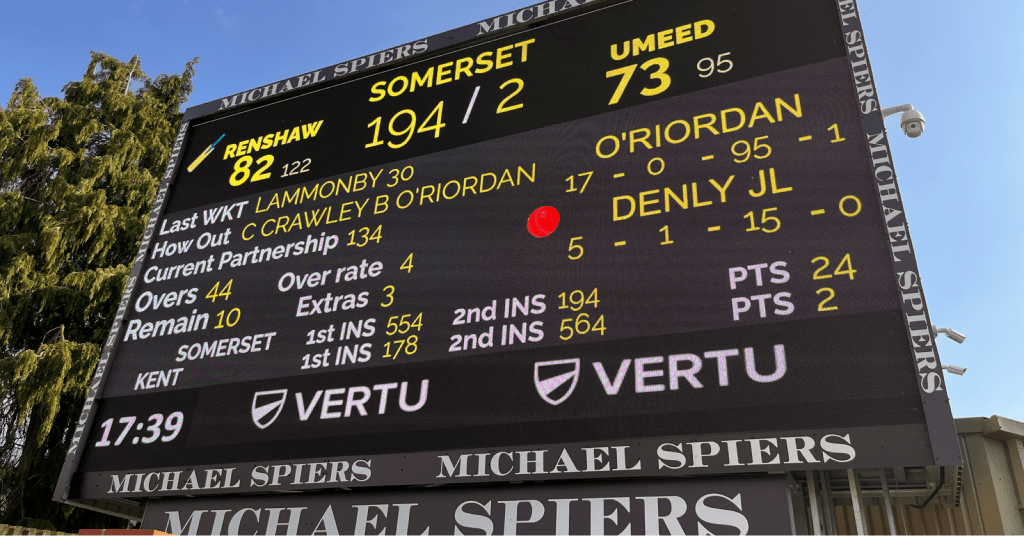


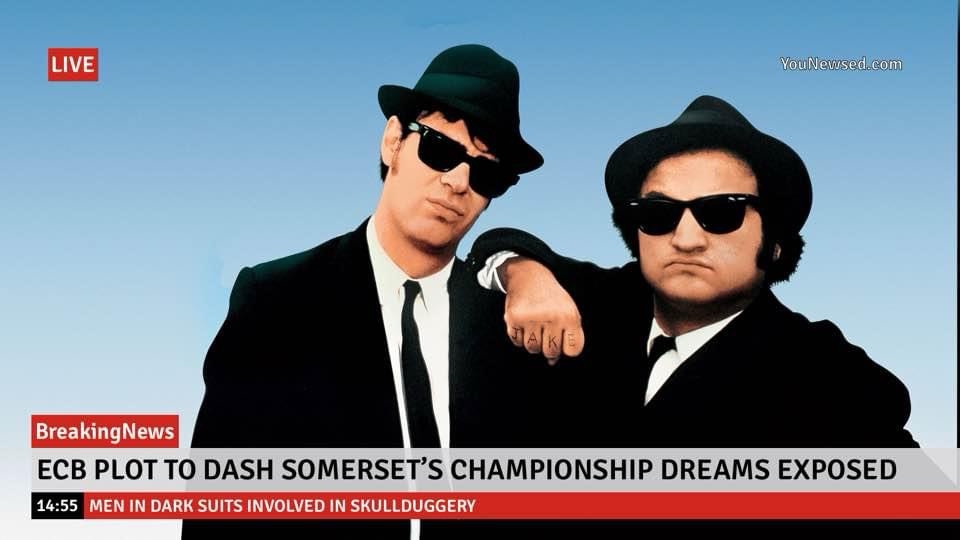

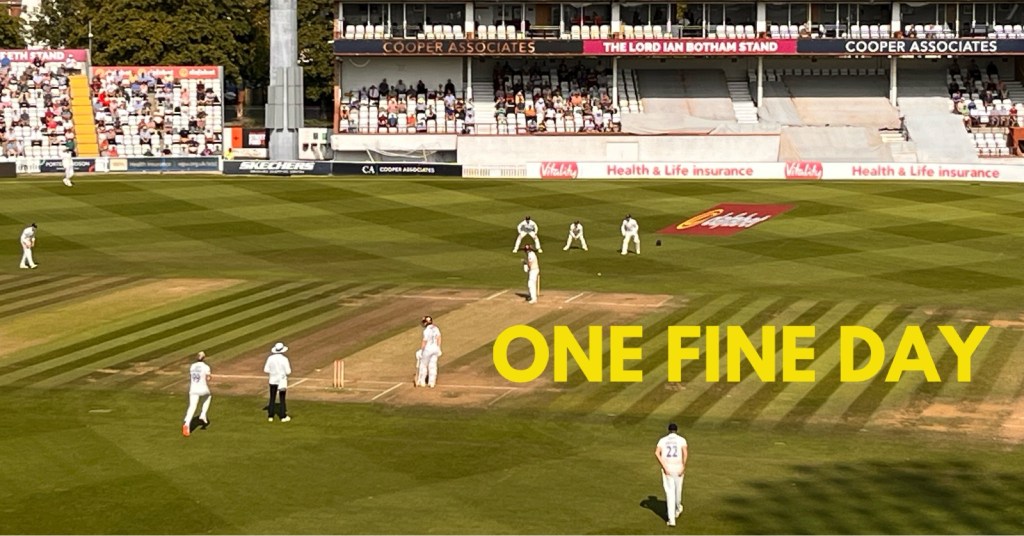







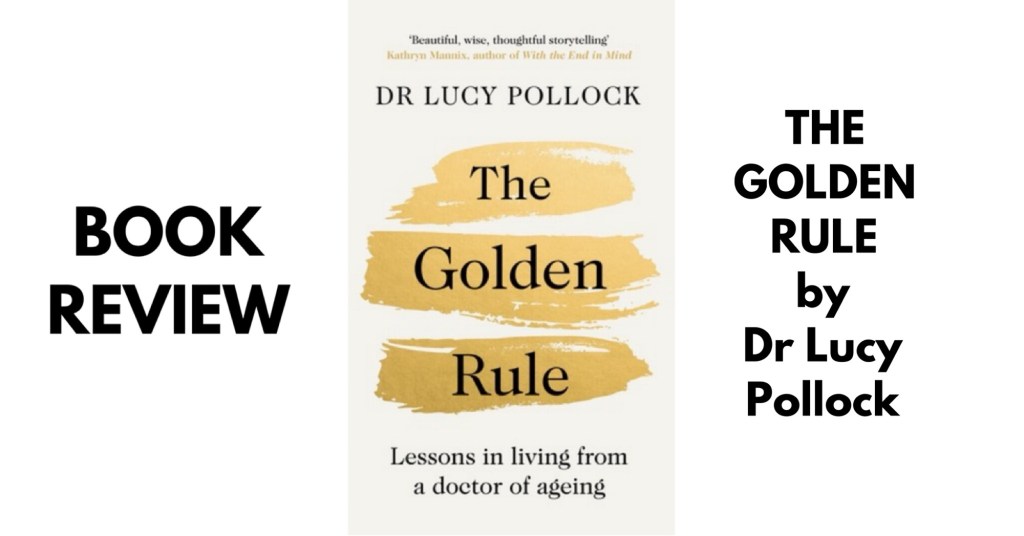





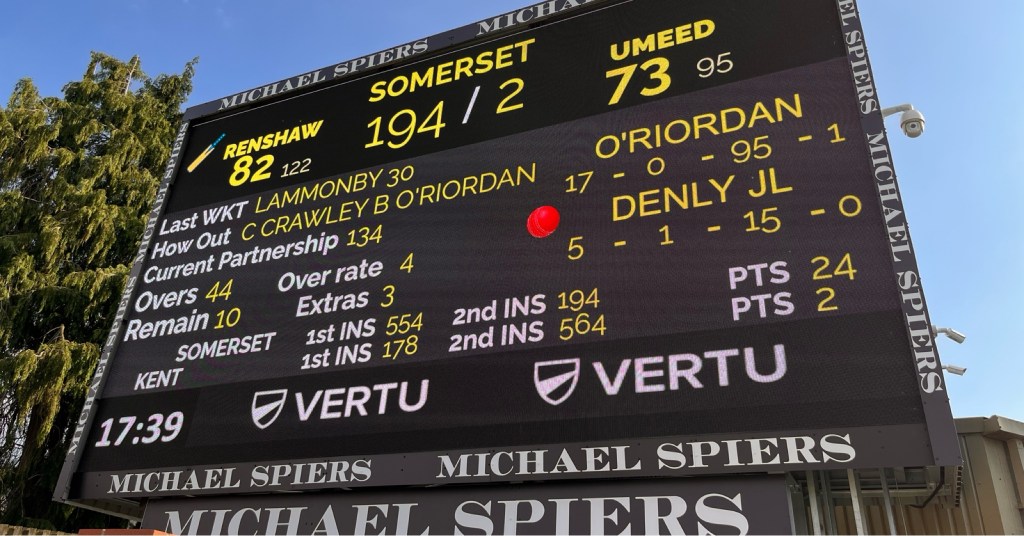
 Some musings