When love comes to town I’m gonna jump that train,
When love comes to town I’m gonna catch that flame,
Maybe I was wrong to ever let you down,
But I did what I did before love came to town,*
What a difference love makes.
The week began with yet more violence on the streets of a number of our towns and cities as crowds gathered in a coordinated attempt to provoke fear in those who, in many cases at least, had previously experienced terrifying situations in their own country, countries they’d left in order to seek safety here, in what they no doubt imagined was a green and pleasant land.
But instead of a warm welcome, they were greeted by stone cold hatred.
How terribly sad that those I myself have known to be both generous and kind, should be treated with such meanness. How terribly sad that those who only want to be able to live peacefully should have to face such hostility. And how terribly sad that those who, having lost there homes, should discover that there are those within our country who would seek to deprive them of making another one here.
So what are we to think of those we have seen on our television screen throwing rocks at the police and setting fire to upturned cars? What are we to think of those who show by their actions how desperately sick the human heart can be? What are we to think of those we live alongside?
It would, of course, be easy to to comfort ourselves with thoughts that we ourselves would never act so maliciously, that we are so much better than those we may have found ourselves, understandably perhaps, delighting to disdain.
But I wonder if we’d be right to.
I read this week about Yehiel Dinur, a holocaust survivor who, having spent time in Auschwitz, was a principal witness at the Nuremberg war trials. The story goes that when, at the trial of Otto Adolf Eichmann, Dinur came face to face with the high ranking officer of the Nazi Party who was responsible for sending countless Jewish people to their death, he started to cry uncontrollably before collapsing in front of the presiding judge and those packed into what was becoming an increasingly chaotic courtroom.
But when asked later what it was that had caused him to become so emotionally overwhelmed, the answer Dinur gave was not the one that might have been expected. It wasn’t that he had been overcome by hatred, nor was he affected by the traumatic memories of his past. Rather, as he saw him standing there in a courtroom, Dinur recognised that, far from being a ‘godlike army officer’, Eichmann was, instead, nothing but an ordinary man. Dinur said that he was then that he feared for who he was himself. That is to say that Dinur saw the terrifying truth that he himself was similarly capable of the dreadful atrocities committed by Eichman.
And so I must concede, so therefore am I.
Because whilst we might not like to admit it, there, but for the grace of God, go each and every one of us. In the right circumstances, we too are all capable of evil – as has been demonstrated by psychologists in, for example, the Stanford Prison Experiment where ordinary people who were asked to play the role of prison wardens were, within days, acting cruelly towards other ordinary people who were asked to play the role of prisoners.
So what are we to make of all this. Should we absolve those responsible for wrongdoing on the basis of them being powerless to act otherwise? Not at all. On the contrary, we should seek to act in ways that, despite our own propensity for bad behaviour, leads us to speak out against the wrongdoing of others.
And rather than blindly following our own deceitful hearts, we should seek to battle the desires that exist within them, desires that so often lead us to do what we should not.
In short, we need to take a stand.
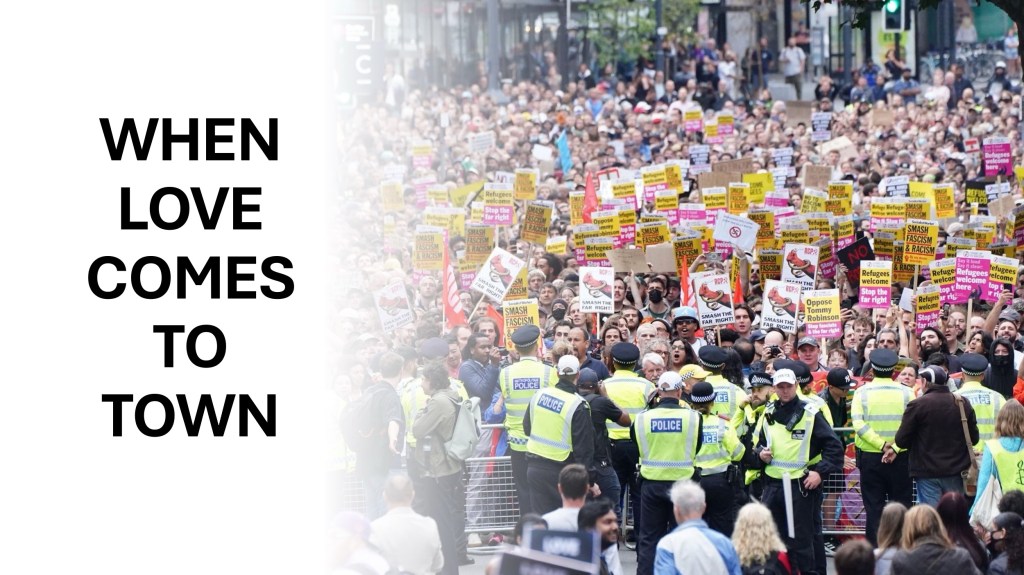
Which is why it was so heartening to see even more people taking to the streets this week – not to join in the violence but to protest against it, to protect those who others were seeking to oppress, and to demonstrate acceptance of those who, despite hailing from far away places, are no less worthy of our support.
It’s as if, this week, we’ve seen what happens, when love comes to town.
But if that is indeed the case, we need to notice both what love is – and what love isn’t. Because as we’ve seen, love doesn’t unconditionally affirm others irrespective of how they act. On the contrary, love calls out wrongdoing for what it is as it stands in the gap and risks its own safety for the sake of the safety of others.
Many have rightly said that we should love our neighbour without exception, irrespective of how differently from us our neighbour may think, speak or act. And so we should. But if we are going to do so, we will have to face the fact that it will entail us loving those who think, speak and act in ways that we don’t find acceptable – like for example, those who consider themselves better than those from overseas, shout abuse at those who seek to find some kind of refuge here, and those who try to storm the hotels where others are temporarily making their home.
That is to say, if we are to love our neighbour without exception, it will inevitably mean that, on occasions at least, we will have to love those who we might justifiably consider our enemies.
And so, try as we might – and try as we must – we will find that loving our neighbour is something that is sometimes easier said than done – that it is something that is sometimes way beyond what is humanly possible for us to do.
Which is perhaps the point of the parable of the Good Samaritan – a parable that Jesus once told to a man who, aware of the command to love one’s neighbour, asked Jesus who his neighbour was [Luke 10:25-37]. Wanting to ‘justify himself’, wanting to earn his way to heaven by behaving in a way that meant he somehow made the grade, the man wanted Jesus to lower the bar of what he was required to do.
But Jesus, in describing how the Good Samaritan acted, revealed what love truly looks like. And what it looks like for Jesus is far more than a few words of support for those in trouble.
For in the parable we have described a man who binds up the wounds of a stranger, a stranger he then sets on his own animal and takes to an inn where he continues to look after him. More than that, we see the Good Samaritan interrupting his own plans, staying with the man overnight and, when the following morning he has to leave, leaving the innkeeper with a sum of money equivalent to two days wages and a promise to return, on the third day perhaps, and make good any further costs that had been incurred in providing for the man’s needs.
And if that wasn’t enough, the Good Samaritan does all this for a man who would have been considered his enemy – doing it all, not out of duty, but out of genuine compassion for the one he’d found left for dead by the robbers who’d attacked him.
Such love is a love that I have never come close to matching. And nor, I believe, has anyone else ever come close to matching it either. Nobody has ever loved like the Good Samaritan loved.
Nobody, that is, save one.
Because there was one who loved me like that – one who saw me when I was spiritually dead, one who tended to my wounds and led me to a place of shelter, one who paid the price for all my restoration.
And his name was Jesus
And he did all this for me whilst I was still a sinner – whilst I was still hostile towards God. And he did it, not out of duty, but out of love.
‘…but God shows his love for us, in that while we were still sinners, Christ died for us.’ [Romans 5:8]
In very many ways then, the parable of the Good Samaritan is a parable about Jesus who stood in the gap for us. Hanging on the cross, he opposed evil, suffering for the sake of others before returning, three days later, from the grave.
And so, whilst still endeavouring to love our neighbour as best we can, we must not imagine that our efforts, in and of ourselves, will ever be wholly successful. Instead, recognising that ‘a person is not justified by works of the law but through faith in Christ’ [Galatians 2:16], when it comes to our salvation, how much better it is to accept Jesus as our Good Samaritan, the one who saves us by being for us what we are not, and doing for us what we could never do ourselves. .
Rather, then, than trying to justify ourselves, how much better it is to accept Christ’s forgiveness for all that we’ve ever done wrong and finding, as we do so, that he begins to make us more and more like the people we were always meant to be.
People, that is, who love. Those who battle tirelessly, not only against all that we see that is so terribly wrong within our world, but also, if we are brave enough to look, all that we see that is so terribly wrong within ourselves.
Because that’s what happens when loves comes to town.
And what a difference love makes.
I was there when they crucified my Lord
I held the scabbard when the soldier drew his sword
I threw the dice when they pierced his side
But I’ve seen love conquer the great divide*
*Lyrics taken from ‘When Lives Comes To Town’ by U2 and B.B. King, a recording of which can be heard below.
Related posts:
To read ‘Still weeping with those who weep’, click here
To read ‘True Love’, click here
To read ‘A Good Heart these days is hard to find’, click here
To read ‘A Time To Dance’, click here
To read ‘What becomes of the broken hearted? Sorrowful yet always rejoicing on Palm Sunday’, click here
To read ‘Why do bad things happen to good people? Sorrowful yet always rejoicing on Good Friday’, click here
To read ‘Was it not necessary that the Christ should suffer these things? Rejoicing, though temporarily sorrowful, on Easter Day’, click here.
To read ‘T.S. Eliot, Jesus and the Paradox of the Christian Life’, click here
To read “Why do bad things happen to good people – a tentative suggestion”, click here
To read “Suffering- A Personal View”, click here.
To read “Luther and the global pandemic – on becoming a theologian of the cross”, click here
To read ‘The Sacrifice of Isaac – Law or Gospel?’, click here
To read ‘Water from a Rock’, click here
To read ‘Real Power’, click here
To read ‘Foolishness – Law and Gospel’, click here
To read ‘The Promise Keeper’, click here
To read ‘The Rainbow’s End’, click here
To read, ‘But this I know’, click here
To read ‘I’ll miss this when I’m gone – extended theological version’, click here
To read ‘On being confronted by the law’, click here
To read ‘The “Already” and the “Not Yet”’, click here
To read ‘Rest Assured’, click here


it can be so hard to do but we have to try!
LikeLiked by 1 person
Indeed we must try – as we must try to keep the whole of God’s law. But even as we do so we must recognise that we will fail.
And so, knowing that ‘a person is not justified by works of the law but through faith in Jesus Christ’ [Galatians 2:16], we will have to look to him to do what we will never be able to do in and of ourselves.
Wonderfully though, having recognised our inability, and cried out to Him for help, we will find that we are able to love our neighbour more than we would otherwise have ben able to.
LikeLike