When in Salzburg do as the Salzburgians do – so today we went in search of Mozart.
Having seen where he was born and, later, where he was bought up, we hurried past the McDonalds where he once ate. Never mind the fact that it was there that he reputedly wrote Eine Kleine McNachtmusik for today we were after more than a Mozart Megameal or a Wolfgang Waffle. And given yesterday’s gastronomic disaster, not even a Amadeus Apfelkuchen was likely to tempt us.
Eventually though we were successful in our quest and we were privileged to enjoy a wonderful concert of Mozarts’s music in the Marble Hall of the Mirabell Palace. However, despite his regularly performing there, the night we attended we were disappointed to discover that it wasn’t Mozart himself who was playing but a rather impressive tribute band instead, one that was, however, wonderfully adept at capturing the sound of Mozart’s original recordings.
Mind you, I thought the band would have come up with a sassier name for themselves than Ensemble 1833 – something like ‘Recce-M’ perhaps!
The photograph above is of what purports to be the smallest McDonalds sign in the world. It hangs outside the restaurant which is conveniently located just a couple of crotchets away from where Mozart was born.
Which must have proved handy when the musical maestro’s mother and father needed to find something for tea presto!
Related autobiographical blogs, some more tongue in cheek than others:
To say that the seating arrangements were cramped would be an understatement but the fact that every seat was taken suggested to us that the food on offer would be worth sampling.
The waitress did her very best to ensure that we were seated comfortably but her explaining how the restaurant should be evacuated in the event of any untoward incident did nothing for our appetites. Furthermore, her proudly pointing out how every table had its own emergency oxygen supply and her insistence on demonstrating to us how it was to be used was surely over attentiveness on her part.
Oddly we were then asked to temporarily fold our table away. Noticing how our fellow diners complied unquestionably and imagining this was some kind of local custom, we followed suit and took the opportunity to peruse the menu. It’s contents were not as imaginative as we’d have liked and I was left to choose between penne arrabbiata, a hot bacon baguette or the overpriced pea and falafel wrap I’d bought previously and had managed to smuggle through the rather excessive security arrangements that the establishment had in place.
I opted for the latter – and wisely so given how the dishes placed before less wary customers bore little resemblance to how they had been pictured on the restaurant’s website.
We can only hope for a more positive experience when we return in a fortnight having, foolishly perhaps, already pre booked a second visit to the eatery.
Rating: 1 star
The restaurant I attended was Flight LS1841 from Bristol to Innsbruck located at the time of our meal somewhere over Belgium.
[The picture above is from the establishment’s online advertising]
Related autobiographical blogs, some more tongue in cheek than others:
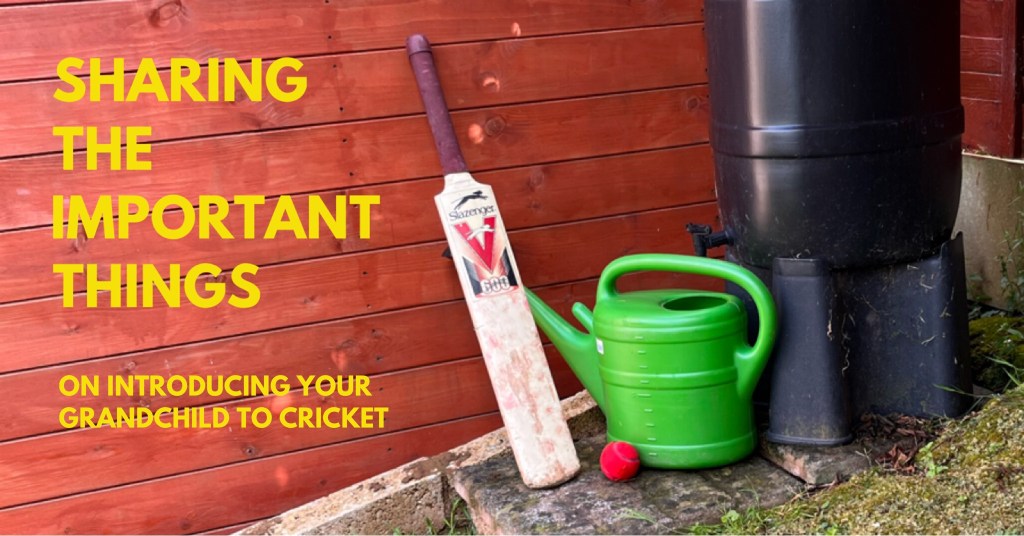
To read ‘Sharing the important things – on introducing your grandchild to cricket’, click here
To read ‘The green green leaves of home’, click here
I’ve always been drawn to magicians and the tricks that they perform. It is, I think, not just the mystery of magic that intrigues me but also the magic of mystery itself. Because whilst it’s fun to try to work out how they do the seemingly impossible, the greatest pleasure comes when the skill of the performer leaves you utterly perplexed. Understanding how the illusion is achieved is invariable disappointing since, in so doing, the extraordinary becomes the commonplace and the unbelievable becomes mundane. We all need a little mystery in our lives – speaking to us as it does that there is something beyond the ordinary that each and every one of us needs. As such there is comfort in the incomprehension.
I was thinking about this again this week after James Rew scored an unquestionably magnificent double century in Somerset’s game against Hampshire. Just 19 years old Rew is a prodigious talent who has already scored six first class centuries and it’s little wonder therefore that his innings is being talked about by many who, looking on admiringly, are already talking about him as a future England player. But as I read more and more of his performance I began to wonder if the extent of the associated analysis might ultimately be detracting from the performance itself. Now don’t get me wrong, I enjoy a statistic as much as the next person and, apparently, considerably more so than my wife, but perhaps there comes a point when we would do better to understand less and marvel more at what it is we are watching. Because, just as the enjoyment derived from a Beethoven symphony is not magnified by knowing the number of notes it contains, the beauty of one of James Rew’s cover drives is not enhanced by knowing the percentage of runs he’s scored in front of square on the off side.
A similar problem exists in the world of medicine where attention is focused on a patients clinical parameters without sufficient thought being given to the individual to whom those parameters apply. The result of this micro management is that too often patients become cases to be managed rather than individuals to be cared for.
And so I find myself asking why this might be the case. Perhaps it’s got something to do with our overwhelming desire to be in control and imagining that with complete understanding of the world in which we find ourselves, we would be like God. But here’s the thing. ‘Overwhelming’ is exactly what that desire is since, finite as we are, we simply aren’t able to know all that there is to know. There is simply too much information out there and we are, as Atul Gawande describes, ‘necessarily fallible’ as a result. Furthermore, in pursuing the infinite our finite minds are deprived of the joy of stepping back and marvelling at the whole.
Because sometimes the wood is more beautiful than the trees.
Perhaps, therefore, science is in danger of trying to do too much. C.S. Lewis had some interesting things to say about how the focus of what science seeks to do has changed over time. In his ‘The Abolition of Man’ (1943) he wrote how, whereas it used to seek knowledge in order to understand how humankind conformed to reality, science now seeks ‘to subdue reality to the wishes of men’. Lewis contended that there were dangers inherent in such an ambition. He realised that it would be those with power who would impose their wishes on the weak and maintained that any attempt to subdue reality to the wishes of the powerful would require nature to be conquered in order that it conformed to their desires. That, he said, would require a reducing of all of nature to nothing but it’s component parts, denying anything beyond the merely physical and quantifying everything only in terms of what we can measure. Lewis believed that, since humanity is itself a part of nature, this diminishing of the whole would ultimately diminish humanity and bring about what he called the ‘abolition of man’.
If Lewis is right, therefore, not only does our perceived need to be in complete control deprive us of the pleasure that comes from simply accepting our position of spectator and marvelling at what there is to see, it also leads to our ultimately diminishing all that has been put in place for us to enjoy. This is not to suggest that we should abandon all attempts to discover the truth – far from it, the truth is out there and is to be pursued – but it is to recognise that there are some things that we can not know and that there is wisdom in accepting that this is indeed the case.
But as well as being content with mystery, perhaps we might find some comfort in it too. Take suffering for example, that aspect of life that eventually enters into all our lives and frequently leaves us wondering ‘Why?’. Some say there is no answer to that question, that suffering is utterly meaningless. But whilst understanding how some are drawn to that conclusion, there is no comfort in it. Furthermore the inference that many go on to make that there is no God reinforces their hopeless position. But just because we cannot understand something doesn’t mean that it has no meaning. It means only that, wrapped in mystery, the meaning is beyond our understanding.
So if there is a God, why does he sometimes chose to allow us to suffer? Given what I have already said about this being mysterious ground, we should of course step carefully – the answer may never be ours to know. The wisest counsel when asked to give a reason for why a person is suffering is almost certainly to keep silent because there is certainly no easy, concise, one size fits all answer. But we could do worse than listen to what God said when Job asked him why he was made to suffer. The answer that God gave may not satisfy everything for what he said from out of the whirlwind was this:
“I will question you” (Job 38:3)
G.K. Chesterton writes:
‘…God comforts Job with indecipherable mystery, and for the first time Job is comforted…Job flings at God one riddle, God flings back at Job a hundred riddles, and Job is at peace. He is comforted with conundrums. The riddles of God, Chesterton writes, are more satisfying than the solutions of men’
In the prologue to the book of Job we see that Job was tormented, not because he was the worst of men, but because he was the best. There is a sense, therefore, in which Job points us to one who later suffered on a cross. Job is not told that his misfortunes were due to his sins, or part of any plan for his self improvement – but we are, none the less, told that he was allowed to suffer under God’s sovereign care. That a good man should suffer at the hands of a loving God is a paradox. Chesterton calls it ‘the very darkest and strangest of … paradoxes’ which is, he says, ‘by all human testimony the most reassuring’.
We cannot then know everything – neither are we meant to. We need mystery in our lives – to be both thrilled and comforted by. As such rather than seeking to understand it is sometimes better to step back and marvel – and most specifically of all at the infinite mystery of God which is both necessary and sufficient to inspire us all to trust in his sovereign goodness.
Wishing you all a magically mysterious day!
By way of light relief, here’s Hugh Laurie singing about ‘Mystery’
Related posts:
To read ‘T.S. Eliot, Jesus and the Paradox of the Christian Life’, click here
To read “Why do bad things happen to good people – a tentative suggestion”, click here
It’s coming home It’s coming home It’s coming Cricket’s coming home
Everyone seems to know the score They’ve seen it all before They just know They’re so sure Somerset’s Gonna throw it away Gonna blow it away But I know they can play Cos I remember
A [Mythical creature of disputed nomenclature]* on a shirt Games on YouTube streaming All those years of hurt Never stopped me dreaming
So many jokes, so many sneers But all those oh-so-nears Wear you down Through the years But I still see: Smeed and Banton unleashed A TKC run feast Matt Henry running in And the Green machine
A [Mythical creature of disputed nomenclature]* on a shirt Games on YouTube streaming All those years of hurt Never stopped me dreaming
Now for the third time in a row To Edgbaston we go We can win We all know Because we have Louie G keeping calm Sodhi turning his arm Tom Abell in the field And Craig O’s big hands
A [Mythical creature of disputed nomenclature]* on a shirt Games on YouTube streaming All those years of hurt Never stopped me dreaming
I know that was then but it could be again
It’s coming home It’s coming home It’s coming Cricket’s coming home
*For better scansion please insert ‘Dragon’ or ‘Wyvern’ depending on your position on this most contentious of issues!
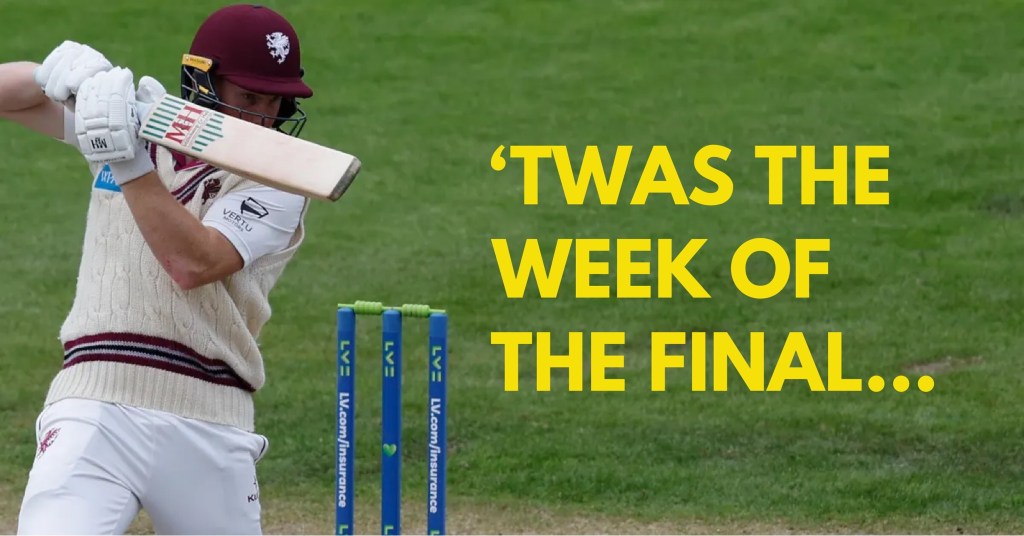
This week Somerset played Hampshire at the County Ground in Taunton. An epic performance deserves to be immortalised in verse. Until such time as it is, this will have to do…
‘Twas the week of the final and though some protested, TKC, Henry and Craig O were rested, Leaving the likes of Bashir and James Rew, To show to the faithful just what they could do.
‘Tis true that their start against Hampshire was poor, (With forty one runs scored, those out numbered four!) But though one or two, on a loss may have betted, It soon became clear that we needn’t have fretted!
The fifth wicket fell with the score on just eighty – The pressure on Aldridge it must have been weighty – But with the aforementioned, cool headed, Rew Together the pair put on one ninety two!
More then were added from the welcomed back Bess, And Shoaib Bashir, with the bat, did impress With the innings completed a glance at the board, Showed us that five hundred runs had been scored.
The man known as ferret then with his first ball, Took the first wicket of Hampshire’s to fall, And fans of that county all started to wince When Lammers, off Ogbourne, caught captain James Vince.
And though for a while they still had a shout Of avoiding the follow on, Hants were all out Twenty runs short of the total they’d needed, And so to enforce it, Tom Abell proceeded
Two wickets fell ‘ere the end of day three, And all who were watching they had to agree, That now, with a wicket conducive to spin, This was a game that the youngsters could win.
But though on the final day, wickets did fall, The bowlers’ best efforts could not take them all, But one thing is certain, yes one thing is clear, They’re talented: Aldridge, Ogbourne and Bashir.
The match it thus ended, the result was a draw, But those who spectated enjoyed what they saw, Cos there’s no denying what everyone knows, the Future of Somerset cricket is rosy!
Other ill-advised attempts at cricket verse:
To read ‘On passing a village cricket club at dusk one late November afternoon’ click here
To read ‘I’ve got a little CRICKET list’, click here
To read ‘How the Grinch stole from county cricket…or at least tried to’. click here
To read ‘My love is not a red, red rose , click here
My first memory of watching the Ashes was in 1977. I was 10 at the time and don’t remember a great deal about it other than seeing Derek Randall taking the catch that meant that most famous of little urns would once again return to England. Oddly enough, what I seem to remember most, is Randall’s rather jaunty walk after he took the catch!
Looking up the scorecard now, I see that the match in question, the fourth test played at Headingly, was a far from close game with England winning by an innings and 85 runs – Rod Marsh, the Australian wicket keeper, being the last man out, caught by the aforementioned Nottinghamshire favourite off the bowling of Mike Hendrick. But in addition to those two greats of the game, there were also many other legendary English players on the team sheet back then. Mike Brearley captained the side that, as well as including the Kent trio of Bob Woolmer, Alan Knott and Derek Underwood, was made up of the likes of Tony Grieg, Bob Willis and Geoff Boycott who, I see, scored his 100th first class hundred in that game. I don’t suppose Geoffrey would be too happy if he ever learnt that I found his greatest achievement less memorable than Randall post-catch gait!
And of course there was also a certain I.T. Botham who made his England debut that year. I remember being at Weston-super-Mare that summer to watch Somerset and being exited to hear some in the crowd singing that all time classic, ‘Botham plays for England, Botham plays for England, La, la, la, la – La, la, la, la’, and being prompted by its imaginative lyrics to wonder who this new young player might be, a novice as I then was to watching Somerset. I soon, of course, found out!
If memory serves me right we were staying at my Great Aunt’s in Teignmouth when the Ashes were regained – the south Devon seaside town being a regular holiday destination for our family in those days. What is certainly true though is that it was there that I first saw Test cricket – watching some of the 1976 series against the West Indies on her, novel for us at the time, colour TV. My parents must have noticed my burgeoning interest in cricket as it was the following summer that they first took me to see Somerset in a game played against Northants. It was played at the Clarence Park ground in Weston-super-Mare and I remember being thrilled to see David Steele, England’s hero of the previous summer, fielding just on the other side of the boundary rope from where we were had laid out our picnic blanket and made ourselves comfortable.
I’m so glad my parents took me to that game for it was the beginning of what has been a life long love of cricket. And that’s why I’ve been so keen to introduce my grandson to the game.
Earlier this summer I took him to see his first game, also, coincidentally enough, a county championship game between Somerset and Northants though this match, played on the day that King Charles was crowned, took place at the county ground in Taunton.
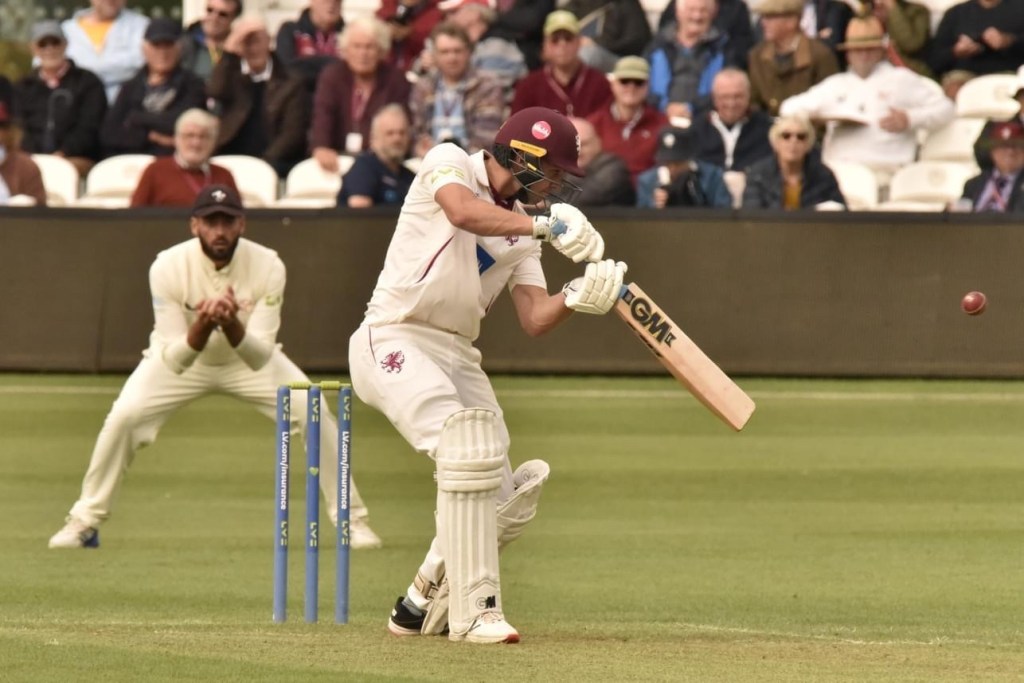
A view from the boundary at the County Ground in Taunton
At just 18 months old, though he had already mastered the necessary oral acrobatics to vocalise, when prompted, not only ‘T – K – C’ but also ‘La, la, la’, he was still unable to combine the latter with ‘Som-er-set’ in a way that would wholly endear him to the Taunton faithful. It was however an undoubtedly formative experience for him even if it is just possible that he was more interested in where Brian the club cat lived than spending time watching England stars of the calibre of Jack Leach and Craig Overton performing out on the playing field. Furthermore, despite my going to some considerable trouble to explain to him the details of how you can be given out LBW, his favourite bit of the evening session that we attended, seems to have been the opportunity he was afforded to splash in the puddles he found in the family stand.
Even so, if he is asked in years to come whether he remembers Coronation Day, I hope he’ll reply ‘Ah yes, that was the day I first watched Somerset’
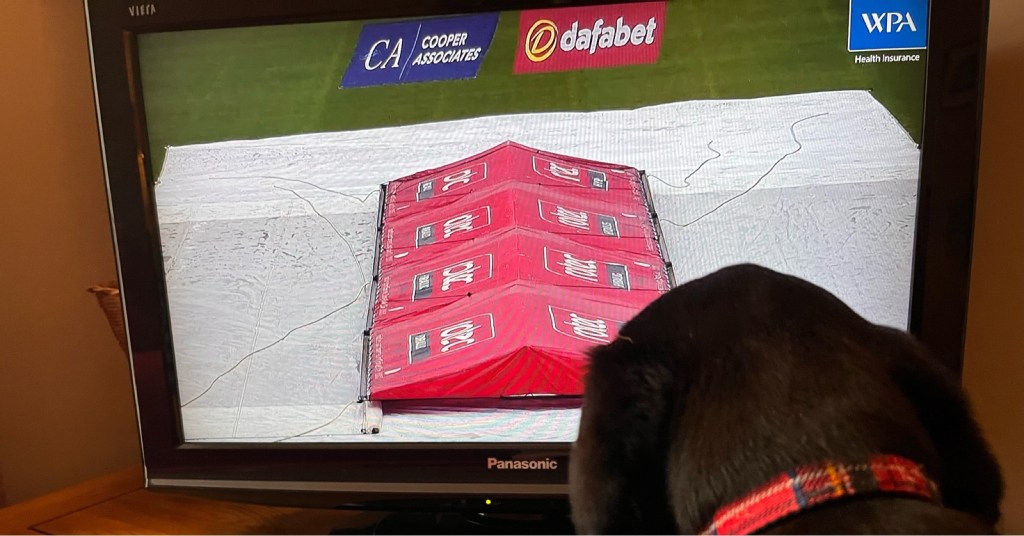
Having then ticked the box for his first experience of championship cricket, I was looking forward to when I would have an opportunity to expose him to a little Test Match cricket. And this weekend, with him yet to reach the grand old age of two, my chance arrived when his visit with his parents coincided with the most recent encounter in this Ashes series. Unfortunately my plans were temporarily thwarted when on Saturday the match at Headingly was affected by bad weather. As such his cricketing education had to take the form of a game played in our back garden instead. The day’s play ended with me on 1658 not out. It was a hugely worthwhile afternoon since, as well as achieving my own highest ever score, I think I also taught the youngster a valuable lesson about the importance of good line and length when bowling. Especially when playing with a kookaburra ball!
I did consider declaring and putting him in for a tricky 20 minutes in fading light but unfortunately he got called in for his bath and bedtime! What’s more, caught up in the excitement of my belligerent batting display, we missed the opportunity to watch Australian wickets fall late on Saturday afternoon but I, very magnanimously, decided to forgo the chance to press home my advantage by making him field again on Sunday morning and together we watched a little of England’s run chase instead. As you’ll imagine, he was absolutely enthralled, as was all too evident by the fuss that he kicked up when his Dad had to drag him away for a nappy change!
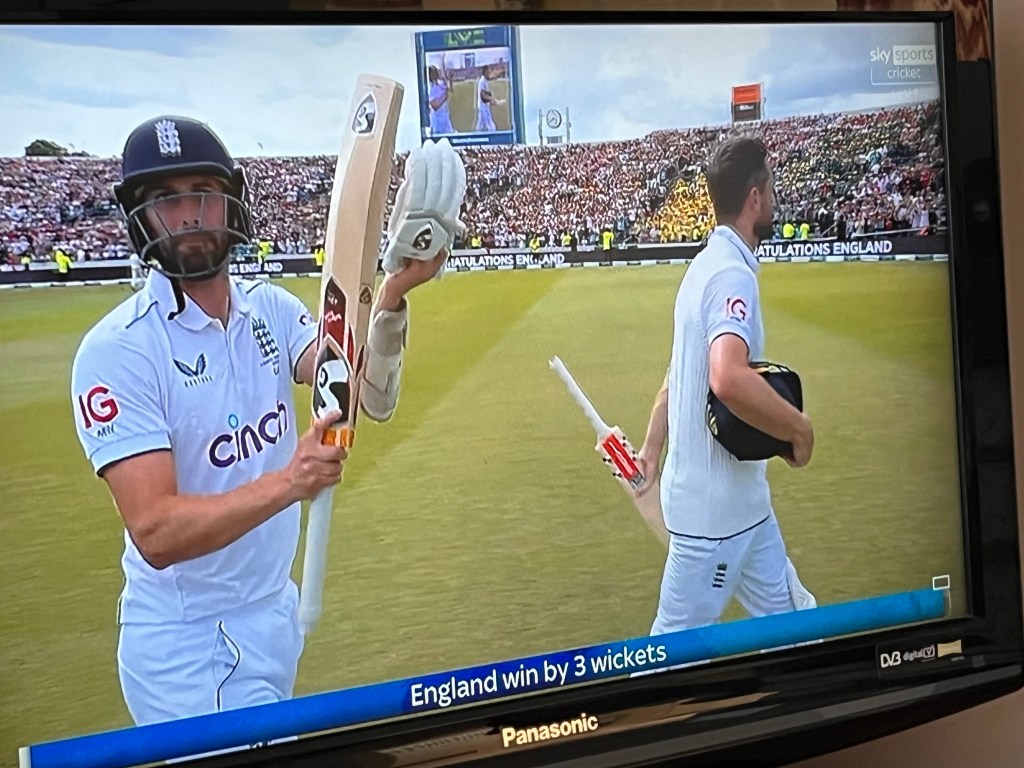
Like me then, his first experience of Ashes cricket was watching a win for England over Australia at Headingly and I’m sure that one day he’ll delight in telling his grandchildren all about it. And perhaps he’ll also wax lyrical about the way his grandad played the cover drive!. Either way I hope it is the beginning of a life long of cricket for him too.
Woakes and Wood walk off after completing the run chase to win the third teat at Headingly
Other cricket blogs:
To read ‘Is Cricket Amusing itself to Death’, click here
To read ‘Safe and Sound at the County Ground, Taunton’, click here
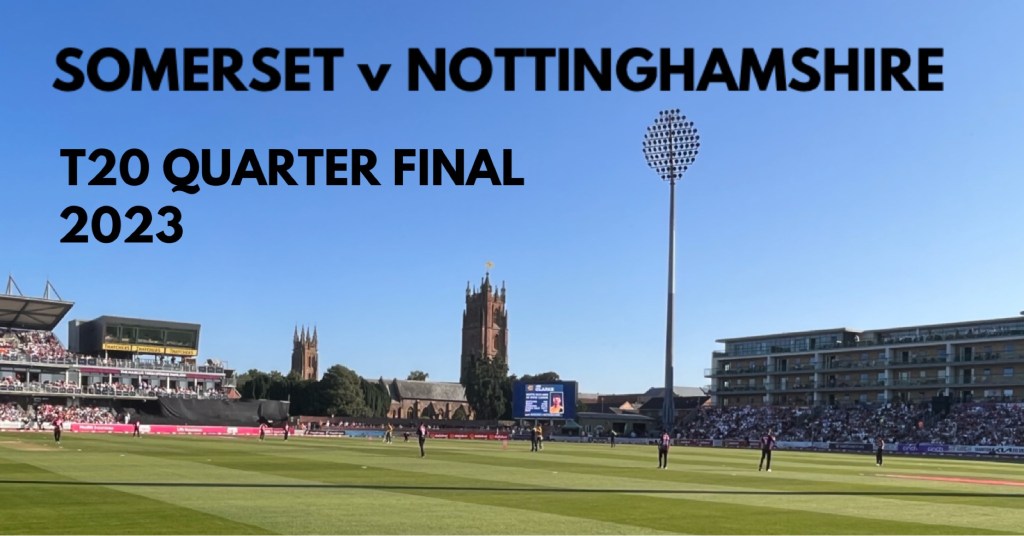
My wife, by way of an early anniversary present, has bought two tickets for us to enjoy a hospitality package at Somerset’s quarter final game against Nottinghamshire on Friday.
The question then becomes, was her shelling out the necessary spondulicks*:
a) a reflection of her undying love for me or
b) an indicator of the proficiency with which I adopted my sad face once I had discovered that I had left it too late to buy cheaper tickets?
I did ask her if the gift should be considered a joint one, thereby negating my need to buy anything in return to express my affection for her. Apparently, though, it should not! On that she was very clear!
Ah well. I suppose I’ll just have to enquire as to what hospitality packages might still be on offer for next weekend at Edgbaston!
I’m sure she’d be thrilled!
*POI she used my debit card!
After
Well we had a splendidly hospitable evening at the county ground watching Somerset beat Nottinghamshire in yesterday’s T20 quarter final.
Highlights for me were:
The nature of the win – all the most enjoyable games are those where victory is snatched from the jaws of defeat and, whilst it would have made for a less stressful evening if our top order had fired, it was terrific to see Lewis Gregory and Ben Green do the business when it was required. A particularly fine innings by Gregory – a great batsman, a great bowler and a great T20 captain.
Having Craig ‘Bucket Hands’ Overton fielding just in front of us. As well as his consistently superb opening bowling, he has now taken 20 (TWENTY) catches in the Blast this year! Two of them last night.
Seeing Tom Abell walk when he edged a ball from Harrison to the wicketkeeper. Perhaps he would have been given out by the umpire anyway but it was nonetheless heartening to see him behaving in the sportsmanlike manner that I have come to expect of Somerset’s red ball captain. And it was all the more honourable given what a precarious position Somerset were in when he was out. Good for you Tom!
Oh, and the company was quite good too! Still apparently willing to put up with me after nearly 32 years of married life – even, it seems, when I’m singing ‘Sweet Caroline’ like the best of them!
And so for all you cricketing Philistines out there, and anybody else who, by severe misfortune, may have allowed said events to pass them by, here’s what you missed.
My advice? Watch on repeat!
Other cricket blogs:
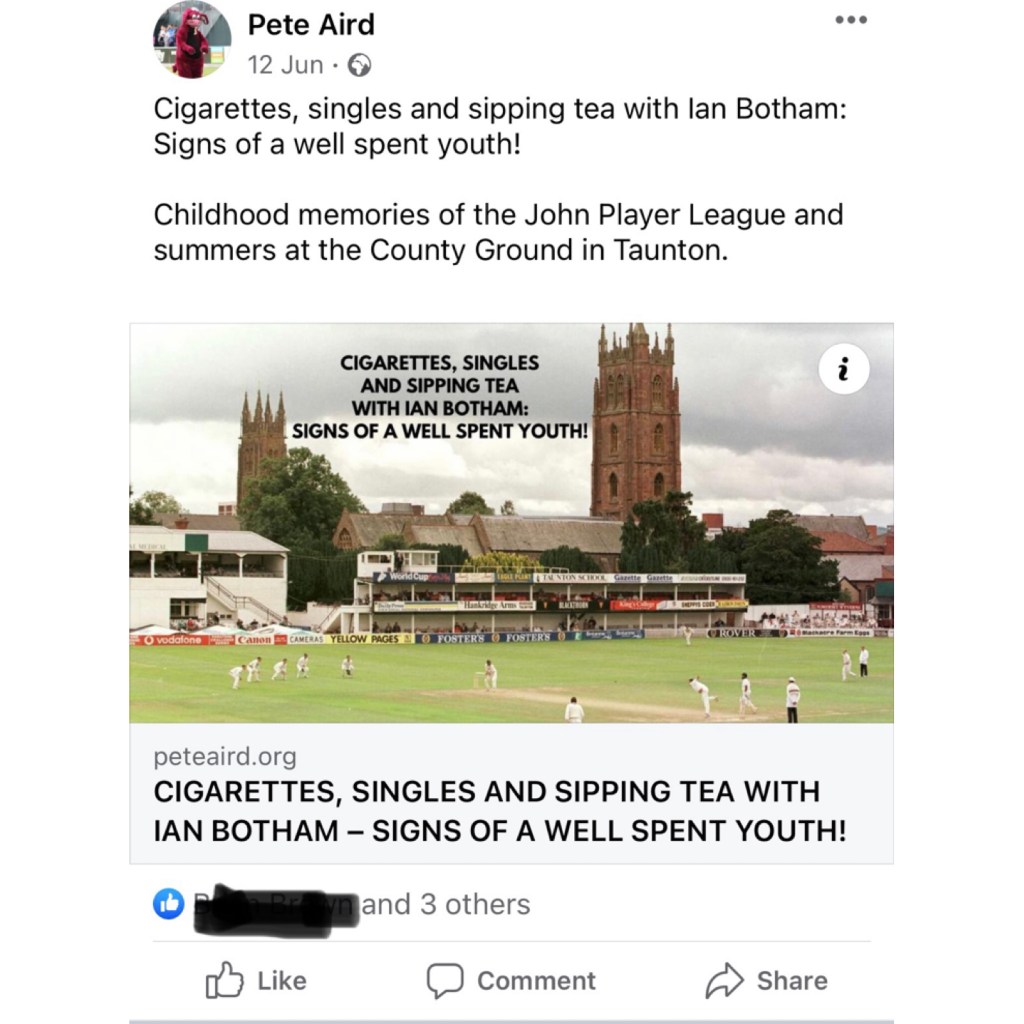
To read ‘Cigarettes, Singles, and Sipping Tea with Ian Botham: Signs of a Well Spent Youth!’, click here
Three weeks ago, having returned to my car and found that my offside wing mirror had been pinched by a person or persons unknown, I was forced to drive home without a clear view of what was going on behind me. And as I did so, I discovered how important it is to be able to look back if one wants to move confidently forward.
Sometimes, when everything is going to plan, life can seem simple. In the good times we find it easy to follow the path that we like to think is laid out for us and we are able to eagerly anticipate the future without ever having to worry too much about the past.
But what about when things go wrong and we struggle to be able to put one foot in front of the other? What about when life is hard and we fear that things will never get better? And what about when, recognising our weakness and our propensity to fail, we fear that nobody could possibly love us anymore? What are we to do then?
For me at least, the answer to these questions is to look back, to an event that reassures me that, however difficult my present circumstances are and however unclear the way ahead might be, my future is no less certain.
Because the crucifixion and subsequent resurrection of Jesus Christ speaks to me in my darkest moments reassuring me that there is one who knows the ‘end from the beginning’ [Isaiah 46:10], one who will not ‘break a bruised reed or quench a faintly burning wick’ [Isaiah 42:3], and one who remains by my side even as ‘I walk through the valley of the shadow of death’ [Psalm 23:4]. And it reassures me too that he is the one who can bring order out of chaos, joy out of sadness and life out of even death itself.
The cross of Christ reminds me that things can and do get better. Because even death is not the end. Furthermore the God who raised Jesus from the dead has promised that a day is coming when ‘every tear will be wiped from our eyes and death will be no more’ [Revelation 21:4]. And confident that God can be trusted to keep his word, I do not doubt that what he promises he will one day bring about. That is the essence of christian faith.
For whilst it is true that ‘faith is the assurance of things hoped for and the conviction of things not seen’ [Hebrews 11:1], that does not mean, as some suppose, that faith is blind. On the contrary, faith, as defined by the Oxford English Dictionary, is belief based on evidence, testimony or authority. As such, my sure and certain hope that after death I will one day be resurrected and go on to experience endless pleasure in the presence of God [Psalm 16:11], far from being just wishful thinking on my part, is, in fact, an entirely rational belief based on compelling evidence for the historicity of the empty tomb, credible eye witness testimony of those who saw Jesus after he had been raised from the dead, and the authoritative word of the one who spoke the universe into existence.
Furthermore, the cross assures me that, however great my failure, there is redemption through the one who died for me, the one who bore the punishment that I deserve, not only for all that I have done wrong in the past but also for all I will ever do wrong in the future. Because ‘when I fall, I shall rise; when I sit in darkness, the LORD will be a light to me’. And though ‘I will bear the indignation of the LORD because I have sinned against him’, even so I know that he will one day ‘plead my cause and execute judgment for me – he will bring me out to the light [and] I shall look upon his vindication’. [Micah 7:8-9]
Why so sure? Because that is what God has promised.
Finally, and most wonderfully of all, the reason that God has gone so far as to send his much loved son to suffer for my sake is down to the fact that he loves me. Yes, even me! But this is not because of anything in me. Since God is love [1 John 4:8], rather than being a response to who I am, his love for me originates from within himself. God loves, therefore, because it is his nature so to do. And so, whilst I hope on occasions my actions will have pleased him, God’s love for me is not dependent on my performance. My security comes, therefore, from knowing that God’s love doesn’t change – that I am loved by him irrespective of how unlovable my behaviour sometimes sadly is.
Some of you may have read a piece I wrote last week about how, having broken down on stage at Glastonbury, Lewis Calpaldi experienced the affectionate support of the huge crowd that sang for him the song that he could not. I wonder if that was the moment when Capaldi felt for the first time the full extent of the love that his fans have for him. Because it is, I suspect, only when we are at our lowest point that any of us are able to recognise the extent to which others care about us. I think that’s true of my experience of God’s love for me. It is only when I fail and feel seemingly beyond redemption, it is only when I am broken and feel seemingly beyond repair, that I know for sure what God has said is true, that his steadfast love never ceases and his mercies never come to an end [Lamentations 3:22].
If then today, you find yourself struggling, and if, for you, the future is something only to be feared, why not try taking a look back to what has already taken place and see if it helps you, like me, to move forward with a degree of confidence.
For if God can love me, then he can most certainly love you – even if you are the one who is now harbouring the wing mirror you nicked from me three weekends ago!
For those who are interested a summary of some of the evidence for the resurrection can be read here and here.
Other related posts:
To read ‘The Resurrection – is it just rhubarb?’, click here
To read “Hope comes from believing the promises of God”, click here
Forget Bazball! Forget the high performance review! New data published today reveals how counties can be guaranteed to attract larger crowds to cricket matches played over four days.
Two post reflecting a typical day spent at a county championship game were posted on social media platforms. One was a fascinating* essay detailing the childhood memories of a now middle aged white male, the other was a photograph of an ice cream obscuring an otherwise out of focus view of the outfield.
Post OnePost Two
Whilst all right thinking individuals within the friendship group of the author of the posts responded positively to his extended reminiscences of his now long distant youth, the post containing the picture of an ice cream attracted significantly more ‘likes’ [p < 0.01] and generated considerably more engagement by way of comments.
At a hastily arranged press conference held this afternoon at the County Ground in Taunton, the author of the study claimed that for clubs to survive they now had no option but to provide more in the way of frozen dairy base comestibles.
Somerset’s Chief Executive conceded that careful consideration would have to be given to the reports findings but refused to be drawn on speculation that the clubs current sponsors would be dropped and that, as from next year, Somerset home games would be played at the ‘Mr Whippy County Ground’.
*Please note, the ‘fascination quotient’ of the posted essay could not be independently verified. But you can judge for yourself by following the link to it that appears below.
Other cricket blogs:
To read ‘Cigarettes, Singles, and Sipping Tea with Ian Botham: Signs of a Well Spent Youth!’, click here
‘I’m going under and this time I fear there’s no one to save me This all or nothing really got a way of driving me crazy I need somebody to heal Somebody to know’
from ‘Someone You Loved’, by Lewis Capaldi
OK, so I’m 50 something and more likely to be found listening to Bob Dylan or Leonard Cohen than a young Scottish singer songwriter crooning about lost love, but before this week I genuinely didn’t know who Lewis Capaldi was. Sure I’d heard the name but, up until now, I had imagined that he was either an actor or a formula one racing driver! It turns out though that he is a talented musician who last weekend performed on the Pyramid stage at Glastonbury. And it was there that he reached a whole new audience, one of whom was me.
Not that I was at Worthy Farm in person to see him in person you understand, nor indeed had I tuned in to watch the BBC’s coverage of his performance. No, I came across Lewis Calpaldi as a result of the media attention garnered by his rendition at the world famous music festival of what I gather is his most famous song – ‘Someone You Loved’
For those of you who don’t know, Calpaldi’s rise to fame has been accompanied by his suffering increasing anxiety as a result of the intense pressure on him to perform. Furthermore, in 2022 he revealed he had been diagnosed with Tourette’s Syndrome a neurodevelopmental disorder characterised by motor and vocal tics. And at Glastonbury last weekend his problems became all too apparent, so much so that he struggled to keep on singing.
But what was so lovely to see was how, as Calpaldi stopped singing, the huge crowd recognising his predicament, didn’t – instead they sang the song for him in a very evident display of support. It was genuinely moving to watch.
Oh that we were all so supportive of those who find themselves struggling. But the truth is we’re not.
Evidence suggests that the more remote we are from them, the less we care for those with whom we interact and this, as well as raising important questions as to how lockdowns and our increasingly remote existence will affect us as a society, goes some way to explaining the insensitive comments that are too often made on social media platforms and elsewhere.
Because it’s easy to criticise from a distance.
In stark contrast to the crowds supportive response to Lewis Calpaldi’s less than perfect performance at Glastonbury, it’s a pity that we are so quick to condemn others, even those we consider our heroes, when they fail to deliver in the way that we would like.
Many of us struggle with the pressures of our everyday lives, how much more difficult must it be then for those in the public eye who have their every act scrutinised by a hypercritical audience who all too often seem intent on bringing down those who have risen to the top, those who not infrequently have had to pay a very high price for any rewards that might accompany their success.
Anyone who has seen ‘The Edge’ * a film that chronicles the England cricket team’s climb to the top of the world’s Test rankings will know, not only how hollow the team’s success felt to many members of the squad when it was eventually achieved, but also how costly it was, in terms of the adverse effect on the mental health of a number of the players, when winning became mandatory. Perhaps that’s why Ben Stokes, the current England captain and someone who has himself struggled with anxiety and panic attacks, wants to play the game in such a way that the manner in which it is played is more important than the result itself.
Because intense rivalry needn’t descend into unpleasantness as was so pleasingly demonstrated by the good humoured exchange, characterised as it was with broad smiles, between Stuart Broad and David Warner after the latter scooped the former in the opening overs of the Test currently being played out at Lords.
Life is frequently hard and kindness is absolutely necessary if casualties are to be kept to a minimum. We mustn’t close our eyes to the hurt that others sometimes feel. And we must not add to their pain by our own insensitive comments. Because though cricket is a game, the life of an individual player is not.
How sad if compassion towards those who struggle is withheld until they break – and how tragic if it isn’t shown until someone is dead. Because whilst the likes of Marcus Trescothick and Jonathan Trott, whose struggles with poor mental health are well documented, have come through their difficulties, not all have been so fortunate. The last Test cricketer that I am aware of to commit suicide was David Bairstow, the father of the current England wicket keeper. Some years before him, the former Somerset player, Harold Gimblett, also took his life. And there are far too many others.
And what is true for well known sportsmen and musicians is just as true for ordinary folk like you and me. Because few of us will make it through our lives without sometimes being overwhelmed. The truth is that it really is OK for us to sometimes be needy. After all, if no one was ever needy, how could our genuine need to be needed ever be realised? Furthermore, isn’t it good that our need to be needed can be so easily fulfilled if we simply take the time to notice those who need us to be kind to them today?
Being outward looking isn’t always easy of course – we do, after all, have our own problems with which to contend. But if we manage to look out for others we may find that though, for now, Lewis Calpadi has had to retire hurt, he and others like him may one day be able to return to the crease and continue their innings. And as is always the case when the wounded take up the fight once more, there will be an almighty cheer from those who are looking on when they do so.
So next time someone representing your team, sporting or otherwise, is out for a literal or metaphorical golden duck, when they drop a catch or leak runs to such an extent that the game is lost, rather than adding to their already significant dismay by commenting about your perception of their weakness in ways that, even if true will never be helpful, why not be a little more like that Glastonbury crowd that metaphorically wrapped themselves around Lewis Calpadi and showed him that they cared.
Because why wouldn’t you do that to ‘somebody you loved’.
Lewis Capaldi sings ‘Somebody You Loved’ at Glastonbury 2023
The Edge’ is currently available to watch on the BBC iPlayer as is Lewis Capaldi full performance at Glastonbury. His rendition of ‘Somebody you loved’ is the final song of his set.
‘Cricket will exist as long as Test Cricket does; when Test Cricket falls, so will cricket; when cricket falls, so will the world.’*
So might the Venerable Bede have said had he ever been asked his opinion on the importance of the longer formats of the game we call cricket. Sadly for him though, having died in 735AD, he never knew the joy of watching the culmination of a game played over the course of an afternoon, a day, or the best part of the week. But he’s not the only one who has missed out on some great cricket contests as a result of getting his timings all wrong. I have too. Because just as timing is the secret of great comedy so it is the secret of great cricket too. And not just for the execution of a glorious cover drive. Timing is all important for those watching cricket as well. And irrespective of how amusing one’s wife may find it, it really isn’t funny when you miss great games.
Take 2019 for example, a year that, like 2023, saw both an Ashes Test series and a Cricket World Cup. But equally exciting for one who supports Somerset, 2019 was also the year in which Tom Abell’s team made it to Lord’s for the final of the Royal London One Day Cup.
Somerset hadn’t made it to the climax of what once was the cricketing equivalent to the F.A. Cup since 2002. That occasion had been my second visit to Lord’s having made the trip the previous year to see Somerset triumph over Leicestershire. The 2001 final had been a memorable day, one that had started with the unfortunate Scott Boswell bowling an over of 8 wides to, if memory serves me right, a 25 year old Marcus Trescothick. Five of those wides came on successive deliveries and I remember cheering the first and second of those wayward balls in the good humoured way one does when one’s team is afforded a free run and an extra delivery. But I remember too how, as the nightmare over continued, one couldn’t help but feel for the man who had been Leicestershire’s hero in their semi-final win over Lancashire. Then he’d taken 4-44 with all of his wickets being those of England internationals. But after this performance in the final, a seemingly broken Boswell barely played professional cricket again. The game, it seems, can be a cruel one.
The match was eventually won when, to complete a wretched day for him, Boswell was clean bowled by Stefan Jones with Leicestershire still 41 runs short of Somerset’s total of 271-5, an innings which had included 60 not out from Man of the Match, Keith Parsons. Reviewing the scorecard I notice that Parsons was scoring at a rate of 115.38 runs per hundred balls, a somewhat modest one in todays terms for what was had been a match winning innings. Only Leicestershire’s Shahid Afridi scored faster and at a rate worthy of note today. He, though, only managed to hang around for 10 balls and had scored just 20 before he skied one so high off the bowling of Richard Johnson that wicket keeper Rob Turner must have had time to boil an egg before it came back down to earth. As a result he was well positioned to take the catch safely.
Andy Caddick with captain Jaime Cox and the C&G Trophy in 2001
The 2002 final was not so memorable. Unlike 2001, there was not the added enjoyment of listening to the football commentary on the radio in the minibus on the way home and hearing Michael Owen score a hat trick as England beat Germany 5-1 in a World Cup qualifier. More importantly though, Somerset that year were well beaten by Yorkshire which is, perhaps, why my memory of the game, is so sketchy. What I do remember is the good natured atmosphere in the crowd that day. Ainsley Harriott, of ‘Ready, Steady, Cook’ fame, was there, seated a few rows back from me and was warmly received by those around him when his presence was noticed. And warm too was the applause offered by the Yorkshire fans in response to the Somerset faithful when they sang new words to the tune of Cwm Rhondda that reflected the northern club’s then team sponsor: ‘We drink cider, we drink cider, we drink cider, you drink tea!’
The erstwhile sponsors of Yorkshire CCC
But I digress, this is not a blog about the relative merits of Yorkshire Tea and Thatchers Gold, rather it is a blog about how I missed three epic games in one year due to bad timing. Because whilst I would have loved to have been at Lord’s on May 25th 2019 to see James Hildreth score the winning runs as Somerset beat Hampshire, my sister-in-law had chosen that day to mark her 50th birthday and invited me and my good lady wife to the party she was organising which, she informed us, would run ALL DAY!
The fact that it was to be an occasion for fancy dress did nothing to lessen my dismay though I did take the opportunity to clothe myself in cricket whites thus providing me with an excuse for discussing the events that were simultaneously unfolding in St. John’s Wood with all who were foolish enough to ask me what I had come as. That anyone had to ask was, of course, an indication of their lack of interest and so I resorted to sending a message to my colleagues via our work WhatsApp group every time a Hampshire wicket fell or Somerset made another 25 runs when their time came to bat. My efforts to generate an excited response were not, however, successful and so, reflecting on how I was surrounded by Philistines, I was left to celebrate Somerset’s eventual six wicket victory alone, with only my mobile phone for company.
The Somerset team celebrate their winning the Royal London One Day Cup in 2019
But as I’ve already intimated, that wasn’t the only time that year I was unable to experience great cricketing moments in the way I would have liked. Once again my timing was at fault when, some months in advance of the date in question, I’d agreed to speak at a church on the evening of Sunday 14th July, not realising at the time that this would be the day of the World Cup Final. Sky had kindly agreed to make their coverage of the event free to air – coverage I’d enjoyed up to the time I had had to leave to make my way to the Bridgwater chapel where I would be leading the service. I lingered in my car for as long as I felt it was polite to do so, listening intently to another over or two of the radio commentary before finally accepting it was time for me to join the congregation who were now gathered inside and waiting for the service to begin. I left with the outcome of the match far from certain and returned an hour or so later eager to find out what had occurred. It was then I discovered how England had not only won the World Cup but done so in the most breathtaking circumstances imaginable, beating New Zealand in a super over which had itself resulted after a dramatic run out attempt by New Zealand had gifted England an additional four runs in overflows, runs which had been key in ensuring the scores of the two teams were tied after 50 overs.
Jos Buttler runs out Martin Guptill and England win the cricket World Cup
But I’d missed it – one of the all time classic cricket moments. But having resigned myself to what had occurred as a result of bad timing on my part, I comforted myself that there would undoubtedly be other great games to witness in the future. And I wasn’t wrong, within six weeks there would indeed be another classic cricket encounter, specifically the climax of the 3rd Ashes Test at Headingly.
And I was to miss that too!
Quite why I had booked our ferry to Santander for Sunday 25th August is now beyond me but so it was that as English wickets fell steadily during the early afternoon I was in a queue of traffic waiting to board the vessel that was waiting to depart from Plymouth. This did at least allow me to follow events via Test Match Special but as Jack Leach came to join Ben Stokes and the pair’s remarkable last wicket stand inched ever closer to victory it was time for us to embark. Deep within the bowels of the ship, radio reception was lost and, having left our car and made our way to the top deck, my son and I found we still had only poor internet reception. And so together we waited anxiously as Cricinfo took ages to update each nerve wracking ball. The astonishing win was, of course, eventually secured but how I would have loved to have been able to witness it, if not in person, at least on a decent sized screen rather than via a slowly updating app.
Ben Stokes and Jack Leach celebrate at Headingly
So you see timing is everything in cricket, not just for players but for spectators too. And it’s something I seem to have got badly wrong in the past. You would thought though that I’d have learned my lesson, but I’m not sure that I have. And so with that in mind you may be interested to know that I’ll be on a flight to Austria on the 4th day of this years 4th Test at Old Trafford – so please do plan for an exciting conclusion to that game. Furthermore, since I’ll not be back till after the conclusion of the 5th Test, I can confidently predict that England will reclaim the Ashes this summer, almost certainly as the result of an exceptional performance by somebody at The Oval on the final day of the series!
Having never been troubled by an overwhelming desire to wrestle to the ground one of the security guards that patrol the boundary at T20 games, the lack of discernible muscle mass in my upper torso has rarely been a problem to me when watching cricket. But for those who play the game, whilst great timing is always essential, raw power can also be very helpful. And when the two combine the result can be destructive.
Which brings me to Will Smeed who many are saying has learnt much since last year when, super confident in the power contained within his admittedly bulging biceps, he seemed to want to hit every ball out of the ground. Though he was frequently successful in his endeavours, this year he seems to have added sensible shot selection and exquisite timing to his already prodigious strength with the result that this week the Venerable Smeed has been mainly hitting boundaries. Over three innings he has scored a total of 180 runs over from just 94 balls, his tally including 16 fours and 13 sixes, a feat that has seen him maintaining a strike rate of 191.5.
That said, there hasn’t been much from him in the way of new ecumenical writings. Maybe next week – if he makes good use of his time!
The Venerable Smeed
*****
*Bede’s original quote reads as follows: ‘As long as the Coliseum stands, Rome shall stand; when the Coliseum falls, Rome will fall; when Rome falls, the whole world will fall.’. So as you can see, pretty much the same as paraphrased above!
Other cricket blogs:
To read ‘Lewis Calpaldi – Retired Hurt?’, click here
View from the Mark Alleyne Stand at the County Ground in Bristol
Cricket, like life, can sometimes surprise you. This week that has most certainly been the case. First there was Ben Stokes unexpected declaration on the opening day off the first Ashes test, then there was Harry Brook’s early introduction into the English bowling attack the following morning, and thirdly there was my attending a T20 game between two sides that I would not normally find myself spectating.
The initial reason for making my way up the motorway to Bristol in order to see Gloucestershire play Kent was because my soon to be married younger brother had arranged for a few sundry individuals to gather there by way of an impromptu mini stag do. But the trip was given additional value by affording me the opportunity to meet a cricket writer whose blogs I have been reading ever since he was mentioned in the hallowed pages of this years Wisden Cricket Almanack. However, though further surprised when, unlike most Saturday afternoon’s in summer, I was not delayed by traffic on the M5 being at a standstill, my new acquaintance was just how I would expect genuine fans of the summer game to be – it was no surprise to me at all when he was somebody who was a joy to meet and spend a little time with.*
Having arrived at the ground unfashionably early because of my less than anticipated travel time, my first task though was to get my bag checked just as it sadly has to be for T20 games at Taunton. Unlike my octogenarian mother who once had a knife confiscated from her person when I took her to a Somerset game – I doubt if ever a son ever been more proud of the one who gave him life! – the search of my belongings took place without incident and so, having received the necessary bright pink cards with which one is encouraged to celebrate boundaries, I was able to proceed and take a walk around the ground.
Just as is the case at Taunton, the walls at the Bristol ground are adorned with images of former cricketing stars and many of the former Gloucestershire greats were familiar to me, Wally Hammond, Tom Graveney and Mike Proctor to name but three. It was good to see Anya Shrubsole honoured there too, reflecting the very welcome burgeoning of the women’s game in recent years. As at Somerset, some stands are named after former players too and I took the opportunity to sit a while in the Mark Alleyne Stand which is located just along from the one named after Jack Russell. As I did so the familiar face of Marchant de Lange appeared on the big screen urging me to resist the temptation to venture onto the playing area and, though he was dressed in the yellow and black of Gloucestershire, it was, nonetheless a reassurance for one who was a foreigner in a foreign land, to see the former Somerset paceman smiling down on me!
Wally Hammond, one of many to grace the ‘Legends Walkway’
I then met up with my brother and his entourage who, given that others in the crowd had, I was disappointed to find them dressed in normal attire rather than going to the trouble to disguise themselves as Richie Benaud in the manner that any self respecting stags would surely see fit. We settled down to watch the game near to the flame throwing machines which threatened to singe our eyebrows each time a four six was hit thereby raising the possibility that those pink cards were actually issued as a safety measure and meant to be deployed to shield oneself from the intense heat.
It was a warm evening at the cricket.
To be honest I wasn’t particularly bothered about who won but out of respect to the new friend I was shortly to met and because it seemed rude not to support the club who were hosting me that evening, I decided to get behind the Gloucestershire side, yet another surprise perhaps for a diehard Somerset fan!
Gloucestershire got off to the worst possible start with Grant Roelofsen caught behind off the first ball of the match but Miles Hammond, the home team’s newly appointed T20 captain, together with Ben Wells then started scoring freely and by the end of the fifth over, the score had reached 51 with no further loss of wickets. From that high point of the Gloucestershire innings though things turned sour with wickets falling with monotonous regularity such that when the last man was out with three balls still unbowled, the total stood at only 137.
It was then that I met my blogging acquaintance who, though no doubt disappointed by his teams poor showing, was nonetheless in cheerful mood. It was good to stop to chat a while about our shared love of cricket before our brief conversation was interrupted by a lady intent on selling us samosas for a good cause and the commencement of the second innings.
Kent also got off to a bad start with Tawanda Muyeye run out in the first over with the score on just 5 but, though Gloucestershire hopes were briefly kept alive when Tom Price took a sharp catch off his own bowling to remove Joe Denly and Ben Wells produced a smart piece of fielding to run out Sam Billings, the opposition captain, Kent eventually romped home to victory with three overs to spare, Daniel Bell-Drummond, a not infrequent thorn in Somerset’s side, unbeaten on 56 and man of the match, Jordan Cox, also not out having scored a brisk 31.
With the St. Paul’s Carnival only a couple of weeks away prematch entertainment had been provided by a dance troop and a steel band who will soon be taking part in what is Bristol’s exuberant annual street celebration. But alongside these worthy offerings there were also, to me at least, those less welcome distractions that were offered in much the same way as they are at Somerset, each seemingly the result of a lack of confidence in the entertainment value of the game itself. Perhaps** I’m just a grumpy old man but for me there are few more depressing sights than spectators scrabbling for a sponsors T-shirt like a bunch of performing seals after the fish that might sometimes be similarly thrown in their general direction. As an act of mercy towards the home crowd, for whom, in light of the match situation, times would almost certainly have been better previously, we were at least spared ‘Sweet Caroline’ but given the Pavlovian response of a large crowd singing along to that ubiquitous song is regularly witnessed wherever T20 is played, doubt must surely be poured on Darwin’s theory that we are as a species inevitably evolving to ever higher levels of sophistication.
Gloucestershire’s team mascot, the splendid Alfred the Gorilla who, please note, neither bears nor apes, any similarity to my new acquaintance!
That these amusements, by which I mean ‘supposed pleasures that require no thought’, are, it seems, standard across the country’s county cricket grounds suggests that how we are supposed to enjoy ourselves is being somehow controlled in ways that aren’t entirely for the best. Now don’t get me wrong, I enjoy being part of a large excited crowd who is lifting its collective voice in melodious accord as much as the next man, but surely this is an opportunity for us not all to be singing from the same hymn sheet. We don’t all have to be the same. Gloucestershire might have ‘Massive Attack’ but Somerset have ‘The Wurzels’ and surely the rural charm of ‘I am a cider drinker’ should be allowed to contrast with the plaintive trip-hop*** of ‘Unfinished Sympathy’!
Leaving all that aside, though the game was not a classic, watching it was a thoroughly enjoyable experience. I wonder if at least part of the reason for this was that, though I wanted Gloucestershire to win, my desire for them to do so wasn’t as great as it would have been for Somerset to win had I been watching them. As such I was able to enjoy the game for what it was, appreciating each individual’s performance in much the same way that Ben Stokes has said he likes to play the game, without any worry about the result getting in the way.
But the idea of playing with a smile on your face whilst looking to entertain by trying something new and exciting isn’t new. My Dad was playing Bazchess before Ben Stokes was even born! He used to tell me how he much preferred playing when the result didn’t matter, when he could try something different, something that would be interesting to try even if it might cost him the game This was in stark contrast to when he was playing competitively for a team who needed him to win. In such circumstances he felt constrained to be cautious and found the whole thing less satisfying.
Because, as with cricket, so it is with chess: the game really is more important than the result.
All of which left me wondering if we all shouldn’t start playing Bazlife! Sport, of course, is not real life and we can’t always live just for the fun of it. For many every day is an unhappy struggle and even those who find life more straightforward have a responsibility to look out for others who don’t. This means we can’t always act as if what we do doesn’t matter. Sometimes we all, as it were, have to try and bat all day whilst pinching the occasional single when the opportunity affords. Even so, perhaps we would all do well to be more concerned about how we live our lives than about any success we might one day achieve. Not only would such an attitude lift the burden of having to achieve what we are unable to but also allow us to celebrate with those who merit our applause without our being jealous of their success.
Furthermore it might just put a smile back on all our faces. And what a pleasant surprise that would me.
* my new blogging pal’s website is called ‘Rain Stopped Play, inspection at 3’, It can be read here. So please give it a try! ** perhaps there is no ‘perhaps’ about it! *** as if I knew what that even is!
The Thatcher’s hot air balloon – timing its traverse across the ground to coincide with the break between innings.
Other cricket blogs:
To read ‘Cricket – it’s all about good timing’, click here
To read ‘Lewis Calpaldi – Retired Hurt?’, click here
‘If you can meet with Triumph and Disaster And treat those two imposters just the same’
Such, suggested Rudyard Kipling, is part of what it is to be grown up.
This week Somerset lost a cricket match and hearty congratulations are due to Essex who ran out the worthy winners of what, for me at least, was still an enjoyable contest even though the result was not the one I would have liked.
Despite yet another century for Sir Alistair Cook, diehard Somerset supporters like myself were, at 12.15 on the morning of the final day, still dreaming that, even with four wickets down, captain Tom Abell and the teenage wicket keeper batsmen, James Rew might have had what it takes to pull off a remarkable win. Such optimism was, on this occasion at least, unjustified, as one and then six wickets fell for just 41 and Somerset were all out with the required target still a distant 196 runs away. I guess we can’t all be like Surrey who impressed by chasing down a remarkable 501 to beat Kent on the same day!
Predictably enough it wasn’t long before the knives were out with some on social media doing what they do best by pouring scorn on the Somerset performance.
Over the last 46 years there have only been two occasions when I have been embarrassed to be a Somerset supporter. The first related to that decision to declare a one day innings in a Benson & Hedges Cup Cup group match for just one run and thus, though forfeiting the game, hoping to guarantee progression into the knockout phase of the competition by preserving the side’s run rate. Thankfully the cunning plan proved fatally flawed when the club was, in my opinion, quite rightly ejected from the competition. Just because something can be done, doesn’t mean it should be. 44 years on, though, a lot of water has passed under the bridge and all is now forgiven!
The second was more recent and down to the particularly poor behaviour of a small group of what I’ll loosely describe as ‘supporters’ when, by late afternoon on a hot sunny day, the perhaps inevitable effects of putting on a beer and cider festival at a RLODC game came fully into effect. Banter is one thing – but this was way beyond what should be acceptable to anyone.
This week there has been a third, when it emerged that the Somerset CCC Official Facebook Group was being discussed by those outside of Somerset as being one that is particularly critical of the team that it’s members are supposed to support.
Cricket is just a game. A wonderfully enjoyable and thoroughly satisfying game, but a game it nonetheless remains. And it is meant to be enjoyed as such. As was suggested by those who were commenting on the events that unfolded at Chelmsford this week, all sport is unimportant – and paradoxically that is precisely why it is so important. It is in the end no more than a much needed distraction from the sometimes all too painful realities of day to day life. The news of the senseless death of three people in Nottingham on Tuesday, two the same age as the aforementioned James Rew and active in sport themselves, makes that plain.
But there is one thing that is even less important than sport – and that is my opinion on it – and, dare I say it, that of everyone else who also feels the need to comment.
This is not to say that one shouldn’t voice one’s thoughts on what one feels passionate about. It’s OK to express disappointment when our team loses but that should not be an excuse for rudeness or unkindness. Nor is it an attempt to limit free speech, the claim made by some who are sometimes called out for their overly critical remonstrations. But it is a plea for a little objectivity. By all means express an opinion on how a game is progressing and feel free to debate the rights and wrongs of an umpiring decision, but let’s not resort to personal comments about a players character or denigrate those doing their best to make what are often very difficult calls. Because just as not everything that can be done, should be done, not everything that can be said has to be said. Sometimes the wise keep quiet.
Here then are a few reasons why I intend to keep any comments I may make on social media about the summer game positive
1. I’m not very good at cricket! True I once captained my school house to cup success but it was the third eleven and though I opened the innings my average for the season was an astonishingly unimpressive nought. Though others on Facebook may have a better record than I, none that I see comment regularly have played for their county, still less for their country. It doesn’t seem right for me to criticise those who are a zillion times better than me.
2. Even if I did have the combined skills of Sachin Tendulkar, Muttiah Muralitharan and Jonty Rhodes, I’d not consider it appropriate to voice my criticism of someone’s seemingly reckless reverse sweep, expensive bowling figures or embarrassing misfield in public. Having once been on the receiving end of a bawling by a consultant whilst stood in the middle of a hospital ward, I can vouch for how ineffective that is as a means of receiving negative feedback!
3. I am not party to all that is behind an individual’s disappointing performance. Knowing, as I do, those who carry immense burdens which sometimes impact on their day to day behaviour, I recognise that there are often hidden factors that might explain the otherwise inexplicable. Kicking someone when they are down is neither kind nor helpful. The constructive criticism that is undoubtedly sometimes necessary, and indeed helpful, comes best from somebody who has a relationship with the one in need of help. And that’s not me. As such I’ll leave the coaching to the coaches.
4. Any hurtful comments I make won’t just affect the player, they’ll affect their friends and family too, many of whom who are part of the Facebook groups where their loved ones performance is dissected. As one with children myself, I really don’t want to see them being vilified in public, especially for something as trivial as an injudicious waft at a ball passing outside their off stump which results in them getting caught in the slips.
5. As a fan of my team, the players are important to me. They may not be family, but I do care about them. Having in many instances watched them come up through the ranks, they are more to me than employees contracted to make me happy. As such they shouldn’t be discarded the moment they don’t deliver. Though I suspect they are best advised to stay well away from Facebook groups which analyse their performance, I know for a fact that some players do read some of what is posted online. And so, because they too have feelings and I don’t doubt they’re trying to do their best., if any player were ever to come across something I’d written, I’d want them to feel better for reading it not worse.
6. Not infrequently I’ll be made to look stupid! Happily those who have come in for the sharpest criticism and been dismissed by some as no hopers have proved their detractors wrong. When things are going badly it’s important not to give up. As such posts should be encouraging for those we long to see come good, not an attempt to finish them off completely.
But over and above all, I’ll endeavour to remain positive on social media because the game is so much important than the result. What one achieves is less of an issue than how one achieves it. Furthermore we should care about our online performance every bit as much as we care about the on-field performance of our team.
Because unsporting behaviour on Facebook…we’ll it’s just not cricket.
A fine bit of fielding by Sean Dickson, the recipient of some particularly harsh criticism after a difficult start to the season. It demonstrates the importance of never giving up, something Dickson has epitomised with the result that he has had a pleasing return to form.
Other cricket blogs:
To read ‘Cigarettes, Singles, and Sipping Tea with Ian Botham: Signs of a Well Spent Youth!’, click here
The County Ground at Taunton – before the ground’s redevelopment
Yesterday, after a frenetic eighteen days of T20, the domestic cricket season returned, albeit briefly, to the calmer confines of the four day county championship. As I watched the livestream of the afternoon session between Essex and Somerset I was taken back to childhood summers in the late 1970s when I would watch the match shown live on Sunday afternoons throughout the months on BBC2. Each week as 2pm approached I would position myself in front of our black and white television hoping as the familiar title music began that there would be a shot of the three church towers that, being in close proximity to the ground, were always shown when the game being televised was from Taunton.
The matches shown were part of the John Player League, which itself seems odd in this day and age when tobacco companies are no longer allowed to sponsor the sport. But things were different in the 1970s. Back then as well as Benson and Hedges also giving their name to the 55 over knockout completion that took place in the early part of each season. cricketers were more likely to be photographed smoking a cigarette than agonising over the details of the diet they were following to maximise their fitness!
A photograph of Ian Botham smoking – famously taken after his heroic innings against Australia in the Ashes Test at Headingly in 1981
As I watched Sir Alistair Cook move steadily towards yet another hundred, I noticed that Essex were scoring at a rate of 3.68 runs per over and I mused to myself how that probably wasn’t all that different to the run rate in those limited over games I watched as a boy. The John Player League was made up of 40 overs a side and I remember how a total of 160 was considered a decent score and if teams were to reachthe giddy heights of 200 they were deemed to have performed exceptionally well. And so, like the scores of 250 plus and the attendant run rates of more than 12 an over that are sometimes seen in todays twenty over games, I did something else that couldn’t have been dreamt of in my youth – I ‘googled’ Somerset’s run rate for the John Player League in 1979. That they won the competition that year by scoring an average of just 4.25 runs an over is remarkable enough itself, but what makes it more astonishing still is the fact that Somerset’s victorious double winning side included the likes of both Viv Richards and Ian Botham both of whom are remembered for their prolific scoring.
Clip of a John Player League game from 1983. Somerset needing just over 4 an over to beat Warwickshire with a seemingly world weary Vic Marks at the crease.
Dull though this statistic might seem to some, I shared it on a couple of cricket related Facebook groups and received numerous comments which suggested that that I am not alone in harbouring fond memories of watching the JPL on Sunday afternoons. And these recollections prompted more of my own. At the time my Dad was a curate and, as the games were scheduled to finish at around 6.40, he was never around to see the final overs of the game as he’d would have needed to leave home before 6pm in order to get to Evensong in good time. One of his parishioners though was a particularly keen follower of cricket and, arriving at church rather later than my father, would often be able to update him on the score.
The parishioner in question must have learnt of my interest in cricket as on a couple of occasions he was kind enough to take me to Taunton to watch Somerset play. He was a Vice President of the club, a class of membership that allowed him, and his guests, to sit in the elevated area of what then was simply the Pavilion. I remember feeling particularly honoured, and really rather important, to be afforded the opportunity to sit in the cinema style seats that allowed you to view the game from high up behind the bowlers arm. It was from there that I once saw the South African all rounder Mike Procter hit the Somerset slow left armer, Dennis Breakwell, for six successive sixes across two overs for Gloucestershire. That whoever was captaining Somerset that afternoon gave the elf like Breakwell that second over seems somewhat brave to me now but at the time I was simply thrilled to be watching one of the great allrounders of the day in action.
And it was over the top of that same Pavilion that I remember the aforementioned Viv Richards hit a massive six in what was one of the first John Player League game I actually attended at Taunton. I forget now who it was against but I remember sitting on the grass where the Somerset stand is now located and seeing, if memory serves me right, the great man take 34 off a single over, a feat that I seem to recall was achieved by another player that same day at another ground! Over the years the county ground at Taunton has, of course, been developed, and so over time the Pavilion became the Old Pavilion and more recently it was knocked down and replaced by the new stand that now bears the name of Marcus Trescothick, a Somerset legend who was possibly still in nappies the first time I ever saw Somerset play live in 1977. That was a game at Clarence Park in Weston-super- Mare played against Northamptonshire and I remember David Steele, England’s hero of the previous years Test series against the West Indies, fielding just in front of me as Brian Rose began the innings which would end with him scoring 205, his highest score in first class cricket.
Another childhood memory was autograph hunting. As a boy I used to pore over the sports pages of newspapers that in those days had full reports of every county cricket match. And there were pictures too, pictures I used to cut out and glue onto sheets of paper that I kept in ring folders, and organised into sections, one for each of the 17 first class counties that existed at the time. This treasured possession would then accompany me to games and, loitering close to the pavilion, I would hold it open in front of passing players in the hope that they’d sign the photographs of themselves in action.
As all self respecting schoolboy should, I also had an autograph book too, reserving several of its pages for England players who, in the days before central contracts, would regularly turn out for their counties in between Test matches. I remember asking John Emburey to sign when Middlesex visited Taunton. Noticing the heading I’d given the page in which I’d asked him to sign, the right arm spinner was initially hesitant to put pen to paper as he’d yet to be selected for national team. I assured him though that he soon would be and he must have believed me because he duly added his autograph to that of David Gower and others of his ilk. Within a week he was playing Test cricket!
Another favourite of mine to have players sign was a book I had been given as a Christmas present. Together with sports journalist Dudley Doust, ‘The Ashes Retained’ was written by Mike Brearley the former England captain. It was a memoir of the Ashes series played in Australia during the winter of 1978-79. Having joined the long line of adults and youngsters who wished to acquire the autograph of arguably the greatest captain England has ever had, I eventually made my way to the front of the queue and proffered Mr Brearley my copy of his book. Interested in what I thought of it, he asked me which chapter I had enjoyed the most. ‘Rags to Riches’ I answered without hesitating, referring to the chapter detailing Derek Randall’s 150 in the second innings of the the fourth test played at Sidney. To which I was somewhat embarrassed to hear one of my then heroes inform me that that was the only chapter in the book he had had no part in writing himself! Despite my faux pas, however, that giant of the summer game was still gracious enough to sign the title page.
‘The Ashes Retained’ was also the focus of a contact I had with another icon of English cricket – the late, great Bob Willis. Warwickshire were playing Somerset but Willis wasn’t playing. This wasn’t because his run up was longer than there was room for on what was then and still remains a relatively small ground but rather because he’d apparently not made it to the ground in time for the start of play. As a result he was sat with spectators in the stand and seemingly had been enjoying a glass or two of the locally produced liquid refreshment. He was in the mood to chat and as I showed him the book he delighted to inform those around him of how it held within its pages a picture of him batting, something which, having taken the book from me, he turned to and proceeded to proudly display to anyone and everyone who was in his vicinity.
Those were formative days for me, days that instilled in me a love for the game that has stayed with me until now. Interestingly to me, despite the slower run rates that were the norm in those days, I nonetheless remember the games being just as exciting as those played today. How I used to love watching the likes of Vic Marks and Phil Slocombe scampering between the wickets to take a quick single as they inched Somerset towards what today would be considered a modest total to secure a win for the home side. And though I have thoroughly enjoyed being at Taunton this year to watch the likes of Banton, Smeed, and Kohler-Cadmore belting the ball to all corners of the ground, I sometimes wonder if the matches that took place all those years ago were more more enjoyable than those today. If so, perhaps it’s because the scoring of runs was more difficult back then that the games thus seemed more compelling.
That the playing field on which the battle between bat and ball took place was more even is without doubt, for how else could the same format have produced both Viv Richards 34 from a single over and the astonishing bowling figures of Brian Langford, another Somerset player who, in a match against Essex in 1969 ended with the incomparable figures of eight overs, eight maidens, no wickets for no runs! Or maybe it was because each of those one day games in the 70s and 80s was an occasion, one that, rather than being concentrated into an amorphous few weeks, came along at intervals throughout the season, offering contrast to the longer championship games.
Furthermore, though still limited in overs, those Sunday afternoon games were long enough to require those watching to set aside a day, or at least a half day, if they wanted to enjoy them properly. They offered a genuine break from the everyday unlike todays T20 games which are frequently squeezed onto the end of an already busy day and not infrequently necessitate a rush from work if one is to make it in time to see the opening over. Irrespective of whether one watches the games at the ground or online, the ubiquitous coverage of every game, though wonderful, can at the same time be a little exhausting.
Now that their is a dearth of meaningful cricket in August, I consider myself fortunate to have grown up when I did, able as I was to spend my summers watching the game I have grown to love. During my early teens my Dad was ordained and we moved to Taunton. Living now closer to the ground I was able to seemingly spend my whole summer at the county ground, cycling there early on match days complete with my packed lunch, the latest Playfair Cricket Annual and just enough money to treat myself to a Slush Puppy if the weather was hot and sunny – which in those days, of course, it always was.
For one glorious week though things got even better when I was able to dispense with my cheese and pickle sandwiches having been asked by a friend if I’d like to help him operate the mobile scoreboard Somerset use to employ alongside it’s permanent static one. The normal operators were unavailable for some reason and my friend and I were given the temporary honour of pulling the levers that changed the numbers on the metal boxes that attached to the scoreboard’s frame. While today’s modern electronic scoreboards may be less cumbersome than those used in the past I’m not sure they are any more efficient at conveying the actual score – and what is absolutely certain is that the way they do so in far less romantic than their mechanical predecessors.
But it wasn’t just being able to stand on the roof of the scoreboard and watch the game by gazing over the top of that part of it that use to fold up that made the job so thrilling. More than that we were allowed to go to the pavilion during the lunch and tea intervals and sit in the same room as the players were eating their cucumber sandwiches!
I hope such opportunities remain for youngsters today because, though we may not have been on the same table as he was, I can’t help thinking that life doesn’t get very much better than when you get to take tea with Lord Ian Botham!
That close encounter with ‘Hero of Headingly’ is something that I will never forget. I wonder if he remembers it too!
‘This above all: to thine own self be true, And it must follow, as the night the day, Thou canst not then be false to any man’
Polonius to his son Laertes: Hamlet, Act 3, Scene 1
Though it is now over 400 years since Shakespeare said it first, it’s still being said today. I heard it again this week, perhaps you did too – that ubiquitous call to be true to oneself.
Of course those who urge such a way of life cannot really mean it since to do so would be to ignore the internal contradiction of their own advice since any protestation by another that I should act in such a way is itself a call for me to act in accordance with their will and not my own. Furthermore, if they are honest, those who advocate such a philosophy would surely limit the extent to which they would wish me to follow their advice for surely they’d have a different view if my being true to myself meant I acted in ways that were contrary to what they deemed acceptable. That, I guess, is why one who was first heralded as brave and courageous for being true to himself could subsequently be forced to resign his job when that same motivation caused him to act in a way that was considered ‘unwise but not illegal’.
The thing is that to follow one’s heart is, for me at least, a bad idea because all too often my heart is not how it should be. Just as my thinking something doesn’t necessarily make it true, so my feeling something doesn’t necessarily make it right. To believe otherwise would surely be the height of arrogance. The reality is that being true to myself will frequently mean my acting falsely towards others, and my being kind to myself will result in my being mean to those around me. And so that other modern adage that asserts that we should first look after ourselves is revealed to be nothing other than a veil to conceal our true desire to put others second.
That’s why, rather than looking inside of ourselves to determine what is true and then imposing that on those around us, we need to look for truth outside of us and then seek to conform to that objective measure of what is right and wrong. Only then will we not fall foul of our ‘deceitful and desperately sick’ hearts.
And as we seek to do that, we may just find ourselves being found by the only one who, ‘though being in very nature God, did not consider equality with God something to be used to his own advantage’ but instead ‘made himself nothing by taking the very nature of a servant’.
And then, as we discover the one who was the truth, the one who, unlike any other, could justifiably follow his heart, we will see how he did just that by being kind, not to himself but to us as ‘being found in human form he humbled himself by becoming obedient to death – even death on a cross!’ [Philippians 2:6-8].
Rather, then, than following our own hearts, we would do well to follow the only one whose heart is as it should be.
For as surely as night follows day, as Jesus Christ is true to himself, he cannot be false to any man.
Things that will surely happen today. Not necessarily in order of importance:
The coronation of King Charles III
The completion of Tom Kohler-Cadmore’s maiden century for Somerset.
Huge crowds have been gathering over night with thousands of people now lining the streets of Taunton all hoping for a glimpse of TKC as he arrives at the CACG this morning. The 28 year old who has spent the last decade waiting to begin the job for which he was born is expected at the ground sometime before 10am and will later don the ‘Pads of Tibial Protection’ and take up the ‘Bat of Abundant Power’ before being crowned with the ‘Helmet of the Glorious County of Somerset’
The inclement weather has not dampened the spirits of those eager to be a part of what will be a truly historic day. One ardent Somerset supporter who had driven his tractor all the way from Nempnett Thrubwell spoke of the relaxed atmosphere amongst those who had spent the night together on Priory Bridge Road. ‘Today is a day to put our differences aside’, he said clutching a pint of Thatchers Haze. ‘We’ve seen Wyvernists and Dragonists laughing together – no longer arguing over the correct nomenclature of Somerset’s world famous and much loved mascot Stumpy. Today’, he concluded, ‘is all about the cricket’.
Of course there have been some who have expressed concern over the ‘Pledge of Allegiance’ that is set to be a part of todays proceedings. A small minority of those who watch Somerset seem reluctant to commit to the team when results don’t go as intended but it is expected that the vast majority of fans will willingly affirm their undying loyalty, not just to Kohler-Canmore, but to any who have the honour of wearing the shirt emblazoned with that four-legged and two-winged maroon coloured mythical beast.
It’s sure to be a memorable day.
SATURDAY 6TH MAY – 2.01 PM one minute after a ‘reign’ delayed start of play.
TKC hits his first ball of the day for 6 and completes a brilliant first century for Somerset. No doubt the first of many!
SATURDAY 6TH MAY – 6.30 PM at close of play
I first watched Somerset back in 1977, in a game against Northants played at Clarence Park in Weston-super-Mare. I remember David Steele fielding just in front of where I was sitting and Brian Rose making his way to 205, a score that turned out to be his highest in first class cricket.
Today I took my grandson to his first cricket game, also against Northants. At 18 months old he is somewhat younger than I was and it’s possible that he was more interested in where Brian the club cat lives than watching England stars of the calibre of Jack Leach and Craig Overton. Furthermore, despite my going to some trouble to explain to him the details of how you can be given out LBW, his favourite bit of the evening session that we attended may have been the opportunity he was afforded to splash in the puddles he found in the family stand.
Even so, if he is asked in years to come whether he remembers Coronation Day, I hope he’ll reply ‘Ah yes, that was the day I first watched Somerset’
His was the last bed on the left, at the very end of the ward. As a medical student, he had been allocated to me at the start of my first clinical attachment and it was up to me to get to know him and familiarise myself with his treatment. He didn’t say much. Maybe that was because of the no doubt awkward way I spoke to him as I dutifully asked him how he was each day and tried to prepare myself for the questions that would later be asked of me on the weekly teaching ward round.
Or maybe it was because he recognised what I hadn’t, that he was becoming increasing frail and was no longer able to do what once he could. Maybe it was because he was aware of what I was not. Maybe it was because he knew he was dying.
And so it was that when I arrived one morning at his bedside with all the paraphernalia necessary to take his blood, I was surprised to find his bed empty. After waiting the few minutes it took to establish that he wasn’t visiting the bathroom, I asked one of the nursing staff where my patient was and was rather taken aback to be told that he had died in the night.
Thinking back it seems foolish now but I don’t think I’d appreciated then that medicine couldn’t always make people better and that even those in hospital sometimes died. Over the ensuing 35 years I have of course realised the truth, the lesson of that autumn morning in 1987 being repeated with disturbing regularity. Perhaps it needs to be because, though I hope I’m not as naive as I once was, I sometimes wonder if medicine and the world in which I practice it, is. Perhaps more so than it was back then.
Now don’t get me wrong medicine should indeed make every effort to alleviate suffering and prevent untimely death, but to imagine that it will be wholly successful in such endeavours is simply unrealistic. Furthermore, busying themselves in trying to do the impossible, those charged with delivering healthcare won’t have time to do what medicine actually can.
But even though I played no useful part in his final days, at least my patient died in a bed on a ward where those looking after him weren’t too busy to notice. In that respect he was fortunate, receiving what some are now in danger of missing out on.
Writing in the BMJ this week, one time GP, John Launer, reflects on the decline of the NHS that has taken place over the last decade. As one who is getting older he says ‘I’m frightened that I’ll end my days on a ward where the staff, however hard they try, won’t have the time or resources to give me the care I need, either to cure me or to relieve my passing.’ [John Launer’s full article can be read here]
These are sobering words – words which, as well as his own fears describe the real death experiences of far too many others. And something needs to change if it’s not to become the experience of far too many more. We need to recognise that the NHS is becoming increasingly frail and is unable to do what once it could. We need to be aware that the NHS is dying. And rather than allowing those in power to complete a DNAR form without consulting with those who love it most, we need to start caring for it better.
What then must be done. First, and perhaps foremost, investment in the NHS is undoubtedly required if it is become once more what it was before, somewhere where one could have confidence that you’d be treated well, not only as a patient, but as an employee too. Only then will there be the workforce necessary to deliver the care that is required.
But equally important will be to recognise that death is not avoidable and that irrespective of how many pills it encourages us to pop, medicine will never be able to give us the eternal life it persists in trying to deliver. Furthermore, we need to stop compounding the suffering that some people experience by slavishly trying to prevent what has, for them, already become both inevitable and imminent. Manage this and not only will many be spared an undignified end but those we need to be there to tend the sick will find they have time to do what really needs to be done and, what’s more, be able to do it well.
Best of all, when our time comes we too may be afforded the very great privilege of being allowed to die, not on a trolley in the corridor of an A&E department, nor indeed in a bed on a hospital ward, but in our own homes surrounded by those who we love, and are loved by, most.
Because for my last death, such would be the one I’d choose.
This week a really good thing happened to me and, as with most really good things in life, it had something to do with cricket. It came at me out of the blue and, though it will have gone unnoticed by most and been considered of little significance by the few who were aware of it’s occurrence, it was still enough to put a spring in my step and a smile on my face. It wasn’t able to take away the unhappiness that has, for far too long, been a part of my life but, and here’s the thing, even that circumstance’s pervasive sadness did not lessen the pleasure of the good thing that took place.
And so I was reminded once again of what I have been taught many times before – that happiness and sadness coexist in our lives. We must not wait for every sadness to end before we allow ourselves to be happy nor imagine that we won’t be unhappy simply because there are things that make us smile. Paradoxically, we can be happy and sad at the same time. Life isn’t merely about being happy. We can smile – even as we cry.
Last weekend as Somerset performed disappointingly against Nottinghamshire I was reminded of something else. As wickets at Trent Bridge fell, for me at least, with alarming regularity, I was out walking. As I strolled the countryside surrounding the small Devonian town of Silverton, my route took me through a country churchyard where it was brought home to me that not everyone is fortunate enough to still be able to enjoy the game I have loved watching since I first saw Somerset play in 1977. Furthermore, inside the church itself, as I saw the list of men who had given their lives in two world wars and read of the former vicar who, along with his wife, lost all five of his children before they reached the age of 22, it was all too obvious that many people have far bigger things to worry about than the batting technique of Somerset’s top order.
Cricket then is just a game. A wonderfully enjoyable and thoroughly satisfying game, but a game it none the less remains. And it is meant to be enjoyed as such. Paradoxically, though it matters hugely to me, in many ways cricket doesn’t matter at all. The result at least surely doesn’t. And for this reason it can, and should, be enjoyed even when the outcome is not the one that we would wish for.
For me watching county cricket has long been more enjoyable than watching Test Matches and international games. This is because of the greater connection I have with those players who, without central contracts, turn out regularly for their local team. Though life has a habit of sometimes getting in the way and prevents me from attending as often as I would like, I am fortunate to live within ten miles of Somerset’s home ground and have, therefore, been able to spend many happy days over the years enjoying the view from the boundary at Taunton. I watch wanting, not just the team to do well, but individual players to do well because, as part of Somerset CCC they are people I care about, irrespective of whether they’ve grown up in the club or been adopted by the county from elsewhere. In a way they are like family to me. What they most certainly are not, are employees, contracted merely to make me happy and worthy, therefore, of being discarded the moment they don’t deliver.
Which is why when players underperform I won’t disparage them but rather continue to hope that they will one day come good. As one who wouldn’t make it to the middle without tripping over my batting pads, I’ll leave criticism to those who can offer it both constructively and with compassion. I’ll enjoy celebrating an individual’s success and, when they fail, share a little of the disappointment that they also will undoubtedly be feeling. Too many seem to think that it’s OK to publicly rubbish those who are endeavouring to do their best, forgetting that these are people who, like everyone else, have feelings too. And, what’s more, they are somebody’s child and neither do their parents benefit from having their offspring publicly vilified.
As one who daily experiences the sadness of loving somebody for whom every day is difficult, I know the importance of sticking by those who find themselves struggling. I know how those for whom life is hard need the support of those who are supposed to be on their side. And I know the difference it can make to people if they are ever to come out the other side. Because although cricket is just a game, life is not.
So as in life so too in cricket – happiness and sadness coexist. I will enjoy hundreds by Tom Abell and James Rew and smile as quick runs are scored by tail enders. And when the opposition end the day on 302-1, rather than pouring scorn on the bowlers, I’ll endeavour to enjoy that too.
Because though, perhaps, a little sad, I’m happy that I’m still alive to do so.
So with his transformation complete, Stumpy has this week exploded back onto the stage of world cricket having spent the winter months pumping iron and pounding the treadmill. The much loved, but oftentimes, bungling figure of fun has reinvented himself for the 2023 season and now manifests himself as a finely tuned athlete with a steely determination to win.
The original Stumpy.
No wonder then that Ladbrokes have said today that they are no longer accepting bets on Stumpy winning the annual Mascot Race, held each year on T20 Finals Day. The announcement came after scurrilous claims made by his arch rivals, Lanky Giraffe and Caesar the Lion, were finally shown to have no basis in truth. The pair had suggested that Stumpy’s rippling physique may not have been solely down to his efforts in the gym but results,made public today, of the urine test taken by Stumpy, have have completely exonerated Somerset’s favourite mythical beast of disputed nomenclature*
Stumpy – Mark II
The new Stumpy has also been credited for being the principle reason for the success of Somerset’s bid to secure the services of both Cameron Bancroft and Matt Henry for the upcoming season. The antipodean pair have both stated that it had been a long held dream of theirs to work with Stumpy and so, when they were offered the opportunity to partner alongside one who now is so clearly dedicated to total body fitness as well, they jumped at the chance to sign for the club.
But it’s not just a leaner Stumpy who has emerged this week. It’s seems he’s meaner too. Admitting that Stumpy has indeed taken on responsibility for first team fitness, Somerset’s chief executive said he was unable to confirm or deny claims that three of Somerset’s most senior squad members were seen quivering with fear outside Stumpy’s office having been summoned there for apparently showing less than 100% commitment in a recent training session.
Gordon Hollins also refused to be drawn on allegations that one player was reduced to tears after receiving a dressing down by Stumpy for buying a sausage roll from a local branch of Greggs. The player, who was on his way to the ground last week, has not been named but the individual in question, believed to have been a former teammate of Somerset legend Marcus Trescothick, is reported to have commented that ‘It was never like this when Banger played!’
Stumpy, who was unavailable for comment this afternoon, will continue to be highly visible on match days. As well as retaining his traditional role of posing for photographs with youngsters, he is also expected to support those providing security to the rowdier elements of the crowd who gather in the Somerset Stand.
It’s not only rival mascots, therefore, who had better watch out!
*Arguments rage over whether Stumpy is a dragon or a wyvern. My advice? Don’t get involved!
How the transformation took place!
Other blogs featuring Stumpy:
To read ‘Scooby Doo and the Mystery of the Deseted Cricket Ground’, click here
To read ‘Brian and Stumpy visit The Repair Shop’, click here
In recent weeks I have, on more than one occasion, made something of a fool of myself. Perhaps you’ve noticed! I hope so, because that was at least partly my intention when I donned a pink wig and went public with my ludicrous attempt at singing. By that, and other nonsensical endeavours, I wanted to gain your attention so that I could make you aware that there is a GP post up for grabs at my place of work. It’s important for me that people know this because it’s important for the practice that the position is filled. As such I suppose you could say that, by acting in ways contrary to social norms for the greater good of the organisation in which I work, I have been a fool for East Quay Medical Centre.
But important though it is for any potential new doctor to be aware of our job vacancy, the truth is that there are other news stories that are far more important for people to be aware of. For these continue to be difficult days, not only at an international and national level, but at a personal level too. For some these days are particularly dark, and for some the future looks darker still.
And so, rather than being a fool for East Quay, I want, on Easter Day to follow in the footsteps of the apostle Paul who, on account of his willingness to suffer for the sake of the gospel, once described himself as a ‘fool for Christ’ [1 Corinthians 4:10]. Now don’t get me wrong, I don’t expect to be persecuted for writing this in the way that Paul was, but being open about my faith in God and my desire to follow Jesus is something that some consider inappropriate in the public square and may cause one or two others to roll their eyes and consider me something of an embarrassment. But like Paul, I am not ashamed of the gospel believing it to be the power of God for salvation for all who believe. [Romans 1:16]. Furthermore it is what gives me a degree of resilience in my every day struggles both at work and in my personal life. It gives me both some perspective on the here and now and some hope for what will one day be.
So what exactly is meant by the ‘gospel’, a word that simply means ‘good news’? This is an important question to ask because the gospel is something that is often misunderstood, even by those who regularly attend church. Too many confuse the law with the gospel and end up believing that, to be right with God, they need to keep all of his commandments and only by being sufficiently successful in that endeavour will they earn their way into heaven. Now don’t misunderstand what I am saying here – God’s law is good and we should indeed strive to keep it, but the gospel is the good news that God has done something to rectify the situation when we inevitably fail to do so.
Even so, many of us do seem intent on living a life of continuous struggle. GPs perhaps, particularly so. And so, not content with trying to satisfy the just requirements of God’s law, we burden ourselves further by attempting to present ourselves as better than we really are to our patients, our colleagues and those whose love we crave. We live in a world that constantly demands that we are awesome. And what a burden that is for those of us who know how far short we fall, who have given up pretending that we can cope and who recognise our weakness and our need for help.
With this in mind I have noticed lately a tendency for some to encourage friends who are facing great difficulties with the words ‘You’ve got this’. I don’t doubt that such expressions are well intentioned but I wonder how they are received by those who feel lost, confused and powerless, those who feel out of control and are all too well aware that they haven’t ‘got it’ at all. At such times, rather than being told that we can do what we know we can’t, how much better it would be to hear that what we need to do has already been done for us by somebody who really can?
And that, in short, is the gospel. The good news is that God has done what we can not.
But what exactly has God done? To some the answer may sound like more foolishness, at least it did to those who, back in the first century when Paul was writing, considered themselves wise. But as the apostle wrote back then, ‘the foolishness of God is wiser than men, and the weakness of God is stronger than men’ [1 Corinthians 1:25]. What Paul was referring to was the cross on which Jesus was crucified. For this was an act that, despite its apparent foolishness and weakness was the means by which God wisely chose to show his strength. For violent and bloody though it was, the crucifixion of Jesus Christ was the means by which the penalty that was rightly ours was paid. It was on the cross that a righteous God’s need for justice was satisfied, and our peace with God was secured.
On Easter morning though we remember that, having died on Good Friday, Jesus rose from the dead thereby proving that his death was sufficient to fully pay the debt we owed. It proves that there really is no condemnation for those who trust in Jesus.
The law then reveals to us what God demands – demands that we cannot keep however hard we try. In contrast, the gospel tells us that despite our sinfulness, God loves us, and sent his son into the world to save us. The gospel is the news that by living a perfect life, Jesus kept the law that we could not, it is the news that a great exchange has taken place such that we are robed in Christ’s righteousness even as our sinfulness is laid on Jesus, it is the news that, as Jesus allows himself to be crucified in our place, bearing there the punishment we deserve, we are counted right with God.
Some will indeed say this is foolishness, but it is through such apparent foolishness that I believe we have been redeemed and a great salvation has been secured, one that, as well as guaranteeing the forgiveness of our sins, promises a future devoid of sickness, sadness and death. [Revelation 21:4]. And won’t that make our on call days more manageable!
How then should we respond to this good news. A story Jesus once told might help. This is what he said in Luke 18:10-14.
“Two men went up into the temple to pray, one a Pharisee and the other a tax collector. The Pharisee, standing by himself, prayed thus: ‘God, I thank you that I am not like other men, extortioners, unjust, adulterers, or even like this tax collector. I fast twice a week; I give tithes of all that I get.’ But the tax collector, standing far off, would not even lift up his eyes to heaven, but beat his breast, saying, ‘God, be merciful to me, a sinner!’ I tell you, this man went down to his house justified, rather than the other. For everyone who exalts himself will be humbled, but the one who humbles himself will be exalted.”
Jesus is describing two types of people. The Pharisees were the religious types who prided themselves on how well they kept the law. The one spoken of in this story seems particularly pleased with himself and clearly thinks God should be impressed with him. In contrast the tax collector, one of that group of people hated even more in Jesus’ day than they are in ours, recognises his sinfulness and, rather than trusting in his performance, appeals instead to God’s mercy and his willingness to forgive. When Jesus says it was the tax collector who was justified, he is using a word that means that it was he who was counted right before God. And so you see what Jesus is saying – since nobody but Jesus himself was truly good, it is not by keeping the law that we are saved. On the contrary, rather than reaching a certain level of awesomeness, it is by humbling ourselves before God, by recognising our weakness and our need for mercy, that we are reconciled to the God who really does love us in the way we all so long for.
I for one am pleased that this is the case because I haven’t got what it takes. The truth is I haven’t ‘got this’ – but I am glad that God has. Perhaps you will consider it foolishness on my part, but rather than pretend that I can cope, I am content to leave things in the hands of the one who really does know what he’s doing. This of course doesn’t mean that everything in this life will necessarily work out the way I would like, after all, as the old hymn goes, God works in a mysterious way his wonders to perform. Even so, in difficult days it helps me to know that, because he is good and because he is strong, what God ultimately brings about really will be for the best, irrespective of how unfathomable current circumstances might sometimes be.
And I hope this might help you too. For God can be trusted and those who do will surely find the foolishness of God really is wiser than the wisdom of man. God really does ‘have this’ and he has you too – safe in his everlasting arms.
Postscript:
If you have read thus far, I am (a) surprised [I believe the expression is TL:DR – Too long: didn’t read] and (b) grateful. Thank you.
I am aware that this has been long but some things need more than the length of a tweet if one is to have any chance of conveying their importance.
I am also aware that there will be some, perhaps many, who will consider what I have written as naive, irrelevant and perhaps even offensive. If that is you I trust you’ll accept my words as a genuine attempt to explain things I hold to be of first importance for us all to know and understand. If, as a doctor, I genuinely believed I had a life saving cure for your terminal illness, you’d consider it cruel of me if I withheld that treatment from you even if you didn’t share the belief in its effectiveness. So consider me foolish by all means, but I hope you’ll not consider me unkind in writing as I have. If one can not write of these things at Easter, then when can one write of them?
For all that however, I hope that will be those who agree with what I have written and, rejoicing with me at the news of Jesus’ life death and resurrection, know that this news is simply too good not to share.
Irrespective though of what you believe I nonetheless wish you all a very Happy Easter.
Other specifically Easter themed blogs:
To read ‘What becomes of the broken hearted? Sorrowful yet always rejoicing on Palm Sunday’, click here
To read ‘Why do bad things happen to good people? Sorrowful yet always rejoicing on Good Friday’, click here
To read ‘Was it not necessary that the Christ should suffer these things? Rejoicing, though temporarily sorrowful, on Easter Day’, click here.

To read ‘The Resurrection – is it just rhubarb?’, click here
It was Good Friday, but now, as surely as day follows night, sunshine follows rain, and the seemingly dead rhubarb plant in my back garden will soon burst into life and provide the principle ingredient for a fruit crumble, it’s Easter Sunday. A day to both remember and celebrate the most significant event in history, a source of hope powerful enough to sustain us through even the darkest of days.
Because Jesus is alive!
But perhaps you’re not so sure. If not, then you’re in good company, because one of Jesus’ disciples wasn’t convinced either.
Though he often gets a bad press, I’d like to put a word in for ‘Doubting Thomas’ and say how grateful I am to him. Why? Well simply because he reassures me that people in first century Jerusalem were just as unlikely to believe a story about a dead man coming back to life as they are today – unless, that is, the evidence was convincing.
Which it was, even for a dyed in the wool sceptic like Thomas who could not help but come to believe the seemingly unbelievable when he came face to face with the resurrected Jesus. Because with the scars that the nails had made in Jesus’ hands plain for him to see, Thomas believed, on the basis of the evidence, that Jesus really was risen from the dead.
My faith, therefore, is in part, based on Thomas initially doubting and wanting evidence before believing. He demanded the evidence we all need if we are to put our trust in Jesus. As such, we can believe without seeing, because Thomas couldn’t believe until he did.
So thank you Thomas!
Like Thomas, we too have good reasons to believe in the resurrection and can put our trust in Jesus, confident that he is in control today, every bit as much as he always has been.
Because despite what some people think, that God has always been in control is abundantly clear when one considers how the plan of salvation worked out exactly as he intended.
The death of Jesus was long predicted.
Way back in the Garden of Eden, God promised that a saviour would one day come who would crush the head of Satan, even as he himself was struck on the heel [Genesis 3:15]. Further prophecies of the one who would defeat Satan as he himself suffered occur repeatedly throughout the Old Testament, one of the best known being that of Isaiah who, writing in the eighth century BC, describes how a ‘suffering servant’ would be ‘pierced for our transgressions and crushed for our iniquities’ [Isaiah 53:5].
Furthermore, as Jesus himself said, the whole of the Old Testament is about him [Luke 24:44]. How so? Well by virtue of the fact that many of the incidents recorded for us there are themselves pictures of what Jesus would achieve on the cross. A good example of this being the story of Abraham and Isaac that was written more than a thousand years before the crucifixion.
Like Jesus, Isaac, was a willing sacrifice offered by a loving Father. Like Jesus, Isaac carried the wood on which he would be killed to the place of his execution. And like Jesus, Isaac, also on the third day, came back from the dead too.
Because when God decreed that Isaac be killed, he was as good as dead. And so, when three days later God told Abraham to kill a lamb instead, Isaac, as the writer of the letter to the Hebrews explains, was figuratively speaking, brought back to life. [Hebrews 11:18]
And of course, the lamb is a picture of Jesus too. Like Jesus who, as he hung on the cross was adorned with a crown of thorns, the lamb was found with its horns caught in a thicket. And like Jesus who died as a substitute for others, so the lamb died in the place of Isaac.
And if that isn’t enough for us to see how God had predetermined the events of the first Easter, notice that it was to Mount Mariah that Abraham took his son. This hill is the one that hundreds of years later Jerusalem would be built on, indicating that the events of both Genesis 22 and Good Friday occurred in very close geographical proximity. Which is surely not a coincidence!
[More on this can be read here – and thoughts on how another Old Testament story points forward to Jesus can be found here]
The New Testament also confirms God’s sovereignty over all that took place. As had been predicted by the prophet Micah, [Micah 5:2] a baby boy was born in Bethlehem. But this was no ordinary baby – this was God taking on human form. ‘The Word’, as John describes Jesus, ‘became flesh and dwelt amongst us’ [John 1:14].
Directed to do so by the angel who told him that ‘he [would] save his people from their sins’ [Matthew 1:21], Joseph named the child Jesus, a name that means ‘God is Salvation’. Then wise men arrived. They came bearing gifts, one of which was Myrrh, a resin commonly used in the preparation of the dead for burial – a singularly odd present for a child – unless, that is, the reason for his being born was so that he would one day die.
Jesus grew up and, as he began his public ministry, he gathered around him his twelve disciples. They were eyewitnesses to Jesus’s many miracles. They saw how ‘the blind received their sight, the lame walked, [and] lepers were cleansed’ They watched as ‘the deaf heard, the dead were raised up, [and] the poor had good news preached to them’ [Luke 7:22]. All these things had been previously prophesied in the Old Testament.
But it wasn’t just Jesus’ miracles that amazed the disciples. They were amazed by his teaching too. And so the penny eventually dropped and the disciples finally recognised that Jesus was the Christ, God’s chosen king.
No sooner had they done so, however, Jesus told them how he ‘must suffer many things and be rejected by the elders, the chief priests and the scribes’. Furthermore he explained how he would ‘be killed, and after three days rise again.’ [Mark 8:31]
And so, determined to do what was always his Father’s will, Jesus ‘set his face to go to Jerusalem’ [Luke 9:51], fully aware of what lay ahead for him there. In the Garden of Gethsemane, he was ‘distressed and greatly troubled’ [Mark 14:33] at the prospect of his being crucified, so much so that he sweated blood [Luke 22:44], a medical phenomenon known as ‘hematohidrosis’ which can occur in those suffering extreme levels of stress.
With his soul ‘sorrowful unto death’, Jesus asked, if it were possible, for the cup that he was about to drink to be taken from him. But the cup he was referring to was the cup of God’s wrath, and Jesus knew that, if he was to save others from having to drink it, he would have to drink it himself.
And so, sticking with the plan ‘that the Christ should suffer these things’ [Luke 24:26], Jesus finished his prayer by asking not that his will would be done, but rather God’s will would be done.
Then Judas, one of the disciples, betrayed Jesus into the hands of the religious leaders who were intent on getting rid of him. Falsely accused they found him guilty of blasphemy and handed him over to the Roman authorities who had the power to sentence him to death. And despite recognising Jesus’ innocence, that is precisely what Pilate did when, fearing the crowd who were baying for Jesus’ blood, he showed himself to be the weak leader he was by handing Jesus over to be crucified.
All this might look like God was no longer in control – but the truth was quite the opposite. Because though he was ‘crucified and killed by the hands of lawless men’, Jesus was ‘delivered up according to the definite plan and foreknowledge of God’. [Acts 2:23].
When Caiaphas, the high priest that year, had said ‘it is better [that] one man should die for the people, not that the whole nation should perish,”’[John 11:50], he was only thinking in terms of political expediency. But unbeknownst to him, he was being used by God to prophesy how Jesus’ death would be for the salvation of God’s people.
God, you see, was still very much in control of events, so much so that Jesus, died exactly when the ‘Lamb of God’ was supposed to die – at Passover. And this despite the fact that Passover was the one time those plotting his death wanted to avoid him dying! [Matthew 26:4-5].
Jesus had allowed himself to be arrested and said nothing to prevent himself from being sentenced to death. And so, as was always the plan, Jesus was led out to be crucified and was nailed to the cross on which, three hours later, he died. But even here we see that God was still in control – for it is Jesus himself who determines the moment of his death.
After several more prophecies are fulfilled, Jesus finally declares, ‘It is finished’. This is a statement that refers, not to his imminent death but rather to how he had completed the work he had come to do. Only then does Jesus bow his head and allowed himself to die. Only then does Jesus, a man who was totally in control of his own demise, give up his spirit. [John 19:30]
So at just the right time [Galatians 4:4] Christ Jesus came into the world to save sinners [1 Timothy 1:15] – and ‘at just the right time, whilst we were powerless, Christ died for the ungodly. [Romans 5:6].
But that wasn’t the end, for the one who had the authority to lay down his own life, also had the authority to take it back up again. [John 10:17-18]
And so on the third day, just as he had predicted, Jesus, at just the right time, rose from the dead, his resurrection proving his sacrifice had been sufficient, that the penalty for sin really had been fully paid.
And Jesus was then seen alive, not only by Thomas, but by hundreds of others [1 Corinthians 15:6]. As such we can be confident that there is ‘therefore now no condemnation for those who are in Christ Jesus’ [Romans 8:1], for those who look to Christ for forgiveness and accept him as both their Lord and Saviour.
When times are hard it’s good to know that God is just as much in control today as he was in bringing about our salvation. And it’s good to know too that ‘he who did not spare his own Son but gladly give him up for us all’ will surely ‘work all things for good for those who love him and are called according to his purpose’. [Romans 8:32, 28].
This doesn’t mean that everything in this life will always go the way that we would like, but it does mean that, however unlikely it may currently seem, God will bring an end to all that is wrong with the world in which we currently live. Furthermore, notwithstanding the size of the task in hand, he will also complete the good work that he has begun in us, the one that sets out to make us how we were always meant to be. [Philippians 1:6]
That job will not be finished until the day that Jesus returns – but when that day does finally arrive, oh how great our joy will be.
The Bible says that ‘faith is the assurance of things hoped for, the conviction of things not seen’ [Hebrews 11.1]. But that doesn’t mean that faith is blind. On the contrary, my faith depends on the compelling evidence for the historicity of the empty tomb, the credible eye witness testimony of those who saw Jesus after he rose from the dead, and the authoritative word of the one who spoke the universe into existence.
And so, in a world where life for many continues to sometimes be hard, I am confident that God is still very much in control.
And that’s why I’m rejoicing, though temporary sorrowful, this Easter Day.
*****************************
*****************************
Easter Morning. The tomb is empty and Jesus is raised. Obviously.
I say obviously because it never could have been any other way. Some people have a problem with that – they say irrational things like ‘Dead people don’t come back to life – that’s simply impossible’. But the Bible says just the opposite, the Bible says it was impossible for Jesus to stay dead!
‘God raised him up, loosing the pangs of death, because it was not possible for him to be held by it.’ [Acts 2:24]
Granted, the dead rising to life again is not a common occurrence. But if the rationale for you not believing in the resurrection of Jesus boils down to, ‘It can’t happen, so it didn’t happen’, then you are not being intellectually honest with yourself, drawing your conclusions on preconceived assumptions which are not based on fact. For it’d only take a resurrection to happen once for you to have to change your point of view.
At the end of a lecture he had given on the reasons for his atheism, noted philosopher Anthony Flew, was once asked the question, ‘But what if Jesus was raised from the dead?’. ‘Well,’ he replied ‘If Jesus was raised from the dead, that would change everything’. His response was consistent with his lifelong commitment to go where the evidence led, a commitment that would, a few years before his death in 2010, ultimately lead to him coauthoring a book which was entitled ‘There is a God’.
It was the apostle Peter who made the above statement regarding the impossibility of Jesus staying dead. It is interesting to note the change that had occurred in Peter since Good Friday. After Jesus’ arrest he had been running scared, denying to everyone that he had ever even known Jesus. But here, on the day of Pentecost, just seven weeks later, he stands and publicly proclaims, to a crowd of thousands, the reality of the resurrection. The reason for the change in Peter isn’t hard to find:
‘This Jesus, God raised up,’ he says, ‘and of that we all are witnesses.’ [Acts 2:32]
Like Anthony Flew, Peter had followed the evidence.
The evidence for the resurrection is well documented. For those who are interested more can be read here and here.
But why was it not possible for Jesus to stay dead? This is a philosophical argument and is based on the nature of death and the underlying reason for it. We tend to think that death is normal – the inevitable end to the wearing out of our bodies after long years of use or, alternatively, the tragic result of some violent insult, overwhelming infection, or malignant growth, something that our bodies cannot withstand. But the Bible says that there is a more fundamental reason for why we die. And that, it says, is sin.
Death is not part of how things should be – rather it is a travesty, the consequence of the presence of the wrong that is in the universe, the penalty for the sin of which we are all guilty – myself more than anyone. An awareness of this opens the door to our being able to better understand how Peter can make his assertion that it was not possible for Jesus to stay dead.
It is because Jesus was sinless, that death could not hold him.
If we struggle to believe anything about the Easter story, it shouldn’t be the resurrection of Jesus – that bit stands to reason. The amazing part of the story is that he ever died at all. That the author of life should die is a great mystery – but die he unquestionably did. As it is for his resurrection, the evidence for Jesus’ death is overwhelming, even being attested to by a paper published in the Journal of the American Medical Association in 1986. You can read it here.
So what then was the reason for Jesus’ death? The answer to that can be given in one word: Love. The love he had for those he came to save, those he was willing to lay down his life for, [John 10:15], those for whom his death would bring eternal life.
The reason that Jesus’ was born in the first place was ‘to seek and save the lost’ [Luke 19:10]. As the apostle Paul once wrote, the ‘saying is trustworthy and deserving of full acceptance, that Christ Jesus came into the world to save sinners’ [1 Timothy 1:15].
Jesus knew this and understood that the salvation he had come to achieve would be realised through his death. ‘The Son of Man must suffer many things’ he said, ‘and be rejected by the elders and chief priests and scribes, and be killed, and on the third day be raised.’ [Luke 9:22)]. That is the reason why, when the time of his crucifixion drew near, Jesus ‘set his face to go to Jerusalem’. [Luke 9:51].
Jesus went to Jerusalem on purpose, with the expressed intention of dying there.
But why did he have to die? More than that, why did he have to be killed? Why couldn’t he have simply slipped away quietly in his sleep at a ripe old age? The answer to that question is that ‘the wages of sin is death’ [Romans 6:23]. If justice is to be upheld, sin must be punished, and the penalty for sin is death.
We all want to live in a just universe – we cry out for justice when we see others maltreated especially when that injustice is particularly great or when we find that it is we who are the ones who are experiencing the injustice. The only time we are unhappy with justice is when we are the those who are guilty! I believe speeding drivers should suffer a penalty but many were the excuses I had for why I shouldn’t have had to attend the speed awareness course I was invited to not all that long ago!
God is, by his very nature, holy. He is perfectly right, perfectly just. And if he is to remain just, His standards must be he upheld. We, on the other hand, are not what we should be. We know, if we are honest, that we don’t live up to our own standards, let alone those of a holy and righteous God. Therefore, since as has been already been said, the ‘wages of sin is death’, we have a problem. We all deserve death, myself included and, unless a suitable substitute can be found, we face the prospect of experiencing that punishment ourselves.
But this is where the bad news of the law of God becomes the good news of the gospel. Because, not only is God holy and rightly angry at injustice, he is, at the same time, merciful and gracious. God gave his only son to be a penal substitute, one who would act as the wrath absorbing, justice satisfying, atoning sacrifice for our sins.
One who would gladly take our place and suffer for us the punishment we deserve.
At this point it is important to remember the mystery of the Trinity. God, though one, is three persons. We are not, therefore, seeing here a loving Jesus who absorbs the wrath of an vengeful despotic God. On the contrary, Jesus is himself fully God even as he is fully man. And the Father and Son, along with the Holy Spirit are one. As the Father loves the son, so the son loves the Father. Therefore, the death of Jesus, planned and agreed by all three persons of the Godhead before time began, and pointed too throughout the Old Testament [see for example here and here] reveals a loving Father every bit as much as it reveals a loving son,
The Old Testament prophet Isaiah had, some 700 years prior to the crucifixion, prophesied how God would one day lay on Jesus our sin and punish him in our place:
‘But he was pierced for our transgressions; he was crushed for our iniquities; upon him was the chastisement that brought us peace, and with his wounds we are healed. All we like sheep have gone astray; we have turned, every one, to his own way; and the LORD has laid on him the iniquity of us all.’ [Isaiah 53:5-6]
Jesus, because of his love, both for his Father and for us, willingly took on our sin and died in our place so that we need not suffer that punishment ourselves. He was put to death so that ‘whoever believes in him should not perish but have eternal life.’ [John 3:16]
‘For our sake [God] made [Jesus] to be sin who knew no sin, so that in him we might become the righteousness of God.’ [2 Corinthians 5:21]
That is, God treats Jesus as if he had lived like us so that he can justly treat us as if we had lived like Jesus. This is what it means to say that God loves us. It’s not that he thinks everything about us is just peachy, but rather that he treats us well despite how little we deserve his kindness. He loves us, not because we are lovely, but because he is loving.
And how great is that love with which he loves us. We cannot conceive how vast that love is.
‘For as high as the heavens are above the earth, so great is his steadfast love towards those who fear him; as far as the east is from the west, so far does he remove our transgressions from us’ [Psalm 103:11-12]
‘In this is love, not that we have loved God but that he loved us and sent his Son to be the propitiation for our sins.’ [1 John 4:10]
‘The wages of sin is [indeed] death, but the free gift of God is eternal life in Christ Jesus our Lord.’ [Romans 6:23]
‘And this is eternal life, that [we] know…the only true God, and Jesus Christ whom [he has] sent.’ [John 17:3]
This then is how God loves us. Jesus death is not just a sign of God’s love, it is an act of love too, one that achieves our salvation. One that achieves our rescue. Imagine I’m walking along a river with my wife Kaye when I turn to her and say, ‘Darling, I love you – so much so that I am going to throw myself into the river to prove it’. Imagine then that, having made my declaration, I promptly proceed to do as I said I would and subsequently drown. My actions would show me to be, what is commonly known as, an idiot! Imagine now that, whilst we are walking, Kaye slips, falls into the river and begins to drown. Imagine then that, because of my great love for her, I jump in to rescue her but lose my life in the process. In such a scenario I would have acted out of love and demonstrated my love by my actions, by what I had done, by what I had achieved. I would have done a loving thing, but one that is no where near as loving as that which was done by the son of God who, of infinitely greater worth than I, died for those who were only deserving of death.
God then, in the death of his beloved son and at great personal cost, rescues us from himself so that we might enjoy knowing him forever whilst no longer having to live in fear of his righteous anger towards us. God’s justice was satisfied by his wrath being directed toward another, toward Jesus, the one who willingly absorbed it all for us on the cross. So completely did Jesus’ death pay the penalty for our sin that there is now no longer any of God’s anger left over to be directed at us. That is what is meant by Jesus’ death atoning for the sins of those he died for. That is the meaning of ‘propitiation’ in the verse above. God hasn’t merely laid aside his anger at sin only for it to rise up again at some later date – on the contrary, it has gone for good, even as it was fully poured out on Jesus.
That is why Jesus, as he hung on the cross, cried out ‘My God, my God, why have you forsaken me?” [Mark 15:34]. Remarkably God was turning his back on the son he loves so deeply in order to save we who have ourselves turned our back on God. And it why the apostle Paul can write that ‘There is therefore now no condemnation for those who are in Christ Jesus.’ [Romans 8:1]. All condemnation towards those whose only hope for salvation lies in Christ is gone! The job of satisfying the requirements of the law and, thereby, maintaining God’s justice, even as he forgives we who have sinned and deserve death, is complete. As Jesus died he said ‘It is finished’ [John 19:30]. He wasn’t talking about his life, rather he was talking about his work of atonement. And he was right, the resurrection on Easter morning proving that his sacrifice really was fully effective in paying the price for all that we have done wrong. God’s grace really is completely sufficient, even for those of us who consider ourselves to be ‘the chief of sinners’. [1 Timothy 1:15]
Rest assured, knowing God for all eternity will not be dull like some people imagine. We have all had moments in our lives when we have experienced something truly beautiful – a glorious sunset, a magnificent Mountain View or perhaps waves crashing powerfully against a rocky coastline. These are awesome sights, ones to be fully enjoyed. But they are only a faint echo of what we will one day experience – they will pale into insignificance when we see God face to face. God will then dwell with [us], and [we] will be his people. He will wipe away every tear from [our] eyes, and death shall be no more, neither shall there be mourning, nor crying, nor pain anymore, for the former things [will] have passed away.’ (Revelation 21:3-4).
Seeing God and experiencing that future new creation will be infinitely more satisfying than the happiest times this world has to offer, better even than Easter Day. And the prospect of that future joy might just be enough to sustain us through the saddest times this world affords – days like Good Friday.
Easter morning – the tomb is empty and Jesus is raised.That’s good news – but not unexpected. It was always going to happen.
It was Good Friday. But now it is Easter Sunday. Obviously.
Happy Easter.
*****************************
Postscript.
If you have read thus far, I am (a) surprised [I believe the expression is TL:DR – Too long: didn’t read] and (b) grateful. Thank you.
I am aware that this has been long but some things need more than the length of a tweet if one is to have any chance of conveying their importance.
I am also aware that there will be some, perhaps many, who will consider what I have written as naive, irrelevant and perhaps even offensive. If that is you I trust you’ll accept my words as a genuine attempt to explain things I hold to be of first importance for us all to know and understand. If, as a doctor, I genuinely believed I had a life saving cure for your terminal illness, you’d consider it cruel of me if I withheld that treatment from you even if you didn’t share the belief in its effectiveness. So consider me foolish by all means, but I hope you’ll not consider me unkind in writing as I have. If one can not write of these things at Easter, then when can one write of them?
For all that however, I hope that will be those who agree with what I have written and, rejoicing with me at the news of Jesus’ life death and resurrection, know that this news is simply too good not to share.
Related blogs:
To read ‘What becomes of the broken hearted? Sorrowful yet always rejoicing on Palm Sunday’, click here
To read ‘Why do bad things happen to good people? Sorrowful yet always rejoicing on Good Friday’, click here
To read ‘The Sacrifice of Isaac – Law or Gospel?’, click here
If there was ever anyone in history who knew the answer to this age old question, then surely it must have been Barabbas. Barabbas was a murdering insurrectionist [Mark 15:7], one who, along with others, was in prison and under sentence of death on the day that, despite his innocence, the Jewish religious leaders were calling for Jesus to be crucified.
It was the feast of Passover and a custom of that time allowed the Roman governor to release a prisoner according to the wishes of those attending the festival. And so, having found no basis for the charges against Jesus, but wishing to appease an increasing hostile crowd, Pontius Pilate asked those gathered which of the two prisoners they wanted him to set free.
And, stirred up to do so by the chief priests and elders, the answer the crowd gave him was ‘Barabbas’.
‘Pilate said to them, “Then what shall I do with Jesus who is called Christ?” They all said, “Let him be crucified!” And he said, “Why? What evil has he done?” But they shouted all the more, “Let him be crucified!”’ [Matthew 27:22-23]
And so it was that when three men were later led out to be executed, Barabbas was not one of those numbered among them. But Jesus was – just as Isaiah had predicted hundreds of years previously. [Isaiah 53:12]
The two criminals who were crucified alongside Jesus may have been Barabbas’ fellow insurrectionists, receiving the death penalty that, guilty of the same crimes, Barabbas had been sentenced to as well. Be that as it may, what we can be sure of is this: that on that first Good Friday, an innocent Jesus was nailed to the cross that had previously been prepared for a guilty Barabbas.
Jesus took Barabbas’ place that day, bearing the punishment he deserved. Jesus suffered for Barabbas – so that Barabbas didn’t have to.
Why then do bad things happen to good people? If someone had asked that of Barabbas, watching perhaps what was taking place that day, perhaps he’d have answered like this:
‘So that good things can happen to bad people’.
Because as darkness covered the land for three long hours that afternoon, [Luke 23:44] the worst possible thing happened to the best person that ever there was.
And a murderer went free.
Vitally important for us to recognise though, is that Barabbas escaping death and being set free is a wonderful picture of the gospel, the good news by which we too can all be saved.
All of us are guilty of something, and all of us, therefore, have a price we ought to pay. But whilst the Bible rightly tells us that ‘the wages of sin is death’, it goes on to declare that ‘the free gift of God is eternal life in Christ Jesus our Lord’ [Romans 6:23]
So it wasn’t just Barabbas whose place was taken by Jesus on that first Good Friday. Jesus hung on a cross as a substitute for all who, confessing their sin, gladly accept the forgiveness that was secured through Jesus’ sacrificial giving of himself.
If then we accept it, Jesus’ death pays the penalty for all our wrongdoing too, atoning for our sin and, by satisfying God’s need for justice, sets us free from the fear of death.
Which is why the words spoken by those in the crowd that day have far greater significance than they intended. After Pilate famously washed his hands and declared himself innocent of shedding Jesus’ blood, the people said to him
“His blood be on us and on our children!” [Matthew 27:26].
Whilst those who had called for Jesus’ death meant nothing more by their words than to merely accept responsibility for what was about to happen to him, to have Jesus’ blood upon them echos the events of the Passover, the very event they had come to Jerusalem to celebrate.
The origins of the Passover are found in the book of Exodus, when the Hebrew people were slaves in Egypt. Back then, as an act of judgement on those who were oppressing his people so badly, God sent ten plagues, the last of which would result in the death of the first born son in every household in the land.
But to avoid this fate falling on his people too, God told the Israelites to slaughter a lamb and then daub its blood on the frames of the doors to their homes. This would identify those households that contained God’s people and ensure that, when the angel of death arrived, he would, on seeing the blood, ‘pass-over’ them and spare their inhabitants his deadly ministrations.
The events of that fearful night were highly significant in the history of Israel, and so it was that it was remembered annually. But the real significance of Passover was what it pointed forward to, to the events that were even now being played out as Jesus was being sentenced to death.
For five days earlier Jesus had entered Jerusalem and, like the many, many lambs that had arrived in the city with him, he had come in order that he too might be slaughtered – not in remembrance of events long past, but in final fulfilment of them. Previously recognised by John the Baptist as the Lamb of God who would take away the sin of the world [John 1:29], Jesus came to die, not for his own sins, for he was sinless Son of God, but for the sins of the people, for those who, with his blood upon them, would thus be spared the judgement they themselves deserved.
For God, on seeing the blood of Jesus that would figuratively cover them, would thus be able to justly ‘pass-over’ the guilty because their sin had already been paid for.
By saying ‘may his blood be on us’ the crowd were, therefore, not only admitting their guilt in calling for Jesus to be crucified, but also unwittingly acknowledging their need to avail themselves of the benefits that his death would bring about.
And their words also display the extent of God’s mercy, mercy so great that it extends even to those so scornful of his love.
Why then did this bad thing happen to Jesus – not just so a good thing could happen to Barabbas, but in order that a good thing could happen to all who, having opposed him, deserve nothing but condemnation. I include myself in that number. As such a bad thing happened to Jesus in order that a good thing could happen to me.
As a schoolboy I recall singing the old Easter hymn, ‘There is a green hill far away’. Perhaps you do too. Don’t make the mistake though of thinking that it’s a children’s song – it’s not. Because a bad thing happened to Jesus so that a good thing could happen to you as well. Do you remember the words?
‘There is a green hill far away, outside a city wall, where the dear Lord was crucified, who died to save us all.
We may not know, we can not tell, what pains he had to bear, but we believe it was for us he hung and suffered there’
Besides Jesus ‘there was no other good enough to pay the price of sin.’ But paid it he did. And so on Good Friday, whilst mourning the fact that our sin necessitated his dying for us, we can look forward to celebrating his resurrection on Easter Day, the rock solid proof that his sacrifice was sufficient to secure our salvation.
And that’s why, even on this most sorrowful of days, there remains a place for rejoicing.
*******
One Maundy Thursday, some years ago, a good friend of mine hesitated to return my good wishes for the upcoming Easter break because, he said, he understood that Good Friday was a day for Christians like me to be miserable. It got me thinking to what extent he was right.
Paul, writing in his second letter to the Corinthians, describes Christians as, ‘Sorrowful yet always rejoicing’ [2 Corinthians 6:10]. If such a paradoxical existence was the reality for Christians back in Paul’s day, it is surely no less true a reality for Christians living the 21st Century. The name we give ‘Good Friday’ is itself a paradox – for how can we apply the adjective ‘good’ to describe the day of Christ’s crucifixion?
But whilst it is a day on which Christians should grieve over their sin and what Jesus had to suffer as a consequence in order to secure their redemption, it is at the same time a day for rejoicing in the triumph of his sacrifice as we anticipate and remember his subsequent resurrection from the dead on Easter Sunday.
‘Sorrowful yet always rejoicing’ – it was the experience of Paul and it was the experience of Jesus himself the ‘man of sorrows’ [Isaiah 53:5] who, despite being ‘very sorrowful even to death’ [Matthew 26:38] in the Garden of Gethsemane, nonetheless endured the cross ‘for the joy that was set before him.’ [Hebrews 12:2].
Suffering, then, is not the end of joy – it can even be the passage to joy. It’s not a contradiction – but it is a paradox! A paradox that the second of the two criminals who were being crucified alongside Jesus, understood. Here is a man who is about to die the most painful of deaths and who knows he is totally undeserving of salvation. But not only does he still ask to be remembered by Jesus, he does so when the one he is asking is hanging on a cross and about to die too! Hear his remarkable request.
‘Jesus, remember me when you come into your kingdom’ [Luke 23:42].
Unlike the religious rulers, the Roman soldiers and the other criminal who was being crucified that day, the second criminal didn’t see Jesus’ death as a sign of defeat. He continued to speak of Jesus as one who was coming into his kingdom. For him Jesus’ death didn’t mean an end to all the kingdom and salvation talk. In stark contrast to those who mocked Jesus who were looking to him for a salvation FROM death, the second criminal saw that the salvation Jesus was bringing about was one that was brought about THROUGH death.
He saw that Jesus’ death was not the end of Christ’s kingdom, but rather its beginning.
This is a profound truth – one that we would do well to try and grasp.
Far then from simple, the second criminal’s faith was one that was truly remarkable. And we should not be surprised therefore when, as a result, Jesus responds to his request with these words:
‘Truly, I say to you, today you will be with me in paradise’ [Luke 23:43].
Jesus saw in the second criminal somebody who got it! Somebody who trusted the power of God despite seeing what, to unspiritual eyes, was nothing but weakness. Somebody who saw victory where most saw only defeat. Somebody who understood the paradox of Good Friday.
That suffering is not irredeemable, That sorrow is not incompatible with joy and That even the darkest nights can be followed by the brightest days.
‘Sorrowful yet always rejoicing’?
It was the experience of Paul. It was the experience of Jesus. It was the experience of the second criminal. And it will be our experience too.
Some of us are sick. Some of us mourn the loss of loved ones. Some of us worry over our future. Some of us have experienced great tragedy in our lives – some recently, others longer ago but who still feel the pain of it just as keenly as if it had happened yesterday.
There is indeed much today for us to be sorrowful over. Some Christian types can sometimes well meaningly suggest we should always be happy. ‘Smile’, they say, ‘Jesus loves you’. But though they are right to proclaim the truth that God really does love us, they are wrong to suggest that we should never be sad, for even the eternally happy God knows what it is to cry. [1 Timothy 1:11, Luke 22:62]. Even Jesus wept at the tomb of his friend Lazarus, his grief no less intense for knowing that he would soon bring him back to life. [John 11:35].
Perhaps, then, even God knows what it is to be sorrowful yet always rejoicing.
So it’s not wrong to be sad, it’s simply normal. The Bible never tells us to masochistically rejoice about our suffering. But it does tell us to rejoice in our suffering.
Because despite our sorrow there is still much for us to rejoice about! We truly are loved with an everlasting love, a love that transcends our current struggle, a love that means that we too can be sorrowful yet always rejoicing.
As we suffer we can rejoice because of the Gospel. The good news is that Good Friday was followed by Easter Day, that on the cross Jesus died for our sins, bearing the punishment we deserve, and that when he rose from the dead Jesus proved the sufficiency of his sacrifice. By it we are justified, counted righteous, declared to be ‘not guilty’.
Some of us grieve over our unrighteousness and can not even lift our eyes to heaven. We beat our breasts and cry out, ‘Have mercy on me, a sinner’ [Luke 18:13] But because of Jesus’ work on the cross on our behalf we are made right with God – regardless of our current situation.
Not because of our worth – but because of his grace. Not because of what we do – but because of what he did. Not because we are lovely – but because he is loving.
So, if you’re sorrowful today, remember you’re not alone, God weeps with you. And know that, because of Jesus, his life, death and resurrection, ‘Weeping may tarry for the night, but joy comes with the morning.’ [Psalm 30:5].
It’s Good Friday – but Easter Sunday is coming. Because of what took place over those two days nearly 2000 years ago, we can know real forgiveness for all those sins that we so bitterly regret, no matter how great they might have been
But if that were not enough to rejoice over this Eastertide, we can also look to the future with a certain hope. Suffering is all too real today but the day is coming when God ‘will wipe away every tear form [our] eyes, and death shall be no more, neither shall there be mourning, nor crying, nor pain anymore, for the former things [will] have passed away.’ [Revelation 21:4]
‘So we do not lose heart. Though our outer self is wasting away, our inner self is being renewed day by day. For this light momentary affliction is preparing for us an eternal weight of glory beyond all comparison, as we look not to the things that are seen but to the things that are unseen. For the things that are seen are transient, but the things that are unseen are eternal’. [2 Corinthians 4:16-18]
Oh that we would all be granted a faith like that of the penitent criminal who was assured of things hoped for and convinced of things not seen. [Hebrews 11.1] Oh that in the sadness of the nighttime we would all be able to look forward to the joy that comes with the morning. [Psalm 30:5] And oh that we would all believe that, irrespective of how things seem, God is doing all things well [Mark 7:37] and will one day ensure that everything is as it should be.
It’s Good Friday – but Easter Sunday is coming. I pray that we would all know happiness this Eastertide – even those of us who are sorrowful.
Especially those who are sorrowful.
To read ‘What becomes of the broken hearted? Sorrowful yet always rejoicing on Palm Sunday’, click here
To read ‘Was it not necessary that the Christ should suffer these things? Rejoicing, though temporarily sorrowful, on Easter Day’, click here.

To read “Why do bad things happen to good people – a tentative suggestion”, click here
As I walk this land of broken dreams I have visions of many things But happiness is just an illusion Filled with sadness and confusion
So sang Jimmy Ruffin – back in 1967. But as he sings, and ponders, the fate of the broken hearted, he never once mentions the shedding of tears. Which suprised me at first – until I thought about it for a while and I remembered that not all the broken hearted can cry.
Over the years I was a GP, there were a number of patients who came to me because, despite their sadness, they were unable to cry. On such occasions I tried, and largely succeeded, in resisting the urge to recommend that they watch ‘Lassie Come Home’! This is not because of my doubting the film’s effectiveness in the treatment of Keratoconjunctivitis sicca (dry eye syndrome), but simply because, if my attempt at humour had produced the wry smile I’d desired, my patient would only be left even more incapable of producing the tears that they were hoping for!
Unlike my emotionally disadvantaged patients however, crying is something that comes all too easily to me these days. Maybe it’s because the optimism of youth has given way to the realism of late middle age that I feel the inherent sadness of this ‘vale of tears’ more keenly now, or perhaps it’s just that, as the years roll by, I’m becoming a sentimental old fool. Either way it seems to me that Abraham Lincoln was on to something when he said,
‘In this sad world of ours, sorrow comes to all; and to the young it comes with bitterest agony, because it takes them unawares. The older have learned to ever expect it.’
Leaving aside the reasons for my own sometimes melancholy mood, what is undeniable is that there is a lot of sadness about. And irrespective of its cause, be it the consequence of global events, some more local concern, or the personal difficulties experienced by a single person, the unhappiness is always felt at the individual level, and so, even for those whose own lives are devoid of difficulty, there remains the sadness of those whom they love, those whose broken hearts continue to break theirs.
What, I wonder, is to become of them?
But what has all this got to do with Palm Sunday, the day we remember Jesus’ triumphant entry into Jerusalem. Well simply this – despite it being a day on which many took to the streets in jubilant celebration, Jesus, the one who was described by the prophet Isaiah as ‘a man of sorrows’ [Isaiah 53:3], saw fit to weep.
‘And when [Jesus] drew near and saw the city, he wept over it, saying, “Would that you, even you, had known on this day the things that make for peace! But now they are hidden from your eyes.’ [Luke 19:41-42]
So what was going on – why was Jesus weeping whilst so many were celebrating his arrival as the long expected Messiah. From the verses in Luke’s Gospel, the answer is surely tied up in the fact that those who were witnessing his arrival were somehow blind to what was really going on. And this was just as much the case for those who were welcoming him with joy, as it was for the religious types who were there demanding that Jesus rebuke his followers for hailing him as their King.
To take that latter group first, it is perhaps easy to see what they were missing, namely that Jesus ‘Truly…was the son of God’, which was exactly what one centurion recognised him to be when, five days later, he watched him die a long painful death whilst nailed to a cross.
Their failure to recognise him was all the more tragic given how Jesus had fulfilled the many Old Testament prophecies regarding the Messiah, prophecies with which, since they were their nation’s spiritual leaders, they should have been familiar. Not least amongst those prophecies was the one, the fulfilment of which, they were even then witnessing. Because Jesus’ humble arrival in Jerusalem on the back of a donkey, had been foretold hundreds of years previously by the prophet Zechariah.
‘Rejoice greatly, O daughter of Zion! Shout aloud, O daughter of Jerusalem! Behold, your king is coming to you; righteous and having salvation is he, humble and mounted on a donkey, on a colt, the foal of a donkey.’ [Zechariah 9.9]
But what of the excited crowd who greeted Jesus with shouts of ‘Blessed is the King who comes in the name of the Lord!’? What were they missing? Well simply the nature of his kingship. They were expecting Jesus to lead them to victory over the Romans who at the time were occupying their city. But Jesus was not that kind of king for on that first Palm Sunday, like the many Passover lambs who would also have been arriving and would, like Jesus soon be slaughtered, Jesus entered Jerusalem as the Lamb of God, who would take away the sins of the world.
Yes, he was on the way to the throne but, but the throne to which he was heading was a heavenly throne. And the route he was taking would first have to take him to a cross where, having been ‘despised and rejected by men’, he would be ‘pierced for our transgressions’ and ‘crushed for our iniquities’. For, just as Isaiah had predicted centuries previously, it would be by carrying our sorrows and bearing our griefs, that Jesus’ chastisement would bring us peace. [Isaiah 53:3-5].
But the cheering masses were blind to the fact that it was through a display of apparent weakness that peace with God would be won.
And so Jesus wept.
Which is astonishing isn’t it? Think about it for a minute.
Despite these being the very people who had, and would reject him, despite them being the ones that would first bay for his blood as they shouted ‘Crucify, crucify him’ [Luke 23:21], and then undertake to drive those cruel nails through his hands and feet, Jesus still wept for them.
That the sovereign king of creation should weep such tender hearted tears of mercy for those who wished him dead is indeed astonishing. Furthermore they reveal Jesus to be a king like no other, one who, even in the final moments before his death, still prayed for his executioners with the words, ‘Father, forgive them, for they know not what they do’ [Luke 23:24].
I for one am glad that God is as tender hearted as he is almighty – it gives me confidence that, as well as being mighty to save, [Zephaniah 3:17], he is one who will not break a bruised reed or quench a faintly burning wick [Isaiah 42:3]. For as one who is desperately weak and oh so in need of rescue, that is exactly what I need him to be.
Not for nothing have some likened Jesus to those pictures we sometimes see of heavily armed soldiers carrying a tiny baby from the wreckage of a collapsed building. For that is what he’s like – only infinitely more so.
Of course Palm Sunday wasn’t the only time Jesus shed a tear. John 11:35, the shortest verse in the Bible, tells us that ‘Jesus wept’ at the graveside of his friend Lazarus, thereby making it plain, not only that Jesus really was ‘acquainted with grief’, but that our tears are also appropriate in such circumstances.
So then what does become of the broken hearted?
Is their only comfort to be found in seeing Jesus as a miserable messiah who knew what it was to be unhappy too? Not at all! Because Jesus is serious about our joy, and will do whatever it takes to bring us to his Father, the infinitely happy God ‘in whose presence there is fullness of joy’ and at whose right hand there are ‘pleasures forevermore’ [Psalm 16:11]
That’s why Jesus went to the cross, to reconcile us to God by paying there the penalty for all our sin. Enduring the cross rather than enjoying it, Jesus suffered there ‘for the joy that was set before him’ [Hebrews 12:2]. Weeping may indeed tarry for the night but, irrespective of how long or dark that night might be, we can sure that, because of Jesus’ death and subsequent resurrection, joy will come in the morning [Psalm 30:5].
And so the very real sorrow that we experience today needn’t stop us from simultaneously rejoicing in the anticipated joy of tomorrow. Though sorrowful, we can be always rejoicing. [2 Corinthians 6:10]
Which brings me to an incident recorded for us in Luke Chapter 8. On Palm Sunday Jesus wept whilst all around him were rejoicing, but here we read of those who, though appropriately sad, were told by Jesus not to weep.
Jairus, a ruler of the synagogue, had come to Jesus because his 12 year old daughter was close to death. He implored Jesus to come to his house hoping no doubt that Jesus would perform another of his miracles and restore the girl to health. But having been delayed on the way, news comes that the child has died. When he finally arrives, Jesus enters the house with Jairus, the child’s mother and three of his disciples. Everyone is weeping and mourning and it’s then that Jesus tells them not to weep, claiming that, despite evidence to the contrary, the girl is not dead but only sleeping.
Jesus’ words seem laughable and not a little insensitive given the circumstances – but he says them nonetheless. Had we been there we might have been tempted to suggest to Jesus that now might be a good time to ‘weep with those who weep’, something the Bible itself commends. [Romans 12:15].
But had we done so, Jesus would perhaps have reminded us of the words he’d previously said to Jairus when first he heard that his daughter had died: ‘Do not fear; only believe, and she will be well’.
But what exactly was Jesus asking Jairus to believe? Was Jesus advocating a view that is not infrequently heard today that if you somehow muster up sufficient belief in something you want to happen, that thing will magically materialise? I don’t think so. Rather I think Jesus was urging Jairus to believe something that was, and is, objectively true – that Jesus is God made man, that he is the one who has authority over death, the one who, having declared himself to be ‘the resurrection and the life’ [John 11:25], proved the truth of his claim by raising Lazarus from the dead.
Faith in such a one as Jesus is very well placed, as is clear from what happened next. Because Jesus then proceeded to take the girl by the hand and called to her saying, ‘Child, arise’. And as he did so, her spirit returned and she got up at once’ [Luke 8:54-55]
And what was true for Jairus is, I believe, true for us. We need not fear, confident that, if we believe in Jesus, ultimately, all will be well for us too
This is not to suggest that those with faith in Christ can expect a life of health, wealth and prosperity. Far from it – problems will undoubtedly remain. And for those who are persecuted for what they believe, their faith may make their life even harder. Even so, trusting in Jesus does nonetheless guarantee that even on the darkest of days and in the most desperate of situations there is hope, a certain hope, that God will one day keep his promise to wipe away every tear from our eyes and see to it that, as well as death then being a thing of the past, there will be neither mourning, nor crying, nor pain anymore. [Revelation 21:4].
What then becomes of the broken hearted? Let the psalmist tell you,
‘The LORD heals the broken hearted and binds up their wounds’ [Psalm 147:3].
And that is a hope in which we who believe can all rejoice – irrespective of whether, in our current sadness, the tears continue to flow or not.
Related blogs:
To read ‘Why do bad things happen to good people? Sorrowful yet always rejoicing in Good Friday’, click here.
To read ‘Was it not necessary that the Christ should suffer these things? Rejoicing though temporarily sorrowful on Easter Day’, click here.
Why are so many folk On too long waiting lists And why don’t ambulances come? Why are there not enough Nurses now working, And why do the doctors look glum? Could it be down to those who, though in power, Simply do not have a clue?
We must retain the NHS Connection The doctors and nurses and you.
Today the NHS Struggles to cope with All that it’s asked to do Still though it every day Cares for the poorly Though it is staffed by too few But it’s still amazing, still worthy of praising Give it the credit it’s due
We must retain the NHS Connection The doctors and nurses and you.
All of us under its care To lose it would surely be tragic!
So then come gather round All who desire The NHS should remain ‘Care that is free at the Point that it’s needed’ Let that be our refrain Some say the answer lies in private healthcare But I know they’re wrong, it’s not true
We must retain the NHS Connection The doctors and nurses and you.
Da-da-da-dee-da-da dum Da-da-da-da-dee-da-da-doo
Kermit wasn’t available when this was recorded so I donned my most appropriately coloured jumper and stepped in at the last minute to take his place. Turns out it isn’t easy being green!
For other medically themed songs for which I take full responsibility, follow the links below. Audio versions are available for those marked with an asterisk. There are others, but these are the least worst!
Unhappy that you can’t get an appointment at your GP surgery as quickly as you’d like? If so, you’re not alone – because GPs aren’t happy about it either.
Why then do we find ourselves in this sorry position? Part of the reason is because, as has being recently reported in the press 1200 GP Practices have closed since 2015 leaving England with fewer GP surgeries than ever before. Furthermore, rather than the promised increase in the number of family doctors, the last seven years have seen the loss of the equivalent of 2078 fully qualified full time GPs.
And so, with a 7% decrease in the number of GPs coinciding with a 7% increase in the country’s population, the number of patients per surgery is consequently at an all time high. Add to this the increasingly complex needs of an aging population, the long waiting times for those needing hospital treatment, and the all too frequent lack of both sufficient community care and even basic medicines, and it isn’t hard to understand why the pressure on primary care services is higher now than it has ever been before.
It comes as no surprise therefore that the Health Foundation’s report on General Practice described the current pressures as ‘unsustainable’, resulting as they do in GPs and, no doubt, their clinical and non clinical colleagues, experiencing higher workloads, increased levels of emotional distress, and significantly lower levels of job satisfaction. Whilst I am fortunate to work in a wonderfully supportive practice, one that is able to mitigate much of the stress that the job entails, it nonetheless remains the case that we too have not been unaffected by the current crises, unable as we have been to recruit an additional doctor to cope with the extra 1500 patients we were forced to take on a year or so ago after a neighbouring practice in the town collapsed.

Elsewhere however, in practices staffed by those less fortunate than I, where the struggles are so much greater than those with which we have had to contend, the situation is even worse. And for some it has already become impossible with the future looking only bleaker still.
Yet more worrying though is the effect that all of this is having on those with genuine medical need. Because the Health Foundation also reported that half of all GPs believe that patient care is suffering. This is something that should concern everyone irrespective of their current health – and all the more so given how it seems likely that the situation will only continue to get steadily worse.
So how long will your local health centre survive? Who can say, but is it any wonder that, with the future of General Practice in doubt, too few are considering entering the profession and many who are already in it are now looking elsewhere for possible future employment.
As you’ll see below, I myself have been busy honing my skills as a DJ in the event of my needing to find an alternative form of gainful employment. In the meantime though, I’m just hoping that there’s still a GP out there somewhere who can refer me to a plastic surgeon with a special interest in the treatment of those with absolutely no sense of rhythm and an equally meagre level of common sense.
Now has anyone got any Flamazine they could let me have?
THE NHS CONNECTION Kermit the frog wasn’t available this evening so I donned my most appropriate coloured jumper and stepped in at the last minute to take his place. Turns out it isn’t easy being green.
The lyrics can be found along with links to other ill advised attempts at singing by clicking below. You have been warned!