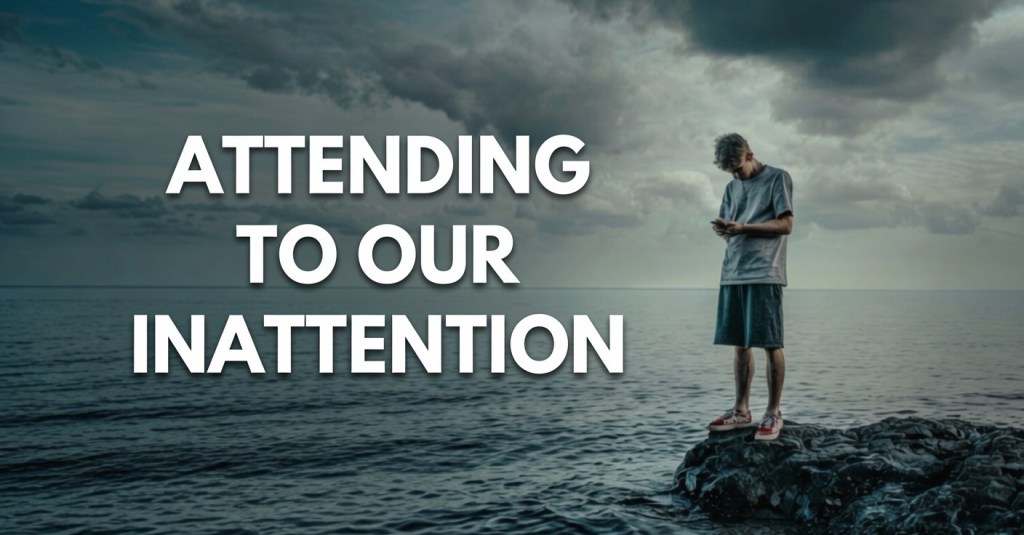
Imagine there was something of infinite value. Something that, though only just out of reach, could only be obtained if you were able to give your complete attention to a simple task that would make it yours to keep.
Would you, I wonder, be able to claim the prize?
Because according to ‘Stolen Focus’, the book by Johann Hari that I’ve been reading this week, it seems likely that most of us wouldn’t. Why? Well, because of our ever-decreasing attention spans that are the result of us now being constantly distracted – principally by the electronic devices that so many of us have become so dependent on.
By which I mean addicted to.
The book gives a fascinating insight into what we are allowing to happen to our brains – one that is both sobering to read and something of a wake-up call for those of us who, with the latest smartphone in our pocket, believe we’re living the dream but are in fact sleepwalking into a more disaffected tomorrow. Because having promised to connect us with the whole world, what they have delivered has left us only more isolated and alone.
And in case anyone was wondering if I’m pointing a finger, I most certainly am. But first and foremost at myself – someone who is very much aware, not only of how I am more easily distracted than I used to be, but also of the obvious irony that, in the unlikely event of anyone reading as far as this, they have almost certainly done so on a social media platform – one of the increasing number that exist and are, perhaps, most responsible for the cognitive decline that, if we care to notice it, many of us are currently experiencing.
Last week I heard Grayson Perry and, if memory serves, Michael Rosen on Radio 4. They were being asked about the effects of the proposed social media ban for under 16s. And, interestingly, they both spoke of the importance of boredom as a stimulus for their own creativity – how taking time out allowed themselves to think and, in so doing, gave opportunity for original ideas to emerge.
All of which leads me to wonder if, in our desperate attempt to remain constantly amused – a word meaning ‘entertained’ but which might equally be taken to mean ‘without thought’ – we will lose what it is to both produce and enjoy art in all its many forms. And whether that will inevitably result, not only in us leading less interesting lives, but in becoming increasingly diminished ourselves as well.
In stark contrast to our relatively superficial thought life, Hari talks in his book about what he calls ‘flow’ – by which he means that blissful feeling we experience when we are ‘in the zone’ – fully focused on something that we are more than happy to give our full attention to.
But in order for us to find ourselves in such a sublime state, Hari, referencing the work of Mihaly Csikszentmihalyi, says there are three conditions that need to be met. Firstly we have to have a single goal – because multitasking as a means of greater efficiency has now been shown to be a myth which, rather than increasing productivity, actually achieves the complete opposite. Secondly that goal that Hari suggests we require is one that we must find meaningful. And thirdly, the thought that we are engaged in has to stretch us a little, taking us into areas of understanding that might be new to us and in which we might not normally feel comfortable.
And so the question inevitably arises: what, if any, of our life goals might come anywhere close to meeting these suggested requirements?
The possible answers to that question are no doubt many and varied, differing according to each individual’s particular interests. For me, for example, they would include cricket – specifically the four-day county game which I find meaningful, not least because, devoid of the distractions inherent in short-format franchise competitions, it includes periods of play that are sometimes slow but which, far from tedious, allow time for variation and, as a result, ultimately make matches more interesting.
But the summer game is just my personal passion, and what gets you up in the morning is likely to be very different. But be it carpentry, kayaking, or carnival, whether it’s ballooning, bellringing, or badminton, I’d wager a small coin that the level of satisfaction you derive from it is directly proportional to the time you are prepared to commit to it, and the effort you are willing to make to know more about whatever it is you’re in to.
But for all that diversity of interests, I nonetheless wonder if there is another goal worthy of us all pursuing, one that is both greater and more unifying than any other, one that has the potential to satisfy every single one of us and give meaning to the lives of everyone.
Because if there is, might not the dissatisfaction that so many of us are currently feeling, be the necessary incentive for us to go looking for it?
Well I believe there is such a goal – one that, interestingly, satisfies all three of Hari’s conditions. Which suggests, to me at least, that in pursuing it, we might go some way towards being freed from the ennui that threatens to overcome us, and instead experience something of the joy that we all can’t help but think – or at least hope – we were made for.
So what am I referring to – what is the big idea I have in mind that might just be enough to satisfy us all?
Well simply but ineffably this – the knowledge of a transcendent yet immanent God.
Jeremiah 29:13 records the words spoken by just such a God who says to us as he once did to the prophet, ‘You will seek me and find me, when you seek me with all your heart.’
God then is the one we are encouraged to go after even as He comes after us. And we are to do so single-mindedly, undistracted by lesser concerns, absolutely convinced that knowing him is what gives life its meaning. As Jesus himself said, ‘This is eternal life, that they know you, the only true God, and Jesus Christ whom you have sent.’ [John 17:3]. Furthermore, scripture encourages us to go beyond a superficial understanding of our creator, to ‘leave the elementary doctrine of Christ and go on to maturity.’ [Hebrews 6:1]
Because He is beyond our understanding, and because His thoughts are far higher than our own, He is a God whom we will never fully comprehend and therefore never become bored of.
But God isn’t just interesting – he matters.
Instead we need to do something somewhat harder. Rather than focusing on the faults of others, we need to concentrate on our own. Rather than blame others for our difficulties, we need to reflect on how we may be contributing to them ourselves, and so take responsibility for all that we think, do, and say, as a result of our own inner restlessness that is made manifest by our all too apparent distractibility.
That is to say, we need to take responsibility for the flawed people we are ourselves.
And having done so we need to turn to the One who really is of infinite value, as near to us as His word which is readily available to us and will, if we would only attend to it, teach us all that we need to know.
We need then to fix our eyes on Jesus – the author and perfecter of our faith who, for the joy set before him, endured the cross, despising the shame. We need to look to the One who, suffering and dying in our place, became sin for us, so that we might become the righteousness of God.
But more than receiving Him as our saviour, we need to accept Him as our Lord. For He is the only leader we will ever need, the only one who can be trusted, and the only one who guarantees that all that is currently wrong will one day be put right.
And that includes the wrong within us – not just our propensity to sin, but our restless and distracted inattention.
Related blogs:
To read ‘Contactless’, click here
To read ‘On not remotely caring’, click here
To read ‘On contentment’, click here
To read ‘On permanence – and the search for stability’, click here
To read ‘Me, myself and AI – interacting with the ghost in the machine’, click here
To read ‘Keeping it real’, click here


