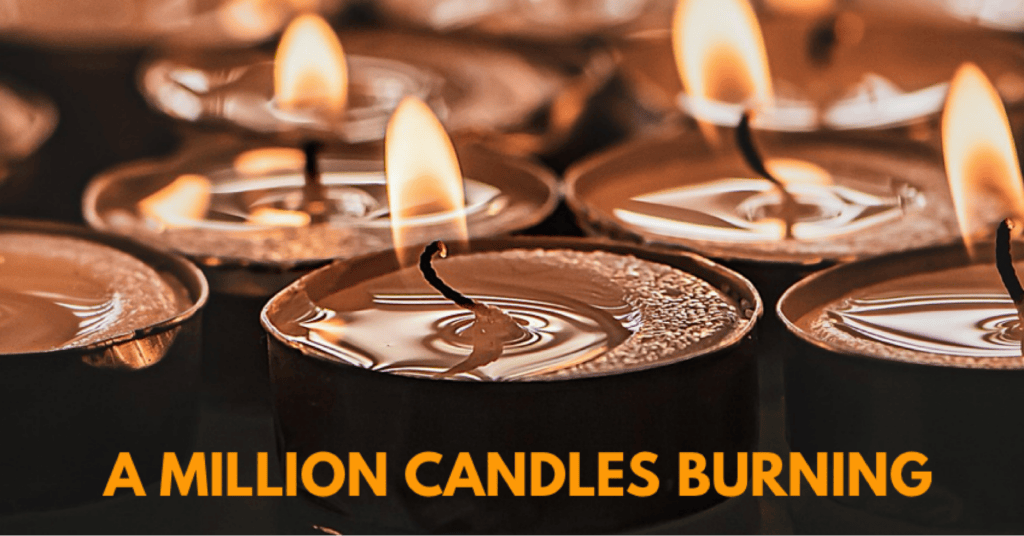
It was Leonard Cohen who, in singing of ‘a million candles burning for the help that never came’, expressed so perfectly what all those in the habit of praying know to be the case – that God sometimes says ‘no’ to our requests when we’d rather He said ‘yes’.
So why is that?
Well let’s start by stating what cannot be denied – that His choosing not to answer our prayers in the ways that we’d like is not necessarily because of a lack of faith on our part. Because it’s not. And the reason we can be so unequivocal about that is because the Bible describes occasions when God acts in ways that His people clearly didn’t believe He would.
Take, for example, the time when the church had met together in earnest prayer for the release of Peter, and then, having done so, refused to believe it was him knocking on the front door of the house where they’d gathered – expecting him, perhaps, to be beheaded in the way that James had previously been.
Furthermore, since ‘faith comes by hearing and hearing by the word of Christ’, it seems to me that we can only have faith in who God has revealed Himself to be and the things that He has said – the things that He has promised. And since He hasn’t promised to always heal those who are sick, whilst we can pray in faith that He will do what is right – because that is something we have been promised – we cannot pray in faith for the complete recovery of our much-loved terminally ill friend or family member.
None of which is to suggest that God won’t heal someone when we ask Him to. Not at all, for God will do whatever He chooses to do. But it is to make plain that if He does answer our prayers in the way we want Him to, He does so both independently of any imagined certainty we may have of what He will do and unconstrained by our lack of belief in His ability or willingness to do it.
So why pray at all, if God will keep His promises irrespective of our prayers? Why pray for His kingdom to come and His will to be done, if both these outcomes are already absolutely guaranteed?
The first answer to these questions is, of course, I don’t know. Other than that God tells us to pray. But the reasons for doing so, whilst way beyond my own understanding, seem to relate not only to our recognising our dependence on Him, but also to His mysteriously choosing to make our prayers one of the means by which He brings about His purposes.
And secondly, our prayers have the capacity to change us, not least by bringing us to the point where we willingly submit to God’s good and perfect will for our lives. And, perhaps, for our deaths as well.
Some years ago I was proper poorly with infective endocarditis. In the early days of what would turn out to be a seven-week stay in hospital, and before the diagnosis was finally made, I genuinely thought that I might die – not least because there was serious concern that my condition was due to an underlying malignancy that, had it been confirmed, would have given a whole new meaning to the extended leave I was looking forward to at the time. And so I prayed – initially in hope of healing but ultimately in faith – that the Judge of the whole earth would do what was right. Even if that meant I died at the age of 47.
Twelve years later it is evident that there is one less candle burning than might otherwise have been. But that doesn’t mean that I have learnt my lesson well and am now completely at ease with what God is doing, or not doing, in the world today. I continue, for example, to grieve over the war in Ukraine, the suffering of so many in the world, and the deep sadness experienced by some of those I love. And I wonder why God doesn’t bring an end to it all. I don’t know why one person with cancer is cured by medical means whilst another deteriorates and dies, any more than I know why Peter was rescued by angelic intervention whilst James was left to be executed – but I am nonetheless learning to be content to believe that God does know what He is doing when I don’t, and that the promises He has made are ones that He will most certainly keep.
Because as Cohen continues:
‘There’s a lover in the story,
But the story’s still the same.
There’s a lullaby for suffering,
and a paradox to blame.
But it’s written in the scriptures
and it’s not some idol claim’
That suffering is the means by which suffering will ultimately be brought to an end is indeed a paradox, but that is the nature of what took place at Calvary – where Christ’s suffering became for us the means whereby our suffering is guaranteed to one day come to an end.
And so I have faith that whilst weeping may tarry for the nighttime, joy will come in the morning – on the day when Jesus finally and forever returns, when wars will be a thing of the past, all our tears will be wiped away, and death will be no more.
Jesus said He was coming soon. Even so, I pray: ‘Come Lord Jesus.’
Related post:
To read ‘Three times a patient’, click here
To read ‘Reflections on the death of Leonard Cohen’, click here.


