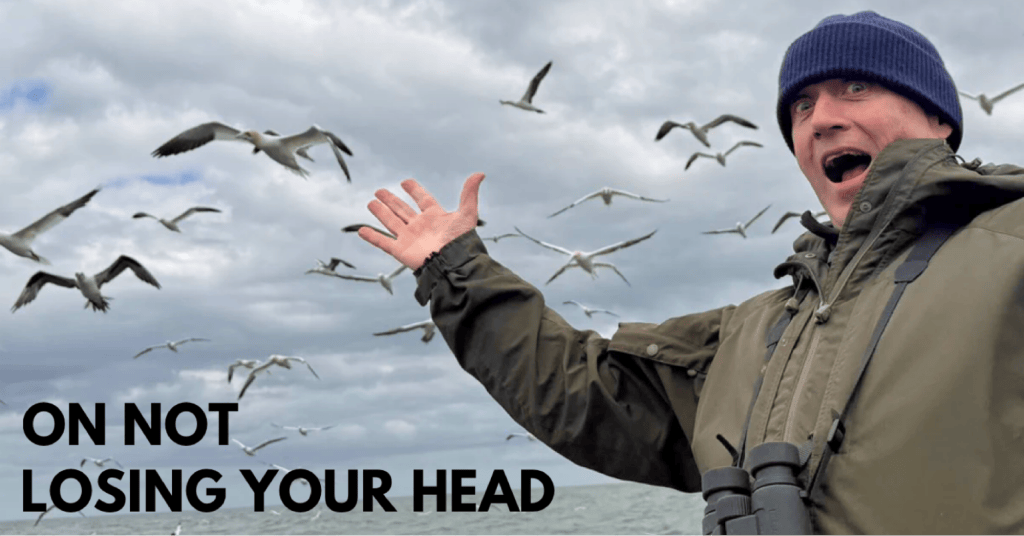
It was, I remember, as a 17-year-old schoolboy that I watched Ade Edmondson, as the anarchic Vyvyan, kick his own decapitated head along a railway line in my most favourite ever episode of ‘The Young Ones’. Little did I know then that yesterday evening I would see him on television again, painting impressively with watercolours, delicately cooking monkfish, and taking obvious pleasure in gannets as they dived into the sea.
And so I am growing increasingly fond of a man who appears gentler, kinder and more thoughtful than his early performances may have suggested.
Not that these are things that we have in common – they are, perhaps, rather more surprising. Because as well as both spending time playing at being a medical student, we each own the exact same Nikwax waterproof coat and have both performed with the RSC at Stratford-upon-Avon – although I ought perhaps to point out that, whereas he had a starring role as Malvolio in ‘Twelfth Night’ at the Royal Shakespeare Theatre, a performance I made the effort to go and see, I trod the boards alongside Patrick Stewart, as an extra in ‘The Winter’s Tale’ at The Swan Theatre, which he didn’t bother to attend!
That said, as I watched him enjoying spending time with Sam West, I couldn’t help sense a contented melancholia about Ade Edmondson – one that I wondered might have arisen as a result of the less than affectionate relationship with his father that he spoke about with his birdwatching friend.
And whilst I can’t of course know for sure, I further wondered if this in turn may have been the reason why, as he grows inevitably older and approaches his 70th birthday, Edmondson may have drawn comfort from the words of acclaimed painter, photographer, and stage designer, David Hockney, whose philosophy he paraphrased when he said that, with both the past and the future being a fiction, life was therefore all about the now.
But it is here that, for what it’s worth, I’d want to gently disagree with the comic who still makes me laugh and whom I nonetheless continue to genuinely admire.
Because whilst we do not experience it in the same way as we do the present, we live now in light of the past that has to some extent determined it. And similarly, though we do not know it in the same way as we do the here and now, the future, to some degree at least, follows as a consequence of what we do today.
And whilst it might be convenient to believe the past no longer matters, and that the future is not our responsibility, neither of these seemingly comforting thoughts are based on reality.
Which is in fact good news.
Because the truth is that we live in an ordered universe – one in which cause and effect follow on from each other. Which means that our actions, far from being inconsequential, really do make a difference. And whilst we can’t change the past, or fully determine the future, rather than simply ignoring what went before and not considering what may happen in the future, we should endeavour, where possible, to put right what went wrong in the past, and seek to make the future even a little better than it might otherwise have been.
And it’s good news too for when we can’t bring about the change we’d like. Because even those who have suffered horribly at the hands of others really can look forward to a day when the judge of all the earth will do what is right – when He will not only vindicate the wronged and bring about justice, but will make all things right as well.
All of which means that, having already had eternity placed in our hearts, we must now consider how we will experience our eternal future – whether we will trust in ourselves and thus forever remain damnably disappointed, or hope in God – the one who offers us salvation and, in Christ, promises eternal satisfaction in His presence.
Because the cross deals with our past just as it secures our future – by atoning for our sin and reconciling us to God, Jesus’ finished work guarantees our place in heaven.
Which is a truth that we should no more respond to by sticking our heads in the sand than we would by kicking them along a railway line.


