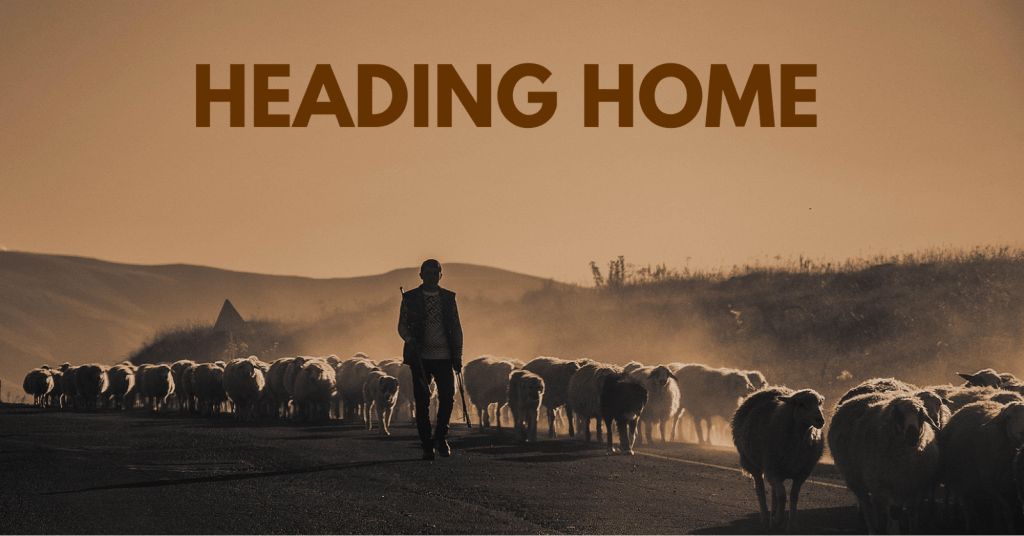
The Lord is my shepherd, I shall not want.
These are the words with which King David began Psalm 23. It is perhaps the best-loved and most familiar of all the psalms – one that has brought deep comfort to millions and been read at countless funerals.
But taken at face value, they are words that also raise an important question – because of the very simple fact that there are many things that I still want. The answer comes, though, when we realise that ‘I shall not want’ should be taken to mean ‘I shall want for nothing’ – which is why some versions of the Bible translate this verse as ‘nothing shall I lack.’
That is to say that those led by Jesus, the good shepherd, will be provided, not necessarily all they want, but all they need – a truth beautifully conveyed in the verses that follow that speak of his sheep being made to lie down in green pastures and walk alongside still waters.
But even more beautiful is the assurance that, in Christ, we have one who restores our soul as he leads us along paths of righteousness. Which means that we are being changed – being made more like the one we follow – not only for our good but, more importantly, for his glory. For, as verse 3 makes plain, the change in our direction is ultimately for his name’s sake.
But to affirm wholeheartedly that followers of Jesus now lack nothing is not to endorse a so-called prosperity gospel. Not at all. Rather it suggests that whatever we currently do not possess – be it health or happiness, money or one of so many other good things – it is, we can be sure, because these are things that God has lovingly – albeit sometimes both mysteriously and painfully – determined we do not actually need.
Not for the time being, at least.
Because if, having sent Jesus, he did not spare his own Son but gave him up for us all, how will he not also, with him, graciously give us all things? [Romans 8:32]
All things, that is, that we need.
Which is why the Psalm can continue as it does – with its second emphatic assertion. I shall fear no evil – even whilst walking through the valley of the shadow of death. Not if Jesus is with us – leading us on our way.
Make no mistake, he has gone before us – as the good shepherd who lays down his life for his sheep [John 10:11] – suffering death for us so that we needn’t die – not in any ultimate sense. For whilst Jesus, hanging on the cross, cried, “My God, my God, why have you forsaken me?”, all who trust in him need never fear being abandoned by God.
Perhaps that’s why David speaks of the valley we walk through as only the shadow of death – rather than of death itself. Because whilst we will all one day die, those of us in Christ can nonetheless look forward with sure and certain hope to the resurrection and the eternal life that will undoubtedly follow, when, as Psalm 23 concludes, we shall dwell in the house of the Lord for ever.
Because, having been led through this life by Jesus our Shepherd, and having been followed by his goodness and mercy, we shall discover there the place he has prepared for us.
One that, overflowing with good things, not least his own divine presence, will more than compensate for anything we might have been lovingly asked to go without in this life.
Which means it’s true what the apostle Paul wrote in 2 Corinthians 4:17 – that our current afflictions really are light when compared to the weight of glory that they themselves are preparing for us.
And indeed only momentary – when set against the everlasting joy we’ll experience there in our eternal home.
Related blogs:
To read ‘Luther and the war in Ukraine’, click here
To read ‘When our joy will be complete’, click here
To read ‘When Bad Things Happen’, click here
To read ‘Weeping with those who weep’, click here
To read ‘Still weeping with those who weep’, click here
To read ‘All’s Well that Ends Well’, click here
To read ‘on the FALLEN and the FELLED’, click here
To read ‘What becomes of the broken hearted? Sorrowful yet always rejoicing on Palm Sunday’, click here
To read ‘Why do bad things happen to good people? Sorrowful yet always rejoicing on Good Friday’, click here
To read ‘Was it not necessary that the Christ should suffer these things? Rejoicing, though temporarily sorrowful, on Easter Day’, click here.
To read ‘T.S. Eliot, Jesus and the Paradox of the Christian Life’, click here
To read ‘Monsters’, click here
To read ‘On Sleeping like a Baby’, click here
To read “Hope comes from believing the promises of God”, click here
To read ‘Reflections on the death of Leonard Cohen’, click here


