
Some while ago I was fortunate enough to be sat in Exeter’s Northcott Theatre to see the opening night of ‘The Life I Lead’. It was a brilliantly written play by James Kettle performed single handedly with equal brilliance by Miles Jupp.
Through a conversation with the audience, it told the story of the life of the British character actor David Tomlinson best known for his portrayal of Mr Banks, the father in the Walt Disney film version of ‘Mary Poppins’. It was a warm and gentle two hours which managed to be seriously funny as well as poignant and moving. It left those watching with a genuine affection for a man who few will have previously known much about.
I’ll not spoil it for those who may yet go and see it but, suffice to say, the play revealed that behind the genial public image, Tomlinson’s personal life, though generally happy was not without tragedy – he was a man who had to live with sadness.
Tomlinson is not alone in having to bear the inevitable sorrows that come as the years pass. Whilst continuing to live and work, attending to the everyday and endeavouring to find happiness, meaning and satisfaction, we all, to a greater or lesser extent, have to endure grief.
In that respect, the performance was made more poignant still from knowing that, as he portrayed Tomlinson so perfectly, Miles Jupp was himself carrying a grief of his own, having lost to cancer, less than a week previously, his friend and colleague, comedian Jeremy Hardy. I hope Jupp was able to enjoy performing despite the sadness he was no doubt still feeling – and appreciated the very warm applause that he received when the show was over.
If he did, then he was not so different from me who was also able to thoroughly enjoy the show, laughing frequently, despite my own ongoing sadness regarding the sudden death of a friend of mine just four weeks previously.
The evening left me reflecting once more how few lives are devoid of tragedy, that life for most is a mixture of the good and the bad and that even when sadnesses come thick and fast, happiness can still be present, intermingling alongside the sorrow.
Life then can, and does, go on, a complex mix of fortune and disaster. Such was the life that Tomlinson led, such is the life I lead and such, perhaps, is the life that you lead too.
T. S. Eliot was right when he wrote: ‘People change and smile: but the agony abides’. I saw it all the time when I worked as a GP, when a little scratching beneath the cheery facade would all too readily uncover a back story to my patients’ lives that I would otherwise never have known about and without which I could not possibly begin to fully understand their presentation.
Why did that woman burst into tears quite so readily over a relatively modest degree of back pain when she consulted that morning? What hidden pain was behind her presentation? What sorrow was she bearing, possibly alone?
It’s sure to have been there because ‘everybody hurts’.
I met Jeremy Hardy once. He was performing his stand up show in Taunton many years ago and I went to see him one evening with a friend who was simultaneously on call for a local GP practice. Those were the days when one could, if covering a small practice population as was he, risk combining an evening on call with a trip to the theatre – provided, that one was careful to position oneself in close proximity to an exit.
Predictably enough, my friends mobile went off and as he sloped out to attend to the sick, Jeremy Hardy took the opportunity to extend his routine by ten minutes with a good humoured berating of anyone who would allow their phone to ring in such a setting. My friend made it back in good time and, having enjoyed the rest of the performance, we were able to indulge in a post show drink in the bar together.
Jeremy Hardy was there too, amiably chatting with anyone who cared to spend time with him. My friend’s phone went off once more and, realising he was a doctor, Jeremy Hardy had a brief chat with us, apologising for his on stage criticism and wishing us well. He seemed to be a genuinely warm and friendly person and I am sorry that no longer entertains us with his fine sense of humour coupled with the earnestness of his politics.
Dying at the age of just 57, Jeremy Hardy no doubt also knew what it was to experience tears amid the laughter.
Sadness then, is universal, even in the happiest of lives. The causes are many, but include both the grief felt for things which are lost – the regret of the broken relationship, the missed opportunity, the faded dream – and the sorrow resulting from the fear that the future will bring no relief – the loss of hope itself. And then of course there is the sadness that results from the unhappiness of others, the misery of those we love.
Many will be familiar with the words of the psalmist who wrote, ‘Weeping may tarry for the night but joy comes in the morning’. I don’t doubt the truth of these words – even so but for some the night has already been long and the day still seems an eternity away.
Elsewhere in those ancient writings are chronicled the trials of Job and the ineffectual efforts of his comforters who needed to learn what we too must appreciate – that sometimes it is best to simply ‘weep with those who weep’ rather than to try to argue them out of their sadness or, worse still, point out to the one who is unhappy the mistakes we think they have made to bring about their misery.
Regardless of whether we believe in God, we can, I think, agree that there is wisdom here.
Regret and sadness have much in common.
In my first year as a GP Principal I recall one Sunday morning visiting a patient who had had a few days of severe diarrhoea and vomiting. He appeared sufficiently dehydrated to require admission and I requested an ambulance to attend, not immediately, as I was soon to regret, but within the hour.
There was, uncharacteristically for those days, some delay in the ambulance attending, and sadly the patient suffered a cardiac arrest and died on route to hospital.
The next day I chatted to my partners about the case. All were supportive and quick to point out that they felt that I had acted appropriately and that the outcome would likely not have been any different even if the ambulance had attended earlier.
But the response that helped me most was that of my senior partner who simply acknowledged that it was tough when things went wrong and related an incident when he had regretted a judgement he’d made some years previously.
That such an experienced and respected GP could ‘regret with those who regret” was very comforting for me.
We are all flawed – even the most experienced make mistakes – mistakes which may be regretted for years but from which, having honestly acknowledged them to both ourselves and those affected by them, we can, none the less, learn much. Perhaps it is even true to say that mistakes are in fact necessary if we are to become the more experienced and better people we desire to be.
Experience comes over time so perhaps it is older folk who recognise this most. Perhaps they are more accepting of their mistakes and are more used to knowing at first hand what it is to experience the associated regret. Just as Abraham Lincoln suggested that the old have come to ever expect sadness, so older people have perhaps come ever to expect regret.
If then mistakes and regret are an inevitable and necessary part of what it is to be human, perhaps sadness is too. Though for the most part I am happy, there is still a sadness that sits alongside my happiness – a sadness which sometimes is easier to feel. That, I suspect, is a feature of the lives we all lead.
But if mistakes and regret have the capacity to make us better people, then maybe sadness has the capacity to make us better people too.
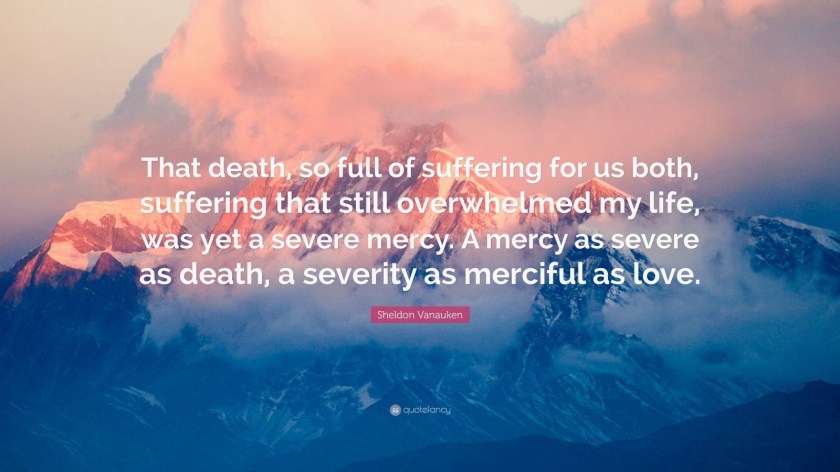
Rather then than trying to constantly avoid sadness and, when it does make it’s inevitably unwelcome appearance, attempting to rationalise it away, perhaps we would all do well to learn to accept life’s sadness as a ‘severe mercy’ – and allow our lives to be paradoxically enriched by it’s presence.
If so, I hope I can become that wise.
To read ‘On Gratitude and Regret’, click here
Other blogs related to Films, Plays and TV Series:
To read ‘Life in the Happy Valley’, click here
To read ‘I’ll miss this when I’m Gone’, click here
To read ‘I’ll miss this when I’m gone – extended theological version’, click here
To read ‘Somewhere over the Rainbow’, click here
To read ‘When the Jokes on You’, click here
To read ‘Three Chords and the Truth’, click here
To read ‘With great power…’, click here
To read ‘An Audience with Grief’, click here
To read ‘The Dig – it’s well worth it’, click here
To read ‘Do You Hear The People Sing?’, click here
To read ‘Life after Life’, click here
To read ‘A Dream if an Antiques Riadshow’, click here
To read ‘Brian and Stumpy visit the Repair Shop’, click here
To read ‘The Great Cricket Sell Off’, click here
To read ‘I’m a GP…get me out of here!’, click here
To read ‘Mr Benn – the GP’, click here
To read ‘A GP called Paddington’, click here
To read ‘Scooby Doo and the Deserted Medical Centre’, click here
To read ‘Paddington and the Ailing Elderly Relative’, click here
To read ‘Dr Jonathan Harker and the post evening surgery home visit’, click here
To read ‘Bagpuss and the NHS’, click here
To read ‘Jeeves and the Hormone Deficiency’, click here
To read ‘Scooby Doo and the Deserted Cricket Ground’, click here
To read ‘General Practices are Go!’, click here
To read ‘A Mission Impossible’, click here
To read ‘Vanity Fair’, click here
To read ‘Measure for Measure – Appraisal formAppraisal’, click here
To read ‘Eleanor Rigby is not at all fine’, click here
To read ‘The State of Disrepair Shop’, click here
Other related post:
To read ‘General Practice – still a sweet sorrow’, click here
To read ‘Dark Reflections’, click here

 Some musings
I think you are pretty wise already.
LikeLiked by 1 person
Anyone who has been in any field of medicine would agree with these words!
LikeLiked by 1 person