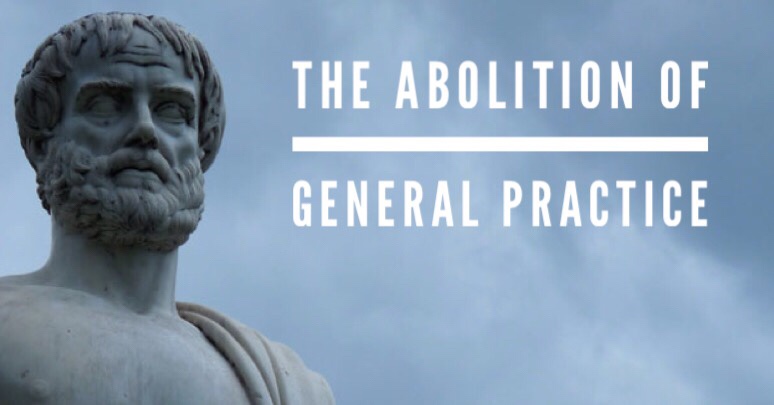
Aristotle had it right when he wrote in his ‘Metaphysics’ that ‘Those who wish to succeed must ask the right preliminary question’. More than 2000 years later, doctors would do well to listen to his advice.
Before adopting each and every new advance that claims to be good for our patients, we should ask what we are hoping to achieve by following such recommendations. And we ought to consider whether the answer we come up with tallies with what I would propose might, in Aristotle’s eyes, be a good preliminary question to ask.
What do good doctors do?’
In ‘The Abolition of Man’, C.S. Lewis had some interesting things to say about how the focus of what science seeks to do has changed over time. Whereas once ‘wise men of old’ sought knowledge in order to understand how humankind conformed to reality, Lewis suggested that for science the problem had become ‘how to subdue reality to the wishes of men’.
But, for Lewis, there were dangers inherent in such an ambition. He realised that it would be those with power who would impose their wishes on the weak and maintained that any attempt to subdue reality to the wishes of the powerful, would require nature to be conquered in order that it conformed to their desires.
And that, he said, would require a reducing of all of nature to nothing but its component parts, denying anything beyond the merely physical and quantifying everything only in terms of what we can measure. Lewis believed that, since humanity is itself a part of nature, this diminishing of the whole would. ultimately, diminish humanity and bring about what he called the ‘abolition of man’.
So what of medicine today? Does it also seek to go beyond trying to help patients face what nature throws at them and seek to conform nature to what is deemed desirable for its’ patients? And if so, is the result a diminishing of what it means to be human – are people reduced to being defined merely in terms of their medical parameters? Is medicine undermining what it is to be alive?
If the answers to any of these questions is ‘Yes’, the route cause may be that we doctors have lost sight of what our purpose really is. We have forgotten to ask ourselves the right preliminary question.
The NHS came into existence in 1948 based on William Beveridge’s 1942 report urging universal access to health care. This was accompanied by a belief that the state should provide social security ‘from the cradle to the grave’. Inherent then, at the inception of the NHS, was a belief that, though every effort should be made to fight disease and promote health, the grave awaited us all and death was an inevitable reality. In the early days of the NHS therefore, alongside social reformers who developed polices to reduce the risk of disease, the wise doctors of old practised medicine for a population of people with disease whilst never forgetting that death remained a reality that could not be ignored.
That was what wise doctors did. But having forgotten this we have moved beyond this worthy endeavour and foolishly sought to employ medicine to subdue reality to mankind’s wishes. A moment’s thought will bring to mind a number of ways in which medicine has tried to do this – and it will be all too apparent that this has often required the reducing of humans to nothing more than their component parts.
Take for example, perhaps man greatest desire, the wish to live happily forever after. Even though for medicine to deliver this is the stuff of fairy tales, medicine has, nonetheless, attempted to subdue the reality of death and unhappiness.
No longer content to busy ourselves caring for the sick, we now, in the name of promoting immortality, label the healthy ill. Those we consult with may never have felt so well but we insist on telling them, often remotely, that they have borderline hypertension, that their cholesterol is too high and to top it all that they have pre diabetes.
No wonder we have the worried well when we tell the well to worry!
Defining them in terms of unfavourable health indices, we then exhort them to take our medications with all their side effects and demand that they behave in ways they would not otherwise choose.
And if they fail to be happy, if they become anxious or sad, we try to convince them that their feelings are not really their own – that rather than experiencing a genuine emotion, they have instead had just a conditioned response to the levels of serotonin floating around their biological system.
And for that, they are told, there is a pill as well.
Slowly but surely, people become patients who, rather than being enabled to live well, are reduced to little more than automaton whose only concern is nothing more than to avoid death and feel pleasure. They are made to worry over what is normal and become dependent on medicine to solve the problems that they do not have. Their lives are diminished by the pursuit of what we have told them they should desire most.
Lewis, I believe, was right. But it’s not just our patients who are at risk. If we in primary care forget what it is we do and capitulate to those in power who seek to impose their ideas on how we practise medicine, if we buy in to their vision and are reduced to only being interested in what can be measured, and if we spend our time frantically generating the data they demand, then we will no longer be the doctors we once were, the doctors we always wanted to be.
‘What do good doctors do?’ It’s a question we must urgently ask ourselves lest the answer becomes that we silently watch over the abolition of general practice.
To read ‘The Abolition of County Cricket’, click here
Related blogs regarding the difficulties with the NHS:
To read ‘General Practice – is time running out?’, click here
To read ‘On being overwhelmed’, click here
To read ‘I’ll miss this when we’re gone’, click here
To read ‘General Practice – still a sweet sorrow’, click here
To read ‘Mr Benn – the GP’, click here
To read ‘A GP called Paddington’, click here
To read ‘Scooby Doo and the Deserted Medical Centre’, click here
To read ‘Paddington and the Ailing Elderly Relative’ click here
To read Dr Jonathan Harker and the post evening surgery home visit’ click here
To read ‘Bagpuss and the NHS’, click here
To read ‘the day LITTLE RED RIDING HOOD got sick’, click here
To read ‘A Dream of an Antiques Roadshow’, click here
To read ‘The NHS Emporium’, click here
To read ‘Jeepy Leepy and the NHS’, click here
To read ‘The Three Little GPs and the Big Bad Secretary of State for Health’, click here
To read ‘The Happy Practice – A Cautionary Tale’, click here
To read ‘The State of Disrepair Shop’, click here

 Some musings
Yes I think you have a point and I note an American oncologists says he will refuse all treatments after he is 75 years old . If like me you are soon to be 77 it’s a bit worrying but as I still go skiing etc I don’t feel my age!
LikeLiked by 1 person
I reckon you’re OK for a good few years yet!
LikeLike
Thanks !
LikeLike