Blaming it on the Boogie

Recently The Guardian reported that doctors were alarmed that an online test, designed to estimate the cardiological health of those completing its short questionnaire, revealed that 78% of British adults had a heart age older than their chronological age. As such they were at risk of an early death.

What was even more alarming, at least for one Somerset man, was that despite having normal blood pressure, a cholesterol comfortably below five and a weight in the healthy range, the computer based algorithm insisted on saying ‘No’ when he asked the question as to whether he’d live to a ripe old age. Neither his lifelong avoidance of cigarettes, diabetes or atrial fibrillation, nor his good sense to have been born of parents whose genetic makeup promised an existence well into his 90s, managed to persuade the online ‘expert’ otherwise and, despite repeated questioning, it stubbornly continued to insist his heart was older than his actual 51 years.

What could be the explanation? All that was left was his post code. Like the rest of the country, Somerset has enjoyed several months during which each week was as warm and dry as the one preceding it – so much so that the BBC helpfully sent out an urgent alert informing the nation that the summer had indeed been hot. This got our worried west countryman wondering if the weather might be to blame. He was, however, quickly assured that neither the sunshine, nor the good times he had experienced of late, could have accounted for the accelerated ageing of his heart. Further questioning confirmed that his lifetime exposure to moonlight was also within normal limits thus leaving his passion for dancing to the music of Bacarra in the late 1970’s as the only possible explanation for his inevitable early demise.

So once again the great British public has been encouraged to fret about their mortality as leading doctors have expressed alarm that the vast majority of people have an older heart than their age would anticipate. But perhaps more alarming still is the fact that they are so alarmed. Once again the cry has gone up that everybody should have cardiological screening tests and thereby throw themselves on the mercy of the medical profession with the promise that, among those public spirited enough to do so, lives will be saved.

But, of course, lives will not be saved – at best they will only be prolonged. And though this may be of some value, one must ask the question as to quite how much can life be extended. The average life expectancy of our Somerset man is, apparently, 79.4 years, not a great deal more than the 79 years his ‘old’ heart promises.

And at what cost will this life extension be achieved. Not only is there the potential of adverse effects from the drugs that will be administered but also the very real emotional consequences of individuals being encouraged to constantly ruminate over their own health.

When normal healthy individuals are labelled as ill, it is no wonder we have the ‘worried well’. And nor is it any surprise that, busy reassuring those they have unnecessarily alarmed and treating them for conditions they do not have, doctors have no time left to attend to the genuinely sick.

This is a tune to which we can no longer dance – the obvious stuck record needs to be changed.

Of course some attention to one’s health is entirely appropriate but when NHS England suggests that only about 20% of us can expect to live a normal lifespan then clearly there is some confusion as to what ‘normality’ really means. When those whose health indices lie comfortably within accepted normal limits are still the recipients of dire warnings of a premature death then something has gone very wrong. And it is a sad day when those individuals are encouraged to spend the next 28 years anxiously fretting about their mortality rather than getting on with the far more worthwhile endeavours of contributing to society and enjoying the years they do have left to them.

Rather than introspectively bemoaning the fact that some of us will die aged 79, we would do well to be glad that we live in a nation where the average citizen is aberrant enough to have a life expectancy that exceeds that number.

Much has been written about how the heart age estimation algorithm exaggerates risk when blood pressure and cholesterol levels are not known, but even when these parameters are entered into the online tool alarmist results are still all too often calculated. One can’t help wondering if that is a consequence of a systematic over emphasis by medics of those parameters for which potentially modifying drug treatments are available. The upshot of such a constitutional bias is an overestimation of the medical profession’s importance and, inevitably, exaggerated profits for pharmaceutical companies. That no attention is given to other lifestyle considerations such as diet and exercise, areas which require no input from a medical professional and no pharmaceutical intervention, is curious to say the least.

Having said that, to get me on the dance floor does generally require a drug treatment of sorts. And if that’s what it takes to get me engaging in what is undoubtedly a good form of exercise then perhaps I could do worse than visit Somerset’s finest, a certain Dr Thatchers, whose advanced access arrangements are very advanced indeed. True the adverse effects of his remedies may result in my mistakenly imagining that ‘Yes Sir, I can boogie’ despite evidence to the contrary but, even so I might just find the whole experience a little more satisfying than once more entering data into a computer and traipsing off to the doctors in pursuit of a guarantee of everlasting life.

So I’m asking, ‘Are you dancing?’ Because if you are it is surely better than merely settling on (ah, ha, ha, ha) stayin’ alive.


Related blogs:

To read ‘The Abolition of General Practice’, click here

To read ‘General Practice – still a sweet sorrow’, click here

To read ‘On being overwhelmed’, click here

To read ‘General Practice – is time running out?’, click here

To read ‘Health – it’ll be the death of us. Is there institutional arrogance in the NHS?’, click here

To read ‘An Audience for Grief’, click here

To read ‘On Not Remotely Caring’, click here

To read ‘Contactless’, click here

To read ‘Vaccinating to remain susceptible’, click here

To read ‘On Approaching One’s Sell By Date’, click here

To read ‘Eleanor Rigby is not at all fine’, click here

AND I GUESS THAT’S WHY THEY CALL IT THE BLUES.

Like the one whose taste in music veers consistently and increasingly away from societal norms and thus is destined to spend too much time sat in darkened rooms accompanied only by an empty bottle and the conviction that only he or she knows how music really ought to sound, it can be a lonely experience seeing things differently to the majority.

Nevertheless, it needs to be said that it’s not unusual, in this vale of tears, for it to be hard to be human. Neither is it abnormal.

True there are others who share such a conviction but they are seldom welcome in polite society. Such is the heresy to which they hold that theirs is an opinion that can only be whispered to one another like those shared by the sad unfortunates who spend too much time weighing the relative merits of Blind Willie McTell over Kansas Joe McCoy. Theirs is not a viewpoint one is likely to hear heralded wholeheartedly by media outlets intent on portraying a world where happiness is a right. We live in a marketplace where fun sells and where sadness, therefore, must not be tolerated.

And so we are urged to clap along if we feel like happiness is the truth. Such is a popular song, a popular notion. But the truth isn’t determined by what is popular. Whilst it’s great, when you’re happy and you know it, to clap your hands, it’s not always possible.

Because the truth is that everybody hurts. Sometimes.

In his book, published in 1872, Samuel Butler imagined a land, Erewhon, where those who offended against that country’s law were treated as being ill, and those who were ill were looked upon as criminals. Imagine how such a story would play out in today’s Britain with all the medical advances that we enjoy 150 years on from when the novel was first written.

Citizens who failed to comply with the demand that everyone must be happy would be duty bound to be treated and thereby cured of their despair. Tears would prompt urgent calls for medical attention and duty doctors would have to offer countless emergency appointments to manage the sad. Anything that might legitimately lead to unhappiness would not be tolerated. To accept the inevitably of death would be frowned upon and the population would be encouraged to perpetually medicate themselves to prevent such an unacceptable outcome regardless of the adverse outcomes and futile nature of their attempts. Those who stubbornly insisted on remaining ill would suffer the ire of a disapproving state and be disciplined for their sickness record by those who employed them.

And even when death finally came, as still it surely would, it would, as much as possible, be swept unseen under the carpet. Rather than dying, people would be allowed only to ‘pass on’. Clocks would not all be stopped, telephones would not be cut off, dogs would not be silenced with a juicy bone. Instead, normality would go on uninterrupted, fun would continue unabated. Rather than unpleasant funerals being held with all their accompanying solemnity and unhelpful and distasteful grief, people would gather together for celebrations, every one of them attired in brightly coloured party clothes. Imagining death had therefore somehow been conquered, everyone would smile and pretend to be happy, all the while posting selfies of themselves to convince themselves, and others, that such was indeed the case. And those who failed to mask their sorrow, those who upset others by being too feeble minded to carry on without experiencing and expressing sadness, would be paraded before clinicians who themselves would be only too ready to label their grief as a sickness and medicate them for their evident ill health.

We must not allow such a world to exist. We must not be complicit in its creation. To admit the normality of sadness is not to deny its pain. On the contrary, to acknowledge the reality that to be human is to sometimes experience intense emotional distress is the first tentative step that must be taken if anyone is to somehow come to terms with their grief and to carry on despite their sorrow – even if that sorrow may last a lifetime. Because to live is not to exist without sadness but rather to feel that intense feeling alongside, and as fully as, all the other emotions that go to make a life.

Weeping is a part of our existence just as much as laughter. It is a sound we must not silence.

Sometimes everything is wrong – and when it is, it is still a time to sing along. To do so is to recognise and understand what we know we feel but might otherwise be unable to fully express. Like crying, to sing of our sadness is to give our feelings voice. Such is the power and importance of lament.

To sing of our sorrow is, perhaps, to refuse to deny how black our feelings are – even as, ever so slightly, we allow that darkness to be lightened.

THE UNCOMFORTABLE PROFESSIONAL

It’s not a new phenomenon but I can’t help thinking that this last year has, once again, seen the professionalism of general practitioners undermined still further. We are increasingly being treated as naughty children.Two issues have particularly highlighted this for me.

I used to think, perhaps naively, that it was just bank robbers and murderers who got sent to prison. But now it seems that, by virtue of my being, for CQC purposes, the registered manager of the practice in which I am partner, I couldn’t go to prison for the heinous crime of pouring a urine sample down the sink in my room despite the fact that, as far as I am aware, this cavalier attitude of mine, has never done anyone any harm. Furthermore I am advised that I could be up on fraud charges for wantonly consulting with an 85 year old lady at what is, for her, a more convenient time than the 7:40pm appointment she had booked under Advanced Access arrangements.

This is, and I hope you’ll excuse the strong language, blinking stupid.

We are having to do things for no other reason than someone, somewhere, demanding that we do. And we are being cowed into submission merely to satisfy their agenda and justify their existence.

And not only is it, and I’m getting really cross now, bloomin’ (yeah, I know!) stupid, it’s also depressing and anxiety provoking.

In his book, ‘Lost Connections’, on the causes of depression, Johann Hari makes the point that “human beings need to feel their lives are meaningful – that they are doing something with purpose that makes a difference”. He quotes a study from as long ago as the 1970s by Michael Marmot who, investigating stress in the workplace, found, perhaps counterintuitively, that ‘the lower an employee is ranked in the hierarchy, the higher were their stress levels’. It turns out that the less control you have on your work, the more stressed and you become. ‘When you are controlled, you can’t create meaning out of your work’. That’s increasingly becoming us in General Practice.

Hari described a group of people who worked in a bike store who, depressed and anxious as a consequence of being ordered around by their boss, decided to break away and set up their own bike store – one run along different lines. Decisions were made collectively and, by giving themselves autonomy and control over their work, they reaped huge psychological benefits for themselves.

So what of general practice? Like those bike store workers we too are being controlled by others and made to work in ways which we disagree with and in which we see no value. And it is depressing. But it’s not just about throwing urine samples down the sink and seeing patients at mutually convenient times that I’m referring to – it’s also so much of our clinical work.

Des Spence, writing in 2016 in the BJGP about the workforce crisis faced by General Practice dismissed attempts at managing an increasing workload by such measures as total telephone triage and Internet based consulting. Acknowledging that there is no substitute for a face to face consultation between doctor and patient, his solution to the problem was, therefore, that we must reverse the escalating patient demand in ‘today’s largely disease-free Britain’. But first we need to understand what is driving our patients’ health-seeking behaviour. His answer to this question makes for uncomfortable reading since he blames the clinical practice of we GPs who, as we medicalise the human existence, fuel health anxiety and thereby make patients increasingly dependent upon us

Spence goes on to rehearse the well known argument that we shouldn’t prescribe antibiotics for a sore throat since it only serves to encourage patients needlessly to return the next time they develop the symptom. But he expands the argument to antidepressants quoting the evidence that most of the observed benefit of antidepressants is merely the placebo response, with any actual benefits being marginal or non-existent. With, according to Cochrane, a NNT for SSRIs of 7, it follows that 86% of patients don’t benefit from their use. But, like antibiotic prescribing for sore throats Spence asserts that prescribing antidepressants for low mood has ‘a far-reaching cascade effect on our time’. So too, he says, does the prescribing of drugs such as opioids and gabapentinoids which have equally poor evidence for their effectiveness.

Warming to his theme, Spence then looks beyond prescribing to how unnecessary investigations and referrals generate still more work as further anxiety is created, for both patient and doctor, with the uncovering of each additional minor abnormality. He concludes that, rather than too few doctors, “there is too much medicine” and that “iatrogenic harm Is the spectre in today’s world of polypharmacy for all.”

His final paragraph rightly asserts that “the debate about workload in general practice should in reality be a debate about clinical practice. If we want to reduce stress and workload the solution is” he sees, “in our hands only. We need to prescribe less, intervene less, and refer less… by implementing non-prescribing policies, actively stopping medications, and analysing referral patterns. Nationally, GPs need to seize total ownership of primary care guidelines, and kick off the idiot aristocrat specialists who know nothing of primary epidemiology and project unrealistic guidance from flawed hospital-based research. Finally, good medicine can only be achieved through good access, and good access can only be achieved by less medicine.”

It’s powerful and inspiring stuff. And yet we still find it hard, or at least I do, to resist doing what in my heart of hearts I know all too often is not really what is required. Why? Because I’m a little too scared to say ‘No’ to the perceived wisdom, too eager to toe the line, too ready to settle for an easy life. Only that easy life is, of course, not easy at all. As previously stated, to be made to behave in ways one doesn’t want to is the way madness lies.

Wouldn’t it be great if general practice could be different? Really different – to go with what is true rather than what is too often uncritically accepted by society. But to do so we’ll have to be brave enough to think differently to what has become increasingly the consensus – namely that life is a medical problem – that medicine is the answer to the bulk of the problems that we are presented with.

As Bob Dylan sang “I’ll go along with the charade until I can think my way out”
But thinking your way out can sometimes be hard.

In his book, ‘How to think’, Alan Jacobs writes of how, once established, the consensus is hard to challenge because there is great comfort in sharing the commonly held position. He quotes Marilynne Robinson who suggests we have a “collective eagerness to disparage without knowledge or information” alternative or unpopular views “when the reward is the pleasure of sharing an attitude one knows is socially approved.” If this is true, as doctors we are, in the medical setting, predisposed, without thinking, to endorse the view that medicine is universally good because we know that those we are talking to are likely to share this view, and approve of us for so doing. This is particularly relevant when we talk to our patients who, by coming to us in the first place, have made it clear that they believe we have the answer to their problems. Simply by bringing their low mood to a doctor, our patients have decided that it is a medical problem, a view that has been encouraged perhaps by their friends and family and generally endorsed by society as a whole. And we tend to all too easily agree with our patients, even when we do them a disservice by doing so. And all the more as we do so love to be needed.

We are, in the moment of the consultation, invested in not thinking because, it would feel too uncomfortable to disagree because, as Robinson puts it, “unauthorised views are in effect punished by incomprehension…as a consequence of a hypertrophic instinct for consensus.”

Jacobs asserts that if we want to think, then we “are going to have to shrink that “hypertrophic instinct for consensus.” But, he says, ‘given the power of the instinct, it is extremely unlikely that [we will be] willing to go to that trouble”

Jacobs believes that the “instinct for consensus is magnified and intensified in our era because we deal daily with a wild torrent of what claims to be information but is often nonsense”. That is the certainly true in the medical world with the nonsensical demands that are too often unjustifiably imposed upon us. Jacobs quotes T.S. Eliot who, almost a century ago, wrote, “When there is so much to be known, when there are so many fields of knowledge in which the same words are used with different meanings, when everyone knows a little about a great many things, it becomes increasingly difficult for anyone to know whether he knows what he is talking about or not.” And in such circumstances, “when we do not know, or when we do not know enough, we tend always to substitute emotions for thoughts.”

That is, confused about what to believe, we will default to what feels comfortable and agree with the consensus, the perceived wisdom. Jacobs believes that “anyone who claims not to be shaped by such forces is almost certainly self-deceived.” We are social beings who need to feel accepted and, since agreeing feels good, we are prone to toe the line. “For most of us”, Jacobs suggests, “the question is whether we have even the slightest reluctance to drift along with the flow. The person who genuinely wants to think will have to develop strategies for recognising the subtlest of social pressures, confronting the pull of the ingroup and disgust for the outgroup. The person who wants to think will have to practice patience and master fear.”

So could we as General Practitioners do that? Could we practise patience and master fear and do things differently? Could we practice medicine in the way those bike shop workers did, resisting the ‘hypertrophic instinct’ for the medical consensus and with it the demand to behave in ways that are imposed on us by government, pharmaceutical companies and society as a whole? Could we instead make collective decisions on how to practice based on what we know as GPs to be true? And could we thereby give ourselves autonomy and control over our work and as a result bring about genuinely better health for our patients and real psychological benefits for ourselves.

I’d like to think we could. It’ll be uncomfortable – speaking the truth often is – but it would be professional.

And just think of the benefits.
We could even keep pouring urine down the sink!

IN LOVING MEMORY OF TRUTH

“The further a society drifts from the truth, the more it will hate those that speak it.” George Orwell

The doctor-patient consultation has much to do with the determination of truth. First a true history needs to be taken – symptoms need to be listened to and interpreted carefully. False beliefs of what symptoms may represent need to be corrected as doctor and patient seek to come to a shared understanding of the true nature of their condition. Once a reasoned explanation of what is going on has been agreed upon, normality needs to be distinguished from pathology if the over medicalisation of life, so beloved of pharmaceutical companies, is to be avoided. And once a consensus of what is true has been established it needs to be acted upon accordingly – an honest discussion needs to be had as to what a course of treatment, pharmacological or otherwise, may genuinely have to offer. The truth of whether a course of antibiotics will benefit that troublesome cough, how much help an antidepressant will really offer somebody with depression or to what extent a patient’s cancer will respond to chemotherapy needs to be determined and explained to the patient based on the available medical evidence rather than either the wishful thinking of patient/clinician or the exaggerated claims of pharmaceutical companies. But in an increasing postmodern world, where no absolute truth is held to exist, and some truths are more convenient for some to hold than others, such certainty seems harder to define. Truth, it seems, is terminally ill and languishing on an outlying ward whilst a DNAR form is being hurriedly completed by those who will benefit most from its death. Truth is in need of some urgent intensive care. Coming to that shared consensus within the consultation is, therefore, becoming more and more problematic.

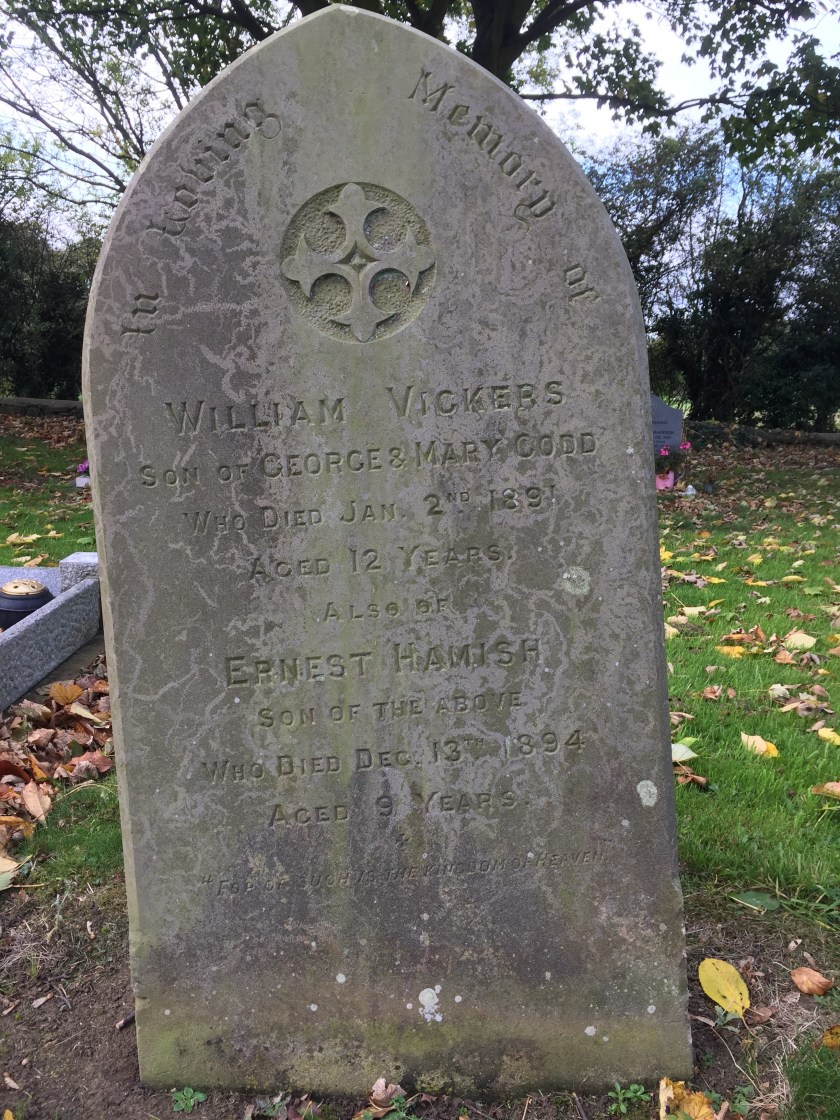
On January 2nd 1891 a 12 year old boy called William died. A little under four years later, on December 13th 1894, his brother Ernest followed suit. He was just 9 years old. You won’t have heard of them – indeed I wonder if anyone alive today remembers that either of them ever even existed. Yet a gravestone in a Lincolnshire churchyard testifies to the fact that they did – it stands in memory of the truth that once they were both very much alive. The gravestone reminded me that those I have no knowledge of were no less real for my ignorance of them. I am glad it was there for me to read.

It’s good to visit graveyards from time to time – and not just to visit the graves of those we have known and loved. It’s helpful to be reminded of the countless generations of people who have gone before us, and to remember that all have died having once lived, not so very differently to us. To forget them does not alter the reality of their once vibrant lives but, by ignoring their former existence, we are diminished ourselves.

We make a mistake if we think we are more important that those who have gone before us.
We make a mistake if we arrogantly imagine that how we see things today is inevitably so much more sophisticated than how our predecessors saw things in the past.
And we make a mistake if we forget that one day we too will die and lie forgotten by those who live on. We, and what we reckon, will be considered of little importance by the strangers who will one day walk amongst our gravestones.

A few miles away from that village churchyard is Lincoln Cathedral. There the invitation again goes out to remember more of those who have died. The heavy stone slabs confirm that death is no respecter of persons. Even the great and the good, rich enough or considered important enough to have their lives commemorated in such grand surroundings, know what it is to die tragically young. Selina Newcomen died on 15th January 1725 aged 29. Just six weeks later, on 25th February, her eight month old son, John, joined her in the grave.

A third graveyard lies within Lincoln Castle, a few hundred yards away from the cathedral. In the 19th century, the castle housed a Victorian Prison. Here the gravestones are less auspicious. Rising no more than a few inches above the ground, the stones are engraved with just the initials of the person whose grave they mark – along with the date on which they were executed. Priscilla Biggadike was hung at 9am on December 28th 1868 for the murder, three months earlier, of her husband, Richard. He had been poisoned with arsenic. She maintained her innocence right up to the point of her execution. Fourteen years later, Thomas Proctor, a lodger of the Biggadike’s at the time, confessed on his deathbed to having committed the murder. Ironically, just a stone’s throw away, Lincoln Castle holds a copy of the Magna Carta of 1215. Famously it promises to deny or delay right of justice to no one. On this occasion however, a misrepresentation of what was true ended in an awful injustice. When truth is absent, something important dies.

Discerning the truth is fundamental if right decisions are to be made, if justice is to prevail, if sensible actions are to be taken.
But for some the truth is sometimes inconvenient.

In his book ‘The Book of Laughter and Forgetting’ the Czech writer, and Nobel Laureate, Milan Kundera wrote, ‘The struggle of man against power is the struggle of memory against forgetting’. His point was that we need to fight to keep remembering what is true because there are those who would have us forget the truth, if indeed we were ever allowed to know it in the first place. Controlling what is believed to be true, controls those who believe it.

Throughout history the rich and powerful have always wanted to control what is remembered, so as to paint a version of events favourable to themselves. Some have used their wealth to buy the silence of those who know the truth, others have used their power to threaten and intimidate those who they do not want to speak. It is no different today. Hollywood has recently been rocked by the news of how one rich and powerful man sought to silence the women he assaulted by paying them large sums of money to sign ‘Non-Disclosure Agreements’ or by threatening them with career failure if they ever opened their mouth and spoke of what he had done to them.

Pharmaceutical companies are sometimes guilty of similar misrepresentations of the truth. Not only do they encourage us to interpret normality as disease, they would also have us believe that their drugs are more effective in producing satisfactory endpoints than they really are, imaginatively misrepresenting data and applying gagging clauses to those who undertake their research lest results of that research is unfavourable for the drug’s marketability.

If something is not said, it is soon forgotten, and what is not remembered is soon no longer believed – no matter how true it actually was. Truth then dies – it ceases to be important.

It is not only a version of history that powerful people want to manipulate. The notion of truth itself is something that some would like to see die – and be left with no memorial stone to mark its passing. Truth can indeed be inconvenient – it gets in the way of allowing us to do what we want. This wish, to see truth conveniently disposed of, is not a new desire – it’s been around for millennia. Nearly 2000 years ago Pontius Pilate, perhaps himself drawing on Plato, asked one who claimed to bear witness to the truth the question ‘What is truth?’ In the 19th century Friedrich Nietzche coined the term ‘Perspectivism’ and, presumably failing to notice his own internal inconsistency, asserted that ‘There are no facts, only interpretations’. And today we have so called ‘alternative facts’. Some, the rich and powerful, claim that these alternative facts, with no objective evidence to support them, have as much validity as facts that are objectively verifiable. Others just shout down, vilify and ridicule any opinion contrary to their own – ad hominem arguments being preferred to reasoned argument. The only thing that is true, it seems, is that there is no truth.

In ‘The Eighteenth Brumaire of Lois Bonaparte’, Karl Marx wrote: ‘Men make their own history; but they do not make it just as they please; they do not make it under circumstances chosen by themselves, but under circumstances directly found, given and transmitted from the past. The tradition of all the dead generations weighs like a nightmare on the brain of the living.’ Marx’s point is that nobody stands outside of history – everyone, even the most progressive of thinkers, is influenced by the particular historical context they find themselves in. The thinking of those in the past was, without doubt, not without error but we are foolish if we think it was completely false. If we try to think in new ways, without drawing on the wisdom of the past, we ourselves will make mistakes influenced as we are by the time in history we find ourselves. We will make mistakes in the conclusions we draw, different mistakes, certainly, from those that have gone before us, but mistakes none the less. Novel ideas of the nature of reality are unlikely to be reliable. Truth matters – and it is best discerned standing on the shoulders of those who have thought before us rather than dismissing that body of understanding as irrelevant and out of date and trying to start afresh. C.S. Lewis advised that at least every fourth book one reads should be from an era prior to our own. He wrote, “Every age has its own outlook. It is especially good at seeing certain truths and especially liable to make certain mistakes. We all, therefore, need the books that will correct the characteristic mistakes of our own period. And that means old books.’

And it means old ideas too. That’s why we need to remember those who have gone before us – and learn from them. Those old and long retired GPs may not be talking out dated nonsense after all. Perhaps they are wiser than we would like to think. Perhaps we should listen more attentively to the advice they might have for us. If only we would ask it of them.

But still there are those who want to redefine truth for us, and make it fit modern sensibilities. If as is sometimes said, truth is the first casualty of war, then it would seem we have a fight on our hands – that the battle has been raging for a while. We must not uncritically buy in to the spirit of the age – uncritically believe what we are told. To do so will spell disaster. If we lose the notion of truth, then what place the news? Will there be any point in switching on our televisions at 10 o’clock each evening? And what will we hear if we do?

*****

THE SWEN AT TEN – A DAILY ROUND UP OF ALL YOU NEED TO FEEL

For those who find any meaning in arbitrary concepts of time: It’s 10pm on Senseday, the 38th of Imaginary, 2084 – here are the perspectives.

Our main story tonight is the inauguration of Liarnel Thump as the new President of the renamed ‘United Provinces of the Relevant World’. President Thump takes up his position after declaring himself as the populace’s undisputed choice of leader following his claiming a 98% approval rating amongst ‘right thinking’ people. Under new legislation that states that supporting evidence is no longer required before attesting such a claim, Thump’s taking power will proceed unopposed. Outstanding criminal charges against the President will not be considered since, as there is no such thing as right and wrong, crime is no longer considered a meaningful concept in a progressive society such as the UPRW. Those who have accused Mr Thump of ‘violating their personal space’ have been instructed to ‘feel differently about it’. Furthermore since it has long been felt by those in power that only the powerful can lawfully own property, those who assert that they have such a thing as personal space are open to a charge of larceny since they have no right to deny any space, personal or otherwise, from others. Legal teams are considering how ‘the unimportant’ might be charged with wrong doing in a blame free society where the concept of wrong is not recognised. Early indications are that the poor, the weak and the easily oppressed will be made exempt from immunity to prosecution to ensure the smooth running of society for those of significance. Similarly mental illness will no longer be acceptable. In a society that is deemed entertainment rich and where a fun filled future is considered guaranteed, low mood and anxiety will be classified as deviant emotions and those displaying such unhelpful and negative attitudes of mind will be subject to incarceration.

Former Prime Minister, Tony Blah, renewing his role as an envoy for peace today urged the government to support military action in response to the alleged chemical attack in Syria. He said people needed to remember that, just because no evidence was ever found that Saddam Hussein had weapons of mass destruction, it didn’t alter the fact that he undoubtedly had the capacity to launch a nuclear attack on western targets within 45 minutes. Meanwhile President Putout maintained that no chemical attack ever took place in Syria and the very idea that it did was as ridiculous a notion as Russia ever using chemical agents against its own citizens. ‘Besides’, Putout added reassuringly, ‘believe me when I say to you, you know we Russians love our children too.’

Health news. Jeremy Stunt has promised to deal decisively with the fact that lazy overpaid doctors are the cause of the undeniably high mortality that inevitably befalls those who are admitted to hospital on a Sunday. With the news that 53% of those who merely visit patients at the weekends are now injured by doctors larking about on the wards, Stunt announced that he would act with the same care and diligence he applies to his personal financial concerns to ensure doctors would work longer hours for less pay. He also confirmed that 5000 new family doctors would be available a week next Thursday.

Dr Frank Trueman’s appeal at the National Court of Personal Opinion came to a premature close this morning when the former family ‘doctor’ refused to swear, on a copy of Judge Expedient’s Shopping List, to tell the post truth, the whole post truth and nothing but the post truth. The guilty verdicts passed against him for having exhibited Unlove and behaving in an Unaffirming manner therefore remain. Last month Dr Trueman was found guilty of these crimes by a jury of his more enlightened when he insisted that Twiggy Silthlike was dangerously underweight and should be refused the bariatric surgery that she, believing herself to be obese, desired and, therefore, demanded as her human right. The court had agreed that Miss Silthlike had suffered great harm from Dr Trueman’s assertions and agreed with her view that to be defined by her BMI of 15.4 was ‘personally limiting’. The court further agreed that her belief that she was overweight was one that she had an inalienable right to hold. ‘I will not allow my nutritional status to be determined on an arbitrary mathematical calculation related to my height and weight’ Miss Silthlike had said in a statement whispered from her bed of restricted consciousness at the initial hearing six weeks ago. Leading surgeon, Mr Dai Cutting, who subsequently performed the stomach bypass surgery, said he was proud to have acceded to his patients wishes and had no regrets over the consequences that had resulted from the procedure. Speaking on Miss Silthlike’s behalf, the family lawyer assured the public that, although her parents had been upset by suggestions that Twiggy’s failure to attend the hearing in person indicated that she may now be biologically challenged, they were comforted that Twiggy had previously stated that she would never desist from identifying as ‘alive’. Dr Tom Foolery, Chair of the National College for General Acquiescers, distanced the professional body from the beliefs of Dr Trueman. He assured the public that today’s young GAs were trained to wholeheartedly agree with their clients ideas, to reassure them that all their concerns are unfounded and to completely meet their every expectation.

In other health related stories, the annual conference of those with a Chronic Obstructive Pulmonary Disposition took place today. It was described by those attending the event as a wonderful coming together of those on a journey of discovery seeking out the benefits inherent in living with alternative lung functionality. Hundreds packed the Assembly Rooms in Battersea to hear Toby Acco, self-appointed Professor of Respiratory Medicine at Neverton University, deliver the keynote address entitled ‘How to be happy with your haemoptysis’. Delegates then coughed, spluttered and wheezed their way through motions seeking to redress the balance resulting from the negative reporting of the consequences of smoking in years gone by. On hearing that no studies in the last thirty years had shown an association between COPDisp and cigarette consumption, a prankster, who had managed to slip past security, asked if this might be because ethical approval for such studies had not been granted in recent times for fear of upsetting smokers were a link to be proven. The question remained unanswered as the imposter was escorted from the hall. Outside the venue, a small gathering of the far right ‘Smoking may not be 100% good for you Party’ demonstrated. As she was dragged from the scene by police, one militant said that she was just a little concerned that, what with all the oxygen cylinders on display, the constant stopping to light cigarettes may pose a risk, not only to those who were smoking but also to those pushing the wheelchairs to the specially designated ‘Fume Rich Spaces’ that had been constructed for the use of those attending and provided by the pharmaceutical company, Gloxo who, along with their sister company, Cigarettes-R-Us, have been stalwart supporters of the conference for many years. A spokesman from London Fire Service dismissed the concerns of the protestors as trivial compared to the dangers inherent in denying an individual the right to do as they jolly well pleased and said that the bigotry displayed by those remonstrating had no place in modern Britain.

The Science Society of Camford Univeristy has been expelled from membership of the leading university’s Student Union. The Society has a reputation for insisting on reasoned argument and the application of logic as a basis for seeking to understand the universe. President of the Student Union, La La Littlethought, stated that such old fashioned views were no longer accepted in advanced institutes of education especially one with such an excellent reputation as Camford. The Science Society had been allowed representation at the Freshers Fair but only if they were prepared to share a stand alongside other organisations holding outmoded outlooks on life. Ms Littlethought confirmed that since The Science Society had felt unable to share space with The Flat Earth Society, and had therefore absented themselves from the event, they could no longer be considered a university approved organisation. A statement released by the Student’s Union press office concluded, ‘It’s such a shame that members of Science Society can’t accept that theirs is just one of many equally valid ways weak minded people choose to look at the world. They ought to consider homeopathy.’

Sport – and it’s now only three weeks till the Olympic Games. This will be the third games to be played since it was universally agreed by members of the International Olympic Committee that competitive sports are unhealthy pastimes since taking part in such activities can encourage the deluded belief that some people are better at some things than others. The IOC have announced that there will be a new event taking place at these games with ‘Watching grass grow’ being introduced alongside the already very popular ‘Waiting for paint to dry’ and ‘Considering one’s navel’. Tickets are still available for all three events. The IOC reassured the public that they were not planning the reintroduction of medals at the forthcoming games since it was felt that to reward one person’s performance over another would go against the fundamental Olympic principal that everybody is equal at everything. It was confirmed however that certificates of attendance would be issued to all participants along with a complete set of commemorative fridge magnets.

Australia have been awarded the cricket fair play award.

In entertainment news, Greenwood Studies have announced that a film version of the popular TV series ‘The Y Files’ is to begin production in the New Year. Who will play investigators Mully and Sculder in this new feature length version has yet to be announced but the producers have confirmed the tag line for the movie remains, as for the television show, ‘The truth is in You’.

This week’s National Referendum Result – after 27 years of being rerun weekly, today’s referendum has finally yielded a result in which a majority of the 13 people who voted elected that day should no longer follow night. The government confirmed that there would be no further referenda on the matter and that they would now act to enforce the new policy as soon as possible. Verity Doubtful is favourite to chair the cabinet committee responsible for implementation after her successfully delivering the ‘Black is White’ initiative last year.

And finally this evening, extreme weather has left vast areas of Bangladesh under water. Tens of thousands are dead and millions are without food and shelter. Some are suggesting that this is a false news story and of course Bangladesh is only a third world country but still, let’s keep our fingers crossed, bless them.

*****

Truth matters. When everybody decides on their own version of what is true based on nothing but what we feel on a matter, no opinion can be challenged as wrong and we all make ourselves out to be gods. It is inherently self-centred and sooner or later we will insist on others dancing to our tune. Society becomes fractured and directionless as no common values are held to be true by all and no distinction exists between the trivial and the important. The result is that those who are rich and powerful, those who can impose their version of reality on others most effectively, become tyrants with no means of being restrained.

The struggle today is to remember that some things are true and some things are not – no matter what the wisdom of the world tries to buy or bully us into believing. But it’s more than that – truth doesn’t need to be just remembered, it’s needs to be upheld. The notion that there is no such thing as truth, has survived infancy, made it to adulthood and is now enjoying comfortable middle age. Perhaps we can’t know everything fully, but some things we do fully know – and certainly more fully than is sometimes claimed. The truth is out there.

This is particularly true for doctors. We need to take responsibility for determining, as far as is possible from our training and experience what is true and relaying this honestly to our patients – even when that truth is unpopular with our patients or indeed inconvenient to ourselves. Of course there will be occasions when there are differences of opinion and when these occur they will have to be resolved honestly, and amicably, based on a thorough assessment of the available evidence. And it’s not only in our dealings with patients that we need to stand up for the truth – we also need to stand up to our political leaders. We need to ensure that no one believes the false reports of what underlies the current crises in the NHS – reports that some are perpetuating as they seek the demise of this much loved institution.

As professionals we have responsibilities to act professionally – we must speak the truth. If we are not known to be truthful, we cannot expect to be trusted. And when trust is lost the profession falls.

It was Aeschylus who wrote ‘In war, truth is the first casualty’. We live in a day when truth is under fire, when contrary opinion is ridiculed and reasoned argument is silenced with a raising of an angry voice and a dismissive wave of the hand. Truth must not die and become something that only once existed – an idea that is fondly remembered. We need to take care of truth, seek it out and visit it often. We need to nurture it and allow it to flourish. And we need to speak truth too. Because the truth, like a young life, is precious. And precious things are worth holding on to.

I sat in another churchyard – on a bench placed there a decade or so ago in memory of a girl in her early teens who had died. She had been killed when a driver, his judgement impaired by alcohol, had recklessly raced his car at excessive speeds and hit her whilst she walked home from the park one Sunday afternoon. It was a criminally stupid act with tragic consequences. In front of me was her grave. On it were some fresh flowers. I’m glad somebody remembers her – but I wish she’d never died at all.

WHEN THE GOING GETS TOUGH, WHAT ABOUT THOSE WHO DON’T FEEL TOUGH ENOUGH TO KEEP ON GOING?

I hope you’ll bear with me for a while but, I wasn’t born yesterday, I know you’ve a lot on and this is a little on the long side.

Recently I watched the BBC adaptation of ‘Little Women’. Despite the fact that it wasn’t the kind of programme I would naturally be drawn to, I enjoyed it and found it genuinely moving. Let’s just say, on a number of occasions I found myself affected by what I can only assume was a speck of dust in my eye. Watching it I was struck by the ability that the characters had to bear great hardship. On several occasions in the story, there were those who spoke of having to simply bear, together, the trials their were experiencing – trials that included the anxiety of having a relative away at war, the pain of experiencing a debilitating illness and the sorrow of having to look on powerlessly as a loved one died. Though only a story, this ability to accept suffering, and bear it together, has a place in real life too.

I wonder, however, if today we have lost our ability to bear with suffering, to sometimes simply endure what life throws at us. We have, perhaps, come to assume that we have a right to comfort and ease and, when that dream falters, have become accustomed to the NHS, and others, always being there to rush to our aid. We may even have foolishly developed the notion that there is no limit to the help that can be provided – that no problem needs to be put up with. If we have come to believe this however, we are deluded. If one thing in life is certain, it is that, to a greater or lesser extent, hard times will come to us all. And sometimes there is no earthly solution to the difficulties we face. Sometimes they simply have to be endured – maybe for weeks, maybe for years. Sometimes the pain just has to be borne.

In his book ‘The Uses of Pessimism and the Danger of False Hope’, Roger Scruton warns against what he calls ‘The best case fallacy’, the illusion that we are prone to believe that progress will inevitably bring about a future state of affairs when all will be well. ‘There is’, he writes, ‘a kind of addiction to unreality that informs the most destructive forms of optimism: a desire to cross out reality…and to replace it with a system of compliant illusions.’ Scruton advises that we act as a ‘scrupulous optimist’ might. Alongside other characteristics, Scruton suggests that a scrupulous optimist ‘knows the uses of pessimism’, that conscious awareness that things may well go wrong, and that we ‘live in a world of constraints’. Scrupulous optimists, he says, ‘like all rational beings’ take risks ‘as part of their desire to improve things’ but do so ‘always counting the cost of failure and evaluating the worst case scenario.’ They know that things sometimes go wrong and that they and those around them are limited.

Both those who are ill and those working in the health service to support them in their sickness need to have this healthy dose of pessimism. We aren’t always as tough as we would like to be and we can’t always assume that we’ll be able to cope. Simply demanding that we, or others, be more resilient, is not always either helpful or realistic. Demanding that we be more resilient can even add to our burden. When the problems really are too much, beyond what any of us can cope with, it’s OK to find ourselves broken and awash with tears. On those occasions we may simply have to bear the pain – and it won’t be pleasant.

Sometimes the problems are too many for even the most capable
Sometimes the problems are too complex for even the most wise.
Sometimes the problems are too heavy for even the most strong.

Every now and then a day will inevitably come along which is just too much – when the demands put upon us exceed that with which we are able to cope. Our best efforts to meet the overwhelming need drains us of every ounce of energy we posses. Sometimes we can be so overwhelmed that it can feel that our inability to deliver the impossible reflects negatively on us, that our failure to solve every problem suggests some moral failure on our part. But we need not feel like this. There is no shame in being asked for more than we have and only being able to give all that we’ve got. We are, after all, only human.

We’re not all #NHSsnowHeroes. Some of us didn’t have 4x4s with which to brave the roads, some of us didn’t walk 20 miles to work, and some of us didn’t work additional hours because we simply couldn’t. I am genuinely grateful for those who did but we must not berate ourselves for not doing what we could not. To make the mistake of thinking we can meet every need will only crush us more. We do not help ourselves by being that foolish.

We need to be more realistic, we need to be those ‘scrupulous optimists’. Of course the demands of all our jobs are often overwhelming and the recent flu epidemic and now this bad weather has made things harder still. When the calls for help from those who are sick just keep on coming, those in health care ought not be surprised that there are days when it is all too much. Sometimes that is simply the way that it is, the nature of the job – the nature, even, of existence. Whilst we might bemoan the actions of others, and let’s face it we’re all good at that, it is not always someone else’s fault that our day has been hard. Though their actions have not always helped, and not denying that we should press for change in how the NHS is run, not even the government is wholly responsible for the struggles the NHS is currently facing. We need to accept that sometimes, in the midst of a flu epidemic or in atrocious weather for example, the job of health care professionals will, as a consequence, be significantly harder. And whilst not encouraging a resigned fatalism, we need to accept that when it is, that harder time will have to be borne for a while, not only by those in the NHS but also by society as a whole. Complaining about it today won’t help anyone. On the contrary, what will help today is if we bear the problem together. Blaming others only serves to isolate us at the very time we need others alongside us.

Though it may cost us to do so, we need to support one another especially those who find the struggle hardest. That includes patents but also those with whom we work alongside. We must not demand that they are superhuman. If we aren’t very careful, exalting #NHSsnowheroes will become a new way of our playing an old game – that of playing God. Some of us aren’t always as resilient as we’d like to be, and when we aren’t we may be the ones who struggle the hardest and need help. I am fortunate to work in a practice where that support is found and I am grateful to all those I work with that that is the case. I am grateful that there are those who help me: other doctors, nurses, reception, admin and managerial staff – even patients, who for the most part appreciate the pressures the NHS is under – we’re all in it together. Sometimes I help others, sometimes others help me.

Medicine is a wonderful thing. It can ease many burdens – but not all. Like those who practice it, it has its limitations and will never bring about a world where sickness and death is no more. I am not suggesting that medicine should therefore stop trying to find new ways of alleviating suffering but none the less, it must maintain that healthy dose of pessimism that reflects the reality that not every need can be met, that nobody lives for ever. Doctors also need that healthy dose of pessimism. Sometimes we should go the extra mile but we mustn’t lose sight of our limitations, our inability to meet impossible demand and that even despite our best efforts, some of those who get sick will have bad outcomes..

Furthermore doctors need to be wise enough to know that sometimes the kindest thing that we can do is stop striving for a cure and not burden a patient more by constantly demanding that they get better. Sometimes, when there is no longer any earthly solution to sickness and disease, when medicine has reached its limit, we mustn’t be afraid to acknowledge our weakness and our inability to help as we would like. Even so, as we look on and watch our patients, even our friends and family, suffer and die, we will do well if we can still bear with them in their suffering, if we can share in their sadness and ‘weep with those who weep’.

So when the going gets tough, what about those who don’t feel tough enough to keep going? What about those who lack, for now at least, the necessary resilience? Do we demand they toughen up as we regale them of the superhuman efforts of the strong? No. Instead we pick them up and carry them just as far as we can because those who are overwhelmed by the avalanche of need are no less worth carrying than those who are sick.

I wasn’t born yesterday – but I may need to be borne tomorrow.
And when one day I am too heavy to bear – and that day will surely come – lay me down and, if you can, please bear with me a while longer. And I’ll try to do the same for you.
Because bearing things alone would be truly unbearable.

JUST IN CASE MEDICINE – THE DANGERS OF PRACTISING DEFENSIVELY

Children don’t die. Not in this country, not in this day and age. Or so we’d like to think. So when, tragically, a six year old does die, society is unsettled and needs to be reassured. Blame must be apportioned and those responsible must be punished and removed in order that the public’s misplaced confidence that nothing bad will ever happen can be restored.

Being a professional is to deal with uncertainty, to apply knowledge and wisdom in complex, never before experienced situations, to do what seems best in less than ideal circumstances. And that’s hard – mistakes will sometimes be made – bad things will sometimes happen. To need professionals is to acknowledge the uncomfortable truth that life, and death, is uncertain. And so there are those who would like to see the end of professionals, to have them replaced by an ever increasing barrage of rules and regulations, protocols and proformas, in the misguided belief that certainty exists, that what needs to be done is always clear, that a good outcome can be guaranteed for all.

Much has been written recently regarding the Hadiza Bawa-Garba case and not all of it has been sensitively handled. In all of our reflections on what has taken place we must not forget that at the very centre of all this are parents grieving a much loved son. Regardless of how uncomfortable we may feel about how a doctor has been treated we mustn’t forget who has lost most. Though I’m sure such is never intended, none of the battles we rightly feel compelled to fight should suggest in any way that the blame for doctors having problems lies with patients who are inconsiderate enough to become ill. Patients are not the enemy – we must not forget to show compassion to those who are hurting the most.

The response of some to recent events is that if doctors are to survive in what many perceive to be an increasingly hostile professional world, one in which doctors feel unsupported by the likes of the GMC, then they have no option other than to practise defensive medicine, that is ‘medical intervention without clinical indication to safeguard the doctors interests’. Recently I have read of those who openly admit to having admitted patients they wouldn’t have previously, just in case, for fear of some comeback on themselves were something to go wrong.

But to assert that practising defensive medicine is the answer is, I believe, a mistake. Such practise is bad for patients, bad for the NHS and bad for the medical profession as a whole.

Defensive medicine is bad for patients since, as well as being frequently inconvenient and often financially costly, it exposes them to unnecessary investigations which are themselves not without risk. Furthermore, defensive medicine burdens patients with unnecessary anxiety since, out of a doctor’s unwillingness to carry any anxiety his or herself, he or she is reluctant to give patients the appropriate reassurance they need.

Defensive medicine is bad for an NHS which can ill afford the expense of inappropriate referrals both in financial terms but also in respect to an already overstretched workforce. Ironically, to practise defensively and admit patients ‘just in case’ serves only to stretch still further our hospital colleagues with whom we say we sympathise and thereby add to the very set of circumstances that increase the likelihood of the errors that brought about in the first place the tragic circumstances that we were all recently debating. Never mind “#IamHadiza”, practise defensive medicine and we might as well tweet “#NotmyproblemHadiza”.

And defensive medicine is bad for the medical profession itself since to practise so is to practise unprofessionally. Being a doctor isn’t easy. To be clear, we all need to acknowledge our uncertainties and make decisions accordingly. We need to be conscious of how confident we feel at work and how the level of that confidence can fluctuate over time. When we are feeling confident and imagine we have finally mastered being a doctor, we need to be careful that we aren’t overly cavalier with our patients’ well being. And when we are feeling less confident and imagine we will never be able to convince anyone that we are really a doctor at all, we need to acknowledge that we may sometimes investigate, refer or admit patients more that we might have otherwise. Furthermore we need to accept that this is part of being a doctor, part of what it takes to remain in practice for 30 years rather than burning out with the stress of it all within six months. So of course there will be times when, because of our own limitations, we investigate, refer and admit that which in time it emerges we need not have. But that is not practising defensively – rather that is practising responsibly, something we should all be doing. Practising defensively is different to that in that its primary concern is the doctors welfare – it is the ultimate in being doctor centred. Like it or not, part of what it means to be professional is to be patient centred, to put our patients welfare before our own.

Thinking only of ourselves and not being willing to make a professional judgment, not being willing to do what’s best for our patients, not being willing to do what seems wise based on our years of training and experience, reduces us to the likes of the 111 protocols we so often delight to criticise and thus only serves to suggest that we are surplus to requirements.. Practising defensive medicine dehumanises us and plays into the very hands of those who would undermine the need for professionals at all.

In short, practising defensive medicine is dangerous.

.

DO WE CARE ABOUT SADNESS?

‘All men seek happiness, this is without exception’. So wrote Blaise Pascal in his Pensées. But despite his assertion, and our best efforts, too many of us, it seems, find only sadness.

The causes are many, but can perhaps be divided into the grief felt for the thing which is lost – the broken relationship, the missed opportunity, the faded dream – and the sorrow resulting from the fear that the future will bring no relief – the loss of hope itself. As C.S. Lewis wrote after the death of his wife, ‘I not only live each endless day in grief, but live each day thinking about living each day in grief’.

Undoubtedly some of our sadness is of our own making. Ovid, somewhat ungraciously, for surely we all make mistakes, once said that ‘What is deservedly suffered must be borne with calmness.’ Perhaps so, but that is, none the less, easier said than done. ‘But when the pain is unmerited’, Ovid continued, ‘the grief is resistless’.

Regardless then of the reasons for it, sorrow has the capacity to overwhelm us.

Despite the joys that are undoubtedly present, this is often a sad world, frequently a vale of tears. And regardless of the cause, the sorrow of sadness hurts. Frequently that pain, for want of anywhere else to take it, is brought to the GP. Without doubt, there is a lot of it about, and it cannot easily be dismissed with the psychological equivalent of ‘it’s probably a virus’ and a facile assurance that the feeling will soon pass.

What then are we to do?

First we need to make the right diagnosis – we need to distinguish normal sadness from pathological depression. The former, I believe, is by far the more common. And having made our diagnosis, we need to resist the temptation to medicalise normality, even if by presenting it to the GP, the person in front of us has themselves sought out a medical solution to their distress.

It’s then that we need to be truly general practitioners, super generalists even. In fact we need to be so general that we are not medical at all, since it is then that the labels of ‘doctor’ and ‘patient’ become barriers to what we really need to be – simply human.

Of course we all want to help and we may understandably want to offer what only we as medics can, namely medication – but to do so tells the patient they are wrong to feel the way they do, that their sadness is inappropriate when, in truth, it is nothing of the sort.

There is, perhaps, a better, though less comfortable remedy. We need to understand the sadness – even if we cannot fully explain it. Having recognised the normality of the sorrow ourselves, the sad patient in front of us needs to be helped to see the normality of their feelings too.

To those who are new to sadness this may come as a shock, especially in the entertainment rich and superficially upbeat culture we inhabit. Abraham Lincoln commented that ‘In this sad world of ours, sorrow comes to all; and, to the young, it comes with bitterest agony, because it takes them unawares.’ Rather depressingly, but perhaps accurately for some at least, Lincoln continued with, ‘The older have learned to ever expect it.’

I once met a patient who had joined my practice when her the one she had previously attended closed down. She came with a diagnosis of bipolar and was taking high doses of quetiapine and an SARI. I asked her what had happened to make her how she was and she told me a long story of physical and emotional abuse at the hands of her first husband. After listening while, I told her I didn’t think she was bipolar, that rather than having a disorder, her emotions were simply the normal response to her distress.

The woman said that I was the first person who had told her that she wasn’t mad to feel the way she did – something which she greatly appreciated. And over the following six months we stopped all her medication without any ill effect.

To acknowledge the normality of sadness is not to deny the intensity of the suffering – because it’s normal doesn’t make it any less awful. But only having acknowledged its normality can we truly accept the sadness, and allow the grief to be expressed without trying to explain it away.

After all, you can’t rationalise away that which is not irrational.

We like to solve problems – to ease suffering. But sometimes their is no pill to take away the distress, no wise insight that will alleviate the pain of sadness. To pretend otherwise is untruthful, unhelpful and unkind. As physical pain alerts us to something being wrong and indicates action must be taken, so too emotional pain can serve a similar purpose. Denying its normality, denying its usefulness, removes all hope of ever addressing it’s cause.

But sometimes, of course, the cause can’t be addressed – because there is no earthly solution, there is no going back, no doing things differently next time. Sometimes not even time will help. Sometimes the pain of sadness may go on and on.

In such circumstances we may well feel useless, but that’s not necessarily so. Knowing our inadequacy allows us to stop being doctors who can’t help, and allows us to become people who can – by entering a little into the grief of those with whom we sit. It’s good to share their sorrow, it’s helpful to ‘weep with those who weep’, because being alone in one’s sadness is too great a burden for anyone to bear

In ‘Out of Solitude’, Henri Nouwen wrote: ,

“When we honestly ask ourselves which persons in our lives mean the most to us, we often find that it is those who, instead of giving advice, solutions, or cures, have chosen rather to share our pain and touch our wounds with a warm and tender hand. The friend who can be silent with us in a moment of despair or confusion, who can stay with us in an hour of grief and bereavement, who can tolerate not knowing, not curing, not healing and face with us the reality of our powerlessness, that is a friend who cares.”

And perhaps that is exactly the type of GP who cares too.

AFTERWORD:

I wrote the above eight years ago when involved with somebody who was, back then, already experiencing a period of prolonged personal sadness – a sadness that continues today. Some of us may be familiar with the words of the psalmist who wrote, ‘Weeping may tarry for the night but joy comes in the morning’. I don’t doubt the truth of these words but the night for some has already been very long and the day still seemingly remains an eternity away.

Elsewhere in those ancient writings are chronicled the trials of Job, and the ineffectual efforts of his comforters who needed to learn what we too must appreciate – that sometimes it is best to simply ‘weep with those who weep’ rather than to try to argue the miserable out of their sadness or, worse still, point out the mistakes we think they have made to bring about their misery. Regardless of whether we believe in God, I think we can agree that there is wisdom here.

Regret and sadness have much in common. In my first year as a GP Principal I recall visiting a patient who had had severe diarrhoea and vomiting for a few days. He was sufficiently dehydrated to require admission and I requested an ambulance to attend within the hour. There was, uncharacteristically for those days, some delay in the ambulance attending, and sadly the patient suffered a cardiac arrest and died on route to hospital.

The next day I chatted to my partners about the case. All were supportive and quick to point out that I had acted appropriately, that, if anyone, the ambulance service was at fault and that the outcome would not have been any different even if the ambulance had attended earlier.

But the response that helped me most was that of my senior partner who simply acknowledged that it was tough when things went wrong and related an incident when he regretted a judgement he’d made some years previously. That such an experienced and respected GP could ‘regret with those who regret” was very comforting for me.

more recently still, I came across this quote:

‘Good judgment comes from experience. And experience? Well that comes from bad judgment.’.

It’s a humorous saying but not without some inherent truth. If we consider the sense of the two statements with a degree of logic we get the following syllogism: ‘If the avoidance of mistakes comes from experience, and experience comes from making mistakes, then the making of mistakes is necessary to gain the experience to avoid mistakes.’

Now I am aware that there are some flaws in both initial statements, the avoidance of mistakes doesn’t only come from experience, and experience doesn’t only come from making mistakes, but for all that, since we are all flawed individuals, I think it remains the case that we learn much from our inevitable mistakes – mistakes that are maybe even necessary to make us more experienced and thereby better doctors. Experience comes over time so older doctors perhaps know this best – and know too what it is to experience the associated regret. Like Lincoln suggested of sadness, so older doctors have perhaps come ever to expect regret.

And if mistakes and regret are an inevitable but necessary part of being a doctor, then perhaps sadness is an equally inevitable and necessary part of being human. If mistakes and regret make us better doctors, maybe then sadness has the capacity to make us better people.

Perhaps wisdom is acknowledging this to be the case and, rather than trying to always avoid it or rationalise it away. learning to accept that life is sad.

If so, I wish I were that wise.

THE ABOLITION OF GENERAL PRACTICE

Aristotle had it right when he asserted in his ‘Metaphysics’ that ‘Those who wish to succeed must ask the right preliminary question’. More than 2000 years later, doctors would do well to listen to his advice. Before adopting each and every new advance that claims to be good for our patients, we should ask what we are hoping to achieve by following such recommendations. And we ought to consider whether the answer we come up with tallies with what I would propose might, in Aristotle’s eyes, be a good preliminary question to ask ourselves: ‘What do good doctors do?’

In ‘The Abolition of Man’, C.S. Lewis had some interesting things to say about how the focus of what science seeks to do has changed over time. Whereas once ‘wise men of old’ sought knowledge in order to understand how humankind conformed to reality, Lewis suggested that for science the problem had become ‘how to subdue reality to the wishes of men’. Furthermore he contended that there were dangers inherent in such an ambition. He realised that it would be those with power who would impose their wishes on the weak and maintained that any attempt to subdue reality to the wishes of the powerful would require nature to be conquered in order that it conformed to their desires. That, he said, would require a reducing of all of nature to nothing but it’s component parts, denying anything beyond the merely physical and quantifying everything only in terms of what we can measure. Lewis believed that, since humanity is itself a part of nature, this diminishing of the whole would ultimately diminish humanity and bring about what he called the ‘abolition of man’.

So what of medicine today? Does it also seek to go beyond trying to help patients face what nature throws at them and seek to conform nature to what is deemed desirable for our patients? And if so, is the result a diminishing of what it means to be human – are people reduced to being defined merely in terms of their medical parameters? Is medicine undermining what it is to be alive?

If the answers to any of these questions is ‘Yes’, the route cause may be that we doctors have lost sight of what our purpose really is. We have forgotten to ask ourselves the right preliminary question.

The NHS came into existence in 1948 based on William Beveridge’s 1942 report urging universal access to health care. This was accompanied by a belief that the state should provide social security ‘from the cradle to the grave’. Inherent then, at the inception of the NHS, was a belief that, though every effort should be made to fight disease and promote health, the grave awaited us all, death was an inevitable reality. In the early days of the NHS therefore, alongside social reformers who developed polices to reduce the risk of disease, the wise doctors of old practised medicine for a population of people with disease whilst never forgetting that death remained a reality that could not be ignored. That was what wise doctors did. But having forgotten this we have moved beyond this worthy endeavour and foolishly sought to employ medicine to subdue reality to mankind’s wishes. A moment’s thought will bring to mind a number of ways in which medicine has tried to do this and it will be all too apparent that this has often required the reducing of humans to nothing more than their component parts.

Take for example, perhaps man greatest desire, the wish to live happily forever after. Even though for medicine to deliver this is the stuff of fairy tales, medicine has, none the less, attempted to subdue the reality of death and unhappiness. No longer content to busy ourselves caring for the sick we now, in the name of promoting immortality, label the healthy ill. Those we consult with may never have felt so well but we tell them they have borderline hypertension, that their cholesterol is on the high side, and to top it all that they have pre diabetes. We tell them they should worry. We tell them they might die. Defining them in terms of unfavourable health indices, we then exhort them to take our medications with all their side effects and demand that they behave in ways they would not otherwise chose.

And if they fail to be happy, if they become anxious or sad, we try to convince them that their feelings are not really their own, that they have not experienced a genuine emotion but rather a conditioned response to the levels of serotonin floating around their biological system. And that there’s a pill for that too.

Slowly but surely, people become patients who, rather than being enabled to live well, are reduced to little more than automaton whose only concern is nothing more than to avoid death and feel pleasure. They are made to worry over what is normal and become dependent on medicine to solve the problems that they do not have. Their lives are diminished by the pursuit of what we have told them they should desire most.

Lewis, it seems, was right. But it’s not just our patients who are at risk. If we in primary care forget what it is we do and capitulate to those in power who seek to impose their ideas on how we practise medicine, if we buy in to their vision and are reduced to only being interested in what can be measured, if we spend our time frantically generating the data they demand, then we will no longer be the doctors we once were, the doctors we always wanted to be.

‘What do good doctors do?’ It’s a question we must urgently ask ourselves lest the answer become that we silently watch over the abolition of general practice.

Toward maintaining a more compassionate resilience

HAPPY TO HELP: STRENGTHENING OUR RESILIENCE BY SAYING NO TO DEFENSIVE MEDICINE.

Shortly before my grandfather died we covered his back with lard.
After that he went down hill very fast.

So quipped Milton Jones. Doctors joke about death and have long had a reputation for subverting the pressures of their job with black humour, laughing together to cope with what work throws at them. But I wonder if, rather than laughing amongst ourselves, an even better defence would be to connect with our patients and enjoy sharing the humour with them. Recently I have had the pleasure of laughing with patients over a couple of malapropisms. Firstly there was the lady who was concerned that one of her nipples was more extroverted than the other. What did she mean? Did it keep embarrassing itself at parties? And then there was the patient who didn’t feel her thrush was improving with the vaginal patisserie she was using. Now I’m all for patients seeking medical advice from a local pharmacist, but deciding to approach the local pastry chef for guidance always seemed to me like a half baked plan.

Of course not all that life presents to us as GPs can be so easily laughed about. I have been a partner in my practice now for a little over 21 years and can’t remember a busier, more demanding time than the past few months. A measure of resilience has never been more necessary. The pressures on us are huge because, as well as the tidal wave of genuine need, we are all sometimes asked to do things that are not strictly our job. At times our response can be that, if we are to survive in what seems to be an increasingly hostile professional world, then, in the name of a hard resilience, we have no option other than to practise a form of defensive medicine that puts up barriers between ourselves and those in need. This can be manifested in a resistance to take on any work that is not strictly ours, covering our backs by investigating and referring more than is necessary, and generally passing onto others as much responsibility as we can. In addition we can sometimes fail to be gracious to both those who ask of us anything that we feel they shouldn’t, and those who have disappointed us in the past, regardless of their actions in the present. Our secondary care colleagues, rather than being those we look to help and support, can all too easily be viewed as the enemy to be repelled. And vice versa, thereby creating a disastrous divide between primary and secondary care. Likewise, we can also sometimes feel that the patients are the enemy but, as with secondary care, we would do well to view our interactions with them as collaborative rather than antagonistic. Such misdirected attribution of hostility is all the more likely if we fail to acknowledge that the real enemies driving the demands upon us are the causes, and the ’causes of the causes’, of the ever more broken society in which we live.

Resilience though should be soft. It is the ability to spring back from difficulties, not a becoming so hard that nothing ever hurts you, or so insensitive that nothing ever stirs you enough to want to help. We must not allow our attempts at resilience to result in our losing all our compassion for those who come to us in need.

Of course the expectations imposed on us are sometimes far beyond what is reasonable and requests that are clearly inappropriate should be resisted – for example, a request to assess a prematurely discharged, acutely unwell patient’s ongoing oxygen needs comes readily to mind. But sometimes we are best placed and could help meet a need that is not strictly ours to meet, a blood test here perhaps, a prescription there and, yes, sometimes more complex matters. This, I know, will divide opinion and I do appreciate why some will, no doubt, disagree and advocate a hard resilience. None the less, to assert that practising defensive medicine is the answer to the overwhelming demand upon us is, to my mind at least, a mistake. Such practise is, I believe, bad for patients, bad for the NHS and bad for the medical profession as a whole. And, counterintuitively perhaps, I think defensive medicine is bad for us too since it reduces our own capacity to build resilience.

Firstly then, defensive medicine is bad for patients because, as well as being frequently both inconvenient and financially costly for them, it also exposes patients to unnecessary investigations and treatments which are themselves not without risk. Furthermore, defensive medicine burdens patients with unnecessary anxiety since, out of our unwillingness to carry the anxiety ourselves, we become reluctant to give patients the appropriate reassurance they need.

Defensive medicine is bad for an NHS which can ill afford the expense of inappropriate referrals both in terms of finances but also in respect to an already overstretched workforce. Ironically, to practise defensively, by admitting or referring patients ‘just in case’ whilst indiscriminately batting away requests from secondary care, serves only to stretch still further our hospital colleagues with whom we say we sympathise. We may all have commendably signed petitions supporting Hadiza Bawa-Garba but such defensive behaviour only adds to the very set of circumstances that increase the likelihood of the errors of that tragic case being repeated. Never mind “#IamHadiza”, practise defensive medicine and we might as well tweet “#NotmyproblemHadiza”.

And defensive medicine is bad for the medical profession itself since to practise so is to practise unprofessionally. Acting professionally as a doctor isn’t easy. It is to deal with uncertainty, to apply knowledge and wisdom in complex, never before experienced situations, to do what seems best in less than ideal circumstances. And that’s hard – mistakes will sometimes be made, bad things will sometimes happen. To need professionals is to acknowledge the uncomfortable truth that life, and death, is uncertain. There are those who would like to see the end of professionals, to have them replaced by an ever increasing barrage of rules and regulations, protocols and proformas, all in the misguided belief that somehow certainty exists, that what needs to be done is always clear and that a good outcome can be guaranteed for all. Thinking only of ourselves and not being willing to make a professional judgment, not being willing to do what’s best for our patients, to do what seems wise based on our years of training and experience, reduces us to the likes of the 111 protocols we so often delight to criticise and thus only serves to suggest that we ourselves are surplus to requirements. Practising defensive medicine dehumanises us and plays into the very hands of those who would undermine the need for professionals at all.

To be clear, we all need to acknowledge our uncertainties and make decisions accordingly. We need to be conscious of how confident we are feeling at work, aware of how the level of that confidence can fluctuate over time and how our practice is consequently affected. Sometimes we may imagine we have finally mastered this being a doctor lark and will have to guard against overconfidence. More often perhaps, when we doubt we’re convincing anyone we ever went to medical school, we need to acknowledge our lack of confidence and accept that to ask for help by referring more patients is a normal part of being a GP, part of what it takes to remain in practice for 30 years rather than burning out with the stress of it all within six months. That, however, is not practising defensively – that is practising responsibly, practising wisely, something we should all be doing. Practising defensively is different in that its primary concern is the doctors welfare – it is the ultimate in being doctor centred. Like it or not, part of what it means to be professional is to be patient centred, not to do what they want but to do what, to the best of our knowledge and ability, is best for them. It is to take responsibility and, when appropriate, carry a patients anxiety so that they do not have to. To be professional is to know when to work for the best interests of our patients rather than our own.

And, as I say, practising defensively risks reducing our own resilience. Now I know I have written previously that we need to guard against demanding a resilience in ourselves and others that is not possible, that we need to acknowledge and accept our inability to meet every need. And yet here I am arguing that we should take on more than is ours to take on – and suggesting we should do so for our own good. So which is it? As in life, few things in medicine are black and white, and the line between when we should protect ourselves from the demands of others and when we should make ourselves more available to their needs is certainly one that is blurred. But here’s the thing. What if resilience was built by giving more of ourselves – not less?

Not that long ago I read an interview given by the novelist Joanna Trollope who, speaking in favour of assisted dying, commented that, if necessary, she would take her own life were she to develop dementia. Hating the thought of becoming a ‘nuisance’, she said: ‘I have no intention of moving in with either of my daughters and ruining their lives.’ Leaving aside for a moment the rights or wrongs of euthanasia for the alleviation of one’s own suffering, that is a debate for another time, note that Trollope here is advocating euthanasia for the alleviation of the suffering of others – those who have the task of caring for the one to be euthanised.

This is a troubling point of view, one that is worth considering further. On the surface, not wanting to be a ‘burden’, appears a selfless attitude, one even to be admired. But is it really true that rather than ever significantly imposing on others, we should all do the decent thing and take our life when our needs become too great. Are we really all too proud to admit the need for help? Where would we draw the line if we were to take such a view? – an extreme position would solve the problems of the NHS at a stroke. Caring for family, friends and neighbours, not to mention those in need nationally and internationally, always has the capacity to disrupt the smooth running of those who provide that care – it can be physically, financially and emotionally draining. But unless we are so superficial, so inhuman as to think that life is simply about our living a carefree, fun filled life, costly caring for others must be part of our everyday experience. Life hurts sometimes. Love hurts too.

This belief, that the struggle to care for others is an unacceptable inconvenience, explains, perhaps, why some try to minimise the care they show to those in need and why others sometimes, rather than getting their hands dirty themselves, too readily pass that care onto others. Obviously the care some people need is way beyond what can be provided by individuals and expert help is frequently essential, but it a beautiful thing to see families and friends supporting those they love in times of real difficulty. Regardless of where they come from, people in need who come to others for help, are not simply nuisances who ruin the lives of those burdened with their care. Rather, they are those whose lives still have meaning and value despite the struggles they face. Furthermore, their lives have the potential to enrich, rather than ruin, the lives of those who care for them, be those people professional or not.

This is not to say that we should hope for hardships to befall others so that we can be needed. Nor am I trying to suggest that there is some perverse beauty in suffering. No — suffering is suffering and, be it physical or emotional, it is horrible — frequently terribly so. But suffering is a part of our human existence and must not be swept under the carpet with the assistance of, as Trollope suggests: ‘ … a nice man with a pot of happy pills and a plastic bag to pop over [the] head.’

One can understand where she is coming from but it saddens me that a life that is given over to caring for somebody else is considered a life that is ruined. I can understand that nobody wants to be a ‘burden’, but it needs to be remembered that, even in the sadness that comes from entering into the suffering of others, there can be a deep satisfaction, perhaps even a joy, in carrying the burdens of another. And a burden carried joyfully is, of course, no longer the burden that it once was.

We hear constantly about the desirability of high self-esteem but Trollope’s comments raise the question as to what it is that we derive a positive self-image from. She is not alone in undervaluing a life given over to the care of another. A while back I listened to a young woman who felt her life was pointless despite the fact that she spent much of her time caring for the young child of her terminally ill friend. I don’t consider that a pointless life — far from it. As society becomes increasingly fragmented and individuals feel more and more isolated, we need to remember that humans are meant to live in a community, supporting one another. We are not meant to be anything other than dependent on others – after all, if we all sometimes want to be needed, then all of us are sometimes going to have to be those who have needs. As Bob Dylan sang, ‘May you always do for others, and let others do for you’.

I wonder if we have forgotten what a real need is and what is of real value. In a celebrity culture which thrives on the superficial it seems too many of us want to be lauded for our entertainment value rather than our character. Whilst we may admire the work of those who give themselves selflessly for others, too few of us want to be those people. Naturally enough perhaps, some want quick returns on their investment, preferring the dream of all that flows from overnight success than the quiet satisfaction that comes from walking the long, hard road of performing a demanding job well. Perhaps such an attitude underlies the view that a life given over to the care of others is a life ruined, since such a life threatens our pursuit of more superficial pleasures.

But caring for others need not be a dutiful burden, virtuous, but without an accompanying sense of satisfaction. Far be it for me to suggest it but Immanuel Kant was wrong when he said an action was only truly virtuous when done out of duty, with no associated gain for the one who acts. The truth is that, despite the awful pain and terrible sadness, there really is a satisfaction and pleasure to be had in caring for those who suffer – I’ve seen and experienced it. What is more, where there is that joy in caring, the sufferer is more honoured in the giving of the care than if it were done out of duty alone.

An illustration, for which I am indebted to John Piper, may help. Suppose I come home on my wedding anniversary and present my lovely wife with 12 red roses. Unlikely I know – have you seen the price of flowers these days – but go with it and try to imagine that, in her astonishment, she asks me why I should do such a thing. Woe betide me if I claim ‘duty’ as my only motivation. Giving my wife flowers on our anniversary because I consider it my duty to do so as her husband will not impress her and it certainly does not honour her; if anything it would honour only me. But consider her response if instead I was to reply that the reason I bought her flowers was that I couldn’t help myself, and that, what’s more, she should go and get ready because I was taking her out for dinner whilst adding that nothing makes me happier than my being with her. I suggest that such a response, if true, far from being considered selfishness on my part, would add to her joy and honour her all the more.

Of course, loving someone is more than buying them flowers and taking them out to dinner. It is often hugely costly – but it doesn’t always have to be a burden. A valueless job may be a burden, chasing meaningless QoF points may be a burden and satisfying the demands of the CQC most certainly is a burden, but it is a sad day if we’re saying loving someone, or caring for someone, is nothing but a burden. If those we love become nothing but an unwanted problem, become those who do nothing but ruin our lives, those whom we can take no satisfaction in caring for the moment they have needs, then can we really claim to ever have loved them at all? Likewise with our patients – if we take no pleasure in being able to help, it might mean we are in the wrong job. I recall arriving late at a party one evening some years ago having been held up at work admitting a patient with meningitis. Many at the party were sympathetic towards me, wrongly assuming that my long hours at work must have meant I’d had a bad day. They did not realise that, on the contrary, my long hours that day, doing something worthwhile, were a source of genuine pleasure. We are fortunate to be GPs, that our job affords us such opportunities. Worthwhile work done well is satisfying to the worker. It really is a joy. And caring for others, professionally or otherwise, is always worthwhile work.

As a doctor if a patient ever thanks me for some care I may have given, I try to remember that responding with a curmudgeonly ‘Just doing my job’ doesn’t honour my patient half as much as a heartfelt, ‘It’s my pleasure’. Caring for friends and family, for strangers near and far, is no different – it can and should be a joy.

So let’s stop imaging that those who suffer can be conveniently swept out of sight along with our need to care for them. Remember that those who suffer most aren’t doctors. Our fleeting contact with patients exposes us to but a fraction of the distress that is experienced by patients and those who love them, and live alongside them, as they suffer. We must not always keep our distance but rather be prepared to pay – not only with our time and energy, but also, through at least our tax bill, with our money. One day it’ll be we who suffer, we who will need the care. And let’s stop imagining that those who want to die with dignity will achieve this best by being encouraged to do the decent thing and end their ‘inconvenient’ lives prematurely. Rather, we will dignify their final days and years most by loving them enough to find a degree of contented satisfaction in looking after them.

And finally lets not imagine that we win when we avoid taking on the care of somebody with real needs. We don’t – on the contrary, we lose. There is a joy in helping others, a joy that builds resilience even when it is not strictly our job to offer the help. Maybe all the more so when it’s not our job, when we have acted, not out of duty, but out of delight. Defensive medicine is dangerous not least because it deprives us of the satisfaction that comes from doing what is still, despite everything, a great job.

So let’s laugh with our patients – and when there’s nothing to laugh about, let’s cry with them. Let’s subvert the pressures that threaten to crush us by moving towards the needs of others rather than distancing ourselves from them. Because, even when there’s little practical we can do to help, nothing demonstrates a springing back from difficulty, nothing demonstrates resilience better, than showing a little compassion and finding a satisfaction in connecting with those who present their needs to us.

I don’t pretend this will be easy, I know we will often fall short of this ideal, that often we simply won’t be able to give as much as we might like. We’ll need to lean on each other even as others lean on us. But could we not at least acknowledge the possibility that it is good for us, as well as our patients, when we sometimes go the extra mile?

Compassionately connecting with others has the capacity to build our resilience more than anything I know. And a soft resilience will be stronger and healthier than one that is hard because, renewing our pleasure in caring may, as a consequence, mean we might just enjoy our work a little more.

Advanced Access – a step in the wrong direction

So Gary Oldman looks set to win the Oscar for best actor for his starring role in ‘The Darkest Hour’.
If that film is anything to go by, Winston Churchill would have liked what I had my eye on as 2017 drew to an end – that is a ‘Drinks by the Dram’ Advent Calendar available last December on Amazon for a shilling short of £10,000. But then who wouldn’t want to start the day with a 60 year old Glenfarclas or a shot of Pappy Van Winkle’s 23 Year Old Family Reserve to accompany their coco pops? Churchill’s penchant for starting the day in the manner he intended to continue may have had us reaching for our CAGE questionnaires and dolling out the health advice but one can’t help admire the man for his leadership. He was a man willing to take a stand.

Locally, advanced access [AA] is up for discussion again. A year ago we extended opening hours until 8pm on two nights a week as a tentative step towards the government’s wish that GP surgeries open 8 till 8, seven days a week. It’s not been a great success. Ours is not a commuter town and, for the most part, patients who have taken the late appointments would have preferred appointments in normal working hours. After all, late appointments are hardly the natural habitat of babes in arms and the frail elderly. So should we continue AA as we are being pressured to – or say enough.

Most fundamentally I think we need to be clear that the problem with the NHS is not the failure of GPs to be open for longer. The suggestion, therefore, that such would solve the problems the NHS is facing is disingenuous. The problems are far greater than that and, I suspect, largely reflect the broken society in which we live. Going along with AA only serves as one small further encouragement to the continued overlooking of the real issues.

I believe that Advanced Access is a step in the wrong direction – I think it is bad for us, bad for our patients, and bad for society as a whole.

Despite being a strong partnership, over the last year AA has fragmented the practice by making us more disconnected – we have seen less of each other and, outside of work, it has impinged negatively on our personal lives. Continuing with AA will perpetuate this still further and all the more if it’s extended as planned. The only real benefit to us personally is a little extra money – money the NHS can ill afford to spend on dubious initiatives like AA. The world tells us that money is the route to greater happiness, and makes the extra work worth while. But if we were to ask ourselves what our intrinsic values are, what it is that is really important to us, few of us would say money. For sure we need enough but AA takes us away from what is really important to us and thus has us being paid to be less happy. This will inevitably increase the risk of burn out, worsen GP recruitment and hasten the exodus of GPs leaving the profession early. Each of these will impinge negatively on patient care.

So what of the patients? More altruistically we might say that one of our intrinsic values is the provision of good quality care to our patients. But I don’t believe AA offers this. Your practice may be different but we have shown from experience that locally there is little call for extended opening. Seeing people late is a less good service for those patients who are being forced into taking less convenient appointments. And even for our working patients AA comes up short since it reduces still further the little leisure time workers can enjoy. AA actually forces those who do work to work longer and harder and denies them the right to take time out of work for genuine health concerns. It’s not our working patients who benefit from AA, rather it’s their employers – employers who, all too often, demand more than their pound of flesh from their staff and who far, too readily it seems, discipline them for even the most legitimate time off work due to ill health. This isn’t good.

AA demands both we and the workforce in general work longer and harder with the promise that that will make you happier due to some scant financial reward. It’s not true. As Lily Tomlin once said, ‘The trouble with the rat race is that, even if you win, you’re still a rat.’ And nobody on their death bed ever said ‘I wish I’d spent more time at the office.’

Neither is AA safe. We already work long, intense hours. Working longer will lead to errors – patients will be harmed. The GMC has advised that we should speak out if we are being asked to do more than we can reasonably be expected. Regardless of what we may currently feel about the GMC, we simply can’t just roll over and do more.

AA is, therefore, bad for us and our patients but it is, I think, another small nail in society’s coffin. The problem the NHS has is that it is being asked to solve the problems of a broken society. But it can’t because society’s problems simply aren’t predominately medical. This needs to be shouted from the roof tops if anything is going to change. Simply capitulating to the notion that ‘improved’ access to health will solve everything is to perpetuate the myth. Of course the powers will be will try to make life difficult for us if we say this (indeed they have, for us, already) but we won’t be wrong just because they don’t like what we say. It is, after all, in their interests to make us out to be the villains since doing so lets them off the hook of really addressing the problem. I’m no conspiracy theorist but isolating individuals and making them the problem rather than acknowledging the system itself is broken seems to be a trend. Blame Hadiza Bara-Garba for the death of a child, blame GPs for the failure of the NHS – it’s all much the same. We need to come together and standup for what we know to be true if we’re not going to be complicit with what is making society worse.

Some seem to think that Advanced Access will just go away if we tow the line for the time being but if we do we may risk it gradually establishing itself as the norm and remaining with us for ever. If we’re happy with that then fine but, if not, shouldn’t we be at least saying so now. I know it’s only a tiny little stand – hardly on a par with Churchill’s – but could we not take some professional satisfaction in coming together and making it our stand?

These are my thoughts but perhaps they are the ramblings of grumpy old man who is trying to justify his selfish desire to lie in at the weekend with some wordy pronouncements which, despite his protestations, have no merit. Or perhaps they are the ramblings of a grumpy old man who selfishly wants to lie in at the weekend but, fortuitously for him, on this occasion at least has a point. Is this a battle worth fighting and if so what price – financial or otherwise – should we be prepared to pay? Or should we save ourselves for bigger battles ahead and hope that it does indeed just go away soon? I’d be genuinely interested to hear your thoughts.

So the motion is: ‘Advance Access should be abandoned and GP practices trusted to be run professional enough to determine opening times according to individual local need and individual practice capacity.’

Do I hear ‘Aye’?

GENERAL PRACTICE – STILL MY BATTLEGROUND OF CHOICE

It’s conference season and, after the warm up acts of the political parties, we have now had the big one, the main event – the conference of the Royal College of General Practitioners. I know you’ve been excited – it’s always good to hear GPs bemoaning their lot and calling the government to account. But the problems are genuine and GP practices really are closing at an alarming rate with more and more GPs abandoning the profession as workload rises exponentially and recruitment continues to struggle to keep up with the number of doctors leaving.

Reflecting on the assertion, given some support at the conference by RCGP chair Dr Helen Stokes-Lampard, that the causes of ill health are largely social, Dr Phil Hammond has said: ‘For 90% of symptoms you’re better of with a dog than a doctor’. He points out that ‘Dogs are an antidote to loneliness and a lack of exercise. And they give encouraging licks, which generally GPs are reluctant to do’. He’s probably right but life as a GP does feel more challenging than a job that can be discharged with a pair of appealing eyes, a shiny coat and a tail that wags. The reason for this is, in part, that medicine continues to be asked questions to which, largely, it doesn’t have the answers. That’s why we need GPs and, especially, GPs with a special interest in being a generalist. We need super generalists every bit as much as we need super specialists. If GPs are ‘ideally positioned’ to do anything, then it is to navigate the uncertain waters of discerning the cause of a patient’s symptom and distinguishing the minority which are medically important and warrant hospital attention from the rest that are medically less worrying and can be safely managed, medically or otherwise, in primary care. GPs have long been considered to be the gate keepers to secondary care who, by assessing and managing risk, protect hospitals from unnecessary patient attendance even as they protect patients form unnecessary, and potentially harmful, hospital intervention. It is a key role within the NHS, one which, with all due respect to our canine friends, is beyond the ability of even the most diligent of hounds. Primary and secondary care compliment each other – both are vital and each need the other.

Though, like a tickle on the tummy, offering money for a state-backed indemnity scheme for general practice is welcome, something more has to happen if things are going to improve. Insisting on the continuation of such harmful activities as over regulation and the slavish pursuit of all that can be measured won’t solve the problems the profession faces. Neither will having yet another tick box to complete as has been suggested this last week with the proposal that we now ask every patient the nature of their sexuality. It’ll take more than a doggie choc to get me to do that! As, perhaps, in much of life, we would do well to listen to Pete Doherty singing ‘You’ll never fumigate the demons, no matter how much you smoke’.

So what needs to change? Much has been suggested previously but not least is a need to realise that doctors, like patients, are people, They are not robots, programmed to infallibly do the right thing. Like patients they need to be allowed to acknowledge their limitations and work within them. It is simply unrealistic to expect GPs to comprehend the intricacies of, for example, cardiological problems at the level of a cardiologist. Furthermore, an expert, judging, from a distance, that a particular referral isn’t warranted doesn’t mean that it was inappropriate from the point of view of the GP. Far less when the inappropriateness of that referral is the opinion of a medically untrained person following a protocol. Despite having less specialist expertise in a particular field, GPs have a good deal more understanding of the patient sat in front of them. Quite apart from the obvious negative impact on patient care, demanding GP’s function at levels higher than they feel competent, and dismissing their genuine concerns, will increase levels of stress within the workforce still more significantly and consequently accelerate the exodus from the profession. General Practice continues to deal with the overwhelming majority of medical concerns presented across the country each day – remarkably few are beyond the competency of GPs. This should be appreciated more highly and the fact accepted that a small proportion of those concerns, as deemed appropriate by the, on ground and in the firing line GP, will need to be passed on to those with the requisite additional knowledge and skill.

Equally doctors need to be given time to grow into their roles. All good things take time to mature – it’s not just fine wines that get better with a few years behind them. The government have pledged more GPs. This is good but, even if these doctors can be found and this promise can be kept, it will take a long time for it to make a real difference – longer even than the 10 years or so that it requires to train a GP since it takes more than just having the letters after your name to be a family doctor. As a young GP I was fortunate to work in a supportive practice that was nurturing rather than critical of what I did. Without question I sometimes referred what I need not have, investigated more than was strictly necessary and admitted patients who more experienced eyes may have managed at home. No doubt sometimes I still do. But this is, in part, how one learns. If I am any better now than I was then it will be because I have been allowed to mature over the subsequent twenty years in a practice whose more experienced doctors were wise enough and kind enough to consistently encourage and support me rather than question me on every decision I made and criticise me for every less than perfect action I took. We must not insist that less experienced doctors behave in the same way as those who have years of on the job learning behind them anymore than we should expect GPs to manage specific conditions at the level of those with specialist knowledge. I am fortunate to work with a bunch of young GPs who are, not that it’s a competition, far better doctors than me. And without a doubt, in 20 years time, if they are allowed to grow into their roles, they will be better doctors still. We all need that time to develop. My progress may not have been as great as I would have liked but demanding perfection, at any point in ones career, is both unrealistic and damaging.

But despite all this I am not planning on leaving General Practice anytime soon – and no, I’m not barking! I’ll stick with it a while longer because, quite simply, despite everything, being a GP is one of the best jobs in the world. Each week I have the very great pleasure of being consulted by patients who are people of whom I am genuinely fond and who I find it an absolute privilege to see. We often laugh together – and occasionally cry. Daily I share in the joy of patents who are pregnant or who are venturing out on the adventure of parenthood; I try to offer reassurance and help to those who are unwell and to those who, in innumerable ways, are struggling; and I share in the sadness of terminal illness and bereavement. And occasionally maybe I may make some small difference. It is an inherently rewarding way to spend ones working hours. Perhaps on occasions, patients feel they need to see me – but what is more certain is that my day is enriched for seeing them.

And its not just the patients who make each day worth getting out of bed for. What also makes the job so good, despite the difficulties, is the people I work with, who allow me to be the doctor I am rather than insist I am the doctor some faceless authority demands me to be. The flexible and supportive nature of the team in which I work is fundamental to what makes our practice, and the NHS as a whole, work so remarkably well. And I’m not just referring to my partners who notice when I’m running behind and help out by seeing a patient of two. In addition, there are nurses (both practice and district) who, on top of their already busy workload, are always happy to help with one more dressing and HCAs who don’t complain when I ask them to squeeze in an extra ECG; there are reception staff, manning the front line with good humour and still managing a smile when they bring round coffee and cleaners who stop for a chat at either end of the day; there are admin staff, who cope with my garbled dictations and smooth my way through the machinations of the NHS with good grace, and pharmacy staff who are ready with advice on prescribing issues and information on the availability of yet another difficult to source drug. And there is a manager who manages with the understanding that General Practice is a team effort that works for the benefit, not only of those who rely on the practice for medical help, but also for those who work within it, a manager who realises, as does everybody else who makes up the team, that the bottom line is not the bottom line, that people matter more than targets and financial reward.

Primary care needs to remain locally responsive to individuals – both its patients and staff. General Practice needs to remain small enough to see the big picture. Larger, regional primary care centres, obsessed with chasing targets, ticking boxes, and slavishly adhering to protocols, may appeal to those holding the purse strings but there will be a high price to pay for such economies of scale,

General Practice can sometimes feel like a battleground – like the NHS as a whole, it certainly has a fight on its hands. But it a fight that is overwhelming worth fighting.

Now who’ll take me for a walk?

ARE WE TOO BUSY TO BE HAPPY?

I won’t keep you. I know you’re busy, crazy busy – possibly busier than you’ve ever been before. Certainly the NHS and its 1.7 million employees are. There were 24.8 million attendances at A&E departments last year and more than 312 million visits to general practices. Demand is increasing faster than the chronically underfunded NHS can cope with and waiting times for some services have increased way beyond what is remotely acceptable. With up to 40% of GP consultations now being related to mental health, the local wait for NHS counselling services is too long to be useful and it seems likely to lengthen as society fractures further. Attention needs to be given to the causes of both physical and emotional ill health and the extra funding needed to provide the necessary resources to attend to all these very real needs must be forthcoming if we, as a nation, want to be considered a caring society. But, rather than just charging the NHS to solve our problems and demanding our politicians provide the funds for it to do so, what else, if anything, can be done to ease the load?

As I say, we’re all busy – it’s not just the NHS – and none of us are happy about it. It’s hardly a surprising statement and neither is it a new problem. Back in 1660 Blaise Pascal wrote:

‘I have often said that the sole cause of man’s unhappiness is that he does not know how to stay quietly in his room’.

We are too busy to be happy. But interestingly Pascal asked the question as to why we are busy and came up with the answer that we keep ourselves busy to distract ourselves from the fact that we are ultimately going to die. He writes:

‘Despite [his] afflictions man wants to be happy…But how shall he go about it? The best thing would be to make himself immortal, but as he cannot do that, he has decided to stop thinking about it.’

Now what I find interesting is that the world of medicine is inordinately busy pursuing that same illusion of immortality – trying to deny what we do not want to think about, namely that we will all one day die. And it has got itself into all kinds of trouble.

Atul Gawande, in the first of his 2014 Reith Lectures, asked the question as to why Doctor’s fail. In it he spoke eloquently of how, as the body of medical knowledge increases, the ability to be aware of it all, or apply it all in every situation, becomes increasingly difficult. Furthermore, he explained that, because science cannot tell us everything, since each of us is unique, we cannot have omniscience.

The medical profession fails therefore, not only because of its underfunding, not only because of its ignorance and occasional ineptness but also because of its necessary fallibility. Medicine, you see, is not the answer to the problem of our mortality. Though this may be hard for us to face, one thing at least seems certain – because of it we will continue to suffer and die.

Society has bought into the lie that perhaps in years past we doctors have been guilty of encouraging – that we have godlike capabilities, that medicine can solve every problem. Hence the increasing demand that the NHS is all too evidently experiencing. And because that expectation has taken too firm a root in the minds of some patients, health care professionals can find themselves charged with being infallible and, as a result, increasingly find themselves being criticised for failing to be so. No wonder the recent reports of decreased satisfaction in GP services.

Putting ones ultimate faith in doctors is never wise because, despite our best efforts, suffering in life is, sadly, inevitable. And yet too often, our patients, and we doctors, busy ourselves trying to deny the fact. Denying the reality of death, too many have become intolerant of even the slightest suffering and we have become unable to accept our inability to relieve it. As a consequence of becoming too busy chasing absolute health, too many make it increasingly difficult for themselves to enjoy being mortal – and we make it harder four ourselves to enjoy being doctors.

Pursuing immortality, we have become dissatisfied with mortality.

Attempting to avoid death, we have forgotten what it to live.

And busy chasing a happiness defined by the absence of imperfection, we are rendered more unhappy than ever before.

So what is the answer to our busyness? Could it be that, rather than pretending we have the answers, we need to acknowledge our ‘necessary fallibility’ – rather than frantically attempting to deny the inevitable, we need to face up to the reality of suffering and death and become more realistic in our attempts to avoid it? Counterintuitive though it may seem, might we be happier if we accepted suffering, and even death, as part of life?

We live in a world which constantly massages the truth, portraying real life as more ideal than it is – take advertisements, the ‘beauty’ industry and our own Facebook profiles. Medicine must stop airbrushing reality and be honest enough with society to acknowledge what some of us know all too well – that suffering, though an unwelcome aspect of day to day existence is, none the less, one that cannot be avoided. If we stopped demanding that medicine correct every spot or blemish, remove every ache and pain and curtail every cough and sneeze, might we not be freed up to enjoy life more and, at the same time, free up NHS time and resources for the care of those with more pressing concerns?

The NHS still won’t be able to make all things well – we’ll have to put our faith elsewhere for that – but we will have helped an overburdened NHS cope with the demands placed upon it rather than having added still further to its load.

And we all might be a little less busy – and a little more happy.

[Updated 30th November 2019]

References:
Pascal B. Pensées. 1660.
Gawande A. Why do doctors fail? BBC Reith Lecture – 25th November 2014

Increasing anxiety – a relative certainty.

This last year I have mainly been dealing with anxiety. Anxiety, with its lonely companion, it’s accomplished accomplice, depression, seems, in all its forms so pervasive these days that it’s easily the most common problem that presents to me on a day to day basis.

Firstly there are those patients who present with frank anxiety – by which I do not mean to suggest they have an irrational fear of Frank’s be that Sinatra, Zappa or D. Roosevelt. Rather I mean those patients that present with anxiety symptoms up front – panic attacks and the like. Then there are those patients who present with symptoms that they are anxious represent serious underlying disease. They are often hard to reassure, so twitched are they by the twitches they experience. And then there are the patients whose symptoms generate anxiety in we doctors who are left concerned that we may be missing something serious and fear what that might mean for the patient and, indeed, our own reputation that we cherish more highly than perhaps we ought. Put these all together and it seems that almost every consultation has an agenda, hidden or otherwise, driven by anxiety.

I wonder how much of this is tied up with the current postmodern notion of relative truth. Many have remarked that 2016 was a particularly bad year and perhaps, with all the terrorist outrages, natural disasters and political upheaval the year bought, not to mention all those celebrity deaths, we all have good reason to be uneasy. But, over and above all these events, might it not be that the most concerning thing of all in 2016, was the fact that the Oxford English Dictionary made ‘post-truth’ its word of the year – a decision that reflects that public policy is being decided based on appeals to personal emotions rather than objective facts. Paul Weller and ‘The Jam’ sang, ‘The public gets what the public wants’ and it seems today the public is at least promised what it feels it wants, independently of what it needs, because it is politically expedient so to do. I am left wondering if all the anxiety we see, and feel, stems from the fact that, with the throwing out of the still clean, clear bathwater of objective truth, we have thrown out the baby of any sense of assurance.

If nothing is certain, how can our patients be anything but anxious about everything? How can they be reassured that their symptoms are not concerning when the opinion we hold can never be more than what we feel to be true? Our feeling, that their symptoms are not worrying, can never counter their feeling that they are, since their feelings are no more valid than ours. I was surprised once when my assurances, that a lesion on a patient’s scalp was a harmless seborrheic wart, were not accepted by the patient because her hairdresser had thought it was a skin cancer. But then, if truth is relative, an expert’s opinion (and I use the term lightly) has no more authority over that of a non specialist. Another patient once challenged a consultant cardiologist’s opinion that her ECG was normal as she felt her symptoms were consistent with what she had read of Wolf-Parkinson-White syndrome. The objectively normal ECG, and the expert opinion of the consultant on that ECG, was contrary to the patients feelings. And so a second opinion was requested and, when this was declined, the patient chose to write directly to the consultant expressing her belief that her concerns were being ignored.

This notion extends to the anxieties we experience as doctors. If truth is relative, how can we have any confidence in what we feel to be true, and, if the patient feels differently to us, how can we say that we are right and they are wrong? I am aware, of course, that there are, inevitably, times when a diagnosis is in doubt, when the truth is uncertain, but it sometimes seems we are no longer confident that we know anything for sure. In a society suspicious of intellectualism, the learned are themselves suspicious of their learning. Too concerned that our patients be happy with our opinion, our clinical diagnoses have to be malleable, tempered to acknowledge the validity of the patients’ opinion regardless of how lacking in objectivity that opinion might be. Is it only me who, knelt at a patients feet and examining their sylph like ankles has reluctantly murmured; ‘They are a little swollen I suppose’? Of course it is no wonder we sometimes behave like this since we have had it driven into us that we be patient centred when all along we really should have been urged to be truth centred. But it’s arrogant to claim to be right about anything these days – facts prove nothing. In a consumer society, the customer is always right. Is it any wonder then that, as medicine was opened up to market forces, the result would be that the patient is always right too?

And if feelings are what are important, then what others feel about me are every bit as much an indicator of who I am as what I feel about myself. After all, a satisfactory satisfaction survey is sacrosanct – I’m OK, if you’re OK with me. But if everybody’s feelings are different, how can I be OK, since how can I be OK with everyone? How can I make everybody feel positively toward me when they all have different criteria for what it is that would cause them to feel in such a way?

Anxiety is, I think, largely, a fear of unhappiness in the future which leads inevitably to us being unhappy in the here and now. That’s why anxiety and depression are such common bedfellows. With, to a great extent, the loss of religious belief, and with it the hope of a better time and place to come, society no longer is prepared to accept that we must sometimes wait for happiness. In an age when everything is instant, waiting is not an option – we must be happy now. But in a materialistic, consumerist society which daily advertises to us our discontentment by displaying what it insists we need, but do not have, to be happy, it is no surprise that we are anxious that life is passing us by, that we are missing out on being fulfilled today. And of course it’s not just material goods that our society consumes. We consume health – it is the ‘must have’ we assume and insist upon. No suffering, however small, ought to be tolerated. We must have health and we must have it now – not next month, nor next week or tomorrow – we must have that appointment now be it Tuesday morning or Sunday afternoon. And so the National Health Service has become the National Health Slave, even as the NHS itself, colluding with the society that it can meet its greatest need if it would just do as it was told, slavishly insists patients behave in ways current medical opinion deems appropriate. Don’t smoke, don’t drink, don’t fail to exercise, don’t eat just four of your five a day, and whatever you do, don’t forget your Vitamin D. Don’t, don’t, don’t, don’t, don’t – and you might just live forever.

And so it seems to me that what this all ultimately boils down to the existential question of death. It is the one thing certain about life but we, increasingly perhaps, try to pretend that this too is uncertain as we pursue, and push, eternal life through medicine, lifestyle adaptations and sentimental and fanciful notions of how those who undeniably have died, somehow live on. In a world where nothing is certain, the certainty of death is above all to be doubted.

But we need to face facts, and so must our patients. Despite how much money is pumped into the NHS to fund all that medicine increasingly can do, despite how long GP surgeries are open or how short waiting times in A&E departments become, and despite how much we heed medical advice and adjust our lifestyles accordingly, we and our patients will all one day die. Regardless of what we may or may not believe about life after death, if we are to find any happiness in this life, we need to stop pretending otherwise. We must stop believing that our interventions could ever prevent the inevitable. Rather than doing more for longer, if we want a population that is healthy in the fullest sense of the word, we need to do less. Yes the NHS must be funded adequately but it must be funded adequately to do what a long hard look determines is objectively thought to be important rather than subjectively felt to be urgent. We must stop pandering to those who are intolerant to even the slightest inconvenience or hardship and we must stop suggesting to our patients that life is all about cholesterol, BP and vitamin D levels, that they are somehow the route to eternal life. Such a view is all too often an expensive and time consuming distraction that compels us to look down at the temporary and trivial and leaves us neglecting to look up at the significant and satisfying. We need to learn to ignore the mundane and consider instead the transcendent. Only then will we, instead of enduring an existence weighed down with anxiety and depression, enjoy a life buoyed by contentment and joy.

Christmas

It’s been another bad week at the end of what has been a bad year, a year that some are suggesting has been the worst of all years. Events in Berlin should shock us but I wonder if they do to the extent that they really ought. With all the bad news this year, the terrorist attacks in Nice and Brussels, the conflict in Syria and the appalling destruction in Aleppo, earthquakes in Ecuador, Italy, and Taiwan, plane crashes, hurricanes and flooding not to mention the deaths of so many celebrities, might we be becoming too familiar with tragedy, numbed to the horror, unable to process the awfulness? Do we distance ourselves from the news, holding on to the lie that it couldn’t happen to us, imagining that it doesn’t really having anything to do with our lives? In the week before Christmas, do we simply pay lip service to how dreadful it all is before continuing on our merry way – unchanged, unmoved, unaffected. After all – what’s it got to do with Christmas?

And that’s the problem with Christmas, or rather the problem with the Christmas that we have created. As with life, we struggle to conceive that the realities of hate, pain and suffering sit alongside those of love, joy and peace – that these things, to a greater or lesser extent, are present in all our lives – present indeed, even in ourselves. We have marginalised the horror of the Christmas story, preferring the sanitised version that fits better with our over optimistic outlook on life, our over optimistic view of who we are. ‘It’s all good’ we try to tell ourselves but the truth is rather different – we exist in a world of good and evil.

Life can be filled with overwhelming joy.
And yet, life can be hard, very hard. For some, impossibly hard.
And for many the sadness is just too much.

The Christmas story reflects this – the joy of the birth of Jesus and the hope that the arrival of a saviour brought with it, is mixed with the abject poverty into which he was born, the rejection experienced by his parents and the murder of the innocents at the hands of Herod. And, of course, what began in ‘O little town of Bethlehem’ led to ‘…a green hill far away, outside a city wall’ – ‘the little Lord Jesus asleep in the hay’ grew up and suffered the horror of crucifixion. The Roman orator Cicero described crucifixion as ‘a most cruel and disgusting punishment’ and suggested that ‘the very mention of the cross should be far removed not only from a Roman citizen’s body, but from his mind, his eyes ,his ears.’ That is the world we live in, joy and sadness, pleasure and pain – we cannot have one without the other. Indeed the two are mutually dependent on each other – the existence of suffering is why we need a redeemer and redemption is secured through the suffering that redeemer endured – suffering that we all still share in.

Sorrowful yet always rejoicing. These were words of the apostle of Paul in his second letter to the church at Corinth and we would would do well to ponder them, to reflect on the fact that we cannot expect to live trouble free lives. Hardships and calamities will befall us and they will bring with them great sorrow. Yet despite those hardships, despite the awful suffering, there is, in Christ, still hope and a cause for rejoicing. Leonard Cohen says it well:

There’s a lover in the story but the story’s still the same
There’s a lullaby for suffering and a paradox to blame
But it’s written in the scriptures, and it’s not some idle claim

We live in the tension of the already and the not yet. Because of Jesus life death and resurrection and the redemption that he as secured, the future is assured – it is so certain that we can count it as already here. We we can live rejoicing in the confidence of its inevitability whilst at the same time, honestly acknowledging that it is ‘not yet’. We live in the very real pain of today, the heart breaking awfulness of now. Even as we rejoice in the joy of Christmas, we dare not tell ourselves, or indeed our children, differently. To do so is to delude ourselves, and them, and ensure disillusionment and despair when eventually the truth can be denied no longer.

Advent

Today is Advent Sunday – the countdown to Christmas has begun. And up and down the country the first doors have already been opened on a million ‘Sleeps till Santa’ calendars. The choice gets ever greater. Believe it or not, this year you could be opening drawers or pulling back cardboard squares to reveal herbal teabags, individual jars of Bonne Maman jam, or pots of chilli sauce. My favourite though has to be the ‘Drinks by the Dram’ Calendar available once again on Amazon for a shilling short of £10,000 – who wouldn’t want to start the day with a 60 year old Glenfarclas to accompany their coco pops? But don’t worry if you’re a traditionalist, there are still plenty of calendars out there that retain the true meaning of the holiday season and counting down the days with chocolate impressions of characters from Peppa Pig remains an option. There’s no doubt about it, ‘It’s beginning to look a lot like Winterval’.

The word Advent is derived from the Latin ‘adventis’ which is itself a translation of the Greek word ‘parousia’ which was often used to speak of the second coming of Christ. Traditionally, therefore, the advent season is that time of year when the church not only looks forward to remembering Jesus’ birth at Christmas but also anticipates his return at the end of history. In many households, as Christmas approaches, the excitement is, no doubt, beginning to build but, when all is said and done, for many Christmas is a huge anticlimax, a deeply unsatisfying time. I wonder why that might be.

For some, Christmas is just too busy, there is simply too much that has to be done. Perhaps we long for the Christmases of our childhood, fondly remembered as magical times when we believed in someone who was better and kinder than ourselves, who insisted on bestowing upon us one kindness after another without us doing anything whatsoever to deserve it. Now though, as adults, we have lost sight of any transcendence that Christmas once held and, rather than resting in the generosity of one greater than ourselves, find ourselves burdened with a list of a thousand things we must do if we are to be deemed acceptable celebrants of what a consumerist society has made of Christmas. Wouldn’t it be lovely if we could experience Christmas, indeed experience life as a whole, as we did when we were little, with a childlike faith that someone other than ourselves would be kind to us in ways we don’t come close to deserving and would see to it that everything worked out just fine in the end. If that sounds appealing to you, if that sounds like heaven, then be encouraged by the words of one wiser than me who once said ‘Truly, I say to you, unless you turn and become like children, you will never enter the kingdom of heaven’ [Matthew 18:3]. You can’t work your way in, but you are offered a free pass – because the one who said these words has paid the entry fee for us and, undeserving though we are, seen to it that everything will indeed work out just fine in the end. We enter the kingdom of heaven by grace, not works.

For others, of course, the forced jollity is unwelcome – when life is characterised by sorrow and despair few of us are up for a party, regardless of how many amusing Christmas jumpers are on display. Some have said that we should no longer wish others a ‘Merry Christmas’ as to do so risks being insensitive to those who are experiencing difficult times. But to suggest as much is to misunderstand Christmas, to consider it nothing more than an excuse for overindulgence as we try to deny the vicissitudes of life. One of my favourite carols is ‘God rest ye merry, gentleman’ – note the position of the comma. For many years I misunderstood this carol imagining that the words were expressing the hope that God would give a bunch of already merry gentlemen a well earned rest! This is not the point at all, as the position of the comma makes clear. What is being hoped for is that God would cause these souls, of undisclosed happiness, to be rendered merry. And the reason that they should be left in such a state of merriment, the reason that, as the carol goes on, nothing should cause them to dismay, is that ‘Jesus Christ our Saviour was born on Christmas Day’. And why was he born? ‘To save us all from Satan’s power when we had gone astray’. This is news worth hearing, very good news in fact, tidings, no less, of comfort and joy, even for those whose lives may have taken the most precipitous of down turns.

Some years ago I asked a group of youngsters which of the following had the most to do with Christmas: a Christmas tree, a mince pie or a fire engine. The answer I was looking for was the fire engine, my point being that Christmas was all about rescue or at least the arrival of a rescuer – the birth of a saviour. Forget this and Christmas loses all of its significance. But even if we are minded to remember what Christmas is really all about, even if we piously pronounce ‘Jesus is the reason for the season’, might we still be missing the point? Could it be that even religious types sometimes get too excited about Christmas?

Imagine this. It’s night time and you wake up to discover your house is on fire. You’re trapped upstairs in your bedroom and the flames are getting higher and higher. The heat is intense and the smoke is getting thicker and thicker. All hope seems lost. The morning was to have brought with it a shot of Pappy Van Winkle’s 23 Year Old Family Reserve but now, at best, it is going to be a little on the warm side to appreciate at its finest. And then, in the distance, you hear the sound of sirens telling you that help is on its way. You run to the window and in the distance you can see the flash of blue light that confirms that the fire brigade is close by. What a relief. Moments later the fire engine comes round the corner and stops outside your house and the neighbours all gather around the crew celebrating their arrival. Everyone is happy. But then you realise that the firemen aren’t doing anything to rescue you and, to your horror, none of your neighbours seem concerned by the fact. They’re just happy that the rescuers have arrived. What a tragedy that would be. Christmas is about the birth of Jesus but his arrival is only the start – he came with a job description, work to do. The angel had it right – you remember what he told the shepherds? [Luke 2:10-11].

‘Fear not, for behold, I bring you good news of great joy that will be for all the people. For unto you is born this day in the city of David a saviour, who is Christ the Lord’

The Angel brings good news ‘for all the people’ which gives the lie to the assertion so often heard at this time of the year that ‘Christmas is for the children’. And the good news of great joy is that a saviour has been born. At Christmas, God became man and, born into poverty was given the name Jesus because he would ‘save his people from their sins’ [Matthew 1:21], But remarkable though this is, Jesus’ birth, in and of itself, achieved nothing. More important than his arrival, Jesus went on to secure the salvation he had come to achieve. By living a perfect life, a life which God graciously credits us as having lived, and then dying in our place, bearing the punishment we deserve for our sinfulness, Jesus saves us from the wrath of God by satisfying God’s need for justice. At Christmas, forgetting the rescue that Jesus was sent by God to secure for us is as tragic, and foolish, as our delighting at the arrival of the fire brigade at our burning home and having no interest in them putting out the fire!

But there’s more. It is not the arrival of the rescuer at Christmas that is the main thing. Nor is it our rescue itself that is the main thing. The main thing is what we are rescued for namely to glorify God and enjoy him for ever.

This life cannot satisfy – not ultimately. Sometimes it might seem like it might, but, sooner or later, its inability to do so becomes all too obvious – when life is hard and bad things happen to us, as to a greater or lesser extent they surely will for all of us, there is no pretending otherwise. Not even the very best of times can ultimately satisfy as even the most pleasant of days, when everything goes well for us, will eventually come to an end. A year or six ago, Kaye and I had a great day out in London – we went on the London Eye and took a boat trip down the Thames, we visited the Houses of Parliament and took tea on the terrace there. And lastly, we went to the theatre and saw ‘The Lion King’ – you know the one, ‘Hakuna Matata’ and all that (It means, as you are probably aware ‘No worries’ – great little song but a facile philosophy for this life if it’s not grounded in anything that can genuinely relieve us of our anxieties). It was a really lovely day but eventually, of course, it ended. The day after the last door of our advent calendars are finally opened I hope we will all have a really lovely day celebrating Christmas with those we love most – but it will end. All good things do, inevitably so – it’s the nature of our human condition. Memento mori. So what are we to do?

C.S. Lewis, author of the Chronicles of Narnia, wrote :

‘If I find in myself a desire which no earthly experience in this world can satisfy, the most probable explanation is that I was made for another world’.

But where might that other world be – where might our longing for infinite joy be eternally satisfied. David gives us the answer in Psalm 16 where he writes:

‘[O God,] You make known to me the path of life, in your presence there is fullness of joy; at your right hand there are pleasures forevermore.’

You want infinite joy? It’s found in the presence of God
You want everlasting pleasure? It’s found at his right hand.

The rescue that was heralded by the prophets of the Old Testament, that began with the arrival of Jesus at the first Christmas and was secured by the death and resurrection of Jesus at the first Easter prior to his ascension into heaven, will find its fulfilment when Jesus comes back. Advent is that season of the year when we look forward to the coming of Jesus. It’s good to remember Jesus’ first coming at Christmas but it’s better still to remember he’s coming back. If we’re looking for infinite and everlasting joy, let’s not put our hope in a few fun-filled days at the end of December each year, pleasant though those days may be. Let’s not put our hope in our perhaps seventy or eighty years of life for those years are soon gone and we will ultimately ‘bring our years to an end with a sigh’ [Psalm 90]. Instead let’s hope in God and the new heavens and new earth that he will establish when Jesus returns. It is going to happen! It’s not wrong to long for infinite and everlasting joy, indeed we only truly honour God when we find our joy in him for delighting in God honours him far more than any dutiful religious observance does. So let’s rejoice in God – we have every reason to do so as God has promised that he will dwell with us and we will be his people.

Another name for Jesus often heard at Christmas is Emmanuel which means ‘God with us’. Jesus came at the first Christmas as God in human form ‘The word became flesh and dwelt among us’ [John 1:14]. And he has promised that he’s coming back again one day. And when he does he will wipe away every tear from our eyes, death will be no more, and there will be no mourning or crying or pain. Only then will ‘Hakuna Matata’ be a philosophy that will hold true. Today we can only know this by faith – taking at his word the God who has told us that this is how it will be, confident that he has done everything necessary to see that everything really will work out just fine in the end. For now we see this by faith, but when Jesus comes back, we will see it in all its glorious reality!

This certain hope for the future has the power to change our present, to lift our hearts today, no matter how downcast they might be, as we consider the tomorrow that awaits us. As the psalmist wrote:

“Why are you cast down, O my soul, and why are you in turmoil within me? Hope in God; for I shall again praise him, my salvation and my God. My soul is cast down within me; therefore I remember you” [Psalm 42:5-6]

Merry Christmas.


Related posts:

To read ‘Everything is Alright’, click here

To read ‘Order out of chaos’, click here

To read “Hope comes from believing the promises of God”, click here

To read, ‘But this I know’, click here

To read “Suffering- A Personal View”, click here.

To read “Why do bad things happen to good people – a tentative suggestion”, click here

To read “Luther and the global pandemic – on becoming a theologian of the cross”, click here

To read ‘Covid -19. Does it suggest we really did have the experience but miss the meaning?’, click here. This is a slightly adapted version of “T.S. Eliot, Jesus and the Paradox of the Christian Life’.

To read ‘The “Already” and the “Not Yet”’, click here

To read ‘The Sacrifice of Isaac – Law or Gospel?’, click here

To read ‘on being confronted by the law’, click here

To read ‘Good Friday 2022’, click here

To read “Easter Sunday – 2021”, click here

To read, ‘The Resurrection – is it Rhubarb?’, click here

To read “Waiting patiently for the Lord”, click here

To read, ‘Real Love?’, click here

To read ‘Real Power’, click here

Reflections on the death of Leonard Cohen

I have a confession to make. I like the music of Leonard Cohen and was saddened to hear this week of the announcement of his death at the age of 82 just three weeks after the release of what was his last album. I understand that he is not everybody’s cup of tea, it wasn’t without reason that he was known as ‘the godfather of gloom’. But for all that, he seemed to me, in his later years at least, a gentle person with a wry self-deprecating sense of humour who thought deeply about the big issues of life. I would have been interested to have met him and would certainly have liked to have heard him play live and see first-hand the obvious pleasure he experienced from the audience’s ironic cheer as he growled out the line ‘I was born like this, I had no choice, I was born with the gift of a golden voice.’

Born and raised in a Jewish family, Leonard Cohen evidently explored religious ideas throughout his life even spending several years at a Buddhist retreat in California where he eventually became a Buddhist monk in 1996. Many of his songs convey religious ideas and his own struggle to understand the nature of existence and though some of what he wrote, to my mind at least, falls very wide of the mark, sometimes his lyrics, often rich in Christian imagery, get things absolutely right.

One of my favourite songs is one called ‘Amen’ which includes the line: ‘Tell me again when the filth of butcher is washed by the blood of the lamb’. This powerfully brings home to me the idea of how the sacrifice of Christ’s death by crucifixion is enough to secure redemption even for the very people who nailed him to the cross. Elsewhere he sings: ‘There is no God in heaven, and there is no hell below, so says the great professor of all there is to know. But I’ve had the invitation, that a sinner can’t refuse, and it’s almost like salvation, it’s almost like the blues.’

I was interested to read in the coverage of his death, an answer Cohen gave some years previously in response to a question regarding the fact that much of his music is melancholic in tone. He said:

“We all love a sad song. Everybody has experienced the defeat of their lives. Nobody has a life that worked out the way they wanted it to. We all begin as the hero of our own dramas in centre stage and inevitably life moves us out of centre stage, defeats the hero, overturns the plot and the strategy and we’re left on the side-lines wondering why we no longer have a part – or want a part – in the whole…thing. Everybody’s experienced this, and when it’s presented to us sweetly, the feeling moves from heart to heart and we feel less isolated and we feel part of the great human chain which is really involved with the recognition of defeat”.

I like this quote as I think that it gets to a truth that is rarely expressed in these days of perpetual self-promotion. It confronts us with the view that making ourselves the hero of our life is sure to end in defeat, and that to make life all about us, is foolishness.

This is something that those of us who are Christians have known, or at least ought to have known, for a long time. And yet it is a truth that I all too often forget. Are we not all, perhaps, tempted to make our triumphs, or even our disasters, front page news imagining that what happens to us is of huge importance rather than realising that we are but minor characters in His story, the story in which he, Christ, is the hero. As John the Baptist said: ‘He must increase, but I must decrease’ [John 3:30].

There is in all of us, admittedly stronger in some than others, a desire to be important, to be newsworthy. The truth, though, is that few of us will ever make the headlines. Though occasionally someone of the stature of a William Wilberforce may live a life of historical significance, most of us will live ordinary lives each with its everyday ups and downs. This is, I believe, to be expected. A constant searching for the so called ‘wonderful plan’ God has for our lives can be, if we are not very careful, little more than a seeking to make a name for ourselves and risks leaving us thinking that when our lives are merely ‘ordinary’ that somehow we have missed out on what God had planned for us.

As Mike Horton writes:

‘Facing another day, with ordinary callings to ordinary people all around us is much more difficult than chasing my own dreams that I have envisioned for the grand story of my life’.

The truth is that God has told us what his ‘wonderful plan’ for each of our lives is and it is this – that we be transformed into the likeness of his son Jesus Christ ‘who, though he was in the form of God, did not count equality with God a thing to be grasped, but emptied himself, by taking the form of a servant, being born in the likeness of men. And being found in human form, he humbled himself by becoming obedient to the point of death, even death on a cross.’ [Philippians 2:6-8].

This is quite a calling and one that will see us having to give up being ‘the hero in our own drama’ that will surely end in our defeat. It will, of course, be a struggle, a struggle in which we will all too often fail. But before we get too introspective and constantly bewail our inadequacies, let’s remember that even our inadequacies fade into insignificance when we recall that the story of our lives has a hero who will never be defeated. Even our sinfulness, great though that sinfulness is, is far eclipsed by the greatness of the one who really is newsworthy. It is He, not us, who guarantees our salvation since we are promised that ‘he who began a good work in [us] will bring it to completion at the day of Jesus Christ.’

The lyrics of his final album clearly reflect Leonard Cohen’s awareness that he was approaching death. ‘Magnified, sanctified, be thy holy name. Vilified, crucified, in the human frame’ he sings and then adds ‘Hineni (a Hebrew word meaning ‘Here I am’) I’m ready my Lord’. The album also contains a song called ‘Treaty’ and it is a reprise of this track with which the album ends. Cohen’s last recorded words were therefore those that the song ends with:

‘I wish there was a treaty between your love and mine’.

These are heart achingly sad final words. I said I’d liked to have met Leonard Cohen, I said I’d like to have heard him sing live, but most of all I’d loved to have been able to tell him that there is a treaty, a covenant between God and his people, not signed by us, but secured by the blood of Christ.

Jesus, at the institution of the Lord’s supper, and referring to his imminent death on the cross said ‘this is my blood of the covenant, which is poured out for many for the forgiveness of sins’ [Matthew 26:28]. I really hope that Leonard Cohen understood and rejoiced in that when he died, I really hope he was one of the many. I really hope he was ready – if so I may yet have the pleasure of meeting him one day.

ADDENDUM – added November 7th 2020

Leonard Cohen died four years ago today. I wrote then on some of the words he had written during the course of his life and, in particular, those contained in what I imagined would be his final album, released as it was a few weeks before his death.

But last November a posthumous collection of new songs was released, one of which is called ‘The Goal’. It opens with words which seem particularly relevant today.

‘I can’t leave the house’.

But in penning that line, rather than foreseeing our heading into another lockdown, Cohen, was referring to his own failing health. The song continues to reflect on his frailty and failures and includes the lines

‘I sit in my chair

I look at the street

The neighbor returns

My smile of defeat.’

Some may think these lyrics as depressingly typical of Leonard Cohen but the song ends, perhaps, more optimistically. Echoing words from the final track on the album in which he urges us to listen, not to himself but to ‘the mind of God’, he leaves us with this final thought

‘No one to follow

And nothing to teach

Except that the goal

Falls short of the reach.’

What did he mean by that enigmatic last couplet. We must all of course decide for ourselves but I wonder if he is suggesting that too often we strive for something impossible and miss what we actually have, something we have been given which is more precious than we give ourselves time to realise.

This lockdown, despite our feelings of powerlessness, I hope we all may have the opportunity to uncover that ‘pearl of great price’. [Matthew 13:45-46]

An Inappropriate Blog? – I Hope You Like It

It can be difficult to decide whether to write a blog. Most blogs aren’t appropriate and can have adverse effects. Too many blogs can mean the benefits of genuinely necessary and helpful blogs are lessened. But, knowing all that, I’ve decided to blog anyway – just in case. After all you’ve come to the blog page, you presumably expect a blog, and you might not be happy if one isn’t offered – I don’t want to disappoint you.

So here goes. This week I’ve received some good news! I’ve been ‘liked’ by the GMC! 🙂 Well I say liked, I mean of course ‘revalidated’ but it comes to the same thing. I posted a few comments of dubious value on an appraisal website and, lo and behold, I’ve been affirmed by no less an organisation then the GMC! My wife may not have been impressed when I told her but, come on, I mean, the GMC. Does it get any better than that?

Yet the experience left me feeling somewhat flat. Curiously, being approved of by a faceless organisation, who demands of me certain requirements that I must satisfy in order to have their approval bestowed upon me, turns out not to be as fulfilling as I’d hoped!

Tragically though,it seems that we are being driven by an ever greater desire to be liked. It’s not just Facebook. It is a requirement that we be approved of by various groups – groups that sometimes have diametrically opposed ideas of what it is they want from us.

Take the antibiotic prescribing issue. On one hand we are quite correctly being encouraged to reduce our antibiotic prescribing and being threatened with a reprimand if we do not curtail their inappropriate use. But, on the other hand, we are being judged by how satisfied our patients are by our practice and, despite, what patient education programmes try to convey, the idea continues to be held, even by some of the most educated of our patients, that antibiotics are required for minor self limiting infections. Without them many of our patients won’t be satisfied. One wonders if scientific explanation of the facts will ever be effective in a society that increasingly has dismissed scientific fact in favour of what we feel is right. Aren’t we all a little like Stewart Lee’s taxi driver who dismisses what he doesn’t want to believe with, ‘Well you can prove anything with facts!’? Leaving aside that particular question though, one thing is certain – it is impossible to satisfy the competing desire of patients who want antibiotics and the ‘powers that be’ who want us to reduce their being prescribed.

Similarly we are being asked to avoid unnecessary admissions to hospital whilst being increasingly criticised for delays in diagnosis and referral. Some have called for a doubling of our referrals to cancer services and starting primary prevention for heart disease at ever lower levels of risk, and yet our referral rates and prescribing practices are under ever more scrutiny.

Who are we going to choose to please?

I wonder if we doctors are particularly vulnerable to the need to bring liked. How many of us were the good boys and girls at school, driven by the desire to please our teachers, who didn’t like to disappoint the careers advisor who suggested we tried our hand at medicine, and jumped at the chance of entering a profession which made our parents proud. Not that there’s anything wrong with any of this – it’s just that we may not be the best people to say an appropriate ‘No’ to our patients and risk disappointing them. After all didn’t we go into medicine, first and foremost to help patients – to please them, and not our bureaucratic taskmasters?

The truth is that one can’t please everybody all the time – and we are fools to try. In a society which constantly and increasingly seeks affirmation is it any wonder that we are overwhelmed by the need to please those with competing desires. Whatever we do is wrong in somebody’s eyes. The incessant double binds threaten, not only our own happiness but also the stability of the whole system – a system already creaking from the overwhelming demand and time limitations that together drive us, perhaps, along the route of least resistance – the route that earns us a ‘like’ most easily – the one that comes from our patients. We may not be proud of it, but haven’t we all issued an antibiotic or renewed a sick note, not entirely appropriately, as we simply did not have the time or energy to do otherwise and out of a desire to please the patient – after all, the customer is always right, aren’t they, the doctor-patient relationship is at least partly built on the doctor being seen as helpful rather than obstructive isn’t it, and we need a positive patient satisfaction rating and some thank you letters to show our appraiser, don’t we?

But none the less, something is going to have to change in regards to the the way we behave if things are to improve. In short we need to be professionals who are in the job, not to be admired, but to do what is necessary. Whisper it quietly, but we are going to have to be less patient centred in order to be more patient friendly. We are going to have to be less concerned about doing what our patients want, what they will like us for, and try instead to do, to the best of our ability, what is right. And we are going to have to care less about how we are thought of by our patients – I’m not sure just how valid their opinion is anyway. On a single day last month I received two pieces of feedback – one accused me of negligent incompetence, the other rated me as unusually astute. So which is it? Well of course it is neither – I am no more ‘awesome’ than I am ‘useless’. I am in fact ‘ordinary’ – an ordinary GP who, like ordinary GPs up and down the country, knows less cardiology than a cardiologist – but more than my patients. Our patients, our politicians, and we ourselves are going to have to accept this – whether they, or we, ‘like’ it or not.

Well that’s the blog written – I’ll leave you to decide if it was appropriate or not.
But I hope you ‘like’ it!