A Language All Of Its Own.

Death doesn’t discriminate

Between the sinners and the saints

It takes and it takes and it takes.’

Lin-Manuel Miranda from ‘Hamilton’

‘Today, tomorrow, and yesterday too

The flowers are dyin’, as all things do’

Bob Dylan: ‘I contain multitudes’

‘Death is like the rumble of distant thunder at a picnic.’

W. H. Auden

Last summer we spent our holiday in Northern Spain. It was my first time in the country and I thoroughly enjoyed my time there, walking in the Los Picos de Europa, swimming off the north coast, and sampling the local fare. One thing though would have improved the experience – if I had bothered to learn a little of the language. It’s remarkable how isolated and uneasy one can feel performing the most simple of activities when you neither understand or are understood by the people with whom you are interacting.

The same can be said for that place that doctors inhabit for large periods of their lives – the land of medicine. I wonder how our patients feel when they consult with us and we fail to speak in their natural tongue. Does our language leave them feeling isolated and uneasy too?

But this post isn’t about the rather obvious importance of being careful that we don’t slip into speaking a form of ‘medicalese’ that is incomprehensible to our patients. Rather, it is about our need to lean the language of growing old and dying.

It’s important that we do so for at least three reasons.

Firstly many of our patients already live in the place where such language needs to be spoken, but too often isn’t. We are frequently like the Englishman abroad who, by speaking a little louder and a little more slowly, foolishly imagines that he will make himself understood. We do this by labelling people with conditions rather than treating them as individuals, by exaggerating the benefits of interventions that have long since past their point of usefulness and by insisting on the absolute importance of our treatments, be they statins or chemotherapy. Such talk can encourage patients to continue to unreasonably hope in that which medicine too often falsely promises and thus inhibit, not only the appropriate expression of grief, but the search for hope elsewhere.

A little honesty as to the inevitability of death would not only be more candid. but also, paradoxically perhaps, more helpful. When you know you’re dying, having your doctor with you in that experience will be less isolating than having to listen to someone who refuses to face facts and keeps talking about what should be tried next. Far from being reassuring, such talk urging patients to keep fighting only serves to heighten their unease and prevents them from easing themselves gently towards their death.

Secondly, such honesty may also help doctors too – to lessen their feelings of guilt when the inevitable happens. Too often, in an attempt to preserve our status, the death of a patient can lead us on a search for something or someone other than ourselves to blame for what has happened. An honest acceptance of the inevitability of death will free us from this self serving practice that sadly I sometimes see, at least in myself. Lose our exaggerated belief in ourselves and we may find that we are better able to support those who grieve over a far greater loss.

Though it is commonplace in our speech to say how our treatments save lives, the reality is that no doctor, nurse or other health care professional ever saved a life – at best we only ever prolong some. Of course this is often a wonderfully worthwhile thing to do – but it isn’t always. We need to realise there is a difference between things that can be prevented and things that can’t. There comes a point when our efforts to extend life need to come to an end and we need to start speaking the same language that our patients, all too aware of what is happening to them, have already begun to speak. We need to talk about death. Our vocabulary needs to expand so as to be able to talk about the sadness of loss, the pain of a life coming to an end and the inevitable regret of things that might have been which, now, can never be.

The third reason we need to learn to speak about growing old and dying is that it is the language of the land in which we all will one day make our home. Conjugating the verb ‘to grow old and die’ gives us both the first person singular as well as the third person plural. I suspect the language may be a hard one to pick up so, though I’m only 53, perhaps I should start learning it now.

So why the melancholic introspection on holiday? Simply because, whilst away, I had been reading Alan Bennett’s beautifully written ‘Untold Stories’. In it he chronicles the illnesses of family members and the effect they have on others. He also describes the death of a number of his relatives including that of his mother. ‘All her life’, he writes of her as she dies, ‘she had hoped to pass unnoticed and now she does’. The book helpfully speaks to the ordinariness, perhaps even banality, of much of life and death and it is, ultimately, an uplifting and enlightening read One short paragraph that particularly caught my eye reads like this:

‘A diagnosis, which is, essentially, a naming, puts someone in a category. Neither Mam nor Dad was ever a big joiner, ‘not being able to mix’ both their affliction and their boast. So now, faced with the choice of enrolling her in the ranks of those diagnosed and named as having Alzheimer’s, I still prefer to keep my mother separate, so that she can die as she has lived, keeping herself to herself’

I hope, when my time comes, rather than being treated as a condition to be managed and offered futile hopes of a cure, I am seen as a person whose life is drawing to a close, spoken to as an individual cognisant of my impending death and given the time and space to get on with the important matter of dying well. Until then I hope I can offer that same courtesy and respect to those whose last days I am privileged, as their doctor, to be a part.

Dying can’t be easy, but it must surely help if we use words that allow us to acknowledge its reality and face it together rather than words which seek to pretend it isn’t really happening and serve only to leave the one dying to face it silently and alone.

We would all do well to remember that, ‘For everything there is a season, and a tine for every matter under heaven: a time to be born, and a time to die’ [Ecclesiastes 3:1-2].

For when we can’t see why.

‘True heroism is remarkably sober, very undramatic. It is not the urge to surpass all others at whatever cost, but the urge to serve others at whatever cost.’

Originally a quote by the former American tennis player, Arthur Ashe, I heard it this week applied to Jack Leach the number 11 batsmen who survived 17 balls in the last test match, scoring 1 not out and sticking around while Ben Stokes made 135.

It was a remarkable performance on the part of Jack Leach, made all the more so when one learns that, not so long ago, so fearful was he of batting, Leach would almost throw up in the Somerset dressing room waiting to bat.

Of course Ben Stokes received most of the praise but it was together that Leach and Stokes won a remarkable game of cricket.

Jack Leach’s one not out mattered. Enormously.

No Jack Leach – no victory celebrations.

The quote has, I think, some bearing on what we do every day in General Practice. Now I am sure that none of us would feel comfortable being called a hero, perhaps that is in the nature of what true heroism is, but nonetheless, though it rarely hits the headlines, what we do is hugely significant too.

No General Practice – no functioning NHS.

Some of us will have seen the recent, highly enjoyable film ‘Yesterday’, which imagines a world where all the songs of the Beatles have been forgotten. The world is a lesser place as a consequence. Others will have seen ‘It’s a Wonderful Life’ the 1946 film which has become a staple of the Christmas TV schedules. In it, George Bailey’s thoughts of suicide are reversed when he is made to see how his life has had a positive effect on others. Though he was not aware of it, what he has done has benefitted others in ways he could not have imagined.

So it is with our day to day work.

Perhaps it’s not as dramatic as some of the things that our colleagues in secondary care do, things that most of us are not even capable of – trust me, you don’t want me holding the knife when you rupture your aortic aneurysm.

Perhaps the praise more readily lands on those heading up large departments developing cutting edge medical treatments.

True what we do is sometimes forgotten, and not even appreciated by ourselves as of importance, but what we do is every bit as vital. The little things count. The comforting word here, the early diagnosis there: the preventative intervention the benefit of which we’ll never be aware of and a million other minor interventions with major implications.

So let’s be encouraged – to keep going perhaps if we have begun to wonder whether there is any point to it any more. Let’s not do ourselves down – the great and the good may not care all that much about what we do each day, but many of our patients do.

Because it matters.

Enormously.

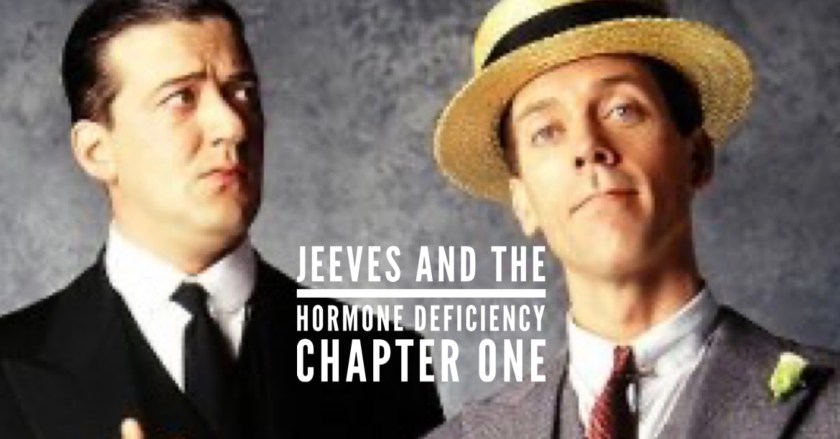
Jeeves and the Hormone Deficiency – Complete

Chapter 1

Whether it be in response to a request to rate one’s quality of life on one of those infernal questionnaires that doctors these days seem so keen on employing, or the answer one gives to a pal enquiring as to how one is faring in the steeplechase of life, everyone has times when the expression ‘Tickerty-Boo’ is not the one that comes most readily to mind. This was just such an occasion. Only the previous day I had left my home with a spring in my step and a lightness in my spirit that would have left nobody in any doubt that the bells were ringing out in celebration of all that was propitious in the world of Mr B. Wooster – but then the world become an altogether less joyous place. ‘Boos’, ‘Tickerty’ or otherwise, were no longer les mots juste.

It all began to go wrong whilst I was seated in my dining room perusing the national papers. I had finished breakfast when the finest gentleman’s personal gentleman in the Home Counties, if not all England, glided into the room. I greeted him cordially and, eager as ever to hear what a man with a brain the size of a planet thought concerning the issues of the day, proceeded to regale him with what I had gleaned from my reviewing of that morning’s headlines.

‘I say, Jeeves’, I began, ‘it says here that one now has to wait an average of over two weeks for a routine GP appointment and, furthermore, that there’s a national shortage of HRT.’

‘Indeed so, sir. It is a concern for us all.’

‘A concern for us all it most certainly is, Jeeves, and a bally sizeable one at that. One dreads to think how Aunt Agatha will cope if deprived of her hormonal replacement. The aged relative is barely human when she’s taking the dashed pills, imagine how she’d be without them. Make no mistake Jeeves, the thought itself is enough to make a grown man don a disguise of a mountain goat and head for the hills. There’s not a nephew in all the world who will be safe within a hundred miles of her.’

‘An encounter with Lady Worplesdon in such a state would, undoubtedly, be one that was best avoided, sir. Perhaps it is for the best then that she has sent a note.’

‘A note, Jeeves? What note?’

Jeeves did not answer but instead extended his gloved hand and passed me the piece of paper that he had been carrying on the tray with which he had entered the room. It is a well established fact that the Wooster’s are renowned for their bravery – in the face of danger they laugh with ne’er a care, in the moment of crisis they rise to the challenge, but I don’t mind admitting that I was made to physically stagger by what I now had cause to read. I was left, not only speechless and open mouthed, but also in such a state of tremulousness, that it was as much as I could do to avoid spilling the morning Darjeeling down my as yet undivested nightwear.

The piece of paper that Jeeves had handed me was the right hand side of a prescription. On it were printed the words Elleste Duet Conti. Alongside was a box that had been ticked and below, in a hand befitting one well practiced in the training of her evil acolytes in the dark art of advising on medicines management, were scrawled the words: ‘Obtain these for me Bertram – or I’ll see to it that you marry Madeleine Bassett The choice is yours’. A large letter ‘A’ confirmed, if confirmation was ever needed, who had authored such a minacious ultimatum.

‘Is anything the matter, sir?’, enquired Jeeves. I couldn’t help noticing, however, that there was an air about him that suggested he already knew the contents of the note he had conveyed.

‘Not at all, Jeeves, not at all.’ I spluttered, struggling as I did so to regain my composure. ‘Aunt Agatha can attempt to put the frighteners on me all she likes but I happen to know that the Bassett has eyes, and heart, for just one man. And that man is Augustus Fink-Nottle. There’s no uncertainty about it – Gussie’s the chap for Madeline, always has been and always will be. Theirs is a love which acts as a constant in a world of ever changing health service management structures, an engagement as unshakeable as the mind of an administrator who has determined that a breach has occurred in a two week wait referral pathway. Without doubt Aunt Agatha’s threats are as empty as a health secretary’s promises.’

‘One would like to think so, sir’ replied Jeeves in that tone he employs when he knows something that others do not. ‘But the word is that Miss Bassett is not as enamoured with Mr Fink-Nottle as was once the case’

‘Madeline not enamoured with Gussie! She is as besotted with Gussie as Gussie is with newts. And greater love has no man than that which Augustus Finknottle has for all things amphibian.’

I had hoped that Jeeves would have remarked favourably on my knowledge of taxonomy but he continued on, seeming unimpressed.

‘Mr Fink-Nottle’s love for members of the subfamily Pleurdelinae is undoubted sir; as, indeed, is his love for Miss Bassett. But, alas, that love no longer finds itself requited. It is a matter of regret that Miss Bassett has ended the agreement that once was in place.’

To say I was shocked would have been an understatement. But dealing with the unforeseen was something that I was becoming increasing used to, as I now proceeded to explain to Jeeves.

‘Well I don’t know Jeeves – is nothing sacred anymore? Can’t a man depend on anything? Only yesterday I was treated in a most unexpected manner. As is my custom on a Thursday afternoon I had it in mind to drop in at the Drones. As I arrived, Bates, the hall porter, ushered me to one side and asked if I would be so kind as to leave. He informed me that Bingo Little had, for reasons I cannot begin to imagine, turned against me and engineered a vote of the members, the upshot of which was such that I have been barred from the club for behaviour unbecoming of a gentleman. Can you imagine it Jeeves?’

‘Hardly, sir.’

‘Bates was clearly ill at ease as a result of the whole dashed business. Usually, to borrow a phrase from old Bill Shakespeare, he is as polite as a pineapple, but yesterday, his manner was nothing short of offish’

‘Sheridan, sir’

‘Sherry what, Jeeves? To what are you referring?’

‘Sheridan sir. ‘As polite as a pineapple’ – a phrase coined by Mr R. B. Sheridan in his 1775 play ‘The Rivals’. The phrase was not one of Mr Shakespeare’s’

‘Well thank you for that Jeeves. Here am I facing potential disaster in the form of marriage to Madeline Bassett without so much as a bolt hole to escape to as a consequence of my having been mysteriously excluded from the Drones, and all you can see fit to do is to correct my knowledge on matters literary. Thankfully, I have this to cheer me in the hour of my distress’

With that I lifted from the chair next to me the fine Stetson hat that I’d previously ordered and which had arrived from the United States by that morning’s post. I placed the item on my head, ignoring Jeeves’ obvious displeasure as I did so.

‘I trust sir is not considering wearing such an item out in public. I feel to do so would be less than wise. It makes you look somewhat…’, he hesitated for a second, ‘…American.’

‘It’s all very fine you taking that attitude Jeeves. As you well know I once wrote a piece entitled ‘What the Well-dressed man is wearing’ and I am here to tell you Jeeves, that a certain well-dressed man will most certainly be wearing this very fine hat – and I’ll not have you suggesting otherwise. Arriving at the Drones with this on my head will ensure that the unpleasantness of yesterday will be cast aside in an instant. I’ll be ushered in once more, greeted with open arms, like an adventuring hero returning from distant shores’.

‘If you say so, sir’

‘I jolly well do say so Jeeves, and there the matter must end. Your comments regarding what I choose to adorn my head were unsolicited and they have only added to the stress that this mornings revelations have caused me. It’s all beginning to make me feel quite unwell. In fact I’ve not felt this nauseous since Madeline Bassett once described the stars as God’s daisy chain. If it wasn’t so difficult to get a doctors appointment I’d have half a mind to seek urgent medical attention’.

‘I’m sorry to hear that sir. If the young gentleman would like, I’d be happy to be of service to you and enquire into whether a GP appointment might not be forthcoming for you this morning. Perhaps sir could enquire regarding your Aunt’s medication at the same time.’

‘Haven’t you been listening Jeeves. Doctors appointments can’t be had for love nor money. Whilst it’s true Jeeves that, over the years, you have managed the seemingly impossible on more than one occasion, not even you could secure a tête-à-tête with my doctor today. But try if you wish, I’ll not deny you the opportunity of making yourself look a fool!’

Jeeves silently left the room and I took the opportunity to assess how I might don the Stetson so as to maximise the air of jauntiness that I hoped to exude. Within a few moments, Jeeves was back.

‘The doctor will be pleased to see you this morning sir’

I was dumbstruck. It was clear that Jeeves was pleased with himself and though aware that to do so would only serve to increase his sense of self satisfaction, I couldn’t help but ask how the devil he’d managed it.

‘I simply dialled 111 and told the young lady who answered my call that I was concerned that you might do something foolish’. He paused for a moment to cast a censorious glance at the hat that continued to bedeck my head. ‘The recommendation I was afforded was that you should see a doctor within two hours. On relaying this information to the receptionist at the practice at which you are registered, an appointment was duly offered. Apparently they have a new doctor in post. He can see you at noon.’

Chapter 2

A couple of hours later I was minding my own business sat in the waiting room of the local GP surgery. In the absence of a copy of ‘Milady’s Boudoir’ I occupied my time by flipping through the latest edition of ‘What Ho!’ magazine replete as it was with photographs of Stiffy Byng and Harold ‘Stinker’ Pinker’s recent nuptials. My reverie was disturbed however by a ruckus that was taking place at the reception desk where a young women was becoming increasing agitated with the staff.

‘Never mind your zero tolerance policy, I simply must see the doctor this morning regarding a matter of the utmost importance. I shall take a seat in the waiting room and won’t be leaving until I’ve been attended to.’ The women fixed her steely-eyed gaze upon the lead receptionist and added in a lower, more menacing tone, ‘Be warned, about my person I have a list of all my problems – and I’m not afraid to use it.’

Though heartened by the fact that the doctor seemed to have a loyal and enthusiastic following, my mood dipped when the aggrieved party took a seat next to me and I recognised her as Honoria Glossop, a woman to whom I once had the misfortune of being engaged.

‘Bertie Wooster, as I live and breath.’ She let out a shriek of what less enlightened souls may have mistaken for laughter, before adding in a conspiratorial tone, ‘I was hoping we might run into each other, I’ve been thinking about you recently…ever such a lot’

‘Have you H,Honoria?’, I stammered, far from flattered by the notion that I had been on her mind and not a little alarmed by the seductive wink with which she ended her sentence. ‘Why might that be?’

‘Oh Bertie, surely you must know. Of late a change has come upon me. I’m not the women I once was. No longer is Bingo Little the one for me. I need someone more virile, a real man. Somebody a lot like you, Bertie. I have feelings for you Bertie – surely you feel it too’.

It was not just her words that threatened the Wooster composure but also the manner in which they were spoken. More practiced in the art of breaking in horses than that of the seduction of menfolk, Honoria then made an ill advised attempt to appear coquettish. Undoubtedly the affect had more of the macabre about it than she had intended and the upshot was that, in my alarm, I all but fell off my chair.

If there is one thing a true gentleman knows it is to recognise when a quick exit is required. This was, without a doubt, a clear example of such an occasion. I was afforded my opportunity when a buzzing sound was heard and my name flashed up on a display panel indicating that the doctor was now ready to see me. I smiled awkwardly, proffered a hurried farewell and made my escape, I darted off in the direction of the consulting room with the sound of Honoria’s sonorous voice ringing in my ears, announcing to those patiently assembled how she wanted all the world to know that she longed that we would always be together.

Reaching the relative safety of the doctors room, I knocked on the door but entered without waiting for the customary invitation to do so. Inside the Wooster nervous system was dealt another shock no less unexpected than the surprise experienced by many the year I won the school scripture knowledge prize. Sat at a desk, stethoscope around his neck, was none other than my old chum Gussie, his horn rimmed glasses and small chin confirming as true what I found hard to believe and making the matter unworthy of debate.

‘Good morning, it’s Mr Wooster isn’t it?’, he began, attempting to adopt a professional air.

‘Yes it is Gussie, And well you know it – but what the dickens are you doing passing yourself off as a family physician?’ Gussie tried to ignore what surely none could consider an unreasonable question.

‘If you don’t mind Mr Wooster, it’s Dr Augustus Fink-Nottle. The doctor-patient relationship works better that way. Now, if you would be so kind, please inform me of the number of units of alcohol you consume per week, whether or not you smoke, and the degree to which you exercise. Then I will measure your blood pressure and undertake a blood test to determine your cholesterol before asking you to complete a patient satisfaction survey as you leave. Would that be acceptable to you Mr Wooster?’

I was uneasy about answering the questions he had posed, suspecting he’d be less than impressed with my replies.

‘Aren’t you going to ask me why I’ve come to see you?’ I countered before adding, with what I liked to think carried an air of contemptuous disbelief, ‘Dr Fink-Nottle”

‘Oh, OK, if I must. Tell me, what is concerning you today?’

‘As it happens, a number of things’, I replied.

Gussie attempted to point out that he could deal with just one problem per consultation but I was having none of it.

‘Firstly I want to know how you find yourself working as a General Practitioner, and what’s all this I hear about you and Madeline Bassett breaking of your engagement and leaving me at risk of being paired with her myself on account of my disgruntled Aunt Agatha. Answer me these questions in a satisfactory manner and then I’ll thank you if you’d simply issue a prescription for said aunt’s HRT and show me to the back door through which I can leave and thereby escape Honoria Glossop who, even now, is sat outside waiting to devour me like some human form of preying mantis’

At these words, Gussie’s professional demeanour left him and was replaced by an appearance consistent with that of a small frightened child.

‘She’s not here again is she? She turns up repeatedly demanding more HRT. She believes they are the answer to her violent mood swings and comes here each day with implausible stories of how she needs additional supplies. Thus far her medication has allegedly been left on the bus, eaten by the dog and stolen by person or persons unknown. She’s clearly taking far too much. I try to refuse to issue her any more but you should see the menace in her eyes when she holds me up against the wall and threatens me with physical harm if I don’t give her what she wants. I’ve taken to stockpiling pills, patches and topical gels in order to ensure her demands are met.’

‘Well that my explain her alarming behaviour in the waiting room. A gentleman doesn’t like to cast aspersions on a ladies character, but her forwardness in the waiting room was unseemly to say the least’

‘I’m sorry Bertie, but you understand that I daren’t spare you any HRT for your Aunt Agatha, or indeed anyone else – my life simply wouldn’t be worth living if I were to deny Honoria”

“Your life wouldn’t be worth living?! What about mine? Doesn’t it bother you Aunt Agatha is lining up Madeline as my future wife.’

‘Alas, Bertie, having put myself through the new government programme which seeks to train fully qualified GPs in just six weeks, she won’t even talk to me. Turns out she regards being married to a GP as social suicide.’

‘Well give it all up then Gussie, return to your newts!’

‘I can’t Bertie. This is my new vocation. It turns out that my years of studying pond life was preparing me for this.’

‘I say, old thing, that’s a bit harsh’

‘I didn’t mean it like that Bertie. It’s just that my love of newts has been replaced by a love for my fellow man. But it’s all a lot harder than I’d imagined – I’m not sure six weeks training is really enough. People constantly come to me in trouble Bertie. All day long I see those who are ‘out of sorts’, those who are ‘all of a dither’, and even some who are ‘in a proper pickle’. There are these frightful NICE guidelines to tell me what to do, but they don’t cut the mustard Bertie and I never know whether I’m supposed to be applying a protocol or following an algorithm. Not even Jeeves would cope with what I have to deal with each day. It’s all so very difficult Bertie but, I have heard the call. I must continue as a GP even though I fear Madeline will never be able to bring herself to look at me again. Unless, of course, you had a plan of how I might win her back?’

It was then that the code of the Wooster’s crept up behind me, tapped me politely on the shoulder, and bid me ‘good day’. Gussie was a pal, and pals, no matter how trying, are never to be let down. I gave the matter some thought and, given the impossibility of the situation, applied my top drawer strategy – I tried to think what Jeeves would do.

‘We could try that scheme of Jeeves’s – the one where I push a small boy into a lake and we engineer things such that Madeline is watching on as you dive in to effect a rescue. Seeing you act so gallantly is sure to elevate you in her affections and so ensure the path of true love once again runs smooth.’

Gussie fell silent and adopted a countenance more serious than I had ever seen him adopt before.

‘Mr Wooster, that is a dreadful suggestion to have made. Small boys should on no account be pushed into water, no matter the seriousness of the situation. I’m afraid I will be forced to raise a safeguarding concern about you. Or at least I would but, given the dashed referral forms are so beastly complicated, I shall merely glare at you disapprovingly and insist that you promise never to speak of such things again.’

I gave him my word after which Gussie insisted that it was time for me to leave.

‘As ever Bertie, I’m running late and I’ve other patients to see. I’m afraid that, to avoid returning to the waiting room you’ll have to leave through the window. I’ve only been here a short time but I’ve already used it on the numerous occasions that the practice manager has been after me for not coding things properly for QoF purposes.’

Though he’d been of little help, I thanked Gussie anyway and made my undignified exit through the consulting room window and thence I made my way back to my rooms. There I found Jeeves packing as if for a weekend retreat. I asked him what the occasion might be.

‘I hope you don’t mind sir, but I took the liberty of accepting an invitation to Ditteridge Hall. Miss Glossop has been on the phone and has requested the pleasure of your company for the weekend. I felt sure you’d respond in the affirmative and assured the young lady that we would make our way there the moment you returned.’

That some consider Jeeves as the wisest of men is sometimes hard to swallow. Here he was, once more placing me in a situation that could not help but end in disaster. But a gentleman’s word is his bond and since Jeeves had promised I would travel to Ditteridge Hall, then to Ditteridge Hall I would have to travel.

I did however insist on one thing. My stipulation was simply this, that my new Stetson hat should accompany us on the jaunt to Hampshire. To his credit, Jeeves obliged, packing the headwear without so much as the raising of an eyebrow.

Chapter 3

If my sense of perturbation and not been sufficiently aroused already, it was given an additional invigorating poke with an exceedingly sharp stick when, as we loaded up the car, Jeeves informed me that both Madeline Bassett and Aunt Agatha had also been invited to the weekend chez Honoria.

‘I am perturbed, Jeeves’, I told him, ‘increasingly so. Were I to now, round the corner and bump into that fellow Dante, I would take him to one side and teach him a thing or two about what it is to experience utter despair in the face of impending horror.’

‘“Lasciate ogne speranza, voi ch’intrate”, sir?’

I looked at him, and decided not to ask for clarification.

‘That’s easy for you to say Jeeves, but the fact remains that the places were rough enough already – this news has not served to make them any plainer.’

‘Indeed not, sir.’

With that, Jeeves dealt with the last of the bags before I took my place behind the wheel and we set off together. Despite my sense of foreboding, the drive down to Hampshire was, at the same time, a cause for celebration. The storm clouds may well have been gathering over Ditteridge Hall, but, for now at least, the sun was shining brightly. And if three hearty cheers were the order of the day for the celestial b’s donning of his haut-de-forme, then an additional hip hip hooray was surely appropriate for one Bertram Wilberforce Wooster. Sporting the splendid Stetson, I felt sure I was setting a trend that would soon be de rigueur in gentlemen’s clubs up and down the country.

Though I was therefore feeling somewhat cheered as we travelled, I none the less took it upon myself to maintain a frosty silence on our journey. I was determined to make Jeeves aware that my annoyance at his agreeing to this trip had not been dissipated in the slightest. As we neared our destination and crossed the county border, Jeeves, however, endeavoured to effect a conversation.

‘I wonder if sir might be interested to learn that, according to the science periodical to which I subscribe, the newt population in the county of Hampshire is in decline. Experts have blamed the…’

‘Stop right there Jeeves,’ I countered with a forcefulness that surprised even myself a little. Generally, I’m not one to play the high and mighty but this line of discussion threatened to take, not only the biscuit, but the biscuit tin too. ‘You may wonder away, to your hearts content, Jeeves, but no’ I continued, ‘such matters do not interest me. Were I ever to be asked to offer up a fig in order to learn more, I would, without a doubt, declare that the price being asked was far too dear. I could not pay it. And even were the subject to take on a degree of fascination that was hitherto unknown to me, as a consequence, perhaps, of a severe blow to the head, now would not be a fitting time for it to be discussed – not when I find myself driving head long into the lair of a creature who would likely have Heracles thinking twice before he engaged it in combat. We’ll have no more of it Jeeves, do I make myself clear?’

‘Most efficaciously so, sir. I’ll not mention the matter again.’

And with that no more was said until we at last arrived at Ditteridge Hall. I climbed out of the car and headed up the steps to the front door leaving Jeeves to deal with our luggage. The door was open and Honoria was there anxiously looking up the driveway.

‘Hello Bertie, so glad you could come. But I was hoping you might be Gussie. I’ve just requested a home visit and though we’re well out of his practice area I nonetheless demanded he came. I’ve run out of my medication you see, and simply can’t do without it. He hesitated about coming at first but I threatened to complain to the GMC if he didn’t and he soon came round to my way of thinking. I can’t imagine why, but I think he finds me a little intimidating. By the way, seeing that he’ll have come all this way, I’ve insisted he stay for the weekend. You don’t mind do you Bertie’’ she asked before adding coyly, ‘there’ll still be plenty of time for us to be alone?’

I nervously mumbled a non-committal reply, made my excuses and entered the house where I was promptly shown to my room. There I found Jeeves dutifully unpacking my bags.

‘This weekend is getting worse by the moment Jeeves. It was bad enough knowing Honoria’s father, the eminent psychiatrist Sir Roderick Glossop, would be here. Surely it’s enough to have one doctor in the house who disapproves of smoking and gambling, drinks no wine and once declared me to be ‘en vacance avec les fairies’ simply on account of my having cats in my flat. But now Gussie’s going to be here too. Put two doctors together and the conversation over dinner is sure to be reduced to tedious medical talk, unable as they are to exchange anecdotes on any other subject. And one can hardly indulge with any enthusiasm in those little pleasures that weekends were made for when your own GP is looking on with a disapproving eye’

‘It is certainly regrettable sir, one can only hope that some good might come out of the weekend.’

Such optimism may all be very commendable but, as we gathered around the dining table that evening, anyone in search of an ‘all’s well that ends well’ would have been left scanning the horizon in vain. Gussie, who was well out of his depth discussing matters medical with Sir Roderick, spent the evening gazing forlornly at Madeleine who resolutely refused to meet his eye. She, despite Debrett’s no doubt having some pretty stern words to say on the matter, maintained an endless monologue on the happiness of flowers, the delightful essence of puppies and her conviction that rabbits are in fact gnomes who serve the Fairy Queen. Honoria exerted all her effort in a vain attempt to appear alluring without drawing the attention of her father who himself continued to regard me as someone about whom he saw no reason to change the less than favourable opinion he had previously formed. And Aunt Agatha scowled as only a hormonally deficient aunt can.

Once dinner was over each went their separate ways leaving me alone. In the absence of medical supervision I settled down to make the most of the supply of cigars and decanter full of port that rested on the sideboard. However, no sooner had I poured myself a stiff one, Jeeves entered the room.

‘Might I make a suggestion sir?’

‘Suggest away Jeeves” I replied, feeling more positive now that the evening held out the possibility of not being entirely without its merits.

‘I wondered if it might not be beneficial if you were to meet with Mr Fink-Nottle. He’s just left the house to wander round the lake. He has an air of melancholia about him. It occurs to me that he would benefit from a little company’.

‘I sometimes wonder at you Jeeves. What could possibly induce me to spend time with Gussie when he is largely the cause of the precarious position in which I now find myself? And besides what would I talk to him about’

‘I”m sure you’d find something sir. And it would be an opportunity for you to wear your hat. I fancy this evening is just the occasion for it’

Jeeves passed me the hat that he had been concealing behind his back and, as I placed it upon my head, the suggestion Jeeves had made suddenly seem to hold some appeal. I quickly sank the drink I had just poured and headed off for the front door.

Chapter Four

As I made my way across the driveway a car pulled up and out climbed one whose finely chiselled features could belong to none other than Bingo Little. Despite his being the instigator of my downfall at the Drones, he was still an old school pal, and so I decided that a civil course remained the most appropriate to pursue.

‘What ho, Bingo! It’s not like you to frequent country houses on the weekend. I didn’t expect to bump into you here.’

‘I don’t suppose you did. I expect you rather hoped that you would be able to continue, uninterrupted, your despicable attempt to steal from me the woman I love. Out of my way Wooster, I don’t wish to talk to you.’

To say I was flabbergasted was not the half of it. How anyone could imagine that I was foolish enough to put myself anywhere near the line of Honoria’s fire, was beyond me. Up until now Bingo had avoided looking directly at me but now, his eyes no doubt drawn by the splendour of my hat, he turned his head to face me. And then, just as Bingo had noticed something remarkable about my appearance, it now became my turn to note something remarkable about his.

‘I say Bingo, what’s that on your top lip?’

‘That Bertie, is what is termed a moustache, a sign of masculinity – something for which real men are well known. I thought Honoria would be interested to see it.’

‘I don’t doubt it Bingo. And very impressed I’m sure she’ll be. How ever did you manage to grow it so quickly?’

Bingo seemed to be pleased with my positive appraisal and softened a little.

‘Well Bertie, I’ve been to see Gussie in his new role as a GP. He’s been marvellous. He gave me this cream and told me to rub it into the requisite area three times a day.’ He pulled a tube of testosterone gel from his pocket and demonstrated the application process. ‘So you see Bertie, with this being so effective, I believe I can win back Honoria’s affections. May the best man win,’ And with that he placed the tube back in his pocket, turned back toward the house, and strode off purposefully.

Alone again I continued on my way to the lake. Gussie was there, just as Jeeves had suggested and, true to his description, he was the very picture of a soul bereft. Clearly he was thinking about Madeleine, a subject about which I, however, was not prepared to enter into discussion. We stood looking at each other for a few minutes, the silence growing more awkward, until I blurted out the only thing I could think of to say.

‘I say Gussie. Have you heard that the newt population in these parts is in decline?’

With the conversation turning to the subject of his beloved newts, Gussie’s eyes lit up and his tongue was loosed.

‘Newts in trouble Bertie, but why?’

For a moment I wished I’d not silenced Jeeves on the matter earlier in the day. Unable to answer him, Gussie took it into his head to discover the reason for himself.

“Would you pass me your hat Bertie, I have an idea”

‘An idea, Gussie, what sort of an idea?’ I asked, not liking the turn this conversation was taking. Take it from me, a man capable of spending long hours in the company of semi-aquatic creatures with a penchant for stagnant bodies of water, is capable of pretty much anything.

‘Trust me, Bertie, I’m a newt enthusiast’

With that Gussie snatched the hat from my head and plunged it into the lake, drawing it back out brimming with water. He proceeded to pour the contents out onto the ground in front of him and went on to repeat the procedure time and again until, eventually, a newt was included in the sodden contents of my Stetson. Gussie examined the creature closely and then announced his findings.

‘It’s a male newt Bertie and at this time of year a young male newt’s fancy ought to be turning to thoughts of love. But this newt seems to have no such inclinations. He should be changing his colour and bending his body in an expression of romantic intent – but he’s not.’ Gussie was finding it difficult to speak now, choking with the emotion of it all as he forced the words out. ‘It’s as if he’s lost what it is to be male – it’s almost as if this male newt is…female’

At that moment a cough came from the bushes and Jeeves stepped out from behind them.

‘I’m sorry to interrupt you Mr Fink-Nottle, but I couldn’t help but overhear your observations. The article I was referring Mr Wooster to earlier this afternoon was suggesting that the feminisation of male newts was occurring as a consequence of high levels of oestrogen in the water, possibly as a result of local women on excessive doses of HRT excreting high levels of the hormone. Might that tie in with your findings Mr Fink-Nottle?’

Gussie went pale.

‘What a fool I’ve been Bertie. I see now how foolish I’ve been to think I could ever be a doctor. My real love is for newts. I’ve neglected them and threatened their existence trying to be something I’m not, something I don’t have the passion for, nor the necessary resilience. I renounce it all. No longer will I be a GP – no longer will I prescribe HRT to Honoria’.

And with that, displaying a sense of urgency I’d rarely seen in him, he dashed back to the house shouting as he went ‘Let me through, I’m a doctor no longer’.

Jeeves looked at me as I gazed crestfallen upon my hat that lay, ruined forever, on the ground.

‘The misfortune that has befallen your hat is most regrettable sir. But perhaps you might find some consolation in the good that seems to have resulted from its misappropriation. Miss Basset will soon have Mr Fink-Nottle back now that he is no longer a GP and a deoestrogenised Miss Glossop, her ardour dampened, is sure to find her desire for you diminished. Mr Little will, I am sure, replace you once more as the one who leads among those vying for her affection. Furthermore, with the reduction in the prescribing of HRT for Miss Glossop, one can only imagine that there is enough for everyone else, not least your own Aunt Agatha.’

‘I agree Jeeves, but for the state of my hat, a satisfactory resolution all round.’

We began to make our way back to the house. As we did so we saw Gussie and Madeleine, walking hand in hand together. As they passed Gussie nonchalantly tossed a couple of small cardboard boxes in my direction which, in one deft movement, I swiftly pocketed. All the evidence suggested that a burden had been lifted from Gussie’s shoulders and love was in the air once more. Further indication that Cupid had been busy putting in the hours presented itself when, on nearing the Glossop ancestral home, we were greeted by the disconcerting sight of Honoria and Bingo, arms entwined in what can only be described as a clinch. Clearly the moustache was already having the desired effect.

‘One wonders how long Bingo will be required to maintain his hirsute appearance once Honoria’s HRT is reduced’, I commented to Jeeves as we climbed the steps to the front door.

‘One does indeed, sir. One can only hope that Miss Glossop’s passion for facial hair is temporary since, I fear, Mr Little has had his last tube of testosterone cream now that he too will be needing to find a new GP’

‘Indeed Jeeves. The plan to take short cuts on the training of GPs seems not to have worked out so well after all. And there therefore still remains, the problem of getting a GP appointment in a timely fashion. You understand the posish Jeeves?’

‘Indeed I do sir, the problem is a most vexing one.’

‘Have you a solution, Jeeves?’ I asked hopefully.

‘Alas no, sir. I fancy it’ll take a greater mind than mine to solve that particular problem’

‘But Is there a greater mind than yours Jeeves?’

‘Who can say, sir? Who can say?’

I dismissed Jeeves for the night but, feeling the need for a restorative before retiring myself, I made my way back to the dining room. I had not forgotten the decanter of port that was stationed there and which was no doubt anxiously awaiting my return. Sauce in hand I headed then for the drawing room where I made myself comfortable in an old leather armchair and contented myself with the thought that, with Bingo and Honoria reunited once more, all charges of my supposed ungentlemanly behaviour would be dropped and I would once more be held in good standing at the Drones. Within moments, however, a deafening roar disturbed by reverie. I looked up and saw the imposing figure of Aunt Agatha standing in the doorway, clearly with malevolence still very much on her mind.

‘Bertram Wooster, where have you been? You’re as bad as my doctor. I can never get to see him when I want to either. I’ve been looking for you. Have you got me my pills yet?’

I paused a moment, quelling the habitual panic that Aunt Agatha invariably evoked in me, before getting to my feet. I placed my hand in my pocket and, pulling out what I found there, answered her with a smile.

‘Yes, Aunt Agatha, I rather think I have!’

[With huge apologies to P.G. Wodehouse, the master of comic prose which always brightens even the darkest day.]

Jeeves and the Hormone Deficiency – Chapter Three

For Chapter 2 click here

Chapter 3

If my sense of perturbation had not been sufficiently aroused already, it was given an additional invigorating poke with an exceedingly sharp stick when, as we loaded up the car, Jeeves informed me that both Madeline Bassett and Aunt Agatha had also been invited to the weekend chez Honoria.

‘I am perturbed, Jeeves’, I told him, ‘increasingly so. Were I to now, round the corner and bump into that fellow Dante, I would take him to one side and teach him a thing or two about what it is to experience utter despair in the face of impending horror.’

‘“Lasciate ogne speranza, voi ch’intrate”, sir?’

I looked at him, and decided not to ask for clarification.

‘That’s easy for you to say Jeeves, but the fact remains that the places were rough enough already – this news has not served to make them any plainer.’

‘Indeed not, sir.’

With that, Jeeves dealt with the last of the bags before I took my place behind the wheel and we set off together. Despite my sense of foreboding, the drive down to Hampshire was, at the same time, a cause for celebration. The storm clouds may well have been gathering over Ditteridge Hall, but, for now at least, the sun was shining brightly. And if three hearty cheers were the order of the day for the celestial b’s donning of his haut-de-forme, then an additional hip hip hooray was surely appropriate for one Bertram Wilberforce Wooster. Sporting the splendid Stetson, I felt sure I was setting a trend that would soon be de rigueur in gentlemen’s clubs up and down the country.

Though I was therefore feeling somewhat cheered as we travelled, I none the less took it upon myself to maintain a frosty silence on our journey. I was determined to make Jeeves aware that my annoyance at his agreeing to this trip had not been dissipated in the slightest. As we neared our destination and crossed the county border, Jeeves, however, endeavoured to effect a conversation.

‘I wonder if sir might be interested to learn that, according to the science periodical to which I subscribe, the newt population in the county of Hampshire is in decline. Experts have blamed the…’

‘Stop right there Jeeves,’ I countered with a forcefulness that surprised even myself a little. Generally, I’m not one to play the high and mighty but this line of discussion threatened to take, not only the biscuit, but the biscuit tin too. ‘You may wonder away, to your hearts content, Jeeves, but no’ I continued, ‘such matters do not interest me. Were I ever to be asked to offer up a fig in order to learn more, I would, without a doubt, declare that the price being asked was far too dear. I could not pay it. And even were the subject to take on a degree of fascination that was hitherto unknown to me, as a consequence, perhaps, of a severe blow to the head, now would not be a fitting time for it to be discussed – not when I find myself driving head long into the lair of a creature who would likely have Heracles thinking twice before he engaged it in combat. We’ll have no more of it Jeeves, do I make myself clear?’

‘Most efficaciously so, sir. I’ll not mention the matter again.’

And with that no more was said until we at last arrived at Ditteridge Hall. I climbed out of the car and headed up the steps to the front door leaving Jeeves to deal with our luggage. The door was open and Honoria was there anxiously looking up the driveway.

‘Hello Bertie, so glad you could come. But I was hoping you might be Gussie. I’ve just requested a home visit and though we’re well out of his practice area I nonetheless demanded he came. I’ve run out of my medication you see, and simply can’t do without it. He hesitated about coming at first but I threatened to complain to the GMC if he didn’t and he soon came round to my way of thinking. I can’t imagine why, but I think he finds me a little intimidating. By the way, seeing that he’ll have come all this way, I’ve insisted he stay for the weekend. You don’t mind do you Bertie’’ she asked before adding coyly, ‘there’ll still be plenty of time for us to be alone?’

I nervously mumbled a non-committal reply, made my excuses and entered the house where I was promptly shown to my room. There I found Jeeves dutifully unpacking my bags.

‘This weekend is getting worse by the moment Jeeves. It was bad enough knowing Honoria’s father, the eminent psychiatrist Sir Roderick Glossop, would be here. Surely it’s enough to have one doctor in the house who disapproves of smoking and gambling, drinks no wine and once declared me to be ‘en vacance avec les fairies’ simply on account of my having cats in my flat. But now Gussie’s going to be here too. Put two doctors together and the conversation over dinner is sure to be reduced to tedious medical talk, unable as they are to exchange anecdotes on any other subject. And one can hardly indulge with any enthusiasm in those little pleasures that weekends were made for when your own GP is looking on with a disapproving eye’

‘It is certainly regrettable sir, one can only hope that some good might come out of the weekend.’

Such optimism may all be very commendable but, as we gathered around the dining table that evening, anyone in search of an ‘all’s well that ends well’ would have been left scanning the horizon in vain. Gussie, who was well out of his depth discussing matters medical with Sir Roderick, spent the evening gazing forlornly at Madeleine who resolutely refused to meet his eye. She, despite Debrett’s no doubt having some pretty stern words to say on the matter, maintained an endless monologue on the happiness of flowers, the delightful essence of puppies and her conviction that rabbits are in fact gnomes who serve the Fairy Queen. Honoria exerted all her effort in a vain attempt to appear alluring without drawing the attention of her father who himself continued to regard me as someone about whom he saw no reason to change the less than favourable opinion he had previously formed. And Aunt Agatha scowled as only a hormonally deficient aunt can.

Once dinner was over each went their separate ways leaving me alone. In the absence of medical supervision I settled down to make the most of the supply of cigars and decanter full of port that rested on the sideboard. However, no sooner had I poured myself a stiff one, Jeeves entered the room.

‘Might I make a suggestion sir?’

‘Suggest away Jeeves” I replied, feeling more positive now that the evening held out the possibility of not being entirely without its merits.

‘I wondered if it might not be beneficial if you were to meet with Mr Fink-Nottle. He’s just left the house to wander round the lake. He has an air of melancholia about him. It occurs to me that he would benefit from a little company’.

‘I sometimes wonder at you Jeeves. What could possibly induce me to spend time with Gussie when he is largely the cause of the precarious position in which I now find myself? And besides what would I talk to him about’

‘I”m sure you’d find something sir. And it would be an opportunity for you to wear your hat. I fancy this evening is just the occasion for it’

Jeeves passed me the hat that he had been concealing behind his back and, as I placed it upon my head, the suggestion Jeeves had made suddenly seem to hold some appeal. I quickly sank the drink I had just poured and headed off for the front door.

For Chapter 4 click here

Desert Island Drugs

Who’s up for Desert Island Drugs?

Few of us, if any, will ever find ourselves guests on that stalwart of the Radio 4 Sunday morning schedule, “Desert Island Discs’, but we can all imagine what it might be like to be marooned on a small island without an adequate drug supply – some may even be able to picture that particular scenario on a larger island, one perhaps somewhere in the North Sea.

So if you could have just eight drugs with you on that island, what would they be? Don’t forget you can take a book with you (I’ll give you the BNF and the complete works of Helen Stokes-Lampard), and a luxury item too (It must have no practical use though, so no suggesting an unnecessary locum, booked at the last minute, for your duty doctor day).

I’ll get the ball rolling with my choices:

Not all drugs are associated with special occasions in one’s life – some just become part of the furniture, they’re like good friends without which life just wouldn’t be the same. In this category then, of drugs I just couldn’t do without, would come Ibuprofen, Omeprazole and, of course, Methadone.

Then there are drugs that are linked to particular holidays – Cinnarizine (recalling a wonderful family vacation to France, or at least the memorable pre-holiday channel crossing) and Mefloquine (taken for that once in a lifetime trip to Africa which changed how I thought about things in ways I didn’t expect).

My next choice would be infant paracetamol. I had an idyllic childhood and nothing conjures up memories of those happy days better than the memories of being sat on my mother’s knee with the pain of a bulging tympanic membrane throbbing in my ear and the taste of a plastic spoon in my mouth.

Drugs have helped me through the bad times too, times when I thought the tears would never end. It was then that Roaccutane was there to dry my eyes.

And finally, a medication recalling the good days. Nitrous Oxide was the drug my wife and I shared surreptitiously whilst the midwife nipped out of the delivery suite in the hours prior to the birth of our first daughter. How we laughed…and laughed…and laughed…and laughed.

My luxury would be print outs of my patients’ contact with the 111 service. They contain no information of any practical use but would provide paper with which I could indulge myself in a spot of Origami.

My book would be any medical text book. Never having got round to studying one before, it’d be great to finally have the time to devote to reading one. And they tend to be quite thick so, being a little deficient in the feet and inches stakes, it’d come in handy for reaching up high.

And lastly, what if I could only save one drug from the waves, what would it be? Well the Methadone of course, though the excuse ‘lost at sea’ would be a novel one I could try using when trying to get additional supplies early.

Over to you! Play now for fun, as we may all be playing for real soon.

Jeeves and the Hormone Deficiency – Chapter Two

For Chapter 1 click here

Chapter 2

A couple of hours later I was minding my own business sat in the waiting room of the local GP surgery. In the absence of a copy of ‘Milady’s Boudoir’ I occupied my time by flipping through the latest edition of ‘What Ho!’ magazine replete as it was with photographs of Stiffy Byng and Harold ‘Stinker’ Pinker’s recent nuptials. My reverie was disturbed however by a ruckus that was taking place at the reception desk where a young women was becoming increasing agitated with the staff.

‘Never mind your zero tolerance policy, I simply must see the doctor this morning regarding a matter of the utmost importance. I shall take a seat in the waiting room and won’t be leaving until I’ve been attended to.’ The women fixed her steely-eyed gaze upon the lead receptionist and added in a lower, more menacing tone, ‘Be warned, about my person I have a list of all my problems – and I’m not afraid to use it.’

Though heartened by the fact that the doctor seemed to have a loyal and enthusiastic following, my mood dipped when the aggrieved party took a seat next to me and I recognised her as Honoria Glossop, a woman to whom I once had the misfortune of being engaged.

‘Bertie Wooster, as I live and breath.’ She let out a shriek of what less enlightened souls may have mistaken for laughter, before adding in a conspiratorial tone, ‘I was hoping we might run into each other, I’ve been thinking about you recently…ever such a lot’

‘Have you H,Honoria?’, I stammered, far from flattered by the notion that I had been on her mind and not a little alarmed by the seductive wink with which she ended her sentence. ‘Why might that be?’

‘Oh Bertie, surely you must know. Of late a change has come upon me. I’m not the women I once was. No longer is Bingo Little the one for me. I need someone more virile, a real man. Somebody a lot like you, Bertie. I have feelings for you Bertie – surely you feel it too’.

It was not just her words that threatened the Wooster composure but also the manner in which they were spoken. More practiced in the art of breaking in horses than that of the seduction of menfolk, Honoria then made an ill advised attempt to appear coquettish. Undoubtedly the affect had more of the macabre about it than she had intended and the upshot was that, in my alarm, I all but fell off my chair.

If there is one thing a true gentleman knows it is to recognise when a quick exit is required. This was, without a doubt, a clear example of such an occasion. I was afforded my opportunity when a buzzing sound was heard and my name flashed up on a display panel indicating that the doctor was now ready to see me. I smiled awkwardly, proffered a hurried farewell and made my escape, I darted off in the direction of the consulting room with the sound of Honoria’s sonorous voice ringing in my ears, announcing to those patiently assembled how she wanted all the world to know that she longed that we would always be together.

Reaching the relative safety of the doctors room, I knocked on the door but entered without waiting for customary invitation to do so. Inside the Wooster nervous system was dealt another shock no less unexpected than the surprise experienced by many the year I won the school scripture knowledge prize. Sat at a desk, stethoscope around his neck, was none other than my old chum Gussie, his horn rimmed glasses and small chin confirming as true what I found hard to believe and making the matter unworthy of debate.

‘Good morning, it’s Mr Wooster isn’t it?’, he began, attempting to adopt a professional air.

‘Yes it is Gussie, And well you know it – but what the dickens are you doing passing yourself off as a family physician?’ Gussie tried to ignore what surely none could consider an unreasonable question.

‘If you don’t mind Mr Wooster, it’s Dr Augustus Fink-Nottle. The doctor-patient relationship works better that way. Now, if you would be so kind, please inform me of the number of units of alcohol you consume per week, whether or not you smoke, and the degree to which you exercise. Then I will measure your blood pressure and undertake a blood test to determine your cholesterol before asking you to complete a patient satisfaction survey as you leave. Would that be acceptable to you Mr Wooster?’

I was uneasy about answering the questions he had posed, suspecting he’d be less than impressed with my replies.

‘Aren’t you going to ask me why I’ve come to see you?’ I countered before adding, with what I liked to think carried an air of contemptuous disbelief, ‘Dr Fink-Nottle”

‘Oh, OK, if I must. Tell me, what is concerning you today?’

‘As it happens, a number of things’, I replied.

Gussie attempted to point out that he could deal with just one problem per consultation but I was having none of it.

‘Firstly I want to know how you find yourself working as a General Practitioner, and what’s all this I hear about you and Madeline Bassett breaking of your engagement and leaving me at risk of being paired with her myself on account of my disgruntled Aunt Agatha. Answer me these questions in a satisfactory manner and then I’ll thank you if you’d simply issue a prescription for said aunt’s HRT and show me to the back door through which I can leave and thereby escape Honoria Glossop who, even now, is sat outside waiting to devour me like some human form of preying mantis’

At these words, Gussie’s professional demeanour left him and was replaced by an appearance consistent with that of a small frightened child.

‘She’s not here again is she? She turns up repeatedly demanding more HRT. She believes they are the answer to her violent mood swings and comes here each day with implausible stories of how she needs additional supplies. Thus far her medication has allegedly been left on the bus, eaten by the dog and stolen by person or persons unknown. She’s clearly taking far too much. I try to refuse to issue her any more but you should see the menace in her eyes when she holds me up against the wall and threatens me with physical harm if I don’t give her what she wants. I’ve taken to stockpiling pills, patches and topical gels in order to ensure her demands are met.’

‘Well that my explain her alarming behaviour in the waiting room. A gentleman doesn’t like to cast aspersions on a ladies character, but her forwardness in the waiting room was unseemly to say the least’

‘I’m sorry Bertie, but you understand that I daren’t spare you any HRT for your Aunt Agatha, or indeed anyone else – my life simply wouldn’t be worth living if I were to deny Honoria”

“Your life wouldn’t be worth living?! What about mine? Doesn’t it bother you Aunt Agatha is lining up Madeline as my future wife.’

‘Alas, Bertie, having put myself through the new government programme which seeks to train fully qualified GPs in just six weeks, she won’t even talk to me. Turns out she regards being married to a GP as social suicide.’

‘Well give it all up then Gussie, return to your newts!’

‘I can’t Bertie. This is my new vocation. It turns out that my years of studying pond life was preparing me for this.’

‘I say, old thing, that’s a bit harsh’

‘I didn’t mean it like that Bertie. It’s just that my love of newts has been replaced by a love for my fellow man. But it’s all a lot harder than I’d imagined – I’m not sure six weeks training is really enough. People constantly come to me in trouble Bertie. All day long I see those who are ‘out of sorts’, those who are ‘all of a dither’, and even some who are ‘in a proper pickle’. There are these frightful NICE guidelines to tell me what to do, but they don’t cut the mustard Bertie and i never know whether I’m supposed to be applying a protocol or following an algorithm. Not even Jeeves would cope with what I have to deal with each day. It’s all so very difficult Bertie but, I have heard the call. I must continue as a GP even though I fear Madeline will never be able to bring herself to look at me again. Unless, of course, you had a plan of how I might win her back?’

It was then that the code of the Wooster’s crept up behind me, tapped me politely on the shoulder, and bid me ‘good day’. Gussie was a pal, and pals, no matter how trying, are never to be let down. I gave the matter some thought and, given the impossibility of the situation, applied my top drawer strategy – I tried to think what Jeeves would do.

‘We could try that scheme of Jeeves’s – the one where I push a small boy into a lake and we engineer things such that Madeline is watching on as you dive in to effect a rescue. Seeing you act so gallantly is sure to elevate you in her affections and so ensure the path of true love once again runs smooth.’

Gussie fell silent and adopted a countenance more serious than I had ever seen him adopt before.

‘Mr Wooster, that is a dreadful suggestion to have made. Small boys should on no account be pushed into water, no matter the seriousness of the situation. I’m afraid I will be forced to raise a safeguarding concern about you. Or at least I would but, given the dashed referral forms are so beastly complicated, I shall merely glare at you disapprovingly and insist that you promise never to speak of such things again.’

I gave him my word after which Gussie insisted that it was time for me to leave.

‘As ever Bertie, I’m running late and I’ve other patients to see. I’m afraid that, to avoid returning to the waiting room you’ll have to leave through the window. I’ve only been here a short time but I’ve already used it on the numerous occasions that the practice manager has been after me for not coding things properly for QoF purposes.’

Though he’d been of little help, I thanked Gussie anyway and made my undignified exit through the consulting room window and thence I made my way back to my rooms. There I found Jeeves packing as if for a weekend retreat. I asked him what the occasion might be.

‘I hope you don’t mind sir, but I took the liberty of accepting an invitation to Ditteridge Hall. Miss Glossop has been on the phone and has requested the pleasure of your company for the weekend. I felt sure you’d respond in the affirmative and assured the young lady that we would make our way there the moment you returned.’

That some consider Jeeves as the wisest of men is sometimes hard to swallow. Here he was, once more placing me in a situation that could not help but end in disaster. But a gentleman’s word is his bond and since Jeeves had promised I would travel to Ditteridge Hall, then to Ditteridge Hall I would have to travel.

I did however insist on one thing. My stipulation was simply this, that my new Stetson hat should accompany us on the jaunt to Hampshire. To his credit, Jeeves obliged, packing the headwear without so much as the raising of an eyebrow.

For Chapter 3 click here

Jeeves and the Hormone Deficiency – Chapter One

Chapter 1

There comes a time in every man’s life when the expression ‘Tinkerty Tonk’ can no more be called into action to describe the course upon which one’s life is set than it can be used to respond to an enquiry regarding the quality of life of a patient scoring highly on a LUTS questionnaire. Though only yesterday I had left my home with a spring in my step and lightness of spirit that would have left nobody in any doubt that the bells were ringing out in celebration of all that was propitious in the world of Mr B. Wooster, this morning, that world was found to be an altogether less joyous place. Today, ‘Boos’, ‘Tickerty’ or otherwise, were nowhere to be heard.

It all began to go wrong whilst I was seated in the dining room perusing the national papers. I had finished breakfast when the finest gentleman’s personal gentleman in the Home Counties, if not all England, glided into the room. I greeted him cordially and, eager as ever to hear what a man with a brain the size of a planet thought concerning the issues of the day, proceeded to regale him with what I had gleaned from my review of the headlines.

‘I say, Jeeves’, I began, ‘it says here that one now has to wait an average of over two weeks for a routine GP appointment and, furthermore, that there’s a national shortage of HRT.’

‘Indeed so, sir. It is a concern for us all.’

‘A concern for us all it most certainly is, Jeeves, and a bally sizeable one at that. One dreads to think how Aunt Agatha will cope if deprived of her hormonal replacement. The aged relative is barely human when she’s taking the dashed pills, imagine how she’d be without them. Make no mistakes Jeeves, the thought itself is enough to make a grown man don a disguise of a mountain goat and head for the hills. There’s not a nephew in all the world who will be safe within a hundred miles of her.’

‘An encounter with Lady Worplesdon in such a state would, undoubtedly, be one that was best avoided, sir. Perhaps it is for the best then that she has sent a note.’

‘A note, Jeeves? What note?’

Jeeves did not answer but instead extended his gloved hand and passed me the piece of paper that he had been carrying on the tray with which he had entered the room. It is a well established fact that the Wooster’s are renowned for their bravery – in the face of danger they laugh with ne’er a care, in the moment of crisis they rise to the challenge, but I don’t mind admitting that I was made to physically stagger by what I now had cause to read. I was left, not only speechless and open mouthed but in such a state of tremulousness. that it was as much as I could do to avoid spilling the morning Darjeeling down my as yet undivested nightwear.

The piece of paper that Jeeves had handed me was the right hand side of a prescription. On it were printed the words Elleste Duet Conti. Alongside was a box that had been ticked and below, in a hand befitting one well practiced in the training of her evil acolytes in the dark art of advising on medicines management, were scrawled the words: ‘Obtain these for me Bertram – or I’ll see to it that you marry Madeleine Bassett The choice is yours’. A large letter ‘A’ confirmed, if confirmation was ever needed, who had authored such a minacious ultimatum.

‘Is anything the matter, sir?’, enquired Jeeves. I couldn’t help sensing though an air about him that suggested he already knew the contents of the note he had conveyed.

‘Not at all, Jeeves, not at all.’ I spluttered, struggling as I did so to regain my composure. ‘Aunt Agatha can attempt to put the frighteners on me all she likes but I happen to know that the Bassett has eyes, and heart, for just one man. And that man is Augustus Fink-Nottle. There’s no uncertainty about it – Gussie’s the chap for Madeline, always has been and always will be. Theirs is a love which acts as a constant in a world of ever changing health service management structures, an engagement as unshakeable as the mind of an administrator who has determined that a breach has occurred in a two week wait referral. Without doubt Aunt Agatha’s threats are as empty as a health secretary’s promises.’

‘One would like to think so, sir’ replied Jeeves in that tone he employs when he knows something that others do not. ‘But the word is that Miss Bassett is not as enamoured with Mr Fink-Nottle as was once the case’

‘Madeline not enamoured with Gussie! She is as besotted with Gussie as Gussie is with newts. And greater love has no man than that which Augustus Finknottle has for all things amphibian.’

I had hoped that Jeeves would have remarked favourably on my knowledge of taxonomy but he continued on, barely seeming to have noticed.

‘Mr Fink-Nottle’s love for members of the subfamily Pleurdelinae is undoubted sir; as, indeed, is his love for Miss Bassett. But, alas, that love no longer finds itself requited. It is a matter of regret that Miss Bassett has ended the agreement that once was in place.’

To say I was shocked would have been an understatement. But dealing with the unforeseen was something that I was becoming increasing used to, as I now proceeded to explain to Jeeves.

‘Well I don’t know Jeeves – is nothing sacred anymore? Can’t a man depend on anything? Only yesterday I was treated in a most unexpected manner. As is my custom on a Thursday afternoon I had it in mind to drop in at the Drones. As I arrived, Bates, the hall porter, ushered me to one side and asked if I would be so kind as to leave. He informed me that Bingo Little had, for reasons I cannot begin to imagine, turned against me and engineered a vote of the members, the upshot of which was such that I have been barred from the club for behaviour unbecoming to a gentleman. Bates was clearly ill at ease as a result of the whole dashed business. Usually, to borrow a phrase from old Bill Shakespeare, he is as polite as a pineapple, but yesterday, his manner was decidedly offish’

‘Sheridan, sir’

‘Sherry what, Jeeves? To what are you referring?’

‘Sheridan sir. ‘As polite as a pineapple’ – a phrase coined by Mr R. B. Sheridan in his 1775 play ‘The Rivals’. The phrase was not one of Mr Shakespeare’s’

‘Well thank you for that Jeeves. Here am I facing potential disaster in the form of a marriage to Madeline Bassett without so much as a bolt hole to escape to as a consequence of my having been mysteriously excluded from the Drones, and all you can see fit to do is to correct my knowledge on matters literary. Thankfully, I have this to cheer me in the hour of my distress’

With that I lifted from the chair next to me the fine Stetson hat that I’d previously ordered and which had arrived from the United States by that morning’s post. I placed the item on my head all the while ignoring Jeeves’ obvious displeasure.

‘I trust sir is not considering wearing such an item out in public. I feel to do so would be less than wise. It makes you look somewhat…’, he hesitated for a second, ‘…American.’

‘It’s all very fine you taking that attitude Jeeves. As you well know I once wrote a piece entitled ‘What the Well-dressed man is wearing’ and I am here to tell you Jeeves, that a certain well-dressed man will most certainly be wearing this very fine hat – and I’ll not have you suggesting otherwise. Arriving at the Drones with this on my head will ensure that the unpleasantness of yesterday will be cast aside in an instant. I’ll be ushered in once more, greeted with open arms like an adventuring hero returning from distant shores’.

‘If you say so, sir’

‘I jolly well do say so Jeeves, and there the matter must end. Your comments regarding what I choose to adorn my head were unsolicited and they have only added to the stress this mornings revelations have caused me. It’s all beginning to make me feel quite unwell. In fact I’ve not felt this nauseous since Madeline Bassett once described the stars as God’s daisy chain. If it wasn’t so difficult to get a doctors appointment I’d have half a mind to seek urgent medical advice’.

‘I’m sorry to hear that sir. If sir would like, I’d be happy to be of service to you and enquire into whether an appointment might not be forthcoming for you this morning. Perhaps sir could enquire regarding your Aunt’s medication at the same time.’

‘Haven’t you been listening Jeeves. Doctors appointments can’t be had for love nor money. It’s true Jeeves that, over the years, you have managed the seemingly impossible on more than one occasion, but not even you could secure a tête-à-tête with my doctor today. But try if you wish, I’ll not deny you the opportunity of making yourself look a fool!’

Jeeves silently left the room and I took the opportunity to assess how I might don the Stetson so as to maximise the air of jauntiness that I hoped to achieve. Within a few moments, Jeeves was back.

‘The doctor will be pleased to see you this morning sir’

I was dumbstruck. It was clear that Jeeves was pleased with himself and though aware that to do so would only serve to increase his sense of self satisfaction, I couldn’t help but ask how the devil he’d managed it.

‘I simply dialled 111 and told the young lady who answered my call that I was concerned that you might do something foolish’. He paused for a moment to cast a censorious glance at the hat that continued to bedeck my head. ‘The recommendation I was afforded was that you should see a doctor within two hours. On relaying this information to the receptionist at the practice at which you are registered, an appointment was duly offered. Apparently they have a new doctor in post. He can see you at noon.

For Chapter 2 click here

Unchained Malady

Let me weep

My cruel fate,

And that I

should have freedom.

The duel infringes

within these twisted places,

in my sufferings

I pray for mercy

[Lyrics from Lascia ch’io pianga, an aria from the opera Rinaldo by George Frideric Handel.]

Not so long ago, somewhat disappointingly, I had the very great pleasure of consulting with a patient as part of a Saturday morning surgery. I say disappointed because, to be participating in advanced access arrangements which, in our parts at least, are unnecessary, goes somewhat against the grain. But, for all that, it was a genuine pleasure to see the young lady and her partner and spend some time sharing in their excitement of the pregnancy which promises a little brother or sister for their two year old son. My pleasure was helped significantly by the fact that there was plenty of time to chat since nine of the sixteen appointments offered that Saturday morning weren’t booked and one that was ended as a DNA.

It’s good to have time to connect with patients – to attend to the things that count.

A couple of days later, I also spent time with somebody who was deeply unhappy. Life has dealt her a very poor hand of late and she was understandably bereft. There was little I could say or do that would make much difference. It would have been foolish to imagine that medication held the solution for her wholly appropriate sadness and had even all the counselling in the world been available to her I doubt it would have been any more successful in dissolving her sorrow since the rational cannot be rationalised away. The situation was simply sad. And so I listened and tried to understand whilst endeavouring to share a little of her grief by entering into it with her. Curiously I enjoyed this consultation too – and was left asking myself why that might be.

The answer I came up with was not that I felt some pious sense of self-satisfaction, that in somebody else’s struggles I had somehow proved my worth. Rather my pleasure in the consultation came from a sense that it was good to spend time with someone, connecting with them over things of genuine importance. In a world where too much time is taken up superficially dealing with the trivial, it’s good to go deep with matters of substance.

Whilst there is a place for the trivial, we can over indulge in such sideshows. Too much of what we do in life is superficial and false, undertaken to amuse or distract from what is real. The same can be said for much of what we do at work. We spend far too long worrying about minutiae and passing on our anxieties about things of doubtful significance to patients who, as a consequence, repeatedly pass through the revolving door of a medical system that acts as an anxiety factory perpetually creating work for itself. No wonder we struggle for time. And when something weighty does walk into our consulting rooms, rather than appreciating the heaviness of the burden that is being experienced, we are encouraged to try to lighten the load by reducing it to the manageable by the application of labels and the apportioning of values. In so doing though we simplify the complex, trivialise the important, and diminish the one who has come for help by medicalising them, reducing them to nothing more than their individual clinical parameters.

We tie ourselves up as we try to tie the problem down. What we need to do, what would make a difference is to loosen the chains we are bound by and free ourselves from the constraints of having to deal with a patient’s problem with one eye on QoF, another on the clock and another, as the three eyed mythical beast we are increasing called to be, on national guidelines.

My consultations last week were such an opportunity to practice unchained. The first was a pleasure because of the inherent delight of a planned pregnancy and my having the time to share in the couples joy. Of course a few bits of advice were given, a blood pressure was taken and a referral was made to the midwife, but these were essentially incidentals in the consultation. The second was a pleasure, despite the sadness, because it was similarly a real interaction between two individuals which wasn’t reduced to a dehumanising clinical encounter.

No PHQ-9 was completed.

Imagine the humiliation of having to have the depth of your individual grief scored. Imagine if it wasn’t enough to simply acknowledge the intensity of your sorrow. Imagine if your distress didn’t qualify for compassion.

Worse still, imagine if your distress scored too high for you to be helped. A work based,counsellor, for NHS employees, this week contacted the surgery having rated her client as a ‘3’, out of 10, in terms of self harm risk. This apparently rendered her too disturbed to be supported through her work. As a consequence, rather than being supported there and then, she’d have to wait months for NHS talking therapies instead.

Thankfully PHQ-9 scores are no longer required for QoF purposes. But clinical scores are still very much in favour. Scoring the severity of somebody’s illness by way of a NEWS score may have its place but when, as occurred this week in my practice, a colleague is asked the NEWS score of a patient presenting with unstable angina something has gone wrong – someone isn’t thinking and, perhaps more concerning, someone isn’t feeling either. Reducing an individual to a clinical score serves to distance oneself from the person in need and makes it easier to avoid being affected by the problem being presented. It risks dehumanising both patient and doctor alike. It was bad enough when patients were referred to as ‘the pneumonia in Bed 6’ – how long before patients are not even shown the courtesy of being known even by their diagnosis? How long before they are reduced to being known solely by a number quantifying their clinical condition, the ‘7’ in Bay 2?

And how long before we are categorised similarly. How do you rate as a GP? Are you a ‘7’? You know you ought to be at least a ‘7’. Perhaps you’re an ‘8’, pushing on towards ‘9’. Well done you – but just don’t imagine that you’re you.

We need to keep it real – It’s easy enough to take pleasure in the joy filled experiences of life but there is a kind of joy that can be had in the sadnesses that cross our path if only we can bear to face them as they really are. People are people who need to be cared for, not numbers to be managed – which is as true for us as it is for our patients. We need to remember we are human and that our patients are human too. And since sadness is a normal part of being human, sadness is something we must all feel, something we must all learn to deal with.

The writing of sad songs has been described as more satisfying than the writing of ones that are happy – the writing seeming to sew up a scar in the one who writes. Leonard Cohen said that listening to sad songs helps us feel less isolated as we each form ‘a part of the great human chain which is really involved with the recognition of defeat.’ Though at times messy, being involved in sad consultations can be healing too. Entering into the sadness rather than trying to medicalise it away lessens the loneliness, provides the compassionate touch for which we all hunger, and moulds something capable of holding the tears we all sometimes experience.

There is an authenticity to sorrow,

an exquisiteness to grief,

and beauty in a minor key.

The Resurrection – is it just Rhubarb?

One night, unable to sleep, I came across this verse:

‘Truly, truly, I say to you, unless a grain of wheat falls into the earth and dies, it remains alone; but if it dies, it bears much fruit.’ [John 12:24]

It strikes me how our everyday experience reflects the truth that death is not the end – so much so that the miracle of the resurrection need not be quite so difficult to believe, even for supposedly enlightened 21st century minds, who seem so certain that such things as people rising from the dead just can not happen. If they would just open their eyes they would see such impossible things happening all around them.

In my garden I have a rhubarb plant which never fails to amaze me. Towards the end of the year it disappears and, as it withdraws into the ground leaving absolutely nothing of itself to see above the surface, it looks as though it is as dead as the proverbial door nail. And yet, come the spring, new life emerges, as if from the grave. Huge leaves rapidly grow on the end of the chunky rhubarb stalks that, in time, will go on to delight me by becoming the principle ingredient of delicious crumbles and flavoursome fruit fools.

As Jesus was saying in the verse that I read earlier, my rhubarb plant is a picture that hints at the resurrection.

Likewise, as I write this, it is still dark outside. Yesterday evening the sun went down, but, in an hour or two, it will come up once more. This is another echo of the truth that death is not the end.

God in his wisdom has kindly placed in creation pictures of the deep truths of the gospel to help us see and understand.

The truth of the resurrection, in one sense therefore, is not something unfathomable, something that rational minds must struggle to believe. We see echoes of the resurrection all around us. It is as certain as day follows night.

And just as day follows night so does joy follow sadness. ‘Weeping may tarry for the night, but joy comes with the morning.’ [Psalm 30:5b] For some the night is already long and the day still seems far off but, when the last trumpet sounds, the dead will be raised imperishable, and we shall be changed. [1 Corinthians 15:52]

And our joy in Christ will be complete.


Related posts:

To read ‘Good Friday 2021’, click here

To read “Easter Sunday – 2021”, click here

To read “Hope comes from believing the promises of God”, click here

To read “Waiting patiently for the Lord”, click here

Who serves in a service?

Now before the Feast of the Passover, when Jesus knew that his hour had come to depart out of this world to the Father, having loved his own who were in the world, he loved them to the end. During supper, when the devil had already put it into the heart of Judas Iscariot, Simon’s son, to betray him, Jesus, knowing that the Father had given all things into his hands, and that he had come from God and was going back to God, rose from supper. He laid aside his outer garments, and taking a towel, tied it around his waist. Then he poured water into a basin and began to wash the disciples’ feet and to wipe them with the towel that was wrapped around him. He came to Simon Peter, who said to him, “Lord, do you wash my feet?” Jesus answered him, “What I am doing you do not understand now, but afterward you will understand.” Peter said to him, “You shall never wash my feet.” Jesus answered him, “If I do not wash you, you have no share with me.” Simon Peter said to him, “Lord, not my feet only but also my hands and my head!” Jesus said to him, “The one who has bathed does not need to wash, except for his feet, but is completely clean. And you are clean, but not every one of you.” For he knew who was to betray him; that was why he said, “Not all of you are clean.”

John 13:1-11

Recently I read the above verses from the gospel according to John in which Jesus washes the feet of the disciples, a vivid reminder that Jesus ‘came not to be served but to serve, and to give his life as a ransom for many.” [Matthew 20:28]

The passage left me asking this question. On Sundays, when we go to a church ‘service’, who is doing the serving?

Going to church is something that reflects, not our virtue, but our need. It is something we primarily do, not because we have so much to give but because there is so much we must receive.

Some might say that we serve God in our praise and worship. Our church services should of course include praise as part of our worship but I am not sure that God is served by such.

Our praise is drawn out of a realisation of who he is and what he has done. It is initiated in response to one who is entirely self sufficient. God does not need our praise – rather we need to praise him in order for our joy in him to be complete. C.S. Lewis wrote “I think we delight to praise what we enjoy because the praise not merely expresses but completes the enjoyment; it is its appointed consummation….The Scotch catechism says that man’s chief end is ‘to glorify God and enjoy Him forever.’ But we shall then know that these are the same thing. Fully to enjoy is to glorify. In commanding us to glorify Him, God is inviting us to enjoy Him.”

Paul says to the men of Athens at the Areopagus that God is not served by human hands, as though he needed anything, since he himself gives to all mankind life and breath and everything. [Acts 17:24-25]. And as Martin Luther said, “God does not need your good works, but your neighbour does.”

There is a sense then in which we are God’s hands and feet in a needy world, but we serve as those who serve by the strength that God supplies. [1 Peter 4:11].

There is no neediness in God. We do not serve God as one who is in need of our help. Church services are, I think, more about receiving from God so that we are strengthened to have the very great honour of being his instruments in the world during the rest of the week.

On Sundays we are drawn, summoned even, by our loving Heavenly Father. We gather as his people, the people of God, to receive from our loving Heavenly Father who ministers to us through his word and the sharing in communion. Each week we have the very great privilege of being served by God, no less so than the disciples when they had their feet washed by Jesus. It is a privilege we should not neglect in order that, as we are served, we might also serve others by our encouraging one another, and all the more as we see the day drawing near. [Hebrews 10:25]. We need to be changed by our going to church and leave praying that we might be sent out in the power of the Holy Spirit to live and work to God’s praise and glory.

Amazingly, church services are special times when God graciously serves us. We make a mistake if we make church services more about the quality of our singing than the qualities of the one to whom we sing, more about our commitment to him than his commitment to us, more about our always less than perfect love for God, than his always perfect love for us.

‘He must increase, but we must decrease.’ [John 3:30]

Measure for Measure – Appraisal for Appraisal

“O, it is excellent

To have a giant’s strength

But it is tyrannous

To use it like a giant”

Watching the recent RSC production ‘Measure for Measure’ was not a comfortable experience. Despite the fact that Shakespeare wrote it over 400 years ago, this brilliantly performed play still managed to leave a twenty first century audience asking questions that remain prescient today. Questions regarding the abuse of power, the nature of virtue and the necessary tension that exists between justice and mercy. Never has a curtain call been such a part of the performance. Never has an applauding audience been such an integral member of the cast. Never has my desire to clap left me feeling complicit in encouraging the problems a play has addressed.

But whilst perhaps having most to say to a political world in a #MeToo culture, it also left me reflecting on how these themes work out in medicine.

In the play, the one who holds power wields it to uphold the law without mercy, despite the fact that he himself is similarly guilty of the law breaking which he judges so harshly. I wonder if sometimes we are not the same. To be a doctor is to be in a position of power. Like it or not we make judgements, not only as to the significance of the signs and symptoms that are presented to us, what they might mean and how they might be managed, but also on the individuals who present them. We constantly make judgements as to the appropriateness of their presentation and inherent in our dealing with patients are the judgements we make on their worthiness to receive the assistance that they request. This is not without some cause but we must be careful about how we use our power and remember that we too sometimes struggle. That which we sometimes disapprove of in our patients is, on occasions, all too present in ourselves. Are we really so sure that we wouldn’t present ‘inappropriately’ if we weren’t fortunate enough to have received the medical education that we have and enjoy the social support that we do? Equally are we sometimes too quick to judge the behaviours of colleagues we feel manage our patients in ways that create us work and forget that we too sometimes practice is less than perfect ways? Do we judge our behaviour that puts a burden on others less harshly than another’s actions which places a burden on ourselves? I doubt that that it is only me.

As seen also in the play, seemingly good deeds can be a cloak concealing the principal concern of the one performing them and, in reality, be little more than a means of manipulating others into positions that serve to advance the cause of the one performing the virtuous act. We like to look good, to be admired for what we do. Might we not sometimes be guilty of using our position more to build a reputation for ourselves, one that put us in a good light in the eyes of others, than a means of genuinely serving those we seek to help? Despite what we may say to patients, how often is our motivation to treat an individual more about maximising our income by the securing of additional QoF points than doing what is convincingly in the best interests of the patient? Are our cries of righteous indignation about the state of the NHS and are our occasional, ever so slightly, exaggerated descriptions of the struggles which we experience within it, really an effort to highlight how noble our efforts are and an attempt, at least in part, to invoke admiration in our audience? A doubt that that is only me either.

We must also ask about the power we exert on our patients when we diligently give them the labels we have been taught to apply and thereby control how we, others and indeed they themselves look upon those so categorised. This is particularly the case in the area of mental health where all too often we describe as disordered those who respond in ways wholly in keeping with the difficulties they have experienced. By doing so we force individuals to see themselves as sick rather than as simply experiencing understandable distress. As has been said elsewhere, madness is a label given by powerful people to those who behave in inconvenient ways.

The play infers that the rule of law is good, that it provides social order, and that justice ought therefore to be upheld but, since none are without fault, there is a need for mercy if all are not to be condemned. Grace needs to be offered to those who fail. To borrow a theological framework, though good, the law condemns and crushes those under the burden of its demand for perfection and thus serves only to highlight ones own individual shortcomings. Grace, however, the treating kindly of those who perhaps don’t deserve it, motivates those so treated by lightening their load and, as a consequence, empowers the recipient to change for the better.

This has at least two applications in medicine. Firstly it speaks to how we ought to act towards our patients. If we constantly criticise our patients, point out their shortcomings and then demand better adherence to the barrage of good health advice we offer, if in so doing we simply apply the law of medicine, they are likely to find themselves feeling guilty and condemned. They will feel powerless to change under the weight of all that they are being asked to do in order to find acceptance, and so, despite perhaps initial efforts, soon abandon any attempts at change, disheartened by their failure to make progress. This is especially true for those who, having been particularly proficient in not looking after themselves the way they should, have, over years, fallen furthest. Such people need to be understood and accepted for who they are – treated with a little grace and offered a little hope. Therein lies the power they need to start to make the small changes necessary that, over time, will lead to genuine improvement.

The second area in medicine into which the notions of justice and mercy can speak to is our own acceptance as doctors. Though we do have a degree of power, we are also under authority of those who have power over us. We have demands placed upon us, the burden of performing to the exacting standards of the law of good medical practice which insists we adhere to every medical guideline, fulfil every requirement for revalidation and meet every exacting standard of various regulatory bodies. The medical law is indeed a cruel taskmaster that we cannot hope to satisfy. We too need a little grace.

Which is why we need to return to a form of appraisal which is formative rather than summative. Summative appraisal is a law based system which simply demands of us and so serves only to crush us under the weight of all that it insists has to be done. The burden demotivates us and leaves us weary and weak, powerless to pursue change. Formative appraisal on the other hand seeks to come alongside us, to understand us and offers us a little grace. It is a system that actually serves us and better enables us to make the changes that no doubt would be helpful in us all. It will help to make me the better doctor I would like to be.

Every good play ends with a curtain call during which the audience offers it’s warm appreciation by applauding the cast who, as they take a bow, humbly accept the acknowledgement of those they have served. It’s a fitting, and gracious, way to end any performance – one we should be pleased to offer and one which we would all, no matter our trade, be glad to receive when our work is finally complete.

CONTACTLESS

If, in the late 70’s, cocooned under the bedclothes, you were to have switched on your transistor radio and listened via a rudimentary plastic earpiece to a popular music radio station, you may have heard the distinctive voice of Karen Carpenter urging the people of the world to telepathically call out to the occupants of any passing interplanetary craft and request that they who had been observing our earth, would make contact with mankind. Whilst we might smile inwardly at such a fanciful notion as ‘World Contact Day’, surely it is not as foolish as the ever more determined attempts we are now making to live our lives isolated form one another.

Each day too many of us wake up and say good morning to our virtual friends before driving to work accompanied only by phones, which unnervingly seem already to know our destination, and Sat Navs, which we rely on to direct our path no matter how familiar our route to work might be. We sit at desks and process electronic data and manage problems according to protocols and algorithms produced by those we do not know whilst fretting constantly for fear of censure from faceless figures of authority if we do not comply.

Our working day complete, we buy ready meals at self service checkouts, purchase fuel at ‘pay at the pump’ garages and when we are begrudgingly forced to pay for things at a till, do so with our ‘contactless’ debit cards, never once having to look anyone in the eye. On arrival home we open parcels delivered whilst we were out that contain the items we bought on line before seating ourselves in front of screens to while away the rest of our day gazing at what our individual devices have recommended for us to watch. And so we fill our lives with noise, desperate to drive away the silence of our loneliness that “like a cancer grows’ ever more deafening.

Despite the current explosion in communication, we have never been more out of reach.

Regardless of all our many contacts, we have never been more alone.

Exchanging data when we should have been sharing time, we have lost touch with those we long to be closest to.

And all of this is deemed to be progress. The use of technology is heralded as a means of enriching our lives despite the fact that our lives our most enriched by the contact we have with others. The more we free up time to spend entertaining ourselves the more we spend that time isolated and alone.

And that’s not healthy.

The Secretary of State for Health, Matt Hancock, is particularly keen for technology to change the way we practice medicine. The truth, of course, is that it already has – and not always for the best. Though computers were once our servants, they have rapidly become our masters who control far too much of our working day, They alert us to nonexistent sepsis, urge us to undertake unnecessary investigations and insist we address matters which are of little concern to our patients – matters which, of importance only to those whose concern is to measure the measurable, serve only to hide more completely the individual behind the data of their biochemical parameters. Now that correspondence and the results of investigations are delivered to us electronically, we spend longer tied to our desk and find it harder to forge good relationships with our colleagues. And so, as Simon and Garfunkel sang, ‘Hiding in our room, safe within our womb, [we] touch no one and no one touches [us]’

Medicine has a problem for which technology is being offered as the solution despite the fact that, in large measure, it is technology that has brought about the problem that medicine is facing, We now have app based health care being heralded as the future. Leaving aside the inherent dangers of such insufficiently tested and impersonal methods of delivering patient care, such so called progress will only serve to create an even greater disconnect between those who seek to help and those who need that assistance.

As GPs, meaningful personal contact with our patients is the highlight of our working day, the foundation on which General Practice is built. And sadly, in this increasingly lonely world, for too many of our patients, that contact with us is the highlight of theirs. We must not give this up. App based medical care is a retrograde step we may not live to regret. It is one more nail in the coffin that we seem determined to prematurely build for ourselves so we can lead lifeless lives utterly alone.

We must resist this ‘contactless’ existence. It’s not good for our patients and it’s not good for medical professionals either.

The truth is that we are meant to live in community, leaning on others as others lean on us. Technology brings many benefits but all too often with the consequence that people become surplus to requirement and are left more and more alone. The Beatles asked: ‘All the lonely people – where do they all come from?’ Perhaps the answer is obvious. Our iThis and iThat may be cool but, as the Beatles suggested, they may just be making the world a little colder.

Loneliness is bad for us – a contagion spread by our drive to be contactless.

General Practice, as all of life, is a team game – resilience doesn’t come by going it alone. To stay resilient we need to stay in touch – with each other and with our patients.

Perhaps the idea of a World Contact Day isn’t such a foolish one after all.

———————-

To read ‘On not remotely caring’, click here

The Sacrifice of Isaac – Law or Gospel?

Genesis 22:1-19

1 After these things God tested Abraham and said to him, “Abraham!” And he said, “Here I am.” 2 He said, “Take your son, your only son Isaac, whom you love, and go to the land of Moriah, and offer him there as a burnt offering on one of the mountains of which I shall tell you.” 3 So Abraham rose early in the morning, saddled his donkey, and took two of his young men with him, and his son Isaac. And he cut the wood for the burnt offering and arose and went to the place of which God had told him. 4 On the third day Abraham lifted up his eyes and saw the place from afar. 5 Then Abraham said to his young men, “Stay here with the donkey; I and the boy will go over there and worship and come again to you.” 6 And Abraham took the wood of the burnt offering and laid it on Isaac his son. And he took in his hand the fire and the knife. So they went both of them together. 7 And Isaac said to his father Abraham, “My father!” And he said, “Here I am, my son.” He said, “Behold, the fire and the wood, but where is the lamb for a burnt offering?” 8 Abraham said, “God will provide for himself the lamb for a burnt offering, my son.” So they went both of them together.

9 When they came to the place of which God had told him, Abraham built the altar there and laid the wood in order and bound Isaac his son and laid him on the altar, on top of the wood. 10 Then Abraham reached out his hand and took the knife to slaughter his son. 11 But the angel of the LORD called to him from heaven and said, “Abraham, Abraham!” And he said, “Here I am.” 12 He said, “Do not lay your hand on the boy or do anything to him, for now I know that you fear God, seeing you have not withheld your son, your only son, from me.” 13 And Abraham lifted up his eyes and looked, and behold, behind him was a ram, caught in a thicket by his horns. And Abraham went and took the ram and offered it up as a burnt offering instead of his son. 14 So Abraham called the name of that place, “The LORD will provide”; as it is said to this day, “On the mount of the LORD it shall be provided.”

15 And the angel of the LORD called to Abraham a second time from heaven 16 and said, “By myself I have sworn, declares the LORD, because you have done this and have not withheld your son, your only son, 17 I will surely bless you, and I will surely multiply your offspring as the stars of heaven and as the sand that is on the seashore. And your offspring shall possess the gate of his enemies, 18 and in your offspring shall all the nations of the earth be blessed, because you have obeyed my voice.” 19 So Abraham returned to his young men, and they arose and went together to Beersheba. And Abraham lived at Beersheba.

This account of Abraham leading his son Isaac up Mount Moriah with the intention of sacrificing him to God is one of the better known in the Old Testament. To many it is an offensive story seemingly telling of a capricious, abusive God who is want to demand child sacrifice.

So what are we to make of this story. Is it simply a story that challenges our commitment to God, a story that asks us to be like Abraham and be prepared to sacrifice everything, even our most treasured possessions, to appease God?

The passage is certainly about commitment, and there is no doubt that our faith ought to be a faith characterised by action – we should be 100% obedient to God’s commands. But if that were all we were to take from this passage I wonder how we’d be left feeling.

Some, perhaps, may be foolish enough to be able to deceive ourselves that we are up to the mark and end up so puffed up with a Pharisaical sense of own self-righteousness that they merited God’s favour. But most of us I suspect would be left feeling guilty and depressed all too aware of how far short we are from this level of commitment. Some of us may even despair as to whether we are saved at all and so strive all the more in the hope we could somehow secure our salvation by ever greater levels of obedience. Trust me I’ve been there – constantly rededicating myself to God in the hope that this time it’d be for real.

But praise God that we are not saved because of how committed we are to God. Rather we are saved because of how committed God is to us!

That’s worth remembering.

I think there is rather more to see in this passage.

The chapter opens with these words

After these things God tested Abraham and said to him, “Abraham!” and he said “Here am I.” He said “Take you son, your only son Isaac, whom you love, and go to the mountain of Moriah, and offer him there as a burnt offering on one of the mountains of which I shall tell you.”

This is quite a request. Remember that God has promised Abraham a land, a people and a blessing, and that these promises were to come to him through Isaac. If Isaac is killed before he has had children of his own, how is God going to fulfil his promise of Abraham being the father of many nations through Isaac?

It’s certainly a strange request for God to make and yet Abraham’s response is one of immediate obedience to God’s command.

‘So early the next morning’

Abraham gets up and makes all the preparations – he saddles his donkey, cuts the wood for the burnt offering and heads off for the place he has been told to go. Abraham’s heart must have been breaking. Make no mistake this is Abraham’s son, Isaac, whom he loves. God knows how Abraham feels about Isaac and makes it crystal clear about which son it is that Isaac is to sacrifice to him. There’s no room for wriggle here – it’s not that any son will do – Abraham can’t opt to offer Ishmael. Rather it is the Isaac, the child God promised, the loved child, the child through whom the blessing was to come that is to die

Well off they go with a couple of servants and then, on the third day, as they see the place to which they are heading up ahead in the distance, Abraham says something very interesting to the two young men who have been travelling with them. In verse 5 Abraham says:

‘Stay here with the donkey. I and the boy will go over there and worship and come again to you.

There is a statement of faith if ever I heard one.

‘I and the boy will…come again to you.’

And here I think we see, for the first time, why it is a mistake to make this passage as mainly about giving up everything for God.

Abraham doesn’t believe that he is going to lose his son. He believes that he AND Isaac will come back down from the mountain.

What we’re seeing is not so much the actions of someone who is prepared to give his son up for God but rather the actions of somebody who wholeheartedly believes God. Abraham has believed God when he said that through Isaac he would have many descendants. He believes God will deliver on this promise. And, therefore, if God has said that he is to kill Isaac then it only stands to reason that God is going to raise him from the dead again afterwards.

Abraham knows that Isaac coming back to life after being killed is LESS improbable than God NOT keeping his promise.

A person coming back to life after they had died had never happened before. It would certainly be unusual – but not impossible – not for God. But God, not keeping his promises – now that really would be impossible

How do I know this? Well because the Bible tells me so in Hebrews 11:17-19

‘By faith Abraham, when he was tested, offered up Isaac, and he who had received the promises was in the act of offering up his only son, of whom it was said, “Through Isaac shall your offering be named.” He considered that God was able even to raise him from the dead, from which, figuratively speaking, he did receive him back.’

So Abraham takes the wood for the burnt offering and lays it on Isaac’s back. He takes the fire and the knife and they continue on together – just the two of them. Isaac points out that there seems to be something missing. There is no lamb for the sacrifice. Abraham simply replies that God will provide for himself the lamb. And so they continue on.

When they arrive, Abraham builds an altar. He lays the wood on it and then binds Isaac, on the altar, on top of the wood. Remarkably there appears to be no struggle. Most scholars believe that, at the time of these events, Isaac was at least in his late teens – rabbinical tradition puts him as even older – at 37. Either way Isaac is plenty old enough to overcome Abraham who by now is an old man – well over a hundred years old. And yet there is no struggle – not even a murmur from Isaac

Could it be that Isaac is a willing sacrifice? Even as Abraham reaches out his arm and takes the knife to slaughter him

And then at the last moment, just at the point of no return, there is a voice – the angel of the LORD speaks. And it is understood that the words spoken are the very words of God.

Abraham is told not to harm his son. He looks up and sees a ram – caught in a thicket by his horns. Abraham takes it and offers it up as a substitute burnt offering in the place of his son. And Abraham names the place in verse 14:

‘”The LORD will provide”; as it is said to this day, “On the mount of the LORD it shall be provided”’

And so we come to the end of the passage but the good news is that I haven’t even nearly come to the end of this blog! Because we haven’t even touched on the main point of the passage yet!

If we were to summarise what we are to learn from this passage as simply:

OBEY LIKE ABRAHAM

what we would have received would be only ‘law’. And whilst the law is good and right, by itself it just condemns.

‘For by works of the law no human being will be justified in his sight, since through the law comes knowledge of sin.’ [Romans 3:20]

We all know we should obey. But what if we don’t? What if we sin and fall short of God’s standards?

These are important questions since every one of us has disobeyed God – for we are all sinners by nature. We will no more behave tomorrow simply because God has told us to today than the Israelites did in the wilderness, despite their protestations, having been given the law in the Ten Commandments.

What we need when the law condemns us is some gospel – some good news. For it is good news, gospel, not law, that is the power of God for salvation.

‘For we hold that one is justified by faith apart from works of the law.’ [Romans 3:28]

There are things we can learn about faith and obedience from this passage but those things aren’t the main point of this passage. The main point of the passage is something far more important – something that will generate the faith from which obedience will come.

And that something is the gospel because, this passage, is really about Jesus. On the road to Emmaus, Jesus, after his resurrection, gave those two disciples, with whom he walked along, probably the best bible study in history when

‘beginning with Moses and all the Prophets, he interpreted to them in all the Scriptures the things concerning himself’ [Luke 24:27]

Jesus was saying that the books of Moses, the first five books of the Bible, as well as the rest of the Old Testament are really about him.

So what has this passage from Genesis 22 got to do with Jesus? Let’s go back to the beginning of the passage and find out.

We started by reading that God told Abraham to take his son, his only son, whom he loved, and offer him as a burnt offering. Now the first question we must ask is why was anything offered as a burnt offering?

The answer is as a sacrifice for the atonement of sin (Leviticus 1:4).

But how dreadful. Surely God can’t demand this. Any of us who have children will feel revulsion at the thought of sacrificing our children to pay the penalty for our sin. Surely such a demand is a bit over the top.

But if that is how we feel, then we do not appreciate either the depth of our sin and the revulsion that God feels towards it, or the beauty and value of God’s glory that we dishonour when we sin. The truth is that God’s glory is of infinite value. Since the punishment we deserve is determined by the value of the thing we dishonour. and because we have all fallen short of God’s glory, we all therefore are rightfully subject to God’s wrath and deserving of his infinite punishment.

This is all scary stuff but having said all of this feel for a moment the anguish you would experience at losing your own child in such a way… and then consider this.

Do the words ‘take your son, your only son, whom you love’ remind you of any other words in the Bible? They should since God uses similar words to speak of Jesus, john 3:16 tells us that God gave his ‘only son’ and at both his baptism in Matthew 3:17 and the transfiguration in Matthew 17:5 God says of Jesus,

‘This is my beloved Son, with whom I am well pleased’

Just as Isaac was Abrahams son, his only son, whom he loved, so too was Jesus God’s son, his only son, whom he loved.

And just like Isaac – Jesus was offered as a sacrifice for sin. Now if you can imagine the heartache Abraham must have felt at the prospect of sacrificing his son, consider the cost to God to offer his son as a sacrifice – not for his own sins but for the sins of those who have sinned against him!

Awesome is a word used too readily these days – but this is just that. That a holy God should sacrifice his son, his only son, whom he loves, for sinners who have sinned against Him is certainly a things which should generate awe in us.

So yes, this story is about Father Abraham’s being prepared to sacrifice his son Isaac. But, more than that, it points us to God the Father’s actual sacrificing of his son Jesus on our behalf.

Genesis 22 is a story about Jesus.

And where was Isaac taken?

To the land of Moriah – to one of the mountains there. Is that significant?

You better believe it! 2 Chronicles 3:1 tells us that

‘Solomon began to build the house of the Lord in Jerusalem on Mount Moriah.

So Jerusalem is on Mount Moriah. And where was Jesus sacrificed. On a hill outside Jerusalem! Isaac and Jesus at the very least were sacrificed in the same area! Now I don’t think we can say for sure from scripture but, were I a betting man, I’d wager a small coin they were both scarified on the self same hill.

Genesis 22 is story about Jesus.

And on whom is it that the wood for the sacrifice was laid – to carry it up the hill? Isaac! Ring any bells?

John 19:17 reads:

‘So they took Jesus, and he went out, bearing his own cross, to the place called the Place of the Skull, which in Aramaic is called Golgotha. There they crucified him…’

Isaac carried the wood for the sacrifice. Jesus carried his wooden cross.

Genesis 22 is a story about Jesus.

I’ve already suggested that if Isaac is at least a late teen, given his youth and Abraham’s advanced age, he must have been a willing sacrifice. Jesus was a willing sacrifice too. In Luke 22:42 we read how, in the Garden of Gethsemane, Jesus prayed

‘Father, if you are willing, remove this cup from me. Nevertheless, not my will, but yours, be done’

Isaac was willing to die at the hands of his father – for it was his father that was to wield the knife. And Jesus was willing to die at the hands of his Father – for it was God the Father who ultimately was behind Jesus’ death. Isaiah 53:10 reminds us

‘Yet it was the will of the Lord to crush him; he has put him to grief’

Genesis 22 is a story about Jesus.

And did you notice how many days it was after God told Abraham to sacrifice Isaac that they arrive at Mount Moriah and Isaac is spared? That’s right – it was on the third day!

Now if God commands that you be offered as a burnt offering you are, effectively, dead. Figuratively speaking then, Isaac died when God commanded Abraham to sacrifice him. And on the third day, when Isaac gets the last minute reprieve, he, figuratively, comes back to life.

Now if you think I’m pushing a point here – a little contrived perhaps – turn to Hebrews 11:17-19 where you’ll read.

‘By faith Abraham, when he was tested, offered up Isaac, and he who had received the promises was in the act of offering up his only son, of whom it was said, “Through Isaac shall your offspring be named.” He considered that God was able even to raise him from the dead, from which, figuratively speaking, he did receive him back.’

Isaac figuratively speaking died and on the third day came back to life. Jesus literally died and on the third day came back to life.

Genesis 22 is a story about Jesus!

I find this amazing – that thousands of years before Christ, God is providing these shadows of what is to come. But let’s be careful. Isaac is just a shadow of Christ he’s not the real deal!

Isaac is spared at the last minute. Jesus was not. Jesus fulfills what Isaac only pointed toward.

Because as Isaac lies on the alter and as Abraham reaches out his hand to take the knife to slaughter him – and note the word ‘slaughter’ – the shadows shift.

A substitute is brought in. In v13

Abraham lifted up his eyes and looked, and behold, behind him was a ram, caught in a thicket by his horns’

– a picture reminiscent, to me at least, of the crown of thorns the soldiers twisted together and placed on Jesus’ head.

And it is now the lamb that is the shadow that points us to Jesus.

A lamb that is a substitute, slaughtered in the place of Isaac.

A lamb that becomes the burnt offering – the sacrifice for sin.

A lamb that took the punishment that would have fallen on Isaac for Abraham’s sin.

A lamb that God had provided.

Look at verse 8.

‘Abraham said ‘God will provide for himself the lamb for a burnt offering, my son’

These are prophetic words. For not only do they prophecy what will happen perhaps an hour or two after they were uttered, but they prophecy a couple of thousand of years in to the future, to the time when God would provide another lamb, to be an atoning sacrifice for our sin, on that self same mountain. And this lamb is Jesus – the Lamb of God.

John the Baptist had it right when he saw Jesus coming towards him at the River Jordan and said in John 1:29

‘Behold, the Lamb of God who takes away the sin of the world.’

Jesus who is described in Isaiah 53:7

‘Like a lamb that is led to the slaughter’

This lamb would carry his cross up Calvary and bear the wrath of God for us – as a substitute – that we might escape the punishment we deserve.

Lastly note that Abraham said that God would provide for himself the lamb.

What does that mean? In what sense did God provide the lamb for himself?

Listen to Romans 3:25-26

‘… God put forward [Jesus] as a propitiation by his blood, to be received by faith. This was to show God’s righteousness, because in his divine forbearance he had passed over former sins. It was to show his righteousness at the present time, so that he might be just and the justifier of the one who has faith in Jesus.’

God’s forgiveness puts his righteousness at stake. It makes him look unjust. But these words from Romans 3 tell us that Jesus was put forward as a propitiation by his blood – that is the death of Jesus absorbed God’s wrath at the sin he had previous passed over. Now, as Jesus is crucified, our sin is punished and thereby God’s righteousness is upheld. And that is why it is said that God provided a lamb for himself.

So yes, it is true that Jesus died for us – to secure the forgiveness of our sins. But it is also true that Jesus died for God – to maintain his righteousness in his forgiving us of those sins. Jesus death is what it costs God to forgive us.

It matters hugely when we sin. It deserves the death of the first born son. That is what God’s just requires – but in his mercy God provides his own much loved only begotten son to be that sacrifice.

We have much to be grateful for.

A forgiveness totally free to us but at such great cost to the Father. Let’s not make the mistake of thinking that Jesus is the nice kind one and that God is the rather severe wrathful one. John corrects us if we were to think such a thing in 1 John 3:9-10 where he writes:

‘In this the love of God was made manifest among us, that God sent his only Son into the world, so that we might live through Him. In this is love, not that we have loved God but that he loved us and sent his son to be the propitiation for our sins.’

God is not a God who approves of and demands child sacrifice of us. On the contrary, Genesis 22 makes clear his love is such that he provides the sacrifice we require.

Nor let us come up with any silly nonsensical notion that God the Father is guilty of some form of ‘cosmic child abuse’. Remember the Father and the Son are one, [John 10:30] and that Jesus was a willing sacrifice who, we are are told in Hebrews 12:2,

”for the joy that was set before him endured the cross, despising the shame,’

So the Bible is not first and foremost a book that tells us how to live. Yes the Bible does give us laws to live by and we should listen to those laws, but first and foremost the Bible is about Jesus – both Old and New Testament – and about what he has done to save us when we do not live as we should. We should not read the story of Abraham and Isaac and primarily take from it that we should be prepared to sacrifice what is most important to us for God. Rather we should see in this story how God sacrificed what was most important to Him to secure our forgiveness.

But can we be sure that God will really forgive us? Look at Genesis 22 v16. A second time the angel of the Lord calls from heaven and says:

‘By myself I have sworn, declares the Lord, because you have done this and have not withheld your son, your only son, I will surely bless you…

And God goes on to confirm that he will keep his promises that he made to Abraham

‘…because you [Abraham] have obeyed my voice.’

Abraham’s obedience as it were secured God’s promises. Abraham’s obedience was an obedience that came from faith – an obedience that proved Abraham’s faith – a faith in those same promises of God.

Similarly Christ’s obedience secures all of God’s promises of blessing to us.

It is not our obedience that secures anything – it is Christ’s obedience that matters. In 2 Corinthians 1:20, Paul tell us,

‘For all the promises of God find their Yes in him. That is why it is through him that we utter our Amen to God for his glory.’

Because of Jesus – his perfect life, his death on a cross, and his resurrection on the third day – we can be certain that all the promises of God for us will be fulfilled.

And so we see in Genesis 22 both law and gospel. The law exposes our need for salvation and drives us to the cross. And there we find good news – a gospel that has the power to draw from us the obedience that comes from faith.

We must not trust in our devotion to God for salvation. Believe me, our devotion doesn’t come close to meriting God’s favour. Rather we must trust that it is what Jesus has done for us that justifies us before God.

So let’s rejoice that his perfect life is credited to us – providing us with the perfect righteousness we require to be acceptable before God, the righteousness that means He can look on us just as if we had always always obeyed.

‘For our sake he made him to be sin who knew no sin, so that in him we might become the righteousness of God’ [2 Corinthians 5:21]

And let’s rejoice that our sins were laid on Jesus and that his willing sacrificial death paid the penalty that is justly deserved for every sin we have ever committed – and will ever commit. A sacrifice that means that God can look on us just as if we had never sinned

Believe this good news today and we might just find we obey a little more than we have before. That would be the obedience that comes from faith.

Jesus is the hero of our salvation – not us It’s all about what he has done – not about what we do. Let’s have faith in Jesus – the one who has secured the promise that all who call on the name of the Lord will be saved.

EXPRESSIVE INDIVIDUALISM AND THE DRIVE FOR PERFECTION

It was, if memory serves me right, Milton Jones who quipped of the sergeant major who he felt lacked self esteem on account of his standing in the centre of the parade ground each day and shouting ‘Attention!’ But, I wonder, are we any better? Might we also be far too busy asking others to look at us and approve of what they see?

Not so long ago I received some good news! I’d been ‘liked’ by the GMC! Well I say liked, I mean of course ‘revalidated’ but it came to the same thing. I”d posted a few comments of dubious value on an appraisal website and, lo and behold, I was affirmed by no less an organisation then the GMC! My wife may not have been impressed when I told her but, come on, I mean, the GMC. Does it get any better than that?

Yet the culmination of five long years producing the alleged evidence that I was OK left me feeling somewhat flat. Curiously, being approved of by a faceless organisation, who demands of me certain requirements that I must satisfy in order to have their assent bestowed upon me, turns out not to be as fulfilling as I’d hoped!

Tragically though, it seems that we are being driven by an ever greater desire to be liked. It’s not just Facebook, Twitter and the GMC. We live in a culture in which expressive individualism is the order of the day. This external encouragement panders to the internal desire we have to be approved of which, when left unchecked, leads to a situation where ugly self promotion and a need to be seen to be the best is the norm. When “it’s all about you’, you have to make ‘you’ what it’s all about. Not only is our expressive individualism bad for our patients, it is also bad for each other and ourselves, both on a professional and a personal level burdening us with the need to be awesome in a way that we are not, and, indeed, could never be.

It’s bad for patients because to focus on our own importance tends to us overvaluing our significance and that of medicine as a whole and leaves us struggling to accept anyone suggesting that they might know more than us. We doctors can be far too dismissive of patients who come to consultations with clear ideas of what they think is wrong with them. Not infrequently of course, there will be some justification for this as not all information gleaned from Dr Google is helpful and even genuine knowledge obtained from an internet search or elsewhere, needs to be applied wisely if a satisfactory conclusion is to be reached. None the less, on other occasions, not only are patients experts in being who they are, it is quite possible that, as interested parties, they might have researched their condition such that they know more about it than we do.

As doctors we need to be honest and humble enough to acknowledge, not only that we do not know all that there is to know, but also that all that there is to know cannot explain everything we would like it to. Albert Einstein had it right when he said ‘The only thing worse than ignorance is arrogance’. We must avoid such arrogance and accept what Atul Gawande calls our ‘necessary fallibility’. If we’re honest enough to admit we’ve made mistakes in the past, and are realistic enough to expect to make them in the future, we’d be wise to accept that we’re probably making them in the here and now. Caring for our patients involves doing our best and mourning our worst, being appreciated when we do well and being on the receiving end of a forgivenesses when we fail – a forgiveness that we will not experience if we arrogantly suggest we know it all. That’s why, when we smile and nod our head at this:

We should also recognise the truth in this:

Expressive individualism is bad for us professionally too since, determined to maximise our importance, it tends to minimise the help that lies outside of our own field. It is no good bemoaning how busy we are if we continue to insist that medicine can solve all of life’s difficulties. Only when we acknowledge that we do not have all the answers can we hope for patients not to expect that we do.

The need to promote self and seek approval is also detrimental to us as professionals as, no matter how hard we are encouraged to try, it is simply impossible to obtain the required approval of groups that sometimes have diametrically opposed ideas of what it is they want from us.

Take the antibiotic prescribing issue. On one hand we are quite correctly being encouraged to reduce our antibiotic prescribing and being threatened with a reprimand if we do not curtail their inappropriate use. But on the other hand, we are being judged by how satisfied our patients are by our practice and, despite what patient education programmes try to convey, the idea continues to be held, even by some of the most educated of our patients, that antibiotics are required for minor self limiting infections. Without them many of our patients won’t be satisfied.

Similarly we are being asked to avoid unnecessary admissions to hospital whilst being increasingly criticised for delays in diagnosis and referral. Despite recent calls for a doubling of our referrals to cancer services and expert advice urging primary prevention for heart disease at ever lower levels of risk, our referral rates and prescribing practices are under ever more scrutiny.

And that’s not to mention, of course, the competing demands of our responsibilities at work and the care and concern we long to give those we love the most, our families and friends.

It is impossible then to please all the people all of the time – and we are fools to try. In a society which constantly and increasingly seeks affirmation is it any wonder that we are overwhelmed by the need to please those with competing desires. Whatever we do is wrong in somebody’s eyes. The incessant double binds threaten, not only our own happiness, but also the stability of the whole system – a system already creaking from the overwhelming demand and time limitations that together drive us, perhaps, along the route of least resistance – the route that earns us a ‘like’ most easily – the one that comes from our patients.

Something is going to have to change in regards to the the way we behave if things are to improve. In short we need to be professionals who are in the job, not to be admired, but to do what is necessary. Whisper it quietly, but we are going to have to be less patient centred in order to be more patient friendly. We are going to have to be less concerned about doing what our patients want, what they will like us for, and try instead to sensitively do, to the best of our ability, what is right. Whilst on one hand some may complain, a greater acknowledgement of our inherent ordinariness may lower expectations such that complaints are less frequent and, with our self worth less tied to an unattainable perfect performance, when they do come they may not hurt us quite as keenly on a personal level. And remember, sometimes, to do less, really is to do what is right. Recently I read an excellent blog by someone whose mother, whilst pregnant with her, was disappointed when her doctor refused to treat her morning sickness but told her instead she’d just have to put up with her troubling symptoms. Years later the writer of the blog ponders what might have been were her mother to have been given the Thalidomide she had wanted. You can read that blog here.

We need to care less about how we are thought of by our patients – I’m not sure just how valid their opinion is anyway. On a single day a few years back I received two pieces of feedback – one accused me of negligent incompetence, the other rated me as unusually astute. So which is it? Well of course it is neither – I am no more ‘awesome’ than I am ‘useless’. I am in fact ‘ordinary’ – an ordinary GP who, like ordinary GPs up and down the country, knows less cardiology than a cardiologist – but more than my patients, or at least most of them. Our patients, our politicians, and we ourselves are going to have to accept this – whether they, or we, ‘like’ it or not!

Constantly promoting ourselves is unhelpful to others too. If we so massage the presentation of who we are such that we portray ourselves as better than we really are, it only adds to the pressure that others feel and leaves them anxiously striving to attain a level of perfection they imagine everyone else to have achieved. Competing with one another in a misguided attempt to prove our perfection makes losers of us all. We need to be honest about our mistakes, normalise failure and be realistic with one another about the difficulties we all experience. Rather than airbrushing reality and pretending life is always what we long it to be, we need to learn to walk together through the unwelcome mess of the everyday.

Finally, this need to be approved of is bad for us on a personal level. It makes us too sensitive to our fragile egos being upset. We are all, it seems, too easily offended. Take for example the furore a while back surrounding Jo Brand. Ironically, one of the qualities that we perhaps most desire in order that we be seen in a good light, that of being considered to have a good sense of humour, increasingly these days can get us into all sorts of trouble. For me Jo Brand’s joke was clearly simply meant as that, a joke – what else would you expect from a comedian on a comedy radio programme? – and, regardless of whether we find it funny or not, would have been best received as such.

As an aside, given that a good sense of humour is seemingly valued above integrity and compassion, my concern is more that, just as school debates were always won by the funniest argument, there is an increasing trend whereby political and social opinion is swayed more by how funny a statement may be rather than how true a comment is. Satire is important to pop the pomposity of those in power but equally comedians shouldn’t become our opinion formers merely on the strength of how much they make us laugh. That also goes for politicians who try too hard to be funny. Imagine how it would be if our Prime Minister was chosen as a consequence of enough people finding him or her amusing – a word, incidentally, which means without thought! As Neil Postman pointed out, Aldous Huxley ‘was trying to tell us that what afflicted the people in Brave New World was not that they were laughing instead of thinking, but that they did not know what they were laughing about and why they had stopped thinking.’

But be that as it may, it seems to me that the world would be a far happier place if, regardless of what we personally believe to be true, offence was taken only when it was meant. It’d be happier still if, even when meant, offence still refused to be taken. Then perhaps we might be able to talk and think well rather than shout and feel bad. But for that to occur we will, I believe, have to have a much lower sense of our own self importance.

This is not to say we do not have worth. Quite the opposite, our worth could be said to be infinite but, paradoxically, our importance, at least to all but a few, is small – it does not match our significance.

For me at least, getting this wrong and continuing along the road of expressive individualism, and portraying oneself as important, all too frequently gets in the way of anything that is genuinely worthy. At the risk of reaching new heights of pretentiousness, I’ll finish with one last thought – and it’s this: that ‘self’ even gets in the way of the unconditional acceptance, let’s call it love, that we all so want to know. To truly be loved unconditionally speaks more about the merits of the one doing the loving than the merits of the one being loved. As I have suggested though, most of us expend far too much energy trying to make ourselves worthy of love which serves then only to leave us with the burden of constantly striving to remain loveable since we have made our happiness and security dependent upon it. But love that is conditional on performance is not love at all – to be required to constantly promote oneself thus hinders the joy of knowing true love and acceptance.

Rather than striving to become loveable so that we can be loved, real security is, therefore, to simply know one to be loved because of the nature of the one who is truly loving. And in such security, I believe, lies what is needed for the one who is loved to become truly lovely. We do not improve by being constantly criticised for what we fail to achieve and having acceptance denied until we perform better – that is not the basis of a good relationship, either personal or professional. On the contrary, ultimately we are paralysed by the pressure to be perfect – crushed under the fear of failure. Genuine progress comes only as a result of the motivation that flows from being accepted for who we are – only then, are we free to flourish, only then can we truly grow, both as doctors and as human beings.

Medicine can be a cruel taskmaster – demanding and unforgiving. We need to be sure that we do not allow our relationship with it to develop in such an unhealthy manner. We must not imagine the fault is all ours when we fail to satisfy the demands that the system unreasonably imposes upon us. The inner belief, or outer demand, that it’s all about us being perfect and that we cannot be appreciated before we are, will spoil everything both inside and outside of work. It’ll make us unhappy. Real happiness comes not so much from being admired, but from admiring that which is truly admirable.

It must not be that we always have to be the best.

It must not be that we always have to do it all alone.

It must not be that we, by being perfect and pleasing everyone, have a duty to keep everyone happy.

We’re none of us that strong – not physically, not emotionally

Life should not be a competition- that’s not the way it was ever meant to be.

Travelling to work under grey skies, I sat alone in my car. Noticing those I passed, sat alone in theirs, I was left thinking that that was a lot like life – too many of us travelling alone to similar locations with nothing to look up for. And that’s not healthy. Rather than living and working in lonely isolation, we need each other. At least I know I do.

If we’re going to get through life, not as individuals who promote ourselves, but as those who live in community and know the need to lean on one another, then we going to have to grasp something that Bob Dylan captured in the words of the song ‘Forever Young’. And with those words I’ll finish:

May you always do for others and let others do for you’.

Suffering – a personal view.

‘Two others, who were criminals, were led away to be put to death with him. And when they came to the place that is called The Skull, there they crucified him, and the criminals, one on his right and one on his left. And Jesus said, “Father, forgive them, for they know not what they do.” And they cast lots to divide his garments. And the people stood by, watching, but the rulers scoffed at him, saying, “He saved others; let him save himself, if he is the Christ of God, his Chosen One!” The soldiers also mocked him, coming up and offering him sour wine and saying, “If you are the King of the Jews, save yourself!” There was also an inscription over him, “This is the King of the Jews.”

One of the criminals who were hanged railed at him, saying, “Are you not the Christ? Save yourself and us!” But the other rebuked him, saying, “Do you not fear God, since you are under the same sentence of condemnation? And we indeed justly, for we are receiving the due reward of our deeds; but this man has done nothing wrong.” And he said, “Jesus, remember me when you come into your kingdom.” And he said to him, “Truly, I say to you, today you will be with me in paradise.”‘

[Luke 23:32-43]

When thinking about how we should view suffering, it is worth considering first the responses of those who witnessed the suffering of Jesus when he was crucified. I am indebted to Carl Trueman whose own thoughts I found particularly helpful in this regard and which form the basis of the first part of this blog.

As you’ll be aware crucifixion was a particularly unpleasant way to die. The Roman orator Cicero described it as ‘a most cruel and disgusting punishment’ and suggested that “the very mention of the cross should be far removed not only from a Roman citizen’s body, but from his mind, his eyes, his ears.” The Gospel accounts are, however, remarkably light on the details of crucifixion. In the verses above Luke is far more concerned with the four different responses of those who witnessed Jesus’ death. Three responses were wrong – each tempting Jesus to use his status as the son of God to escape suffering. The fourth was fundamentally different – and absolutely right.

First then we have the religious rulers who in v35 scoffed at Jesus saying:

He saved others; let him save himself, if he is the Christ of God, his Chosen One!’

One can understand the thinking of the religious leaders. Jesus hadn’t exactly endeared himself to them. Take the parable of the Pharisee and the tax collector. What Jesus had said in that parable was truly shocking. That God considered a truly repentant tax collector acceptable but not a Pharisee, who tithed and fasted so diligently, was hardly the stuff to win him friends in religious circles. Jesus had made the lives of the religious leaders a misery and, as a result, they had plotted for his death. Now, at last, it seemed they had won.

They didn’t get everything wrong though. In fact they got something very right. They realised that Jesus had claimed to be the Christ, the chosen one of God. Indeed, it was these claims of his that were the fundamental problem they had with him. It was why they sought to have him put to death. They were also right to understand that the Christ’s coming was to bring about salvation and the coming of the kingdom of God. The fact that Jesus was now dying on the cross was, to them, proof positive that his claims were exaggerated for, surely, the Christ would not suffer and die in such a way. It seemed, to them, that as Jesus hung dying, their rejection of him as Messiah was being vindicated.

This however was their big mistake – a mistake they made because they couldn’t see what was happening on the cross in any other terms than their own. They didn’t understand the kind of salvation that Jesus would secure or the type of kingdom that the Christ would bring in. They mistakenly thought that that salvation would be a salvation from death.

The next response that we see is that of the soldiers. They too mocked Jesus saying:

If you are the King of the Jews, save yourself!

Soldiers bring about the ends for which they are employed by force. They looked at the cross – and saw nothing but overwhelming defeat. Powerful men wield that power by force. If one thing is certain, it is that power is not epitomised by a man dying on a cross. But, like the religious leaders, they too were aware that Jesus had claimed something – that he was the King of the Jews – and they understood that his claims had something to do with salvation and a bringing in of a kingdom. ‘If you are the King of the Jews’ they said, ‘save yourself!’ But again, like the religious rulers, they too, could not see the cross in any other terms than their own. Death in such a dreadful way was, for them, unquestionably, defeat.

The next voice we hear is that of the first thief. He is in just about as bad a position as one can imagine. He knows he is going to die soon – and in the most unpleasant of circumstances. And yet he chooses to add his sneers to those that have gone before saying:

Are you not the Christ? Save yourself and us!

On the verge of death he tragically makes the same mistake as the religious rulers and the soldiers before him. Like them he understands that Jesus has made claims about being the Christ and about salvation – but he too can only think of God on his own terms – that salvation is a salvation from death. Tragically he dies without an understanding of what is really going on right next to him.

So all three responses thus far rightly understand that Jesus has made claims about being the Christ and about bringing salvation. But they all make the same mistake – believing that salvation is a salvation from death. Consequently they see Jesus as fraudulent, weak and pathetically defeated.

But there is one more response for us to consider – that of the second thief. Often he is considered as an example of somebody with a simple faith – a simple faith which is, none the less, sufficient to save. But if we look carefully at the details of what he says we’ll see that his is a very profound theology.

Firstly, in v40 he asks of the first criminal:

Do you not fear God, since you are under the same sentence of condemnation?

This second thief is in the exact same predicament as the first. Though experiencing the worst sort of torture, his focus is not on his present suffering, but rather, what is going to happen to him after his death. Being crucified is nothing compared to falling into the hands of a holy, fearsome and just God. Such a God should not be treated lightly. Such a God should be feared.

Do we, I wonder, appreciate our predicament as vividly as this thief did? We should.

In v41 the thief goes on:

And we indeed justly, for we are receiving the due reward of our deeds

He acknowledges the justice of his earthly punishment. He makes no excuses for his crimes but instead accepts his guilt and that the punishment he is receiving is deserved. Quite an admission.

Do we, I wonder, admit the same? We should.

In v41 the thief continues with the words:

But this man has done nothing wrong

He may not have understood that Jesus was totally without sin but he does appreciate that there is a fundamental difference between the two thieves and Jesus. He understands that Jesus is not on the cross because of anything that he had done wrong. He understands that Jesus doesn’t deserve to be there.

Do we, I wonder, understand similarly the reality, beauty and importance of Jesus’ sinlessness? We should – for if Jesus had sinned even once in his life, then his death could not have atoned, could not have paid for, our sin.

Then comes the thief’s remarkable statement in v42 – the moment he doesn’t make the same mistake that everybody else has been making. He says:

Jesus, remember me when you come into your kingdom

These words cast doubt on the idea that his is a minimal faith. Do you see their significance? Like everybody else that day, he sees Jesus suffering and dying on a cross but, unlike the others, doesn’t see defeat. He continues to speak of Jesus coming into his kingdom. For him Jesus’ death doesn’t mean an end to all the kingdom and salvation talk. All the others understood salvation as being a salvation from death, but this man sees that the salvation Jesus brings is a salvation THROUGH death – primarily the death of Christ. Jesus’ death isn’t the end of Christ kingdom – rather his death brings in his kingdom.

Do we, I wonder, understand so clearly such profound truth as this thief did? We should.

The faith the thief displays is why we should not be surprised by Jesus’ response when he says:

Truly, I say to you, today you will be with me in paradise

Jesus sees in the second thief somebody who gets it! Somebody who trusts the power of God despite seeing that which to unspiritual eyes is nothing but weakness. Somebody who sees victory where most would see defeat.

Do we, I wonder, get it too?

And so the second thief witnesses, at close quarters, Jesus’ substitutionary death on a cross that takes the punishment the thief, and we who also put our trust in Christ, deserve and which thereby spares him and us from Gods just wrath at our sinfulness – and secures for us a place in paradise with him.

So what about ourselves – how do we view the world? By nature, we think differently to the way that God thinks and, as a result, if we are not very careful, we will make all kinds of mistakes. Romans 12 reminds us – we need to change our way of thinking:

Do not be conformed to this world, but be transformed by the renewal of your mind, that by testing you may discern what is the will of God, what is good and acceptable and perfect.

God thinks differently to us (Isaiah 55:8)

For my thoughts are not your thoughts, neither are your ways my ways, declares the Lord

We must learn to think more like God if we are to understand the Cross.

For the word of the cross is folly to those who are perishing, but to us who are being saved it is the power of God.

The fact that God thinks differently to ourselves should challenge the way we think about our lives. Do we, like the Pharisees, soldiers and first thief, expect to escape suffering as Christians and live lives of comfort and ease. Or do we, like the second thief, expect suffering, perhaps great suffering, in our lives – and even see the need for it. And if so are we ready to accept it when it comes as part of God’s good plan for us?

As I have said, God thoughts are not our thoughts. We make a mistake if we think God is bound to act the way we think he should. Luther would have said that we are all prone to be theologians of glory – or as we might term it today, purveyors of a health, wealth and prosperity gospel. However much we may say we disapprove of such a gospel, we are all prone to think that God wants for us what we think is good for us. We need to be, as Luther would have said, Theologians of the Cross and understand not only that Jesus had to suffer – and ultimately die – as an atoning sacrifice for our sins, but that we are called to suffering too.

I’ll consider our suffering under four headings.

So firstly: We suffer because all suffer – Christians and non-Christians alike

There is vast suffering in the world – one only has to look at the news to realise that. And we all know something of what it is to suffer – some of you all too well. Fundamentally we suffer because we are living in a fallen creation. Suffering exists because of the reality of sin and, though we should guard against the inference that one’s individual suffering is a result of one’s individual sin, the fact remains that, were there no sin in the world, there would be no suffering.

I spent a brief time in hospital a year or two ago but more significant than my relatively trivial suffering was that of those around me. As I recovered and got to know the nursing staff better, I learned of the one whose niece died of breast cancer in her 30s, days before my admission, of the one whose son had died a few years previously, aged two; of the one whose mother died during my inpatient stay, and of the one whose husband had just been diagnosed with lymphoma.

Suffering is everywhere – I could tell you of a husband who lost a wife aged 40 and is left, himself with a crippling disease, to bring up his 11 year old son, of a mother who within a year lost two prematurely born children hours after birth and whose first child had previously lost her legs to meningitis, of a married couple who within weeks both received bad diagnoses – he of Parkinson’s Disease, she of inoperable cancer. I could tell you of colleagues and friends whose children died tragically young, who gave birth so prematurely that life was unsustainable, who delivered a baby whose stomach contents herniated into their chest compromising their ability to breath. I could tell you of those with crippling anxiety and hope destroying depression.

Some of the above are Christens – others are not. But we must not think that, as Christians we deserve better than those who don’t believe. We do not have a right to a healthy life without pain disability and bereavement? It’s normal for Christians to suffer – but we do not suffer without hope.

‘We know that the whole creation has been groaning together in the pains of childbirth until now. And not only the creation, but we ourselves, who have the first fruits of the spirit grown inwardly as we wait eagerly for adoption as sons, the redemption of our bodies. For in this hope we were saved.’ Romans 12:22-24

Consider this illustration of John Piper. If, whilst walking through a hospital, you heard somebody screaming in pain – how you felt about what you heard would differ greatly depending on whether you were on an oncology ward or a labour ward. Our cries of anguish in our suffering are not unto death but rather they are unto life – and life eternal at that.

Heading number two – we will suffer because of the very fact that we are Christians. The Christian is called to a life of suffering.

We may not like the idea but it is one that is in the scriptures. In Acts, God, speaking of Paul, says

‘…I will show him how much he must suffer for the sake of my name’ Acts 9:16

Paul himself writes to the Philippians

‘For it has been granted to you that for the sake of Christ you should not only believe in him but also suffer for his sake’ Philippians 1:29

And to Timothy he says

‘… share in suffering for the gospel by the power of God, who saved us and called us to a holy calling.’ 2Timothy 1:8-9a

Most well known of all, Jesus calls us to take up our cross daily and follow him – ‘for whoever would save his life will lose it,’ he says, ‘but whoever loses his life for my sake will save it.’

The suffering may be great. The writer to the Hebrews doesn’t pull any punches when he describes some of the suffering endured by Christians.

‘Others suffered mocking and flogging and even chains and imprisonment. They were stoned, they were sawn in two, they were killed with the sword. They went about in skins of sheep and goats, destitute, afflicted and mistreated – of whom the world was not worthy – wandering about in deserts and mountains, and in dens and caves of the earth.’ Hebrews 11:36-38

As Christians, we must not demand a decent standard of living, fulfilling relationships, rewarding jobs and all that goes to make up what the world considers a good life. We have no right to health, wealth and prosperity. That is not normal Christian experience.

But surely you say, God wouldn’t want to deprive us of these things. We might like to think not. But remember, God thoughts are not our thoughts. Would God want Jesus to be beaten and tortured and left to hang on a cross? Well it seems He would. For the joy set before Him Jesus endured the cross despising the shame – we too are called to suffer.

So we must ask ourselves some tough questions – as to why we are Christians. Most fundamentally, we should ask ourselves are we Christians because Christianity is true – or because we see it as a means to personal fulfilment. Do we accept the scriptures as true because they are the word of God – or only so far as we agree with it? Do we know God to be good because we know that that is what He is – or do we only consider him good when he gives us what we want?

Paul learnt what it was to submit to God’s way of thinking – and so must we. He would dearly have loved the thorn in his flesh to have been removed, requesting three times for it to be taken from him. Paul no doubt believed that it would have been good if God had acceded to his request but God said ‘No’. Instead God simply told him ‘My grace is sufficient for you’. And so it is for us.

So then, God chooses for us to sometimes suffer. But how that suffering is perceived distinguishes the Christian from the non-Christian. The unbeliever looks on suffering and concludes that God must be either non-existent, or, alternatively, that He is not powerful or loving enough to prevent it. But to the one who believes, suffering doesn’t suggest any of these things. Rather, suffering reveals a God who thinks differently to us. Suffering ceases to be something to be avoided at all costs but rather, trustingly accepted for the sake of Christ.

Yes we are all called to suffer. But know two things – know your place in heaven will not be dependent on how well you endure that suffering – how patiently you bear it. If you, like me, can lose it over even the most trifling of hardships, take heart. Only Jesus ever endured suffering the way he should – and for Christians, for those ‘in Christ’, the way Jesus bore his suffering will, by God’s grace, be the way that God looks on as us as having suffered. Praise God that we are saved by grace. Know too that however great the sufferings of this present time may be, they are light and momentary compared to the glory that is to be revealed to us. Our suffering is preparing for us an eternal weight of glory beyond all comparison, as we look, not to the things that are seen, but to the things that are unseen.

The call to us to embrace suffering is an offensive one – the gospel was ever thus – offending before it comforts. We are called to suffer and it will not be pleasant for any of us but we must accept that God works through suffering even as he worked through the suffering of his son. We are called to be like him – to join him in his suffering.

Rather than be offended that we are called to suffer, perhaps we should be amazed we are not called to suffer more. We have no rights – we are not our own – we are slaves of God – called to obedience. But remember – even as we are called to suffering we are caused to be born again to a living hope through the resurrection of Jesus Christ from the dead, to an inheritance that is imperishable, undefiled and unfading, kept in heaven for us, who, by God’s power, are being guarded through faith for a salvation ready to be revealed in the last time.

But first, I’m afraid, suffering. Only then is there glory. That is God’s way.

But why does God chose to allow us to suffer? This is mysterious ground and we should step carefully. The answer may never be ours to know and the wisest counsel may be to keep silent when asked to give a reason for a persons suffering – there is certainly no easy, concise, one size fits all answer. God’s answer, from out of the whirlwind, to the questions Job asked of his suffering was

“I will question you” (Job 38:3)

G.K. Chesterton writes:

…God comforts Job with indecipherable mystery, and for the first time Job is comforted…Job flings at God one riddle, God flings back at Job a hundred riddles, and Job is at peace. He is comforted with conundrums. The riddles of God, Chesterton writes, are more satisfying than the solutions of men’

In the prologue to the book of Job we see that Job was tormented, not because he was the worst of men, but because he was the best. There is a sense, therefore, in which Job points us towards Jesus. Job is not told that his misfortunes were due to his sins, or part of any plan for his self improvement – but we are, none the less, told that he was allowed to suffer under God’s sovereign care. That a good man should suffer at the hands of a loving God is a paradox. Chesterton calls it ‘the very darkest and strangest of … paradoxes’ which is, none the less, ‘by all human testimony the most reassuring’. The truth is that the infinite mystery of God is enough to inspire our trust in his sovereign goodness, even when the specific reasons to why we suffer remain a mystery.

So why do we suffer – we will never fully know the answer to that question. But, having hopefully stressed the mystery inherent in the question, and the foolishness of trying to give specific reasons for our specific suffering, God isn’t, I believe, totally silent as to some of the reasons why we might suffer. At least part of the answer comes in our third and fourth headings the first of which is:

When we suffer for the sake of Christ’s and the gospel – we glorify him

If you were to ask yourself : ‘Where, in all of history, has God most glorified himself ?’ the answer you would be right to come up with would be: ‘At the cross of Jesus Christ’. And it wasn’t by delivering Jesus from the cross that he was glorified – rather it was by his being crucified that Jesus was glorified.

What was true for Jesus is also true for ourselves. Paul writes:

‘Now I rejoice in my sufferings for your sake, and in my flesh I am filling up what is lacking in Christ’s afflictions, for the sake of his body, that is, the church.’ Colossians 1.24

Paul is not saying here that Christ’s sufferings were not sufficient for our salvation – but, for the sake of the church being reached, for the sake of the gospel being spread, suffering on the part of those who share it, is necessary.

Peter makes clear that we glorify God as we suffer for his sake. He writes

‘…if anyone suffers as a Christian, let him not be ashamed, but let him glorify God in that name.’ 1 Peter 4:16

Jesus, speaking after his resurrection, told Peter of how, when he was old, he would stretch out his hands, be dressed by another and be carried to where he did not want to go. This he said to show by what kind of death Peter was to glorify God.

Faith is not believing in a God who provides health wealth and prosperity – there is nothing in such a belief that makes the world sit up and take notice – who wouldn’t want to follow such a god. The truth is that those who embrace a prosperity gospel do not honour God – rather they honour that which their imagined god can give. True faith is trusting in the God who is there – the God who has revealed himself to us by his Spirit, through His word and in His son Jesus Christ. And when we suffer for what we believe about that God, for the sake of Christ and the gospel, and yet still continue to hope in Him – well then the world looks on and wonders why. And it concludes that we must value this God very highly if He is more valuable than the earthly comforts the rest of the world chases after. Surely he must be great to warrant such devotion.To pinch a phrase from John Piper, ‘God is most glorified in us in our suffering, when we are most satisfied in Him, in our suffering.’

And this is also true when we continue to hope in God in our every day, non-gospel related suffering. And the reasons for our hope? Those reasons we should be ready to give to those puzzled folk who, looking on, enquire of them? Well here are just three!

First Peter gives us this:

‘Resist him, firm in your faith, knowing that the same kinds of suffering are being experienced by your brotherhood throughout the world. And after you have suffered a little while, the God of all grace, who has called you to his eternal glory in Christ, will himself restore, confirm, strengthen and establish you. To him be the dominion forever and ever. Amen’ 1 Peter 5:9-11

Secondly Jesus himself says

‘Truly, I say to you, there is no one who has left house or brothers or sisters or mother of father or children or lands, for my sake and for the gospel, who will not receive a hundredfold now in this time, houses and brothers and sisters and mothers and children and lands, with persecutions, and in the age to come eternal life.’ Mark 10:29-30

And then thirdly he says in Revelation:

‘Do not fear what you are about to suffer. Behold the devil is about to throw some of you into prison, that you may be tested, and for ten days you will have tribulation. Be faithful unto death, and I will give you the crown of life.’ Revelation 2:10

And so to our last heading – another reason why God may choose to allow us to suffer.

Our suffering is for our own good

Again this is counterintuitive. How can suffering be for our good? But we must not lean on our own understanding but believe God’s word that assures us that suffering is indeed good for us. First Paul:

‘We rejoice in our sufferings, knowing that suffering produces endurance, and endurance produces character, and character produces hope and hope does not put us to shame, because God’s love has been poured into our hearts through the Holy Spirit who has been given to us.’ Romans 5:3-5

And Peter writes:

‘But rejoice insofar as you share in Christ’s sufferings, that you may also rejoice and be glad when his glory is revealed. If you are insulted for the name of Christ, you are blessed, because the Spirit of glory and of God rests upon you’ 1 Peter 4:13-14

This is counter cultural and counter intuitive stuff – but true none the less. Suffering should not surprise us. Rather than shaking our confidence in God when it comes our way – if we have an understanding of the way God uses it, we will trust that he sends it our way for our good.

The truth is we grow through suffering. Jesus, the book of Hebrews teaches us, was made

‘…perfect through suffering’ Hebrews 2:10

and amazingly.

‘…learned obedience through what he suffered. Hebrews 5:8

It will be no different for us.

A couple of years ago, as I mentioned, I had a brief spell in hospital. In the early days of my hospital stay, I was pretty crook and there was a concern, as doctors undertook tests, that I had an underlying malignancy. I remember lying in my hospital bed conscious of the fact that I might die. I would like to have been sure that God would heal me and I never doubted that he could. But I do not believe I had a right to assume he would. I had to face the fact that God may have chosen for me to die. If that was his will – then I had to be OK with it – for if he loves me, then he loves me even as he calls me to die. And had that been his will, it would have been for my good. Why he chose to bring that tricky time my way I do not know, and in all probability, not for me to ever fully understand. But I do believe it was for my good. If nothing else, suffering is an effective way to break our love affair with all that the world tells us we should want. If nothing else suffering helps us to fix our eyes on Jesus, the author and perfect or of our faith – and that is always a good thing for us to do.

J.C. Ryle, the 19th century Bishop of Liverpool, had it right when he said this:

“Let us mark this well. There is nothing which shows our ignorance so much as our impatience under trouble. We forget that every trial is a message from God and intended to do us good in the end. Trials are intended to make us think, to wean us from the world, to send us to the Bible, to drive us to our knees. Health is a good thing. But sickness is far better, if it leads us to God. Prosperity is a great mercy. But adversity is a greater one, if it brings us to Christ”

In suffering, our comfort doesn’t come from false assurance that in this life all will end well in worldly terms. Rather our comfort comes from knowing that our suffering is in the sovereign hands of our loving Heavenly Father who wills it for our good. If we, by God’s grace, are able to grasp something of his wisdom in our suffering then, perhaps we too may be able to respond like Paul who wrote:

‘For his sake I have suffered the loss of all things and count them as rubbish, in order that I may gain Christ and be found in Him, not having a righteousness of my own that comes from the law, but that which comes through faith in Christ, the righteousness from God that depends on faith – that I may know him and the power of his resurrection and may share in his sufferings, becoming like him in his death that by any means possible I may attain the resurrection from the dead.’ Philippians 3:8b-11

And

‘For the sake of Christ then, I am content with weaknesses, insults, hardships, persecutions and calamities. For when I am weak, then I am strong.’ 2 Corinthians 12:10

We must learn to embrace suffering – we cannot look forward to eternal glory without giving up all rights now. It is not all about us and our fulfilment in this life. As Paul writes in 1 Corinthians 15,

if Christ was not raised, and we have hope in this life only then we are of all people most to be pitied.

Christian faith may well, in worldly terms, make things worse for us in this life – not better. If Christianity is not true then eat drink and be merry for tomorrow we die – go for maximum pleasure today for to behave in any other way makes no sense whatsoever. But Jesus WAS raised from the dead and Christianity IS true. As such we should be different from the world around us – in it and all its suffering – but not of it. We should stop living for this life only, for our own fulfilment and comfort today. Instead we must live according to the truth – valuing above all else the spiritual blessings we already have in Christ and accepting suffering when it comes, as come it shall, confident that the God who loves us has ordained it for our own good.

J.C. Ryle again:

“The Lord Jesus makes no mistakes in managing His friends’ affairs. He orders all their concerns with perfect wisdom: all things happen to them at the right time, and in the right way. He gives them as much of sickness and as much of health, as much of poverty and as much of riches, as much of sorrow and as much of joy, as He sees their souls require. He leads them by the right way to bring them to the city of habitation…He mixes their bitterest cups like a wise physician, and takes care that they have not a drop too little or too much. His people often misunderstand His dealings; they are silly enough to fancy their course of life might have been better ordered: but in the resurrection-day they will thank God that not their will, but Christ’s was done”

So let’s be like the second thief who hung on that cross alongside Jesus. Let’s not see suffering as a contradiction of what Christianity should be – rather let’s see suffering as a necessary means to our eternal hope, lovingly ordained for us by our Heavenly Father for our good and his glory. And above all else let us hope in Christ alone – whose perfect sacrifice on the cross for us is what guarantees for us a place in the eternal holy city, the new Jerusalem, where God will dwell with us. We will be his people and God himself will be with us as our God. Then he will wipe away every tear from our eyes, and death shall be no more, neither shall there be mourning, nor crying nor pain anymore, for the former things will have passed away.


Related posts:

To read ‘T.S. Eliot, Jesus and the Paradox of the Christian Life’, click here

To read “Why do bad things happen to good people – a tentative suggestion”, click here

To read “Luther and the global pandemic – on becoming a theologian of the cross”, click here

To read ‘On NOT leaving your comfort zone’, click here

To read “Hope comes from believing the promises of God”, click here

To read ‘Looking back to move confidently forward’, click here

To read ‘on the FALLEN and the FELLED’, click here

To read ‘The Resurrection – is it just rhubarb?’, click here

To read “Hope comes from believing the promises of God”, click here

To read ‘Faith and Doubt’, click here

To read ‘What becomes of the broken hearted? Sorrowful yet always rejoicing on Palm Sunday’, click here

To read ‘Why do bad things happen to good people? Sorrowful yet always rejoicing on Good Friday’, click here

To read ‘Was it not necessary that the Christ should suffer these things? Rejoicing, though temporarily sorrowful, on Easter Day’, click here

Be Drunk (Short Version)

How about impressing your appraiser with this as one of your goals for personal development in the coming year. ‘Be drunk’.

Charles Baudelaire (1821 – 1867) wrote:

You have to be always drunk. That’s all there is to it – it’s the only way. So as not to feel the horrible burden of time that breaks your back and bends you to the earth, you have to be continually drunk.

But on what? Wine, poetry or virtue, as you wish. But be drunk”

I know this because yesterday morning, having dealt with his chronic cough, a patient quoted the above to me – in the original French. He also plays jazz professionally and in the past has, on occasions, performed with Acker Bilk. How cool is that?

The poem goes on:

And if sometimes, on the steps of a palace or the green grass of a ditch, in the mournful solitude of your room, you wake again, drunkenness already diminishing or gone, ask the wind, the wave, the star, the bird, the clock, everything that is flying, everything that is groaning, everything that is rolling, everything that is singing, everything that is speaking. . .ask what time it is and wind, wave, star, bird, clock will answer you: “It is time to be drunk! So as not to be the martyred slaves of time, be drunk, be continually drunk! On wine, on poetry or on virtue as you wish.”

I suspect many of us have woken again this week, ‘in the mournful solitude’ of our consulting rooms, stone cold sober as a consequence of having had the cold water of another day on the front line thrown in our face. Baudelaire tells us that to avoid being the ‘martyred slaves of time’ the only way is to be intoxicated by something good that consumes us. Many of us will have an interest outside of work that does this for us but what if, in addition, it were possible to be continually drunk on our practice of medicine?

Currently this is far from easy, given the way we are forced to practice. Rather than losing ourselves in our work, delighting in it, we are forced to be too self aware – having as we are to constantly justify ourselves. Have you ever thought how the system inherently criticises us.? Our constant need to demonstrate improvements in our practice implies that we are never considered to be good enough whilst our endless need to gather feedback is a system of policing employed by those who can not bring themselves to trust us.

Medicine, like life itself, is a team game in which we all play our part. Highlighting individual weaknesses rather than emphasising team strengths is like a lion isolating the injured in a herd of antelope and going in for the kill. Together we can survive, leaning on our colleagues in both primary and secondary care even as we allow them to lean on us.

How does the poem go? ‘If a child lives with criticism, he learns to condemn’. Is it any different for doctors? Is it any wonder that sometimes we are a little condemning, a little bitter, a little negative? But if instead we lived with encouragement, might we not learn to be a little more confident, if we lived with approval, might we not learn to like ourselves a bit more, (something too many of us struggle with), and if we lived with acceptance, might we not learn again to love what we do. And wouldn’t that make us better, more caring, doctors?

So let’s get drunk this weekend on whatever it is that does it for us but don’t forget that, leaving aside the nonsense, being a GP remains a worthwhile endeavour. Yes it could be better but it still has the capacity to be both wonderfully enjoyable and genuinely satisfying. Of course we’re not perfect, it’s an impossible job, but regardless of what some might say, remember that, as we frequently say to our patients by way of encouragement, together we are ‘good enough’.

Stick that knowledge in your hip flask and sip from it frequently this coming week.

Professor Ian Aird – A Time to Die?

Recently I came across Hugh McLeave’s biography of Professor Ian Aird entitled ‘A Time to Heal’. In it Aird is described as having been ‘a brilliant surgeon, an inspired teacher and one of the great medical personalities of his generation’. He was also, if I have my family tree correct, my grandfather’s cousin. Born in 1905 in Edinburgh he attended George Watson’s College where school certificates record he never achieved anything less than ‘Excellent’ and where contemporaries described him as one who ‘could not help himself, being a perfectionist’. He subsequent studied medicine at Edinburgh University and embarked on a career which, in time, saw him rise to become Professor of Surgery at the Hammersmith Postgraduate Medical School. Here he became best known for separating Siamese twins, most notably the Nigerian pair of Boko and Tomu. Dying in 1962, five years before I was born, meant I never met him but photographs of him are strangely familiar as, in appearance, he bore a striking similarity to my Uncle John.

Few, despite his pioneering work, remember him today and I have only once in my own career come across anybody for whom his name meant anything. My first house job was in Bristol, working as part of a urological firm in Southmead Hospital. The consultant under whom I worked, Mr Roger Feneley, had himself studied from Aird’s Textbook of Surgery, and he took some delight in imagining he was nurturing ‘the young Aird’ to become a fine surgeon in his own right. Disappointingly, I suspect, for Mr Feneley, I was in no way cut out for surgery and chose instead to become just a GP’, a decision that has led to an equally satisfying career.

That textbook of surgery was not the last thing that Ian Aird wrote. His final words were found in a notebook alongside a Bible opened at Ecclesiastes 3 where he appeared to have been reading these words: ‘To everything there is a season, and a time to every purpose under the heaven: a time to be born and a time to die’. This is what, in a ‘bold and unequivocal hand’, he had written:

‘To the Hammersmith Coroner: I have taken a fairly substantial dose of barbiturates. I have never taken a drug before in my life. I have passed my apogee. My skill is going and I am in deep despair. I find myself in unmitigated gloom. Although I am a sincere and practising Christian, I cannot continue. I have burnt myself out. There is too much to do. I cannot write my book again. My department has produced the electronic control of patients in operating theatres, done the first intra-cardiac operations, transplanted the first kidney homografts in Britain, shown the connection between blood groups and disease – and there has been no distinction given to us…Ian Aird

McLeave, who knew Aird well, interpreted that final comment, not as an embittered comment at the lack of personal recognition, such was not his nature, but rather as a reflection of the struggles he’d long had in attracting funding for his work and the active discouragement he’d experienced from within the medical profession. The frustration that he was not achieving all that he could, together with his own excessively high standards that fuelled that frustration, culminated in producing the emotional distress with which he no longer felt able to cope.

The conclusion McLeave then drew was that ‘Had [Aird] taken a holiday, sought medical advice or resigned himself to living at a slower tempo, he might have lived – but he demanded nothing less than perfection in himself’.

Though I never knew Professor Aird, I recognise, both inside and outside of medicine, that same perfectionism that demands of individuals more than they are able to give and renders them both guilt ridden and unhappy. As expectations increase both from within and without, what Atul Gawande describes as our ‘inevitable fallibility’ leaves us imagining we are moral failures simply because of our inherent ordinariness. We, and those with whom we live alongside, need to be kinder to one another, acknowledge our humanness, and stop insisting that we are more than we could ever become. There are many factors that drive individuals to take their own life, and none but those who follow this drastic course can fully understand those reasons, if indeed they can ever understand them themselves, but amongst those factors lie the unhelpful and unrealistic demands and expectations put upon individuals by both themselves and others. Hannah Arendt had it right when she said ‘In order to go on living one must try to escape the death involved in perfectionism’.

In life, Ian Aird was fond of quoting Shakespeare’s words spoken by Cardinal Wolsey in Henry VIII:

And, when I am forgotten, as I shall be,

And sleep in dull cold marble, where no mention

Of me more must be made of, say I taught thee.

A fitting memorial for my long forgotten relative would be that he did indeed teach, and that we learnt, that perfectionism, and the demand for it, kills, just as it surely, at least partly, killed him.


And now three blogs which, in my mind at least, make up a trilogy on the subject of burnout:

To read ‘Somewhere over the Rainbow’, click here

To read ‘When the Jokes on You’, click here

To read ‘With great power…’, click here

Other related blogs:

For more on being ‘only a GP’, click here

For more about Hannah Arendt, click here

And finally, for a blog reflecting my Christian worldview and offering perhaps a perfect solution to our imperfection, click here

SOMERSET CCC – GOOD FOR THE SOUL

Supporting Somerset – Good for the Soul

May 25th 2019 was a great day. Why? Because Somerset CCC won the Royal London One Day Cup at Lord’s, beating Hampshire by six wickets. Supporting Somerset for the last 40 odd years has been good for me, and not just because I have got to enjoy days like last weekend. Here’s why.

Over the years supporting Somerset has been full of highs and lows. There have been the glory days of the late 1970’s and early 1980’s, the likes of which fans are hopeful of being matched, or even exceeded, by the current team, but there have also been days of disappointment, days of all too frequently finishing second best. To experience these ups and downs is to experience real life – disappointment is not abnormal. To face disappointment and keep on going in sport is to be reminded that life too will sometimes let you down – that those set backs must be faced and life must go on just the same, with the hope, always, of better days to come.

Loyalty and commitment are important too – it is good to stick with something, or someone, you care about in life, regardless of their ‘performance’, to support them come what may. When a batsman plays a reckless shot and gets needlessly out, when a bowler bowls with poor control, though disappointing, it is hardly something for which, given they are almost certainly doing their best, they should be castigated and rejected as of no longer any use. I for one am grateful for all necessary second, and third chances I’ve been given.

To be ‘for’ someone only in the good times is to use them for your own satisfaction, for the pleasure you can derive from their existence, and is, therefore, inherently selfish. But to be ‘for’ someone come what may, even when their behaviour disappoints, is to really care and, what is more, heightens the joy that comes when the dark clouds eventually roll away and the sun shines through.

Supporting Somerset has also taught me that the result is more important that the individuals who bring about that result. I have supported Somerset ever since first watching them as a lad the day Brian Rose scored 205 at Clarence Park in Weston-suoer-Mare. Since then players have come and gone. For sure there have been players I have particularly enjoyed watching but, in the end, it is the team that matters more than the individuals. It is the team I support and who I want to see do well. After all, as the Twitter hashtag has it, #WeAreSomerset. Ultimately it doesn’t really matter who scores the most runs or turns in the best bowling performance.

And so with life. We each have our part to play, but ultimately what is important is that good prevails, not that I myself am admired for any contribution I may sometimes make in bringing that good about.

And then there is the capacity for sport to remind me that it is good to forget about myself and focus on something bigger and better – something outside of me. To do so is always helpful but particularly in a world that increasingly insists that I must strive to be awesome. This is burden which, given my inherent ordinariness, I can not bear. Watching cricket allows me to forget myself and enjoy the greatness of others.

Let me explain further by describing a game I saw in 2017. Somerset fans will remember it well. It was a fantastic day – Somerset v. Surrey (the old enemy). Surrey batted first and, in their 50 overs scored 291. Somerset started their innings but before very long, disaster struck and they were in in all kinds of trouble at 22 for 5. Somerset looked to be down and out. But then Roelof van der Merwe joined Dean Elgar in the middle and the pair put on 213 for the 6th wicket leaving just 56 more to win, a task that van der Merwe and Lewis Gregory managed with several overs to spare. You can imagine the tension as that great stand progressed – one more wicket and surely it would be over. But gradually the crowd became more hopeful and the excitement built such that, when the winning runs were scored, I was out of my seat – as were most of the crowd – celebrating in a way that could possibly have embarrassed my son had he been with me – which he was! It was a genuinely memorable victory. I was high as a kite with excitement – the crowd cheered and applauded the players as they left the field. It was a great, great day!

The match left me thinking – thinking how healthy my emotions were that early summer’s evening in Taunton and how I wished they would be like that more often. I was an unimportant member of a large crowd that day – not thinking about myself and how significant I was but instead rejoicing in the greatness of the players and what they had done in bringing about the victory. I had contributed nothing to Somerset’s victory. Indeed my faith in their ability to win varied during the course of the match but whether I believed in them or not had no effect on the outcome of the game. But win they did and I rejoiced in praising Somerset CCC that evening. And I did so joyfully – not reluctantly. Nobody at the ground that evening was there out of duty. Every Somerset fan would have felt ‘better is one day at the county ground Taunton, than a thousand elsewhere’. There was a real sense of fellowship as we left the ground – strangers united in the joy they had just witnessed, smiling and chatting with one other, enjoying together the moment. I came home and just had to talk about it – even posting a photo of the scoreboard on social media. I had seen the glory of Somerset Cricket – I was satisfied by it and just had to talk about it.

 We all would do well sometimes to forget self and be caught up in something bigger and better than ourselves. It’s extraordinarily healthy to do so. Of course not everyone (astonishingly) will be in to cricket, but hopefully we all will have had similar experiences with something that genuinely thrilled us – something that took us out of ourselves, something that made us feel really alive. For some it may be a music concert, a film or a trip to the theatre, for others perhaps an experience of nature such as standing on the top of a mountain or a trip to the Grand Canyon. It’s good for us to take pleasure in these things and be reminded as we enjoy them that true happiness comes not from being admired but admiring the truly admirable.

Charles Baudelaire (1821 – 1867) wrote a poem called ‘Be Drunk’ . He wasn’t referring to the consequences of overindulging on the Thatcher’s Terrace. It goes like this:

“You have to be always drunk. That’s all there is to it – it’s the only way. So as not to feel the horrible burden of time that breaks your back and bends you to the earth, you have to be continually drunk.

But on what? Wine, poetry or virtue, as you wish. But be drunk”

And if sometimes, on the steps of a palace or the green grass of a ditch, in the mournful solitude of your room, you wake again, drunkenness already diminishing or gone, ask the wind, the wave, the star, the bird, the clock, everything that is flying, everything that is groaning, everything that is rolling, everything that is singing, everything that is speaking. . .ask what time it is and wind, wave, star, bird, clock will answer you: “It is time to be drunk! So as not to be the martyred slaves of time, be drunk, be continually drunk! On wine, on poetry or on virtue as you wish.”

It is good for me to be taken out of myself – to be ‘drunk’ on something other than who I am, and to enjoy the sense of release that comes from realising that it’s not all about me. Glorious days at the County Ground do that for me. And of course, on less successful days, when tragedy strikes and results disappoint, I am remind that not even Somerset can fully satisfy, and that it would be unfair to lay that burden on the club. For that I will need to look elsewhere, to something, or someone, even greater still.

So it’s good to be caught up in something bigger than yourself. It’s healthy. It’s not so much that that we simply need enough self esteem to be happy – rather, to truly be happy, we need to esteem highly that which is genuinely worthy of our praise. As John Piper once said,

‘Do people go to the Grand Canyon to boost their self esteem? Probably not. This is at least a hint that the greatest joys in life come not from savouring the self, but from seeing splendour.’

To go the Grand Canyon and pull out a spade, then dig a little trench and seek to draw the attention of tourists to what one has done is surely folly of the highest order. It would be an attempt to distract others from what is worth seeing – to try to deprive them of a greater joy.

The truth, for me at least, is that the ‘self’ all too frequently gets in the way of the genuinely worthy. At the risk of reaching new heights of pretentiousness, I’ll finish with one last thought – and its this: the self even gets in the way of the love we all so want to know.

To truly be loved speaks more about the merits of the one doing the loving – not the merits of the one being loved. Most of us spend all our efforts in trying to make ourselves worthy of love which serves only to leave us with the burden of needing to constantly strive to remain loveable since we have made our happiness and security dependent upon it. To promote self thus hinders the joy of knowing true love.

Rather than striving to become loveable so that we can be loved, real security is to know one to be loved by one who is truly loving. And in this security, I believe, lies what is needed for the one who is loved to to become truly lovely. Only when truly loved are we free from the fear of not being good enough – only then can we truly grow.

Watching Somerset, forgetting myself, reminds me of this.

So Somerset CCC – thank you, not only for wonderful childhood memories, (an Ian Botham century between lunch and tea, five Viv Richard’s sixes in a single JPL over, and numerous run chases characterised by scampered ones and twos from the bats of Vic Marks and Peter Denning) not only for more recent glories, (a T2O hundred from James Hildreth against Glamorgan, Arul Suppiah’s world record bowling of 6-5 also against Glamorgan, and last wicket heroics by Tim Grownwald twice in a week with first Jack Leach and then Jamie Overton to beat Surrey and Gloucestershire – what could be better?!)*** not even for just the joy of last Saturday’s success, but even more than that, thank you that, over the years, by directing my attention away from myself you have been good for my soul.

*** I could add many other great memories by others not yet mentioned, – attacking striking of the ball from Peter Trego, Craig Kieswetter, Johann Myburg, Jos Buttler and Tom Banton, classic stroke play from Sunil Gavaskar and Azhar Ali, match winning bowling from Joel Garner, Andy Caddick and Alfonso Thomas, game changing performances by George Bartlett, Josh Davey and Dom Bess, brilliant fielding from Tom Abell, Craig Overton and Max Waller and wonderful wicket keeping by Derek Taylor, Steve Davies and yes, in addition to his countless batting master classes, Marcus Trescothick. Thank you one and all.

EVE OF THE RLODC FINAL LIMERICKS

A cricket team mascot called Stumpy

Arriving at Lord’s got all jumpy

Till R. Van de Merwe’s

Cure for his nerve-ers

Proved to be flagons of scrumpy.

*****

Old Farmer Time’s all a muddle

Wherever he turns he sees double

Twins Ali and Trego

Plus Jamie and Craig O

Are sure to give Hampshire some trouble

*****

A farmer from near to Bridgwater

Supported the county he oughta

So on Finals Day

He stopped making hay

And saw Hampshire put to the slaughter

*****

Tom Banton, he strides to the crease,

He’ll give Hampshire bowlers no peace

Cos no one can fathom

How, with back still in spasm,

From six hitting he will not cease

*****

When tactics demand change of tack

Rolef comes in to the attack

But success from his arm

Might do him some harm

When hyperextending his back

*****

The captain is willing and Abel

And Hildy brings class to the table

With Gregory enthralling

When batting or ‘balling’

The day will be most ‘memor-rable’.

ANTIDEPRESSANT PRESCRIBING – A NEW HIGH?

Writing in the BMJ back in 2007, Des Spence said ‘Medicine should admit that it’s offer to ‘cure’ depression was naive and wrong. Drug treatment should be reserved for the very few, not the many’. Twelve years on it seems we were not listening. In the last ten years antidepressants prescribing in the UK has doubled and, in a Mental Health Awareness week that would, given that increase, seem to have been unnecessary, professors at Oxford University have pledged once more to find the cure for mental illness.

Why then have we seen such an escalation in antidepressant prescribing?

Of course one explanation might be that the country is more unhappy than it was a decade ago. Despite the fact that the UK now ranks 15th in the World Happiness Index, it’s highest position since the measurements began, with its highest ever World Happiness Index Score, living in the UK has undoubtedly become harder. The BBC recently reported that UN Special Rapporteur, Prof Philip Alston, has described poverty in the UK currently as ‘systematic’ and ‘tragic’ with 14 million people in the UK living in poverty and 1.5 million people experiencing destitution. Furthermore he accuses the DWP of the ‘systematic immiseration of the British population’.

This has certainly translated into more people visiting their doctor with low mood. But to explain the increased prescribing of antidepressants on this is to acknowledge that we have come to believe that understandable unhappiness can be resolved by pharmacological treatment. No doubt much unhappiness has resulted from these and other social factors but do we really believe that the answer to such unhappiness is found in a pill? Sadly the answer to that question appears to be ‘Yes’.

We doctors, not without some reason, are all too fond of the quotation ‘Please don’t confuse your Google search with my medical degree’. But equally we would do well to acknowledge that our medical degrees are not to be confused with something that is sufficient to fully understand the personal experience of those who consult us.

Too many in medicine have lost sight that we are more than biological organisms. This is perhaps not surprising as we live in a reductionist world where everything is explainable by the purely tangible with the result that we our reduced to nothing more than biochemical automaton. Sadness then is seen as sickness, not just by doctors, but by society itself. Of course the media fuels much of this. Society has changed and now believes happiness is a right. For years doctors were, sometimes justifiably, criticised for acting as if they were God – now it seems that society demands that doctors fulfil that role and meet its every need. Patients are sent to us by teachers, employees, health visitors and other family members all with the belief that the patient needs tablets in order to restore the happiness that we have come to believe is normal.

But sadness is normal too. Please don’t misunderstand. To say someone’s emotional distress is a normal and understandable response to circumstances rather than due to illness is not to diminish the extreme pain of that distress or to imply that the person needs to simply get over it and pull themselves together. People who suffer like this are not stupid, lazy or pathetic. Far from it. It is simply that, for all of us, life sometimes is more than we can bear. In a world where we are constantly urged to be awesome, to be ordinary can sometimes feel like failure. It is not. I for one am slowly learning to be content with being ordinary.

Not only is sadness normal, it also has purpose. As Des Spence wrote back in 2007, ‘Depressive pain has a psychological purpose in the same way that physical pain has physiological purpose. Low mood is as normal and as important to our sense of well being as happiness is.’ Interestingly of course we are seeing an epidemic of opiate prescribing suggesting that we have become as intolerant to pain as we have to an unhappiness. Prescribing antidepressants without attempting to address the cause of the unhappiness is as foolish as giving painkillers for a broken leg without any attempt to fix the fracture.

We have forgotten too that sadness and difficulty can be good for us. In his book ‘Lament for a Son’, Nicolas Wolterstorff wrote ‘I shall look at the world through tears. Perhaps I shall see things that dry-eyed I could not see’. And Marcel Proust in his ‘In Search of Lost Time’ comments that ‘We do not receive wisdom, we must discover it for ourselves after a journey through the wilderness which no one can make for us, which no one can spare us, for our wisdom is the point of view from which we come at last to regard the world’

In my practice, the cause of a persons distress is generally at least partly explainable within a few minutes of talking. It’s lovely then to tell folk that they’re not as ‘mad’ as they thought they were – that in fact they’re not ‘mad’ at all. With patients now, when talking about antidepressants, I liken them to strong analgesics – they may have the potential to numb pain a little in the short term but they fix nothing, have nasty side effects, risk dependency and, as is increasingly being recognised, cause significant withdrawal effects that can make stopping them very difficult.

Another problem is that the supposed chemical imbalance theory, a theory increasingly under fire, is convenient for the state. A year of antidepressants only costs about a tenner whilst delivering talking therapies costs far more. Those services are already unable to cope with demand and patients on the NHS often have to wait over a year to see somebody for psychological support.

But the cost of bringing about the real social change that would address the causes of emotional distress and reduce the number who experienced significant adverse childhood experiences would be far more financially costly. None the less this is where governments should concentrate their efforts rather than lazily cough up for dubious pharmacological solutions. What’s needed fast is the healing of our broken society which leads to so much emotional distress – together with an acknowledgment that, even in the healthiest of societies, sadness is normal and inevitable and love and support needs to be provided by friends and family rather than being outsourced to professionals in the misguided belief that sadness equals illness.

But the increase in antidepressant prescribing is not solely the result of life being more difficult. It is also a consequence that we are less tolerant of the sadness we do experience.

“What Orwell feared were those who would ban books. What Huxley feared was that there would be no reason to ban a book, for there would be no one who wanted to read one. Orwell feared those who would deprive us of information. Huxley feared those who would give us so much that we would be reduced to passivity and egoism. Orwell feared that the truth would be concealed from us. Huxley feared the truth would be drowned in a sea of irrelevance. Orwell feared we would become a captive culture. Huxley feared we would become a trivial culture.”

So wrote Neil Postman in his book ‘Amusing ourselves to death’. Entertainment has become the opium of the people so much so that we can not tolerate unhappiness.So fundamental to our nature has the pursuit of happiness become that its absence is deemed pathological and something for which a cure must be found. And so we have pills that seek to make us happy so we can die amused – that is without a thought – regarding the reasons of our unhappiness. Huxley, who predicted there would come a time when a pharmacological method existed that would make people ‘love their servitude’ certainly knew a thing or two.

Last week I saw Arthur Miller’s play ‘All My Sons’. It devastatingly charts the collapse of a family as the lies, secrets and greed needed to maintain the American Dream are exposed. Surely there are parallels for us today where the dream is that life should be nothing but fun. The gambling industry has a lot to answer for, not least for it’s recent advertising tag line which attempts to suggest it’s a responsible organisation that only wants to be one of life’s many entertainments offering enjoyment to those who indulge in having a flutter. But with ‘When the fun stops, stop’ they are in fact adding to the clamour that that is what life is all about. By suggesting that where fun is absent from our lives we should immediately look to find something else to amuse us is to suggest that life should be nothing but happiness. The dream that we can live anaesthetised to every pain – physical end emotional – is one we must wake up from lest we continue to live a lie. Insisting that those who persist in being unhappy are ill is wrong. To paraphrase Jenna Coleman’s line in last weeks episode of ‘Victoria’ (I know – sorry!) ‘Madness is a label given by powerful people to those who behave in inconvenient ways.’

And this is where the medical profession needs to acknowledge its own part in the over use of antidepressants, a practice every bit as concerning as the overuse of antibiotics. Though for the most part out of a desire to help as best we can, we have colluded with patients that medication can take away their pain. Furthermore, in the misguided belief that medicine has the answer to all our patients problems, those who have had the audacity to refuse to benefit from the pharmacological solutions they are offered for their supposed illness, rather than being accepted as those for whom medicine does not have an answer, are all too readily labelled as psychological ill. What’s more, those who react to the antidepressants they are given or suffer withdrawal effects from their cessation are too readily seen to confirm the psychological illness with which we labelled them. Interacting with those who have suffered at our hands is humbling. We owe them the courtesy of listening to them and an acknowledgment that we were wrong. We need to be sorry.

That said it is not all the fault of GPs. We have been misled to believe in the merits of antidepressants by a pharmacological industry who has reported exaggerated benefits and minimised side effects. The pressure of workload that requires us to see more patients than it is accepted is safe means that there is little time to spend with patients to uncover the causes of their emotional distress or follow them up adequately. And even when the time is taken to determine the cause, and talking therapies are deemed to be the way to go, counselling services are not resourced sufficiently to provide the support that is required.

Though not excuses, these are all factors for why doctors themselves are at least partly responsible for antidepressant prescribing increasing so dramatically. We need to be professional enough to acknowledge the truth and seek to bring about change, not only within our consulting rooms but also on a local and national level. We need to stop believing that science and medicine can solve all our problems. Medicine needs to acknowledge its limitations but equally society must accept that limitation and not constantly demand solutions that medicine can’t give.

Des Spence’s words 12 years ago are just as relevant today. We should have listened then – we must listen now. Antidepressants are over prescribed and should be used not as a first port of call but only as a last resort, and even then with extreme caution.

Evidence suggests giving somebody a label of mental illness makes them more likely to be treated pharmacologically but that they will fare less well. Furthermore being labelled as mentally ill can worsen the isolation such people experience as someone who is deemed to be unhappy because of circumstances generally garners sympathy and support whilst those seen as mentally ill can come to be seem as less predictable, less approachable and less able to be helped by simple kindness and understanding.

What then is the answer? For some it’ll be an encouragement for science to go further to find solutions to the problems we currently can not solve. For others it’ll be to accept that they are more than their physical make up and cause them to look elsewhere for something they can hope in. And for others, like me, who are grateful for all that medicine has to offer but hopes in something more than mere science, it’ll be both.

So when the fun stops, as someday it surely will, let’s take a moment and, in that rare moment of stillness ask, ‘Is there more to life than merely having fun?’ And then, rather than stopping until the next shot of fun is provided, carry on, content to sometimes do without amusement and experience life as it really is.

GRACE IN A POLITICAL WORLD

They say that politics and religion shouldn’t be discussed in polite company…in which case…we better hope that this isn’t polite company. But it is all getting a bit messy isn’t it? On their 1988 album, ‘Sunshine on Leith’, The Proclaimers asked the question, ‘What do you do when democracy fails you?’ At the moment, what ever party you might support and whatever position you hold regarding membership of the EU, I think it’s probably fair to say that democracy isn’t really succeeding for anyone.

Back in November 1947, Winston Churchill said:

‘Many forms of Government have been tried, and will be tried in this world of sin and woe. No one pretends that democracy is perfect or all wise. Indeed it has been said that democracy is the worst form of Government except for all those other forms that have been tried from time to time’.

To be frustrated with the limitations of democracy then is nothing new – we shouldn’t be surprised when democracy fails. But what should we do when it does. First, perhaps, it would be wise to consider why it comes up short.

Firstly democracy will ultimately fail because of the nature of the people who run for government – and the nature of those given the responsibility and privilege to vote.

Those who run for election aren’t omniscient. Politics is a complicated business and no politician can genuinely know what is best in all situations for all individuals. Furthermore, though I don’t doubt that most are in it for the right reason, politicians aren’t devoid of selfish ambition and are therefore prone at times to promote themselves and their own ends in preference to what may be best for the country.

We who vote are no different. We are not infinitely wise either and can not appreciate what is always for the best. Like turkeys who, in the excited anticipation of a visit from Santa Claus, vote for Christmas, we too can be swayed by promises of short term gains without fully appreciating the long term consequences. Like politicians, neither are we selfless. Concerned for our own welfare, anxious about our future, and understandably longing to be sure that we’ll be looked after when we need to be, we are prone to vote in ways that serve us best rather than the country as a whole.

This is not to suggest that we or our politicians are incapable of doing good – created in the image of God there is much that is good in the human condition. But despite this we are all, at our heart, flawed. The one time Dean of King’s College London put it like this:

‘It is precisely when you consider the best in man that you see there is in each of us a hard core of pride or self centredness which corrupts our best achievements and blights our best experiences. It comes in all sorts of ways: in the jealousy which spoils our friendships, in the vanity we feel when we have done something pretty good, in the easy conversion of love into lust, in the meanness which makes us depreciate the efforts of other people, in the distortion of our own judgement by our own self-interest, in our fondness for flattery and our resentment of blame, in our self-asserted profession of fine ideals that we never begin to practice.’

A second reason that democracy fails is the failure by those in power to be sufficiently gracious to the less than perfect and thus not fully deserving people like me they govern.

At one end of the political spectrum there is the view that everyone is worthy and all have a right to the support of government. To one holding such a view, a question asked regarding the worst thing they had ever done might be laughed off with a nod and a wink as if there was no such thing as wrongdoing, nothing at least for which one ought to be ashamed. But denying the existence of wrong in oneself or others is both naive and ultimately precludes justice.

Considering everyone as deserving isn’t what grace is all about.

At the other end of the political spectrum there is the view that only those who have been responsible enough should have the support of government. To one holding such a view a question asked regarding the worst thing they had ever done might be answered in such a way that makes it clear that at heart they consider themselves as pretty good – they wouldn’t have done anything really bad, nothing worse perhaps than running through a field of wheat. But imagining that one is fundamentally good is naive and leads to arrogance.

Only helping the sufficiently deserving isn’t what grace is about either.

Grace though is being generous to the undeserving. It fully acknowledges the sinfulness of those one acts generously towards – but acts generously towards them just the same. One can understand why a government might be anxious about embracing such a notion. Apart from anything else, to be genuinely gracious is impossible for those with finite resources. Who could possibly fully meet everybody’s needs – there has to be limits doesn’t there? After all, there isn’t a magic money tree.

So democracy fails because of human nature, a misunderstanding of the nature of grace and the lack of sufficient resources to act genuinely graciously even if a government genuinely wanted to. This is not to suggest that democracy should be abandoned or that we should not be fully engaged in the democratic process. It is the best form of human government but ultimately it remains inadequate.

So what do you do then when democracy fails you? Well perhaps we should look for an alternative form of government. A government led by a genuinely good ruler, one with a truly good heart who is wise enough to be trusted to rule over us well. A government led by one who not only understands grace but who is benevolent enough to want to act graciously and who has the requisite infinite resources to do so. But where might we find such a ruler?

To continue the gospel according to the music of my youth, as Feargal Sharkey sang:

A good heart these days is hard to find,
True love, the lasting kind.
A good heart these days is hard to find
So please be gentle with this heart of mine

We can relate to these words, can’t we? We all want to be loved with a perfect and everlasting love all the while conscious of the frailties of our own. The Bible tells us in no uncertain terms though that ‘the heart is deceitful above all things and desperately sick’ [Jeremiah 17:9]. A good heart, a heart able to love us the way we would like, therefore is ‘these days’, and indeed always has been, hard to find. I certainly don’t find one in myself.

And the problem that we face is all the greater for God. We may be fooled by our looking on the outward appearance but God looks on the heart [1 Samuel 16:7] – he sees us as we really are. This is not good news. He has searched us and known us, discerned our thoughts from afar and is aquatinted with all our ways [Psalm 139:1-3]. And his verdict is that ‘none is righteous, no not one’ [Romans 3:10].

The problem becomes all the more pressing when we start looking for a good leader. Consider Psalm 24. ‘Who shall ascend the hill of the Lord and who shall stand in his holy place?’ asks King David, the writer of the Psalm. Who is the one worthy to rule, to be the ‘King of Glory’, to be God’s chosen King – to be the Christ. The psalmist answers his own question: ‘He who has clean hands and a pure heart, who does not lift up his soul to what is false and does not swear deceitfully.’ And with these words King David rules himself out of the running for the job – he is not fit to be the King. His hands are not clean, his heart is not pure. Like everybody else, David’s heart was deceitful above all things and desperately sick. His was a heart capable of adultery and murder. Since God was all too well aware of this as he looked on David’s heart when he selected him to be King of Israel in 1 Samuel 16, it follows that David was never intended to be God’s ultimate King.

A better King than David is needed. Who might that be? Who might God chose? The prophecy of Isaiah gives us a clue when in Chapter 42 we find the first of the so called Servant Songs in which Isaiah speaks of one who was yet to appear on the scene.

‘Behold my servant, whom I uphold, my chosen, in whom my soul delights; I have put my Spirit upon him; he will bring forth justice to the nations. He will not cry aloud or lift up his voice, or make it heard in the street; a bruised reed he will not break, and a faintly burning wick he will not quench; he will faithfully bring forth justice. He will not grow faint or be discouraged till he has established justice in the earth; and the coastlands wait for his law.’

Here then is somebody who is qualified for the title King of Kings and Lord of Lords. One in whom God delights. But to whom does this prophecy refer? The answer, of course, is Jesus, of whom God spoke, as he put his Spirit upon him at his baptism, ‘This is my beloved Son, with whom I am well pleased’. Jesus is God’s chosen King – Jesus is the Christ.

Jesus’ is the only perfectly good heart we will ever find. He alone is worthy to ascend the hill of the Lord and stand in his holy place. But, we must ask, will he be gentle with these hearts of ours? Will he be gracious? Isaiah’s prophecy assures us he will ‘a bruised reed he will not break, and a faintly burning wick he will not quench’. Our frail hearts are safe with Jesus.

Such grace sounds too good to be true – but true it is. It can be hard to receive such unmerited favour – generally we don’t like to be indebted to others, we’re too proud to be helped. And so, if someone does something for us, we are inclined to want to repay the compliment – to return the favour. But God’s grace to us doesn’t create a debt – rather it pays one. We have only to be humble enough to accept the kindness he shows us. Any good work we may subsequently do having been the recipient of grace is not by way of pay back for that kindness. It is, or should be, done out of a joy to serve the one in whom we delight.

Now, not only can it be hard to receive grace, it can be hard to see others treated graciously. Indeed some people hate the idea of grace. As an example, remember the hoo-hah a few years back in 2009 over the release of Abdelbaset Ali Mohmed al Megrahi – the Libyan man convicted of the Lockerbie bombing. Released on compassionate grounds as doctors believed he’d less than three months to live, the Scottish justice system was being gracious.

But many criticised the move – reacting angrily – crying out ‘where is the justice’. I wonder whether those who shouted so loud will be so eager for justice when they stand before God and their lives are on trial. Will they want justice then – or will they want grace. I know what I will want – what I’ll need. I will need grace. And if on judgement day, as I am declared “Not Guilty” on account of Christ work on my behalf, any then shout ‘Where is the justice?’ the answer I’ll give will be ‘On the cross at Calvary – where Jesus paid the price for my crime, where as my substitute he bore the punishment for my sin, where God’s justice and mercy so perfectly met.’

Finally on this point I word about the triumphant homecoming of Megrahi to Libya. You may remember it. All I can say is that, however inappropriate that response was, it in no way alters the value of the gracious act. But when a repentant sinner receives grace, their response is a humble not arrogant joy. They don’t mock the one who has shown grace to them but respond in love and praise for the one that has shown them such favour.

So too should be our response to the grace we have received.

Which brings us to the question of how our hearts should be now. Certainly they should be growing in goodness. Though counted righteous now, declared to be so on the basis of Christ’s work outside of ourselves. our justification should be followed by a growing sanctification, the gradual and ongoing gracious transformation of our character by God such that we are changed into the likeness of Christ, a process that, in me at least, is sadly far too slow and which will only fully be realised on the day of Jesus’ return.

But there is another characteristic that our hearts should display. Contrition. In Psalm 51, all too conscious of his adultery with Bathsheba and his having her husband Uriah killed, David asks of God

‘Wash me thoroughly from my iniquity, and cleanse me from my sin! For I know my transgressions, and my sin is ever before me.’ [Psalm 51:2-3].

David acknowledges his sin and expresses repentance and then, in verse 17, he asserts

‘The sacrifices of God are a broken spirit; a broken and contrite heart, O God, you will not despise.’

Perhaps that is what God saw in David when he identified him as the one Samuel should anoint. One who, acknowledging his weakness, was prepared to plead,

‘Create in me a clean heart, O God, and renew a right spirit within me’ [Psalm 51:10].

King David is one who knows he is undeserving, one who recognises his need for grace, and one who, in his humility, is prepared to cry out to a God who is gracious. This would be a wise course for us all to take for:

‘God opposes the proud, but gives grace to the humble.’ [James 4:6].

Here then is comfort for the contrite heart. Contrition is the quality that God is looking for our hearts to possess. It is the contrite heart to which salvation comes.

‘For thus says the One who is high and lifted up, who inhabits eternity, whose name is Holy: “I dwell in the high and holy place, and also with him who is of a contrite and lowly spirit, to revive the spirit of the lowly, and to revive the heart of the contrite.’ [Isaiah 57:15]

This is a truth echoed by Jesus in the sermon on the mount

‘Blessed are the poor in spirit, for theirs is the kingdom of heaven. Blessed are those who mourn, for they shall be comforted.’ [Matthew 5:3-4].

A good heart these days is hard to find. But though we do not see one in ourselves, we do find one in Jesus. His is a true love of the lasting kind. A good heart these days is hard to find, but Jesus is one who will be gentle with these contrite hearts of ours.

So if you’re hopeful about what politicians will achieve – don’t be too hopeful
And if you despair at what they get up to – don’t despair too much.

Psalm 121 begins:

‘I lift up my eyes to the hills. From where does my help come?
My help comes from the LORD, who made heaven and earth.’

The psalm is one of the so called psalms of ascent sung as travellers headed to Jerusalem. On the way they would have seen on the hills the evidence of pagan worship but the psalmist affirms that, rather than looking to such sources for assistance, his help comes from the Lord. Similarly today there are those who put there hope in science and technology, medicine and sociology and especially at election time, politics and economics. But these sources of help will all fail. The truth is, regardless of who you voted for in the last general election – Theresa May, Jeremy Corbyn, or Tim Farron, Lord Buckethead, Elmo or Mr Fishfinger, nobody will be able to govern the nation in the way that is ultimately required. We need a leader whose qualifications to govern are infinitely greater – one who is truly good and has the resources to be infinitely gracious, one indeed who has shown us ‘the immeasurable riches of his grace in kindness towards us in Christ Jesus’ [Ephesians 2:7]

But will such a government really last. Well yes – in Isaiah’s prophecy we hear these words made 700 years before the birth of Jesus, words well known even to non-Bible types through another big hit – Handel’s ‘Messiah’

‘For to us a child is born, to us a son is given; and the government shall be upon his shoulder, and his name shall be called Wonderful Counsellor, Mighty God, Everlasting Father, Prince of Peace. Of the increase of his government and of peace there will be no end, on the throne of David and over his kingdom, to establish it and to uphold it with justice and with righteousness from this time forth and forevermore. The zeal of the LORD of hosts will do this.’ [Isaiah 9:6-7]

God’s kingdom will endure, his government will last – and the reason we can be so sure is given in that final sentence. It will last because it won’t depend on us – rather it will all depend on God – his zeal will ensure that what He has promised will be delivered.

Nearly 3000 years ago King Uzziah died, and the future seemed so uncertain for the people of Isaiah’s day. Isaiah, however, saw beyond the immediate political uncertainty.

‘In the year that King Uzziah died I saw the Lord sitting upon a throne, high and lifted up; and the train of his robe filled the temple. Above him stood the seraphim. Each had six wings: with two he covered his face, and with two he covered his feet, and with two he flew. And one called to another and said: “Holy, holy, holy is the LORD of hosts; the whole earth is full of his glory!” And the foundations of the thresholds shook at the voice of him who called, and the house was filled with smoke.’ [Isaiah 6:1-4]

There is an image of one who is utterly in command. Uzziah may have died but God was still on the throne. He still is today. Many today are yearning for a leader who is wise enough, good enough and powerful enough to bring about real positive change. The good news is that that is exactly the kind of ruler God is. He is not fretting anxiously over the rights or wrongs of Brexit which, in universal terms, is no more than a falling out in the playground. On the contrary – God is unphased by all the uncertainty that causes us such concern. He will fulfil all that he has promised.

So what do we do when democracy fails us? We stop being surprised and look outside of ourselves to one who, undeserving though we are, is gracious toward us and can deliver what He promises. We remain confident that no matter the political instability that may be going on all around us, God is sovereign. And we hold fast to what we know with absolute confidence – that our loving God’s authority is absolute, his power is infinite, and his wisdom is supreme, He really is in total control of every second of our lives.

What do we do when democracy fails us? We rejoice that the Lord is King,

NIKKI ALEXANDER – DR PERFECT?

This week has seen me relieved of a burden that was becoming too hard to bear – that of watching ‘Silent Witness’. Of late it has been a show I have been watching more out of a misplaced sense of loyalty, more in appreciative memory of when it was entertaining, than because I was still genuinely enjoying it. Of course the programme has always been ridiculous – nothing has changed from that point of view. Now, it’s not that there is anything wrong, for the sake of entertainment in having pathologists, in their attempt to single handedly make all our lives safer, straying from their natural habitat of the post mortem room and running around the countryside on the trail of anyone involved in the many nefarious practices which result in bodies ending up on the dissection table. For an hours distraction, I can forgive such nonsense. But what I found difficult to swallow in the last story in the most recent series, was Dr Nikki Alexander’s constant maintaining that she was perfect, her repeatedly insisting that ‘I did not make a mistake’ – a position taken, not so much because of the details of the particular case in question, but rather, it seemed to me, because she could not conceive that she might sometimes get things wrong.

Now for some time I have felt that Dr Alexander has been close to the edge. And if she fails to accept the normality of her ordinariness, if she admits no possibility of her own fallibility and insists that only personal perfection is acceptable, it’ll surely not be long before she topples over it.

And the same will be true for us.

I wonder how many mistakes I have made this week. Thankfully most won’t have mattered all that much but, inevitably, over a career, there will be those which do. Human error is a reality – not necessarily because we are negligent, lazy, or lacking in knowledge, but simply because we are human, and all of us are flawed. Atul Gawande speaking of what he calls our ‘necessary fallibility’ is reassuring. If the Professor of Surgery at Harvard knows he’s fallible, then I guess I shouldn’t be too surprised that I am too! And knowing it’s normal to be less than perfect helps me in a small way to live with the fact – and the sometimes painful emotional consequences.

As less than perfect people in a less than perfect world, difficulty and disappointment is to be expected. We should not be surprised by it. That is not to say we should fatalistically accept it. On the contrary, as doctors we should try to change what we can for the better, both in others and indeed within ourselves. Sometimes that will be possible be that by the prescribing of an antibiotic, the administration of an injection or the simple offering of a comforting word. But oftentimes we won’t be able to help as much as would like and may have to be content to share some of the sadness that our patients feel. Such sadness, does not necessarily mean there is something wrong with us, though it might if we are the cause of the sadness, which sometimes we will be. On the contrary, sadness in ourselves more commonly will indicate that there is something very right in us – that we have a degree of compassion for those who suffer.

But unlike Dr Nicky Alexander we need also to be realistic of our real limitations because of both the enormity of the problems we are trying to help and our own personal frailties which inevitably make us a part of the problem too. Rather than wearing ourselves out trying to convince ourselves and others that we are without fault, we must accept the sadness of our own inadequacy. Demanding of ourselves perfection is unhelpful for our patients who will thus be encouraged to have unrealistic expectations of what we can do for them and thereby find that their trust in medicine is all too frequently misplaced. And demanding perfection of ourselves is unhelpful for us too, leading as it will to a sense of overwhelming despondency, an excessive self criticism and a constant fear of reproach from others which will ultimately deprive us of any joy and satisfaction in the good we do achieve in our work.

Mistakes are part of life. And when they are made, what is needed is an abundance of kindness. When we make mistakes, rather than others demanding of us their pound of flesh, we will be glad if others are kind to us, forgiving us of our errors and accepting us as we are – warts and all. Sometimes, if we are to last the course, we will need to show ourselves such kindness and, when we know we have reached our limit, demand of ourselves no more.

And when we are those who are affected by the mistakes of others, when we are disappointed and frustrated by our patients, our colleagues and even total strangers, we would do well to try and be understanding of, and equally kind to, those who, having reached their limit and can ask no more of themselves, ask of us instead – even, sometimes, on those occasions when we are unreasonably put upon and the kindness is undeserved. To be kind in such circumstances is hard, very hard – it costs us something be it our time, our energy or our emotions. But true kindness makes a difference, because when done with no expectation of a returning of the favour, it changes what has gone before, allowing past mistakes to be left behind.

That sort of kindness eases burdens, lightens loads – it pays a debt without creating another.

Kindness like that is something we, and all who fall short of perfect, need far more of.

Kindness like that will allow us to keep on keeping on.

THE LIFE I LEAD

THE LIFE I LEAD

Some while ago I was fortunate enough to be sat in Exeter’s Northcott Theatre to see the opening night of ‘The Life I Lead’. It is a brilliantly written play by James Kettle performed single handedly with equal brilliance by Miles Jupp. Through a conversation with the audience, it tells the story of the life of the British character actor David Tomlinson best known for his portrayal of Mr Banks, the father in the Walt Disney film version of ‘Mary Poppins’. It is a warm and gentle two hours which manages to be seriously funny as well as poignant and moving. It leaves those watching with a genuine affection for a man who few will have previously known much about. I’ll not spoil it for those who may yet go and see it but, suffice to say, the play reveals that behind the genial public image, Tomlinson’s personal life, though generally happy was not without tragedy – he was a man who had to live with sadness.

Tomlinson is not alone in having to bear the inevitable sorrows that come as the years pass. Whilst continuing to live and work, attending to the everyday and endeavouring to find happiness, meaning and satisfaction, we all, to a greater or lesser extent, have to endure grief. In that respect, the performance was made more poignant still from knowing that, as he portrayed Tomlinson so perfectly, Miles Jupp was himself carrying a grief of his own, having lost to cancer, less than a week previously, his friend and colleague, comedian Jeremy Hardy. I hope Jupp was able to enjoy performing despite the sadness he was no doubt still feeling – and appreciated the very warm reception that resulted. If he did, then he was not so different from me who was also able to thoroughly enjoy the show, laughing frequently, despite my own ongoing sadness regarding the sudden death of a friend of mine, in particularly tragic circumstances, just four weeks previously.

The evening left me reflecting once more how few lives are devoid of tragedy, but that life is a mixture of the good and the bad and that even when sadnesses come thick and fast, happiness can still be a close companion, intermingling with the sorrow. Life can and does go on, a complex mix of fortune and disaster. Such was the life that Tomlinson led, such is the life I lead and such too are the lives my patients lead.

T. S. Eliot was right when he wrote: ‘People change and smile: but the agony abides’. I see it all the time in my work when a little scratching of the surface all too readily uncovers, beneath the cheery facade, a back story to my patients that I may never have otherwise known about and without which I cannot begin to fully understand their presentation. Why did that woman burst into tears quite so readily over a relatively modest degree of back pain when she consulted this morning? What hidden pain was behind her presentation? What sorrow was she bearing, possibly alone? It’s sure to have been there because ‘everybody hurts’.

I met Jeremy Hardy once. He was performing his stand up show in Taunton many years ago and I went to see him one evening with a friend who was on call for a local GP practice. Those were the days when one could risk, if covering a small practice population as was he, combining an evenings on call with a trip to the theatre provided one was careful to position oneself in close enough proximity to an exit. Predictably enough, my friends mobile went off and as he sloped out to attend to the sick, Jeremy Hardy took the opportunity to extend his routine by ten minutes with a good humoured berating of anyone who would allow their phone to ring in such a setting. My friend made it back in good time though and, having enjoyed the rest of the performance, we were able to indulge in a post show drink in the bar together. Jeremy Hardy was there too, amiably chatting with anyone who cared to spend the time with him. My friend’s phone went off once more and, realising he was a doctor, Jeremy Hardy had a brief chat with us, apologising for his on stage criticism and wishing us well. He seemed to be a genuinely warm and friendly person and I am sorry that he will no longer be entertaining us with his fine sense of humour coupled with the earnestness of his politics. His life too, of course, also knew what it was to experience tears amid the laughter.

Sadness then, is universal, even in the happiest of lives. The causes are many, but can perhaps be divided into the grief felt for the thing which is lost – the regret of the broken relationship, the missed opportunity, the faded dream – and the sorrow resulting from the fear that the future will bring no relief – the loss of hope itself. Sometimes the sadness is easier to feel than the joy.

For some time now, I have been involved with somebody I love who has been experiencing a period of prolonged personal sadness. It is a sadness that makes me sad too. Many will be familiar with the words of the psalmist who wrote, ‘Weeping may tarry for the night but joy comes in the morning’. I don’t doubt the truth of these words but the night for some has already been very long and the day seemingly remains an eternity away. Elsewhere in those ancient writings are chronicled the trials of Job and the ineffectual efforts of his comforters who needed to learn what we too must appreciate – that sometimes it is best to simply ‘weep with those who weep’ rather than to try to argue them out of their sadness or, worse still, point out to the one who is sad the mistakes we think they have made to bring about their misery. Regardless of whether we believe in God, we can I think agree that there is wisdom here.

Regret and sadness have much in common. In my first year as a GP Principal I recall one Sunday morning visiting a patient who had had a few days of severe diarrhoea and vomiting. He appeared sufficiently dehydrated to require admission and I requested an ambulance to attend, not immediately, as I was soon to regret, but within the hour. There was, uncharacteristically for those days, some delay in the ambulance attending, and sadly the patient suffered a cardiac arrest and died on route to hospital.

The next day I chatted to my partners about the case. All were supportive and quick to point out that I had acted appropriately, that if anyone was at fault, it was the ambulance service and that the outcome would likely not have been any different even if the ambulance had attended earlier. But the response that helped me most was that of my senior partner who simply acknowledged that it was tough when things went wrong and related an incident when he had regretted a judgement he’d made some years previously. That such an experienced and respected GP could ‘regret with those who regret” was very comforting for me.

We are all flawed – inevitably even the best doctors make mistakes – mistakes which we may regret for years but from which, having honestly acknowledged them to both ourselves and those affected by them, we can, none the less, learn much. Perhaps it is even true to say that mistakes are in fact necessary if we are to become the more experienced and better doctors we desire to be.

Experience comes over time so older doctors perhaps feel this most. Perhaps they are more accepting of their mistakes and are more used to knowing at first hand what it is to experience the associated regret. Just as Abraham Lincoln suggested that the old have come to ever expect sadness, so older doctors have perhaps come ever to expect regret.

And if mistakes and regret are an inevitable but necessary part of being a doctor then perhaps sadness is an equally inevitable and necessary part of being human. Though for the most part I am happy, sadness sits constantly beside me. That is the life I lead. And If mistakes and regret have the capacity to make us better doctors then maybe sadness has the capacity to make us better people. Perhaps wisdom is acknowledging this. Rather than trying to constantly avoid sadness and, when it does make it’s inevitably unwelcome appearance, attempting to rationalise it away, perhaps we would do well to learn to accept that life is often sad and our lives can, paradoxically perhaps, be enriched by those times

If so, I hope I can become that wise.


Related blogs:

To read ‘I’ll miss this when I’m gone’, click here

To read ‘Dark Reflections’, click here

General Practice – a sweet sorrow

GENERAL PRACTICE – A SWEET SORROW

So the new contract is out and, in some circles at least, it has been met with some enthusiasm -particularly in regard to the plan to fund additional GP support staff. Now, although this is not unwelcome and may lighten the load a smidge, I can’t help thinking that something is being missed. Because, for my money, rather than employing additional support staff to give us the time to continue to pretend to be able to do what many insist General Practice must, the real problem remains that there are not enough GPs. Only greater numbers of GPs will give us the time to properly do what GPs do best – tread the thin line between on one hand delivering a healthy dose of medicine whilst, on the other, resisting the medicalisation of normality and easing us instead toward an understanding that we will inevitably fail to do that thing that everyone would like us to – that is make everything OK.

The problem, it seems to me, is that we continue to try to practice medicine in a world that does not exist – one in which health can be indefinitely preserved, sadness can be successfully avoided and suffering can be permanently diverted. If such a world did exist, all we would need is sufficient experts, each working in their respective fields, doing their part to deliver the required utopia. But in fact we live in a world where death is inevitable, suffering is widespread and sadness is ubiquitous. Rather than specialists to steer us away from what can’t be avoided, we need generalists to be with us as we walk through the mess of the everyday.

‘There are two kinds of pity: difference perceived – which is the beginning of pride; or fellowship recognised – which is the beginning of love’.

So said J.R.R. Tolkien and, if he is right, to really care, we are going to need a kinship with our patients which will require us to live, grow old and, perhaps, die alongside them as we experience something of all that they are going through. We need to be like them, if we are to understand them. Many of them are more realistic of what they can expect to get out of life than we are. Rather than always being offered spurious solutions to the problems that can’t be solved, they are often content with the knowledge that someone simply understands them and can accompany them as they face their difficulties. Just as joy can be found in sadness, and strength can be found in weakness, General Practice’s greatness is found in its lowliness – a lowliness that we must not lose.

I have a confession to make. I like the music of Leonard Cohen and was saddened a couple of years ago to learn of his death. I understand that he is not everybody’s cup of tea, it wasn’t without reason that he was known as ‘the godfather of gloom’, but, for all that he seemed to me, in his later years at least, a gentle person with a wry self-deprecating sense of humour, who thought deeply about the big issues of life. I would have been interested to have met him and would certainly have liked to have heard him play live and see first-hand the obvious pleasure he experienced from the audience’s ironic cheer as he growled out the line ‘I was born like this, I had no choice. I was born with the gift of a golden voice.’ Some years before his death he was asked a question regarding the fact that much of his music is melancholic in tone. His answer was, for me, illuminating. He said:

‘We all love a sad song. Everybody has experienced the defeat of their lives. Nobody has a life that worked out the way they wanted it to. We all begin as the hero of our own dreams in centre stage and inevitably life moves us out of centre stage, defeats the hero, overturns the plot and the strategy and we’re left on the sidelines wondering why we no longer have a part – or want a part – in the whole …. thing. Everybody’s experienced this, and when it’s presented to us sweetly, the feeling moves from heart to heart and we feel less isolated and we feel part of the great human chain which is really involved with the recognition of defeat.’

I like this quote – its honesty about the reality of what life is really like – an honesty that we too often lack. If a melancholic song can connect singer and the one listening, and make us feel less isolated, how much more can a genuine sharing of our defeat help us feel part of the ‘great human chain’?

To be that kind of a doctor, despite all the good we can genuinely do, we need to acknowledge and share our own failures, our own ordinariness, our own inadequacy. Rather than consider some tasks beneath us, we need to deal with the dull, because, out in the sidelines, the mundane is every bit as meaningful, as that which allows us to pretend we’re still the hero in centre stage. We really aren’t any different from our patients – the more we realise that and stay close to them, the better General Practice will be for it.

Take sadness. Despite the joys that are undoubtedly present, this is often a sad world, frequently a vale of tears. And regardless of the cause, the sorrow of sadness hurts. Frequently that pain, for want of anywhere else to take it, is brought to the GP. Without doubt, there is a lot of it about, and it cannot easily be dismissed with the psychological equivalent of ‘it’s probably a virus’ and a facile assurance that the feeling will soon pass. What then are we to do?

First we need to make the right diagnosis – distinguish normal sadness from pathological depression, if such a thing exists at all. Certainly the former is by far the most common. In almost every presentation the cause for the sadness is all too apparent with no need to suppose a pathological biochemical imbalance to account for it. Be that as it may, having made our diagnosis we need to resist the temptation to medicalise normality, even if by presenting to the GP, the person in front of us has themselves sought out a medical solution to their distress. It’s then that we need to be truly general practitioners, super generalists even. In fact we need to be so general that we are not medical at all since it is then that the labels of ‘doctor’ and ‘patient’ become barriers to what we really need to be – simply human. Of course we all want to help and we may understandably want to offer what only we as medics can, namely medication. But whilst the pills may help to numb the pain, they don’t take fix the problem any more than morphine may alleviate the agony of a broken leg without fusing the bones. Furthermore an undue reliance on medication, as well as potentially leading to dependence, risks telling the patient they are wrong to feel the way they do, that their sadness is inappropriate when, in truth, as we have all surely known ourselves, it is nothing of the sort.

There is, perhaps, a better, though less comfortable remedy. We need to understand the sadness – even if we cannot fully explain it. Having recognised the normality of the sorrow ourselves, the sad patient in front of us needs to be helped to see the normality of their feelings as well. To those who are new to sadness this may come as a shock, especially in the entertainment rich and superficially upbeat culture we inhabit. Abraham Lincoln commented that,

‘In this sad world of ours, sorrow comes to all; and, to the young, it comes with bitterest agony, because it takes them unawares.’

Rather depressingly, but perhaps accurately for some at least, Lincoln continued with,

‘The older have learned to ever expect it.’

To acknowledge the normality of sadness is not to deny the intensity of the suffering – because it’s normal doesn’t make it any less awful. But only having acknowledged its normality can we truly accept the sadness, and allow the grief to be expressed without trying to explain it away. After all, you can’t rationalise away that which is not irrational.

We like to solve problems – to ease suffering – and sometimes, wonderfully, we can. But sometimes there is no pill to take away the distress, no wise insight that will alleviate the pain of sadness, no remedy to stem the flow of tears. To pretend otherwise is untruthful, unhelpful and unkind. As physical pain alerts us to something being wrong and indicates action must be taken, so too emotional pain can serve a similar purpose. Denying its normality, its usefulness, removes all hope of ever addressing its cause.

But sometimes, of course, the cause can’t be addressed – there is no earthly solution, there is no going back, no doing things differently next time. Sometimes not even time will help. Sometimes the pain of sadness may go on and on.

In such circumstances we may well feel useless, but that’s not necessarily so. Knowing our inadequacy allows us to stop being doctors who can’t help and allows us to become people who can – by entering a little into the grief of those with whom we sit. There is a sweetness in sharing sorrow because being alone in one’s sadness is too great a burden for anyone to bear.

In ‘Out of Solitude’, Henri Nouwen wrote,

‘When we honestly ask ourselves which persons in our lives mean the most to us, we often find that it is those who, instead of giving advice, solutions, or cures, have chosen rather to share our pain and touch our wounds with a warm and tender hand. The friend who can be silent with us in a moment of despair or confusion, who can stay with us in an hour of grief and bereavement, who can tolerate not knowing, not curing, not healing and face with us the reality of our powerlessness, that is a friend who cares.’

And perhaps that is exactly the type of GP who cares too.

Here’s to 2019

HERE’S TO 2019

At the end of one year, and the beginning of another, we can, no doubt, look back on what made last year hard and consider what may make this coming year harder still. Unquestionably, there will be bad times in the coming months – times when life will be difficult. There may also be moments when, in the face of overwhelming demand, some of us will hold our head in our hands and wonder if we can keep on going. But, amidst all the very real problems, there will be good times too. So, for today at least, here’s to those good times:

Here’s to the young couple who, together, will consult us, excited about their expecting a baby for the first time.

Here’s to the anxious parent we will be able to reassure that their child hasn’t got meningitis and is going to be just fine.

Here’s to the depressed patient, who after months of support, we will see begin to smile again.

Here’s to the early diagnosis we will make in a patient who goes on to make a full recovery.

Here’s to that restorative cup of tea the receptionist will bring when we’re running an hour behind.

Here’s to the laughs we will share with colleagues – and to those we will share with patients.

Here’s to the advice and support we will receive from our secondary care colleagues.

Here’s to the blood sample which, allegedly, no one will be able to get as well as we can.

Here’s to the ‘thank you’ we will receive from a genuinely appreciative patient.

Here’s to the empty waiting room we will be pleased to see at the end of the day.

Here’s to the practice nurse who will manage our patients with chronic disease better than we ever could and who will reapply a dressing we’ve just undone, and here’s to the HCA who will squeeze in an ECG because they’re only too happy to help.

Here’s to the patient we will reassure isn’t as mad as they think they are.

Here’s to the prescription we will write that the pharmacy has in stock and which actually does make our patient better.

Here’s to the patient we will encourage back to work.

Here’s to the couple who, for want of knowing where else to go, will do us the honour of coming to see us because they think we might just be able to help them sort out their differences.

Here’s to the practice manager who will solve problems before we even knew they existed.

Here’s to the patient who will not have a stroke because of our urging them to stop smoking twenty years ago.

Here’s to the patient who we will be able to tell that the scan that they were so concerned about is normal.

Here’s to the lonely who will find in us a friend.

Here’s to the colleague who will help us out when we’re struggling.

Here’s to the terminal patient we will enable to stay at home to die.

Here’s to the secretary who will transform our mumbled dictation into a letter that makes sense and who will understand referral pathways however many times they change.

Here’s to the prompt emergency treatment we will give ensuring a patient arrives safely at hospital.

Here’s to the one with whom we will simply sit and listen – the one whom we will be privileged to be allowed, just a little, into their sadness.

Here’s to those who will pass their CSA and will be welcomed into practices with open arms.

Here’s to those who, at the end of a hugely worthwhile career characterised by care and compassion, will reach retirement and be sorely missed.

Here’s to those times when we will somehow find ourselves bringing comfort, offering hope, sharing joy.

Here’s to the times we will know that, against all the odds, we really have made a positive difference.

Here’s to when we will be glad we did a little more than was required of us just because we could.

Here’s to the job that is unlike any other and still has the capacity to be among the best in the world.

Here’s to everything that will be good about working as a GP this year.

And here’s to ensuring that there will be many more good years to come.

HAPPY NEW YEAR!