Easter Sunday


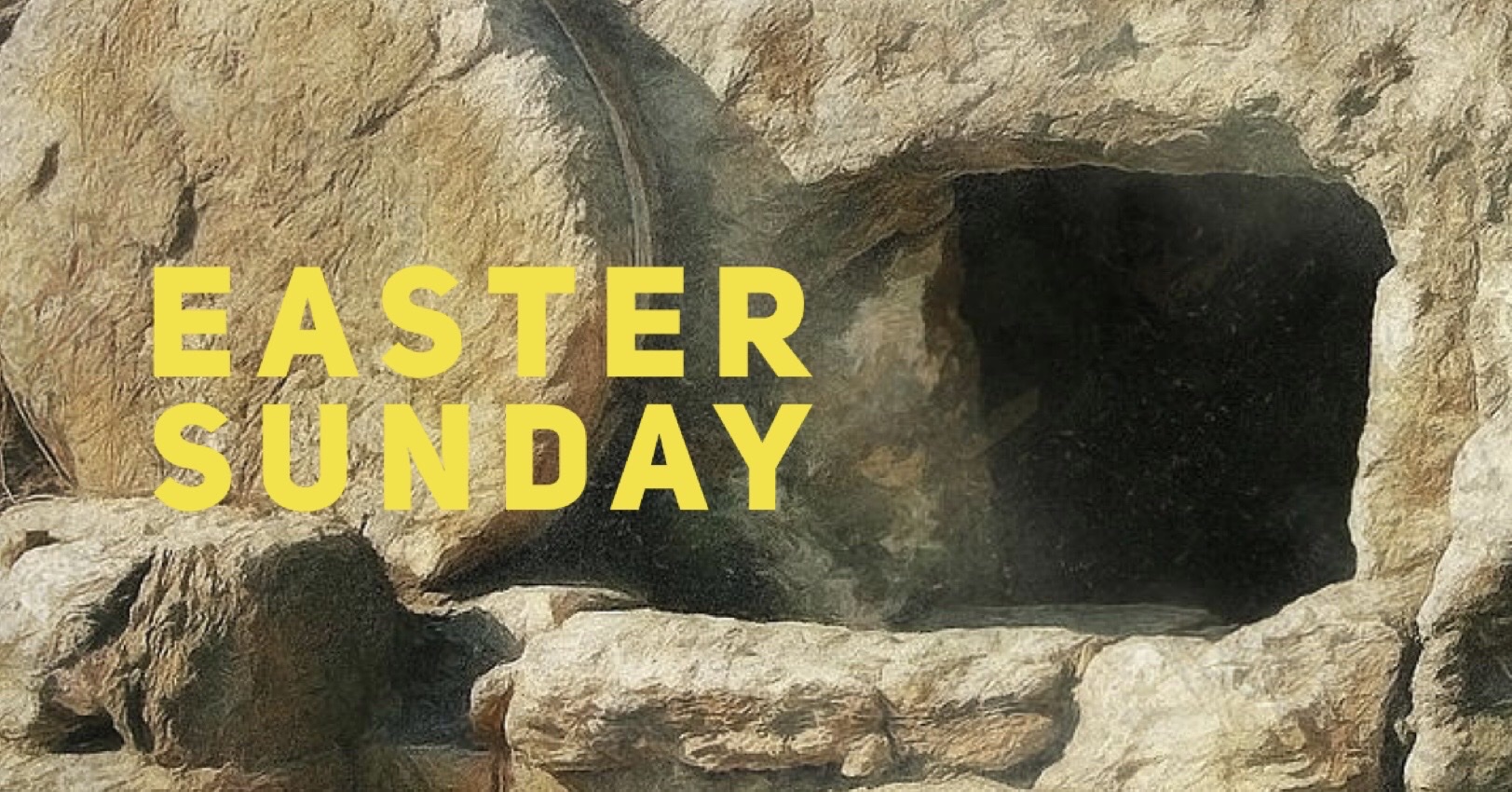
Easter Morning. The tomb is empty and Jesus is raised. Obviously.


I say obviously because it never could have been any other way. Some people have a problem with that – they say irrational things like ‘Dead people don’t come back to life – that’s simply impossible’. But the Bible says just the opposite, the Bible says it was impossible for Jesus to stay dead!


‘God raised him up, loosing the pangs of death, because it was not possible for him to be held by it.’ (Acts 2:24)


Granted, the dead rising to life again is not a common occurrence. But if the rationale for you not believing in the resurrection of Jesus boils down to, ‘It can’t happen, so it didn’t happen’, then you are not being intellectually honest with yourself, drawing your conclusions on preconceived assumptions which are not based on fact. And it’d only take a resurrection to happen once for you to have to change your point of view.

At the end of a lecture he had given on the reasons for his atheism, noted philosopher Anthony Flew, was once asked the question, ‘But what if Jesus was raised from the dead?’. ‘Well,’ he replied ‘If Jesus was raised from the dead, that would change everything’. His response was consistent with his lifelong commitment to go where the evidence led, a commitment that would, a few years before his death in 2010, ultimately lead to him coauthoring a book which was entitled ‘There is a God’.


It was the apostle Peter who made the above statement regarding the impossibility of Jesus staying dead. It is interesting to note the change that had occurred in Peter since Good Friday. After Jesus’ arrest he had been running scared, denying to everyone that he had ever even known Jesus. But here, on the day of Pentecost, just seven weeks later, he stands and publicly proclaims, to a crowd of thousands, the reality of the resurrection. The reason for the change in Peter isn’t hard to find: ‘This Jesus, God raised up,’ he says, ‘and of that we all are witnesses.’ (Acts 2:32).

Like Anthony Flew, Peter had followed the evidence.


The evidence for the resurrection is well documented and a couple of links follow for those interested:


http://www.desiringgod.org/articles/historical-evidence-for-the-resurrection


https://biblicalstudies.org.uk/article_resurrection_anderson.html

But why was it not possible for Jesus to stay dead? This is a philosophical argument and is based on the nature of death and the underlying reason for it. We tend to think that death is normal – the inevitable end to the wearing out of our bodies after long years of use or, alternatively, the tragic result of some violent insult, overwhelming infection, or malignant growth, something that our bodies cannot withstand. But the Bible says that there is a more fundamental reason for why we die. And that, it says, is because of sin.

Death is not part of how things should be – rather it is a travesty, the consequence of the presence of the wrong that is in the universe, the penalty for the sin of which we are all guilty – myself more than anyone. An awareness of this opens the door to our being able to better understand how Peter can make his assertion that it was not possible for Jesus to stay dead.

It is because Jesus was sinless, that death could not hold him.

If we struggle to believe anything about the Easter story, it shouldn’t be the resurrection of Jesus – that bit stands to reason. The amazing part of the story is that he ever died at all. That the author of life should die is a great mystery – but die he unquestionably did. As it is for his resurrection, the evidence for Jesus’ death is overwhelming, even bein* attested to by a paper published in the Journal of the American Medical Association in 1986. You can read it here:

https://jamanetwork.com/journals/jama/article-abstract/403315

So what then was the reason for Jesus’ death? The answer to that can be given in one word: Love. The love he had for those he came to save, those he was willing to lay down his life for, [John 10:15], those for whom his death would bring eternal life.

The reason that Jesus’ was born in the first place was ‘to seek and save the lost’ [Luke 19:10]. As the apostle Paul once wrote, the ‘saying is trustworthy and deserving of full acceptance, that Christ Jesus came into the world to save sinners’ (1 Timothy 1:15).

Jesus knew this and understood that the salvation he had come to achieve would be realised through his death. ‘The Son of Man must suffer many things’ he said, ‘and be rejected by the elders and chief priests and scribes, and be killed, and on the third day be raised.’ (Luke 9:22). That is the reason why, when the time of his crucifixion drew near, Jesus ‘set his face to go to Jerusalem’. (Luke 9:51).

Jesus went to Jerusalem on purpose, with the expressed intention of dying there.

But why did he have to die? More than that, why did he have be killed? Why couldn’t he have simply slipped away quietly in his sleep at a ripe old age? The answer to that question is that ‘the wages of sin is death’ (Romans 6:23). If justice is to be upheld, sin must be punished, and the penalty for sin is death.

We all want to live in a just universe – we cry out for justice when we see others maltreated especially when that injustice is particularly great or when we are find that it is who are the ones who are experiencing the injustice. The only time we are unhappy with justice is when we are guilty! I believe speeding drivers should suffer a penalty but many were the excuses I had for why I shouldn’t have had to attend the speed awareness course I was invited a few years ago!

God is, by his very nature, holy. He is perfectly right, perfectly just. And if he is to remain just, His standards must be he upheld. We, on the other hand, are not what we should be. We know, if we are honest, that we don’t live up to even our own standards let alone those of a holy and righteous God. Therefore, since as has been already been said, the ‘wages of sin is death’, we have a problem. We all deserve death, myself included and, unless a suitable substitute can be found, we face the prospect of experiencing that punishment ourselves.


But this is where the bad news of the law of God becomes the good news of the gospel. Because, not only is God holy and rightly angry at injustice he is, at the same time, merciful and gracious. God gave his only son to be a penal substitute, one who would act as the wrath absorbing, justice satisfying, atoning sacrifice for our sins. One who would gladly take our place and suffer for us the punishment we deserve.

At this point it is important to remember the mystery of the Trinity. God, though one, is three persons. We are not, therefore, seeing here a loving Jesus who absorbs the wrath of an vengeful despotic God. On the contrary, Jesus is himself fully God even as he is fully man. And the Father and Son, along with the Holy Spirit are one. As the Father loves the son, so the son loves the Father. Therefore, the death of Jesus, planned and agreed by all three persons of the Godhead before time began, and pointed too throughout the Old Testament [see for example here and here] reveals a loving Father every bit as much as it reveals a loving son,

The Old Testament prophet Isaiah had, some 700 years prior to the crucifixion, prophesied how God would one day lay on Jesus our sin and punish him in our place: ‘But he was pierced for our transgressions;’ he wrote, ‘he was crushed for our iniquities; upon him was the chastisement that brought us peace, and with his wounds we are healed. All we like sheep have gone astray; we have turned, every one, to his own way; and the LORD has laid on him the iniquity of us all.’ (Isaiah 53:5-6).

Jesus, because of his love, both for his Father and for us, willingly took on our sin and died in our place so that we need not suffer that punishment ourselves. He was put to death so that ‘whoever believes in him should not perish but have eternal life.’ (John 3:16). For our sake [God] made [Jesus] to be sin who knew no sin, so that in him we might become the righteousness of God. (2 Corinthians 5:21).

That is, God treats Jesus as if he had lived like us so that he can justly treat us as if we had lived like Jesus. This is what it means to say that God loves us. It’s not that he thinks everything about us is just peachy, but rather that he treats us well despite how little we deserve his kindness. He loves us, not because we are lovely, but because he is loving.

And how great is that love with which he loves us. We cannot conceive how vast that love is. ‘For as high as the heavens are above the earth, so great is his steadfast love towards those who fear him; as far as the east is from the west, so far does he remove our transgressions from us’ [Psalm 103:11-12]

‘In this is love, not that we have loved God but that he loved us and sent his Son to be the propitiation for our sins.’ (1 John 4:10). ‘The wages of sin is [indeed] death, but the free gift of God is eternal life in Christ Jesus our Lord.’ (Romans 6:23). ‘And this is eternal life, that [we] know…the only true God, and Jesus Christ whom [he has] sent.’ (John 17:3).

This then is how God loves us. Jesus death is not just a sign of God’s love, it is an act of love too, one that achieves our salvation. One that achieves our rescue. If I’m walking along the river with my wife and I turn to her and say ‘Darling, I love you so much and because I want to show you how much I love you I’m going to throw myself into the river’, and then, having made my declaring, I promptly proceed to do just that and drown, I am, what is commonly known as, an idiot! If however, as we walk along the riverbank she falls in and begins to drown, and I jump in to rescue her but, in so doing, lose my own life, then I have acted out of love. I will have demonstrated my love by my actions, by what I have done, by what I have achieved. I will have done a loving thing, but one that is no where near as loving as that which was done by the son of God who, of infinitely greater worth than I, died for those who were only deserving of death.

God then, in the death of his beloved son, at great personal cost, rescues us from himself so that we might enjoy knowing him forever, no longer having to live in fear of his righteous anger towards us. God’s justice was satisfied by his wrath being directed toward another, toward Jesus, the one who willingly absorbed it all for us on the cross. So completely did Jesus’ death pay the penalty for our sin that there is now no longer any of God’s anger left over to be directed at us. That is what is meant by Jesus’ death atoning for the sins of those he died for. That is the meaning of ‘propitiation’ in the verse above. God hasn’t merely laid aside his anger at sin only for it to rise up again at some later date, on the contrary, it has gone for good, even as it was fully poured out on Jesus.

That is why Jesus, as he hung on the cross, cried out ‘My God, my God, why have you forsaken me?” (Mark 15:34). Remarkably God was turning his back on the son he loves so deeply in order to save we who have ourselves turned our back on God. And it why the apostle Paul can write that ‘There is therefore now no condemnation for those who are in Christ Jesus.’ (Romans 8:1). All condemnation towards those whose only hope for salvation lies in Christ is gone! The job of satisfying the requirements of the law and thereby maintaining God’s justice even as he forgives we who have sinned and deserve death is complete. As Jesus died he said ‘It is finished’ (John 19:30). He wasn’t talking about h8s life, rather he was talking about his work of atonement. And he was right, the resurrection on Easter morning proving that his sacrifice really was fully effective in paying the price for all that we have done wrong. God’s grace really is completely sufficient for even the chief of sinners.


Rest assured, knowing God for all eternity will not be dull like some people imagine. We have all had moments in our lives when we have experienced something truly beautiful – a glorious sunset perhaps, a magnificent mountain view maybe or perhaps waves crashing powerfully against a rocky coastline. These are awesome sights, ones to be fully enjoyed enjoyed. But they are mere a faint echo of what we will one day experience, they will pale into insignificance when we see God face to face, when heaven is on earth and the dwelling place of God is with man. ‘He will dwell with [us], and [we] will be his people, and God himself will be with [us] as [our] God. He will wipe away every tear from [our] eyes, and death shall be no more, neither shall there be mourning, nor crying, nor pain anymore, for the former things [will] have passed away.’ (Revelation 21:3-4).

Seeing God and experiencing that future new creation will be infinitely more satisfying than the happiest times this world has to offer, better even than Easter Day. And the prospect of that future joy might just be enough to sustain us through the saddest times this world affords – days like Good Friday.


Easter morning – the tomb is empty and Jesus is raised.That’s good news – but not unexpected. It was always going to happen.


It was Good Friday.

But now it is Easter Sunday.

Obviously.


Happy Easter.


Addendum:


If you have read thus far, I am (a) surprised [I believe the expression is TL:DR – Too long: didn’t read] and (b) grateful. Thank you.


I am aware that this has been long but some things need more than the length of a tweet if one is to have any chance of conveying their importance.


I am also aware that there will be some, perhaps many, who will consider what I have written as naive, irrelevant and perhaps even offensive. If that is you I trust you’ll accept my words as a genuine attempt to explain things I hold to be of first importance for us all to know and understand. If, as a doctor, I genuinely believed I had a life saving cure for your terminal illness, you’d consider it cruel of me if I withheld that treatment from you even if you didn’t share the belief in its effectiveness. So consider me foolish by all means, but I hope you’ll not consider me unkind in writing as I have. If one can not write of these things at Easter time, then when can one write of them?
For all that however, I hope that there may be others who will agree with what I have written and, rejoicing with me at the news of Jesus’ life death and resurrection know that this news is simply too good not to share.


Related posts

To read, ‘Good Friday – 2021’, click here

To read, ‘The Resurrection – is it Rhubarb?’, click here

To read, ‘Real Love?’, click here

To read, ‘Hope comes from believing the promises of God’, click here

To read ‘John 3:16’, click here

To read ‘Water from a rock’, click here

To read ‘The Sacrifice of Isaac’, click here

Good Friday

One Maundy Thursday I wished a good friend of mine a happy Easter break. He hesitated however to return my good wishes because, he said, that he understood that Good Friday was a day for Christians like me to be miserable. It got me thinking to what extent he was he right.

Paul, writing in his second letter to the Corinthians, describes Christians as, ‘Sorrowful yet always rejoicing’ [2 Corinthians 6:10]. If such a paradoxical existence was the reality for Christians back in Paul’s day, it is surely no less true a reality for Christians living the 21st Century. ‘Good Friday’, the name we give today, is itself a paradox – for how can we apply the adjective ‘good’ to describe the day of Christ’s crucifixion? For sure, it is a day on which Christians should grieve over their sin and what it was that Jesus had to suffer in order to secure their redemption, but, at the same time, it is a day for rejoicing in the triumph of his sacrifice as we anticipate and remember his subsequent resurrection from the dead on Easter Sunday.


‘Sorrowful yet always rejoicing’ – it was the experience of Paul and it was also the experience of Jesus himself. For he was himself ‘a man of sorrows and acquainted with grief’ [Isaiah 53:5]. Matthew recalls the words of Jesus to Peter, James and John, in the Garden of Gethsemane:


“My soul is very sorrowful, even to death; remain here, and watch with me.” [Matthew 26:38].


And yet the writer to the Hebrews has it that Jesus, ‘for the joy that was set before him endured the cross’ [Hebrews 12:2].


Suffering, then, is not the end of joy – it can even be the passage to joy. Again this is not a contradiction – but it is a paradox! A paradox that the second thief, even as he was being crucified alongside Jesus, understood. There he was, in just about as bad a position as it is possible for a person to be in, minutes away from an excruciating death, when he, nonetheless, made his remarkable request:


‘Jesus,’, he said, ‘remember me when you come into your kingdom’ [Luke 23:42].


Like everybody else that day, the second thief saw Jesus suffering and dying on a cross. But unlike the religious rulers, the Roman soldiers and the other thief who was also being crucified that day, he didn’t see defeat. He continued to speak of Jesus as one who was coming into his kingdom. For him Jesus’ death didn’t mean an end to all the kingdom and salvation talk. Whilst all those others, those who mocked Jesus as they watched him die, were looking for a salvation FROM death, the second thief saw that the salvation Jesus was bringing about was a salvation THROUGH death.

Jesus’ death wasn’t the end of Christ kingdom, on the contrary, his death was its beginning.

This is a profound truth – one we do well to try and grasp some understanding of.


Far from a simple faith, the second thief’s faith was remarkable. And it is on account of his wonderful faith that we should not be surprised by Jesus when he responds to him with these words:


‘Truly, I say to you, today you will be with me in paradise’ [Luke 23:43].


Jesus saw in the second thief somebody who got it! Somebody who trusted the power of God despite seeing that which to unspiritual eyes was nothing but weakness. Somebody who saw victory where most saw only defeat. Somebody, indeed, who understood the paradox of Good Friday.


That suffering is not irredeemable,

That sorrow is not incompatible with joy,

That even the darkest nights can be followed by the brightest days.


‘Sorrowful yet always rejoicing’? It was the experience of Paul. It was the experience of Jesus. It was the experience of the second thief.
And it will be our experience too.


Some of us are sick? Some of us mourn the loss of loved ones? Some of us worry over our future? Some of us have experienced great tragedy in our lives – some recently, some longer ago but who nonetheless still feel the pain just as keenly as if it were yesterday.


There is indeed much today for us to be sorrowful over. Some Christian types can sometimes well meaningly suggest we should always be happy. ‘Smile’, they say, ‘Jesus loves you’. But though they are right to proclaim the truth that God really does love us, they are wrong to suggest that we should never be sad, for even the eternally happy God knows what it is to cry. [1 Timothy 1:11, Luke 22:62]. Even Jesus wept at the tomb of his friend Lazarus, his grief no less intense for knowing that he would soon bring him back to life. [John 11:35].

Perhaps, then, even God knows what it is to be sorrowful yet always rejoicing.

So it’s not wrong to be sad, it’s simply normal. The Bible never tells us to masochistically rejoice about our suffering. But it does tell us to rejoice in our suffering.


Because despite our sorrow – there is much to rejoice over! We truly are loved with an everlasting love, a love that transcends our current struggle, a love that means that we too can be sorrowful yet always rejoicing.

As we suffer we can rejoice because of the Gospel. The good news is that Good Friday was followed by Easter Day, that Jesus died for our sins, bearing the punishment we deserve, and that when he rose from the dead Jesus proved the sufficiency of his sacrifice. By it we are justified, counted righteous, declared to be ‘not guilty’.


Some of us grieve over our unrighteousness and can not even lift our eyes to heaven. We beat our breasts and cry out, ‘Have mercy on me, a sinner’ [Luke 18:13] But because of Jesus’ work on the cross on our behalf we are made right with God – regardless of our current situation.


Not because of our worth – but because of his grace.

Not because of what we do – but because of what he did.

Not because we are lovely – but because he is loving.


So, if you’re sorrowful today, remember you’re not alone, God weeps with you. And know that, because of Jesus, his life, death and resurrection, ‘Weeping may tarry for the night, but joy comes with the morning.’ [Psalm 30:5].


It’s Good Friday – but Easter Sunday is coming. Because of what took place over those two days nearly 2000 years ago, we can know real forgiveness for all those sins that we so bitterly regret, no matter how great they are.

But if that were not enough to rejoice over this Eastertide, we can also look to the future with a certain hope. Suffering is all too real today but the day is coming when God ‘will wipe away every tear form [our] eyes, and death shall be no more, neither shall there be mourning, nor crying, nor pain anymore, for the former things [will] have passed away.’ [Revelation 21:4]


‘So we do not lose heart. Though our outer self is wasting away, our inner self is being renewed day by day. For this light momentary affliction is preparing for us an eternal weight of glory beyond all comparison, as we look not to the things that are seen but to the things that are unseen. For the things that are seen are transient, but the things that are unseen are eternal’. [2 Corinthians 4:16-18]


It’s Good Friday – but Easter Sunday is coming.


So may we all know happiness this Eastertide – even those of us who are sorrowful.

Especially those who are sorrowful.


Related Blogs

To read, ‘Luther and the Global Pandemic – on becoming a theologian of the cross’, click here

To read, ‘T.S. Eliot, Jesus, and the paradox of the Christian Life’, click here

To read, ‘Why do bad things happen to good people? – a tentative suggestion’, click here

To read, ‘Suffering – a personal view’, click here

To read, ‘The “Already” and the “Not Yet”‘, click here

To read, ‘Hope comes from believing the promises of God’, click here

To read, ‘Faith in the time of Coronavirus 1’, click here

Faith in the time of coronavirus

A few reflections written in the days of Covid-19

IN THIS TIME OF UNCERTAINTY

‘In this time of uncertainty’.

These are words I’ve heard several times over the last few weeks – indeed I’ve said them myself, on many occasions. But here’s a thought, are things really any more uncertain at the moment?

Well of course they are. Doh!

But then again, perhaps not.

How so? Because what we once imagined was certain about tomorrow was never as certain as we thought it was. Indeed James, never one to mince his words, tells us that we are arrogant and evil to ever imagine that we know what tomorrow will bring!

‘Come now, you who say, “Today or tomorrow we will go into such and such a town and spend a year there and trade and make a profit” – yet you do not know what tomorrow will bring. What is your life? For you are a mist that appears for a little time and then vanishes. Instead you ought to say, “If the Lord wills, we will live and do this or that.” As it is, you boast in your arrogance. All such boasting is evil. [James 4:13-16].

The only things that are seemingly more uncertain to us today are those things we are told we shouldn’t ever have considered as certain in the first place!

But that’s not the only reason why we shouldn’t unquestionably accept that everything is now uncertain. Because it is still wonderfully true that the things that really matter, those things that relate to the unchanging character of our loving Heavenly Father, are no less certain today than they were a month ago.

God remains totally in control and, as James implies, it is still true that what the Lord wills, that will be what happens. We can draw comfort from that can’t we?

Furthermore, the writer to the Hebrews also reassures us. ‘Jesus Christ is the same yesterday and today and forever.’ [Hebrews 13:8] And his steadfast love is therefore no less certain in these days. The truth is that His love will never cease. Likewise the Lord’s mercy – it too will never come to an end. Indeed it’s newness is as certain today as it proved to be yesterday, and will prove to be tomorrow. [Lamentations 3:22-23].

So, uncertain times? Well maybe, but then again, maybe not.

Now I am sure that there will be many other verses that we can think of that contain promises made by God. Each offers us certainty today because God’s promises, all of which find their ‘Yes’ in Jesus, [2 Corinthians 1:20] can be utterly depended upon. God is faithful.

So, if you’ve a mind to, why not add some of God’s promises that come to your mind in the comments below. They’ll be an encouragement to us all.

Go on…you know you want to! We could end up with quite a list.

That is, of course, God willing!


SELF ISOLATING AND FEELING ALL SO ALONE?

Self isolating and feeling all so alone?

Wondering if anyone is thinking of you, if anyone knows what you’re doing – whether you’re standing, sitting or lying down?
Questioning if anyone knows, or cares, what you think?
Guessing that you’re talking to yourself – that nobody is listening?

Then know this: Our Heavenly Father sees our every move, knows our every thought. and, even now, surrounds us. He has His hand upon us.

‘O LORD, you have searched me and known me!
You know when I sit down and when I rise up; you discern my thoughts from afar.
You search out my path and my lying down and are acquainted with all my ways.
Even before a word is on my tongue, behold, O LORD, you know it altogether.
You hem me in, behind and before, and lay your hand upon me.
Such knowledge is too wonderful for me; it is high; I cannot attain it.’
[Psalm 139:1-6]

We are none of us, ever alone

‘The LORD is near to all who call on him, to all who call on him in truth.’ [Psalm 145:18]. ‘In Christ Jesus [we] who once were far off have been brought near by the blood of Christ.’ [Ephesians 2:13]

And to we who are His;

God the Father has said, ‘I will never leave you or forsake you’ [Hebrews 13:5];

Jesus the Son has said ‘I am with you always, to the end of the age’ [Matthew 28:20];

and the Holy Spirit is the one who dwells within us.
[2 Timothy 1:14]

May we all know that, today, the triune God is with us. He is near.

with thanks to my son-in-law, Dan Wallace, for the idea.


JESUS DOESN’T NEED TO SELF ISOLATE

‘And [Jesus] told his disciples to have a boat ready for him because of the crowd, lest they crush him, for he had healed many, so that all who had diseases pressed around him to touch him. [Mark 3:9-10]

I read these verses this morning. What a contrast to these days of social isolation. The diseased press around Jesus to touch him in search of a healing.

When the diseased touch the clean the clean are made diseased – except when the one who is clean is Jesus, the only one who is truly clean. Then the diseased are made clean by his touch.

In these days let us draw comfort from the fact that he has cleansed us from our sin, a far more deadly thing than any coronavirus. We are clean in the sight of God because of Jesus. His death has bought us life. And may we touch others with the gospel. It is the good news we all need to hear today.

‘For our sake he made him to be sin who knew no sin, so that in him we might become the righteousness of God.’ [2 Corinthians 5:21]


YOU’RE NOT AS LOST AS YOU MIGHT THINK

‘I am God, and there is no other; I am God, and there is none like me, declaring the end from the beginning and from ancient times things not yet done, saying, ‘My counsel shall stand, and I will accomplish all my purpose,’ [Isaiah 46:9-10]

Some years ago, whilst out on a walk, one of my children announced that they were lost. This was on account of said child not having a clue as to where they were. But the individual in question was wrong – they weren’t lost because the one who held their hand, [me], knew exactly where they were.

I knew the way home.

Perhaps you can’t see a way through all that’s going on just now. But be assured – you’re not lost because the one who holds your hand knows exactly where you are and, even in these particularly difficult days, that same loving Heavenly Father will ensure that we will all eventually make it safely home.

The one who really does know the end from the beginning holds us still.


COMFORTING WORDS

‘Even though I walk through the valley of the shadow of death, I will fear no evil, for you are with me; your rod and your staff, they comfort me.’ [Psalm 23:4]

I don’t know about you but, with all this talk of death, I am in need of some comforting. But where can we find such a thing when daily there is so much bad news that unsettles us?

We could simply avoid listening to the news, try to ignore reality by refusing to live in the real world. But such comfort would not be genuine.

We could pour over the statistics which perhaps suggest that any individual’s chance of coming to serious harm remain small. But such comfort would not be complete.

We could lose ourselves in fictional dramas offered up by our Netflix subscriptions and try to simply forget. But such comfort would only be temporary.

But I for one need a greater comfort than that.

‘Blessed be the God and Father of our Lord Jesus Christ, the Father of mercies and God of all comfort, who comforts us in all our affliction, so that we may be able to comfort those who are in any affliction, with the comfort with which we ourselves are comforted by God.’ [2 Corinthians 1:3-4]

God is the God of ALL comfort. There is therefore no real comfort to be found elsewhere. He may not remove us from the difficulties we are experiencing, (the verses don’t promise that, only that He comforts us IN our affliction), but He none the less comforts us however great that affliction is. His is a complete comfort, one that comforts us in ALL our affliction.

So we would do well to stop trying to do things to comfort ourselves but instead allow God to comfort us with what He has already done.

How?

By hearing the most important news of all. ‘that Christ died for our sins in accordance with the Scriptures, that he was buried, that he was raised on the third day in accordance with the Scriptures’ [1 Corinthians 15:3-4]. This is not false news – on the contrary, ‘The saying is trustworthy and deserving of full acceptance, that Christ Jesus came into the world to save sinners.’ [1 Timothy 1:15]

By focusing on the statistics that are able to completely reassure, those that tell us that ‘EVERYONE who calls on the name of the Lord will be saved’ [Romans 10:13], that ‘ALL who come to [Jesus, He] will never cast out’ [John 6:37], that if ANYONE does sin we have an advocate with the Father, Jesus Christ the righteous [and] He is the propitiation, the ‘wrath absorbing, justice satisfying, atoning sacrifice’, for our sins [1 John 2:1-2] and that ‘if we confess our sins, he is faithful and just to forgive us our sins and to cleanse us from ALL unrighteousness.’ [1 John 1:9]

And by remembering the greatest drama that ever played out, the historically verifiable one in which ‘God so loved the world, that he gave his only Son, that whoever believes in him should not perish but have eternal life.’ [John 3:16].

The first question of the Heidelberg Catechism asks ‘What is your only comfort in life and death?’. It has a beautiful answer:

‘That I am not my own, but belong with body and soul, both in life and in death, to my faithful Saviour Jesus Christ. He has fully paid for all my sins with his precious blood, and has set me free from all the power of the devil. He also preserves me in such a way that without the will of my heavenly Father not a hair can fall from my head; indeed, all things must work together for my salvation. Therefore, by his Holy Spirit he also assures me of eternal life and makes me heartily willing and ready from now on to live for him.’

‘Comfort, comfort my people, says your God. Speak tenderly to Jerusalem, and cry to her that her warfare is ended, that her iniquity is pardoned’ [Isaiah 40:1-2]

Here then, in God’s true word, is found comfort indeed

May it be a comfort that is sufficient for each of us. One that, knowing that all that God says is true, enables us, regardless of whether we live or die, to confidently say with Paul that ‘to live is Christ, and to die is gain’ [Philippians 1:21]. Because even if we do die, we can be sure that, just as with the second thief at the crucifixion, Jesus will remember us and ensure that, on that day, we will be with him in paradise. [Luke 23:43]

Even though I walk through the valley of the shadow of death, I will fear no evil, for you are with me; your rod and your staff, they comfort me.’ [Psalm 23:4]

That is our hope – not that we will not die but rather that we will surely be raised, resurrected to eternal life, to dwell in the house of the Lord forever. [Psalm 23:6]


THE FEAR OF THE LORD

Psalm 147:11 says,

“But the Lord takes pleasure in those who fear Him
In those who hope in his steadfast love”

This is a curious thing to say, suggesting as it does that we should hope in the one we fear. Generally speaking we run away from what we fear, hide from it, isolate ourselves from it, hoping as a result to find some safety.

But if we fear God – if we fear the consequence of all the wrong things we have done – then our only hope is to run NOT AWAY from God. But towards Him.

And most particularly we need to run to the cross – where God’s anger was poured out – not on us, but on his son Jesus who took the punishment we deserve. Think of some dreadful fire destroying all before it – the safest place to be is where the fire has already been and burned the ground before moving on. That ground can’t be burnt again. So it is with God – the safest place from God’s wrath is where it has already fallen and cannot fall again. Some of us may be wisely seeking a degree of safety today by isolating ourselves in our homes, but ultimately we are safe only in Christ.

“God is our refuge and strength, a very present help in trouble.’ [Psalm 46:1]

Though at first glance it seems crazy for sinners like us to run towards a holy, righteous God, the truth is that actually the only sensible thing for those who fear God is not to hide from Him but to run to Him for mercy – putting our trust in his steadfast love.


WISHFUL THINKING?

As the news grows ever more concerning, are you, like me, longing for better days? Perhaps then you may be comforted by these words of Victor Hugo.

“Even the darkest night will end and the sun will rise”

Such is an encouraging and hope filled assertion, not dissimilar to those made by others in recent times who have expressed the view that ‘these days will pass’. But are such assurances merely wishful thinking?

Hugo’s words reminded me of a time last year when I found myself in what I believe these days is called a ‘space’. On the walls were a number of displays one of which caught my eye. Upon it were written these words:

‘There will be other times and better times’

Of course these words may also have been no more than wishful thinking. But what was unusual about them was where exactly they were inscribed. Because the space I was in was a church, and the display I was looking at was a memorial stone to somebody who had died.

To many people therefore, the words would have been nothing but foolishness for how can there be other, better times after death?

But to those who believe that what God says is true, the words are neither the consequence of foolishness nor the result of naive optimism. On the contrary, to those who trust God, the words are most certainly true because they are based on his promises.

They are the words of somebody with genuine faith, of somebody who is assured of the things which are hoped for, who is convinced of the things not yet seen. [Hebrews 11:1]

Because for the Christian, even in death there is hope, a certain hope – that of resurrection. It is not that we hope to avoid death and suffering but rather that, even as we do suffer and die we will still be able to confidently declare that ‘There will be other times and better times’.

David put it slightly differently:

‘Weeping may tarry for the night, but joy comes with the morning.’ [Psalm 30:5]

For some, of course, the night has already been long and the dawn is yet along way off. Even so, the sun will eventually rise.

But for now we wait. As we do, ‘May the God of hope fill [us] with all joy and peace in believing, so that by the power of the Holy Spirit [we] may abound in hope.’ [Romans 15:13]


For ‘Faith in the time of Coronavirus – 2’, click https://peteaird.org/2020/05/19/faith-in-the-time-of-coronavirus-2/here

For ‘Faith in the time of Coronavirus – 3’ click here

For ‘Faith in the time of Coronavirus – 4’ click here

Covid -19. Does it suggest we really did have the experience but miss the meaning?

In 1957 Harold MacMillan told the British people that they’d never had it so good.

How though, things have changed. In these days of a coronavirus pandemic, our way of life is being threatened in a way not seen since WWII and the NHS, which we have come to expect will always be there for us when we need it, is being stretched to the point where medical care may not be as wholly available for some as we would like.

What are we to think? What if this were to become the new norm? What if the past 75 years were an anomaly?

Perhaps now would be a good time to ask ourselves if T.S. Eliot was right. Did we have the experience but miss the meaning?

The following is a reissue of a blog first written nearly two years ago under the title, ‘T.S. Eliot, Jesus and the Paradox of the Christian Life’.

WE HAD THE EXPERIENCE BUT MISSED THE MEANING

Recently I read ‘Histories’ by Sam Gugliani – It’s a very good read relating the stories of various individuals, clinical and non clinical, who work in a hospital, and gives their differing perspectives of what takes place there. To give you a flavour, here are a few quotes that stood out for me and got me thinking.

“Hospital words spun like stones across the still waters of people’s lives.

“We’re all victims, aren’t we, of medicine’s success.”, and

“Their voices change key when they speak to him, lengthening to a sing-song, as if his dying might be rendered in nursery rhymes.”

And then there was, “We had the experience but missed the meaning”. Those more literate than I will know without resorting to an internet search that it is a line from the third of T.S. Eliot’s ‘Four Quartets’ entitled ‘The Dry Salvages”. It has been on my mind since discovering this remarkable, if perhaps bleak, poem.

Drawing on a 2010 blog by Ben Myers which helped me understand the poem, Eliot seems to be saying that ‘as one becomes older’ our pasts reveal, if we will see it, a pattern in which moments of ‘sudden illumination’, those times when we are happy, are the temporary exception to the norm. They are like a ‘ragged rock in the restless waters’ which serve only to reveal that the true nature of our existence is one in which permanency is characterised by abiding ‘moments of agony’ – such is ‘the primitive terror’.

“And the ragged rock in the restless waters, Waves wash over it, fogs conceal it; On a halcyon day it is merely a monument, In navigable weather it is always a seamark To lay a course by: but in the somber season Or the sudden fury, is what it always was”

Eliot describes ‘Time’ as both our ‘destroyer’ and our ‘preserver’. The only thing that keeps us alive is the very thing that brings about our demise. Eliot is urging us to see this deeper truth that our moments of happiness display. We have these experiences, he says, but are want to miss their meaning.

So what do I take from this as a doctor? Like moments of happiness, health is but temporary. In due course normality will be restored and we will all succumb to the ravages of time. It will ultimately destroy us. I don’t mean that we should resign ourselves to a life of melancholic anticipation of death, but we should, I think, appreciate health for what it is – a state of being that we should value whilst we have it.

Furthermore, as doctors, we should be realistic in terms of what we can expect to achieve for our patients. We are, after all, only doctors. We should make every effort to tend the sick and whenever possible endeavour to effect a cure.

But just as important perhaps is how we encourage our patients to value their health as the fragile state it truly is and we would also do well to consider how we might prepare them for the inevitability of death. Colluding with patients that with the right combination of pills, and sufficient attention to lifestyle, death will be avoided is dishonest and, perhaps, detrimental to all our chances of enjoying the life that we have.

To continue on a more positive note, it should be remembered that ‘The Dry Salvages’ is but the third of Eliot’s ‘The Four Quartets’. The fourth, ‘Little Gidding‘ offers us some hope of redemption. Ironically perhaps, the reader is asked to reflect on their experience of what they have read earlier and understand that they may indeed have missed the meaning. There is redemption but it is a redemption not from, but through death.

What we call the beginning is often the end And to make an end is to make a beginning. The end is where we start from… We shall not cease from exploration And the end of all our exploring Will be to arrive where we started And know the place for the first time.

Similarly then, might we, and our patients, know happiness, not by the avoidance of all sadness but rather through experiencing sorrow in all its dreadful intensity? Too often I make the mistake of thinking that I can only be happy when I’m not sad, and so, when unhappiness steals its inevitable way into my life, I am left feeling that I can no longer know what it is to be happy. Foolishly, before allowing myself to smile again, I insist on striving to put an end to everything that reduces me to tears, on endeavouring to put everything right.

But I simply cannot do it. Whilst I hope for that time when all will be well, waiting until then before being happy only succeeds in leaving me a long time sad.

But, seemingly contradictory, happiness and sadness are not mutually exclusive. In some sense we cannot know what happiness really is without knowing the pain of sorrow – and sorrow requires the memory of the temporary nature of happiness.

To be truly happy then we cannot deny sadness – on the contrary we must embrace it. And we must learn that it is possible to know what it is to be ‘sorrowful yet always rejoicing’. It is not that we can not be happy because we know sadness, nor that we can not be sad because there are things to be happy about. Paradoxically, we can be happy and sad at the same time.

As Leonard Cohen sang, shortly before his death, ‘There is a lullaby for suffering and a paradox to blame’.

Understand this and we, and our patients, may experience life without missing its meaning.

******************

T.S. Eliot professed a Christian faith, converting to Anglicanism in 1927 and served as a warden at his local parish church of St. Stephen’s, Gloucester Road, London. The question arises then as to whether Eliot’s bleak view of a life, a life characterised by inherent sadness, all be it with the hope of redemption, is in contradiction to the joy that the Bible teaches results from the receiving of the gospel.

As with much in the Christian life there is a tension here, but the simultaneous experience of joy and sadness is better described as a paradox, one experienced by the apostle Paul himself who wrote of how he was ‘sorrowful, yet always rejoicing’ (2 Corinthians 6:10). Furthermore, Eliot’s line ‘We had the experience but missed the meaning’ is one that might have been used by Jesus himself.

John 6 recounts the feeding of the 5000. The following day the people come to Jesus again only to be rebuked by him when he said to them, “Truly, truly, I say to you, you are seeking me, not because you saw signs, but because you ate your fill of the loaves” (John 6:26). ‘You had the experience of eating the bread’, Jesus is saying, ‘but missed the meaning of what it meant to be fed’.

So what was the meaning? Undoubtedly the miracle was a sign and, as with all signs, what they point too is more important than the sign itself. Nobody on a trip to the seaside, sees a sign to the beach and stops and admires the sign rather than hurrying on to play in the sand.

The miracle of the feeding of the 5000 points to who Jesus is. By miraculously feeding so many people, Jesus is recreating God’s miraculous provision for the Israelites in the wilderness when he daily provided them with manna from heaven. In so doing Jesus is declaring himself to be God. But if Eliot is right then perhaps there is more here to be learnt.

Just as the experience of moments of happiness are meant to display our abiding sadness, might not the experience of being fed be meant to reveal our enduring hunger. Jesus’ words urging the people not to work for ‘the food that perishes’ suggests this might indeed be the case.

Being fed with bread one day leaves you hungry the next even when that bread is miraculously provided by Jesus. Hunger is the default position. As far as we know, Jesus did not feed the people when they came to him this second time. Instead he tells the people to work ‘for the food that endues to eternal life’ which, he says, will be given them by ‘the Son of Man’ (John 6:27).

Jesus then famously declares that he is ‘the bread of life’ and that ‘whoever comes to him shall not hunger’. Here is redemption – an end to all hunger – a redemption secured by looking on the Son and believing on him – a redemption that is all of God whose work it is that we should believe in the one he has sent. (John 6:29).

To have the experience of being temporary fed with physical bread and miss the meaning it points to of our perpetual hunger is to miss seeing our need for redemption by feeding on the everlastingly satisfying bread of heaven. That would be a disaster.

I think Eliot is saying something similar. Our moments of happiness are meant to point to our permanent sadness and our need for a redemption which will secure an eternal joy.

Not many of us today, in our comfortable middle class churches, know what it means to be genuinely hungry. But we do know what it is to be genuinely sick and genuinely have problems that leave us sad. Frequently, and very appropriately, we come to Jesus on account of these things to seek his help.

Now just as Jesus fed the 5000, he also healed many people, but just as the relief of the people’s hunger was temporary, so too the physical healings that Jesus performed were also only temporary. Just as the people he fed returned to him hungry the following day, so those he healed all eventually became sick again. Even Lazarus, who Jesus raised from the dead, in time knew what it was to become ill once more and ultimately die a second time.

I wonder if sometimes, just as he rebuked the people for coming to him for food, for their physical needs, Jesus might, when all we are concerned about is our health, sometimes rebuke us for our constant requests for healing.

This is not to say we shouldn’t pray for healing, the Bible clearly gives us warrant for this, but we must be careful that we don’t use Jesus as a spiritual circus pony who must perform tricks at our bidding. Might he not sometimes say to us, ‘Truly, truly, I say to you, you are seeking me, not because you saw signs, but because you want a healing’? Might he not urge us sometimes not to work for the healing that perishes, but the healing that endures to eternal life?

If so, when we are not healed the way we would like, when our problems are not resolved the way we would chose, just as the people were not fed the way they would have liked the day after the feeding of the 5000, might we be encouraged that the reason for this is that Jesus wants us to have something better than physical healing? Might he want us not to have had the experience but miss the meaning?

Our moments of health are but temporary and we should treasure them. But we must also see in them the meaning of our permanent sickness and our need for an eternal healing. Those who look on Jesus, who believe in him, will not spiritually die for, not only is Jesus the bread of life, he is also the resurrection and the life.

The idea that health is an aberrant exception to disease, mirroring Eliot’s suggestion that happiness is an aberrant exception to a life of unhappiness, has support from scripture. 2 Corinthians 4:16 reminds us that ‘our outer self is wasting away’. For our bodies to fail is the norm. Lately I met somebody who assured me that I would soon be out of a job on account of ‘a new wave of the Spirit’ that would, in this present age, see an end to all disease. Similarly we may have dreams of ‘making poverty history’ in the here and now but Jesus said we would always have the poor with us (John 12:8) – I suspect he could have also said we will always have the sad and the sick. But taking those words that speak of our outer self wasting away in context we again have a paradox, for it is by that wasting away that our inner self is being renewed day by day. It is this suffering, this ‘light and momentary affliction’ that is preparing for us an eternal weight of glory, beyond all comparison’. (2 Corinthians 4:17).

And ‘so we do not lose heart’. Temporarily being fed should remind us of our perpetual hunger and our need for spiritual food. Temporarily being healthy should remind us of our perpetual sickness and our need for spiritual healing. Temporarily being happy should remind us of our perpetual sadness and our need for spiritual joy. All of which we find in Jesus.

So yes we are hungry, yet always feeding, we are sick yet always being healed, and we are sorrowful yet always rejoicing. Such is the Christian life, not a contradiction but a mysterious and wonderful paradox. It is not that we can not be happy because we know sadness, nor that we can not be sad because there are things to be happy about. Rather we can be simultaneously happy and sad. It is a paradox, not a contradiction.

We may see in our lives hunger, sickness and unhappiness, things that sometimes may be ordained for our good by our loving Heavenly Father in order that we might ‘look not to the things that are seen, but to the things that are unseen’ namely spiritual food, life and joy. ‘For the things that are seen are transient, but the things that are unseen are eternal’ (2 Corinthians 4:18). We all experience health and happiness. When we do we must not have the experience but miss the meaning. And so too, when we suffer and are sad, as well as recognising how the longing for happiness whispers of the happiness that really does exist for us somewhere, we must also acknowledge that there is meaning in our experiences of suffering and sadness.

We can rejoice, then, when we are sorrowful and we can give thanks in every circumstance, for we have been, are being and will be redeemed – from sorrow, through sorrow, from suffering, through suffering and from death, through death.

Some trust in chariots…

As Covid-19 continues to dominate the headlines and stretch our health services like nothing before, it is, of course, a very concerning time for us all.

But now is not the first time that the people have found themselves unnerved. Nearly 3000 years ago King Uzziah died, and the future then seemed very uncertain for the people of Isaiah’s day. Isaiah, however, saw beyond the immediate uncertainty.

This is what he wrote:

‘In the year that King Uzziah died I saw the Lord sitting upon a throne, high and lifted up; and the train of his robe filled the temple. Above him stood the seraphim. Each had six wings: with two he covered his face, and with two he covered his feet, and with two he flew. And one called to another and said: “Holy, holy, holy is the LORD of hosts; the whole earth is full of his glory!” And the foundations of the thresholds shook at the voice of him who called, and the house was filled with smoke.’

[Isaiah 6:1-4]

There is an image of one who is utterly in command. Uzziah may have died but God was still on the throne. And, despite the difficulties and uncertainties we all are currently facing, I believe he still is today

As one who works in the NHS, it was heartening to hear the applause that rang out on Thursday night for those who work in it. But we do need to be careful that we don’t begin to misplace where we put our hope. Because if we hope only in the NHS we are lost. I don’t doubt the NHS will go above and beyond in the coming weeks, many will show huge devotion to the care of others, often at risk to themselves, and I pray that I may play my part well in that great effort too, but what we are facing is beyond the best efforts of even the worlds greatest health care system.

Furthermore, amazing though the NHS is and though we will rightly all be immensely grateful for the no doubt many many people who will be kept alive that might not otherwise have survived, it cannot save everyone. Indeed it can not, in eternal terms, save anyone. Whilst many will be preserved through this coronavirus pandemic, each of those whose deaths are thus delayed will still face that great enemy in time.

So whilst there is a place to applaud the NHS, and, really, thank you if you did, I don’t want to appear churlish, it really is appreciated, we must not allow it to become an idol in which we put our ultimate trust. Maybe it’s just me but this week I have found myself trusting in the statistics, the news of a 4000 bed coronavirus unit being provided in London and, in the absence of proper PPE, the sourcing of some suits designed for those working with asbestos to offer a little more protection than the flimsy plastic aprons we would otherwise have to rely on.

It was Martin Luther who described the human heart as an idol factory. In my case at least, he wasn’t wrong. Whilst it is right to be grateful for these things, and while I really should be striving to adhere to the government restrictions regarding social distancing, I am wrong to imagine my ultimate security is found in such things. Rather than drawing comfort from the degree of safety that these things provide, I should be trusting the one who truly holds my future in his hands. I should be on my knees crying out to the one who can secure for us the eternal salvation we require. So let’s appreciate the NHS by all means, it is after all undoubtedly a means of God’s grace to many, but let us not forget to honour the one who is truly worthy of all our praise

God has made promises, promises that there is a day coming when He will wipe away every tear from [our] eyes, and death shall be no more’, a day when ‘neither shall there be mourning, nor crying, nor pain anymore, for the former things [will] have passed away.”

[Revelation 21:3-4]

The NHS cannot deliver this – it simply isn’t up to the task. If we demand this of the NHS it will let us down, if not in the next few months then later in our lives. Expect the NHS to solve all of our problems and not only will we be disappointed but we will also put a burden on those who work in it way beyond that which they can bear.

I am part of a fantastic primary care team and I value each and every member of the team including those wonderful retired partners who are even now considering how they can help. I am fortunate indeed to have them around me but, for all that, I know they are all only human. And so, as well as being immensely grateful for them, I am currently praying for them daily – and please if you are minded to, join me in this. The NHS may be the greatest health organisation in the world but the truth is that there isn’t any organisation anywhere that can possibly deliver what we would really like it to.

But God can. The same God who has demonstrated His ability to keep his word most vividly in the life, death and resurrection of Jesus Christ. So let’s be grateful for the NHS, let’s applaud it, every week if we wish, but let’s not forget where our real hope must lie.

As I have said, God has has made promises – promises that he can and will keep.

Now there may be some that ask how I can be so confident in God when there is plainly so much suffering in the world and which some of those reading this will have had all too real experience. There is, of course no easy answer to that. But I trust in the God that entered into our suffering that He might redeem us through that suffering. It may not be the way that we’d have chosen to do it, but then we’re not God and his thoughts are not our thoughts, neither are our ways his ways. [Isaiah 55:8].

And I for one am very comfortable in accepting that God is wiser than I am – consider the arrogance it would take for me to think otherwise. And I believe that I can have every confidence in believing it when He assures me that ‘though weeping may tarry for the night, joy comes with the morning. [Psalm 30:5]

So we can rightly be very grateful for the NHS but we must put our hope ultimately in God, banking on his promises.

Rather than boast in man’s abilities, we need to humble ourselves. God is for those who know their weakness. He blesses the poor in spirit, blesses and comforts those who mourn. [Matthew 5:3]: a bruised reed he will not break and a faintly burning wick he will not quench, he will faithfully bring forth justice. [Isaiah 42:3] My God gives rest to all who labour and are heavy laden.[Matthew 11:28]

So, ‘shall not the Judge of all the earth do what is just? [Genesis 28:25] I believe He will and it’s what will get me to sleep tonight despite the world’s current uncertainties.

‘Some trust in chariots and some in horses, but we trust in the name of the LORD our God. ‘[Psalm 20:7]

And I for one am convinced that we are right to do so because He is one who can be trusted.

Addendum:

‘And [Jesus] told his disciples to have a boat ready for him because of the crowd, lest they crush him, for he had healed many, so that all who had diseases pressed around him to touch him. [Mark 3:9-10]

I read these verses recently. What a contrast to these days of social isolation. The diseased press around Jesus to touch him in search of a healing.

When the diseased touch the clean the clean are made diseased – except when the one who is clean is Jesus, the only one who is truly clean. Then the diseased are made clean by his touch.

In these days let us draw comfort from the fact that he has cleansed us from our sin, a far more deadly thing than any coronavirus. We are clean in the sight of God because of Jesus. His death, by paying the penalty for our wrongdoing, has bought us life. And may there be many who are touched by this gospel. It is the good news we all need to hear today.

‘For our sake he made him to be sin who knew no sin, so that in him we might become the righteousness of God.’ [2 Corinthians 5:21]

But this I call to mind, and therefore I have hope

This was written in the first week of March when coronavirus was just beginning to make its presence felt in the UK.

This week, as coronavirus continues to spread and increasingly dominates our thinking, I have been reading the book of Lamentations. It can be a difficult book to read at times describing as it does the anguish of one who, seeing disaster all around him, recognises that it is God himself who has brought about the tragic events he is witnessing. He acknowledges those events to be the just consequence of the corruption that exists in a world that has rejected God. The book is a helpful reminder that as well as being a God of love, God is to be feared since, as a holy God, he is also a God who requires that justice be done.

Proverbs 9:10 tells us that ‘The fear of the LORD is the beginning of wisdom’ and yet, today, the fear of God is something we rarely feel, preferring other things to worry about instead. Currently many are concerned about the coronavirus, and the prospect of a world pandemic. This is wholly understandable but the threat posed by the virus pales into significance against the danger we all face before a righteous God. As the writer to the Hebrews put it, ‘It is a fearful thing to fall into the hands of the living God.’ [Hebrews 10:31].

Without presuming to imagine I know the mind of God by suggesting that the disease is a specific judgement from God for any specific sin, we would nonetheless do well to see the current spread of coronavirus, like any threat to our lives, as not only a call to action but also as call to repentance. I know it is for me. [See Luke 13:1-5]. As C.S. Lewis wrote, ‘Pain insists upon being attended to. God whispers to us in our pleasures, speaks in our conscience, but shouts in our pains: it is his megaphone to rouse a deaf world.’

What then are we to do in the face of Covid-19? Is it really sufficient to hope solely in the effectiveness of catching our unexpected sneezes in our elbows, preferring foot-taps to handshakes and repeatedly washing our hands whilst singing ‘Happy Birthday’? Now don’t get me wrong, these are all vitally important things that we should all be practicing, and no less so for those like me who have a high regard for the sovereignty of God and thus believe that He determines the moment when each of us will die – after all such people rightly take great care to look both ways before they cross the road. As a doctor, I fully recognise the value of good advice and the benefits of medical science, frequently the means of God’s wonderful grace but we all nonetheless need something even greater than these sensible measures in which to place our trust.

The writer of Lamentations thought so too. Despite being cast down by the trouble he saw all about him, he none the less called to mind that the steadfast love of the LORD never ceases, that His mercies never come to an end, that they are, in fact, new every morning. He recalled God’s great faithfulness and, therefore, on account of what he knew to be true, had good cause to have hope. [Lamentations 3:21-23].

Even as a Christian I can sometimes find myself forgetting this. Sometimes I can find myself drawing more comfort from the survival statistics that suggest that if infected with coronavirus I am likely to come through it alive, than the more certain truths that I profess as a believer. This is unwise of me since the reality is that I cannot tell whether God will allow me to become infected, and, if infected, whether he will allow me to live or die. But, like the writer of Lamentations, this I know for certain – that God’s steadfast love for me will never cease and that, whether I live or die, his mercy towards me will never come to an end.

As it happens I have next week off and I am planning, God willing, to spend it in a holiday cottage in Eyam in Derbyshire. This seems strangely fitting since Eyam is remembered as the plague village. The first death from bubonic plague occurred there in September 1665 and by the Spring of 1666, 42 villagers had died. As a result there were understandably many residents who were at that time planning on fleeing the village but the recently appointed rector, William Mompesson, with the help of the previous incumbent Thomas Stanley, called a meeting and managed to persuade the villagers to stay with him and face death rather than put the lives of those outside the village at risk. As a consequence many residents died. Elizabeth Hancock buried six of her children along with her husband over an eight day period and by November 1666, when the last death occurred, a total of 260 people, at least a third of Eyam’s total population, had died. But their sacrifice had, by containing the disease, spared thousands of others who lived outside the area that had been cordoned off.

What enabled the villagers to act in the way they did must surely have been that in their distress they were, like the writer of Lamentations, able to call to mind that the steadfast love of the Lord never ceases, that his mercy never comes to an end. Despite the pain and sorrow of the sickness and death that they experienced and witnessed all around them, they continued to hope in God, whose own beloved son, Jesus Christ, had himself given his own life to save others. They knew that Jesus’ sacrifice on the cross, that place where God’s justice and mercy met, had paid the penalty for all their sin and that they could, therefore, as forgiven people, look confidently forward to a day when God would ‘wipe away every tear from their eyes, and death [would] be no more’ [Revelation 21:4]. They knew that though ‘weeping may tarry for the night, joy [would come] with the morning’ [Psalm 30:5]. As such they could hold the things of this world lightly.

May we also know what it is to hope in that same God as we, like them, recall His steadfast love and mercy. And rather than being more concerned about the amount of toilet roll we can stockpile, may we, as we seek to look after both ourselves and others, be strengthened by that hope so that we are able to serve those who are in need of help in these difficult days, putting their welfare before our own as we too look ahead to that time when there will there be neither ‘mourning, nor crying, nor pain anymore, for the former things [will] have passed away.’ [Revelation 21:4].

For ‘The LORD is my portion,” says my soul, “therefore I will hope in him.’ [Lamentations 3:24]

Addendum:

A couple of quotes, now that Covid-19 has been declared a global pandemic.

Firstly from C.S. Lewis, writing 72 years ago with reference to the atomic bomb. Replace atomic bomb with ‘coronavirus’ and the words have some relevance to us today.

‘In one way we think a great deal too much of the atomic bomb. “How are we to live in an atomic age?” I am tempted to reply: “Why, as you would have lived in the sixteenth century when the plague visited London almost every year, or as you would have lived in a Viking age when raiders from Scandinavia might land and cut your throat any night; or indeed, as you are already living in an age of cancer, an age of syphilis, an age of paralysis, an age of air raids, an age of railway accidents, an age of motor accidents.

In other words, do not let us begin by exaggerating the novelty of our situation. Believe me, dear sir or madam, you and all whom you love were already sentenced to death before the atomic bomb was invented: and quite a high percentage of us were going to die in unpleasant ways. We had, indeed, one very great advantage over our ancestors—anesthetics; but we have that still. It is perfectly ridiculous to go about whimpering and drawing long faces because the scientists have added one more chance of painful and premature death to a world which already bristled with such chances and in which death itself was not a chance at all, but a certainty.

This is the first point to be made: and the first action to be taken is to pull ourselves together. If we are all going to be destroyed by an atomic bomb, let that bomb when it comes find us doing sensible and human things—praying, working, teaching, reading, listening to music, bathing the children, playing tennis, chatting to our friends over a pint and a game of darts—not huddled together like frightened sheep and thinking about bombs. They may break our bodies (a microbe can do that) but they need not dominate our minds.’

Of course, when social distancing measures are fully introduced not all of this will be possible but the point is, nonetheless, well made. And secondly a quote from Augustine, the great theologian and Bishop of Hippo, writing in the 4th century,

‘What does it matter by what kind of death life is bought to an end? When man’s life is ended he does not have to die again. Among the daily chances of this life every man on earth is threatened in the same way by innumerable deaths, and it is uncertain which of them will come to him. And so the question is whether it is better to suffer once in dying or to fear them all in living.’

The threat of death that we face today is real, but not new.
But the ‘God of all comfort’ [2 Corinthians 1:3] who, through the centuries, has comforted our brothers and sisters in Christ who faced that same threat, has not changed. He is the same ‘yesterday today and forever’ [Hebrews 13:8].

Whether we live or die, he is always to be relied on.

Mind the Gap

This week I did something reckless. I put a patient at risk of potential harm without informing them of the fact. I purposefully denied them of their right to weigh the pros and cons of the treatment I was offering and thus make up their own mind as to whether they wanted to accept it. It was crazy of me I know, but I paid no heed to the high severity warning that EMIS flashed at me when I prescribed some flucloxacillin to a patient already taking paracetamol and thus wilfully exposed my patient to the increased risk of high anion gap metabolic acidosis associated with that combination of drugs. I did not practice caution in my prescribing in the way that the manufacturers of paracetamol advise.

It seems to me that one can barely prescribe anything these days without receiving a warning of the potential harm one may be causing a patient such that it is a wonder that anyone ever leaves my consulting room alive. Perhaps I am the only one who for years has prescribed flucloxacillin with paracetamol with ne’er a care, perhaps I am the only one who has been fortunate enough never to have run into trouble with the associated high anion gap metabolic acidosis, but I rather suspect that the high severity alert I received was a tad exaggerated. Correct me if I’m wrong but I rather expect I may not be the only one who, as well as struggling to explain what high anion gap metabolic acidosis actually is, had never heard of its association with what I previously had considered a pretty benign combination of drugs.

Why then the marked increase in these alerts which, apart from anything else, make it more likely that we will fail to notice appropriate warnings for genuine prescribing errors that we may be at risk of making? Part of the answer to that question no doubt relates to the desire of all and sundry to cover their backs in the belief that, if a warning has been given, they will no longer be culpable for any harm that may result from their product. This is understandable to a point but the consequence will be that, with nobody else being prepared to take responsibility for a management plan, in order for a patient to decide to accept a proposed treatment they will require a higher medical qualification than their doctor who is is somewhat unsure of the finer details of the warnings that they are passing on.

I wonder, however, if another reason for the explosion of warnings that we are currently being exposed to might lie in the belief that if we simply have enough information we will always be able to make the right decisions and thus always ensure a happy outcome – that if we are well enough informed, the means for success will surely lie entirely within us. To believe as such is however, not only a mistake but one that puts an ever increasing burden on us to be what it is, in reality, not possible for us to be – that is perfect.

We have, I think, adopted what might be called a ‘Philosophy of Victory’ – a philosophy which results in us believing that our goals are always attainable. We are essentially invincible – if we will only try hard enough we are always sure to win. Health, wealth and prosperity, can all be ours and we have only ourselves to blame if they are not. But our excessive desire for these things, and our belief that they are ours for the taking, has resulted in a society where the strong succeed and the weak can go to the wall. Ours is a culture where pride and self advancement are heralded as virtues and humility and self effacement are seen as weakness.

But if I have learnt anything this week from the existence of high anion gap metabolic acidosis it is not so much the dangers of simultaneously prescribing paracetamol and flucloxacillin but rather that, the more we learn the less certain everything becomes.

In his book ‘The Uses of Pessimism and the Danger of False Hope’, Roger Scruton warns against what he calls ‘the best case fallacy’, the illusion that we are prone to believe that progress will inevitably bring about a future state of affairs when all will be well. ‘There is’, he writes, ‘a kind of addiction to unreality that informs the most destructive forms of optimism: a desire to cross out reality…and to replace it with a system of compliant illusions.’ Scruton advises that we act as a ‘scrupulous optimist’ might. Alongside other characteristics, Scruton suggests that a scrupulous optimist ‘knows the uses of pessimism’, that conscious awareness that things may well go wrong, and that we ‘live in a world of constraints’. Scrupulous optimists, he says, ‘like all rational beings’ take risks ‘as part of their desire to improve things’ but do so ‘always counting the cost of failure and evaluating the worst case scenario.’ They know that things sometimes go wrong and that they, and those around them, are limited. Was this ever more evident than this weekend when, uncertainty around Covid-19 abounds and we find ourselves anxiously wondering what the coming weeks will bring?

Both those who are ill and those working in the health service to support them in their sickness need to have this healthy dose of pessimism. We aren’t always as clever as we would like to be and it can’t always be assumed that we’ll get things right. We need to take risks, even go ahead and prescribe that flucloxacillin to our paracetamol taking patient, but, at the same time, be aware that things may go wrong.

Because sometime bad things happen – and they always will. That is, sadly, inevitable.

Rather then than a ‘Philosophy of Victory’ perhaps we’d be better off adopting a ‘Philosophy of Defeat’, a philosophy which acknowledges our weakness and, therefore, the inevitability of suffering, pain and sadness. This is not to suggest that happiness is not something to be had, or indeed that good outcomes should not be desired or sought after, but rather to acknowledge that there is a gap between what we might hope for and what we may actually experience. Accepting this may just serve to leave us less discontent than when we deny the fact and so continue to constantly strive to attain the unattainable.

As Leonard Cohen once said,

“Everybody has experienced the defeat of their lives. Nobody has a life that worked out the way they wanted it to. We all begin as the hero of our own dramas in centre stage and inevitably life moves us out of centre stage, defeats the hero, overturns the plot and the strategy and we’re left on the side-lines wondering why we no longer have a part – or want a part – in the whole damn thing. Everybody’s experienced this, and when it’s presented to us sweetly, the feeling moves from heart to heart and we feel less isolated and we feel part of the great human chain which is really involved with the recognition of defeat”.

The result of accepting such a ‘Philosophy of Defeat’ would, as Cohen suggests, leave us less isolated. Instead of finding ourselves all alone as we seek to promote ourselves as unique and special, seeking to advance ourselves to the potential detriment of others, we may find that, by losing sight of ourselves and our need to be something we may just end up finding out who we really are and being content with who we already are. Accepting our ordinariness and seeking to serve others despite our weakness may result in our finding ourselves happier and more connected with those with whom we come into contact even if we come to harm ourselves. What is certainly true is that if faced with a full blown pandemic, we will not be well served by an ethos of every man for himself.

We need to walk through this thing called life together, the strong supporting the weak, and all the more so when times are hard. Manage to do this and we may just find that the distance between us, far more dangerous than any high anion gap, will be considerably narrowed.

And that would be very good medicine indeed because some of us have been self isolating for far too long already.

Three chords and the truth?

“Moon hanging low over my window

Shoebox of dreams hid under my bed

Follow the bright light city of gold

I had to leave to realise all I needed was here”*

[This post contains spoilers for the film ‘Wild Rose’]

Not so long ago I watched ‘Wild Rose’, the film for which the wonderfully talented Jessie Buckley received a BAFTA nomination for best actress. She plays the part of Rose-Lynn, a young Scottish woman who has made some poor choices in life but who, on being released from prison, starts to pursue her dream of becoming a country singer. Her desire to make it to Nashville, Tennessee is, however, somewhat hindered by her being a single mother to two young children and having a mother who, having looked after the children whilst she was in jail, not unreasonably believes her daughter’s responsibility towards her little boy and girl take precedent over her ambitions of making it in the music industry.

Rose-Lynn however is set on succeeding and despite having it pointed out to her by her mother that there is ‘no shortage of folk who can sing’ eventually makes it to Nashville only to discover when she arrives there that there are no end of young hopefuls, all of whom are trying to do the same thing that she is. On a visit to the legendary country music venue, the Ryman Auditorium, Rose-Lynn slips away from the tour guide and finds herself on the stage where she sings an impromptu song to the empty auditorium, accompanied only by a few members of the band who are there rehearsing. At this point in the film one might have expected her to have been overheard by a music promoter who would then have offered her a recording contract. But no industry mover and shaker is listening, only a security guard who remarks how ‘you would not believe how many people do what [she] has just done’. Shortly after Rose-Lynn returns home to her family and a year later is seen performing at her local country music club, content not to have made it big.

In a world where we are constantly promised that our dreams will come true if we only want them to enough, it was refreshing to watch a film where this was not the case. Despite some bad language and a scene or two that you may not want to have watched alongside your grandmother, it seemed to me that this was a more suitable message for our children to hear than those contained in many films that are specifically aimed at them.

Rather than being told that everyone is awesome and that whatever we dream of can be ours if only we would believe it enough, Rose-Lynn discovers the truth; that though she can undoubtedly sing, not only is she not so very different to many others, not so very special, but also that she doesn’t have to travel far from home to find the satisfaction she desires in life. She learns that, rather than trying to earn the admiration of strangers on account of her striving to be someone she isn’t, it is better to be loved by those who will continue to do so despite her being who she actually is. Because, though to be lauded by others may have some temporary appeal, the constant demand to perform beyond your capabilities is unsustainable and will eventually lead to your downfall whereas, those who are unconditionally loved for who they are know the security that enables them to become better than they would otherwise have been. Sometimes we all just have to simply accept who we are – even if to do so is, at times, impossibly hard.

Perhaps there is a message in there, for both our patients and ourselves.

Discontent – there’s a lot of it about these days and much of it is, of course, both wholly understandable and entirely appropriate. Even so, without suggesting that no one should ever seek to better themselves but instead simply accept one’s lot in life regardless of how poor the deal they have been dealt in life might be, perhaps if we were all to have more modest ambitions of what to expect in life we would all be less disillusioned and unhappy than we sometimes find ourselves. Endlessly striving for levels of awesomeness that are simply beyond most of us, constantly being told we can and should be better, fuels our unhappiness and stops us appreciating what of value we already have.

Because by sowing the seeds of discontent, we reap a harvest of disillusion.

And it’s not only in the area of our emotional well-being that we might benefit from more realistic goals. In my work as a doctor I wonder how many people I have told that they aren’t good enough – that they need to exercise more, eat better, and have a lower cholesterol, blood pressure or BMI. For sure, to suggest such things, is not bad advice but we should ask ourselves whether a 11% chance of developing heart disease in the next 10 years is really so bad when related to a 75 year old, whether a cholesterol of 5.2 is something that is inherently something to be dissatisfied about, and whether a BMI above 25 needs as urgent attention as we sometimes suggest. Surely these things are only tantamount to disaster to the degree to which our dream is to never die. Sadly, however, such a dream is not ours to have, however much we may want it.

But what of we medical professionals we who so often find ourselves defined by who we are at work. Too often we are told we are required to be better than we know ourselves to be, not only by a system that demands that we be without fault but which still insists that we show year on year improvement, but also by our own, frequently too critical, internal systems of self judgement. Perhaps our inherent ordinariness needs to be accepted a little more by both ourself and others if we are to be both happier and, consequently, ultimately more effective.

Some of us may even need to give up the notion that the only way to be happy is by being a doctor. Some dreams only fail to come true – some, however, become nightmares. Whilst medicine can be a very rewarding career, the truth is that for many it is simply not. For some happiness lies elsewhere.

Of course it is not just medics who can sometimes feel out of their depth in the career they find themselves in. Regardless of what job we may do, for those of us who are ‘tired and weak and worn’ the answer isn’t to simply ‘keep on keeping on, to keep on being strong’. Instead, when it all becomes too much, we, like Rose-Lynn, need perhaps to stop and rest in the acceptance of those who love us, however weak we may be. ‘Keep your loved ones near’ is always good advice but particular so when times are hard.

Though it may be a cause of sadness, there is no shame in being unable to give what you do not have and can not attain. It is a shame however when we imagine that there is.

Another thing that struck me in ‘Wild Rose’ was when Rose-Lynn’s mother says to her “I wanted you to learn responsibility. I didn’t want to take away your hope.”

The line stood out for me and raised the question in my mind as to whether the two need to be at odds with one another. For Rose-Lynn it seems at first that the responsibility she has towards her children, the duty she has to look after them, is the end of all hope of her ever being truly happy. But that isn’t necessarily so, as is made clear in the film. Though a struggle at times, doing what is right has its own rewards, not for any associated acclaim but for the satisfaction that comes simply from doing what needs to be done for others.

Some years ago I finished work particularly late on account of being caught up with a patient I’d visited after evening surgery. I’d been invited to a gathering that evening for a friends 70th birthday but as a result of my having to manage and admit the patient I was visiting, the celebrations were all but over by the time I arrived. Those at the party commented on how I must have had a bad day given how long the day had been but in truth they were mistaken. On the contrary it had been a good day because, on that occasion at least, doing what was required of me, was both worthwhile and satisfying.

What I’d done wasn’t anything particularly amazing, there were no QoF points attached to my actions, nor was a box ticked that day that would, at some later date, satisfy my appraiser. Instead it was just a small thing that made a difference, something that mattered to the individual concerned. Sometimes it’s the ‘sweet little nothings that add up to some things that we can’t do without’.

Acting responsibly then can be rewarding especially if we remember that, first and foremost, those to whom we should act responsibly towards are not those who seek only to regulate us but those who come to us for help. Contrary to popular belief, success is not all about personal development, we were not ‘born to run, to get ahead of the rest’, it’s not good to always want, or need, ‘to be the best’.

The truth is that sometimes ‘it’s alright to be all wrong.’, that ‘you’ve got to be weak, if you want to be strong’. We all want to be needed which means of course that somebody has to be the one who has needs. On occasions that somebody will have to be us. And that is something we all need to be OK about.

Furthermore, there is more joy to be had in seeing someone other than oneself flourish and enjoy what passes as success than there is in insisting on our having that success oneself. We none of us need to be loved by everyone and, in a world where some do not know what it is to be loved by anybody, what kind of person would require that they were?

And so we need to resist the constant demand that we must always be improving in the mistaken belief that what we have and what we are is not enough. But if it’s true that others need to be content with who we are, then perhaps we need to learn what it is to be more content with who we are too. Happiness lies more in the acceptance of our ordinariness than in a pursuit of an impossible perfection that will drain us of any joy we may otherwise have had.

In my recent appraisal I was asked what I thought I needed to improve in the coming year. I answered, and yes I was subsequently revalidated, ‘nothing much’. This was not because I am foolish enough to think that I am without fault, far from it, but because, conscious of my limits, I can’t help thinking that, rather than loading myself down with the burden of having to do what in all probability I will not be able to, I, and everybody else, would be bettered served if I concentrate on doing the things I can. And in a years time, if ‘progress’ doesn’t spoil things, I hope that you’ll find me, not singing in a local club, I’ll spare you that, but contentedly plying my trade in the local GP practice where I work, among and alongside the people of the local community of whom I am very fond. Because after 23 years my practice feels a bit like home and, as we all know, ‘there’s no place like home’.

So let’s accept who we are a little more, enjoy doing the little things we can that help others, because the little things matter enormously. A few weeks ago I reflected on the fact the things that I did that most made a difference included my knocking on the door of somebody whose mental state was concerning his wife, showing somebody what I considered an amusing 40 second film that I’d made of my dog, and reassuring an elderly lady newly diagnosed with coeliacs disease that of course she could ‘cheat’ occasionally and so have the gluten rich curry she wanted at a special family gathering she was looking forward to attending. Such seemingly insignificant actions are important even if their effect is unmeasurable. They can be, and often are, enough.

Not all of life is special and not every story has a happy ending. None of us are all that special either. But it needn’t matter if we can find enjoyment in the ordinary and satisfaction in the every day. Not everything that is important is big, and the notion that we can only know happiness if our wildest dreams come true is not one that comes close to according with the truth.


[*all unattributed quotes are lines from songs in the film]

For anyone interested, here’s a link to hear Jessie Buckley singing ‘Glasgow (No Place Like Home)’ from the film ‘Wild Rose’

https://youtu.be/E-l-Ly0ly4M

Better still, the whole film is available on Amazon Prime and Netflix.

Health – it’ll be the death of us. Is there institutional arrogance in the health service?

‘I went to the woods because I wanted to live deliberately, I wanted to live deep and suck out all the marrow of life; to put to rout all that was not life and not, when I had come to die, discover that I had not lived.’

Henry Thoreau

Benjamin Franklin was wrong – as well as death and taxes, there is, in this world, at least a third thing that can be said to be certain – and, in case you’re wondering, I’m not thinking of the defecatory habits of ursine mammals in areas with a healthy tree population. Instead, the certainty to which I’m referring is the notion that the NHS will continually be asked to deliver more than it can reasonably be expected to in the mistaken belief that it is the conduit to perfect health.

A few years ago now, a new health initiative to improve patient health by means of personalised care plans was introduced. It generated some interest. Doctors were encouraged to sit down with patients and generate individualised advice on how those patients should go about their day to day lives so that they might maximise their health. It was patient centre health care – with bells on.

Now nobody would deny that suggesting patients stop smoking, eat healthily and take more exercise is anything other than good advice but, no matter how good that advice is, there will be no benefit in giving it to those who are not motivated enough to follow it.

With apologies to Henry Thoreau:

‘I went to the health centre because I wanted to lower my BMI, I wanted to live to 103 and maintain a blood pressure of 130/70; to reduce my serum cholesterol below 5.0 and not, when I had come to die, discover that I really should have switched to a low fat spread.’

Somehow it doesn’t have the same ring to it. Working to achieve targets is not what life is about – not at work, nor indeed in our personal lives. But in a world obsessed by what can be measured, data is increasingly becoming more important than the people to whom that data relates.

And that’s not healthy.

Encouraging people to be too focused on improving their health parameters is to do them a disservice. Furthermore, it is never going to work. Instead, in order to motivate people to live healthily, they will first need to lead lives about which they are motivated enough to go on living. If, the best part of 2000 years ago, Juvenal was dismayed by the people being superficially appeased by ‘bread and circuses’, he’d be no less frustrated at our being far too easily satisfied by a packet of chocolate hobnobs and a Netflix subscription. Without, for one minute, denying the joys inherent in such things, you get my point – if that is all life holds out for you, if the biggest thrill you get in a day is the momentary pleasure of a fag, a bottle of scotch or a Happy Meal, you will continue to seek your pleasure in these things.

But if life is rich and rewarding, then people just might be motivated enough to give up these lesser pleasures and thereby improve their health. There is more to life than being alive and a preoccupation with health can become little more than a distraction to the important matter of actually living.

Furthermore, drawing people into ever more complex care pathways, even if it did produce improved health indices, may only serve to bring about a more healthy population of ‘dead’ people whose health becomes the sole goal of their lives.

We need to be less interested in health. Rather than it being the end in itself, we need to see it simply as the servant which enables us to live. The nation’s demand for health has steadily increased as medical science has made medical interventions possible that once could only ever have been dreamed about.

Health provision has risen hugely but, we must ask, are we any healthier? We may be living longer, but our sedentary lifestyle and epidemic levels of obesity suggest that the best efforts of healthcare professionals have failed to achieve the healthier population for which we would have hoped. Indeed medical advances may even be considered to have encouraged unhealthy practices by their promise of sorting the problems that such practices inevitably cause.

Now don’t misunderstand me. If one is suffering from appendicitis, then a doctor is undoubtedly a handy person to have about. But, if we are to be healthier as a nation, we are going to have to want to be healthier because the lives we are living are worth being healthy for. We’ll need to be drawn towards health rather than driven, cajoled and bullied towards it. If happiness promotes healthiness then might nor our current unhealthy lifestyles be explained by the fall that has been seen in the nation’s happiness in past years even if that downward trend may now be turning a corner. Addressing that unhappiness may, therefore, be a more effective way to improve our health.

And this makes me consider whether there is an arrogance about health care provision. Have we doctors got ideas above our station? Do we overestimate our significance, imagining we are the most important factor in bringing about health in our patients as we go on constantly about their cholesterol, blood pressure and smoking status? Do we set ourselves up as the high priests of the god of health – laying down the laws of wellbeing and threatening terrible consequences to those who contravene that law? The way we often talk about health advances suggest perhaps we do. How often do we hear of some new medical advance promising to save any number of lives when, in truth, such advances will, at best, only prolong some and save none.

Albert Einstein once said, ‘The only thing more dangerous than ignorance is arrogance’. He was right. And not only is an arrogance on the part of medicine bad for patients, it is bad for doctors as well.

An exaggerated sense of our own importance increases the responsibility we feel in our dealings with patients and with that sense of responsibility, the anxiety we feel also increases. Everyone who deals with patients will know the anxiety that results from that sense of responsibility coupled with the uncertainty that is so often intrinsic to such interactions. Dealing with this uncertainty is one of the challenges that I and every doctor has to learn to cope with. The problem, of course, is that none of us are quite as able as we’d like to think we are – we can not know what we can not know. Could it be then that our anxiety is another form of arrogance?

Now hold on a minute, you might think, that can’t be right. After all doesn’t anxiety convey feelings of uncertainty and inadequacy – hardly the characteristics of the proud? But think again. Could it be that my anxiety is bourn out of a belief that, once again, it all depends on me – that the outcome is entirely down to my interventions, that in some way I have the power to determine the future if only I could do the right thing guided by my god-like qualities of omniscience and omnipotence with which I must save the world or at least my little corner of it? Now that would be arrogance.

An example may help. Take that patient who attended the other day with a headache. For all the world it seemed like a common or garden tension headache with no sinister sounding features whatsoever. The advice to take two paracetamol and call me in the morning was never more apt. Yet as the patient left my anxiety began to grow. What if the patient has a brain tumour, what if they die, what if it’s my fault? Now the truth of the matter is that if the patient has a brain tumour then, though sad, there was no way that that could have been determined from taking a history and performing an examination. Sad to say I do not have the god like quality of an MRI built into my forehead enabling me to notice what is otherwise impossible to see. I have to accept that I am only a doctor.

All doctors have to learn to acknowledge the fact that that is all we are. We are limited in what we can do. Now that is not to say we shouldn’t do our best – of course we should but we would all, I think, be a lot less anxious if we realised it didn’t all depend on us.

Our patients’ health does not depend wholly on us, and what’s more, believing it does often serves to make us defensive when things don’t end well, more concerned to justify our actions rather than showing the compassion we would do well to express in such circumstances. Doctors can’t make everyone healthy any more than they can make everyone happy. Perhaps we should, at times, allow ourselves to step back as doctors and, rather than killing our patients with health advice, somehow encourage patients to look away from health as the source of their happiness to something bigger and better – something really worth living for.

Then we might see an increase in health flow from a reduced concern about health.

At general election time, our politicians promise a utopia that is way beyond what they have the ability to bring about and, though they should be encouraged in their efforts and we should be responsible with our vote, they, and we, must be realistic in what they can truly deliver. Politicians are no more solely responsible for the health of the nation than we are but, having said that, they could adopt policies that better promote happiness.

Finland has recently been voted the worlds happiest nation scoring highly on levels of healthy life expectancy whilst the US, despite it having the world’s largest economy is increasingly unhappy and struggles with an epidemic of obesity, substance abuse and depression. Why the difference? One answer seems to be that Finland, along with the other Nordic countries that sit alongside Finland at top the happiest countries list, has one of the highest tax bills in the world, one that limits the wealth gap and encourages equality. And that tax bill is one that is happily paid by a people who see it as necessary for delivering quality of life for all with free health care and university education for everyone.

Medicine is important but the causes, and the causes of the causes, of ill health need to be addressed if we are to become a healthier society. A little honesty about who we are and what we can do as a profession would go a long way. And individually too. We’re all pretty average, all pretty ordinary. Rather than pretending we’re more than we really are, let’s have a little humility. As Harry Callahan used to say: ‘A man’s gotta know his limitations’. We might just feel a little better by acknowledging them.

Furthermore, such an attitude may, as a result, help us to stop the constant berating of ourselves, and others, for not being what we, and they, could never be.

So what makes life rewarding? Certainly not the hitting of health targets so often imposed on us by ourselves and others, regardless of whether those targets be optimal blood pressure, BMI or cholesterol levels. Though all desirable in their way, a life that is genuinely rewarding is surely more than that and has something to do with experiencing life with all its ups and downs alongside others who, regardless of how close they come to some arbitrary notion of what is ideal, we love unreservedly and who love us equally despite our frailties, despite our failure to reach the mark. It’s acknowledging each other as equal and valuing each other accordingly, connecting with others, appreciating them for who they are and what they bring to the world, that makes life worthwhile.

And a rewarding life is also something to do with living in the hope that however hard, however difficult life is today, someday things can and will be better. If we are to live abundantly, experience life in all its fullness, we’ll need to stop constantly setting health targets and endlessly striving to achieve them imagining that they alone will bring about the better world we desire. Of course we can each make our small contribution to making our society a better place, good health care is part of that, but we’ll need to appreciate that we aren’t the most important people in the world, upon whom the whole fabric of the universe depends. We’ll need to acknowledge that we all need more help and to be shown more kindness than a mere doctor can offer.

Understand these things and we might live a little more happier, a little more deep – whether we take a trip to the woods or not.

Has anyone seen General Practice?

‘No one to follow

And nothing to teach

Except that the goal

Falls short of the reach’

Leonard Cohen

A few weeks ago I made it to London’s Guilgud Theatre to see ‘The Girl from the North Country’. It’s a play by Connor McPherson which incorporates the music of Bob Dylan and, though on the face of it having nothing to do with medicine, nonetheless touches on a number of issues which relate to general practice.

The first was pretty obvious. Set in 1934 during The Great Depression, the play charts the fortunes of those staying in a rundown guesthouse in Duluth, Minnesota. Nobody is finding it easy. The various residents have each suffered some downturn or other be that the heartache of a broken relationship, the financial hardship of a failed business venture or the disappointment of a dream that has failed to materialise. And so they find themselves endeavouring together to eek out an existence at a time when hope is in short supply. As such they are not so very different to the folk we find sitting in our waiting rooms each day.

And then there is the plays’ portrayal of those with problems in relation to their mental health. The son of one couple staying in the guesthouse has learning difficulties and the wife of the owner of the hostel suffers from a form of dementia which makes her behaviour erratic and difficult to manage. Neither can find their difficulties easy to live with but it is equally apparent that neither is it easy for those who are close to them.

To love those who are distressed can be extremely painful. When supporting patients with mental health problems it’s easy for us to forget how hard it is for those they live alongside.

Inevitably there are times when those we love make life more difficult for us, but it is a measure of the depth of the love that we feel for them that we are prepared to accept and live with that difficulty. After all, to love is to bear the pain that the love brings with it.

To abandon someone when the cost is too high has nothing to do with love, and yet, because we are all still human, it should not surprise us too much when, like the characters in the play, we find ourselves struggling with conflicting emotions and frustrated by those we love the most. Sometimes we may even find part of ourself longing to be free from those to whom we are most closely bound. True love, however, does not cut itself free, no matter how strong that desire sometimes becomes.

Thinking about this I found myself wondering about my relationship with the world of medicine. It too can drive me to distraction. At times it can make my life both difficult and frustrating, all on account of the way that it sometimes behaves, ways that seem irrational, demanding from me as it does what is not only undeliverable but also that which seems nonsensical. And yet, despite all this there is something that holds me to the profession, a profession which continues to remain dear to me.

Which brings me to the final thought that I had in relation to the play, one that follows on from what I have just said. And it’s this – that the love I have for the job that I have had now for nearly 30 years often goes unrequited, not by the colleagues I work with, nor by the patients I see each day, but by the system that I work within.

For me the most powerful song in the play comes early in the first act and is sung by a character who finds herself pregnant. The father is nowhere in sight. A load is born on account of one who offers no support. The song she sings is bittersweet. Full of longing for the one who has deserted her she repeatedly pleads, ‘Has anyone seen my love?’ And yet she is honest about the hurt that she has been caused. The song, ‘Tight Connection to my Heart’, contains words that seem particularly appropriate for those of us for whom medicine remains dear, despite the fact that, as the years go by, we are forced to bear an ever increasing burden with little encouragement from those who ask us to carry it.

Isn’t our love affair with medicine sometimes like a dysfunctional one sided relationship where one individual is taken advantage of by the other?

Think about it. How often do you feel anxious before the day gets started at the mere prospect of being on call, how often could you sing along with ‘my hands are sweaty and we haven’t even started yet’. How often do we feel overwhelmed by the demands of a job that forces us to work at a speed with which we are uncomfortable and yet find ourselves tied down by the requirements of the very system that demands we practice at the rate we do. I for one this week could have readily sung, ‘I had to move fast, and I couldn’t with you around my neck’.

We all know that there’s something seriously wrong with the system and yet we struggle to find a way to change it. And so we find ourselves having to go ‘along with the charade until [we] can think [our] way out’. The ridiculousness of so much of what we do bothers us constantly, it seems sometimes like ‘a big joke’, one that ‘sometime, maybe, [we’ll] remember to forget’. Our working conditions are often far from ideal but still the work has to be done and so we press on, ‘[We’re] gonna get [our] coat[s], [we] feel the breath of a storm, there’s something [we’ve] got to do tonight’. The policy makers however, they can ‘go inside and stay warm’.

But despite our best efforts the powers that be are never satisfied with us. They ‘want to talk to [us]’. Well they can ‘go ahead and talk, whatever [they’ve] got to say to [us] won’t come as any shock.’ We’ve familiar with the constant implication we could and should do better. ‘[We] must’, it seems, ‘be guilty of something, [they] just whisper it into our ears’.

Deep down though, we believe, or at least want to believe, that General Practice remains ‘the one [we’ve] been looking for, the one that’s got the key’. Nonetheless, we not infrequently find ourselves wondering if we’re up to the task whilst, at the same time, questioning why we continue to put up with what we are asked to. And so we feel unable to ‘figure out whether [we’re] too good for [the job] or [it’s] too good for [us]’.

‘Oh but it’s sad when a love affair dies but’ as Tim Rice penned, ‘we have pretended enough’. But about our relationship with medicine in this way might just help us to understand why we find ourselves where we are. So why do relationships sometimes fail?

One reason perhaps is that the one who was loved was originally viewed through rose tinted spectacles, perceived far most positively than was ever warranted. This may largely be because the idealised version of the beloved was the one that the person who once loved wanted to believe. In time though, the true nature of the beloved becomes apparent and, with the truth no longer deniable, love grows cold. How many of us I wonder went into medicine encouraged by a careers advisor who promised us that it was the best of all possible jobs and how many of us imagined that our working lives would look like something out of the ‘Doctor at Large’ films. I doubt I’m the only one who went into medicine with my eyes firmly closed and subsequently found the reality somewhat different.

Another, and far more important, reason why relationships fail is that the one who was loved changes. Somebody who once genuinely promised good things to another changes and becomes somebody who now takes advantage of the one who loves them and demands from them only what they themselves desire. Might not medicine have been a little like that?

Where once medicine promised secure employment along with plenty of opportunity to genuinely help people, it has now become, for many, a cruel task master who, as well as demanding we act in ways that we are not always sure are in the best interests of our patients, constantly threatens us with severe reprimand if we ever fall short of its definition of perfection.

And finally, of course, relationships can fail because the one who once loved changes, perhaps as a result of the very relationship they entered into so enthusiastically. Over time, the one who once loved no longer wants the things that the beloved once offered. Broken by the system, I wonder how many of us now realise what we should have appreciated long ago, that the financial reward and degree of social status that medicine offers, comes, for some, at too high a price.

Of course it’s not just medicine. We live in a world where too many people are treated as commodities to be consumed. The media uses individuals for as long as they are useful and individuals are exploited by those who are only out to make a quick buck. And it also seems to me that increasingly many of our patients, regardless of the genuineness of their illness, are unaccountably facing ‘disciplinary meeerings’ when, on account of their sickness record, they are not as productive as their employers would like.

A wise old counsellor once said to me that when we find ourselves in a unhealthy relationship we have three options. We can put up and shut up, we can get out or we can change.

Whilst the first of these options is undoubtedly the worst, and the second, though understandable, is frequently a cause for sadness, the third, if it is at all possible, is the most preferable option. My counsellor friend may have missed an option however because, of course, sometimes, getting out or change simply isn’t possible, not immediately at least. And when that’s the case, better than ‘putting up and shutting up’ it’s far better to voice ones struggles to a friend who can be with you through the pain even if they can’t take it away.

That said, positive change, making good what currently is not, is, undoubtedly the ideal and therefore, what we need to try to bring about. But it’s not our colleagues that continue to support us and who are a joy to work alongside that need to change, and nor is it our patients who are generally a pleasure to interact with day by day. Rather it is the system that needs to change, a system on whose behalf we must no longer make excuses.

Rosa Parks was the woman who, in 1955, lit the spark that ignited the civil rights movement when she was asked to give up her seat on a Montgomery bus for a person with white skin. She simply said ‘No’. Our problems are comparatively trivial, but I can’t help thinking that we would do well to say a quiet yet determined ‘No’ to the ‘general practice’ that is being forced upon us. Not only is it unsustainable, it is also, for all its frenetic earnestness, threatening to have as its goal something that falls short of what it could be reaching. Medicine needs to stop sacrificing its soul on the alter of algorithm driven protocols and seek, instead, to retain its heart and mind and remember how to think and feel. Although we may have to accept the consequences, it may just have the effect of maintaining the profession which we chose to become a part of and mean that, when our time comes to retire, we are genuinely sad to leave.


For anyone interested, you can listen to Sheila Atim’s wonderful rendition of ‘Tight Connection to my Heart’ from the Original London Cast Recording of ‘The Girl from the North Country’ here. Do have a listen, it’s well worth it even if, unaccountably, you’ve no interest in Bob Dylan himself.

Something to reflect upon – are we too narcissistic?

I’m 53 now and due something of a midlife crisis, so you’ll forgive me for looking back on my career in general practice and asking how worthwhile it has been. No doubt I’m not the only doctor in the country that looks critically at their performance and sees their weaknesses rather more readily than their strengths. And yet, as the years go by, there seems to be an ever greater requirement to justify myself, to prove my value.

Paradoxically this leaves less time to do valuable things. The need to look inward and prove myself, as well as being a crushing burden personally, is detrimental to my patients since the pressure to tick boxes all day renders me content to have ticked those boxes rather than to do something that would actually make a difference.

Once, when things didn’t go as we would have hoped, we talked about the event of significance, as professionals. Then such discussions became formalised as significant event audits (SEAs) and in time they became a requirement, necessary for revalidation. But with the addition of a list of situations that the SEA meeting had to cover, they largely lost their value. Once when we came across something we didn’t know, we looked it up, as professionals. Now we have to document our learning and reflect on the process. Once training was an apprenticeship, now it is a tiresome collecting of CBDs, COTs, DOPs, PSQs, and MSFs. Once we sought to advise, help, and treat patients who were sick, now we have to chase QOF points and are rewarded for them regardless of how meaningless the chase for them actually is.

What have you done this last week that you felt was particularly worthwhile? I’d wager a small coin it wasn’t starting someone on a statin.

And the result of all of this is, I think, a devaluation of general practice, such that it is in danger of becoming a profession of which I am no longer proud to be a part. Medicine as a whole is becoming a job not a vocation. We need to wise up to the fact that general practice is being dumbed down as we are forced to focus on the minutiae at the expense of the whole.

Others have remarked that wisdom is being lost for the sake of knowledge, which in turn is being lost for the sake of facts. And now facts are losing out for the sake of data. The fact that our computers urge us to consider lowering the blood pressure of the patient consulting with on account of their recently having suffered the death of their spouse, proves the point.

Computers can process data, they may even be able to carry out a form of thinking, but I’m pretty sure that they can not feel. If we allow them to, computers will ensure that we will find ourselves moving toward an ever greater validation of the sacredness of a patient’s clinical parameters at the expense of our capacity to consider the individual as a whole

There is a place for data, of course there is, but I want to be wise, not merely accurate. Do we really want our legacy to be successfully filling the local nursing home with the next generation of older mentally infirm patients who really may have been better served staying away from our life-prolonging medicines? The point of living is not a long life. It may not be wise to strive for it.

A while back I filled out my appraisal forms and, for my plans for the coming year, I put down that I wanted to approach the problems that would be presented to me with a degree of medical know-how, mixed with a healthy measure of common sense, pragmatism, and good fortune. I wondered if that would satisfy my appraiser? Or would I just have to prove I’m ok, by producing the ‘evidence’ that would prove no such thing?

As I say, I want to do things more wisely, and that just may mean my doing less.

Those of you still reading this post and who are of a similar age to myself may recall the television series that first aired in 1973 entitled ‘Why Don’t You Just Turn Off Your Television Set And Go And Do Something Less Boring Instead’. Amazingly the series ran until 1995 when, presumably, the producers realised they were losing the argument. There is of course an irony inherent in the fact that the only medium through which the message to stop watching television stood a chance of being listened to was the very medium the producers were reacting against.

They were not the only ones to be concerned by the influence television has on us. In the preface to his book, ‘Amusing Ourselves to Death’, a critique of the effect of television on our culture, Neil Postman compared the concerns of George Orwell in ‘1984’ to those of Aldous Huxley in ‘Brave New World’. He wrote:

“What Orwell feared were those who would ban books. What Huxley feared was that there would be no reason to ban a book, for there would be no one who wanted to read one. Orwell feared those who would deprive us of information. Huxley feared those who would give us so much that we would be reduced to passivity and egoism. Orwell feared that the truth would be concealed from us. Huxley feared the truth would be drowned in a sea of irrelevance. Orwell feared we would become a captive culture. Huxley feared we would become a trivial culture.”

What is particularly astonishing is the fact that Postman’s book was published in 1985, long before the exponential rise in the number of TV channels and the dawn of Facebook, Twitter and the like which has only served to confirm Postman’s view that Huxley, not Orwell, was right.

The point is well made that the very presence of the medium demands that it be filled regardless of whether there is anything worthwhile to be said. Trivia thus reigns. One only needs to compare the number of ‘likes’ attracted by my Facebook post of Dorothy L. Sayers’ admittedly lengthy article ‘The Lost Tools of Learning’ to that of a friend who posted a picture of a dog balancing biscuits on it’s nose to see my point. And yes I am too narcissistic not to care. Having said that, to be fair, the picture did amuse – by which I mean ‘a-muse’ in it’s literal sense of requiring no thought. But then maybe I’m just a grumpy old man, guilty of ‘triste supercillium’ – intellectual snobbery!

And it’s not just Facebook where there is too much information.

The same could be said of medicine and, no doubt, many other professions. Every day, countless new periodicals pour through our letterboxes, both real and virtual. None of us can pretend to consider all that even the most respected journals offer up for our delectation – what chance then the legion of lesser publications that are produced each week?

And it doesn’t end there. The media presents its own view of ‘what’s what’ in medicine and feeds it to patients as fact. And this, in turn, is mixed with the opinion of all and sundry with the result that, as the juggernaut of medical opinion lumbers on to the next medical hot potato, seeking its own 15 minutes of infamy, nobody left in its wake knows what to believe. But then, everybody’s entitled to their opinion aren’t they? What do you reckon?

Without doubt, it is all too easy to miss the significant in the tidal wave of trivia.

So why do we find ourselves so inundated with information and opinion? And why do so many of us insist on adding to the noise?

Undoubtedly the internet and improved communications systems have made it possible to disseminate information faster and more efficiently than ever before, but that doesn’t fully answer the question. To understand how and why we use that technology we need to appreciate how we have been changed by it. For all our on-line connectivity, we are, perhaps, lonelier than ever before and are, therefore, increasingly desperate to be noticed. We are becoming increasingly narcissistic as we insist on our opinions being heard, considered important and approved of. The irony of my saying so here does not go unnoticed, but the truth is that, for many of us, we need to be ‘liked’.

Because, with apologies to Orwell: ‘Many likes good, few likes bad’.

However popularity does not define what is good and truth is not determined by how many assent to a point of view. Furthermore, if the important is lost in a sea of trivia, might not our adding to that ocean be an attempt, all be it a subconscious one, to deny that there is anything important at all. Because, as the important goes by unnoticed amidst the trivial, so also, with all our incessant comment, does not the important itself become trivial?

Which brings me to the thorny issue of our being patient centred. Is it all it’s cracked up to be? Of course we should seek to understand where a patient is coming from but there is a difference between respecting a patient and respecting what that patients tells us. As with our reading of the medical press, we need to discern just how meaningful what a patient says is on a personal level. And be professional enough to disagree. As a patient said to me ‘It’s all very well you saying that the mark on my head is nothing serious doctor, but my hair dresser says it’s cancer’. Perhaps I should have offered to cut her hair!

Yes we should understand our patients’ ideas, concerns and expectations, but that doesn’t mean we should surrender to them any more than our politicians should surrender to the patients expectation of GPs being open seven days a week. Of course the difference there is that the politicians need votes, GP’s don’t, or at least shouldn’t – except at patient satisfaction survey time of course. We really do need to be motivated by a desire to be good doctors – whatever that might be – not just doctors who are liked as a result of giving patients what they want. But with all the information out there it is becoming increasingly difficult to know just what the good doctor should do.

As well as questioning what the system demands of us, we need to become more discerning of what we hear. Just because a thing is said confidently, repeatedly or passionately, doesn’t make it true or worth listening to – and that includes, of course, these words. A thing is true because it’s true – not because its popular or ‘true for me’. The problem is that discerning what is true is increasingly difficult as the tidal wave of information crashes over us each day, the sources of which are often far from clear, and opinions are continuously shouted by those with questionable authority to pass comment on the matters they profess expertise.

So what should we do?

Well here’s the thing – perhaps we should do nothing. Or at least nothing new until we really, really know what is worthwhile.

Medicine needs to take a long hard look at itself and question the validity of the information that is inexorably presented if it is to avoid jumping between successive bandwagons, each promising to deliver us to the promised land where perfect health is enjoyed by all. Rather than more, we need less information – information that is more considered and reliable. Medical journals shouldn’t publish information just because they have pages left to be filled, study days shouldn’t include sessions run just to fill the hours required, and educational activity shouldn’t be undertaken simply to satisfy our appraiser. Before ticking the box, we need to ask whether the box is necessary at all.

As Christopher Hitchins warns us, we should ‘not take refuge in the false security of consensus’ because as George S. Paton reminds us ‘If everyone is thinking alike, then someone isn’t thinking’.

And so we need to think, but in a way that leaves us free to feel as well. We need to ask the questions which matter – and attend to the answers that will really make a difference to our patients and not simply burden them with a load more anxiety as we admire the ‘emperor’s new clothes’ of medical certainty. It’ll take time but anything that is worthwhile needs just that – be it a relationship, an education or a fine bottle of wine. Nothing of worth can be said in 280 characters, and wisdom is not immediate.

So we need to take some real time to consider the wisdom of what we do. Let’s have jam tomorrow rather than yeast extract today. That way we may avoid imposing on our patients all our self important interventions, along with all of their adverse effects and dubious benefits, before, confusing them, and ourselves, when the medical consensus changes again next week.

Ancient wisdom calls us to ‘Be still’ – such a phrase doesn’t refer just to the absence of movement – it’s a call to be quiet and realise that we make too much noise and that much of what we say and listen to would have been better left unsaid.

Wouldn’t it be great then if we could just ignore it all? If we could be that wise! But of course we couldn’t…could we? We have to be seen to be learning to comply with revalidation regardless of whether that learning is helpful. And just to make sure that we’re doing it, we must reflect on how that learning has helped us lest we conclude that it hasn’t. It all seems just a little bit, dare I say it, Big Brother. There seems to me an irony in the fact that the very educationalists who, not so long ago, encouraged us to understand our learning style and play to our strengths, are the very same educationalists who now insist that reflection is king.

All learning styles are equal, but, it seems, some learning styles are more equal than others.

Is it just me or has anybody else noticed that those of us who actually are more reflective by nature, aren’t activist enough to record the process of doing so and those of us who are activist enough to record their reflections aren’t reflective enough to have anything to reflect upon!

So let’s at least spend less time reflecting on ourselves. We’re really not that interesting you know. Narcissus, from whose name we get the words ‘sleep’ and ‘numbness’, came to a soggy end. So let’s wake up and feel something other than the sense of being drowned by the information bombarding us.

So why don’t you just stop reading this medically related post and go and do something less boring instead? Come on – who’s up for doing less?. Who’s ready for such a brave new world? Because something really does need to change.

And with that, I think I’ll take my own advice and shut up for a bit because I suspect I’ve said far too much already.

Three Times A Patient

Shadows are falling and I been here all day

It’s too hot to sleep and time is running away’

I’m 13 years old, only a youngster, and I’ve cycled into the back of a stationary lorry opposite Chelston Chapel on the way home from school. I’m still lying unconscious on the floor when the ambulance arrives but I eventually begin to come round and, thinking for some reason that it is what one does in such circumstances, I start repeating my telephone number over and over again to anyone who’ll listen. The upshot of my carelessness is two weeks spent in Musgrove Park Hospital on an ENT ward where I fall in love with a nurse for the first but not last time. I’m the only child on the ward and I imagine the nursing staff find me kind of cute in a way that nobody does anymore. I end up having two operations on my nose, and suffer as a consequence that most serious of surgical complications, that first fledgling desire to be a doctor. A few weeks later, at an outpatient review, my mother tells the consultant of my new career intentions. He smiles to himself having, no doubt, heard such an ambition voiced many times before. But years later, as he reviews a child under my care, he looks at me and, with an inkling of recognition asks, ‘Didn’t you once cycle into the back of a lorry?’

A little over thirty years later, now comfortably middle aged, I’m back in the same hospital, this time in a bed on Fielding Ward.

‘It’s the act of a desperate man’, says the cautious consultant’s in response to my asking why I’m to have a PET scan. His attempt at humour is not reassuring, abnormal results from such investigations rarely being associated with happy endings. But it seems it’s not just GPs who have a differing tolerance to uncertainty. He’s not as confident as his colleague that we’re dealing with endocarditis. Not all criteria for that particular diagnosis have been satisfactorily fulfilled and, apparently, ‘we’ve all got a dodgy mitral valve’. He’s decided that further investigations for my night sweats, back pain and impressive CRP are in order. He’s probably right – after all I’d been admitted on a Sunday so, if some are to be believed, it was always likely that I wouldn’t leave hospital alive.

The next day, too weak to walk, I’m wheeled to the scanner, a blanket over my knees like a frail elderly man. The mouths of some in the waiting room drop open, their heads turning to follow me as I pass by. They’ve not seen their GP like this before. Nor, back on the ward, has the bank HCA, herself my patient. She seems to gain just a little too much enjoyment asking her doctor whether or not he’s managed to open his bowels yet today.

And then the waiting, and worrying, begins. How will I tell the children that I don’t have long? The inevitable bad prognosis will, when it comes, give a whole new meaning to the extended leave I’m anticipating later in the year. Reassuringly, confident cardiologist, no longer responsible for my care, seems surprised that a PET scan has been requested when he leans over my bed that evening. ‘It’s definitely SBE’ he tells me and I’m happy to believe him until, a little later, I’m passed a phone. It’s my GP. She’s rung the ward asking how I am. ‘So you’ve back pain?’ she asks me. Unquestionably she must know something I don’t, has surely learnt of some retroperitoneal malignancy by accessing my scan result online. However, it seems that that is not the case since, the following morning, after a long dark night of existential soul searching, the ST3 assures me the report is not yet available. But by midday it is. Cautious consultant will be along to discuss it soon. I can’t, it seems, just be told it’s normal.

Visitors arrive and, finding me just a little distracted, later leave with still no consultant stopping by. Who said ‘No news is good news’? I’ve decided that no news means that he’s waiting till the end of the day, to talk to me when he’ll not be interrupted. Then he’ll have the time to unhurriedly tell it to me straight. Doctor to doctor? Hardly – I’m no doctor now, just ordinary anxious patient.

‘You OK?’ asks Sister, as the evening meals are served.

‘Yes…fine, thank you. Just waiting for, you know, the scan report. It’s back…apparently.’

‘I’ll see what I can find out’

A few minutes later, she’s back – with a plate and a cheery ‘All normal’. Hospital food never tasted better.

And I promise myself to remember, when I eventually recover and get back to the job I long to continue to do, that good news isn’t good until it’s told.

And now another episode. I’d only stood up to put the dog to bed when I fainted. And no it wasn’t because I should have taken more water with it. I chose to come down hard, my head striking the corner of a wall. I’m unconscious for a time and behaving oddly enough to concern everyone who is at home with me, not least the dog whose night time routine has been aborted before the provision of his bedtime snack. And so an ambulance is called and before long I’m laid up in casualty waiting for my results. Eventually of course they’re all shown to be normal and I turn down the kind offer of a head injury advice sheet as I’m discharged and, in the early hours of the morning, make my way home.

A few hours later I’m at work thankful for an additional significant event I can add to my appraisal folder but reluctantly agree with my kind and considerate colleagues who insist I shouldn’t be at work. I don’t like not being up to it but I allow myself to be taken home. It’s the day before my birthday – perhaps I need to accept I’m beginning to get old.

Three times a patient, each difficult in varying degrees, but each, in their way, formative and, therefore, helpful. Looking back I’d not have had it any other way.

Behind every beautiful thing, there’s been some kind of pain’

One the stimulus to becoming a doctor, one a help in understanding more of what it’s like to be a patient, and one, perhaps, the first hint that one cannot remain a doctor forever.

In a world that glories in the strong and heralds the individual, it’s good to be reminded of one’s weakness and one’s dependence on others. Even the strongest will one day grow week – even the youngest will one day grow old. None of us will always be able to do what we once could and each of us will soon enough have to accept our increasing limitations, our increasing dependence on others. To value ourselves and each other only by what we can achieve will, therefore, inevitably result in increasing disappointment.

Rarely does a month go by without somebody I have known, perhaps for over two decades, reaching the point beyond which they can continue no longer. And so they stop. One day their experience will be mine and someone like me will draw my family aside and speak quietly to them.

In 1997 Bob Dylan, then 56, sang ‘It’s not dark yet, but it’s getting there’. In the succeeding twenty three years he has produced arguably some of his best work and even today he still continues to tour. I am now just a few years younger than Dylan was in 1997 but I am, perhaps, just beginning to realise for myself what he knew then. Like Dylan, I hope that there are still a good few years left in me too but it does me no harm to remember that, however much I may dislike it, there will come a time when I will have to call it a day too.

‘I was born here and I’ll die here, against my will

I know it looks like I’m movin’ but I’m standin’ still’

*All quotes in italics from ‘Not Dark Yet’ by Bob Dylan. Have a listen by clicking on the link below.

https://youtu.be/5fGYWAVw2zg


To read ‘Reflections on the death of Leonard Cohen’, click here.

Introducing GPs Anonymous

It’s New Year’s Day, traditionally the time for making resolutions. This year there is, perhaps, one particularly bad habit that we should all resolve to give up. You know the one – being a GP. In recent years it’s been increasingly accepted that GPs are to blame for most of the problems in the NHS and being a GP is now seen as something for which we all ought to be ashamed. Surely then it’s time we considered getting ourselves some help.

Whether it be our delayed diagnoses, our inappropriate admissions or our failure to offer enough appointments, it’s time to face up to the uncomfortable truth, GPs are the problem. It’s not as though we haven’t been told enough times by enough people. Finally it’s time we listened. The facts, as they say, speak for themselves – it really is all the fault of we GPs.

We must deny it no longer. We must stop trying to convince ourselves we’re OK and instead acknowledge our failings. After all, if we don’t, how can we expect anything to be done to help us. We will just go on making our own life, and everyone else’s, miserable.

Everyone’s aware of how embarrassing GP behaviour can be. You know the kind of thing, how we spoil everything for everybody on Christmas Day by turning up at family gatherings rather than opening our surgeries as normal. Without a doubt it is selfishness such as this that, at this time of year, leads to A&E departments being inundated with patients who are then forced to waste precious hours of their time in waiting rooms burdened by their sore throats and itchy toes. And then, of course, there is our wilful ignoring of patients whose symptoms clearly suggest that they have cancer but who we deliberately neglect to refer preferring instead to put an unnecessary burden on secondary care services by recklessly admitting patients to hospital just for the fun of it.

So let’s all face up to our problem. I’ll go first by introducing myself:

My name is Peter – and I’m a General Practitioner.

If you’re similarly afflicted, come and join me – I’m setting up ‘GPs Anonymous’ in the hope that together we can support all those who are stricken with the affliction that is ‘being a GP’.

But perhaps you’re still not convinced that you have a problem. If so, can I urge you to ask yourselves these four screening questions? Answer two in the affirmative and you may have a problem – answer ‘Yes’ to all four and you’re in real trouble.

C – have you ever felt you wanted to cut down how much general practice you do?

A – have you ever been annoyed by criticism of your actions as a GP?

G – have you ever felt guilty for what you have done as a GP?

E – have you ever started doing your ‘GP thing’ early in the morning?

Extra phone lines will be installed should demand for this new service prove overwhelming.

But why do people fall into the destructive behaviour patterns that are characteristic of general practitioners? Some have suggested that in some cases there may be a genetic component – seeing your parents behaving as GPs seems to predispose some to follow a similar path. Mercifully, however, this is becoming less common. Others experience a little bit of general practice early on in their medical career and naively imagine that it’s a good thing – something that they can control. After all, just one attempt at a ten minute consultation can’t hurt can it? But before long they’re out of control – only in it for the extortionate pay, the long hours of ‘off duty’ and the kicks one gets from the systematic mismanagement of those who thought they were there to help.

It’s a tragic condition but this year, with the arrival of ‘GPs Anonymous’, there is at last some real hope for change. So please give generously, together with your help, this year we can rid the country of the blight that GP’s have become.

And then won’t everyone be happy?

HAPPY NEW YEAR!

[This is a reworking of something I wrote back in January 2015. Apologies to those who may have seen it before but sadly it seems it is no less relevant today.]

‘Twas the Day before Christmas

Twas the day before Christmas and all through the nation

People prepared for the great celebration.

And any who suffered a cough or a sneeze

Wanted a drug for their symptoms to ease

.

The ‘flu vaccinations had not seemed to work

So phones in reception were going berserk

With calls to be seen from those indicating,

The hue of what they had been expectorating.

.

With seasonal sickness at an all time high,

No wonder some duty docs started to cry

As calls kept on coming, they looked with alarm,

And wondered just how they would cope with demand.

.

Though routine appointments were gone for the year

‘Yet you must still see all who have a health fear’

Said a man in a suit, who thought it was swell

To urge consultations for all worried well.

.

So EVERYONE contacted their health care providers

Knowing that they were the licensed prescribers

To getting appointments they showed dedication

‘Twas simply a must to have right medication

.

The clinical leads checked protocols twice

(Ensuring compliance with guidance from NICE)

Relaying their learning to practice clinicians

On management options for Christmas conditions

.

There’s a tablet for when you’re deficient in joy

A tablet for when you’re not given that toy

A tablet to counter the courage that’s Dutch

A tablet for when you have eaten too much

.

A tablet for all of the stress of the crackers

A tablet to give to the washing up slackers

A tablet to help you put up with Aunt Jean

A tablet to keep you awake for the Queen

.

Whilst sitting on sofas and watching TV

And longing for chocolates that hang on the tree

By taking these drugs, nobody need fear

You’re sure to stay healthy right through to New Year

.

On Codeine, on Senna, on Brufen, on Zantac

On Statin, on Zoton, on Calpol, on Prozac,

And so that the cooking, guilt free you can shirk

There’s a note can be given, to say you can’t work

.

The Medicine Management Advisor’s away

I don’t think he’s working on this Christmas Day

But I heard him exclaim, ‘ere he drove out of sight

HAPPY CHRISTMAS TO ALL AND TO ALL A GOODNIGHT

[An updated version of last years effort]


Other Christmas themed blogs of a medical nature:

For ‘How the Grinch stole General Practice’s Christmas’ click here

For ‘A Primary Care Christmas Carol – Stave One’ click here

For ‘A Merry, and Resilient, Christmas – a Personal View’ click here

And to read ‘How Covid-19 stoke the cricket season’ click here

A Merry, and Resilient, Christmas – A Personal View.

Some posts are liable to divide opinion – this post may well be one of them. Not because I’m going to discuss the merits of Marmite, not because I’m about to express a political opinion, not even because I’m on the verge of venturing a view as to whether GPs should cap the number of patients they see on any individual day. No, far more contentious than any of these things, this post is about Christmas.

Well the wait is almost over, with the last doors now being opened on a million ‘Sleeps ‘till Santa’ calendars. The choice this year has been huge. Believe it or not, today you could be opening the final drawer or pulling back the last cardboard square to reveal nail varnish, Play-doh, or the remaining component required to finish building an FM radio. My favourite though has to be the ‘Drinks by the Dram’ Calendar, sold on Amazon for a shilling short of £1000. Who wouldn’t want to start the day with a 60 year old Glenfarclas to accompany their Coco Pops? But don’t worry if you’re a traditionalist, there have still been plenty of calendars out there that retain the true meaning of the holiday season and counting down the days with chocolate impressions of characters from Star Wars has also been an option this year. There’s no doubt about it, it’s beginning to look a lot like Winterval.

As the year draws to an end it’s inevitable perhaps that one looks back at what that year has brought. And if one thing is certain it’s that it’s not just been me, my friends and my patients who have known sadness and difficulty these past twelve months – it’s also been your patients, those you work alongside and, almost certainly, to some degree or another, you yourself. And as Christmas approaches for many the suffering still continues. Even so, irrespective of whether or not it’s a bad time for you right now, I’d still like to take a moment and wish you a very Merry Christmas.

When life is characterised by sorrow and despair, the forced jollity of Christmas is, however, frequently unwelcome – few of us are up for a party in such circumstances, regardless of how many amusing Christmas jumpers are on display. As a result, it has been suggested by some that we should no longer wish others a ‘Merry Christmas’ since to do so risks being insensitive to those who are experiencing difficult times. But to suggest as much is to misunderstand Christmas, to think of it as nothing more than an excuse for overindulgence as we try to deny the vicissitudes of life. One of my favourite carols is ‘God rest ye merry, gentleman’ – note the position of the comma. For many years I misunderstood this carol, imagining that the words were expressing the hope that God would give a bunch of already merry gentlemen a well earned rest! This, though, is not the point at all – as the position of the comma makes clear. Whilst rest fir many of us would undoubtedly be very welcome just now, what is being hoped for here is not that God would organise a couple of days off for these men of gentle disposition but, as yet, undisclosed happiness. Rather the hope is that, no matter how happy the aforementioned chaps currently are, God would render them merry.

Whether you are a person of faith or not, and regardless of what that faith might look like, my wish for you is that you will rest merry this Christmas, that you will know some happiness this coming week, even if it has to be experienced alongside tears of enduring sadness.

This though will not be easy. For many Christmas is just too busy to be enjoyable. Even without the current prevalence of winter illnesses which are making our on call days busier than I can recall them ever having been before, at Christmas there is just too much that has to be done. Some of us, perhaps, long for the Christmases of our childhood, fondly remembered as magical times when we believed in a red suited figure who insisted on bestowing upon us one kindness after another without us having to do anything whatsoever to deserve it. Now though, as adults, we have lost sight of any transcendence that Christmas once held and, rather than resting in the generosity of one greater than ourselves, find ourselves burdened with a list of a thousand things we must do if we are to be deemed acceptable celebrants of what a consumerist society has made of Christmas. Wouldn’t it be lovely though if we could experience Christmas, indeed experience life as a whole, as we did when we were little, with that childlike faith that someone other than ourselves would be kind to us and see to it that everything turned out just fine in the end.

Perhaps, to you, that sounds like heaven, something that is simply too good to be true, especially at the end of a year in which so much has been wrong with the world. This year, in addition to the current turmoil within the NHS, there has been war in Eastern Europe, numerous natural disasters, and too many headline grabbing tragedies. And it’s not only been nationally or globally that things have been difficult. Closer to home, with the economic downturn and the relentless breakdown of public services, we have all looked on as many of our patients have suffered and not a few have died. Add to all of this our own difficulties and one can understand why some see any prospect of merriment this Christmas as nothing other than an impossible dream.

There will be those of us who, over the next few days, will try to shut our eyes to the reality of suffering, endeavouring as we do so to hold on to the lie that it couldn’t happen to us – until, of course, it does. And for those of us who do acknowledge that life for many is tough, do we at Christmas simply pay lip service to how dreadful it all is before pushing it to the back of our minds and continuing on our merry way – unchanged, unmoved, unaffected. After all, we might think, what’s suffering got to do with Christmas?

And therein lies the problem with Christmas, or rather the problem with the Christmas that we have created. As with life, we struggle to conceive that the realities of hate, pain and suffering sit alongside those of love, joy and peace, that these things, to a greater or lesser extent, are present in all our lives, present indeed, even in ourselves. We have marginalised the horror of the Christmas story, preferring the sanitised version that fits better with our forever optimistic outlook on life and our overly positive view of who we really are. But, though we might say ‘It’s all good’, the reality is it not – the truth is that we live in a world of both good and evil.

Life can be filled with overwhelming joy.
But life can also be hard. Often, very hard. For some, impossibly hard.
And for many the sadness is just too much.

Regardless of whether or not you are somebody who believes the Christmas story, the biblical account does at least reflect the reality that life is a mix of the good and the bad. The joy of the birth of Jesus, and the hope that his arrival brought, is mixed with the abject poverty into which he was born, the rejection experienced by his parents and the murder of the innocents at the hands of Herod. And what began in ‘O little town of Bethlehem’ continued on to ‘a green hill far away’ where the baby whose birth we celebrate at Christmas suffered as a grown man the horrors of crucifixion. The Roman orator Cicero described crucifixion as ‘a most cruel and disgusting punishment’ and suggested that ‘the very mention of the cross should be far removed not only from a Roman citizen’s body, but from his mind, his eyes, his ears.’ That is the world we live in, joy and sadness, pleasure and pain – we cannot have one without the other. Indeed, for me at least, the two are inextricably linked with the existence of suffering being the reason why we need a redeemer, one who, through the suffering he himself endured, ensures that the suffering that we all still experience will one day come to an end.

‘Sorrowful yet always rejoicing’. These are words, written by the apostle Paul, that I find helpful to reflect upon. We cannot expect to live trouble free lives. Hardships and calamities will befall us all and when they do they will bring with them great sorrow. Yet despite those hardships, despite the all too awful suffering, there is, I believe, still hope in Christ. And it is because of that sure and certain hope that there is still a reason for rejoicing this Christmas. Leonard Cohen said it well:

‘There’s a lover in the story but the story’s still the same
There’s a lullaby for suffering and a paradox to blame
But it’s written in the scriptures, and it’s not some idle claim’

We live in the tension of ‘the already and the not yet’. For those who believe these things, Jesus’ life, death and resurrection, and the redemption that he thereby achieved, has secured the future – a future so certain that we can count on it as if it were ‘already’ here. We can live rejoicing in the confidence of its inevitability whilst, at the same time, honestly acknowledging that it is still ‘not yet’. We, and our patients, live in the very real pain of today, the heart breaking awfulness of now. Even as we rejoice in the joy of Christmas, and the hope that, because of it, still remains, we dare not tell ourselves differently. To do so is to delude ourselves, and ensure disillusionment and despair when eventually the truth can no longer be denied. Joy then, is not the absence of sadness any more than sadness is the absence of joy. Just as we must not imagine that we can not be happy when we have things to be sad about, we must not think we cannot be sad because there are things that make us happy. A paradox it may be, but we really can be happy and sad at the same time.

Some years ago, at our daily get together over coffee, I announced to my partners how I was rather enjoying Justin Bieber’s Christmas album. There followed an embarrassed silence, one that I did not fully understand until that evening, when I finally realised my mistake. I had confused my Justin Bieber’s with my Michael Bublé’s! That was an embarrassing Christmas mistake, one that I was quick to put right the very next morning! But it is not as big a mistake as the one that some might think I’m making here. Some may be asking what place do matters of faith have on an online forum encouraging GPs to be strong. For me, the answer to that is simple and lies in the the fact that, in and of myself, ‘strong’ is exactly what I’m not. Not infrequently the job is beyond me. The demand is too great, the need is too vast, and the expectation is too much. Furthermore, rather than always being hard done by as a consequence of the actions of others, too often it is me who is the problem, it is my actions that burden others with the additional work I create.

Of course I endeavour to carry on, to do my very best, but my faith brings with it the realisation that, when I’m overwhelmed it’s not all down to me. It gives me the encouragement I need to keep on keeping on in the face of ongoing difficulty, and reminds me that hardships aren’t some kind of anomaly, on the contrary they really are to be expected. And when life itself is just too sad, it is my faith gives me the assurance that even as we suffer and are sorrowful we can still hope and rejoice in the better future that I believe is surely coming, one in which every tear will be wiped away. If then I have any resilience at all, it is my faith that lies behind it. Furthermore it gives me something to sometimes offer my patients when it’s not just me who’s reached the limit of what I can offer, when it’s all too clear that medicine has reached its limit too.

So I’m going to embarrass myself some more by saying that I really do believe the message that those angels brought to the shepherds that first Christmas night. So often at this time of the year I hear that ‘Christmas is for the children’ and yet, as the angels said, the birth of a Saviour is good news ‘for all the people’, even for those of us who are worn out and exhausted from having worked all year in general practice. Indeed it is, perhaps, when life is at its hardest, when sadness and suffering are all around, that our need for Christmas and the hope it brings is most obvious. Because Christmas really can cheer the broken-hearted, and rest merry even the most downcast.

I said this post may divide opinion and so it might. But if it has and you feel that what is written here is not for you, please know that it is nonetheless sincerely offered with the intention that it might provide a little encouragement and hope to at least some who have known what it is have struggled this year. It is, after all, Christmas. But irrespective of whether you have found it helpful or simply consider me to be a naive fool, whether you share my faith or follow another, my hope for you remains the same, that this year, no matter what your current circumstances may be, yours will be a very Merry Christmas.

Now, where’s today’s shot of Pappy Van Winkle’s 23 Year Old Family Reserve.


Other medically related Christmas themed blogs:

To read ‘The Scrooge Chronicles’, click here

To read ‘How the Grinch and Covid stole General Practices Christmas’, click here

To read ‘Twas the NHS week before Christmas – 2022’, click here

To read ‘Paddington and the ailing elderly relative’, click here

To read ‘Working in a Healthcare Hinterland’, click here

Other specifically Christian posts

To read ‘Rest Assured’, click here

To read ‘Good Friday 2022’, click here

To read “Easter Sunday – 2021”, click here

To read ‘I’ll miss this when I’m gone’, click here

To read “Hope comes from believing the promises of God”, click here

To read, ‘But this I know’, click here

To read “Suffering- A Personal View”, click here.

To read “Why do bad things happen to good people – a tentative suggestion”, click here

To read “Luther and the global pandemic – on becoming a theologian of the cross”, click here

To read ‘Covid -19. Does it suggest we really did have the experience but miss the meaning?’, click here. This is a slightly adapted version of “T.S. Eliot, Jesus and the Paradox of the Christian Life’.

To read ‘The “Already” and the “Not Yet”’, click here

To read ‘On being confronted by the law’, click here

To read ‘Real Power’, click here

How the Grinch stole General Practice’s Christmas

Every Doc

Down in Doc-Ville

Liked Christmas a lot…

But the Grinch, he was different

In short he did NOT!

.

Nor could he stand and he viewed with suspicion,

Anyone calling themselves a physician.

.

He did not like doctors who treated with pills,

He did not like doctors with surgical skills,

He did not like doctors who’d pessaries fit,

He did not like doctors not one little bit.

.

The Grinch made his home in an ivory tower,

From where he enjoyed a position of power

His aim it was simple, to make life more tricky

For those who took care of the folk who felt icky.

.

While seasonal sickness caused workloads to rocket

The Grinch paced the room with his hands in his pocket

And came up with schemes that would lessen staff joy,

Schemes that he knew he could happ’ly employ.

.

‘Repeat medication prescribing’s a bore,

Though not a particularly challenging chore.

And yet’, thought the Grinch, ‘were the pills to run short,

It might take them longer than that which it ought.’

.

So to the town chemist, the Grinch sneaked one night

(His fiendish design was to him a delight)

He emptied the shelves that he found out the back –

Of the drugs that folk needed, he took every pack!

.

Next day in the practices chaos ensued,

Patients they hollered, and patients they booed

And doctors worked late as they took up their quest

For substitute drugs that might suit patients best.

.

Though hassle abounded, he did not rest yet, he

Came up with a diktat, one even more petty,

A rule he’d impose and for no other reason

Than it would suck joy from the holiday season.

.

‘Advanced Access sessions must not go undone,

Everyone knows that they offer such fun,

Christmas can not be allowed to impede

The late evening access we know patients need’.

.

Still one further burden he wished to impose

You’d expect nothing less from a Grinch I suppose

This most evil scheme would all others surpass

I guess you could call it his Grinch ‘coup de grâce’

.

‘One of the things of which Christmas comprises

Is the joy we all get from those festive surprises

What fun could be had then if on Christmas Eve

We schedule a call from the loathed CQC?

.

Whilst fretting ‘bout protocols of questionable worth

There’ll be no more time left for laughter or mirth –

All tinsel and trees will be faced with removal

Since they will not meet with inspector approval’.

.

His plans all enacted, a smile crossed his face

And he snuck back to town to see what would take place

He entered a practice and hoped he’d see there

A clinic in crisis and filled with despair.

.

But though he’d caused hassle, frustration and grief

The Grinch he had failed to deliver his brief

Cos all of the staff, they continued to show,

Patience and kindness, despite all the woe.

.

No matter how grinchy the Grinch keeps on grinching,

No matter the pennies he can’t stop from pinching,

No matter the hurdles he puts in the way,

Staff will keep caring e’en on Christmas Day.

.

If you want a moral to take from this rhyme,

An adage, a maxim, to last for all time,

It’s ‘Grinching the service will all of us cost.

But NHS spirit will never be lost.’

.

With that I will leave you,

And wish you good cheer,

A most Merry Christmas,

And a Happy New Year.


Other medically related Christmas themed blogs:

To read ‘Twas the Night Before Christmas’, click here

To read ‘A Primary Care Christmas Carol – Stave One’, click here

To read ‘A Merry, and Resilient, Christmas’, click here

And to read ‘How Covid-19 stoke the cricket season’ click here

Because sometimes, not even chocolate is enough.

When your day is long, and the night, and the night is yours alone. When you’re sure you’ve had enough of this life, hang on. Don’t let yourself go, ‘cos everybody cries, and everybody hurts, sometimes.’

R.E.M

Every now and then a day comes along which is just too much – when the demands put upon us exceed those with which we are able to cope. There is just too much need and we simply can’t meet it. You get days like this in many walks of life, wherever individuals make themselves available to others who require assistance, but those working in general practice are, perhaps, particularly vulnerable to days such as these since those on the front line are so accessible to those in search of help – the only barrier to the one seeking assistance being the queue of needy people that stretches out in front of them.

The result is that too often we are drained of every once of energy that we posses. No wonder then that, as has been reported this week, full time GPs are becoming increasingly hard to find with, according to the King’s Fund, only 5% of current GP registrars planning to be working full time 10 years after they qualify.

And of course it’s not just work – family life with the needs of young children and elderly parents add to the burden, regardless of how willingly that burden is borne. We can be so overwhelmed that it can feel that our inability to deliver the impossible reflects negatively on us, that our failed attempts to solve every problem suggests some moral deficiency on our part.

But this is not the case.

Sometimes the problems are too many for even the most capable
Sometimes the problems are too complex for even the most wise.
Sometimes the problems are too heavy for even the most strong.

There is no shame in being asked for more than we have and only being able to give all that we’ve got. We are, after all, only human. Our mistake is to imagine that we could ever meet every need – to imagine that we could do that would, in truth, be the height of presumption.

A while ago, Amazon were kind enough to email me, informing me that here at last, on ‘Black Friday’, were the deals I had been waiting for. 40% off exclusive Le Creuset Cast Iron Round Casseroles, 45% off a Braun Cordless Epilator and 33% of a giant bar of Toblerone. Admittedly that last one did have some appeal, but do Amazon really think this is what my life has been reduced to, an anxious wait for a bargain priced gadget to remove troublesome hair from undesirable places. Amazon, for all their recommendations ‘just for me’, don’t know me very well at all for they have never offered me the thing that I’d really like. Rest. On the contrary, by trying to convince me that these are deals that I really didn’t want to miss, they seek only to add to my stress by encouraging me to strive still further to avoid missing out.

It’d be good, wouldn’t it, really good, to get some rest?

For me rest is not so much an absence of work but rather an end to struggle, the gaining of some satisfaction from what one does rather than finding work reduced to no more than a fight for survival whilst dutifully adhering to protocol. In an episode from the third series of ‘The Crown’ [minor spoiler alert], Prince Philip is portrayed as having a mid-life crisis. Bored by an endless cycle of uninspiring royal engagements he is seen briefly taking control of the plane in which he is travelling and climbing to an altitude that stretches the limits of the plane’s capacity. Criticised for his unsafe behaviour, the Prince, marvelling at the beauty of the view above the clouds, responds by remarking how, for a minute at least, he has experienced what it is to really live. Later he meets the first lunar astronauts and is disappointed to learn how even those who first landed on the moon were so caught up in following protocol that they had little time to appreciate what they were experiencing. It is, no doubt, an account that is more fiction than fact but the point is well made that there needs to be more to life, and work, than simply going through the motions, if we are going to be able to ‘hang on’ in there when times are hard.

How then might we find some rest in a world where there is no sign of any let up in the overwhelming demand? How might we find some satisfaction in a life which is often a fight for survival accompanied by a threat of censure if our actions are deemed to have deviated from approved procedure?

The answer is not by looking within ourselves. Accepting that we are not as able as some, including ourselves, would demand us to be, and giving up the pretence that we are capable of meeting the overwhelming need, is always the first step towards making things better. Instead we need to rest in the truth that satisfaction comes, not from proving our worth by our performance but by appreciating what is out there for us to see. Nobody this week will have gone home with a smile and a sense of satisfaction that a job has been well done on account of a particularly impressive piece of statin prescribing. But many will have been cheered by a connection made with a patient which has visibly made a difference even if it may not be clear quite how that difference has been made.

Our worth isn’t merely a measure of our ability, or otherwise, to deal with the innumerable problems to which we are exposed on a busy on-call day. And simple survival is never going to bring us satisfaction. We must endeavour to rid ourselves of the heavy burden of constantly trying to prove our value by religiously following procedure and instead, by straying off limits if necessary, experience what it is to live. Therein lies the root of resilience.

Not so long ago I saw a T-shirt. Emblazoned across it were the words: ‘Don’t forget to be awesome’. Such advice is dangerous for a number of reasons. Firstly it puts an onerous burden upon us and requires us to be so much better than we know ourselves to really be. It encourages us to pretend to be something we know inside we are not and it forces us to compare ourselves unfavourably to others who, seemingly, are so much more awesome than we are.

Secondly, if we genuinely believe ourselves to have achieved a level of awesomeness, we will, inevitably, arrogantly imagine ourselves to be far more important than we really are, and so much better than others. We may even be foolish enough to consider that what we think, do and say has intrinsic worth simply because it is we, the allegedly awesome, who have thought, done or said it.

And thirdly our having to be awesome will make us unhappy because satisfaction doesn’t come from being awesome but having something awesome to find satisfaction in. Resting in our ordinariness is where real happiness begins.

Having accepted our ordinariness we would then do well to learn to lean on others – and allow others to lean on us. Bob Dylan had it right in the song ‘Forever Young’ when he sang ‘May you always do for others, and let others do for you’. Medicine is a team game. For best result we must be prepared to pass the ball to others when they are in a better position than ourselves and be content to not always be the star player. If, as has been said, ‘A man may do an immense deal of good, if he does not care who gets the credit for it’ then the corollary is also true, that a man who cares too much about getting the credit, can do himself an immense deal of harm. Insisting on pursuing a go it alone individuality will only serve to produce a lonely and exhausted isolation.

Thinking about ‘compassion fatigue’ this week, I wonder if it is something more likely to be experienced by those who constantly feel they must be the answer to every problem that they encounter and who then get weighed down by a burden that it is not really for them to carry. Whilst it’s good to do what one can, we need to accept that we are not the answer to everybody’s problems and can simply offer only what we have. To feel guilty for not being omnipotent is a subtle form of arrogance, implying as it does that, part of us at least, thinks we ought to have the God like qualities that we obviously do not. When things are tough, it is, I think, better to share the sadness with the one who is suffering than proudly, and perhaps selfishly, feel guilty for not being the answer to their problems.

We are all part of something far bigger than ourselves. This is the case, not only in work, but also in life as a whole. Endlessly having to promote ourselves as more significant than we really are is exhausting and, ultimately, soul destroying. If we are to find some rest, we would do well to be content to be less important than we are generally encouraged to consider ourselves to be and take some time to enjoy something that has the genuine capacity to give satisfaction. As John Piper has said,

‘The really wonderful moments of joy in this world are not the moments of self satisfaction, but self-forgetfulness. Standing on the edge of the Grand Canyon and contemplating your own greatness is pathological. At such moments we are made for a magnificent joy that comes from outside ourselves. Do people go to the Grand Canyon to increase their self esteem? Probably not. This is at least a hint that the deepest joys in life not from savouring the self, but from seeing splendour.’

Bearing the burden of everything that work throws at us will eventually crush us and cause our hearts to sink far lower than any single encounter with a trying patient ever will. When we find our hearts cast down we would do well to acknowledge our smallness and consider the truly great, just like J.B. Priestly who said of the Grand Canyon,

‘It is all Beethoven’s Nine Symphonies in stone and magic light. Even to remember it is still there lifts up the heart’.

Not so far from the Grand Canyon is another, perhaps even more beautiful canyon named after Ebenezer Bryce who, on discovering it whilst out searching for his cattle remarked, ‘It’s one hell of a place to lose a cow’. When work wears us down, as it inevitably sometimes will, and exhausted we find ourselves reaching the end of who we are, that is the time when we all need something big enough in which we can lose ourselves. We will find some rest at last only when we stop thinking about ourselves and start finding our satisfaction elsewhere.

In something even more satisfying, surely, than an oversized bar of Swiss chocolate.

Black Friday

A Black Friday – one that was genuinely Black.

“And when the sixth hour had come, there was darkness over the whole land until the ninth hour. And at the ninth hour Jesus cried with a loud voice, “Eloi, Eloi, lema sabachthani?” which means, “My God, my God, why have you forsaken me?” And some of the bystanders hearing it said, “Behold, he is calling Elijah.” And someone ran and filled a sponge with sour wine, put it on a reed and gave it to him to drink, saying, “Wait, let us see whether Elijah will come to take him down.” And Jesus uttered a loud cry and breathed his last. And the curtain of the temple was torn in two, from top to bottom. And when the centurion, who stood facing him, saw that in this way he breathed his last, he said, “Truly this man was the Son of God!” [Mark 15:33-39]

A Black Friday – that bought us something worth having.

“Surely he has borne our griefs and carried our sorrows; yet we esteemed him stricken, smitten by God, and afflicted. But he was pierced for our transgressions; he was crushed for our iniquities; upon him was the chastisement that brought us peace, and with his wounds we are healed. All we like sheep have gone astray; we have turned, every one, to his own way; and the LORD has laid on him the iniquity of us all.” [Isaiah 53:4-6]

A Black Friday – for those of us who can’t possibly afford the very best.

“Come, everyone who thirsts, come to the waters; and he who has no money, come, buy and eat! Come, buy wine and milk without money and without price. Why do you spend your money for that which is not bread, and your labour for that which does not satisfy? Listen diligently to me, and eat what is good, and delight yourselves in rich food. Incline your ear, and come to me; hear, that your soul may live; and I will make with you an everlasting covenant, my steadfast, sure love for David.” [Isaiah 55:1-3]

A Black Friday – that promises us rest.

“Come to me, all who labour and are heavy laden, and I will give you rest. Take my yoke upon you, and learn from me, for I am gentle and lowly in heart, and you will find rest for your souls. For my yoke is easy, and my burden is light.” [Matthew 11:28-30]

A Black Friday – that brings a free gift from God.

“For by grace you have been saved through faith. And this is not your own doing; it is the gift of God.” [Ephesians 2:8] “Thanks be to God for his inexpressible gift.” [2 Corinthians 9:15]

That was a Black Friday – a truly Black Friday.

But a bright Sunday was coming. On Easter Day, Jesus was raised from the dead, he “who was delivered up for our trespasses [was] raised for our justification.” [Romans 4:25]

And however black a Friday it may be today – a bright hope still remains.

For a day is coming when God will wipe away every tear from our eyes, and death shall be no more, neither shall there be mourning, nor crying, nor pain anymore, for the former things have passed away. [Revelation 21:3-4]

Medical Stereotypes – not being defined by our mistakes.

A week or two ago I was challenged by the suggestion that ‘GPs need a lot more guidance on how NOT to diagnose people’. The claim came from a nationally renowned clinical psychologist and it got me thinking as to how the making of a diagnosis might be detrimental to how we manage patients. Though the comment was perhaps directed most specifically to the management of those who come to us regarding their mental health, it is worth considering how applying a diagnostic label to any individual, whilst being helpful to the clinician, may be harmful to the patient. Having categorised a patient as having a certain condition, the clinician finds it easy to apply the corresponding, off the peg, management plan and is helped to feel comfortable in what they are doing. The patient, however, whose unique individuality is liable to be lost as a result of the label being applied, can end up being offered less personal care as a consequence of a one size fits all approach. Furthermore, because of the way we think, once a diagnosis is made it can be difficult for us to change our mind. This is, of course, particularly important if our original diagnosis is wrong.

Back in my undergraduate days I intercalated in psychology and wrote my dissertation on stereotypes. Stereotypes are cognitive structures which are used to take short cuts to determining how we might best act and feel in uncertain situations. Thus if we see a hooded individual brandishing a knife as they approach us in a darkened alley, though we may not know anything about the individual in question, we might understandably jump to a stereotypical conclusion as to how we might expect that individual to act and thus we may be prompted to make good our escape. On the face if it, therefore, one might be forgiven in thinking stereotypes are good and helpful but it’s a bit more complicated than that. Firstly stereotypes can be formed despite having no basis in fact. Take, for example, the ‘illusory correlation’. The idea here is that when two uncommon occurrences occur together, the combination is particularly salient to those watching on and are thus deemed to occur together more prevalently than is actually the case. So, for example, if a rare occurrence, such as some form of antisocial behaviour, is seen to have been committed by a minority group, then that minority group can easily be perceived as being disproportionately responsible for that antisocial activity. One can see, therefore, how stereotypes can lead to unfounded beliefs being held about those we know little about which can, in turn, result in inappropriate prejudice towards out groups.

Furthermore stereotypes are very difficult to change once formed. If stereotype incongruous behaviour is witnessed, the tendency is to explain away the anomalous activity in order to maintain the belief that the stereotype is valid. Far be it for me to suggest such a thing, but were we to hold, for example, the deeply held belief that accountants are ‘dull, dull, dull’, on coming across an exciting member of the profession, one who wanted to be a lion tamer perhaps, it is likely that we would come to the conclusion that, whilst there may be a subtype of accountants who have a fascinating personal life, our previously held notion, that they should not be one’s first choice for an interesting dinner party guest, would still seem to us a valid one. In contrast, where strong convictions are not held about a group of people, new information about such a group is more easily assimilated. So, for example, not knowing much about homicidal barbers, on encountering one who secretly desired to be a lumberjack, it would not be cognitively difficult to incorporate such longings as being typical of the group as a whole.

Making a diagnosis can be likened to the applying of a stereotype, but like stereotypes they too can be misapplied and difficult to change once one has it ones mind that the diagnosis we have settled on is right. So take breathlessness for example. When an individual known to have ischaemic heart disease presents with dyspnoea we may be too quick to jump to the conclusion that the individual has heart failure. Whilst there is of course some justification for this, as heart failure is indeed more common in people with IHD, one can perhaps see how, were the actual cause of the dyspnoea to be multiple PEs, we may find it difficult to be persuaded to change our mind and alter how we manage the individual in front of us.

And if we need to be careful about applying stereotypical diagnoses where there are diagnostic tests that give some objectivity to the diagnostic process, we need to be more careful still when no such objective diagnostic test exists. This was, I suspect, the thinking behind the aforementioned clinical psychologists comment, particularly in regard to the labelling and subsequent management of those experiencing emotional distress. Once given a psychiatric label in keeping with a biomedical understanding of their distress, there is evidence that suggests that such individuals are more likely to be medicated and do less well than those who are seen as individuals experiencing a collection of difficult emotions which are understandable as a response to the situation they find themselves in.

These days, the only label I allow myself to give such patients is their name because, rather than asking somebody what’s ‘wrong’ with them, surely it’s better to ask them what’s been going on that has made them feel the way they do.

Finally, I wonder about the effect of the labels that we give ourselves. Do we sometimes see ourselves in unhelpfully stereotypical ways. This week I came across this quote by Jonathan Landry Cruse:

‘The hunt for an identity is the hunt for something that is true of me in every circumstance I’m in. But we are changing beings; our desires our constantly in flux. If we base our identity in transient things we’ll be constantly disoriented, lost and unfulfilled’

Not infrequently I hear of those who are completely devastated having experiencing the unpleasantness of being complained about or as a result of making a significant mistake. I understand the feeling having been there myself but, I wonder, might it be that we are shaken to the degree we have formed unhelpful stereotypes of who exactly we are. Our mistakes are highly salient to us, of course they are, but we must be careful not to make illusory correlations whereby, as a result of such ‘transient things’ we stereotype ourselves as medical failures. The likelihood of our doing so is, I suspect, increased if, as is perhaps true of many of us, we already have a nagging doubt that we aren’t good enough and that everyone else is so much better than we are. Once the stereotype is established, it then becomes increasingly difficult for us to see ourselves as anything other than a failure and any good thing we might do is explained away as an aberrant exception to our fundamental nature, a subtype of our behaviour that doesn’t change the principal truth of our inadequacy.

We need to treat ourselves like we ought to treat our patients, as complex individuals who are more complicated than the simplistic diagnostic label that we too often inappropriately apply to them. We need to understand that we, like them, are affected by our circumstances and that we are indeed ‘changing beings’ who are ‘constantly in flux’. We must not base our, or our patients identity, on transient things such as the isolated mistakes that we all make.

On the contrary, when such things occur we need to know that we’re not alone, that we are not atypical of the profession. Most of us will have had serious complaints made against us, those who haven’t almost certainly will in time and, despite the fact that many of these will be unfounded, we will do well to seek advice from the medical defence organisations which exist precisely because all doctors sometimes make mistakes.

Though it may take a long time for complaints to be resolved, we need to try to remember that neither we nor our careers are defined by an individual case. Sometimes I think our job is a bit like pushing people out of the way of speeding trains. Sometimes we will fail to push someone away in time. Sometimes we might get hit ourselves. During our working life we’ll be involved in thousands and thousands of cases where our management has been sound and disaster has been averted. We need to try to remember all the good we have done, all the people we have helped, all those bad outcomes we have played a part in preventing.

Hopefully, when we are the subject of a complaint, we will eventually be shown not to be at any fault but, inevitably, this won’t always be the case. But even then, any mistake we may have made will have been an honest one. We all sometimes do things wrong, for a variety of reasons – sometimes simply as a consequence of our all being human and, therefore, far from perfect. Being a GP is a hugely demanding career, medicine a hugely complex subject, we all, therefore, will sometimes get it wrong. And so, on those occasions we are deemed to be at fault, though we will appropriately feel regret and should endeavour to apologise to those we have harmed, we also need to try not to be too hard on ourselves. The going though will not be easy and we will need the support of colleagues we trust – we shouldn’t be afraid to ask for and accept their help. More importantly still we will need to keep those we love and who love us close, knowing that our relationships with them are unchanged since, I trust, they were never based on our having to be perfect in the first place. We are loved because there are those who love us. We need to be humble enough to take some comfort from the fact that really being loved, loved even when our mistakes are up front and central, says more about the qualities of the one who loves than the one who is loved. Rather than insisting on being somebody who is perfect and is always there to give, we will do well to joyfully experience being somebody who is imperfect but continues to receive the unconditional love necessary to cover our mistakes.

Rather than pretending to be the perfect clinicians we are expected to be, we need, as a profession, to acknowledge our need to be supported in our genuine weakness.

To know oneself to be always loved, always accepted, is perhaps what we need to avoid being ‘constantly disorientated, lost and unfulfilled’. If we are fortunate enough to experience this in our lives, then we may find ourselves better able to continue, even whilst being the subject of a complaint, to care for our patients as well as we always have, the way we stereotypically do.

We are more than just our mistakes. We are more, even, than simply doctors. And seeing ourselves as such will increase the chance of our treating those who come to us, not as merely patients in need of a diagnostic label, but rather as people just like us.

GPs do indeed need a lot more guidance on how NOT to diagnose people. So, by way of a start, rather than telling me what you call yourself, tell me your name. Because it’s not what you are, but who you are, that matters.

The NHS – the ‘S’ is for ‘Service’ not ‘Slave’

With an election looming it’s no surprise that the NHS is once again in the headlines with the BBC reporting that waiting times are the worst now since records began. The way politicians talk about the NHS, those working within it might be be forgiven for being confused. In recent years there has been both talk of ‘weaponising’ the NHS, like some all powerful superhero, and also of it being treated like a naughty child who is to be sent to bed with no supper for causing all those ‘avoidable deaths’.

It seems the NHS is not so much a service that is offered but rather a slave that is used – and abused – by those who would seek to master it for their own, often political ends. But it’s not just the politicians who behave like this. Nor is it only the pharmaceutical industry who use it to push their products beyond where there is a genuine need. Patients too, and that includes all of us, can sometimes also use the NHS inappropriately, arrogantly proclaiming that it is ‘our NHS’, demanding it meets ‘our wants’ in a manner which we deem appropriate and in a time scale we consider acceptable. It’s time we appreciated that the NHS is just that – a ‘service’ that we are privileged to have offered to us, not a ‘slave’ we own and can demand of what we will.

A different perspective is required, the current situation is no longer sustainable.

It’s really is time to free the NHS.

Free it from political interference, pharmaceutical manipulation and unreasonable consumer demand

Free it to become the genuine service that we require – one that seeks to meet only the genuine health needs of the nation.

So what exactly will this emancipated NHS offer us? That is something that needs to be decided upon, without political or pharmaceutical interference, by guardians of the service appointed because they are wise enough to see that there is a difference between what medicine can do and what medicine should do. They need to be clear headed enough to appreciate that advances in medicine have outstripped the capacity that exists to deliver healthcare, both in terms of finances and workforce, and that decisions on what services will and won’t be offered have therefore to be made.

Those decisions need to be made, not because they are politically expedient or serve an individual’s self interest, but because wisdom dictates that they are so made. Not all such decisions will be popular but they need to be made, and accepted, none the less.

Of course, where inefficiency and poor practice exists there needs to be improvements but the fact remains that with the body of medical knowledge increasing exponentially, and more and more expensive treatments appearing on the market on a daily basis, it is simply no longer possible to know all that there is to know, or fund all that could be funded. Finances are limited – as are the human resources within the NHS. Constant promises by our politicians and demands by its users of what the NHS will provide, along with often unwarranted criticism and blame when these impossible targets are not met has a human cost on those who try to do their best in an increasingly difficult workplace – a workplace that is threatening to become a battleground*. No wonder there are casualties.

It’s true that the NHS is ‘not the Messiah’ we would perhaps like it to be, but neither is it ‘a very naughty boy’. To coin a phrase – ‘I think you’ll find it a bit more complicated than that’.

It seems to me that the fundamental problem lies in the fact that we as a society continue in search of the holy grail of a never ending life of perpetual happiness – death and sadness must be avoided at all costs. And we have charged medicine with delivering this dream. So certain have we become that this is possible, that when death does rear its ugly and unwelcome head, the appropriate response so often is deemed to be one of moral censure of those who failed to deliver the impossible. When things go wrong, it seems, we are more comfortable attributing the problem to the moral failings of those who have tried to help, than the reality that death and suffering are part of the world we live in.

And here is the irony of it all. By treating the NHS as our slave, demanding it deliver us from our inevitable death, we have made medicine our master and have become enslaved by it ourselves. By making the meaning of life the avoidance of death, we are in bondage to the health parameters that we have imposed upon ourselves, even as we strive to impose them on others. As Augustine wrote:

“What does it matter by what kind of death life is bought to an end? When man’s life is ended he does not have to die again. Among the daily chances of this life every man on earth is threatened in the same way by innumerable deaths, and it is uncertain which of them will come to him. And so the question is whether it is better to suffer once in dying or to fear them all in living.”

We need to spend less time and energy striving not to die – and more on learning how to live.

And so, rather than being forced to offer answers that won’t work, thereby adding to the futility that all too many, both within and without the profession experience, medicine must be allowed to stop trying to be the solution to the problems for which it is not the answer. Less may well be more. Rather than requiring the NHS to continue to vainly try to deal with the consequences of unhealthy lifestyles and the broken society in which we live, we would all do well to look to enable lives that are worth the living. Because however hard the NHS is made to work, whilst the highlight of a person’s day remains yet another evening sat in front of the TV watching another box set accompanied only by a bottle of scotch and a Happy Meal, it will never succeed in improving the health of the nation in the way we all would like.

A manifesto that, rather than promising and demanding more from the NHS, seeks instead to unburden it, lifting from it the unrealistic expectation that weighs it down, is a manifesto that might just get my vote.

Because the answer is never merely more medicine.

********************************************************************************************************************

*For why General Practice is still my battle grown of choice, click here

With great power…

This week I recalled a study day that I went to some years ago. Suitably interactive, involving a variety of teaching styles and fully addressing a personally relevant learning need, it was the best educational event that I’ve ever attended. Given how excellent it was, you might be surprised to hear that I did not claim any CPD points for being there. The reason for this, seemingly schoolboy, error was, however, simply this – it was a Speed Awareness Course.

The day began with the leader asking for a show of hands from all those present who’d told friends and family that they were attending the course that day. Most hands went up, as did the corners of many people’s mouths, their smiles suggesting that few, if any, were ashamed at their having been required to be there. The leader then pointed out that breaking the speed limit was no less likely to cause a road traffic accident than driving whilst over the legal blood alcohol limit. He then asked how many people would have told friends and family they were on the course had it been run for those who had committed a drink driving offence. You’ll not be surprised to learn that no hands went up. Latter in the day, those gathered were asked to list the reasons why, on occasions, they might drive faster than the law permitted. A substantial list was generated. A short recording was then played of a man describing how his child had been killed by a speeding motorist. The leader then commented how our list, made up of what we had felt were potentially justifiable reasons for speeding, now seemed like nothing but a collection of weak excuses. It was a highly effective learning experience.

I was reminded of all this whilst discussing with a friend how we cope with our failures. We tend to be uncomfortable accepting that we sometimes make mistakes and so, when we do err, we are want to try to preserve our spotless image, either by relativising our failures such that there are not really seen as failures at all or, alternatively, justifying them by insisting they were understandable given the circumstances at the time. Over the years I have made mistakes as a doctor, some of which have had significant consequences for patients and I am conscious of having adopted both these approaches in an attempt to preserve an image of myself that I am comfortable with, one in keeping with what I perceive a doctor should be, specifically that of one who is immune to error. What the speed awareness course taught me was just how inappropriate and foolish both these approaches really are.

In the Spiderman films, Peter Parker is warned by his Uncle Ben that ‘with great power comes great responsibility’. As health professionals, the power that we have over our patients may not be equivalent to that of a superhero, I trust none of us are that arrogant, but it is still significant. And so, regardless of how uncomfortable it may make us feel, we have to take responsibility for what we do.

For me, as a doctor, that sometimes means owning my mistakes and feeling the genuine regret of not being as good a doctor as others need me to be. This isn’t, I trust, an exercise in self pity that forgets who it is who has suffered most as a consequence of my mistakes, but simply an honest acknowledgment of the reality of the sadness that my inevitable mistakes bring to myself as well as others. Though it would be kind of you to do so, please don’t try to reassure me by telling me I’m ‘good enough’. Because, as a doctor, as in every area of my life, it simply isn’t always the case. Though sometimes, of course, I am good enough, maybe even most of the time, sometimes, really, I am seriously not. Because the truth is that I make mistakes – real mistakes that really matter, mistakes for which there are no mitigating circumstances sufficient to absolve me of the responsibility for what I have done.

I don’t believe I am alone.

Of course, some of the errors we all make are indeed the result of the unreasonable demands of the job but, however loudly we may shout about how hard the job can be, we know that it is not always the case. And so we cannot drown out the words that we continue to whisper to ourselves, words that tell us that we could have done better, words that we know are, at least sometimes, true.

So what then? How are we to cope when we fail?

Given that I am in a confessional mood with regard to my history of driving offences, let me tell you about something else that happened to me some years ago. One sunny afternoon, I was merrily driving along the North Devon Relief Road on my way to visit my parents. when I noticed a police car following on behind. It was flashing its somewhat ostentatious blue lights at me. Well, I thought, I’d better stop and see if the police officer concerned wanted any help with his enquiries. And you know what – he did! In fact, so keen was he to have my assistance, that he invited me to step out of my car and join him in his.

Now I should point out that at this point I had no idea what he wanted to talk to me about. Perhaps, I wondered, it was simply that he was rather proud of his car and just wanted to show me how much better it was compared to mine! Because better it most certainly was – it even had a built in camera which he delighted to demonstrate, by replaying the footage he had taken of my driving too close to the car in front me for the previous four miles. ‘Only a fool’ he said, ‘breaks the two second rule’ and though I hadn’t appreciated it at the time, I realise now that he was, by implication, saying that a fool was what I was. He then went on to tell me that my crime of ‘driving without due care and attention’ was worthy of a court appearance and six points on my licence. I was somewhat taken a back. Now, whilst I could have tried at that point to argue that my offence wasn’t really as bad as all that, or attempted to come up with some mitigating factors to justify why I had been driving the way I had, it would have done me no good. It was the proverbial ‘fair cop’. And so I simply apologised, hoping against hope that he might show me some leniency. And, amazingly, he did. Without the need to beg, or indeed cry, and for reasons I still don’t really understand, he let me off, simply urging me to drive more carefully in the future. I suppose you could say he forgave me!

I don’t know about you, but when I make a mistake I am not comforted by the profession closing ranks around me and insisting that I am OK – not when, deep down, I know that I’m not. Neither, as some suggest, can I make myself feel better by ‘forgiving myself’ for the harm I have done to others since, surely, only those so harmed can possibly forgive me for what I have done to them. What has helped though, far more so than the actions of that kindly police officer one Sunday afternoon on the A361, is when, having apologised to a patient for my mistake, my apology has been graciously accepted. Though the harm done remains, and the regret remains real, it helps me to carry on knowing that my error is no longer held against me – that I’m accepted despite my faults. Recently there was an article in the newspapers saying that kind doctors had healthier patients. Be that as it may, what is more certain still is that kind patients have healthier, and happier, doctors.

Of course though, not all patients will be so forgiving – that is their right. What then?

Well, if it’s hard to have made mistakes that are forgiven, then it’s harder still to have made mistakes that aren’t. To live with the knowledge that our actions have harmed another who, not unreasonably, continues to hold it against us is, I’m afraid, part of the job. So when our turn comes, it may just help a little to know that it’s something we all will experience at some point in our careers.

Because to sometimes fail is normal.

I know how reassuring it was for me when, as a still relatively young GP, a highly respected senior colleague of mine spoke of how he also knew what it was to experience the pain and regret of having made mistakes.Though at that time the mistake was mine, it helped to know that mine was not the only mistake. Though I still knew sadness and regret, it helped that sadness and regret was not only mine to know.

And so, rather than tending towards protesting, sometimes a little too much, how wonderful we all are, we should instead acknowledge our ordinariness and quietly accept one another, not on account of how marvellous we manage to portray ourselves to be, but rather on the basis that we all know ourselves to be less than perfect. As well as great responsibility, we need to appreciate that, with great power comes the need for great personal honesty, regardless of how painful the truth we consequently have to face might be.

The problem is, of course, that we are all only human. For me, the answer to that problem, isn’t to find self acceptance by considering myself ‘good enough’ since it is patently obvious to me that, on occasions at least, I’m not. Nor do I believe I do others a favour by trying to convince them when they fail that they remain ‘good enough’ since to do so only burdens them with the endless struggle of pretending to be what they know, all too well, they’re not either. Personally, I need to know the security that comes from being accepted, not on the basis of who I pretend to be, but who I really am, not as a result of being a perfect doctor but rather because someone, who despite knowing I fall well short of that ideal, accepts me just the same. Perhaps you do to.

For this is love.

We are fortunate indeed if we know such unconditional acceptance supporting us when times are hard, but to expect it within the workplace is perhaps unrealistic given that professional standards need to be maintained and the public has to be protected. Nonetheless, within the profession, were we to care for each other with a healthy appreciation of our limitations, what Atul Gawande calls our ‘necessary fallibility’, not only would it alleviate the burden felt by those who imagine everyone else is performing so much better than they are themselves, but it would also surely bring about the more nurturing environment required if we are to see ourselves becoming the better doctors we all so long to be.

But for that to happen we are going to have to stop pretending that mistakes are only made by those anonymous others that we read about in the paper – those who allow us to feel better about ourselves by being there for us to collectively look down upon. Instead we need to be honest enough to admit that it is we who sometimes make mistakes, that each of us are just ordinary, and that none of us are all that we’re sometimes cracked up to be.

That is the truth, at least it is for me.

That said, on reflection, my spidey sense is telling me that I have some CPD points I can retrospectively claim for an excellent study day I once attended!

**********************************************************************************

For some thoughts, related to the film ‘Joker’, on when responsibility may be mitigated click here – and related to the film ‘Judy’ click here.

For some further related thoughts, with a political and theological flavour click here.

Jeeves and the Hormone Deficiency – Chapter Four

For Chapter 3 click here

Chapter 4

As I made my way across the driveway a car pulled up and out climbed one whose finely chiselled features could belong to none other than Bingo Little. Despite his being the instigator of my downfall at the Drones, he was still an old school pal, and so I decided that a civil course remained the most appropriate to pursue.

‘What ho, Bingo! It’s not like you to frequent country houses on the weekend. I didn’t expect to bump into you here.’

‘I don’t suppose you did. I expect you rather hoped that you would be able to continue, uninterrupted, your despicable attempt to steal from me the woman I love. Out of my way Wooster, I don’t wish to talk to you.’

To say I was flabbergasted was not the half of it. How anyone could imagine that I was foolish enough to put myself anywhere near the line of Honoria’s fire, was beyond me. Up until now Bingo had avoided looking directly at me but now, his eyes no doubt drawn by the splendour of my hat, he turned his head to face me. And then, just as Bingo had noticed something remarkable about my appearance, it now became my turn to note something remarkable about his.

‘I say Bingo, what’s that on your top lip?’

‘That Bertie, is what is termed a moustache, a sign of masculinity – something for which real men are well known. I thought Honoria would be interested to see it.’

‘I don’t doubt it Bingo. And very impressed I’m sure she’ll be. How ever did you manage to grow it so quickly?’

Bingo seemed to be pleased with my positive appraisal and softened a little.

‘Well Bertie, I’ve been to see Gussie in his new role as a GP. He’s been marvellous. He gave me this cream and told me to rub it into the requisite area three times a day.’ He pulled a tube of testosterone gel from his pocket and demonstrated the application process. ‘So you see Bertie, with this being so effective, I believe I can win back Honoria’s affections. May the best man win,’ And with that he placed the tube back in his pocket, turned back toward the house, and strode off purposefully.

Alone again I continued on my way to the lake. Gussie was there, just as Jeeves had suggested and, true to his description, he was the very picture of a soul bereft. Clearly he was thinking about Madeleine, a subject about which I, however, was not prepared to enter into discussion. We stood looking at each other for a few minutes, the silence growing more awkward, until I blurted out the only thing I could think of to say.

‘I say Gussie. Have you heard that the newt population in these parts is in decline?’

With the conversation turning to the subject of his beloved newts, Gussie’s eyes lit up and his tongue was loosed.

‘Newts in trouble Bertie, but why?’

For a moment I wished I’d not silenced Jeeves on the matter earlier in the day. Unable to answer him, Gussie took it into his head to discover the reason for himself.

“Would you pass me your hat Bertie, I have an idea”

‘An idea, Gussie, what sort of an idea?’ I asked, not liking the turn this conversation was taking. Take it from me, a man capable of spending long hours in the company of semi-aquatic creatures with a penchant for stagnant bodies of water, is capable of pretty much anything.

‘Trust me, Bertie, I’m a newt enthusiast’

With that Gussie snatched the hat from my head and plunged it into the lake, drawing it back out brimming with water. He proceeded to pour the contents out onto the ground in front of him and went on to repeat the procedure time and again until, eventually, a newt was included in the sodden contents of my Stetson. Gussie examined the creature closely and then announced his findings.

‘It’s a male newt Bertie and at this time of year a young male newt’s fancy ought to be turning to thoughts of love. But this newt seems to have no such inclinations. He should be changing his colour and bending his body in an expression of romantic intent – but he’s not.’ Gussie was finding it difficult to speak now, choking with the emotion of it all as he forced the words out. ‘It’s as if he’s lost what it is to be male – it’s almost as if this male newt is…female’

At that moment a cough came from the bushes and Jeeves stepped out from behind them.

‘I’m sorry to interrupt you Mr Fink-Nottle, but I couldn’t help but overhear your observations. The article I was referring Mr Wooster to earlier this afternoon was suggesting that the feminisation of male newts was occurring as a consequence of high levels of oestrogen in the water, possibly as a result of local women on excessive doses of HRT excreting high levels of the hormone. Might that tie in with your findings Mr Fink-Nottle?’

Gussie went pale.

‘What a fool I’ve been Bertie. I see now how foolish I’ve been to think I could ever be a doctor. My real love is for newts. I’ve neglected them and threatened their existence trying to be something I’m not, something I don’t have the passion for, nor the necessary resilience. I renounce it all. No longer will I be a GP – no longer will I prescribe HRT to Honoria’.

And with that, displaying a sense of urgency I’d rarely seen in him, he dashed back to the house shouting as he went ‘Let me through, I’m a doctor no longer’.

Jeeves looked at me as I gazed crestfallen upon my hat that lay, ruined forever, on the ground.

‘The misfortune that has befallen your hat is most regrettable sir. But perhaps you might find some consolation in the good that seems to have resulted from its misappropriation. Miss Basset will soon have Mr Fink-Nottle back now that he is no longer a GP and a deoestrogenised Miss Glossop, her ardour dampened, is sure to find her desire for you diminished. Mr Little will, I am sure, replace you once more as the one who leads among those vying for her affection. Furthermore, with the reduction in the prescribing of HRT for Miss Glossop, one can only imagine that there is enough for everyone else, not least your own Aunt Agatha.’

‘I agree Jeeves, but for the state of my hat, a satisfactory resolution all round.’

We began to make our way back to the house. As we did so we saw Gussie and Madeleine, walking hand in hand together. As they passed Gussie nonchalantly tossed a couple of small cardboard boxes in my direction which, in one deft movement, I swiftly pocketed. All the evidence suggested that a burden had been lifted from Gussie’s shoulders and love was in the air once more. Further indication that Cupid had been busy putting in the hours presented itself when, on nearing the Glossop ancestral home, we were greeted by the disconcerting sight of Honoria and Bingo, arms entwined in what can only be described as a clinch. Clearly the moustache was already having the desired effect.

‘One wonders how long Bingo will be required to maintain his hirsute appearance once Honoria’s HRT is reduced’, I commented to Jeeves as we climbed the steps to the front door.

‘One does indeed, sir. One can only hope that Miss Glossop’s passion for facial hair is temporary since, I fear, Mr Little has had his last tube of testosterone cream now that he too will be needing to find a new GP’

‘Indeed Jeeves. The plan to take short cuts on the training of GPs seems not to have worked out so well after all. And there therefore still remains, the problem of getting a GP appointment in a timely fashion. You understand the posish Jeeves?’

‘Indeed I do sir, the problem is a most vexing one.’

‘Have you a solution, Jeeves?’ I asked hopefully.

‘Alas no, sir. I fancy it’ll take a greater mind than mine to solve that particular problem’

‘But Is there a greater mind than yours Jeeves?’

‘Who can say, sir? Who can say?’

I dismissed Jeeves for the night but, feeling the need for a restorative before retiring myself, I made my way back to the dining room. I had not forgotten the decanter of port that was stationed there and which was no doubt anxiously awaiting my return. Sauce in hand I headed then for the drawing room where I made myself comfortable in an old leather armchair and contented myself with the thought that, with Bingo and Honoria reunited once more, all charges of my supposed ungentlemanly behaviour would be dropped and I would once more be held in good standing at the Drones. Within moments, however, a deafening roar disturbed by reverie. I looked up and saw the imposing figure of Aunt Agatha standing in the doorway, clearly with malevolence still very much on her mind.

‘Bertram Wooster, where have you been? You’re as bad as my doctor. I can never get to see him when I want to either. I’ve been looking for you. Have you got me my pills yet?’

I paused a moment, quelling the habitual panic that Aunt Agatha invariably evoked in me, before getting to my feet. I placed my hand in my pocket and, pulling out what I found there, answered her with a smile.

‘Yes, Aunt Agatha, I rather think I have!’

[With huge apologies to P.G. Wodehouse, the master of comic prose which always brightens even the darkest day.]

When the Joke’s on You

Arthur Fleck’s was not a happy life.

Some while ago, I went to see Joaquin Phoenix in ‘Joker’. It’s a remarkable performance in a film that portrays Arthur Fleck endeavouring to earn a living as a clown whilst still harbouring dreams of making it as a stand up comedian. This was before he embarked on the life of organised crime that led to him becoming Batman’s most famous and most psychologically disturbed adversary. The film reveals the effect on Arthur of having been physically and emotionally abused as a child, rejected by a society intolerant of anyone deviating from behaviours considered to be the norm, and failed by the system that was supposed to offer him the support he so badly needed.

The mental breakdown that followed was surely inevitable. At one point he admits that all he ever has is negative thoughts and is left asking ‘Is it just me or is it getting crazier out there?’ He ends up on multiple medications which fail to make him feel any better and then, despite his ongoing need for it, has the professional support he had previously been given precipitously withdrawn. Frustrated by the fact that ‘the worst thing about having a mental illness is that people expect you to behave as if you don’t’, he is left alone in the world, wanting only to ‘not feel so bad anymore’.

Arthur knows, both literally and figuratively, what it is to be kicked when he is down. Eventually he can take no more. With nobody in sight to fight his corner, he sees no option than to come out fighting for himself. Consequently he behaves in ways that go far beyond that which the law permits and in so doing crosses a line that leaves us asking ourselves whether he is mad, bad or simply the sad but inevitable product of the experiences he has had to endure.

Though on the face of it they are very different films, there is much that ‘Joker’ and ‘Judy’ have in common. Whilst they both explore the consequences of having experienced adverse events in childhood and the years that follow, the films differ both in regard to how the titular protagonists are shown to respond to their respective predicaments, and in the questions they cause us to ask ourselves as we look on.

In ‘Judy’ we see one who, attempting to numb her emotional pain, strives all the more to find approval and we are left asking how people could have treated her the way they did. In ‘Joker’ we see one who having given up the search for someone who truly cares about him, responds in kind, by giving up caring about anyone else. And we are left asking, not only how people could have treated him the way they did, but also how we treat such people ourselves.

In our lives, we all come across both ‘Judys’ and ‘Jokers’. Though the reasons for why individuals from each group behave in the way they do are more similar than we might care to acknowledge, we, like society as a whole, are prone to treat them in very different ways.

The ‘Judys’ of this world tend to be those we sympathise with, those we are prepared to try to understand and to whom, in our efforts to help, we are willing to move towards. Though at times emotionally draining, they don’t threaten us since, compliant in their distress, they generally remain appreciative of our efforts to help.

This is in stark contrast to the ‘Jokers’ of this world. Anxious, for fear that by doing so we might be thought to condone their behaviour, we are reluctant to sympathise with ‘Jokers’ and are, therefore, prone to judge them more harshly than is perhaps fair. Rather than trying to understand the reasons for what they do, we prefer to insist that such people take full responsibility for their actions. In so doing we can too easily deny them the help that they so badly need even though we may be left with the uncomfortable feeling that, were we to find ourselves in similar circumstances, we might act just as ‘irresponsibly’ ourselves.

Furthermore, uneasy that, by being part of the society that has contributed to making them who they are, we might be partly culpable for their behaviour, and more uneasy still on account of our inability, and, perhaps, reluctance to help, we comfort ourselves by too readily jumping at the opportunity to blame them for their supposed inadequacy. Though we may not feel physically threatened by such people, we are, on account of their ‘inconsiderate’ and persistent ‘failure’ to respond positively to our advice, threatened professionally. And so we distance ourselves from such individuals by the labels we apply to their so called deviant and disordered personalities. Absolving ourselves from our responsibility to help, we thus can end up leaving them more alone than ever, devoid of any hope and even more entrenched in their deeply desperate situations.

This, of course, is not to suggest that we should take full responsibility for the actions of others and burden ourselves with the notion that we are the answer to all of society’s ills. On the contrary, people must take responsibility for what they do and we must remember that we are just medical professionals, that the problems these patients face are far beyond our capabilities to solve, limited as we are both professionally and personally. But we should, I think, be careful that, as a consequence of our attitude, we don’t make things worse for them. We need to make room for a little understanding of their situation, to show them a little grace rather than take such a hard line that we compound their problems. I know from this past week that I at least should take more care in this area.

But it’s not just our patients who struggle. Many within the medical profession struggle too, and often for the same reasons as those who come to us for help. Medicine is a world where the expectations of those within it are high and clearly defined. Any variation from the sometimes arbitrarily prescribed professional standards of behaviour that are expected of us are poorly tolerated. It is a world where the abuse of those inhabiting it is far too common, and one where those who struggle are too often urged to simply cope without the support that ought to be in place.

How those in difficulty within the profession manifest their struggle is analogous to those without. Burdened by a system that has asked too much and offered too little, there are, on the one hand, the ‘Judys’ who respond by striving ever harder to achieve. When they eventually go under they do so as those who look on sympathise with their plight. On the other hand are the ‘Jokers’, those who can give no more and so stop trying. They have nothing but negative thoughts and don’t doubt that it really is getting crazier out there. Admittedly few resort to the violence characteristic of the Joker, were they to do so they’d be well advised to step away from the scissors and take a break from their minor surgery responsibilities. But, none the less, overwhelmed and feeling uncared for, some lose their ability to show compassion for others. As a consequence, rather than being viewed sympathetically, they find themselves rewarded with our censure, disciplined for not caring in the way we deem they ought and left without the support that might just have helped them survive.

In the film, Arthur Fleck makes a statement in which he claims that it is the system that decides what’s right and wrong, that decides what’s funny or not. But with the assertion that comedy is subjective, he implies that what is right and wrong is similarly subjective. Thus, judging ourselves on a curve, we define wrong behaviour as that which we consider as worse than how we would behave ourselves. And so, by convincing ourselves that we are better than those we look down upon, we find comfort in believing that we are OK. We applaud ourselves whilst conveniently forgetting the advantages that we have enjoyed and which have enabled us to achieve to the degree that we have.

Likewise, with regard to those who struggle in medicine, who is to say which is the better way to burn out? Why is it that we reserve our sympathy for those who care less for themselves as they try too hard to care for others and disapprove of those who, feeling uncared for, find themselves giving up caring altogether?

Might it be that the world of medicine is too invested in its high ideals, ideals beyond the attainment of any of us who work within it? In attempting to preserve medicine’s saintly image, might it be that self sacrifice is seen as inherently virtuous and implicitly encouraged whilst those mere mortals with limits to their compassion, are demonised for their deviant normality? The former are treated better since, even in their struggles, they still belong. They uphold the noble ideals of a profession that seeks to distance itself from those honest enough to want to rebel against the system that has little mercy for those it sees as a poorly performing underclass. Failure is seen as nobody’s fault but those who fail, and never the consequence of a system that fails to support those who feel they can carry on no longer.

What ever the causes of the variant forms of struggle, the truth is that both ways of burning out are equally regrettable, equally unhealthy, equally tragic. Regardless of how it is manifested, rather than judging those in difficulty, we need to address the causes for burn out and take the necessary steps to stop it occurring in the first place.

And that has to start by a concerted effort to eliminate the abusive experiences too many doctors experience in their careers, to support individuals more fully throughout what is undoubtedly a difficult career, and to stop judging those who find it hard by demonising them for the failure of the system in which they work. We may not be able to solve all the difficulties that our colleagues are experiencing, but we can at least try not to make things harder for them by having an unhelpful attitude towards them.

But, you might say, the Joker is a fictional character and of course you’d be right.

But the struggles some of us experience are all too real.

And they’re no joke.

*****

Related blogs

For some further related thoughts on the film ‘Judy’, click here

For some thoughts on when responsibility for poor outcomes lies with us, click here

I’ll miss this when we’re gone – extended theological version

Recently I went to see ‘Stan and Ollie’, the new film about Laurel and Hardy. There’s a scene towards the end of the film, when Hardy says to Laurel ‘I’ll miss this when we’re gone’. He speaks the words, indicating his eagerness to finish the show with the dance routine that, due to his heart disease, he knows, from a solely medical point of view, he is unwise to perform.

Oliver Hardy knows it’s not just his career with Stan Laurel that is drawing to a close – it’s also his life. What he chooses to do though is not simply based upon the notion that one should live only for the moment. Mindful of the future, the sadness he will feel, and recalling the past, the joy he has known, he makes a decision in the present. Hoping not to be left with the sadness of regret – he dances.

For those who’ve not seen the film, I’ll not spoil it by saying what happens but, suffice to say, it’s a bittersweet moment. The sadness is extenuated by the joy, the joy extenuated by the sadness. It made me smile – as I cried.

It reminded me of four things:

1. Good advice is sometimes best ignored

As a doctor I need to remember that there are some things more important than one’s health – the value of a life is not measured by its length. In our efforts to extend life we must not deprive our patients the opportunity to live. Sometimes we need to say to our patients that they’d be well advised to pay no heed to what we doctors tell them. And we sometimes have to be wise enough to ignore conventional medical wisdom and deliberately fail to pass it on.

As a Christian, likewise I need to remember that there are some things more important than one’s health – the value of a life is indeed not measured by its length. As a Christian I need to be wise enough to question the wisdom of the world, regardless of how loudly that voice insists that it is right. Instead I need to listen to ‘a better word’. [Hebrews 12:24] so that my faith ‘might not rest in the wisdom of men but in the power of God’. [1 Corinthians 2:5]. So regardless of how wise the worlds advice might seem, I must listen more closely still to Jesus whose words I know, even if I die, are the words of eternal life.

2. The main thing is to keep the main thing the main thing.

Neither doctors, nor their patients need more guidelines focusing in on every symptom that is experienced with the demand that each is managed perfectly. Though following guidelines may make us all feel safer, they risk leaving us trapped in a very small corner of the here and now. Too much attention to problems gives them undue prominence in our consciousness and risks diminishing our lives more than is necessary. This is even more true when the problems are only risk factors – that is, merely potential problems. Similarly, neither doctors nor their patients need any more spurious health scares. Though undertaking a precipitous and wholesale change to their medical practice may give them a momentary sense of satisfaction that current advice is being followed, we all will be left too busy to alter the things that genuinely matter today and thus delay any movement towards a truly better tomorrow. We need to keep in mind the bigger picture and focus on what’s most important. We need to keep the future in mind rather than be obsessed with the present. Colluding with patients that with the right combination of pills and careful attention to lifestyle death will be avoided is dishonest and, as Oliver Hardy perhaps understood, detrimental to all our chances of enjoying the life we have now.

As a Christian I also hold fast to what Jesus said – that eternal life is to know the only true God, and Jesus Christ whom he has sent. [John 17:3]. That truly is the main thing. Paradoxically, to really live is not to avoid death. The book of Revelation reminds us that living as a Christian may lead to suffering and even death. But if we live for Christ we will have truly lived – we will have known life in all its fullness, even if we lose all that the world offers. ‘For what does it profit a man to gain the whole world and forfeit his soul?’ [Mark 8:36]. And so we should dance, whatever the cost.

3. Contradictory emotions can be experienced simultaneously

We can not deny the existence of sadness – on the contrary it’s inevitability is universal. Furthermore, we cannot know what happiness really is without knowing the pain of sorrow – and sorrow requires the memory of the temporary nature of happiness. If, then, we are to be happy, it must be alongside our sadness. We dare not wait for the absence of sorrow before allowing ourselves to be happy. It is not that we can not be happy because we know sadness, nor that we can not be sad because there are things to be happy about. Paradoxically, we can be happy and sad at the same time. We can smile – even as we cry.

Similarly we can have a healthy appreciation of life despite serious ill health. We can live well, maybe even dance, despite our approaching death. Life is not black or white, it’s a kaleidoscope of grey. We would do well to see the light in the darkness.

Christians, neither, can deny the existence of sadness – it is a reality for Christians as much as anyone, perhaps more so. Jesus himself was described as ‘a man of sorrows and acquainted with grief’ I don’t doubt He cried out in agony as the nails were driven into his hands and feet. His crucifixion was no less painful for knowing he’d rise from the dead three days later. Jesus wept at the tomb of Lazarus. His tears were no less anguished for knowing that he would shortly bring Lazarus back from the dead. At these times Jesus shows his humanity – his being 100% man even as he is 100% God. And being human can, in this vale of tears, be incredibly hard. Our sadness today is no less real for it being a sadness that is accompanied by the joy of the knowledge of our salvation. ‘In this [we] rejoice, though now for a little while, if necessary, [we] have been grieved by various trials [1 Peter 1:6]

Joy then is not the absence of sadness just as sadness is not the absence of joy. As I say, though a paradox, we can be happy and sad at the same time and as with Paul, who described himself as ‘sorrowful yet always rejoicing’ [2 Corinthians 6:10], we can indeed know what it is to shed tears as we smile.

4. We need hope.

As a doctor I know that, unlike, Oliver Hardy, too many people, won’t miss this life when they’re gone. Merely keeping people alive and healthy shouldn’t be my sole concern. Nobody for whom the highlight of their day is a bottle of scotch, a packet of fags and a happy meal will adopt healthy lifestyles no matter how much we bully them to do so. Better would be to give them the hope of better lives – lives that will be missed – lives which might just motivate the healthy living that will enable such lives to be more fully enjoyed.

Rather than offering answers that won’t work, and adding to the futility all too many experience, medicine must stop trying to be the solution to the problems for which it is not the answer. Being encouraged to constantly look inward at ourselves is the opposite to what is needed if we are to enjoy the fulfilled lives we hope to live. More than a fourth antihypertensive or a third line statin, to be happy we need to be valued as members of local communities, enjoy meaningful connections with others, and know what it is to love and be loved. That is all of society’s responsibility.

At work, to keeps us going in hard times, we need the hope that our practices will continue to be communities which provide such opportunities. They need to remain small enough to allow relationships between both staff and patients to develop in ways that just aren’t possible in large anonymous organisations. Staying reasonably small enables us to notice and appreciate others even as we are noticed and appreciated ourselves. Lose this and we will find we have gotten’ ourselves into another nice mess. And so, as long as I am privileged to be able to continue to practice in the way I do now, in a supportive partnership looking after personal lists, I’m not looking to leave or reduce my commitment any time soon.

Because, I guess, ‘I’ll miss this when we’re gone’

But as a Christian, I know that merely having such high ideals will not be enough. Merely striving for better will never solve the problems we face today because we’re simply not up to the task. We need a better hope than one that rests on us. Again I must turn to Christ for a hope that genuinely sustains in hard times. For Jesus in the garden it was the hope of ‘the joy that was set before him’ that sustained him as he ‘endured the cross, despising the shame’. [Hebrews 12:2]. God has made promises – promises he cannot fail to keep. We often find that what we experience now and what we hope for in the future stand in contradiction to each other. Our hope is directed at what is not yet visible, and it is our faith in God’s promises that assures us that what he promises we will surely one day experience. God’s promises do not always throw light on the reality that exists today, mystery often remains, but they do illuminate the reality that will one day be.

So lets be reminded again of some of those promises. Though the grief remains, there is a day coming when the Lord himself will descend from heaven with a cry of command, with the voice of an archangel, and with the sound of the trumpet of God. And the dead in Christ will rise. (1 Thessalonians 4:16). There is a day coming when what is sown perishable, will be raised imperishable; what is sown in dishonour, will be raised in glory and what is sown in weakness will be raised in power (1 Corinthians 15:42-43). There is a day coming when God will wipe away every tear from our eyes, and death shall be no more, neither shall there be mourning, nor crying, nor pain anymore, for the former things will have passed away (Revelation 21:4).

God is sovereign and reigns supreme. The battle has been won, Satan is defeated. That, despite the suffering and sadness we experience today, remains the message, the good news, that we find in, the Bible, from Genesis to Revelation.

In the film, Oliver Hardy said ‘I’ll miss this when we’re gone’. But will I? The hope for the Christian is that there is a new heaven and a new earth coming, which is better by far. Ultimately, we’ll not miss what we have now, for the best is yet to come.

Now if only I could dance!


To read “T.S. Eliot, Jesus and the Paradox of the Christian Life”, click here

Somewhere over the rainbow?

Judy Garland’s was not a happy life.

Some while ago I went to see Renée Zellweger in ‘Judy’. It’s a remarkable performance in a film that portrays Judy Garland during the visit she made to England in 1969. This was towards the end of her short life which ended tragically early as a result of her taking an accidental barbiturate overdose when she was just 47 years old. It reveals the effect on her of having been driven to succeed for the benefit of others, compelled to be what she may not have chosen for herself, and controlled by some to such an extent that they even decided for her when she was allowed to eat and sleep.

The mental breakdown that followed was surely inevitable. At one point she was asked whether she had ever taken anything for her ‘depression’. She replies ‘Four husbands – it didn’t work’. It’s not all she took – alcohol and a combination of the uppers and downers she was first plied with as a child fared no better in relieving her unhappiness. Paradoxically perhaps, the only place she seemed to be happy was the place where her success had taken her, on stage, in front of the audiences that loved her.

But such happiness was only ever short lived. After the success of her opening night’s performance at London’s ‘The Talk of the Town’, Rosalyn Wilder, her personal assistant at the time, congratulated her and tried to reassure her that she was going to be alright. Garland replied, ‘But what if I can’t do it again?’ In a life where she had been shown little love, she needed the love of her audience but knew that this was always dependent on her constantly delivering what those who came to see her wanted. She was right to be anxious. One night, arriving on stage late and the worse for too much alcohol, the crowd turned hostile and pelted her with bread rolls. Their love was not the unconditional love that she yearned for and needed.

The unconditional love that we all yearn for and need.

There were, however, those who did seem to truly care about her. A couple of ordinary fans might seem an unlikely pair for an international star to have been drawn to, but her fondness for them becomes wholly understandable when it is seen how their genuine affection for her allowed her to be her true self. Interestingly, it was only when she broke down on stage, revealing that true self and exposing how she was really feeling, that real compassion flowed to her from her audience. Only then, as the star became an individual, did the barrier between her and her audience finally come down.

I’m not sure that Judy Garland really knew how she ended up where she did, or that where she ended up was where she ever really wanted to be. So manipulated was she, by the world she found herself in as a child, that, once she had entered it, she ceased to be who she really was.

Some of us may feel similarly.

Boarding the conveyer belt of medical training at an impressionable age, we have been controlled by the system much of our lives, even to the extent of being dictated to by the demands of the job as to when we can eat and sleep. Whilst many have survived this ordeal, and have found satisfaction and happiness in medicine, too many have not and, to their detriment, have been left to struggle on, disillusioned and unhappy.

In such circumstances, I wonder, how we cope with not being the person others demand that we are? More importantly perhaps, how do we cope with not being the person we demand that we are ourselves? Not being able to be the person we long to be, how many of us, like Judy Garland, find ourselves asking, ‘Why, O why can’t I?’.

The answer may reveal why we respond the way we do to complaints, however trivial. Might our self esteem be so easily shattered because that self esteem has become too fragile, too dependent, after a lifetime of having to please others, on having to please everyone? Likewise, might not the anxiety we feel as our appraisal approaches result from our having constantly been driven to perform at ever greater levels? The need for us each year to show improvement comes with the inherent implication that last year we were still not good enough. We must, we are told, do better.

And so we strive all the more to satisfy those who demand more from us – driving ourselves on in the vain hope that, if we could only be the better people we are told we ought to be, all would be well.

‘The Edge’ is a film that chronicles the England cricket team’s climb to the top of the world Test rankings. What becomes apparent as one watches it, is not only how hollow the team’s success felt to many members of the squad when it was eventually achieved, but also how costly it was, in terms of the adverse effect on the mental health of a number of the players, when winning became mandatory.

We live in a world which encourages us to follow our heart and promises us that, if we want them to enough, our dreams will be fulfilled. This is a dangerous philosophy to follow since it is simply not the case. We need to wake up to the fact that our dreams will not necessarily come true and that, as for Judy Garland and a number of the England cricket team, too often those dreams become a nightmare.

The emotional well-being of medical professionals is no more important that that of patients, but neither is it any less. And just as patients will not be helped by being burdened with the unrealistic goal of being responsible for their dreams coming true, neither will those in health care be helped by increasing demands being put upon them to be perfect. An insistence that we should merely increase our resilience to cope with what is unreasonably asked of us is tantamount to being told to ‘come on and just get happy’. The justification for this, that ‘when we’re smiling, the whole world smiles with us’ may well be true, but thinking like this results in too many of us putting up with a situation we long to escape, imprisoned by a desire to be needed and seen to succeed, whilst having to resort to medicating ourselves just so as to get ourselves through the day. And when that fails, too many of us are left crying and, what’s more, crying alone.

None of us are unaffected by our past. Many of our patients come to us struggling as a consequence of hugely adverse circumstances in their childhood and subsequent lives. Some do not understand how they got themselves into the situation that they now find themselves and look to us for help to escape. Some of us in medicine are no different. We too need to be able to drop the facade of our professional image and be honest about who we are so that we too can receive the same compassion and understanding as our patients.

Patients and medical professionals alike, we all need be shown, and show, a little kindness, a little understanding, a little grace – grace that accepts the limitations that we all need to be honest enough to acknowledge that we have, grace that does not demand from us now what we can never hope to give, and grace that frees us to grow into the people we were truly meant to become.

But does such a gracious world exist? Or is it, like the elusive pot of gold that is always just out of reach, only to be found somewhere over the rainbow?

Let’s hope not.


Two further posts which to my mind form a trilogy on the subject of burn out follow:

For some related thoughts on the film ‘Joker’, click here.

For some thoughts on when responsibility for poor outcomes lies with us, click here.


Other related posts:

To read ‘Professor Ian Aird – a time to die?’, click here

To read ‘Wither tomorrow?’, click here

To read ‘The NHS Emporium’, click here

To read ‘On Approaching One’s Sell By Date’, click here

To read ‘General Practice – is time running out?’, click here

To read ‘Friday, Bloody Friday’, click here

To read ‘On being overwhelmed’, click here

To read ‘On Not Remotely Caring’, click here

To read ‘Contactless’, click here

To read ‘An Audience for Grief’, click here

To read ‘Vaccinating to remain susceptible’, click here

To read ‘Eleanor Rigby is not at all fine’, click here

To read ‘The Abolition of General Practice’, click here

To read ‘General Practice – still a sweet sorrow’, click here

To read ‘The Life I Lead’, click here

To read ‘When “Good enough” isn’t good enough’ click here

To read ‘Something to reflect on – are we too narcissistic?’, click here

To read ‘Too busy to be happy?’, click here

To read ‘The NHS – the ‘S’ is for service, not slave’, click here

To read ‘On keeping what we dare not lose’, click here

To read ‘Bagpuss and the NHS’, click here

To read ‘Health – it’ll be the death of us. Is there institutional arrogance in the NHS?’, click here

To read ‘On being crazy busy – a ticklish problem’, click here

To read ‘From A Distance’, click here

To read ‘I’ll miss this when we’re gone’, click here

To read ‘Don’t forget to be ordinary, if you want to be happy’, click here