Some people, despite life’s many trials, never stop hoping in God. People like Anna, an elderly prophetess described in Luke’s account of the nativity as one whose life, though long, had not been easy. [Luke 2:36-38]
Almost certainly married when still a young woman, her husband had died after only seven years of marriage, meaning that, by the time we meet Anna, now aged eighty-four, she may well have been a widow for very nearly half a century.
And yet, despite having lived what must have been an extraordinarily difficult life, she nonetheless continued to worship the God to whom she prayed both day and night. And because of her constant devotion – which kept her always in the place of praise – she, like Simeon, was at the temple when Jesus was presented there by his parents, Mary and Joseph, just forty days after his birth. [Leviticus 12; Luke 2:22-24]
And on seeing the one for whom she had long been praying, the Messiah who had been promised hundreds of years previously, she gave thanks to God.
But more than merely expressing her gratitude, Anna did what all good prophets and prophetesses do – she pointed others to Jesus – the one who deserves, not only her thanks and praise, but ours as well.
And so Anna spoke of the child for whom all who sought redemption were waiting. And she spoke so that others could look forward with the same certainty that she did – to the day when not only will we be fully redeemed, but, because of Christ’s atoning sacrifice on the cross, the whole of creation will be too. [Romans 8:18-22]
For that day that we all so long for is surely coming: when widows and those who mourn will be a thing of the past; when all the wrong that has gone before – and still sadly continues on today – will be forgotten; when every tear is wiped away, death will be no more, and the inexpressible joy that we currently glimpse only a little of will finally be fully realised.
In this time of waiting there is, therefore, every reason for us, like Anna, to persevere in prayer.
For the God who heard her prayers will surely hear ours as well. And though we may not always know quite what to pray, the Holy Spirit will take our sometimes anguished inner groans and present them to our Heavenly Father who does know – not just what’s best to do, but just how best to do it. [Romans 8:26]
Furthermore, because the sufferings of today aren’t worth comparing with the glory that will one day be revealed [Romans 8:18], we can, like Anna, wait, not only with confidence in the future – but with patience too. [Romans 8:24–25]
It’s just over two years since I last worked as a doctor, but I still recall something my very last patient once said to me. With regard to his material possessions, and his ever-advancing years, these were his words:
‘They say you can’t take it with you…so I’m not going’.
Now I don’t doubt that he was speaking with his tongue very firmly in his cheek, but his words nonetheless reflect what many of us like to try and deny – the inevitability of our own death. Which is, of course, something that we all, without exception, will one day have to face. For some, our end will come in advanced old age, perhaps allowing those we leave behind some comfort in knowing that we’d enjoyed a ‘good innings’; but for others our death will appear unannounced and unanticipated, at a time that feels far too early.
But irrespective of when it might take place, our eventual demise is something that we would do well to be prepared for. Just like Simeon, the righteous and devout man who Luke tells us was waiting for ‘the consolation of Israel’ when he met Jesus on the day Mary and Joseph presented Him at the temple, just a few days after His birth. [Luke 2:25]
So what was Luke referring to when he spoke of ‘the consolation of Israel’? Well, it’s a phrase that speaks of the promised restoration of the people of God, as foretold centuries beforehand by Old Testament prophets like Isaiah when he said these words.
‘Comfort, comfort my people, says your God. Speak tenderly to Jerusalem, and cry to her that her warfare is ended, that her iniquity is pardoned, that she has received from the LORD’s hand double for all her sins.’ [Isaiah 40:1-2]
Isaiah was looking forward to a time when the people of God would be totally forgiven and, from what he writes elsewhere, this would be on account of God’s Messiah, the suffering servant, who would be ‘pierced for our transgressions and crushed for our iniquities’. [Isaiah 53:5] His sacrifice would perfectly match the punishment their sins deserved and so, by bearing it for them, secure their peace with God.
And now, hundreds of years later, Simeon had had it revealed to him, by the Holy Spirit, that he would not see death before he had seen the Lord’s Christ that Isaiah had spoken of. [Luke 2:26]
And so we understand, not only that Jesus is the Messiah, God’s long-promised chosen King, but also the one who would bring an end to all suffering, establish God’s Kingdom, and rule over it forever with justice and righteousness. [Isaiah 9:7]
For Simeon, the result of recognising this was that he was able to face death with confidence, knowing that, with his sins forgiven, he would ‘depart in peace’, no longer at enmity with God. [Luke 2:29]
And if we similarly come to see in Jesus the one who brings about the salvation that God has so graciously prepared – for both Jews and non-Jews alike – we will know the same consolation that Simeon did as we too approach our death. [Luke 2:32]
And when we do die, we will depart in peace as well.
Let’s face it, contrary to what we’re always being told, we’re not all awesome – on the contrary, most of us are pretty ordinary. Most of us don’t have superpowers, most of us don’t have untold riches, and most of us don’t have much influence on the global stage.
As such, we may not feel that we have much to offer – and in some ways, maybe we’d be right.
But remember Mary and Joseph who, finding themselves in economic poverty, were only able to offer ‘a pair of turtledoves or two young pigeons’ when they presented Jesus at the temple shortly after His birth. [Luke 2:24] In the world’s eyes, they may not have seemed of any significance but, over the years that they cared for Jesus, they must have, in countless small ways, done more for Him than anyone else who has ever lived.
But there is another reason why not having much to offer is of little importance. And it’s not because, as the popular Christmas carol puts it, we can give Him our hearts. For, beautiful though that sentiment is, scripture tells us that our hearts are ‘deceitful and desperately sick’. [Jeremiah 17:9] They are, therefore, nothing to boast about, and our love for God is certainly not enough to atone for our sins.
Instead we should remember that our hope lies, not in how much we have sacrificed for Christ, but in how much He has sacrificed for us. And rather than imagining that our love for Him is sufficient to save us, we need to rejoice in realising that it is His love for us that brings about that wonderful achievement. And then, having recognised the extent of His forgiveness, see how it causes us to love Him more. [Luke 7:47]
‘What shall I render to the LORD, for all his benefits to me?’ asks the Psalmist, by which he means, ‘How can I ever repay God for all that He has done for me?’ And the answer he comes up with is this: ‘I will lift up the cup of salvation and call on the name of the LORD’ [Psalm 116:12-13]
So then, being a Christian should result in a lifetime of devotion to God, characterised by small, perhaps, but no less significant acts of service. But as He Himself goes about the lifelong process of creating clean hearts within us [Psalm 51:10], our hope remains always in Christ and our confidence is never in ourselves or the degree of change that He has brought about in us. And in return, we show our appreciation for His love, by continually receiving His forgiveness and gladly offering a ‘sacrifice of thanksgiving’.
Mary and Joseph were too economically poor to offer a sacrificial lamb at the temple and so brought the simpler offering God had graciously provided for people in their situation. And we, similarly, because of our sinfulness, are too spiritually poor to offer an acceptable sacrifice. But poverty of any kind is no barrier to receiving from the One who is rich in mercy and grace.
And so, like Jesus’s parents, we too must rely on Jesus, the one who has already brought that wholly sufficient sacrifice. For He alone is the Lamb of God who takes away the sins of the world.
And it is in Him, therefore, the one who really is awesome, that all our hope resides.
Some things are genuinely frightening. All of us know what it is to experience fear, and whilst Christianity does offer a peace that passes understanding, it never promises to rid believers of all that rightly alarms us.
What it does promise, however, is that the God who stands over all that terrifies us is for us. [Romans 8:31] More than that, He is with us, sustaining us even as He sovereignly restrains those things that threaten us, so that – no matter how it may sometimes seem – they cannot harm us more than He lovingly allows.
And that includes death – the greatest of all our fears.
For when our time comes – as it surely will – we are assured that, like Jesus, we will be brought safely through death. And just as He endured the cross for the joy set before Him, so too will we one day experience eternal joy in God’s presence.
Because it is to that great fear of death that Christianity uniquely speaks. And the reason it gives for why we need not be afraid is the same one given to the terrified shepherds by the angel that announced to them the birth of Jesus in the little town of Bethlehem.
This is what he said:
‘Fear not, for behold, I bring you good news of great joy that will be for all the people. For unto you is born this day in the city of David a Saviour, who is Christ the Lord’. [Luke 2:10-11]
Given his heavenly nature, when the angel made his dramatic appearance, the shepherds would undoubtedly have needed some immediate reassurance. But the deeper reason as to why they needn’t have feared was tied up in the fact that a Saviour had been born – one who had come to save them from their sins.
Scripture tells us that ‘it is a fearful thing to fall into the hands of the living God.’ [Hebrews 10:31] But as a result of Christ’s substitutionary death on the cross, bearing there the righteous judgment that we all deserve, we can be forgiven. Which means that we can, as a consequence of being pardoned, stand before God – not as those facing condemnation, but those who have been adopted into His family as his much-loved children.
Death then, for Christians, holds no fear. For not only are we accompanied on that always difficult path by the one who conquered it [Psalm 23:4], by trusting, not in ourselves, but the God who raises the dead, ours has also become the sure and certain hope of the resurrection to eternal life.
Death, therefore, is not the end. Far from it. For when Christ returns and the trumpet sounds the dead will be raised. And the saying that is written shall come to pass:
“Death is swallowed up in victory.” “O death, where is your victory? O death, where is your sting?” [1 Corinthians 15:52,55]
In a world where we’re encouraged to believe that our dreams will all come true, it’s hard for those for whom that’s all too obviously not the case. In a world where we’re encouraged to follow our hearts, it’s hard for those whose hearts are broken. In a world where we’re all supposed to be awesome, it’s hard for those who know just how ordinary they are.
Which, if we’re honest, is painfully true for us all.
And it’s hard to live in a world where you’re looked down on, considered insignificant, and of very little worth – something that was no less true in New Testament times.
Back then, shepherds were seen in just such a negative light. Economically poor and lacking in education, they were considered the lowest of the low. Often despised, they were thought so unreliable that they were rarely allowed to testify in court.
Yet it was to shepherds that God chose to announce the birth of His Son – the Saviour who had come to save His people from their sins. [Luke 2:10] And in making those held in low regard the first witnesses of the incarnation, God makes plain that salvation is for everyone, irrespective of social standing.
Furthermore He reverses the world’s expectations – something Jesus Himself would teach some thirty years later when He spoke of how, in the Kingdom of God, ‘the last will be first, and the first last.’ [Matthew 20:16]
But Jesus didn’t just say these things – He practiced what He preached. His life of sacrifice embodied His words, as He gave Himself for us.
For despite being the King of kings and Lord of lords, Jesus came not to be served but to serve – and give His life as a ransom for many. [Mark 10:45]. More than that, being found in human form, He humbled Himself by becoming obedient to the point of death, even death on a cross. [Philippians 2:8]
But the one who humbled Himself so completely is the one God has highly exalted, on whom He has bestowed the name that is above every name – so that at the name of Jesus every knee should bow, in heaven and on earth and under the earth, and every tongue confess that Jesus Christ is Lord, to the glory of God the Father. [Philippians 2:9-11]
There is, therefore, real and rock solid hope for us all – if we confess our sins and gladly submit to the one who is above all things. For no matter how far we’ve sunk – or indeed been dragged under – and no matter how lowly our station in life, the God who opposes the proud and gives grace to the humble will surely lift us up too. [James 4:6]
For like Jesus, we too will be raised from the dead.
And so we can look forward with absolute confidence to the day when, having waited for the LORD, we shall renew our strength; we shall mount up with wings like eagles; we shall run and not grow weary; we shall walk and not faint. [Isaiah 40:31]
The day when, just as the shepherds glorified and praised God for all that they had heard and seen, so too will we [Luke 2:20] – for all hope will have been fulfilled, and everything will be just as we’ve been promised.
Perhaps what characterises the darkest of days is when diabolical deeds are carried out in plain sight – for it is then that the darkness encroaches on the daylight.
If so, then these are dark days indeed.
So dark in fact that children are beaten to death by their parents and the overwhelmed social services are unable to intervene, kindergartens are targeted by weapons of war that world leaders seem powerless to stop, and violence abounds with such extensive loss of life that the bloodstained ground is visible from space.
Where then lies our hope in times such as these? Not in better funded social services, more intensive peace efforts, or stronger international justice systems, for though these are absolutely necessary, they will always be hopelessly inadequate to dispel the darkness on their own.
Because what’s really needed is light.
And in this season of Advent we remember that Jesus – ‘the true light that gives light to everyone” – came into the world as a baby boy. [John 1:9] And we look forward to the day when he comes again, as Judge of all, when justice will be done and righteousness will reign as the everlasting Kingdom of God comes in all its fullness.
This is our hope – of a light that even now shines in the darkness that has not, and will not, overcome it [John 1:5]; of brighter tomorrows that can sustain us in our all too gloomy todays; of a King who, though he died, rose again and will rule for evermore.
So we can be assured that all that takes place in this ‘vale of tears’ [Psalm 84:6] that we call home is seen by the God who transcends both time and space.
And not from a distance – for His name is Emmanuel – and He is with us.
And it is to this sure and certain hope that we can cling – as indeed can the ill-treated child, the beleaguered nation, and all who are oppressed.
Jesus is coming, and the God of all comfort reigns.
Everyone wants to be accepted. Everyone longs to be loved. But just as none of us can please everyone all of the time, so too some of us find that sometimes we can’t please anyone.
That was certainly the experience of Jesus’ parents when they arrived in Bethlehem. Because despite being described by the angel as highly favoured, Mary and her husband, who had himself been blessed by an angelic visitation, found themselves being turned away from who knows how many places that could have offered them a bed for the night. And so they ended up, having their firstborn in accommodation more suited to a beast of burden than the sovereign Lord of the universe. [Luke 2:7]
But despite being rejected by society, Mary and Joseph fulfilled the purpose that God had ordained for them – one that, despite their faithfulness, caused them to be spurned in the way that they were.
And so we should not be too surprised if followers of Jesus sometimes find themselves similarly marginalised. Not, perhaps, for doing the good works that God continues to prepare for them to do [Ephesians 2:10], for such acts are generally still appreciated – but for the things that they can’t help but believe and express.
Because there are in this world those who will not tolerate such things being considered true or conveyed to others as such – neither in the public square, nor, increasingly, in the privacy of one’s own home.
There are then some who, tragically, are unwilling to hear good news — and some, sadly, who even try to prevent others from hearing it.
And Christians can expect to be persecuted – as Jesus himself predicted they would be. [John 15:20] Which, given His own experience, is perhaps not surprising.
For neither was Jesus despised for healing the sick or bringing the dead back to life. Rather, willing as he was to forgive sins, it was for saying that, as God, He had the authority to do so, that He ended up being nailed to a cross.
Where then is the hope in the face of such persecution?
Well, simply in the fact that, just as Jesus endured the cross for the joy set before Him, so too can His persevering disciples look forward to entering into the joy of their master where they will hear Him say, as both Mary and Joseph surely already have, ‘Well done, good and faithful servant.’ [Matthew 25:21]
For those who are rejected by the world, it will of course be painful. But to be forever accepted, in Christ, and comforted by the God of all comfort, will be more than adequate compensation.
For He is the one who will never leave us or forsake us. [Hebrews 13:5]
When the world keeps spinning in directions we wish it wouldn’t, and those in power act in ways that cause nothing but misery for those who want only to get on with their lives, it’s good to know that it is God who is in ultimate control.
Because whilst it couldn’t have been easy for Joseph and his pregnant wife Mary to make the four-day trek to Bethlehem to satisfy the whim of a Roman Emperor, it was still a journey that had been ordained by the God who had foretold centuries before that His only begotten Son would be born there. [Micah 5:2]
And it’s the same today.
Whilst world leaders like to think that they’re the ones who are in control, they’re not. God is. And we should not therefore make the mistake of putting our hope in those who imagine they have power any more than we should despair of those who attempt to wield it. Because irrespective of the country they represent, God will use all world leaders as a means of grace, or a means of judgment, as He, and He alone, sees fit.
So remember, ‘the king’s heart is a stream of water in the hand of the LORD; he turns it wherever he will’. [Proverbs 21:1]
We are not in the hands of weak men who cannot be trusted – rather we belong to an almighty and ever faithful God who can. And whilst ‘some trust in horses and some in chariots, we trust in the name of the LORD our God’. [Psalm 20:7]
And can confidently continue to do so all the days of our life, no matter where He leads.
You’ve got to feel for Joseph. First he had to cope with the news that his fiancée was pregnant whilst knowing that the unborn child wasn’t his, and then he had to listen to Mary’s explanation that her future offspring was supernaturally conceived by the Holy Spirit – one that must have seemed as fanciful to him initially, as it surely continued to do so to those he was acquainted with.
No wonder he briefly considered breaking off his engagement, for at least that might have silenced the jibes he must have received from friends and foes alike. But reassured by an angel that what seemed oh so wrong was in fact oh so right, he remained faithful to both Mary and to God – and so endured the suffering that was ordained for him. [Matthew 1:18-21]
Joseph, of course, is not the only Christian to have been dismayed by what life threw at him. And he’s not alone in being mocked for his faith. The psalmist similarly had to endure those who, seeing him weeping both day and night, added to his distress with their mocking question: ‘Where is your God?’ [Psalm 42:3]
And such experiences are not uncommon today. Many faithful believers experience things that are the very opposite of what they expected God to bring into their lives, and a Christian’s faith is sometimes seen as foolishness – especially when their lives are characterised, as they often are, more by sickness, sorrow, and suffering, than health, wealth, and prosperity.
But remember that Jesus also suffered. And that as he hung on the cross, He too was mocked by those who didn’t understand what they were witnessing. [Mark 15:29]
Because they didn’t recognise how God’s often unfathomable ways are higher than ours, [Isaiah 55:9], that Christ’s suffering wasn’t without life-saving purpose, and that His death was not only for God’s glory but our eternal good too.
And so we can be confident that when we experience what similarly seems unacceptable, God is no less in control. And knowing He can, and does, work through even the most difficult of circumstances, to bring about His always good purposes, our hope in Him remains appropriately intact.
Because whilst weeping may tarry for the nighttime, joy really will come in the morning. [Psalm 30:5]
And though understanding may still elude us — trust will surely not.
It’s one thing not to believe what God says – but quite another not to understand the things He tells you.
For whilst Zechariah was guilty of not accepting what the angel had told him, and lovingly disciplined as a result, Mary was not.
It must have been incredibly difficult for Mary – to be pregnant and unmarried in a culture that deplored those in that situation. Even so, though she was still a virgin, and though she couldn’t see how it would come about, she believed the angel’s words. And rather than railing against what was happening to her, which would have been a wholly understandable response, she instead, bravely and entirely appropriately, requested further explanation of what would happen to her from the one who had brought her the earth-shattering news that she would bear a child out of wedlock.
And so she asked ‘How will this be?’ For hers was a faith in search of understanding. [Luke 1:34] One that then enabled her, in all humility, to say, ‘Behold, I am the servant of the Lord; let it be to me according to your word.’ [Luke 1:38]
And just as it wasn’t wrong for Mary, neither is it wrong for us to ask God to reveal more of himself. Because He understands our perplexity and delights in our honest enquiry.
And whilst His response may raise more questions than it answers, it is – in part at least – through our seeking to know more of him that our faith slowly grows. And as it does, we gradually come to appreciate that it does all make sense, even if we may not, for the time being at least, see how.
And so there is hope for the bemused and the bewildered, for the muddled and the mystified – because whilst ‘the secret things belong to the LORD our God, the things that are revealed belong to us.’ [Deuteronomy 29:29]
There are those who say that it’s all about faith – and that for those without it, nothing good can possibly happen. But such dogmatic assertions are not wholly true, because whilst faith is, of course, important, God’s grace is far greater than even our biggest doubts.
Take Zechariah for example, for whom the news the angel brought wasn’t enough. As a messenger from God, the angel’s words were completely trustworthy and should therefore have been believed. But Zechariah wanted more than the news he had already graciously been given. He wanted some further assurance that what he’d been told was true. [Luke 1:18]
But such a response, whilst perhaps understandable – for haven’t we all sometimes doubted God – is not the one that should be made.
But God, in His absolute sovereignty, is not hindered by our lack of belief — quite the opposite in fact, because rather than a prerequisite for God to bless us, our faith originates in Him. Far then from being something of our own doing, it is a gift of God, bestowed on us solely according to His sovereign grace. [Ephesians 2:8]
Which is why, though he was temporarily rendered mute for his all too apparent lack of faith, Zechariah still received the fulfilment of God’s promise to him. And despite not initially accepting the angel’s announcement, in time Zechariah still saw the child that he and his wife Elizabeth had been promised.
What’s more, given how he eventually gave his son the name he had been told to give him, and how he rejoiced in doing so, it seems clear from the text that Zechariah’s faith was one that subsequently increased – again a wonderful gift from the loving God who disciplines those he loves. [Hebrews 12:6]
Indeed, one might even regard his temporary muteness as the very sign Zechariah had asked for—albeit not in the form he expected—and therefore a loving act of discipline by the God whose grace is always more than sufficient, even for those whose faith is weak. [2 Corinthians 12:9]
Our hope then is found, not in our faith, but in God’s grace – a place where, because it is absolutely certain, it is altogether more sure.
As indeed is His Word – which, because it’s always true, can always be believed.
Like her husband, Zechariah, Elizabeth was advanced in years. Any hope that the couple had harboured for a child had long since passed. And this despite them both having lived righteous lives, obeying all the commandments of the Lord. One can only imagine their disappointment at their failure to become parents, and how their sadness only deepened as the families of those around them continued to grow.
But in their deep and lasting sorrow, characteristic of so many others who today bear similar burdens, they were visited by an angel who brought, for Zechariah at least, unbelievable news – that God had heard their prayers and that Elizabeth, in her old age, would give birth to a son whom they were to call John [Luke 1:13]. And even more remarkably, out of their years of waiting would come one who would play a significant role in God’s eternal plan of redemption. For not only would John one day baptise Jesus, he would also declare Him to be the Lamb of God who had come to take away the sins of the world. [John 1:29]
So then, without suggesting for one second that He will always answer our prayers in the way that we would like – as many still childless couples will testify – it remains the case that His plans for us are always so much better than our own. And because nothing is impossible for God, there is hope in our hopelessness, and all is not lost, no matter how difficult our situation might be. [Mark 10:27]
The God of hope can be trusted. As we believe in Him, He will, by His Spirit, fill us with all joy and peace – even in the chaos of a sadness that perhaps continues to linger.
And we can have genuine confidence in the future. Because for those who love God, and are called according to His purposes, He will work even the most distressing of circumstances for both their good and His glory. [Romans 8:28]
Biblical faith is defined as ‘the assurance of things hoped for and the conviction of things not seen.’ [Hebrews 11:1] But contrary to popular belief, that doesn’t mean that faith is blind. As one definition in the Oxford English Dictionary puts it, faith is belief based on evidence, testimony, or authority.
This means that, whilst wholly dependent on the Holy Spirit, Christian faith is at the same time rational. It is built on compelling evidence for the historicity of the empty tomb, credible eyewitness testimony of those who saw all that Jesus did, both before and after his death and resurrection, and the authoritative word of the one who still speaks to us today, as His Holy Spirit illuminates what He has already revealed of Himself, through both the created order and the readily available pages of Holy Scripture.
But what I want to consider here is the credibility of the eyewitness testimony, beginning with Luke who gives us the most detailed account of the Christmas story, and begins his Gospel with a statement of great significance. In writing what he calls an ‘orderly account’ of the events that he had followed closely as they unfolded, he states that he has also enquired of those who were eyewitnesses of what he hadn’t seen for himself. This, he says, was in order that his readers ‘may have certainty’ about what they have heard [Luke 1:1-4] – a certainty available to all of us who can read his account now, in the first quarter of the twenty-first century.
What’s more, Luke was no fool. He was a physician, a man of principle, no more likely to believe things like virgin births or people coming back from the dead without good reason than you or I. Nor, I might add, was he any more likely to be so intellectually dishonest as to disbelieve such things when those he trusted affirmed so strongly that they had indeed taken place.
But if Luke wrote so that we might have certainty, John, another of the gospel writers, wrote so that we might believe – for that is what he explicitly stated was his reason for writing what, he freely admitted, was just a fraction of what he himself had witnessed. This is what he said:
‘Now Jesus did many other signs in the presence of the disciples, which are not written in this book; but these are written so that you may believe that Jesus is the Christ, the Son of God, and that by believing you may have life in His name.’ [John 20:30-31]
So rather than somewhat foolishly imagining that we know so much better than those who were there at the time, or mistakenly claim that eyewitness testimony is a poor arbiter of truth, let’s read the gospel accounts of the Christmas story with ears to hear what is being revealed.
Because if we do, we may just find ourselves believing what, deep down, we have always wanted to be true – that there really is more to our lives than a few short, meaningless years spent distracting ourselves from the inevitability of death.
And that we have every reason to hope that, though we die, yet shall we live – and the years that follow will not only never end, but will be infinitely better than those we experience today.
Sometimes life seems empty and devoid of hope – but even then, God is, by His Spirit, with us.
Because just as He was there before the creation of the world, so He remains when our day-to-day lives seem meaningless and absent of anything of worth.
And He was there too in the 400 years that took place between the Old and New Testaments, between the prophet Malachi and Matthew’s account of the Christmas story, during which time He said nothing.
But the long dark days of His silence shouldn’t be taken to mean that the one who had once spoken the universe into existence was no longer there – nor that He wasn’t active.
On the contrary, He was waiting – for just the right moment to do what He always said He would, and send into the world the one who would save His people.
Which is exactly what He did on that first Christmas Day. God then hadn’t been absent – rather He’d been biding His time.
Because when the fullness of time had come, God sent forth His Son, born of woman, born under the law, to redeem those who were under the law, so that we might receive adoption as sons. [Galatians 4:4-5]
So then, because God is, and because He always keeps His promises, we need not be devoid of hope. Even in the emptiness we may feel today – in the unanswered prayer, the ongoing illness, or the perpetual loneliness – we need only to believe, we need only to trust, and we need only to wait patiently.
For at just the right time, when we need Him most, the Lord will surely come again – just as He surely came on that first Christmas Day.
Today is Advent Sunday – the beginning of the run up to Christmas.
Earlier this month, I hosted a series of meetings entitled ‘10,000 Reasons for Hope in a War Zone’.
Igor Bandura, the Vice-President of the Baptist Union in Ukraine, spoke of how the hope found only in the gospel of Jesus Christ continues to be a very real one in his conflict-ridden land, and mention was made of the 10,000 baptisms of new believers that have taken place there since Russia’s full-scale invasion of Ukraine in March 2022.
All this gave me the idea to write an Advent devotional using the Christmas story to focus on that same hope.
Now you will undoubtedly be relieved to hear that I haven’t attempted to find 10,000 reasons for hope in the Nativity – for were I to have done so, we would all have been here till April 29th 2053 and some of us at least would have given up the will to live, literally as well as literarily!
So instead, there will be just twenty-four short pieces this Advent, each of which I hope will offer a daily reason for hope, to any who may be interested, all the way up to Christmas Day itself.
And whether those who read them are many, or no more than just the one or two, the reasons I find will remain here for any who, like me, are in need of a little hope in their lives.
So as we head towards Christmas, my prayer is that the God of hope would fill you with all joy and peace in believing, so that by the power of the Holy Spirit you may abound in hope [Romans 15:13] – that together we might all enjoy a very Merry Christmas, whatever our personal circumstances might be.
We’ll begin tomorrow with Day 1: Hope in the Silence.
Without claiming for one moment that I know what it’s really like to live in Ukraine, my current work does bring me face and to face with many of the real life stories of some of those who do:
of the woman whose husband was called up to fight on their wedding anniversary, and was widowed when he was mortally wounded just a few short months later…
…and another whose husband is missing in action but, because he’s not yet been confirmed as dead, receives no state funded aid.
of the orphanage deprived of heat, water, and electricity after air strikes denied them access to these basic necessities…
and the kindergarten destroyed after being targeted by equally heartless enemy attacks.
of the rural residents who were killed, in the prime of life… when missiles landed as they went about the business in areas far away from any site of military significance,
of the pastor, killed whilst ministering to those he cared for, who was buried unceremoniously in a back yard far away from those he loved, because there was nowhere else available,
of the resident of Kharkiv who has grown accustomed to the city she calls home coming under aerial assault, night after night after night
and the children who can’t understand what’s going on around them who speak of their fears with tears streaming down their face.
And so, as the violence only escalates, and we hear of talks of peace, I can’t help thinking that it’s not the Russian aggressors who should be rewarded.
But then…as some would have you believe…perhpas I’m just being ‘ungrateful’…
…and hopelessly naive to long for a just and lasting peace.
Yesterday a Test match finished early. And though the game was undoubtedly an exciting one, it was played at such a pace that the enjoyment it afforded lasted only two of the scheduled five days.
Which is a pity, because in these dark days such opportunities for entertainment should be savoured – just like a fine wine that has matured over years. Such a gustatory delight shouldn’t be gulped down so quickly that its rich and complex flavours are not as appreciated as they might have been, had it been sipped more slowly.
Much like fast food, which is all too often endured rather than enjoyed, when compared to a lovingly prepared Michelin-starred meal – the like of which I’m still waiting for, and am likely to do so a good many more years yet. But, should that occasion ever miraculously arrive, it is the very waiting that will make that experience not only more memorable, but more meaningful too.
And something similar could be said of most things of value in this world, be it the relationships that are established over decades, the knowledge that results after a lifetime of study, or the understanding, some semblance of which may conceivably be approached only after years of not having a clue what’s going on.
All of which simply serves to say: life’s too short to be rushed.
They say that old age doesn’t come alone – and I’m beginning to think that whoever they are, they’re right.
This week I lost my glasses. And rendered partially sighted as a consequence, I was left irritatingly, if not surprisingly, with little chance of ever finding them again. And so I was left with no option other than to book an admittedly long overdue appointment to have my vision checked in the hope of being bespokedly bespectacled with the provision of an eye-wateringly expensive new pair.
Quite whether I’ll make it to my optician located some 25 miles away from my home, remains to be, dimly, seen, but since the M5 is, broadly speaking, of standard width, I hope to be able to find my way to it and steer myself along its middle lane without having to stop for a comfort break, or being pulled over by a ridiculously youthful looking police officer, and asked to read, unaided, the registration plate of a vehicle situated 20 metres away.
Since my optometrist works out of a building attached to where I worked for 27 years, as I draw near to it I anticipate relying on muscle memory to navigate the final couple of miles. Not that muscles are very much in evidence these days, nor come to that, an ability to recall much of any significance.
Because as well as presumably forgetting where I’d presumably placed my spectacles for, presumably, safe keeping, I also found myself unable to remember it was bin day, And when I was prompted to put them out, I couldn’t recollect whether I’d emptied the rubbish from the bathroom, only to find that, when I went to check, I had.
And then there is the question of whether I need auditory assistance given my wife’s insistence that I never hear what she says. This despite the fact that I never seem to miss her telling me so – a paradox I chose not to point out to her lest I am accused of the more heinous crime of not listening to her. Because whilst I may be going senile, I ‘m not stupid!
And finally there is the tendency for my speech to either be interspersed with random interjections…
…why was my wallet in with the dog food…
…or ramble on endlessly concerning the vagaries of my ever advancing years that nobody is remotely interested in, only to then stop abruptly, just when it seems I might never shut up—
With Christmas now on the horizon, some of you will be understandably alarmed to learn that I have been considering whether to write yet another twenty-four Advent devotions for this December. Because, contrary to what might be imagined by those who’ve been foolish enough to read what I’ve come up with in previous years, rather than frantically cobbling something together at the last minute, I do actually prepare them in advance.
And so it was that I came across Luke 2:19 where we read how Mary, after hearing what the shepherds spoke of when they visited her newborn baby, ‘treasured up all these things, pondering them in her heart.’
Curious then to know a little more about the word, I decided to look up ‘ponder’ in my dictionary. And in so doing I discovered, not only that, after years of relying on Google to answer my every query, I still had sufficient grasp of the alphabet to know that ‘p’ comes after ‘o’ – although not, I reflected, in the word for which I was seeking a definition – but also that ponder means ‘to consider carefully’.
Not that this came as any surprise, you understand, but as a consequence I found myself asking whether any of us actually ponder anything at all these days. Because, as my ironically hurried research revealed, the attention span of the average individual is dwindling such that it is said by some to be just eight seconds in distraction-rich situations. Which is, let’s face it, exactly where most of us now spend most of our time.
And why, perhaps, so many of us are now looking to AI to do our thinking for us.
Because when I asked one suspiciously charming chatbot how long it took to answer a question, it almost instantly replied that it varies depending on what is being asked, but that even the most complex problems take no more than twenty seconds to respond to.
Which in turn caused me to ponder: if the intelligence a chatbot allegedly possesses is artificial, what does that say about us, whose attention span is apparently half that of those fraudulent thinkers?
Rather than using AI to prompt and encourage our thinking, are we instead, having already become intellectually lazy, now becoming even more so as we allow AI to stop us thinking altogether?
And what hope remains, for us, now that our minds are too weak to follow Mary’s example, to ever learn to appreciate things of real worth, develop a deeper understanding of the unfathomable, or know what it is to marvel at the truly divine.
Or even, come to that, to remain focused long enough to finish this sente…
Related posts:
To read ‘Me, Myself and AI – Interacting with the Ghost in the Machine’, click here
The further a society drifts from the truth, the more it will hate those that speak it.”
George Orwell
Irrespective of what you think of the U.S. President, the news, if you can believe it, that the BBC has this week been exposed as having edited a speech made by Donald Trump, so as to suggest he said something that he didn’t, is deeply concerning. Because his being misrepresented by an organisation that prides itself on its so-called impartiality helps nobody, serving instead only to make us all even more uncertain as to what we can and cannot, believe.
Today we live in an increasingly postmodern world, one in which there are those who insist that no absolute truth exists. And so, with some truths more convenient to hold than others, certainty seems ever harder to define.
Truth, it seems, is terminally ill, languishing on an outlying ward while a ‘Do Not Resuscitate’ form is hastily filled in by those who benefit most from its death. Yet truth doesn’t need assisted suicide – on the contrary, it is in urgent need of intensive care.
On January 2nd 1891 a 12-year-old boy called William died. A little under four years later, on December 13th 1894, his brother Ernest followed suit. He was just 9 years old.
You won’t have heard of either of them – indeed I wonder if anyone alive today remembers that one or other of them ever even existed. Yet a gravestone in a Lincolnshire churchyard testifies that they did, standing as it does in memory of the fact that they both were once very much alive. The monument reminded me that those I have no knowledge of were no less real for my ignorance of them, and I am, therefore, glad that it was there for me to read.
It’s good to visit graveyards from time to time – and not just to visit the graves of those we have known and loved. It’s helpful to be reminded of the countless generations who have gone before us, and to remember that those who have died did so having lived, not so very differently to us. To forget them does not alter the reality of their once vibrant lives but, by ignoring their former existence, we ourselves are diminished.
Because we make a mistake if we think we are more important than those who have gone before us. We make a mistake if we arrogantly imagine that how we see things today is inevitably so much more sophisticated than how our predecessors saw things in the past. And we make a mistake if we forget that one day we too will die and lie forgotten by those who come after us.
Furthermore, what we reckon today, will be considered of little importance by the strangers who tomorrow will walk amongst the gravestones that mark our passing.
A few miles away from that village churchyard is Lincoln Cathedral, where the invitation again goes out to remember those who are no longer with us, the heavy stone slabs confirming that death is no respecter of persons. For even the great and the good, those rich enough or important enough to have their lives commemorated in such grand surroundings, know what it is to die tragically young too.
Selina Newcomen died on 15th January 1725, aged 29. Just six weeks later, on 25th February, her eight-month-old son, John, joined her in the grave.
A third graveyard lies within a few hundred yards of the cathedral, in the castle which, in the 19th century, housed a Victorian prison.
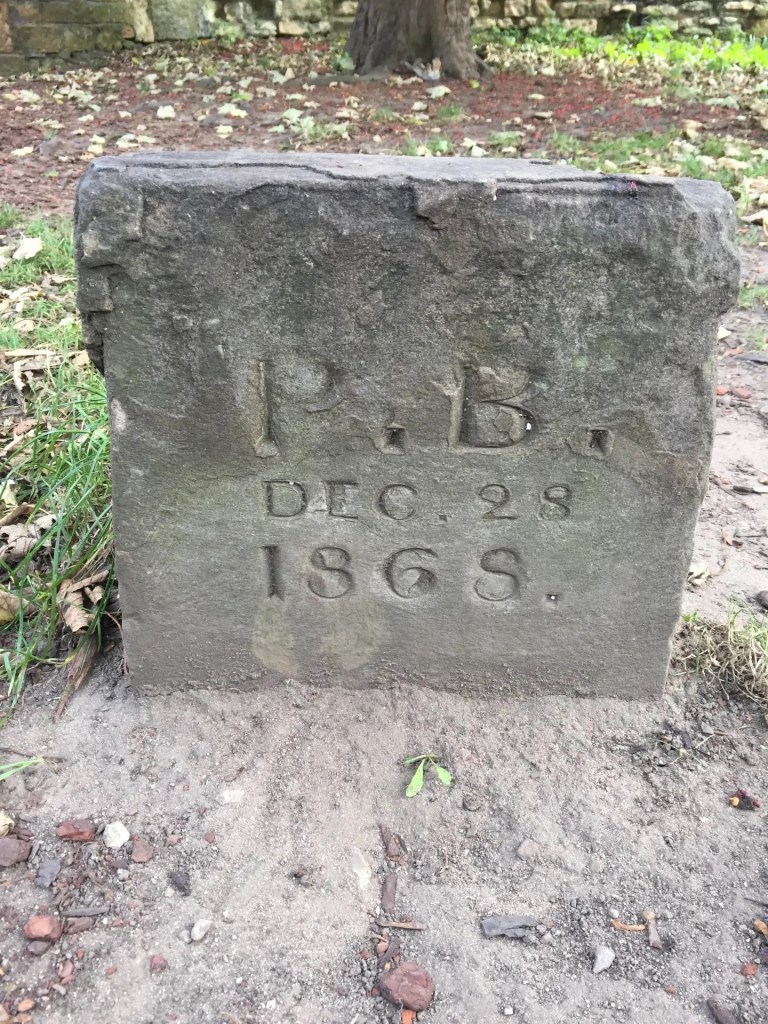
Here the gravestones are less auspicious. Rising no more than a few inches above ground level, they are engraved with just the initials of the person whose grave they mark – along with the date on which they were executed.
Priscilla Biggadike was hung at 9am on December 28th 1868 for the murder, three months earlier, of her husband, Richard who had been poisoned with arsenic. P.B. maintained her innocence right up to the point of her execution, which took place fourteen years before Thomas Proctor, a lodger of the Biggadike’s at the time of her husband death, confessed, on his deathbed, to having committed the murder himself.
Ironically, just a stone’s throw away, back in Lincoln Castle, is displayed a copy of the Magna Carta of 1215, which promises to deny or delay right of justice to no one. On this occasion, however, a misrepresentation of what was true ended in an awful injustice, proof, if proof were needed, that when truth is absent, something important dies.
Discerning the truth is, therefore, fundamental if right decisions are to be made, if justice is to prevail, and if sensible actions are to be taken.
In his book ‘The Book of Laughter and Forgetting’ the Czech writer, and Nobel Laureate, Milan Kundera wrote:
‘The struggle of man against power is the struggle of memory against forgetting’.
His point was that we need to fight to keep remembering what is true because there are those who would have us forget the truth – if indeed we were ever allowed to know it in the first place. Because controlling what is believed to be true, controls all those who subsequently believe it.
Throughout history, the rich and powerful have always wanted to control what is remembered, so as to paint a version of events favourable to themselves. Some have used their wealth to buy the silence of those who know the truth, others have used their power to threaten and intimidate those who they do not want to speak. And it is no different today. All too often society is once again shocked by news of how the rich and powerful have taken advantage of the weak and vulnerable and sought to silence them with wholly inadequate sums of money..
And neither are such terminological inexactitudes confined to those who live a life of celebrity. So too, for example, are pharmaceutical companies sometimes guilty of similar misrepresentations of the truth. Not only do they encourage medics to interpret normality as disease, they would also have them, and us, believe that their drugs are more effective in producing satisfactory endpoints than they really are, imaginatively misrepresenting data and applying gagging clauses to those who undertake their research lest results of that research be unfavourable for the drug’s marketability.
And so it goes on.
If something is not said, it isn’t long before it’s forgotten – and what is not remembered is soon no longer believed. And so, eventually, truth not only dies, but ceases to be important.
But is not only a version of history that powerful people want to manipulate. Because the notion of truth itself is something that some would like to see die – and be left with no memorial stone to mark its passing. For the truth, for some, is inconvenient, getting in the way of allowing them to do what they want.
This wish to see truth unceremoniously disposed of is not, of course, a new desire – it’s been around for millennia. Nearly 2000 years ago, for example, Pontius Pilate, perhaps drawing on Plato, asked ‘What is truth?’ of the one who claimed, not only to bear witness to the truth, but be the personification of truth itself.
In the 19th century Friedrich Nietzsche coined the term ‘Perspectivism’ and, presumably failing to notice his own internal inconsistency, asserted that
‘There are no facts, only interpretations.’
And likewise today, we have ‘fake news’, made up of so called ‘alternative facts’, which, despite having no objective evidence to support them, some claim to have just as much validity as those that are objectively verifiable.
Meanwhile there are others who just shout down, vilify, and ridicule any opinion contrary to their own – ad hominem arguments being preferred over any attempt at reasoned argument.
And so it seems, that the only thing that is true is that there is no truth.
In ‘The Eighteenth Brumaire of Louis Bonaparte’, Karl Marx wrote:
‘Men make their own history; but they do not make it just as they please; they do not make it under circumstances chosen by themselves, but under circumstances directly found, given, and transmitted from the past. The tradition of all the dead generations weighs like a nightmare on the brain of the living.’
Marx’s point was that nobody stands outside of history – everyone, even the most progressive of thinkers, is influenced by the particular historical context in which they find themselves.
The thinking of those in the past was, without doubt, not without error, but we are foolish if we think it was therefore completely false. Furthermore, if we try to think in new ways, without drawing on the wisdom of the past, we too will find ourselves making mistakes, influenced as we are by the time in history that we now find ourselves. Those errors will, no doubt, be different from the ones made by those who have gone before, but the conclusions that we draw will, as a result, be no less fallible than those made by them.
Novel ideas of the nature of reality are unlikely to be reliable. And because truth matters, it is best discerned by standing on the shoulders of those who have thought carefully about important matters before us, and not by dismissing that body of understanding as irrelevant and out of date simply because it is made up of ancient wisdom.
Which is why C.S. Lewis advised that at least every fourth book one reads should be from an era prior to our own.
“Every age has its own outlook’, he wrote, ‘It is especially good at seeing certain truths and especially liable to make certain mistakes. We all, therefore, need the books that will correct the characteristic mistakes of our own period. And that means old books.’
And it means old ideas too.
That’s why we need to remember those who have gone before us – and learn from them. Perhaps they are wiser than we would like to think. Perhaps we should listen more attentively to the advice that they have given.
But still there are those who want to redefine truth for us, and make it fit modern sensibilities. And so we must not uncritically buy into the spirit of the age, uncritically believing all that we hear, especially when, as has been made clear this week, even the most reliable of news channels sometimes lie to us.
Instead we must not lose sight of the notion of truth. Because to do so will spell disaster.
Because truth matters.
When everybody decides on their own version of what is true, based solely on what they themselves think about any particular subject, no opinion can be challenged as wrong, and we all make ourselves out to be gods. It is inherently self-centred and, sooner or later, we will insist on others dancing to our tune.
When we reject the notion that truth is discovered or revealed, society inevitably becomes fractured and directionless, as no common values are held to be true by all, and no distinction exists between the trivial and the important.
The result is that those who are rich and powerful, those who can impose their version of reality on others most effectively, become tyrants with no means of being restrained.
The struggle today is then to remember that some things are true and some things are not – no matter what the wisdom of the world tries to bully us into believing.
But there’s more to it than that –because truth doesn’t just need to be remembered, it’s needs to be upheld.
The notion that there is no such thing as truth, has survived infancy, made it to adulthood, and is now enjoying comfortable middle age. Nonetheless, whilst we can’t perhaps know everything fully, there are some things that we can fully know – certainly more fully than is sometimes claimed.
Because the truth really is out there.
It was Aeschylus who wrote, ‘In war, truth is the first casualty’. So then, living in a day when truth is under fire, when contrary opinion is ridiculed, and reasoned argument is silenced with a raising of an angry voice and a dismissive wave of the hand, truth is something that needs to be fought for.
Because truth must not die and become something that only once existed – an idea that is fondly remembered. We need to take care of truth, seek it out, and visit it often. We need to nurture it and allow it to flourish.
And what’s more, we need to speak truth too.
Because the truth, like a young life, is precious. And precious things are worth holding on to.
I sat in another churchyard – on a bench placed there a decade or so ago in memory of a girl in her early teens who had died. She had been killed when a driver, his judgement impaired by alcohol, had recklessly raced his car at excessive speeds and hit her whilst she walked home from the park one Sunday afternoon.
It was a criminally stupid act with tragic consequences.
In front of me was her grave. On it were some fresh flowers. I’m glad somebody remembers her – but I wish she’d never died at all.
Today is Halloween. It’s a day that many enjoy being frightened by pretending to be dead whilst others live in fear of what genuinely threatens their lives, be that chaos, cancer or conflict.
The word Halloween is a contraction of All Hallows’ Eve, the day which precedes All Hallows’ or All Saints’ Day, an annual Christian celebration dating back to the first millennium when loved ones who have died in the faith are remembered, and comfort is drawn by those who remain from recognising that, because of the sure and certain hope of the resurrection, death holds no fear for those who believe the Christian gospel and put their trust in Jesus Christ.
Over time, this solemn remembrance of the dearly departed extended to include the night before, and children would dress up in spooky attire in order to take part in a kind of ‘Danse Macabre’ in celebration of the victory Christ won over the forces of darkness.
Far from celebrating evil, therefore, the original point of Halloween was, for some at least, to poke a little fun at death, in much the same way, perhaps, that the apostle Paul does in 1 Corinthians 15:55. For it is there that the writer of more than half the New Testament taunts that last great enemy with the words ‘O death, where is your victory? O death, where is your sting?’.
And this is why I am not as entirely negative about Halloween as some of my Christian friends, even though, whether it is by wandering the streets dressed as a zombie, or by attending parties in the guise of vampires, most people who mark Halloween these days do so without any thought being given to Jesus’ wonderful victory over death.
But just because it has been so commercialised that it is now the third highest grossing festival of the year, that doesn’t mean that Christians should have nothing to do with Halloween. Far from it! For if that were the case, then surely Christians should also refrain from celebrating those other great Christian festivals which have been similarly secularised and today are enjoyed by many who do not find time to reflect on the glorious fact that ‘the word became flesh’ at Christmas and, having been crucified on Good Friday, rose to life again on Easter Day.
But of course, just as Christmas can become all about acquiring everything on your Amazon wish list, and Easter nothing more than an opportunity to eat too many chocolate eggs, not everything about Halloween is to be commended.
Evil should not be celebrated and the intimidation of vulnerable people by those who go trick or treating in such a way that some are forced to switch off all the lights in their house and pretend they’re not at home is, of course, totally unacceptable. Even so, it is nonetheless true that, done in the right spirit and remembering what Halloween is really all about, trick or treating can actually help bring communities together. As was the case when a neighbour’s children came to our door one year and, without looking the least bit scary, began offering us treats rather than demanding them!
Furthermore, just as fairy tales serve the very useful function of allowing children to face up to the darker aspects of their lives and, through those stories, see that the things they are frightened of can be overcome, so too some appropriate recognition of the existence of evil can help children see that, with Jesus a reality in their lives, they have nothing to fear.
Pretending that evil does not exist does not help our children. Perhaps then, rather than being concerned about how Halloween may adversely affect our children, we should be more concerned about stories that deny the reality of evil at all – stories that insist that everyone is awesome and, while minimising the very real existence of pain and disappointment, dishonestly suggest we can be whatever we want to be.
So, whilst I understand why some Christians are uneasy about Halloween, concerned as they are that it may encourage an unhealthy interest in occult practices such as endeavouring to communicate with the dead, something which, incidentally, the Bible expressly forbids, for me at least, Halloween does have a redeeming feature.
And that redeeming feature is the opportunity it affords me to talk about Jesus’ sacrificial death on the cross – a death that paid the penalty for all our sin, and assures us that when we do die, rather than it being the end, it will be but a gateway to eternal life with God, a never-ending existence in a new heaven and a new earth where our loving Heavenly Father will wipe away our every tear and ensure that death and evil will no longer have any place in our lives.
And so, until that day finally arrives, I will, on occasions, enjoy poking a little fun at death whilst never forgetting that my confidence for so doing comes only from the one who is standing alongside me as I do.
Because the one I am referring to is Almighty God, my loving Heavenly Father who, by his Holy Spirit, is within me too. And ‘He who is in me is greater than he who is in the world’ [1 John 4:4].
So then, by being wise enough to fear God, appropriately holding him in high esteem and gladly bowing my knee before him, I find I have no need to fear anyone or anything else.
And on this Halloween, that includes death itself.
Which is why I am not afraid to die, confident as I am that at the cross Satan was so completely defeated that we can all be absolutely sure that ‘Death really has been swallowed up in victory’ [1 Corinthians 15:54].
And with all that in mind I hope you all have a very happy Halloween – one that, in the darkness, anticipates the light that is surely coming and will never be overcome.
Whether or not you’re a cricket fan, watching ‘Freddie Flintoff’s Field of Dreams’ is a heartwarming experience – and a thought provoking one too, especially, perhaps, for peculiar types like me who call themselves Christians.
So why do I say this?
Well, simply because of the very obvious parallels that exist between what the former England allrounder is seeking to achieve on a cricket field, and what Christians believe Jesus is bringing about through His church.
Think about it. Flintoff is someone who, having achieved considerable fame and fortune through sport, is now humbling himself by spending time trying to help those who, having not infrequently fallen foul of both the educational and criminal justice systems, have subsequently been largely discarded by society.
It is youngsters such as these that Flintoff is giving a second chance – one that so many others have denied them. And in so doing he is becoming a genuinely loved individual – despite demanding of them a level of behaviour that they are not accustomed to and conveying to them words of genuine wisdom, such as how it isn’t money that makes you happy, but people.
And he gets results too.
Those he might be considered to have rescued from a futile existence, soon want to please their newfound hero by being better people – not only by curbing their often colourful language, but by showing real care for one another, becoming more socially minded, and seeking to share with others what they have experienced themselves.
Which, let’s face it, is more visible change than Christians like me sometimes seem to manage.
So what am I saying? That cricket is, perhaps, a better, more effective religion than Christianity? Well no, that’s not what I am saying, far, far from it – for not even I, cricket mad though I am, would ever say such a thing!
But this third series of the BBC programme has caused me to ask some questions of myself. Because if the lives of those young people can be transformed by the loving concern of a former cricketer, then what should my life look like as someone who claims to be loved by the eternal Son of God?
And could the reason I haven’t become the better person I ought to have, be down to the fact that I haven’t appreciated what it is that Jesus has rescued me from and what, because of Him, I now have to look forward to. And as a result of not adequately valuing the help that I’ve received, could it be that I do not love him as much I should, not enough, at least, to endeavour to obey his commands in the way that his love for me really does call me to.
Because I suspect that is indeed part of the problem. Since, as Jesus himself said, ‘If you love me, you will keep my commandments. [John 14:15]
So then, not underestimating the need for the Holy Spirit to work within me, if I want to be transformed into the likeness of Christ, I need to recognise the depth of my sin, understand what it was I was saved from by His substitutionary death for me on the cross, and fix my eyes on the one who suffered there – the founder and perfecter of my faith who, for the joy set before him, endured the cross, despising the shame, and who, having been resurrected on the third day, ascended into heaven where he now sits at the right hand of the throne of God. [Hebrews 12:2]
And the other thing I need to question is the assertion made by some that the proof that Christianity is true is bound up in the transformed lives of its adherents.
Because it doesn’t.
Firstly, as I’ve indicated, because my poor progress in the faith doesn’t question the truth of Christianity – rather it proves the paucity of my faith in its leader, or perhaps more accurately stated, the gap between what I say I believe and what I believe in practice that only the grace of God can, and will, close.
And secondly, as Freddie Flintoff’s experience makes plain, there are a great many things that can change an individual’s behaviour for the better, none of which require a supernatural explanation.
And the failure of some Christians to change to the degree they really ought to, no more proves the futility of Christian belief, than the continued poor behaviour of some of the youngsters in ‘Flintoff’s Field of Dreams’ proves the pointlessness of cricket or the kindness of one of its greatest ever proponents.
No, the truth of Christianity relies on something far more objective than any individual’s changed life.
Rather it rests on the veracity of the resurrection of Jesus Christ – something we have very good reason to believe in because of the overwhelming evidence for the historicity of his empty tomb, the compelling eye witness testimony of those who saw him after he was raised back to life, and the absolute authority of the one who not only spoke the universe into existence but told us that Jesus, as His beloved Son, was the one we should now all listen to. [Mark 9:7]
All of which means that, though Freddie Flintoff is undoubtedly someone we should appropriately admire, and a role model we can all aspire to emulate, he is not the one who can ultimately bring about our salvation.
For, unable to atone for our wrongdoing, he cannot secure for us the forgiveness of our sins.
For that, we will need someone even greater than Freddie Flintoff – someone that we really should seek to follow in order to be changed in the way that, I at least, need to be.
And that someone is Jesus – for he alone is the way, the truth, and the life, and nobody comes to the Father except through him. [John 14:6]
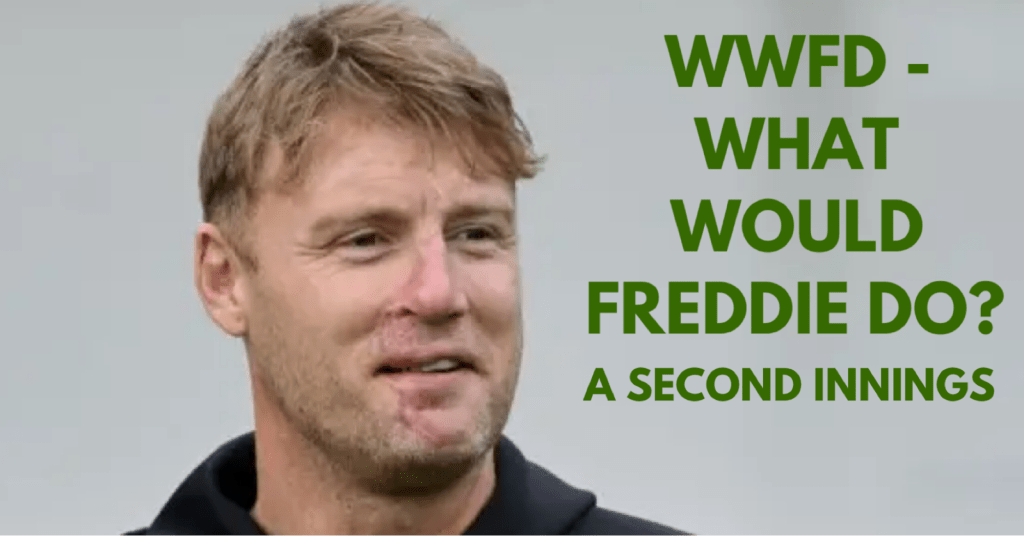
To read ‘WWFD – What would Freddie Do?’, a reflection on the previous series of ‘Freddie Flintoff’s Field of Dreams’, click here.
Last night I went to see ‘I Swear’, the superb new film which tells the story of John Davidson who, since being diagnosed as a teenager, has lived with Tourette’s Syndrome, the neurodevelopmental condition characterised by involuntary tics and vocal utterances which often take the form of words that aren’t altogether acceptable in polite society.
It’s an excellent film and I heartily recommend it, not just for the fine acting but for the very good script made up of some very bad language.
So if anyone does take my advice and go and see it, please do be aware that it might not be a good idea to take your grandmother with you, unless that is she is a big fan of Bernard Manning and has a habit of never wearing her hearing aid.
But having said that, to me at least, the genuinely offensive language never managed to offend, because, perhaps, offence was no more intended than the words were ever meant to be said.
All of which means that the point of the film is not to shock but to make you both think and feel what it must be like to live with Tourette’s Syndrome. Which it does very successfully, forcing those watching to notice how those labelled experience ridicule and rejection which together make their lives so unpleasant that they may no longer want to live.
And what they need most is a little understanding, a lot of kindness, and wholehearted acceptance. Acceptance that brings with it the willingness to offer them a chance in life – a chance to show others what they can do rather than what they can’t.
Because, in a world where few show such respect, and the system simply doesn’t have space for them, that is what will be required if their lives are to be made better and more bearable.
Which is what those with other neurodevelopmental problems need too, those who, rather than being patronised with suggestions that, because of their condition, they have superpowers, should instead be considered to have a very real problem that, despite the marginal benefits that may come with it, frequently makes their lives both horribly sad and nigh on impossible.
And that same kindness is, of course, what we also all need, irrespective of how supposedly normal we may be. Because when we behave in less than ideal ways, and without negating our responsibility, rather than being dismissed as failures, we could all do with being given the opportunity to say, not what’s wrong with us, but what caused us to act in the way that we have.
Because understanding what’s happened to make us as we are will go a long way to understanding why we all, to a greater or lesser extent, make such a mess of our lives.
And if, as a result, we could both show and be shown a little compassion, then I swear – compelled as I am to say it – it would be a mighty good thing for us all
Perhaps I shouldn’t have been listening but it was hard not to overhear what the two friends were saying as they chatted over lunch on the table next to mine. One had recently started a new job and she was explaining how she was already unhappy about how things were going.
What had upset her, it seemed, was that her boss had suggested she might one day be asked to undergo further training and this was not something that had previously been mentioned, either in her job description or her offer of employment letter.
And so her friend, who appeared to share her outrage, heard how she’d felt the need to tell her boss that she should not, under any circumstances, be ever expected to do anything that was not in her contract.
On another table sat another couple for whom life was clearly not easy. The elderly man had approached their table heavily dependent on a walking aid and, judging from the inadequately applied plaster to the nasty looking wound on his badly bruised forehead, had recently taken a fall. Even so, as they passed the place where I was sat, I received a friendly greeting as complimentary comments were made regarding my canine companion.
Later I noticed how, though their words were few, they were comfortable in their quietness as they enjoyed their simple lunch – a soup and a roll with a glass of water. The man’s hand shook somewhat as he lifted the spoon to his mouth, and its contents didn’t always reach its destination safely, spilling down his chin and, on occasions, down his front as well. But what might have been an issue for some clearly didn’t concern his wife.
And I wondered if this was what she had signed up for when they married all those years ago.
But given that she obviously loved him, I rather think it was.
Other Related Blogs:
To read ‘A Time to Dance – Reflections on a Marriage’, click here
To read ‘On Approaching One’s Sell By Date’, click here
To read ‘Vaccinating to Remain Susceptible’, click here
In recent weeks I have written a fair bit on current affairs – on the conflicts in Ukraine and the Middle East, on gun crime, immigration, and the NHS. But lest anyone think otherwise, this in no way means that I’m despairing at the current state of the world.
Not at all.
Because, whilst there is much that I find concerning about all that is going on just now, as a Christian, my hope remains in God. I continue to believe that He is in absolute control even though the way He manifests his sovereignty is often beyond my understanding.
And even though I know that He does indeed have the whole world in His hands, the daily news remains worthy of my attention – for at least two reasons.
The first is that the Christian faith has a lot to say about protecting the weak and welcoming the stranger; it has a lot to say about love and hate; and it has a lot to say about peace, and how we should pursue it.
And secondly, the mess this fallen world finds itself in makes me long all the more for that better world to come.
And before anyone suggests that I am being so heavenly minded that I am liable to be of no earthly use, it is in fact the opposite that is true. Because it is only when we hold lightly to what this current ‘vale of tears’ offers that we will be prepared to risk what we do have in order to make the world a better place. All of which means that it is, in fact, those who are the most heavenly minded who can be of the most earthly use.
But for any hope of heaven to be realised, rather than the constant bad news we see on our televisions, we need to hear instead the good news of the one who truly is the only way to that eternal home. [John 14:6]
Which is why the Gospel of Jesus Christ remains the most precious news of all.
Because to know that His life, death and resurrection were followed by His ascension – not just to heaven but to a throne – changes everything. For as Paul wrote in his letter to the Colossians, these historical events of cosmic significance are the means by which God has
‘…delivered us from the domain of darkness and transferred us to the kingdom of his beloved Son, in whom we have redemption, the forgiveness of sins.’ [Colossians 1:13-14]
But such thoughts are not just theoretical – on the contrary, they are profoundly practical.
One person who really does know what it is to live in constant danger is Igor Bandura, the Vice President of the Baptist Union in Ukraine. A while ago he was asked how, practically speaking, you can live through a time of war?
His answer, recognising that the church exists to offer a message of hope, was to see each day as an opportunity to share the gospel.
None of us can ensure the safety of all those we love – nor can we know all that will happen to us tomorrow. Only God can do and know these things. But we can share the good news of what Christ achieved on the cross.
And so Igor said: ‘If I’m going to die tomorrow, then I want to preach the gospel today’.
And that isn’t a bad way for any of us to live.
Let’s pray then, with Igor, that the gospel becomes, and remains, the main thing – not just for those in Ukraine and the Middle East, or those suffering the effects of gun crime or persecution – but for all of us as well, no matter the less publicised difficulties that we too may be facing.
So let’s not be ashamed of the Gospel, for it really is the power of God for salvation to everyone who believes. [Romans 1:16]
















 Some musings