It’s some years into the future and I’m watching television and the continuity announcer is appropriately enough continuing to announce the evening’s schedules. ‘And now’ he says, ‘it’s the Antiques Roadshow which this week comes to us from Westminster Hall’.
Minutes later I watch as the current Secretary of State for Health as he carefully carries an item wrapped up in an old blanket and slowly places it on the table that stands in front of the show’s relics expert. After briefly looking at the mysterious object, she picks it up and proceeds to make her careful examination. Anxiously the one in whose care it has resided waits, eager to know just what it is that he has brought with him. And, of course, what it might be worth.
The expert turns the battered curiosity over and notices four numbers engraved into its base. These are instantly recognised as the year in which the artefact was crafted.
‘1948’, the expert begins, smiling to herself, confident now of what it is she’s looking act. ‘What we have here is a very fine example of what used to be a National Health Service. And what a unique example it is, perhaps the only one of its kind.’ After silently turning it over in her hands for a few minutes the expert eventually continues. ‘It really is a beautiful piece, or at least it was once. It’s clearly long since seen better days and has now lost much of the shine it once possessed’
Overcome by the tatty condition of the once elegant structure she is holding, the expert is temporarily lost for words but soon is able to regain her composure. She begins to point out the numerous places where damage has been sustained. A crack here, a missing piece there and an overall instability that renders the whole thing inherently unstable.
Her assessment complete she finally looks up at the one who had handed it over to her for inspection. ‘This is one of the most remarkable items that I’ve ever seen. In its day it was very highly prized and would have been greatly sought after by everyone. How did it come into your possession?’ she asks.
‘It was handed down to me by my predecessor who had himself received it from his predecessor. I don’t think any of us realised it was anything of any value and so none of us have really taken much care of it.’ The Secretary of State pauses for a moment before asking the only thing that he was ever really concerned about. ‘Not that I’d ever sell it you understand, but could you give me any indication of just how much it might be worth?’
‘Undoubtedly if it had been looked after rather better and was still in good condition what you have here would have been priceless. But now…’ The expert stops and looks sadly down at the item as she places it back down on the table. Then, looking up again, she fixes her eyes on its guardian before delivering her verdict. ‘Now, in its current state, I’m afraid it’s hardly worth anything at all. Having not bothered with it all these years its now not even worth getting it insured. It’s such a shame, If only you’d all taken better care of it in the past’.
And with that an elderly Fiona Bruce closes the programme and the end credits roll a little too fast such that im unable to make out the year the programme was produced.
And then I wake up to the state of the NHS. And I wonder if anyone else will too.
Related posts
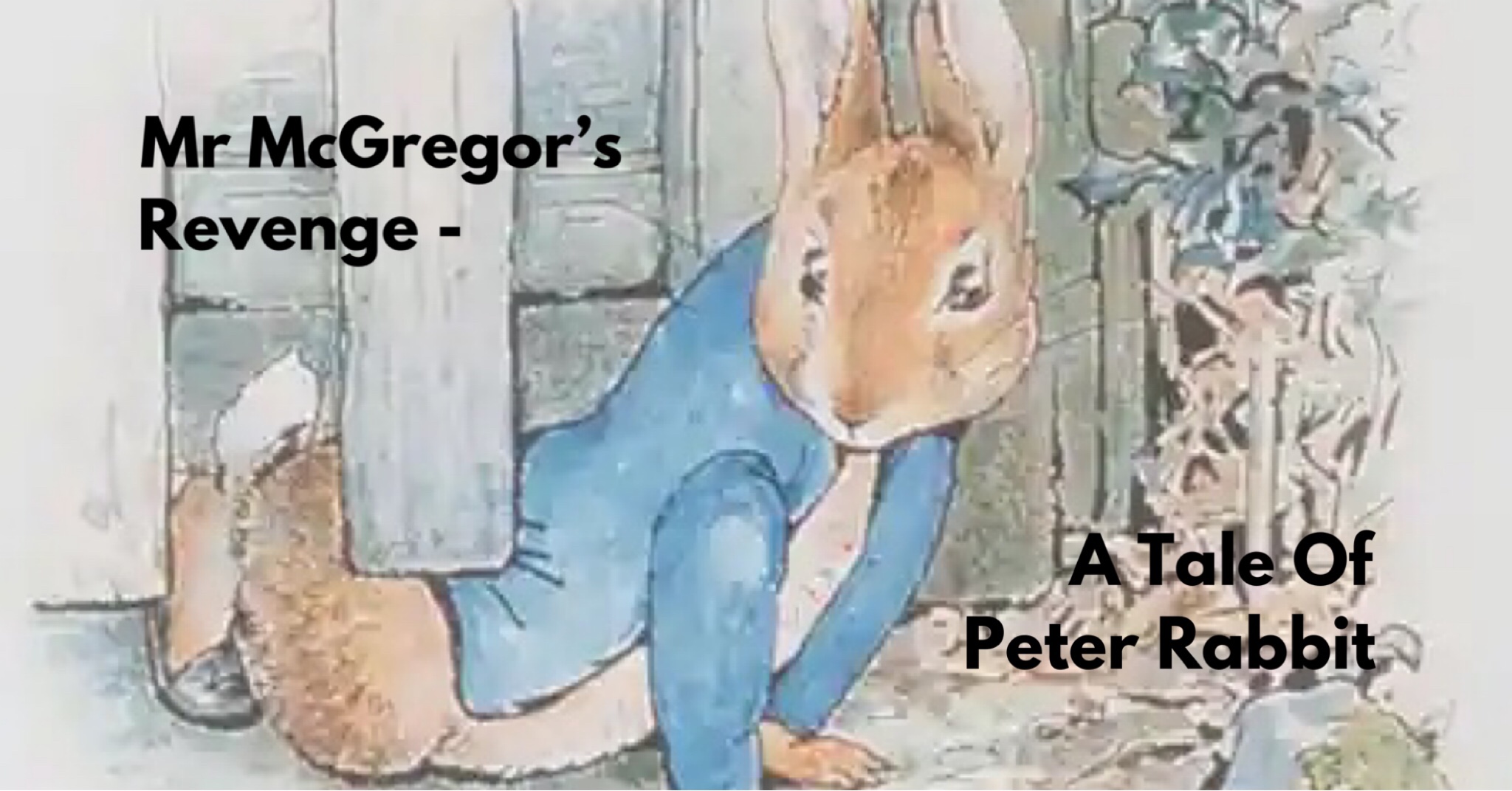
To read ‘Mr McGregor’s Revenge – A Tale of Peter Rabbit’, click here
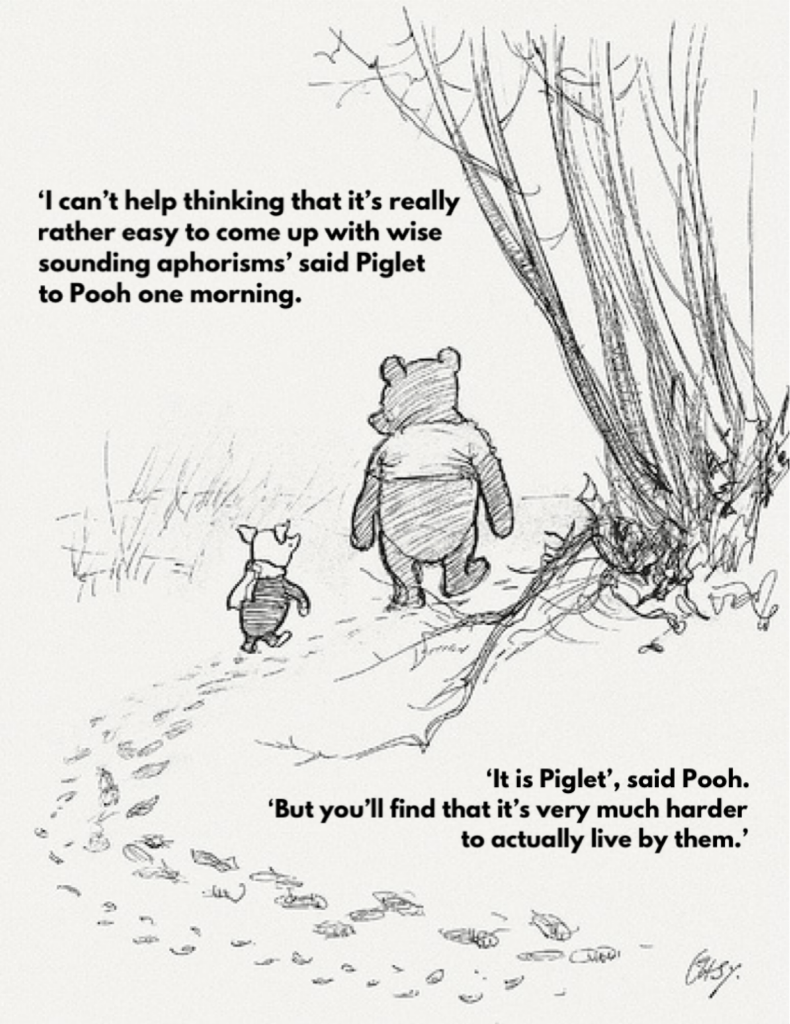
‘I can’t help thinking that’s it’sreally rather easy to come up with wise sounding aphorisms’, said Piglet to Pooh one morning.
‘It is Piglet’, said Pooh, ‘But you’ll find it very much harder to actually live by them’.
#EasierSaidThanDone
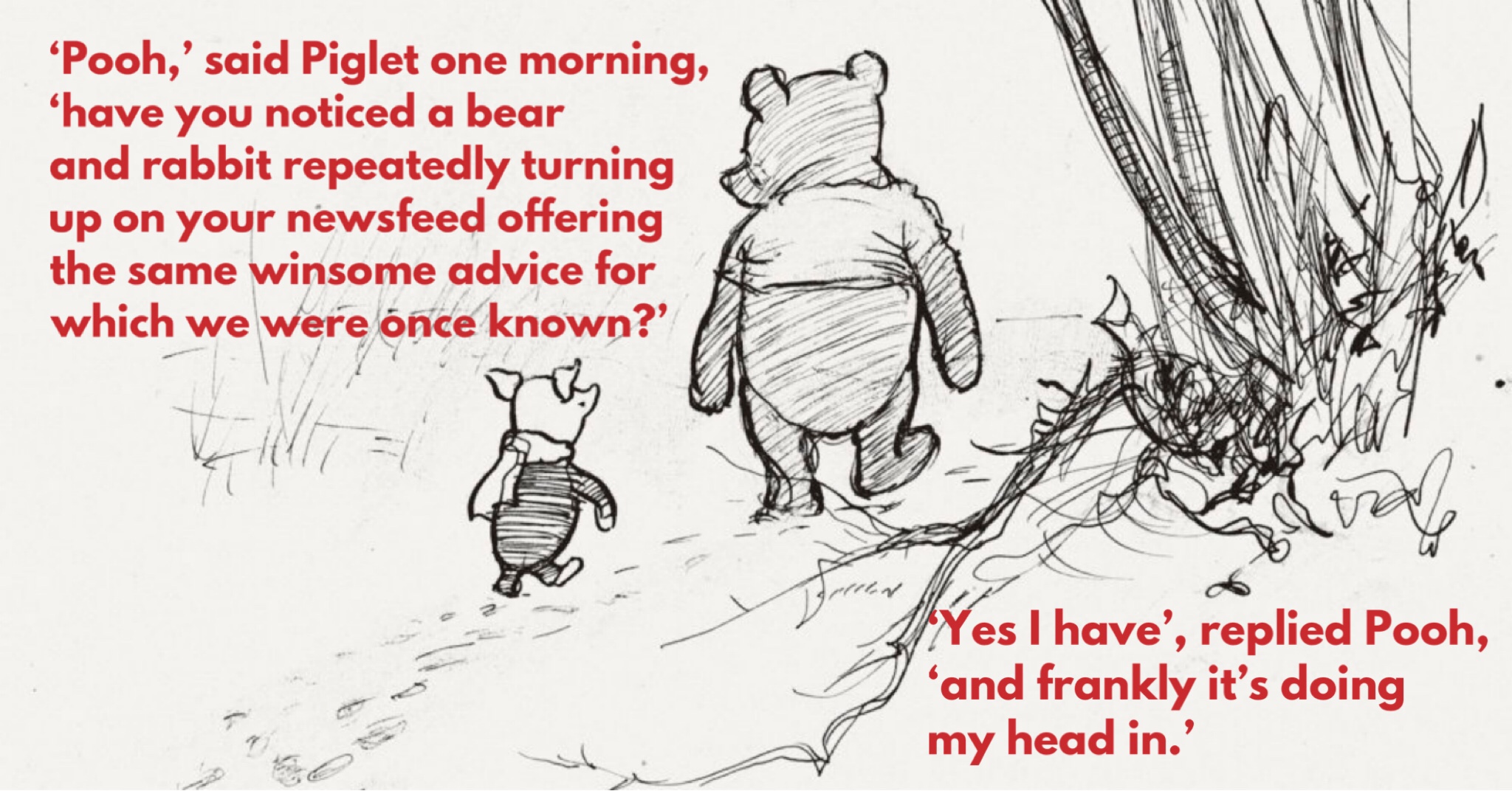
‘Pooh,’ said Piglet one morning, ‘have you noticed a bear and rabbit repeatedly turning up on your newsfeed offering the same winsome advice for which we were once known?’
‘Yes I have,’ replied Pooh, ‘and frankly it’s doing my head in.’
#PoohAndPigletPlaySecondFiddle
‘What’s the matter, Piglet?’ asked Pooh.
‘I feel anxious..overwhelmed by all that I’m asked to do working in the NHS’
‘What do you see around you?’, asked Pooh.
Piglet answered quickly. ‘I see a long,long list of those I need to see today, the anguish in the faces of people waiting for pain relieving surgery, the inevitability of ever longer waiting lists, the fear of those who can’t get an emergency ambulance in a timely fashion…and I see no hope of it ever getting better’.
‘What do you hear?’ asked Pooh.
‘Criticism in the press, demands for more from those in power, sadness in the voices of those with whom I consult and desperation in the voices of those with whom I work.’
‘What can you smell and taste?’ Asked Pooh.
‘Whatever it is I can smell, it stinks and as for taste…well it’s the taste of things to come’, answered Piglet.
‘Now…what do you feel?’ asked Pooh.
‘Worse than ever’, said Piglet.
‘Well that went well’, thought Pooh.
#PoohAndPigketReflectOnTheNHS, #Mindlessness
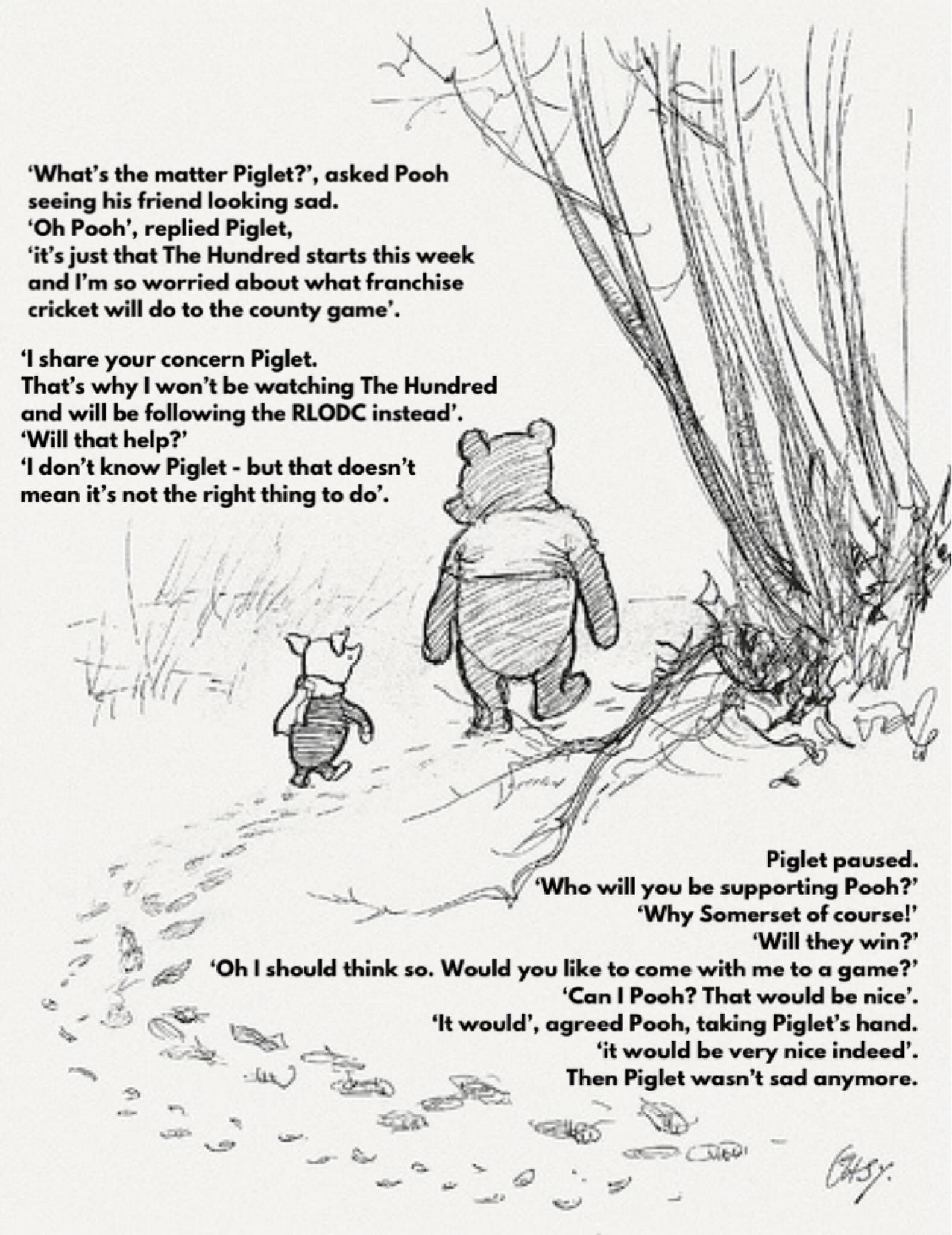
‘What’s the matter Piglet?’, asked Pooh seeing his friend looking sad.
‘Oh Pooh’, replied Piglet, ‘it’s just that The Hundred starts this week and I’m so worried about what franchise cricket will do to the county game’.
‘I share your concern Piglet. That’s why I won’t be watching The Hundred and will be following the RLODC instead’.
‘Will that help?’
‘I don’t know Piglet – but that doesn’t mean it’s not the right thing to do’.
Piglet paused. ‘Who will you be supporting Pooh?’
‘Why Somerset of course!’
‘Will they win?’
‘Oh I should think so. Would you like to come with me to a game?’
‘Can I Pooh? That would be nice’.
‘It would’, agreed Pooh, taking Piglet’s hand. ‘it would be very nice indeed’.
Then Piglet wasn’t sad anymore.
#PoohAndPigletWatchCricketTogether
‘Pooh,’ said Piglet one morning, ‘I’m worried about the rising cost of living. I’ve done as you suggested but looking at the stars and feeling the grass under my feet hasn’t made me feel any less anxious about whether I’ll be able to pay my winter fuel bills.’
At first Pooh said nothing but then a hum came suddenly into his head. It seemed to him a Mindless Hum, such as is Hummed Hopelessly to Others.
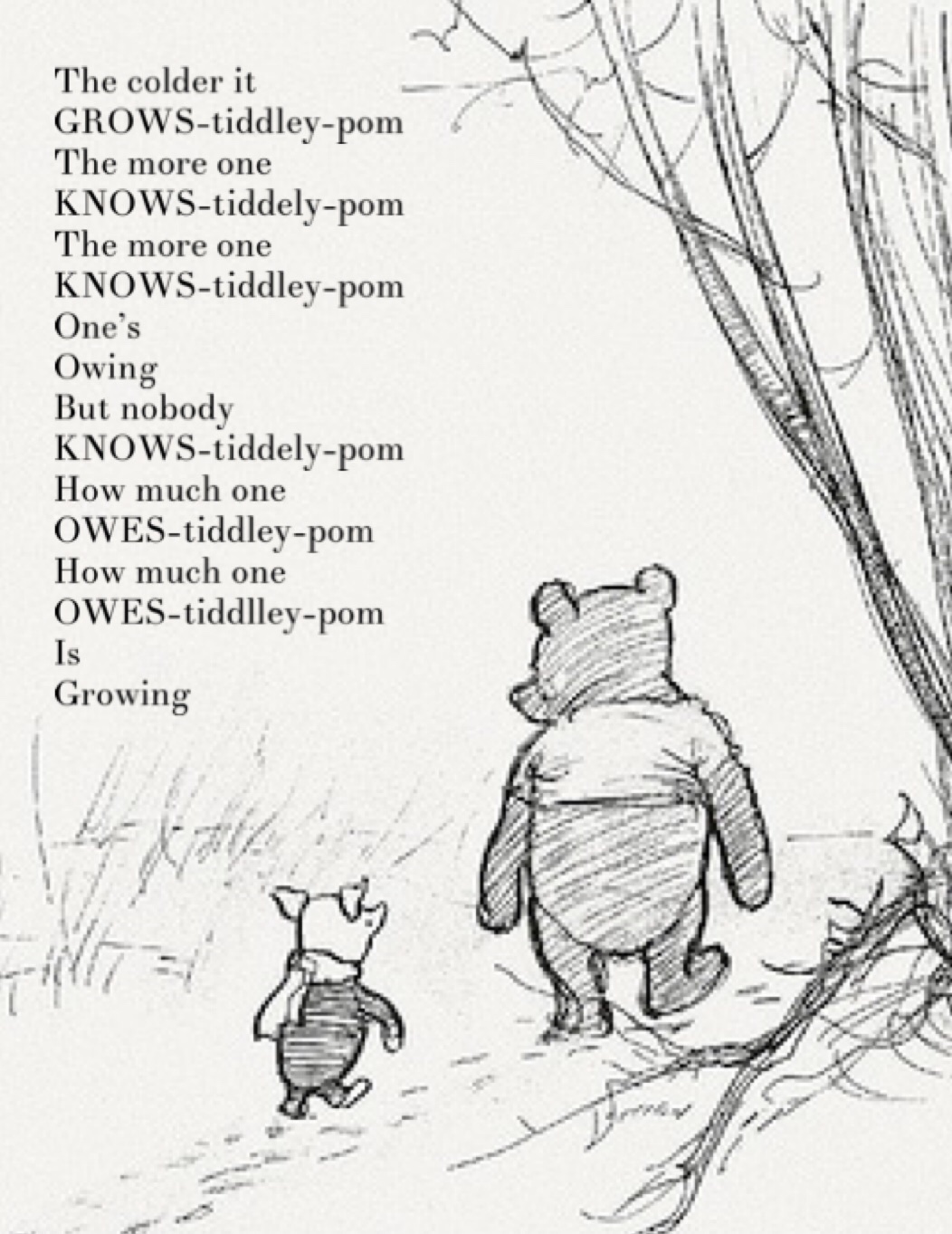
The colder it GROWS-tiddley-pom The more one KNOWS-tiddely-pom The more one KNOWS-tiddley-pom One’s Owing
But nobody KNOWS-tiddely-pom How much one OWES-tiddley-pom How much one OWES-tiddlley-pom Is Growing
His hum completed, Pooh looked at his friend. ‘Has that helped at all?’ he asked.
‘About as much as when I was concerned about my hospital test results and you suggested I just let go of fear and doubt but gave me no reason for doing so’ answered Piglet rocking back and forth in an increasingly agitated fashion.
‘How about remembering a time when energy was affordable? said Pooh. ‘Memories are the proof that good times existed. We can bring them back just by thinking about them’.
‘No we can’t Pooh,’ said Piglet starting to cry, ‘No we can’t. And perhaps you’d be kind enough to go now. I’ve some bedclothes I need to hide under.’
Tom Abell, the obviously disappointed Somerset captain, speaking after the teams performance in the T20 Final’s Day at Edgbaston.
‘Some people think football is a matter of life and death. I assure you, it’s much more serious than that.’
As Bill Shankly, the former manager of Liverpool F.C. quipped about football so I might about cricket and especially about that involving Somerset CCC. Even so, the morning after Somerset lost in the semifinal of the T20 Vitality Blast, a game I was pleased to be present at to support my team, I am beginning to get over my disappointment that, once again, cricket wasn’t coming home after all. And Despite Shankly’s assertion, we will all have come to realise that, whilst an enjoyable distraction, whether Somerset won or lost, it wasn’t really all that important at all. It is perhaps only those whose lives have nothing of greater value to worry about who will still be struggling with the heartbreak of yet another ‘oh so near’ and only those who are so insecure in who they are themselves that will feel the need to vilify those they see as responsible for the disappointment that they continue to feel.
Even so, we all know what it is to feel disappointment when things that we have looked forward to don’t materialise in the way we had hoped they would. Many of us, if we haven’t holidayed already, will be anticipating times away from work. Though it will be good to have that much needed break, it won’t be just a few of us who will experience some disappointment related to our holidays this year. For some of us it will be because our week or two away won’t turn out to be as enjoyable as we had hoped, others of us won’t quite be able to avoid taking with us some of the sadness that we would have liked to have left at home, and for others of us our disappointment will come simply because, however great our vacation experiences turn out to be, they will inevitably eventually come to an end and we will be forced to return to a normality that, for some of us at least, is far from how we would like it to be.
But if we can experience disappointment because our two weeks in the south of France is ruined by the lack of a decent local boulangerie, how much more must the disappointment be for those who don’t have the luxury of being able to look forward to any time away from the difficulties that they face. For some of them it is not merely disappointing individual incidents that they struggle with but rather an overall, all encompassing, disappointment with how their lives have turned out, be that on account of the social deprivation that they have to encounter daily, the poor physical health with which they suffer or the deep personal sadnesses from which there is never any prospect of any even temporary escape. And then there are too those currently living in Ukraine and other war torn areas of the world, and those who, even today, are facing the prospect of death which, after even the most satisfying of lives, is still unwelcome and a cause for disappointment that the good times are now forever over.
So how are we to help those with whom we interact and whose lives have such a sense of disappointment that it is hard for them to carry on. And how are we to cope with our own disappointments when they inevitably materialise in our own lives. Because unlike a lost game of cricket, not all disappointments can be dismissed by a realisation that the thing that brings us sorrow never mattered at all in the first place.
Whilst it is true that we are all sometimes more disappointed about things than we need be, to sing along in nihilistic agreement to the closing lines of Bohemian Rhapsody that ‘nothing really matters, nothing really matters to me’, makes fools of us all. Because some things really do matter. Our disappointment is a measure of how far things are from how we want them to be. Though unpleasant, it is not an unhelpful feeling, given how it speaks to us, not only of the difficulties that we are currently experiencing but also the better circumstances that we all so long for, testifying perhaps that things can and indeed should be better.
Last year I holidayed in Pembrokeshire and I remember sitting on Whitesands Beach not far from St David’s watching people enjoying themselves playing in the sea. For some reason, despite wanting to, I didn’t feel able to join them irrespective of how awesome I would undoubtedly have looked with my wetsuit on and ‘Atom’ emblazoned across my chest like some modern day comic strip superhero! My feelings were similar to those I almost always experience at discos, if indeed discos are what they are still called. On such occasions you will always find me on the edge of the dance floor, too self conscious to show off my highly original and frankly alarming dance moves and resorting instead to clutching a pint and simply wishing I could enjoy myself by joining in with those who are dancing and clearly having such fun in the process. I wonder if this somewhat melancholic experience is one that others of us sometimes have, one in which we are all too aware that genuine happiness really is to be found out there somewhere but that it somehow always remains elusively just out of reach.
It was C.S. Lewis that wrote ‘Most people, if they had really learned to look into their own hearts, would know that they do want, and want acutely, something that cannot be had in this world. There are all sorts of things in this world that offer to give it to you, but they never quite keep their promise…If I find in myself a desire which no experience in this world can satisfy, the most probable explanation is that I was made for another world.’
As I say then, our disappointment has real meaning, speaking to us of a better tomorrow that really is out there for us to enjoy. And, welcome though it would be, I am not referring here to a Somerset’s victory in next year’s T20 Final! On the contrary, regarding our desire for something better, Lewis continues that ‘Probably earthly pleasures were never meant to satisfy it, but only to arouse it, to suggest the real thing. If that is so, I must take care, on the one hand, never to despise, or be unthankful for, these earthly blessings, and on the other, never to mistake them for the something else of which they are only a kind of copy, or echo, or mirage. I must keep alive in myself the desire for my true country, which I shall not find till after death; I must never let it get snowed under or turned aside; I must make it the main object of life to press on to that other country and to help others to do the same.’
If Lewis is right then, for me as a doctor, I need to recognise that medicine can not bring about a utopia of perfect health, still less that which not even a fortnight on the Côte d’Azur can not secure, namely a world characterised by a perfect happiness that never ends. That is something that medicine simply cannot deliver, not with a pill, not with a procedure, not even with a course of therapy. On the contrary, even the happiest of lives come to an end and when death does eventually inevitably draw near, medicine has no answer save to ease an individuals passing. This is not to say that palliative medicine isn’t hugely important, only that we make a mistake if we believe that there is ever such a thing as a truly good death. Because there isn’t, not at least for those who believe that our lives matter and that death, however less bad it can be made, is never truly good given the loss it entails and the end of what might otherwise have been.
Rather then than imagining itself to be the answer to everyone’s problems and in so doing only serving to disappoint those who do come to rely on it too heavily, medicine needs instead to play its part in helping others to press on to that other country of which Lewis speaks.
And so, whilst not being it’s main role, I believe medicine needs to make room for other philosophies and, acknowledging it’s limitations, be honest enough to at least suggest to patients that the answers to their greatest needs may be better found somewhere other than in the treatments we sometimes all too readily offer, in something bigger and better than all that even medicine has to offer. The same is true for those whose walk takes them elsewhere but who nonetheless hear similarly exaggerated claims of the happiness that is on offer. Because, however great it might be, no earthy pleasure, will fully satisfy and however long last, it will, eventually, end. As for me, I am one of those peculiar people who listen to that ancient wisdom that encourages me to consider God, in whose presence, it says, can be found both fullness of joy and pleasures for evermore. [Psalm 16:11].
Recognise this and perhaps we all will be better able to cope when the bad times inevitably come, regardless of whether the associated disappointment is caused by circumstances, others, or ourselves. Furthermore we may be better able to enjoy more fully the good times without our requiring them to be more than they actually are, without our needing them to be perfect. Instead we can enjoy them, recognising them to be the echoes of those endless yet better times which so many of us continue to look forward to.
And when that hope is finally fully realised, as I believe it one day will be, when every tear is wiped away and death is no more [Revelation 21:4], we will discover that it will more than amply compensate, not only for those missed opportunities to go wild on the dance floor, the absence of fresh croissants on our holiday breakfast tables and the consequences following a couple of unfortunate run outs, but also for all the genuinely heartbreaking disappointments in our lives, even that of death itself.
For then it will not just be cricket that’s come home – it will be we ourselves. And having arrived there and found that we are home for good, I for one can’t imagine ever being disappointed again!
Postscript:
Later in the week I spent in Pembrokeshire last year I did finally manage to overcome my former reticence and adopted my altered ego of ‘Atom Man’ to brave the waves of Newgale. It was good to forget myself and to feel, not lost or insignificant, but nonetheless wonderfully small, happily caught up and enveloped in something immensely bigger and vastly more impressive than I will ever be.
But by golly it was cold!
The above is adapted from a piece written a year ago following England losing the football World Cup a year ago. That and related posts can be read by clicking here.
Other Somerset cricket related blogs:
To read ‘How Covid-19 stole the the cricket season’, click here
After being runners up four times since they last lifted the trophy in 2005, will Somerset emerge victorious from this years T20 Final’s Day at Edgbaston. I do hope so!
It’s coming home It’s coming home It’s coming Cricket’s coming home
Everyone seems to know the score They’ve seen it all before They just know They’re so sure Somerset’s gonna throw it away Gonna blow it away But I know they can play Cos I remember
A [Mythical creature of disputed nomenclature]* on a shirt Games on YouTube streaming All those years of hurt Never stopped me dreaming
So many jokes, so many sneers But all those oh-so-nears Wear you down Through the years But I still see: Smeed and Banton unleashed A Rilee Rossouw run feast VDM on the charge And Ben Green’s moustache
A [Mythical creature of disputed nomenclature]* on a shirt Games on YouTube streaming All those years of hurt Never stopped me dreaming
I know that was then but it could be again
It’s coming home It’s coming home It’s coming Cricket’s coming home
*For better scansion please insert ‘Dragon’ or ‘Wyvern’ depending on your position on this most contentious of issues!
Cricket related blogs:
To read ‘How Covid-19 stole the the cricket season’, click here
To read ‘Somerset CCC – Good for the soul’, click here
To read ‘Longing for the pavilion whilst enjoying a good innings’, click here
Addendum :
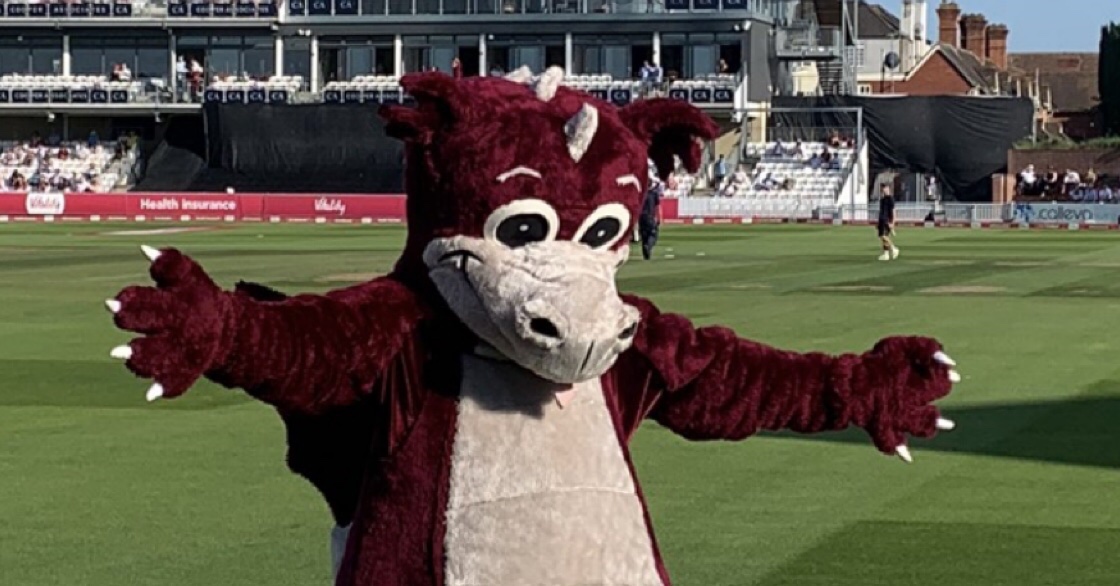
With it being forecast to be 27C at Egbaston today, it’s just as well that Stumpy is a real wyvern/dragon and not some poor soul who’s contracted to climb inside a hot costume and then run round an obstacle course. Wishing him all the best In the Mascot race!
Once upon a time, not so long ago, there was a little girl and her name was Emily. And she had a shop. It was rather an unusual shop because it didn’t sell anything. You see, everything in that shop window was a thing that somebody had once lost and Emily had found and brought home to Bagpuss. Emily’s cat Bagpuss – the most important, the most beautiful, the most magical…saggy old cloth cat in the whole wide world.
Well now, one day Emily found a thing and she brought it back to the shop and put it down in front of Bagpuss who was in the shop window, fast asleep as usual. But then Emily said some magic words:
‘Bagpuss, dear Bagpuss, old fat furry cat-puss Wake up and look at this thing that I bring Wake up, be bright, be golden and light Bagpuss, oh hear what I sing’
And Bagpuss was wide awake. And when Bagpuss wakes up all his friends wake up too. The mice on the mouse-organ woke up and stretched. Madeleine, the rag doll, Gabriel, the toad, and last of all, Professor Yaffle, who was a very distinguished old woodpecker. He climbed down off his bookend and went to see what it was that Emily had brought.
He inspected the object and then made that characteristic cackle of his, the one he always made prior to passing judgement on things about which he new little about. ‘That,’ he said, ‘is nothing more than a very heavy, very old, blanket. I’m not sure why Miss Emily brought it here. Don’t you agree Bagpuss?’
Bagpuss yawned as he gazed down on the item that lay before him. ‘It looks to me like something which has been pressed down by the weight of heavy expectation. Take the blanket off and let’s see what’s under it.’
‘Ridiculous, ridiculous, fiddlesticks and flapdoodle’ said Professor Yaffle. ‘There’s nothing under there which is of any value to anyone.’
But even as he said these words the mice set to work. Slowly they dragged the blanket to one side and revealed what lay beneath. What they saw was a tired and rather worn out organisation, one that had clearly been neglected for years, misused by many and taken for granted by a great number more.
‘What is it?’ the mice squealed excitedly.
‘I rather fancy it’s the National Health Service – or a least it was once,’ replied Bagpuss. ‘It looks as though it’s been overwhelmed by excessive demand and has long since seen better days. It really does appear to be terribly broken’.
The mice looked sad. ‘What should we do?’ they asked in unison.
‘Well, for a start, we all need to look after it better,’ Bagpuss replied.
The mice looked at each other and then one pulled out a role of music and loaded it into the marvellous mechanical mouse organ. Soon they were all singing.
‘We will mend it, we will tend it. We will treat it with care, care care. We adore it, we’ll restore it, We it’s burdens will bear, bear, bear’
Eventually the song came to an end. ‘I know’, squeaked one of the mice. ‘Let’s train Charlie Mouse up as a GP and then make him work extra sessions over the bank holiday weekend’. The other mice cheered in excited agreement and started to haul the smallest of their number toward the door of the shop, forcing into his hand as they did so, a discarded medical bag that Emily had brought back to the shop some months previously.
‘Stop that at once!’ shouted Madeline. ‘You can’t inflict being a GP on Charlie Mouse. He’s only little and without proper training he wouldn’t last five minutes working in primary care, not with current levels of demand. And besides, it’ll take more than a few extra GPs to put things right.’
‘How about employing health care professionals from overseas?’, suggested Professor Yaffle. ‘Better still, let’s parachute in an oversized mouse like creature, one of a race of knitted individuals from a far off planet not dissimilar to the moon?’
‘That’, began Gabriel picking up his banjo, ‘would be to drop one enormous clanger! Sad to say, some people would ignorantly question the creature’s ability to do the job simply because they sometimes found it difficult to understand what it was that it was saying. Furthermore, we can’t go round depriving others of the medical care that they need. Who would remain to look after the soup dragon! I’ll tell you what though. I know a song about the NHS. Several songs in fact. Would you like me to sing one for you?’
‘No, thank you’ growled Professor Yaffle a little more harshly than was strictly necessary. ‘We’ve heard far too many of your folksy tunes that bare such little resemblance to real life. What I want to know is what the NHS was really like.’
‘Madeline, do you know?’ asked Bagpuss turning to the rag doll who was gently rocking back and forth in her rocking chair.
‘When I was young my parents used to tell me stories of the NHS’, she said. ‘Of how when you called an emergency ambulance, one would come, when waiting times for hospital appointments were a matter of weeks rather than years, and of how pharmacies could always supply the drugs that patients needed. Back then, the patients who were served by those working in hospitals and GP surgeries, were invariably appreciative of the help they had received and recognised how fortunate they were that their care was free at the point of access. Back then it was even said that people used to enjoy working in the NHS.’
‘I find all that very hard to believe’, began Gabriel. ‘Some might complain that my songs portray a somewhat romanticised view of the world’, he continued, glaring at Professor Yaffle as he did so, ‘but surely Madeline, weren’t your parents looking at the NHS through rose tinted spectacles? Weren’t their stories actually just fairy tales?’
‘I don’t think so,’ said Madeline. ‘I believe things were once as my parents described them. Or at least more so than they are now. But things have changed. The NHS isn’t like that anymore.’
Everyone fell silent, staring at the crumpled mess that lay on the floor before them. Nobody felt like singing now, not even Gabriel who laid his banjo down at his side. Some of the mice started to cry.
After a few minutes Madeline looked up. ‘Bagpuss,’ she asked, ‘Do you think the NHS could ever recover?’
‘Oh, I do hope so’, Bagpuss replied. ‘But it’ll take some careful thought’
And with that Bagpuss closed his eyes and began to think of all that would be required for the NHS to be restored. He imagined a government that funded the NHS adequately and enabled it to deliver the care that so many relied on, a government with policies that promoted both the physical and mental wellbeing of its population.
He imagined a people who were realistic about what the NHS could do for them, a people who no longer expected it to solve their every problem and instead took more responsibility for their own health, a people who treated those working in the NHS with a degree of respect, recognising that everyone was trying to do their best in what was often an impossible job.
He imagined a press which didn’t undermine staff morale with their constant criticism of what they didn’t understand. He imagined a world in which every aspect of everyone’s lives was no longer medicalised, a world no longer full of the worried well as a result of the well no longer being told to worry about their perfectly healthy medical parameters.
And he imagined those working in primary and secondary care, rather than blaming each other for the problems in the health service, coming together and appreciating the difficulties each other faced.
Eventually Bagpuss opened his eyes again and looked once more on the NHS. And he saw how the mice had been working hard, each busily trying to implement all that he had been thinking about. As a result, the NHS was looking as it had done in its prime.
‘Isn’t it beautiful’, whispered Charlie Mouse, seeing how brightly it now shone.
Their work complete, the mice pushed the NHS into the front window of Emily’s shop. And everyone hoped that those passing by would recognise it for what it was – the National Health Service, not the National Health Slave.
Bagpuss gave a big yawn, and settled down to sleep. And of course when Bagpuss goes to sleep, all his friends go to sleep too. The mice were ornaments on the mouse-organ, Gabriel and Madeleine were just dolls and Professor Yaffle was a carved wooden bookend in the shape of a woodpecker. Even Bagpuss himself, once he was asleep was just an old, saggy cloth cat – baggy, and a bit loose at the seams.
But Emily loved him.
[With apologies to Oliver Postgate, Peter Firmin and everyone at Smallfilms]
To read ‘The General Practitioner – Endangered’, click here
To sample Gabriel’s back catalogue of medically themed songs, follow the links below. Performances of cover versions are available for those marked with an asterisk.
In my Bible notes this morning I was asked the question as to who can know God. This was in the context of my reading Psalm 33 and I was directed towards, what to me at least, is the somewhat curious verse 18. Here it is:
‘Behold, the eye of the LORD is on those who fear him, on those who hope in his steadfast love.’
A similar verse is found in Psalm 147:11 which reads
‘but the LORD takes pleasure in those who fear him, in those who hope in his steadfast love.’
So the eye of the LORD is on those he takes pleasure in. So far so good. But they are those who, whilst fearing him, hope in his steadfast love. And therein is what for me is curious about these verses – we are to put our hope in the one we fear.
Generally speaking we run from things that we are afraid of. Well I do! If a lion came into the room that I’m now sat, I’d be afraid – I’d run from a lion. Likewise, as a result of my dislike of all things eight legged*, if a dirty great big spider dropped from the ceiling above me, I would be mightily unsettled. I’d run from a dirty great big spider. And if the building that I’m in began to collapse I again would be terrified and I would be out of my seat like a shot and making for the door. I’d run from a collapsing building.
But if we fear God – if we fear the consequence of all the wrong things that we have done – then our only hope is to not to run away from God, but to run towards Him.
And most particularly we need to run to the cross – where a loving yet righteous God poured out his anger, not on us, but on his son Jesus who took there the punishment we deserve.
I live in Somerset, on the edge of the Blackdown Hills. If we were ever to have a long dry summer and some dreadful fire took hold and began to destroy the countryside near where I live, the safest place for me to be would be where the fire had already been, where it had already scorched the ground before moving on. That ground can’t be burnt again. So it is with God – the safest place from God’s wrath – is where it has already fallen and cannot fall again – that is – in Christ.
So I think there is no contradiction in hoping in the one we fear. At first glance it might seem crazy for sinners like me to run towards a holy, righteous God. But in truth the only sensible thing that those who have a reverent fear of God can do, rather than hiding from Him in terror, is to run to Him for mercy – putting their trust in his steadfast love, hoping in the one who is both their hope and shield, the one who will surely deliver them from death.
So may that be the response of us all. As the psalmist in the closing verses of Psalm 33 yearns, may the LORD’s unfailing love rest on us as we put our hope in him and may our hearts rejoice as we trust in his holy name.
* Please note that my aversion to all things eight legged does not extend to the rest of my family made up as it is by my wife and three children all of whom have their full compliment of lower limbs!
The following is a transcript of the long lost and little known masterpiece written by Beatrix Potter, one that may prove of interest to some in the medical profession. Entitled ‘Mr McGregor’s Revenge’ it was written whilst Miss Potter was under the influence of a little too much Earl Grey tea, a brew which rendered her able to see into the future with a clarity unmatched by any other novelist of her day.
I was fortunate to come across a copy of the fabled apologue whilst holidaying this last week in the Lake District where it’s author spent much of her life. Unseen and unread since her death in 1943, I gladly share it with you now.
So, if you’re sitting comfortably, I’ll begin.
********
Peter Rabbit was in trouble – big trouble. He had ventured into Mr McGregor’s garden once too often, his predilection for root vegetables getting the better of him such that he was no longer able to heed the dire warnings issued so lovingly by his mother. It had started with a single carrot, tasted initially simply out of the perhaps understandable desire to know just how it would make him feel. But despite telling himself he could cope with, what was known to those with whom he hung out as, a little ‘Orange’, Peter soon found himself nibbling on parsnips, radishes and beetroot and lately he’d even succumbed to indulging in celeriac, that substance so loved by only the highest echelons of leporine society. But now, shivering in the damp watering can where he had hid, and listening to Mr McGregor’s footsteps as they came ever closer, the foolish rabbit knew it was far too late to follow Mrs Rabbit’s advice of just saying ‘No’.
Remembering where Peter had concealed himself before, Mr McGregor looked inside the watering can the moment he entered the greenhouse and finding the sodden rabbit he promptly shook him out on to the cold, hard, red brick floor. Whereas once he wouldn’t have hesitated to turn Peter into a rabbit pie, Mr McGregor had recently adopted a plant based diet. Even so, for a moment he tried to persuade himself that it wouldn’t be against his principles to devour the blue coated individual that cowered before him since the bedraggled creature in question was no more than the product of the bergamot influenced imagination of a young lady from a bygone age. But realising then that the same could also be said of him, he decided that, rather than spending too long wrestling with his conscience, it was probably best if, on this occasion at least, he tried to think of an alternative and less morally conflicting punishment to inflict on the one who once again threatened his chances of taking home first prize in the village turnip growing competition.
Sadly Peter Rabbit was not a particularly bright rabbit, and neither was he one known for his quick thinking. And so, when he sensed his need to plead for mercy from Mr McGregor, rather than a plan of his own, the one that he came up with was one that he recalled from a bedtime story that his mother had once told him.
‘Please Mr McGregor’, whimpered Peter, his teeth chattering as he did so on account of how cold he now was, ‘do whatever you like with me but please, please, please don’t throw me into the briar patch.’
‘Briar patch?’, growled Mr McGregor, laughing menacingly at his captive as he did so. ‘I’m not Brer Fox you know! There’ll be no briar patch for you. I’ve got a far better idea for what I can do to you than that, something so despicably horrible that after you’ve experienced it you’ll never venture back into my garden in an attempt to get your thieving paws on my artichokes!’
Peter Rabbit stood motionless, his eyes staring like the frightened rabbit he was.
‘W-what are you g-going to do with m-me?, he stammered.
Mr McGregor lowered his voice and whispered the following dreadful words into the terrified rabbits ear – ‘You, Master Peter, are going to be banished to the local medical centre where, in a forlorn attempt to deal with the ever increasing shortage of GPs you will do a day’s work as a primary care physician! And,’ Mr McGregor added, his evil face displaying the evident delight in the sheer vileness of his plan, ‘you’re going to be on call!’
********
And so, unlikely as it seems, Peter Rabbit arrived the following day at the medical centre and was duly shown to the room from which he would spend the day consulting. The following are just a few of the many, many individuals who sought his advice:.
Jemima Puddle-Duck came along with a particularly severe form of syndactyly characterised by extreme webbing of her feet.
Miss Moppet was sent from the nearby minor injury unit with a high temperature and the skin lesions that had resulted from the altercation she’d been involved in with Tabitha Twitchit. Peter Rabbit subsequently diagnosed her as having cat scratch fever.
Mrs Tiggy-Winkle consulted worried about what she’d tell her husband if she developed warts having kissed Jeremy Fisher in a moment of madness at her work’s office party. She was also suffering with prickly heat.
Pigling Bland’s father rang concerned about his son’s mental health. He reported that the young man in question wasn’t taking care of himself, that his personal hygiene now left much to be desired and that the place where he was now living was a pigsty.
Mrs Tittlemouse required dietary advice when blood test results revealed that, as a result of her propensity to eat large quantities of cheese, her serum cholesterol level had reached a level that was now the cause of some concern.
During a video consultation in which he divulged that he had recently frequented the hen house at Hilltop Farm, Peter Rabbit was able to confirm that Mr Tod’s widespread blistering rash was indeed chicken pox.
Squirrel Nutkin attended having come out in wheals following the ingestion of an undisclosed quantity of acorns. She went on to insist that she be supplied with an Epipen and that she should be referred to a dermatologist in order that she might undergo allergy testing.
Samuel Whiskers presented with depressed mood and low self esteem. He considered himself unlovable as a result of his belief that he’d been responsible for the death of thousands of people by his involvement in the transmission of bubonic plague.
And Mrs Rabbit presented questioning why she had been commenced on thyroxine tablets having misunderstood how it was myxoedema, and not myxomatosis, for which she was being treated. Not only was this awkward for Peter on account of her being his mother but she then proceeded to ask Peter to deal with a number of minor symptoms being experienced by Flopsy, Mopsy and Cotton-tail who had attended along with their mother in the belief that he’d have time to deal with their problems too.
At the end of the day, when the last patient had finally left, an exhausted Peter Rabbit hopped miserably home and, like so many others before him, vowed never to return again.
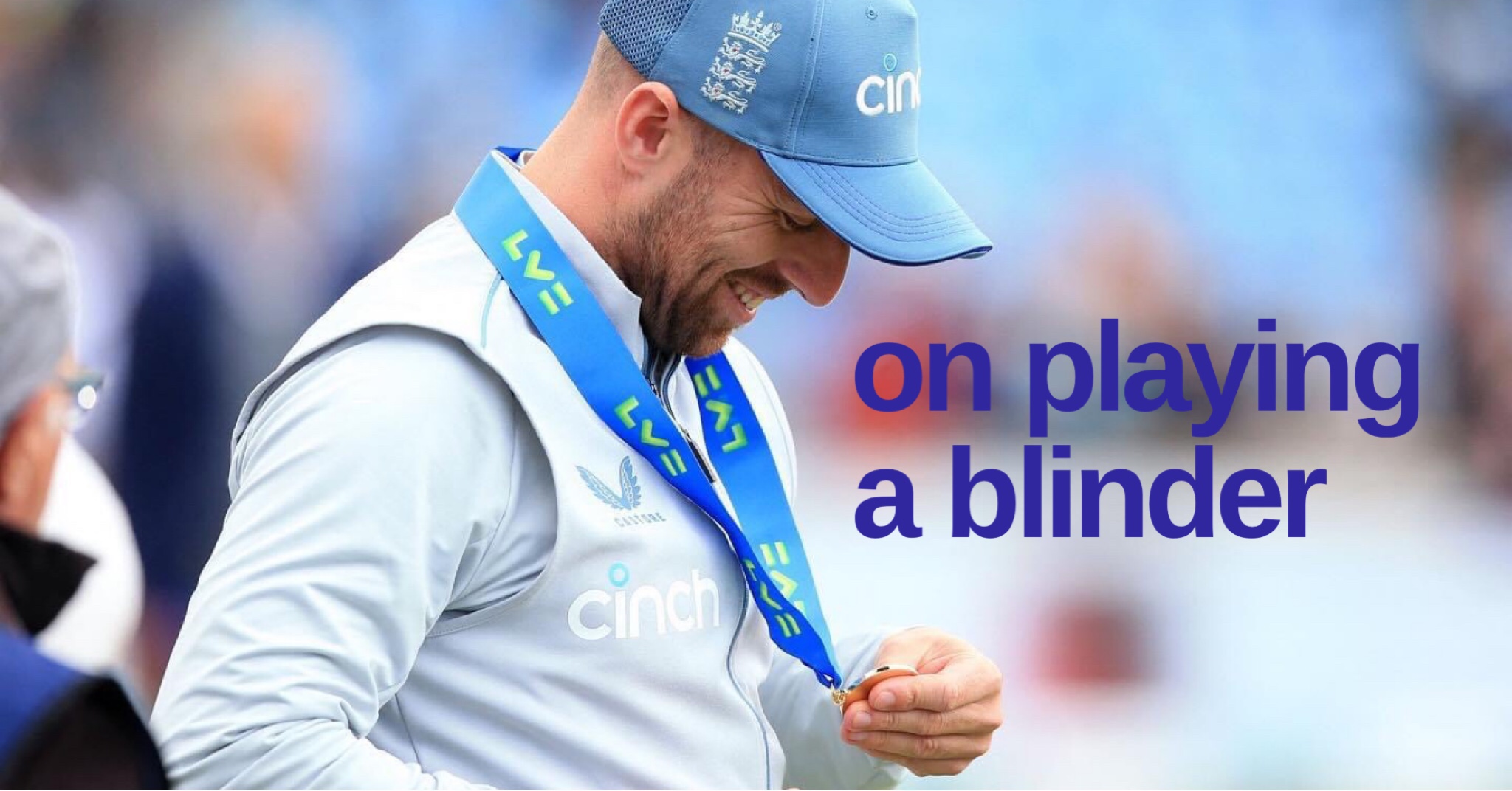
Jack Leach smiling as he inspects his Man of the Match Award
Back in 2019 I wrote about Jack Leach’s now legendary contribution of one not out in the last wicket partnership he shared with Ben Stokes in the Ashes test match held that year at Headingly. Together the pair put on an exhilarating 73 runs and brought about an victory for England that had seemed unlikely when Leach had first walked out to bat.
The perhaps all too obvious point of my blog was to simply highlight how seemingly small contributions are every bit as important as the more obviously headline grabbing performances of others and how, whilst general practice might not seem as glamorous or spectacular as some other aspects of medicine, the countless small interactions that take place in primary care each and every day are, nonetheless, highly significant in the provision of good healthcare in the U.K.
In short my point was that, just as without Jack Leach’s one run there would have been no win for England over Australia, so without general practice, there would be no NHS. As such, despite their seemingly more humble efforts, those working in primary care should not underestimate their value in the exceptional efforts of the NHS as a whole.
That blog entitled ‘For when we can’t see why’, can be read here.
Now, whilst I continue to stand by all that I wrote back then, three years on there is something more that has to be said. Because last weekend, in another test match at Headingly, this time against New Zealand, Jack Leach shone once again. But this time, rather than his being a small but crucial contribution to the teams collective effort, his was a match winning performance in its own right, one that, by his achieving his first ever ten wicket haul in a test match, he earned himself the Man of the Match award.
I guess you could say that the bespectacled slow left armer played a blinder!
And it seems to me that general practice is putting in a career best performance too.
Obviously I exclude myself in that assessment and not solely because I’m contributing nothing to the cause at present, holidaying as I am in the Lake District. But whilst I’m wasting my time dodging the somewhat inclement weather and trying, unsuccessfully, to pen humorous verse, my friends and colleagues up and down the country are continuing to pull out all the stops as they endeavour to care for patients despite the toll that has been taken as a result of what has undoubtedly been an exceedingly difficult couple of years for primary care.
Like Jack Leach who was diagnosed with Crohn’s disease at the age of 14 and consequently takes immunosuppressive medication, general practice is currently clinically extremely vulnerable. Despite governmental promises of additional doctors in general practice, the number of fully qualified full time equivalent GPs currently stands at 1,662 lower than it did in 2015 and, with an increasingly demoralised workforce partly made up by doctors, 80% of whom report having suffered from anxiety, stress or depression in the last year, it isn’t surprising that a third of GPs are looking to leave the profession in the next five years. If that predicted exodus does indeed take place without the necessary recruitment of sufficient new doctors to take their place, one can not help but fear for the future of general practice and with it the future of the NHS as a whole.
And also like Leach who, whilst out on tour in New Zealand just months after his heroics with Ben Stokes, feared for his life when he was hospitalised with sepsis, General Practice too is critically unwell and faces, as has already been said, an uncertain future. With patient demand increasing and the number of both GPs and community nurses in decline, medical centres up and down the country have been forced to close since staff shortages make it impossible for them to remain open safely. 89% of GPs now believe they have inadequate time with patients to provide a thorough diagnosis, 77% of GPs feel that staff shortages are putting patients at risk and, in some parts of the country 82% of GPs say that their practices are not always safe for patients. And all of this is simply because of the immense pressure under which general practice is currently ailing.
Furthermore with the country’s population having been steadily increasing such that it now stands, as was announced this week, at a record breaking 59,597,300 in England and Wales, a 6.3% increase since the census of 2011, it’s little wonder that, like Jack Leach who recently suffered concussion after sustaining a blow to the head whilst fielding, GPs are feeling punch drunk too.
But despite all this General Practice is currently delivering care at levels never seen before with figures proving that it is GP capacity that is the problem and not GP access. According to NHS Digital workforce data, general practice is at present managing an eye watering 1 million appointments a day. This is more than a million more consultations per month than was the case in 2019 and includes an additional 980,000 same day appointments over the last three years. Furthermore, General Practice sees more people every day than the rest of the NHS put together despite the fact that it receives just 5% of total NHS funding.
So whilst they may not be part of the most glamorous aspect of modern medicine, and though they may not be integral to the most eye catching parts of the NHS, those who work in primary care are, irrespective of whether they be doctors, nurses, or HCAs, practice managers, administrative staff or one of the countless other supporting members of the general practice workforce, nonetheless, together putting in an exceptional team performance.
So it’s not only Jack Leach who can feel justly pleased with his efforts. And neither is it only he who deserves a medal!
Because, contrary to what you may have heard, general practice is playing a blinder too!
Holidaying in the Lake District we walked past the one time home of William Wordsworth. Some experiences are truly inspirational…
We wandered lonely ‘neath the clouds, Alas they numbered plenty, And as we strode along the path, Those clouds, they chose to empty. But still we ventured bravely on, We so enjoy our rambles, And soon we were rewarded by, A host of thorny brambles.
With apologies to William Wordsworth
And on a separate occasion, whilst strolling on the Quantocks…
Upon smooth Quantock’s airy ridge we roved Unchecked, or loitered ‘mid her sylvan combes Our faces creased, their smiles, our pleasure showed ‘Till Hinckley C, the idyll fades, on landscapes fair it looms.
There was a dog that I once knew A Labrador of golden hue Who though ‘tis true he’d little brain With him I’d do it all again
Sometimes he lay by sock-less feet And though his breath did not smell sweet All toes of age and toes yet young He’d lick them clean with slimy tongue
He loved to walk he loved to eat He loved to sleep he loved a treat He loved the ones they make for cats He loved those oh so smelly sprats
But now that very special boy The one that brought us all such joy Will no more finish off my sarnie Farewell dear friend, farewell dear Barney.
*******
December 2023
Exciting news for fans of Barney, the internet sensation, social media influencer and much loved family pet who died last year.
Ever since his death in the Summer of 2022, rumours have circulated of a lost recording of the legendary canine superstar singing a tongue in cheek version of ‘Santa Baby’ and then wishing his millions of followers a ‘Happy New Year’.
This week those rumours were proved true when a short reel of film was recovered, hidden amongst several packets of dried sprats and a selection of chewed up tennis balls at the back of the cupboard under the kitchen sink.
Though found in a very poor condition, it has been possible to not only restore the picture quality but also, thanks to the tireless efforts of sound engineers from Abbey Road Studios, remaster the song itself thus making it suitable for a posthumous release.
As such, I am delighted to make this highly anticipated performance exclusively available for Facebook users this evening.
‘Blessed is he whose transgressions are forgiven, whose sins are covered. Blessed is the man whose sin the LORD does not count against him and in whose spirit is no deceit.’ [Psalm 32:-2]
Some years ago I went on a study day. Suitably interactive, involving a variety of teaching styles and fully addressing a personally relevant learning need, it was the best educational event that I’ve ever attended. The only downside was the fact that it was a Speed Awareness Course.
The day began with the leader asking for a show of hands from all those present who’d told friends and family that they were attending the course that day. Most hands went up, as did the corners of many people’s mouths, their smiles suggesting that few, if any, were ashamed at their having been required to be there. The leader then pointed out that breaking the speed limit was no less likely to cause a road traffic accident than driving whilst over the legal blood alcohol limit. He then asked how many people would have told friends and family they were on the course had it been run for those who had committed a drink driving offence. You’ll not be surprised to learn that no hands went up. Latter in the day, those gathered were asked to list the reasons why, on occasions, they might drive faster than the law permitted. A substantial list was generated. A short recording was then played of a man describing how his child had been killed by a speeding motorist. The leader then commented how our list, made up of what we had felt were potentially justifiable reasons for speeding, now seemed like nothing but a collection of weak excuses. It was a highly effective learning experience. And one that offered me spiritual insight too.
Because those contained within the Highway Code aren’t the the only laws I have broken. Though too often I don’t like to admit it, I have broken God’s law too. And so uncomfortable am I in accepting that I sometimes sin that, when I do err, I am, on occasions, want to try to preserve my spotless image, either by relativising my failures such that I am not really seen as a failure at all or, alternatively, justifying them by insisting they were understandable given the circumstances at the time. What the speed awareness course taught me was just how inappropriate and foolish both these approaches really are.
Furthermore to deny my sin is also ultimately burdensome.
‘When I kept silent, my bones wasted away through my groaning all day long. For day and night your hand was heavy upon me; my strength was sapped as in the heat of summer’. [Psalm 32:3-4]
Rather than carrying that burden, it’s better by far to be honest, not only with ourselves but also with God. Regardless of how uncomfortable it may make us feel, we have to take responsibility for our sin, owning our mistakes and feeling the genuine regret of our not being as good as we ought to be. This isn’t, I trust, an exercise in self pity but simply an honest acknowledgment of the reality of my sinfulness and the sadness that it causes. Though it would be kind of you to do so, please don’t try to reassure me by telling me I’m ‘good enough’. Because it simply isn’t the case – the truth is that I am a sinner, one who sins in ways for which there are no mitigating circumstances sufficient to absolve me of the responsibility for what I have done.
I don’t believe I am alone.
So then, ‘If we say we have not sinned, we make [God] a liar and his word is not in us’. But the good news, the gospel even, is that ‘if we confess our sins, [God] is faithful and just to forgive us our sins and to cleanse us from all unrighteousness.’ [1 John 1:9]
Or as David puts it in Psalm 32,
‘Then I acknowledged my sin to you and did not cover up my iniquity. I said, “I will confess my transgressions to the LORD” – and you forgave the guilt of my sin.’ [Psalm 32:4-5]
Admitting our sin will be humbling – but God ‘gives grace to the humble’ [James 4:6]. Grieving over our unrighteousness will be painful but ‘blessed are those who mourn, for they shall be comforted’ [Matthew 5:5]. And though having no confidence in ourselves may put us at odds with a world that likes to think that we are the masters of our fate and the captains of our souls, we will nonetheless find that ‘the LORD’s unfailing love surrounds the man who trusts in him’ [Psalm 32:10]
Then we who are counted righteous in Christ and who, in him, are upright in heart will sing. And rejoicing in the LORD we will be glad. [Psalm 32:11]
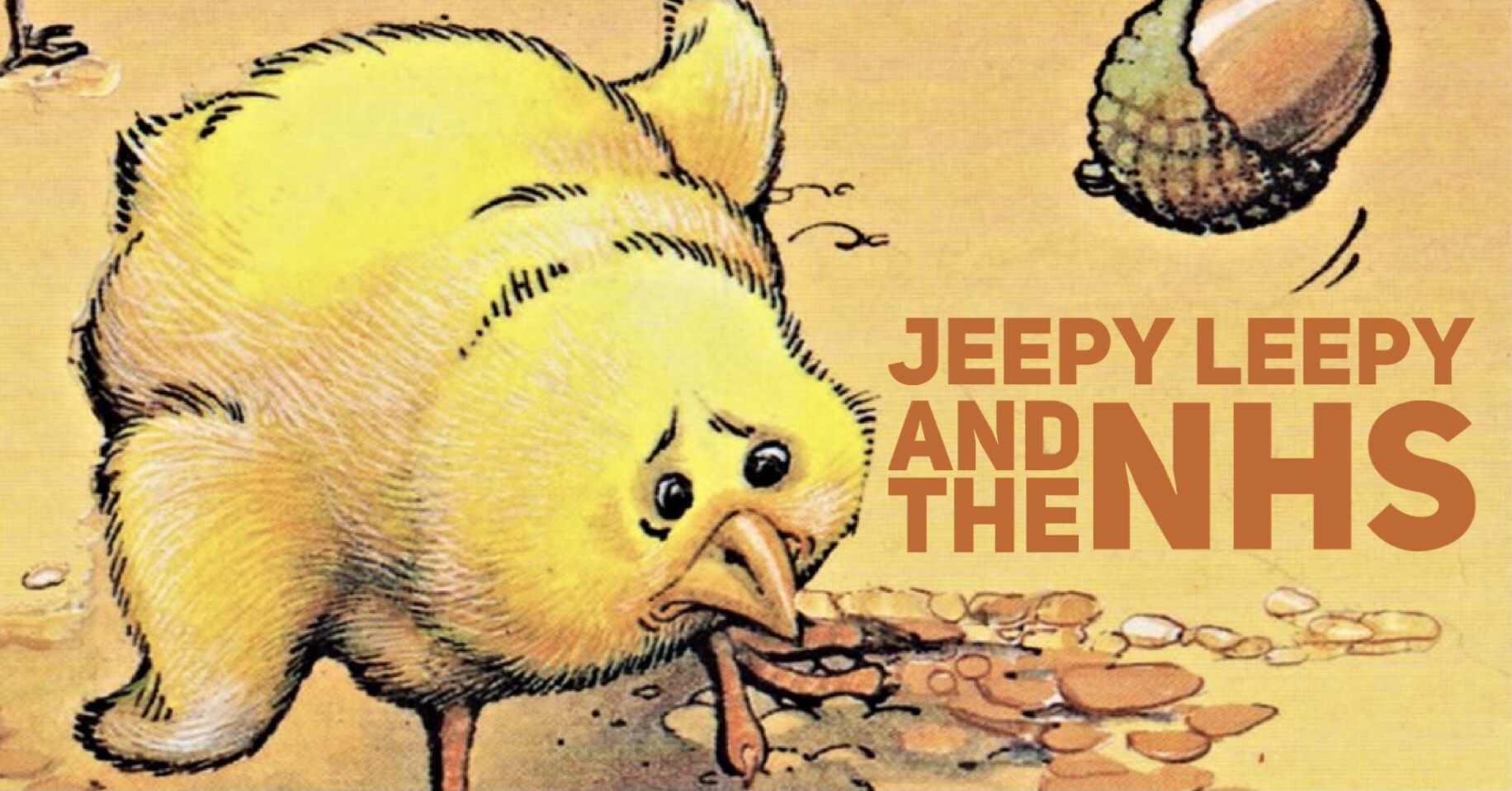
Once upon a time, not so very long ago, in a town close to where you now make your home, there lived a family doctor called Jeepy Leepy. Every day he went to the local medical centre where he worked hard, for long hours, doing his best to care for the sick who came to him for help.
Over time Jeepy Leepy’s workload steadily increased and eventually it reached the point where it was unsafe to try to do all that was being asked of him. But still his workload grew busier and busier until the day inevitably came when he had over a hundred contacts with patients, all of whom were seeking urgent medical advice or treatment. Some needed drugs that the pharmacy could not supply. Some needed a specialist opinion but were told it would be a year before an outpatient appointment could be offered. And some needed an ambulance but found that, even in an emergency, there wasn’t one that was available.
Concerned, too, that, with GP numbers in decline and patient demand outstripping GP capacity, his patients were having to face increasingly long waits before they could see him, Jeepy Leepy knew what was all too obvious to anyone who cared enough to notice – the NHS was falling down. And so, on his next day off, Jeepy Leepy decided to go and tell the Queen. He picked up his medical bag, hung his stethoscope around his neck and set off for London. Most of his patients agreed with Jeepy Leepy’s grave assessment on the state of the nations healthcare system and, sympathetic to his cause, cheered him on his way.
But Jeepy Leepy had only travelled a few hundred yards when he met Covid Lovid. ‘Where are you going?’ asked Covid Lovid. ‘Oh Covid Lovid’, said Jeepy Leepy, ‘The NHS is falling down and I’m off to tell the Queen’. But Covid Lovid laughed at Jeepy Leepy and told him that, because two of his partners had gone down with a new continuous cough, Jeepy Leepy would have to forgo his time off, return to the practice and spend the day working there instead.
Two weeks later, his colleagues having now returned to work, Jeepy Leepy set off again. But before very long he met Entitled Lentitled. ‘Where are you going?’, asked Entitled Lentitled. ‘Oh Entitled Lentitled’, said Jeepy Leepy, ‘The NHS is falling down and I’m off to tell the Queen’. But Entitled Lentitled laughed at Jeepy Leepy and, claiming he knew his rights, demanded that Jeepy Leepy see him immediately about his urgent need for a letter requesting the provision of softer cushions at his place of work.
The patient dealt with, Jeepy Leepy set off again. On the way he met Expert Lexpert coming out of an ivory tower. ‘Where are you going?’, asked Expert Lexpert. ‘Oh Expert Lexpert’, said Jeepy Leepy, ‘The NHS is falling down and I’m off to tell the Queen’. But Expert Lexpert laughed at Jeepy Leepy and insisted that Jeepy Leepy carry out an urgent review of all patients taking both flucloxacillin and paracetamol due to their increased risk of developing high anion gap metabolic acidosis.
The review undertaken, Jeepy Leepy carried on his way. Next he met Journo Lerno. ‘Where are you going?’, asked Journo Lerno. ‘Oh Journo Lerno’, said Jeepy Leepy, ‘The NHS is falling down and I’m off to tell the Queen’. But Journo Lerno laughed at Jeepy Leepy and wrote a story in his newspaper that was full of lies and which implied that Jeepy Leepy was overpaid and lazy.
Hurt though he was by the report, Jeepy Leepy carried on his way. Next he met Seekewsy Leekewsy. ‘Where are you going?’ asked Seekewsy Leekewsy. ‘Oh Seekewsy Leekewsy’, said Jeepy Leepy, ‘The NHS is falling down and I’m off to tell the Queen’. But Seekewsy Leekewsy laughed at Jeepy Leepy and told Jeepy Leepy that he was required to put in place a protocol for the safe storage of paper clips and develop an emergency plan detailing how he would respond if ever an acorn were to land on the medical centre’s roof.
The documents written, Jeepy Leepy carried on his way. Next he met Empee Lempee. ‘Where are you going?’, asked Empee Lempee. ‘Oh Empee Lempee’, said Jeepy Leepy, ‘The NHS is falling down and I’m off to tell the Queen’. But Empee Lempee laughed at Jeepy Leepy and by regurgitating a load of meaningless sound bites tried to convince Jeepy Leepy that the NHS really was safe in his party’s hands.
Far from reassured, Jeepy Leepy continued on his way. Next he met Healthsec Lealthsec. ‘Where are you going?’ asked Healthsec Lealthsec. ‘Oh Healthsec Lealthsec’, said Jeepy Leepy, ‘The NHS is falling down and I’m off to tell the Queen’. But Healthsec Lealthsec laughed at Jeepy Leepy and introduced a law that said that Jeepy Leepy had to work for even longer hours and for additional days in the week.
At which point Jeepy Leepy put down his medical bag, removed the stethoscope from around his neck and sat down on the side of the road. He could no longer go on.
And so the NHS fell a little further. And it kept on falling until, one day, inevitably, it collapsed completely.
And no one lived happily ever after.
THE END.
Other GP based stories:
To read ‘The Three Little GPs and the Big Bad Secretary of State for Health’, click here
Having learnt last weekend that, like Paddington, the Queen always keeps a marmalade sandwich close at hand in case of emergencies, here’s how I’m preparing for my next on call day in General Practice.
This weekend we are celebrating the Queen’s Platinum Jubilee – and it is well worth celebrating because, for the 70 years that she has been Queen she has been one who has served her people dutifully, one who has always shown integrity and one who, though of course not perfect, has been one that many have been happy to have rule over them.
But of course she won’t be Queen forever. She is getting frailer and increasingly we hear how she has not been up to attending certain functions and needing other royals to step in and take her place. And although we may not wish to think about, we know, just as all the Kings and Queens before her have, she too will sadly one day die.
A little over a week ago there was another special day that some of you you may have celebrated. Or maybe you didn’t because, perhaps as it did me, that very special day might well have passed you by. I didn’t notice anything about it in the papers, nor did I hear it mentioned on the news.
I’m referring to Ascension Day.
It’s a shame that Ascension Day doesn’t tend to garner much attention these days. It doesn’t help of course that it’s always falls on a Thursday but even so it really is a pity that we don’t make more of it than we do. Because it really is a very important day, one that we should most certainly celebrate. For it is the day that Jesus ascended, not only to heaven, but also, far more significantly, to a throne.
A throne on which he still sits.
Jesus is King – and not just any old king. He is the perfect king, one who rules over us with ‘understanding and knowledge’ [Proverbs 28:2], one to whom we all can gladly submit confident that his perfect rule is one that is without injustice and characterised by his perfect righteousness.
Furthermore, his is a rule which will never end.
Do you remember the words of Isaiah’s prophecy that we often hear at Christmas? It’s found in Isaiah 9:6-7
‘For unto us a child is born, unto us a son is given: and the government shall be upon his shoulder: and his name shall be called Wonderful, Counsellor, The mighty God, The everlasting Father, The Prince of Peace.
Of the increase of his government and peace there shall be no end, upon the throne of David, and upon his kingdom, to order it, and to establish it with judgment and with justice from henceforth even for ever. The zeal of the Lord of hosts will perform this.’
At the service of thanksgiving for her 70 year reign, the Archbishop of York, Stephen Cottrell, suggested in his sermon that there would be no better way to celebrate the Queen’s Platinum Jubilee than by following her example and putting our trust in Jesus Christ.
And he wasn’t wrong!
And so, at the name of Jesus may we all joyfully bow the knee, gladly submitting to him who, as well as being God, truly is the King of kings and Lord of lords.
Not forgetting of course, as Queen Elizabeth herself recognises, that he is King of queens too!
To read “Why do bad things happen to good people – a tentative suggestion”, click here
To read “Luther and the global pandemic – on becoming a theologian of the cross”, click here
To read ‘Covid -19. Does it suggest we really did have the experience but miss the meaning?’, click here. This is a slightly adapted version of “T.S. Eliot, Jesus and the Paradox of the Christian Life’.
Over the last year, General Practice workload has increased to levels which are unmanageable, unsustainable and, on occasions, undoubtedly unsafe. Why is this? The reasons are undoubtedly many and varied but they do at least include the following.
1. The effects of Covid 19. Whilst a few patients continue to attend with delayed presentations of conditions that should have been dealt with a couple of years ago, far more significant is the fact that the pandemic has left many on long hospital waiting lists and who, as a result, find it necessary to visit their General Practice for interim help for conditions for which they require specialist care.
2. The underfunding over successive governments of an NHS which is now, as a consequence, on its knees but which, nonetheless, continues to be expected by everyone to be there whenever it is needed and able to provide all the care that is asked of it.
3. Increased patient numbers per GP because, despite government promises to the contrary, there has been a reduction in the total number of GPs nationally. Furthermore, in some areas, the closure of GP practices has seen the subsequent reallocation, often at short notice, of patients to neighbouring practices without the necessary additional staff being made available.
4. A surge in the number of those struggling with mental health problems often as a result of the measures taken to combat Covid 19. Social isolation has taken its toll on many, not least children and young people, as too has the economic hardship which now seems only likely to increase over the next year or two.
5. A negative media which has encouraged some to think that GPs are not doing their job properly and led many to demand more of us mistakenly imagining that we have the capacity to do so when in truth we do not.
6. Having been sold the lie that life should be without suffering, there are many who are now intolerant of even the most minor of problems and insist on treatment for things that in the past people would, perhaps, have accepted and put up with for longer. Add to this the fact that, as a consequence of our living in an ‘Amazon Prime’ culture where all our desires are guaranteed to be delivered free tomorrow, many find themselves unable to wait and so insist that their treatment must be ‘now’.
7. An inability of many to tolerate any degree of anxiety with a good number of those who now present to GP practices falling into that group of patients sometimes known as ‘the worried well’.
This last group I think is huge but it is the medical profession who must take much of the responsibility for their growing number. For it is not surprising that we have the worried well when, for years, we have told the well that they should worry. Neither is it surprising, then, that we find ourselves spending inordinate amounts of time dealing with those who are not ill at all.
So what we can do about it? Many of the problems mentioned are beyond our control and though we should still petition for a better NHS, continue to hold the government to account and endeavour to engage with the media to accurately describe the current crisis that we all now find ourselves facing, we need also to a accept that we can’t single handedly change the society in which we live.
What we can do though is rediscover what it is to be good doctors. So what is it that good doctors do?
Well, for a start, they care for patients. And irrespective of how strong the temptation may sometimes be to think otherwise, they remember that the patients are NOT the enemy!
We need to take up our posts once more and act as the gatekeepers of the NHS protecting hospitals from patients but, far more importantly, protecting our patients from hospitals. We need to stop being people pleasers, something I will find particularly hard, and seek to do what is right by our patients rather than that which is popular, telling them the truth rather than what they want to hear. We need to apply a little wisdom in our consultations and avoid falling into the trap of mindlessly following protocols and merely acting according to algorithms. And, instead of adding to the anxiety of our patients, we need to be prepared to carry some of their anxiety ourselves. Because taking on that responsibility is what being professional is all about.
And finally we need to remember what good doctors DON’T do. Good doctors don’t turn away those who are sick and no doctor should feel compelled to do so. To take such an action would be to play into the media’s narrative that we are reneging on our responsibilities as GPs, it would turn our patients against us and so lose their support which is so vital to us if we are to come out of this in one piece, and it would make the already difficult working lives of our receptionist even harder. And of course, rather than being gatekeepers to the hospital, it would make us those who had abandoned our post and left the gate wide open. To do so would be to dump on our friends and colleagues in secondary care who are themselves struggling every bit as much as we are.
So in short it would sadden me hugely if we were to ever cap the number of patients who could see us on any individual day, if we were ever to become a profession which refused to see those who came to us in genuine need and thus deny them the help which was most appropriately provided for them in primary care.
And whilst appreciating the reasons for taking such drastic measures, I hope that I’m not the only one who would be at least a little embarrassed to be associated with such a move if, as some are advocating, it were to be deemed necessary. I fully understand how difficult things are at present, but alternative solutions must be found. Because to be a part of such a profession would, for me at least, only worsen the situation by making my working life even less satisfying. For there is still a joy to be had in helping others in need, a pleasure that comes, not merely from miserably doing our duty and soullessly performing what is required of us, but that comes as a consequence of our being in the privileged position of being able to make a positive difference in the lives of so many.
“What if we had a chance to do it again and again, until we finally did get it right? Wouldn’t that be wonderful?”
Kate Atkinson, ‘Life After Life’
‘Footfalls echo in the memory Down the passage which we did not take Towards the door we never opened Into the rose-garden’
From T.S. Eliot’s ‘Burnt Norton’
This week I have been watching ‘Life after Life’. Though, for me, it is was a flawed drama with a less than entirely satisfactory ending, the BBC series based on Kate Atkinson’s original novel does, nonetheless, present an interesting idea, one perhaps we have all at some time or another wished was true. What if, when we die, we had the chance to live our lives all over again, what if we were able to behave differently at key moments of our existence such that, as a result of acting better, the days that followed would run more smoothly for us and enable us to therefore avoid the pitfalls that in previous lifetimes we were made to endure?
Would we, I wonder, fare any better? Second time round, would we live a happier, more fulfilled, life? Or would we just find yet another of the infinite number of ways that are available to us to mess things up and so be forced to live an alternative but equally flawed existence complete with another, equally unsatisfactory, ending? And would we then be compelled to spend all eternity constantly working out our lives in an endlessly futile cycle, one in which we were always striving to do better, always hoping to somehow make everything all right?
Also this week I listened to the distress of a young woman. Not having benefited from the best efforts of those who have sought to help her with treatments of both the talking and pharmaceutical kind, she told me of her loneliness, her anxiety and her despair. She told me how she was tired and how she wanted it all to stop. And, without any sense of the melodramatic, she told me how she longed to die – more than that she told me how she needed to die if things were ever to get better. Because, for her, without any hope for the future, death seemed the only way to end the pain, the anguish that was hers as a result of existing in a world in which she felt she did not fit.
But, of course, were she to die, there would be no second chance for her. As for countless others before her, there would be no opportunity to live life differently. And though perhaps her distress would be over, that of those left behind, that of those who love her and already know what it is to sorrow over her sadness, would surely only increase.
So what is the answer? Is there an answer at all? Is my young woman right when she says it’s all just pointless?
I for one am not that nihilistic. And whilst I don’t have all the answers that I would like to have for those who struggle as this young woman does, I nonetheless refuse to believe that her struggle is without meaning, I refuse to believe that it has no purpose. And so, believing that suffering can be redemptive, believing it can even be the means by which suffering itself is ultimately brought to an end, I will, at least, continue to care and, in so doing, endeavour, as best I can, to know something of her distress, share a little of her sadness and bear with her the burden of her sorrow.
And though she may have given up hope, I will not. I will hope for her, continuing to believe what she cannot – that a better tomorrow is on its way. And this, not merely in some imagined parallel universe conjured up by the imaginations of those who cannot face the genuine awfulness that is all too often apparent in the one we already know. On the contrary, I will continue to hope for a better tomorrow for this beautiful yet broken world, a better tomorrow when, not only hers but all our tears will have been wiped away, suffering will be no more and each and every one of us will have found a place that we can call our home.
Because when that ‘life after life’ finally comes, all this ‘death before death’ can be forgotten.
And won’t that be wonderful?
Related blogs:
To read ‘General Practice – A Sweet Sorrow’, click here
To read ‘Eleanor Rigby is not at all fine’, click here
To read ‘Do you hear the people sing?’, click here
It was eight days after his resurrection that Jesus appeared to the disciple who is generally remembered, perhaps unfairly, as the one who was slow to believe that Jesus was indeed alive once more. But, despite the fact that ‘doubting’ Thomas is frequently given a bad press, I would like to say that I am genuinely grateful to him.
For the account that we read in John 20:26-29 reassures me that, despite those living in first century Jerusalem being just as unlikely to believe a story about a dead man coming back to life as those who are living today, so convincing was the evidence for the resurrection that, when presented with it, even a dyed in the wool sceptic like Thomas could not help but believe that the seemingly unbelievable had in fact taken place. And so, face to face with the risen Christ, an intellectually honest Thomas followed that evidence and rightly declared Jesus to be both his Lord and his God.
After Thomas believed the evidence that his eyes would not allow him to deny, Jesus said to him, ‘Blessed are those who have not seen and yet have believed.’ In saying these words Jesus was referring to us. But the reason that we can believe without seeing is, partly, the result of Thomas not being able to believe until he did see.
John tells us that he wrote his gospel so that we might believe that Jesus is the Christ, the Son of God, and that, by believing, we may have life in his name [John 20:31]. Our faith, therefore, is partly down to the fact that Thomas’ story was there to be recorded, a story of one who, initially doubtful, demanded the evidence that we all need if we are to have confidence that a faith placed in Jesus is a faith placed in one who can be wholly depended upon.
Confident then that He really is alive, may we, like Thomas, follow the evidence and, therefore, gladly recognise Jesus to be our Lord and our God too.
For, thanks in part to Thomas, we all have very good reason to do so!
It was January 2021 and Lady Penelope was taking tea in the drawing room of Creighton-Ward Mansion when her chauffeur, Parker, appeared at the door.
‘I’m sorry to bother you milady’ he began, ‘but the Secretary of State for Health is on the phone. He’s at some Downing Street party and wondering if you’d care to join him’.
‘Not him again,’ replied Lady Penelope striding over to where Parker was holding the phone. ‘When will that lecherous little man realise I don’t want to have anything to do with him. And, what’s more, to attend a social gathering in the present circumstances is completely wrong and whilst some in government may consider themselves above the law, this lady of the realm most certainly does not! Give me the phone Parker, I’m going to give him a piece of my mind’.
Lady Penelope took the phone from Parker and, before the caller could say a word, that’s exactly what she proceeded to do.
‘Mr Secretary of State’ she growled down the line, ‘you should be ashamed of yourself, partying whilst daily Covid deaths sore ever higher. You need to do something and do something quick. If you had any sense you’d be calling on those who can always be relied upon in an emergency. If I was you, I’d be calling on the new primary care wing of International Rescue.’
And with that Lady Penelope ended the call and threw herself down onto the chaise lounge that was situated by her side.
‘That’s the way to deal with men like that Parker. Now, if you would be so good as to bring me another pot of Earl Grey I’d be most awfully grateful. And, perhaps, a large measure of Talisker to accompany it. Speaking to people like that leave one somewhat in need of a restorative.’
*****
Meanwhile, far away on a remote island somewhere in the South Pacific, Jeff Tracey was in a meeting with two of his five GP sons, the other three joining them via Zoom from International Rescue’s space station. Also present were other allied members of the organisation. They were all discussing what their response should be to the news they had recently received from Lady Penelope. In her role as special agent in London, she had discovered that their evil nemesis, ‘The Hood’, had managed to infiltrate British politics and subsequently risen to become Prime Minister. By employing his powers of hypnosis he had even managed to convince a large proportion of the electorate that he was both a competent and respectable national leader.
Their deliberations were interrupted when the phone on Jeff Tracey’s desk flashed red indicating that a distress call was being received. Picking up the phone and listening to the voice on the other end of the line, he echoed back the callers opening words.
‘You say you’ve had a wonderful idea?’ He said, his voice suggesting that he doubted that such a thing was possible. Covering the mouthpiece of the phone he indicated to the others that it was the Secretary of State for Health who was calling. He then continued the call, repeating key statements so as to convey to the gist of what was being said to everyone one else who was in the room. ‘No I didn’t see the announcement on the television this evening…a national vaccination programme to commence tomorrow you say…with jabs being made available in local centres right across the country.’
When at last the caller had finished speaking, Jeff paused for a moment, considering his reply.
‘Well you might have thought to speak to us before you made such an announcement to the general public. General Practice may well be ideally positioned and though the efforts of those who work within it are not infrequently superhuman, it remains the case that each and every person who makes up the primary care workforce, as well as those who work elsewhere in the NHS, are ordinary individuals whose willingness to help cannot, and must not, be taken for granted in this way. Even so, since International Rescue exists for the sole purpose of saving human life, we will do all we can to help. You can rely on us.’
Ending the call Jeff looked around the room and formulated his plan. First he gave instructions to his bespectacled lead scientist.
‘Brains, you and Tin Tin, must work alongside those infinitely resourceful and wonderfully capable practice managers and coordinate the implementation of the delivery of the vaccine.’
‘Just as you say, Mr Tracey. We’ll get on to it immediately’. Brains and his trusted assistant stood up and made their way to the door. Then Jeff Tracey turned to the two sons who were present with him in the room.
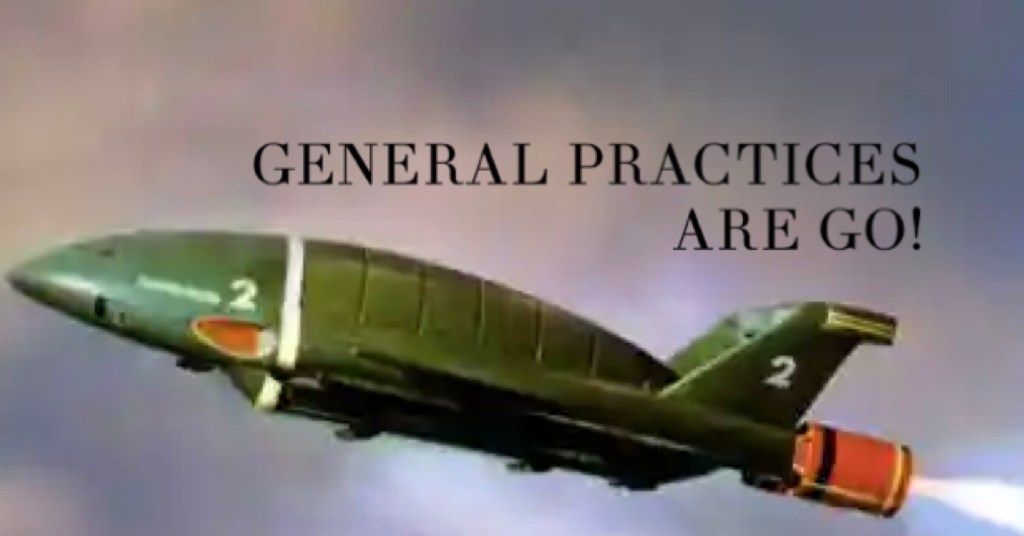
‘Scott, you take Thunderbird 1. I want you to be first on the ground overseeing the set up of vaccination centres across the country. Tap into the eagerness to help, not only of GPs but also of practice nurses, admin staff and receptionists and thus pull together a team capable of delivering the largest vaccination program in history. And Virgil, with Pod 6 packed full of vials of Pfizer, Modena and AZ vaccines, you are to take Thunderbird 2 and distribute them the length and breath of the UK. Have you got that boys.’
‘F.A.B. Father. Thunderbirds are Go!’
And so began the roll out of the highly effective national vaccination programme, the like of which the country had never seen before. Shy of publicity, and eager to keep their identity a secret, International Rescue members smiled inwardly to themselves as those in Government sought, perhaps, to take a little too much credit for what was actually achieved as a result of the tireless efforts of countless individuals. Still, it was enough for those involved to know that there’s was a job well done.
*****
A year or so later, a lone GP sat at his desk and waited for the lateral flow test that he had just taken to reveal it’s result. It had been another long day and as the last consultation had drawn to a close Dr Mungo had begun to feel slightly unwell. Perhaps he was just worn out given how impossible the job had become. Workload had never been so heavy and patient demand had never been so high. It was no surprise of course, given the ever lengthening list of those waiting for hospital treatment, the surge in patients suffering with poor mental health and a workforce crises that was resulting in the collapse of GP practices right across the country. Furthermore, GP morale, already at an all time low, was only being made worse by criticism in the press, a criticism, tacitly endorsed by some in government, that suggested that it was simply lazy and overpaid GPs who were responsible for the problems that the NHS was experiencing.
‘Oh that you could get an ambulance as quickly as the result of a Covid test’, Dr Mungo said to himself recalling how he’d had to wait three hours for an emergency response vehicle to arrive having called for one earlier in the day for a patient experiencing marked difficulty in breathing. ‘Well that’s me working from home for the next week or so.’ he sighed as the second red line appeared in the window of the plastic test that lay on the desk in front of him. He didn’t relish the prospect. It wasn’t only that his being away would put additional strain on the practice, it was also that he did so hate consulting remotely and not being able to see his patients face to face.
As he sat with his head in hands, he remembered something that an aristocratic friend of his had once said to him. Penny, as he had known her, had told him that, were he ever to find himself in dire need of help, there was a number he could call that would be sure to lead to him receiving the assistance he required. He’d kept a note of number she’d given him ever since and he now scrolled through his contacts desperate to make use of it. At last he found it. ‘Under I’, he said to himself smiling, ‘just as you’d expect.’
He entered the number into his phone and waited for what seemed like an age. Eventually a voice came onto the line.
‘Hello’ it said hesitantly. ‘Can I help?’
‘Is that ‘International Rescue?’ Dr Mungo asked, questioning for a moment if he might have misdialled given how uncertain the one who answered his call seemed.
‘Well it used to be’, came the reply. ‘I’m just the caretaker. Most of the others have gone now, what with all the changes we’ve had round here. It’s the funding you see. We used to get some government support but that all dried up, as a result of all the money that was wasted on the crippling expensive, not to mention disastrously ineffective, test and trace service, the budget for which was greater than that for the whole of primary care. And then there was the stress of it all. Scott left to take up a job stacking shelves in a local supermarket and Virgil eventually burnt out and joined the ranks of the long term sick, his precarious mental state evidenced by the fact that he began writing pastiches whose storylines were as stilted as the movements of the characters in a Gerry Anderson TV series of the 1960s. The Thunderbirds themselves have all been decommissioned and sold for scrap – except for Thunderbird 4 that is. Dr Gordon Tracey continues to offer a service as best he can but, without Thunderbird 2 to transport the yellow submersible, it isn’t always possible to reach people in as timely a fashion as he would like. Even so, I’m sure he’ll do what he can if you know someone who’s drowning.’
‘Oh I know a few of those’, Dr Mungo whispered in response, ‘but not in the way you’re thinking. I’m not sure your submarine will be of much help to them.’
And with a ‘Thanks anyway’ not dissimilar to those he’d heard from patients who had sometimes left his consulting room seemingly dissatisfied with what he’d been able to offer them, Dr Mungo said his goodbyes and ended the call.
‘Thunderbirds are go’ he thought to himself. Not any longer. Now it was more a case of ‘Thunderbirds are gone’.
And he wondered how long it would be before the same would be said of General Practices too.
Sorrowful, yet always rejoicing. Happy, yet always sad.
It was true last year in times of pandemic. And it’s true this year in times of war. Trouble abounds.
Though Covid 19, for the time being at least, may be less on our minds than the events in Ukraine, what remains abundantly clear is that difficulties continue to surround us and make up part of all our lives. Even so, it is still the case that there are things for which we can be grateful, things that, though they do not nullify our ongoing distress, can nonetheless cause us to smile. Similarly, how ever good our lives may be at present, there remain those things that persist in pulling us down. The truth is that sadness and happiness coexist, neither one ever entirely absent, each simultaneously intensifying and diminishing the other. There is for all of us, pleasure in our sadness, heartbreak in our delight. I see it on the news, I see it in my patients, I see it in myself – genuine causes for sorrow sat alongside sources of real joy.
Sorrowful, yet always rejoicing. Happy, yet always sad.
Perhaps we cannot know what happiness really is without knowing the pain of sorrow and, for sorrow to be fully realised, perhaps it requires us to have had the experience of knowing what it is to be truly happy. If so, if we are to be happy, it must be alongside our sadness and we must not insist that all sorrow is gone before allowing ourselves to be happy any more than we should deny our sadness simply because there are things for which we can be happy.
Life is not black or white, it is a kaleidoscope of grey. Paradoxically we can be happy and sad at the same time. We can smile even as we cry.
Today is Good Friday – a day like no other, a day on which I find it helpful to ponder such things. For me it helps to make make life more meaningful, more understandable, more bearable. Perhaps it will for you too.
Because even the eternally happy God knows what it is to weep.
What follows is the same as I posted this time last year. I repeat myself for no other reason than what was true in days of pandemic, is still true in times of war.
I remain sorrowful, yet always rejoicing. Happy, yet always sad.
One Maundy Thursday I wished a good friend of mine a happy Easter break. He hesitated however to return my good wishes because, he said, that he understood that Good Friday was a day for Christians like me to be miserable. It got me thinking to what extent he was he right.
Paul, writing in his second letter to the Corinthians, describes Christians as, ‘Sorrowful yet always rejoicing’ [2 Corinthians 6:10]. If such a paradoxical existence was the reality for Christians back in Paul’s day, it is surely no less true a reality for Christians living the 21st Century. ‘Good Friday’, the name we give today, is itself a paradox – for how can we apply the adjective ‘good’ to describe the day of Christ’s crucifixion? For sure, it is a day on which Christians should grieve over their sin and what it was that Jesus had to suffer in order to secure their redemption, but, at the same time, it is a day for rejoicing in the triumph of his sacrifice as we anticipate and remember his subsequent resurrection from the dead on Easter Sunday.
‘Sorrowful yet always rejoicing’ – it was the experience of Paul and it was also the experience of Jesus himself. For he was himself ‘a man of sorrows and acquainted with grief’ [Isaiah 53:5]. Matthew recalls the words of Jesus to Peter, James and John, in the Garden of Gethsemane:
“My soul is very sorrowful, even to death; remain here, and watch with me.” [Matthew 26:38].
And yet the writer to the Hebrews has it that Jesus, ‘for the joy that was set before him endured the cross’ [Hebrews 12:2].
Suffering, then, is not the end of joy – it can even be the passage to joy. Again this is not a contradiction – but it is a paradox! A paradox that the second thief, even as he was being crucified alongside Jesus, understood. There he was, in just about as bad a position as it is possible for a person to be in, minutes away from an excruciating death, when he, nonetheless, made his remarkable request:
‘Jesus,’, he said, ‘remember me when you come into your kingdom’ [Luke 23:42].
Like everybody else that day, the second thief saw Jesus suffering and dying on a cross. But unlike the religious rulers, the Roman soldiers and the other thief who was also being crucified that day, he didn’t see defeat. He continued to speak of Jesus as one who was coming into his kingdom. For him Jesus’ death didn’t mean an end to all the kingdom and salvation talk. Whilst all those others, those who mocked Jesus as they watched him die, were looking for a salvation FROM death, the second thief saw that the salvation Jesus was bringing about was a salvation THROUGH death.
Jesus’ death wasn’t the end of Christ kingdom, on the contrary, his death was its beginning.
This is a profound truth – one we do well to try and grasp some understanding of.
Far from a simple faith, the second thief’s faith was remarkable. And it is on account of his wonderful faith that we should not be surprised by Jesus when he responds to him with these words:
‘Truly, I say to you, today you will be with me in paradise’ [Luke 23:43].
Jesus saw in the second thief somebody who got it! Somebody who trusted the power of God despite seeing that which to unspiritual eyes was nothing but weakness. Somebody who saw victory where most saw only defeat. Somebody, indeed, who understood the paradox of Good Friday.
That suffering is not irredeemable,
That sorrow is not incompatible with joy,
That even the darkest nights can be followed by the brightest days.
‘Sorrowful yet always rejoicing’?
It was the experience of Paul. It was the experience of Jesus. It was the experience of the second thief. And it will be our experience too.
Some of us are sick? Some of us mourn the loss of loved ones? Some of us worry over our future? Some of us have experienced great tragedy in our lives – some recently, some longer ago but who nonetheless still feel the pain just as keenly as if it were yesterday.
There is indeed much today for us to be sorrowful over. Some Christian types can sometimes well meaningly suggest we should always be happy. ‘Smile’, they say, ‘Jesus loves you’. But though they are right to proclaim the truth that God really does love us, they are wrong to suggest that we should never be sad, for even the eternally happy God knows what it is to cry. [1 Timothy 1:11, Luke 22:62]. Even Jesus wept at the tomb of his friend Lazarus, his grief no less intense for knowing that he would soon bring him back to life. [John 11:35].
Perhaps, then, even God knows what it is to be sorrowful yet always rejoicing.
So it’s not wrong to be sad, it’s simply normal. The Bible never tells us to masochistically rejoice about our suffering. But it does tell us to rejoice in our suffering.
Because despite our sorrow – there is much to rejoice over! We truly are loved with an everlasting love, a love that transcends our current struggle, a love that means that we too can be sorrowful yet always rejoicing.
As we suffer we can rejoice because of the Gospel. The good news is that Good Friday was followed by Easter Day, that Jesus died for our sins, bearing the punishment we deserve, and that when he rose from the dead Jesus proved the sufficiency of his sacrifice. By it we are justified, counted righteous, declared to be ‘not guilty’.
Some of us grieve over our unrighteousness and can not even lift our eyes to heaven. We beat our breasts and cry out, ‘Have mercy on me, a sinner’ [Luke 18:13] But because of Jesus’ work on the cross on our behalf we are made right with God – regardless of our current situation.
Not because of our worth – but because of his grace.
Not because of what we do – but because of what he did.
Not because we are lovely – but because he is loving.
So, if you’re sorrowful today, remember you’re not alone, God weeps with you. And know that, because of Jesus, his life, death and resurrection, ‘Weeping may tarry for the night, but joy comes with the morning.’ [Psalm 30:5].
It’s Good Friday – but Easter Sunday is coming. Because of what took place over those two days nearly 2000 years ago, we can know real forgiveness for all those sins that we so bitterly regret, no matter how great they are.
But if that were not enough to rejoice over this Eastertide, we can also look to the future with a certain hope. Suffering is all too real today but the day is coming when God ‘will wipe away every tear form [our] eyes, and death shall be no more, neither shall there be mourning, nor crying, nor pain anymore, for the former things [will] have passed away.’ [Revelation 21:4]
‘So we do not lose heart. Though our outer self is wasting away, our inner self is being renewed day by day. For this light momentary affliction is preparing for us an eternal weight of glory beyond all comparison, as we look not to the things that are seen but to the things that are unseen. For the things that are seen are transient, but the things that are unseen are eternal’. [2 Corinthians 4:16-18]
It’s Good Friday – but Easter Sunday is coming.
So may we all know happiness this Eastertide – even those of us who are sorrowful.
To read “Why do bad things happen to good people – a tentative suggestion”, click here
To read “Luther and the global pandemic – on becoming a theologian of the cross”, click here
To read ‘Covid -19. Does it suggest we really did have the experience but miss the meaning?’, click here. This is a slightly adapted version of “T.S. Eliot, Jesus and the Paradox of the Christian Life’.
To read “Hope comes from believing the promises of God”, click here
To read “Waiting patiently for the Lord”, click here
Yesterday would have been my mother-in-law’s birthday. Almost two years on from her death we spent much of the day with my father-in-law. Flicking through old photographs I was reminded of how it’s not only the dead that are mourned – there are those who grieve for the good times that once were commonplace, for the laughing child who now no longer smiles, for the wasted years that will never be recovered. Later we had lunch in the restaurant of a garden centre where my mother-in law used to like to go for coffee. Sitting at what was once her favourite table, the memories again came back. But she didn’t. All we had were the memories – and the memories weren’t enough.
This week, for a great many, what there was, wasn’t enough.
For some, what they had in the bank wasn’t enough to pay for them to have sufficient heating. For some, the protection afforded by the law wasn’t enough to stop them from being brutally murdered. For some, the NHS wasn’t enough to cure them of their disease. For some, their own sense of self wasn’t enough to get them out of bed in the morning. For some, the combined force of NATO and the United Nations wasn’t enough to prevent them from becoming victims of the atrocities of war.
And for some, it was me who wasn’t enough. Not strong enough, not wise enough, not kind enough. Not for those who needed me to have been far more of all these things, not for those who discovered that I too wasn’t enough for them.
This week, in a world of grief, a world filled with so much sadness, so much pain and so much suffering, there have been those for whom the whole of the world wasn’t enough. And, for far too many, it won’t be enough next week either.
Because sooner or later, everyone needs more than the world has to give. More than we have to give.
No wonder then that sometimes work is hard. We are overwhelmed by what we can do, let alone by what we can’t. What we are asked to do each day doesn’t just seem impossible, impossible is what it all too often really is.
So let’s not be surprised when we are not enough, let’s not add to how difficult it is by being that unfair on ourselves. For there is no shame in being asked for more than we’ve got and only being able to give all that we have.
Three blogs which, in my head at least, make up a trilogy on the subject of burnout: