As coronavirus cases climb And locked down it feels we’re doing time How I long to take your hand in mine To make you feel my love
As the news it goes from bad to worse And we lose those things we cherish most How I wish that I could hold you close To make you feel my love
They say restrictions they must stay for now And so imprisoned we must be They say one day that it will end, but how If nobody has the key
And so behind a mask we still must hide Concealing all of the tears we’ve cried Until I walk again close by your side And let you feel my love
Instrumental
The world is changing as is plain to see Much that is precious has been lost Perhaps some day we’ll all be virus free But what will have been the cost
How much longer must we live like this? How much longer must your touch I miss? I hope that one day soon your lips I’ll kiss To make you feel my love To make you feel my love
IMAGINE COVID
Imagine there’s a.country It’s easy if you try Where you must not give comfort To grieving ones who cry
Imagine all the people Living all alone
Imagine loved ones dying It isn’t hard to do Who as they face their final days Are kept from seeing you
Imagine all the people Kept always apart
You may say that I’m mistaken That these thing could never be But take a look around you It’s already plain to see
Imagine no more parties No sport, no theatre too No singing songs together What would you find to do?
Imagine all the people Scared to show their face
Imagine empty high streets No parks for kids to play No jobs for those without them So unemployed they’ll stay
Imagine all the people Living lives concealed
You may say that we’ve no option If we are to all survive But if this is what is called living Do we really want to be alive?
Now know that there’s a heaven A better place to be No pain no death no sorrow A place where we’ll be free
Imagine all the people Living there at peace
You may say that I’m a dreamer Well I’m not the only one I hope some day you’ll join us And the world will be as one
LOCKDOWN DAY
Just a lockdown day I don’t try to, even dress Just eat and drink, to excess That ain’t on
Just a lockdown day Spend the time, so alone Can’t do this all on my own It’s no fun
Oh, it’s such a lockdown day (I wish) I could spend it with you All of these lockdown days They just keep lingering on They just keep us lingering on
Just a lockdown day Loved ones I long to see All of them kept from me For too long
Just a lockdown day Sadness fills every hour Freedom no longer ours It’s all gone
Oh, it’s such a lockdown day (I wish) I could spend it with you All of these lockdown days They just keep lingering on They just keep us lingering on
We’re going to reap, just what we sow We’re going to reap, just what we sow We’re going to reap, just what we sow We’re going to reap, just what we sow
After Lou Reed
As you’ll have noticed all three of these songs are available on YouTube. They’re best not experienced whilst locked in and alone. Help should be at hand!
For more song adaptations please follow the links below:
I’ve been a GP now for many a year To all the NICE guidelines I’ve tried to adhere But I’ve no idea why the CQC thinks That urine samples can’t be poured down our sinks.
And it’s no, nay, never No, nay never no more Will I play the wild GP No never no more
East Quay is a practice in Bridgwater town The patients are lovely, the river is brown At EQMC we all work as a team And everyone’s awesome except for Doreen*
And it’s no, nay, never No, nay never no more Will I play the wild GP No never no more
Each day you will find us we’re all hard at work The phones in reception are going berserk The patients who ring in then all indicate The hue of the phlegm that they expectorate
And it’s no, nay, never No, nay never no more Will I play the wild GP No never no more
These days of pandemic have made us all sad But not everything at the practice is bad The one very good thing ‘bout Covid 19 Is now our door handles are shiny and clean
And it’s no, nay, never No, nay never no more Will I play the wild GP No never no more
We all wear our masks and our gloves of bright blue My glasses mist over obscuring my view But please do not worry, though blind I’ll not stop I’ll still somehow muddle through your minor op
And it’s no, nay, never No, nay never no more Will I play the wild GP No never no more
When busy on call days make stress levels rise To drink too much coffee is really not wise For there’s every chance when one’s bladder is full There won’t be the time to answer nature’s call
And it’s no, nay, never No, nay never no more Will I play the wild GP No never no more
On duty doc days though we’re jolly and bright We’re cheery, and smiley, we’re just a delight We grin and we laugh and we’re happy and gay But that’s only when it’s the end of the day
And it’s no, nay, never No, nay never no more Will I play the wild GP No never no more
And it’s no, nay, never No, nay never no more Will I play the wild GP No never no more
*With apologies to ‘The Dubliners’…and Doreen who, though I wouldn’t want her to hear me say so, is actually awful awesome too!
The picture above is a photo of Luke Kelly one of the founding members of The Dubliners.
An audio version of this song can be found here:
For more song adaptations and woeful attempts at poetry, all with a GP flavour, please follow the links below:
Once upon a time there were three young doctors who set out to be GPs.
The first little GP built his practice on enthusiasm.
One day the big bad Secretary of State for Health came knocking on the door of the practice where the first little GP was busy working hard.
‘Little GP, Little GP, let me come in’, said the the big bad Secretary of State for Health.
‘Not by the hairs on my chinny chin chin’, replied the first little GP.
‘Then I’ll huff, and I’ll puff, and I’ll bring your practice down’, said the Secretary of State for Health.
And with that the big bad Secretary of State for Health huffed and he puffed and, as a result of years of systemic underfunding of primary care services, he brought the first little GPs practice down. The first little GP had no enthusiasm left to rebuild the practice so he took a job as a barista in a local coffee shop instead.
As well as enthusiasm, the second little GP built his practice on good will.
One day the big bad Secretary of State for Health came knocking on the door of the practice where the second little GP was busy working hard.
‘Little GP, Little GP, let me come in’, said the the big bad Secretary of State for Health.
‘Not by the hairs on my chinny chin chin’, replied the second little GP.
‘Then I’ll huff, and I’ll puff, and I’ll bring your practice down’, said the Secretary of State for Health.
And with that the big bad Secretary of State for Health huffed and he puffed and, by introducing more and more red tape which made it increasingly difficult to get on with the job of caring for patients, he brought the second little GPs practice down. The second little GP had no good will left to rebuild the practice so he took a job stacking shelves in a local supermarket instead.
As well as enthusiasm and good will, the third little GP built his practice on evidence based medicine, an exceptional ability to adapt to change and large amounts of pragmatism and common sense.
One day the big bad Secretary of State for Health came knocking on the door of the practice where the third little GP was busy working hard.
‘Little GP, Little GP, let me come in’, said the the big bad Secretary of State for Health.
‘Not by the hairs on my chinny chin chin’, replied the third little GP.
‘Then I’ll huff, and I’ll puff, and I’ll bring your practice down’, said the Secretary of State for Health.
And with that the big bad Secretary of State for Health huffed and he puffed and announced that GP surgeries would be open in the evenings and on Saturday mornings for routine care.
But although the practice shook a little, the third little GPs practice stood firm.
The Secretary of State looked unhappy. He knocked on the door of the third little pigs practice again and, in as sweet a voice as he could manage, promised the third little GP lots of extra GPs to help get all the work done.
But no extra GPs were forthcoming and the big bad Secretary of State for Health stopped pretending to be nice.
And he began to huff and puff a second time.
This time he tacitly supported a media campaign making GPs out to be lazy ne’er do wells who were being paid large salaries whilst hiding behind locked doors and refusing to see those patients they were supposed to care for.
And again the third little GPs practice was shaken. But still, even with morale at an all time low, it did not collapse.
So the big bad Secretary of State for Health started to huff and puff for a third time and demanded that, despite the fact that they were working harder than ever before, little GPs across the country must work even harder still and promised to ‘name and shame’ any he felt weren’t pulling their weight.
And again the third little GPs practice was shaken. But still, even though it was on its knees, it did not collapse.
The third little GP carried on working and with the rest of the practice team did as good a job as they possibly could. But, over time, fewer and fewer young doctors decided to become GPs and as those who continued to work came to retire, many sooner than they had planned as the result of the job becoming ever more impossible, General Practice eventually was no longer sustainable and so became a thing of the past.
And the big bad Secretary of State for Health was happy at last.
But everyone else was sad and nobody lived happily ever after.
Bond looked at ‘M’, his hand shaking as he lifted the vodka martini to his lips.
‘Let me check that I’ve understand you sir. You want me to work undercover in a primary care setting. You want me to manage unprecedented patient demand, deal with ever more complex clinical cases and battle an increasing hostile press. The only gadget that ‘Q’ has come up with to assist me is a pulse oximeter. And I’m to kill no one?’
‘That’s right James. It’ll be your most challenging mission yet. Can I rely on you?’
‘I’m sorry sir. Such a mission is beyond even my astonishing capabilities. For that you’re going to need someone genuinely exceptional. For that you’re going to need… a GP’.*
[*And just to be clear, that GP will have to be far better than the one I am and will also have to be supported, as I am by an exceptional support team made up of other doctors, practice nurses, HCAs, receptionists, administrators, secretaries, pharmacy staff and, of course Practice managers. And let’s not forget those oh so vital cleaners!]
Paddington woke up. He stretched out his arms and yawned the yawn of a bear that had grown accustomed to the comfort of sleeping in a soft bed in a warm house in Notting Hill rather than in a leafy tree in the rainforests of Peru. He emitted a contented growl as he slid his legs over the edge of the bed and made his way to the bathroom. Having washed his hairy face and attended to his impressive teeth, being a bear who was always careful to obey instructions, Paddington left the cotton buds in their packet and, as had become his custom, proceeded to clean his ears out with an electric toothbrush. Then, with a couple of puffs of Otomize, sprayed into each of his auditory canals to treat his unaccountably persistent otitis externa, he finally completed his morning ablutions.
Downstairs breakfast was almost over and Mrs Bird was already beginning to clear the table. Mr Brown however was still sat there reading the morning paper. Paddington noticed the headline on the front page. Once again it was being reported that GPs were irresponsibly refusing to see patients in their surgeries for face to face appointments.
‘I don’t know’, Mr Brown said to Paddington, noticing him as he clambered onto a chair and began to help himself to a bowl of cereal. ‘Who’d be a doctor these days, what with all the bad press they seem to be getting? Sometimes I worry about whether Judy has done the right thing by going to medical school. Surely there must be better ways for her to make a living’.
Paddington continued to eat his breakfast. He was making something of a mess of things and it wasn’t long before Mrs Bird was fussing around him, mopping up the milk that was dripping off the table and collecting in small pools on the floor.
‘I hope you’re not planning on spending the whole day at home’, she said to Paddington. ‘I’ve already got plenty enough to do today without you making more work for me.’
Paddington thanked Mrs Bird for the breakfast and assured her that he had other plans for the day.
‘I thought I might go and see my friend Mr Gruber’, he said to her. ‘There’s something rather important I’d like to talk to him about’.
Paddington made himself a packed lunch made up solely of marmalade sandwiches which he then proceeded to balance on his head before covering them with his hat. Then he put on his old blue duffel coat and bright red Wellington boots and stepped out of the front door of number 32 Windsor Gardens. As he began to make his way down the steps to the street below he heard an angry voice coming from his neighbour’s house. Mr Curry was leaning out of the front window holding a phone to his ear.
‘Oi bear’, he shouted at Paddington ‘I need you to make yourself useful for once and post a letter for me. It needs to be in the post box at the end of the road before 10 o’clock. I can’t do it as I’m stuck here on the phone trying to get through to the GP surgery. I’ve already been kept waiting for 15 minutes and apparently there are still 37 other callers in front of me in the queue. What kind of service do you call that?’
‘I’m sure they’re all doing their very best’, replied Paddington, ‘I hear they are exceptionally busy at the moment and are struggling to cope with…’
Mr Curry was having none of it and interrupted Paddington mid sentence. ‘Don’t you start with all that rubbish about GPs being busy. The truth is that GPs are overpaid and lazy. They’re just scared of a hard days work and are taking advantage of all this nonsense about Covid-19 to make excuses as to why they can’t do their jobs properly. It’s not good enough. Some of us have urgent medical problems that need sorting. I’ve had a nasty wart on my finger for nearly a week now and I’m going to absolutely insist that somebody sees me about today.’
With that Mr Curry threw an envelope out of the window which landed at Paddington feet. Paddington picked it up and waved it cheerfully at Mr Curry. He then carefully slipped it under his hat explaining that that was where he kept everything that was important. He assured Mr Curry that he’d be sure to post it promptly.
‘Just be sure that you do’ Mr Curry growled at Paddington before slamming his window shut with such force that the glass rattled in the frame and Paddington thought for a moment that it might break.
Paddington continued on his way and before too long he was stood on the Portobello Road, outside the antique shop owned by Mr Gruber. Paddington pushed open the door, and as he did so a small bell chimed to announce his arrival.
‘Ah Mr Brown!’ Mr Gruber exclaimed emerging from the room at the back of the shop, ‘How very lovely it is for me to see you. Come in, come in. You are just in time for elevenses. I was just making some tea. Please join me and tell me what it is that I have done to deserve the honour of your company’.
Paddington sat down on an old chair. Mr Gruber poured them both a small cup of a tea from an old China tea pot and then, noticing that Paddington had a troubled expression on his face, asked his dear friend if anything was the matter.
‘Well it’s like this, Mr Gruber. Everyone seems to be blaming GPs for everything. Almost every day the newspapers have something unpleasant to say about them. Are they really the cause of all the problems in the NHS? And what about Judy? She seems such a kind young lady. Will she become mean and uncaring too after she’s been studying medicine for a few years?’
Mr Gruber walked over to where Paddington was sitting and sat down next to him. He smiled to himself as he placed the cups of tea on the small table that was positioned between them.
‘GPs aren’t the problem’, Mr Gruber began in his strong Hungarian accident. ‘And most of the people know it. But there are those who like to have somebody to blame and though it’s only really a very small number who have it in for GPs at the moment, they are making such a lot of noise just now. So you see Paddington, you shouldn’t believe everything that you read in the papers. If there’s one I know for sure it’s that not everything that’s reported there is strictly true. And something else I know for sure is this. You absolutely needn’t worry about Judy. She’ll always be as lovely as she is today.’
‘But why would reporters not want to tell the truth?’ asked Paddington.
‘Why indeed, Mr Brown Why indeed? Now drink your tea and l’ll see if I can’t find us something nice to eat’.
Paddington and Mr Gruber sat and chatted about how busy the NHS was and discussed what, if anything, could be done to make things easier for those who worked in what was, they both agreed, an organisation that needed to be supported rather than constantly criticised. After a while, Paddington stood up.
‘I think, Mr Gruber, that I had better get going. I think I’ll pop along to the doctors surgery that the Brown’s are registered at and see for myself just how busy they really are. Perhaps I could even lend a helping paw.’
And with that Paddington said ‘Goodbye’. He left Mr Gruber’s shop and made his way to the medical centre. It was about a twenty minute walk away and when he arrived it was approaching midday. Outside the front door of the building was a long queue of people. Paddington made his way to the front where a man was shouting at a receptionist and insisting that he be allowed to speak to the practice manager.
Paddington didn’t like the way the man was speaking to the lady behind the desk who was clearly close to tears. He gave a couple of firm tugs on the man’s sleeve in order to gain the man’s attention. The man duly stopped his tirade towards the poor receptionist and turned to look at the furry faced figure that was standing by his side.
‘Excuse me, sir,’ Paddington began. ‘I’m sorry to interrupt what I am sure is a very important conversation but I thought you might like to hear something that my Great Aunt Lucy used to say. She lives in a home for retired bears in Lima now but she always told me that ‘If we are kind and polite, the world will be alright’.
And with that Paddington wandered on into the main body of the medical centre, the man looking incredulously on as he did so. Slowly the man turned back to the receptionist, seemingly lost for words.
‘Was there anything else’, the receptionist asked him, her mouth now breaking out into a broad smile.
‘No, No, Nothing at all. thank you’, said the man. ‘Other than…’ He paused turning to watch as Paddington slipped out of sight. ‘Are you aware that you have bear in your health centre?’
Paddington, meanwhile, was making his way along a quiet corridor. At the end was a door. He pushed it open and found himself in what appeared to be a small store room. In front of him was a cupboard labelled with the words ‘Blood Bottles’. Paddington was a little concerned as to what might lie within so it was with some relief that, when he eventually summoned up the courage to open the door, he found that the shelves were all empty.
To his right was a trolly on which lay a strange looking machine, the like of which Paddington had never seen before. He looked at it closely and saw written over what appeared to be two handles, the words ‘Lift here’. Doing only what he was instructed, Paddington took hold of the handles noticing as he did so their shiny undersides. As he picked them up a light appeared on the machine and a voice that seemed to come from within the machine announced that a shock was advised. Paddington wasn’t quite sure what that meant but as he was pondering what he should do next the voice in the machine spoke again helpfully suggesting that he should press the button that had now started flashing insistently. Paddington clasped the two paddles to his chest with one hand and in so doing freed up the other hand to press the button as he had been directed.
Paddington wasn’t entirely certain what happened to him at that point but the next thing he knew he was he was lying on the floor looking up at the ceiling. Amazingly his hat was still on his head but the fur on his chest was badly singed, his body was covered with a soot like material and he noticed that wisps of smoke were spiralling out of both his ears.
‘Well that was a shock’, Paddington said to himself getting to his feet and brushing himself down. ‘Perhaps it would be better if I moved on and see if I might be able to offer my help more fruitfully elsewhere.’
Paddington made his way back down the corridor passing the reception area again and continuing on until he eventually came to a large room in which were a number of chairs placed in pairs, each pair a couple of metres away from any others. Only one chair was occupied. A young woman sat with her head down staring at the ground. She was fidgeting with her hands and she was having difficulty keeping her feet still. Paddington thought she looked sad and he went over to her seating himself in the chair next to hers.
‘What’s the problem’, he said to the woman who looked up at him, seemingly not registering the fact that she was being talked to by a bear.
‘Oh just everything’, she answered and with that she began to cry and proceeded to tell Paddington so many things that she was concerned about that Paddington didn’t know what to say. He thought it would be best therefore if he said nothing at all and decided instead to gently place his paw on the woman’s hand.
‘I’m sorry you’re sad’ he said, and as he did so a tear began to trickle down his cheek. As he sat there he remembered something else his Aunt Lucy had once told him, something she’d once read about how a real friend, a friend who truly cares, is someone who knows how to share the pain of another, who can stay with that person in their hour of grief and can face with them the reality of their powerlessness.
After a few minutes of silence, the woman looked up and smiled at Paddington, ‘Thank you’, she said. ‘It’s been lovely having you sat with me for a while. You’re a very kind bear.’
Just then a man stumbled into the waiting room. He staggered around until eventually he collapsed onto one of the chairs on the other side of the room to where Paddington and the young woman were sitting. He looked unwell. Very unwell. His skin was sweaty and he appeared confused. Paddington walked over to man and tried to make conversation but Paddington couldn’t make any sense of what the man was saying.
Paddington looked at the clock on the waiting room wall and noticing that the time was a little after one o’clock, had an idea. Perhaps, he thought, the problem was simply that the man was hungry. And with that Paddington lifted his hat and took the marmalade sandwiches that he’d made earlier down from off his head.
“Would you like to share my lunch?’ Paddington asked the man, ‘I never feel my best if I go without something to eat around this time of the day.’
The man didn’t appear to understand what Paddington was saying. He only seemed to be getting more and more unwell. Paddington, confident now that he’d diagnosed the problem correctly, forced open the man’s lips and pushed a little of one of the sandwiches into the man’s mouth. At first nothing happened but slowly the man’s colour returned and his speech became more coherent. Within a minute or two he’d stopped sweating and was sat upright in the chair smiling.
At that moment a doctor rushed into the room having been called by a receptionist who had noticed the sick man when he had first lurched into the building a few minutes previously.
‘What’s up?’ gasped the doctor, catching his breath after running as fast he could from his room on the other side of the building. He’d been busy all morning seeing other folk who were unwell and had just been admitting a patient who was acutely short of breath with what he suspected was a pulmonary embolus.
‘Nothing now, doc!’ smiled the man. ‘thanks to this ‘ere bear! I’d given myself too much insulin this morning and I was having another one of my hypos. But this young bear’s marmalade sandwich has put me right good and proper so it has!’
Paddington didn’t really understand what the man was saying but was glad he was clearly feeling very much better. A number of other people were now gathering in the waiting room and every single one of them was looking at Paddington. Paddington smiled back at them, taking a mouthful of what was left of the half eaten sandwich. ‘Would anyone else like I bite?, he asked. ‘I find that most things seem better after eating a small amount of marmalade’.
It was then that another receptionist walked into the room. She was looking somewhat alarmed. ‘Dr Mungo’, she said nervously. ‘There are some people here to see you. They say they are from the CQC’.
The receptionist stepped to one side revealing the two men and one women who were stood there behind her. They were all wearing smarts suits and clutching clipboards. None of them were smiling. The woman, who seemed to be the leader of the group, stepped forward.
‘We’ve come as a result of reports we’ve received that there is a bear on your premises. As you’ll be aware this is entirely unacceptable and if true will undoubtedly lead to the practice being rated as inadequate and having to shut down immediately’.
The room fell deathly silent. But then the man who had until recently been so unwell, stood up and approached the group of officials. ‘I’ll have you know this young bear just about saved my life’.
‘That’s as maybe sir. But how well a bear may or may not have managed your particular condition doesn’t change anything. The presence of a bear within the walls of a GP practice is a clear contravention of the guidelines that have been laid down to ensure the safe running of medical centres and I am afraid that I therefore have no option but…’
At this point the CQC inspector stopped talking, her eyes drawn to Paddington who had also stood up and was now looking at the woman intently. In fact, so intently was he looking at her, he might even be said to have been staring, one of those hard stares that Aunt Lucy had taught him to give to those who were acting in ways of which they should be ashamed. The inspector flushed, obviously embarrassed by her behaviour.
‘…but perhaps’ the woman continued slowly, ‘we can make an exception in this case. In fact, it will be my recommendation that this practice be rated as ‘Outstanding’, and I will see to it that you won’t face any further inspection for at least three years’.
With that the team of inspectors turned and left the building and everybody started clapping in delight. Somebody shouted ‘Three cheers for Paddington’ and before long a song started up, the gist of which seemed to be that everyone was happy to agree that Paddington was ‘a jolly good fellow’. Paddington however was feeling uneasy and his ursine features could not conceal the fact. Dr Mungo, noticing something was up, stepped over to where Paddington was sat and asked him what the matter was.
‘It’s this letter’, said Paddington, holding out the envelope that Mr Curry had thrown at him earlier. ‘I promised my neighbour that I’d post it by 10 o’clock but I completely forgot. It was only when I went to get my sandwich out from under my hat coat and it fell on the floor that I remembered. And now it’s too late and I won’t be able to post it on time’.
Dr Mungo took the letter form Paddington and laughed. ‘It’s OK, Paddington’, he said. ‘look at the address. It’s a letter for here! And if I’m not very mistaken I recognise the handwriting. It’s that of somebody who is always writing letters of complaint to the practice. I’ll file it with the others!’
Paddington was delighted by the news that Mr Curry’s letter had safely arrived at it’s intended destination. ‘Oh I am glad’, he said, ‘because it is so important one keeps one’s promises’. He paused for a moment. ‘Dr Mungo, try not to be too hard on Mr Curry. I don’t think he means to be unpleasant, it’s just that he doesn’t seem to have much that makes him happy. I think perhaps his life may have been rather hard’.
‘Don’t worry Paddington‘ said Dr Mungo smiling, ‘I’ll do my best to follow the advice of an old Peruvian bear who I believe once said that, ‘If you look for the good in people, you’ll generally find it’.
Paddington smiled. ‘Oh that’s so true, Dr Mungo. Aunt Lucy certainly is a wise old bear. But before I leave you to get on with your work, here’s something else she used to say. ‘However busy you are – always stop for lunch’.
And with that Paddington removed his hat and held out to Dr Mungo what was left of his lunch. ‘How do you fancy a marmalade sandwich?’ he said.
For those of you who may be wondering where Aunt Lucy gets all of her considerable wisdom from, the answer, at least in part, may be from Henri Nouwen. In his book ‘Out of Solitude’ Nouwen wrote these words which seem to be the basis for what Paddington was trying to remember his Aunt Lucy telling him when he was sat with the young woman in the story:
This is the second of three stories making up the Dr Mungo Chronicles. It is preceded by ‘Mr Benn – the GP’ and is followed by ‘Scooby Doo and the Deserted Medical Centre’. A forth story, ‘Paddington and the Ailing Elderly Relative’, links ‘The Dr Mungo Chronicles’ with ‘The Dr Scrooge Chronicles’.
First introduced in 1911, General Practitioners rapidly became indigenous across the United Kingdom and Northern Ireland following the establishment of the NHS in 1948. They have been considered ideally positioned for pretty much everything ever since.
HABITAT
Although commonly found walking the aisles of the local supermarket during late night shopping hours or overseeing the secondhand book stall at the school summer fête, the principal habitat of the GP is the medical centre. Leaving their burrows and making their way to their consulting rooms an hour or two before dawn they typically remain at their desks until long after dusk. During the middle part of the day, however, they will often venture out and be found in peoples homes, instinctively drawn there by their desire to help the most frail and infirm. Whereas once they could be encouraged to prolong their visits by being proffered cups of tea and pieces of cake, GPs have latterly found it unsettling to leave their medical centres for longer than strictly necessary, preferring instead to return to deal with the countless phone calls that will have come into the medical centre whilst they’ve been away, determining which will require a face to face appointment and then working out how they are to be squeezed into that afternoon’s already busy schedule.
IDENTIFICATION:
GPs come in a wide range of shapes and sizes and vary greatly in the extent to which they employ displays of colour to stand out from their otherwise often drab surroundings. Early in the morning some GPs can be seen clad in brightly coloured lycra riding their high spec bicycles. A more portly subspecies of the genus can be identified by the threadbare jumpers that they wear and the way that they gasp and wheeze as they make the short walk from their car to the back door of the practice building. The characteristic call of the GP is however universal and consists of a high pitched wail often heard alongside the sound of somebody banging their head against a brick wall. Under extreme pressure, such as might be the case when having to deal with a global pandemic, most GPs will revert to a plumage made up entirely of blue. This makes them entirely indistinguishable from one another especially given the obligatory blue latex gloves and surgical face masks that are also worn at such times.
BEHAVIOUR:
Though at times they are active at night, GPs have a principally diurnal existence. They are both industrious and highly pragmatic creatures that are, by nature, capable of dealing with the wide range of problems that are presented to them with a combination of ingenuity and patience. They are easily startled when approached aggressively but if treated gently are by and large amiable souls who will generally try to help those who come to them in some kind of need with a degree of kindness and compassion. Reports of adverse events following GP encounters are mercifully low, with comparable patient mortality rates being recorded irrespective of the gender of the GP encountered thus giving the lie to Kipling’s assertion that ‘the female of the species is more deadly than the male’.
DIET
By day GPs are largely dependent on the coffee and custard creams brought to them by kindly receptionists at designated feeding times. In addition they will sometimes forage for additional foodstuffs in the practice’s kitchen area. In contrast, at weekends GPs confine themselves to the consumption of orzo and fennel along with any other ingredients that may have been mentioned in the Ottolenghi recipe they stumbled across in that Saturday’s edition of The Guardian.
LIFECYCLE:
GPs are hermaphrodites with both male and female GPs being able to bring forth young GPs. The parent GP then takes on the responsibility for the nurturing of their offspring with the fledgling GP typically remaining under their wing for the first year of his or her GP life. During these formative months they are encouraged to act increasingly independently by being asked to take on the most complex of home visits solely because they have been identified by the parent GP as those which will afford ‘the most excellent training opportunities’. Having demonstrated the skills necessary to survive on their own, the young GP then leaves the safety of the training nest to join a separate colony of GPs with whom they will spend the rest of their adult life.
SURVIVAL PROSPECTS:
In recent years GP numbers have been in decline. Whereas once the GP could be expected to survive well into their 60s, the increasingly hostile climate means that few now achieve this degree of longevity having previously either drowned under the excessive workload or, alternatively, killed themselves trying to deliver the impossible. Furthermore, many younger GPs are now considering a change of career with many looking at retraining as HGV drivers seeing the delivery of fuel and other essential items as a more sure way of fulfilling their childhood dreams of wanting to help people. Matters have been made worse with the proliferation of attacks on GPs by a new predator that has recently emerged. These Journalists (Reporteramus deceptionus) are employed by national newspaper editors who love nothing more than having a GP headline displayed on the front page of their daily periodicals. Sadly, calls to introduce legislation to ban the hounding down of GPs have fallen on deaf ears with many to whom such calls have been made enjoying taking part in a spot of GP baiting themselves. In recent years the government has pledged to increase GP numbers by releasing thousands more into the community but as yet this boost to the GP population has not materialised.
SURVIVAL STATUS: ENDANGERED
Related posts:
To read ‘Professor Ian Aird – A Time To Die?’, click here
Patients you help and who start to feel better When you receive an appreciative letter Duty doc days when the fat lady sings These are a few of my most favourite things
Those in the office who suffer frustration Making some sense of my dodgy dictation Those in reception whose phone always rings These are a few of my most favourite things
Helpful consultants who hear my entreaties Practice Nurses who can treat diabetes She who each morning hot coffee me brings These are a few of my most favourite things
When the day’s hard And I’m left scarred And I’m feeling sad I simply remember my most favourite things And then I don’t feel so bad
Health care assistants who though lunch approaches Don’t meet my heart trace requests with reproaches Stories of patients with happy endings These are a few of my most favourite things
Patients who know of my love of malt whiskey How every evening my dog shows he’s missed me Those who each year send me Christmas greetings These are a few of my most favourite things
Those on the days that the workload it tests you Friends who are colleagues who come to your rescue Managers skilled at what work at them flings These are a few of my most favourite things
When the press lies It’s no sur-prise That I’m feeling blue But then I remember my most favourite things And focus on what is true.
After Oscar Hammerstein II and Richard Rodgers
For more song adaptations and woeful attempts at poetry, all with a GP flavour, please follow the links below:
Fifty plus phone calls to make of a morning CQC visits with too little warning He who a very long problem list brings These are a few of my least favourite things
Not enough bottles now for venesection Those who are rude to the staff in reception Just one appointment for several siblings These are a few of my least favourite things
Visit requests at the end of the hard days Ambulance shortages causing long delays Slurs that at GPs the press daily slings These are a few of my least favourite things
When the day’s done And the blood’s spun And I’m feeling glad I simply remember my least favourite things And then, very soon, I’m sad
Long waiting times to be seen in outpatients Early requests for repeat stupefacients Headlines inflating a GP’s earnings These are a few of my least favourite things
Busy on call days with patients too numerous MPs who don’t know their glutes from their humerus Fitted Mirenas with no sign of strings These are a few of my least favourite things
Lies about lazy GPs in the papers Flatulent folk with their foul smelling vapours Replacing PVC pessary rings These are a few of my least favourite things
When the week ends And I’m with friends And I’m feeling high I simply remember my least favourite things And then I begin to cry
After Oscar Hammerstein II and Richard Rodgers
For more song adaptations and woeful attempts at poetry, all with a GP flavour, please follow the links below:
In his essay ‘The Decay of Lying – An Observation’, Oscar Wilde has one of his characters say, ‘If something cannot be done to check, or at least to modify, our monstrous worship of facts, Art will become sterile and beauty will pass away from the land.’ I think Wilde has something to say to our current situation for unless something is done to check our monstrous worship of modern medicine, a world in which a patients clinical parameters are all too often elevated above the individual to whom those clinical parameters apply, our working lives will also become sterile and devoid of beauty.
That is, of course, if they haven’t already.
Life is more than merely attending to one’s health and yet, as we plough on through our working days with our heads permanently down and without us ever having a chance to look up, this is something that we all too often fail to appreciate. Whilst, as their enter end of life care, we might be pretty good at rationalising the medications that we have previously urged our patients to take, I wonder if we sometimes have delayed too long the lightening of the burden that we sometimes place on our patients to be healthy. Because medicine is a burden for many – and not just for our patients. It has become a burden for us too.
At the end of another extraordinary busy week, not only for me and the other doctors but for everyone in the practice, one in which we have once again been flooded with patients and their concerns, it’s no wonder that many of us feel that we are drowning. When, as now, many feel they are on the point of going under and are understandably concerned only about survival, it’s hard to appreciate beauty. As a result, as we try to cope with all the competing, seemingly urgent, demands made upon us, as we struggle to simply make it through the day, all the joy that we once drew from our working lives slowly drains away
Part of the problem though is of medicine’s own making. We have medicalised life too much by our insisting that what is in reality entirely normal is in fact dangerously abnormal and in need of medical attention. This is as true for what we would term marginally raised cholesterol levels as it is for the everyday unhappiness that characterises all our lives from time to time. No wonder we are inundated with requests for medical help when we have made far too much a medical matter, no wonder the lists of those we have to phone grow ever longer when we continue to urge everyone to ‘not hesitate to call if it gets any worse’, no wonder we have the worried well when we have told the well that they should worry.
It’s not only that there aren’t enough of us working in medicine, part of the problem is that medicine is trying to do more than it should. With our increasing obsession with data we are in danger of losing sight of the art of medicine and consequently we risk doing ourselves and our patients a disservice by causing concern where none was warranted. We need more medics but we also need less medicine, at least less of the unthinking algorithmic, protocol driven medicine that is increasingly encouraged. If only though we had the time to think!
Because the truth is that it really is possible to live a long and happy life with a cholesterol of 5.8. Indeed, it may be easier to do so than with a cholesterol of 4.7 when one has to worry whether that externally imposed target is being maintained by the medication one is taking, medication that, in addition to its side effects, daily declares to us as we are take it, that we are ill. This is not to say that we should never prescribe, but we must not imagine that what we tell our patients to do is more important than the real purpose of living. We will all have our views on what the real meaning of life is but I suspect we can all agree that it consists of more than swallowing a tablet of atorvastatin every day.
The truth is that we will continue to find our jobs impossible to bear for as long as we insist on carrying the weight of demand that we have created.
Elsewhere in ‘The Decay of Lying’, Wilde famously made the claim that ‘Life imitates Art far more than Art imitates Life’. I’m still pondering whether or not I agree with Oscar on this, but what I do know is that the lives of our patients are mirrored in our professional lives. As our patients lives are a mix of the good and the bad, so too are our times at work. Our jobs will never be easy – did we really ever expect them to be – and as it is sometimes a struggle for our patients, so too will our jobs sometimes be a struggle too.
This is not to suggest that we should roll over and accept how impossible our jobs are becoming, far from it, but we do have to accept the inevitability that sometimes we too will experience times of particular difficulty. Even so, it is worth perhaps remembering that even in the toughest of times there will be, if we look out for them, moments to enjoy and beauty to be appreciated. This last week has been as tough as any I can remember but in it I have experienced the kindness of a colleague, the appreciation of a grateful patient, and the concern of the person that, as I rang them at 9pm, told me that I really ought to be going home. There have even been the odd occasions when, amidst the chaos, I have even enjoyed the satisfaction of having managed one or two genuine medical problems with perhaps a modicum of competence!
But it’s not just our work that is this mixture of pleasure and pain. As our patient lives mirror our work lives, so too do they mirror our personal lives. Ancient wisdom tells us that there is ‘a time to weep, and a time to laugh; a time to mourn, and a time to dance’. [Ecclesiastes 3:4]. We are, therefore, out of synch with reality if we think we should be happy all the time. It is normal to grieve the sadnesses that we all sometimes experience in this life.
Even so, as one of those Christian types, I am frequently comforted by those words written by the apostle Paul, with which he describes himself as somebody who is ‘sorrowful, yet always rejoicing’. [2 Corinthians 6:10]. For me this speaks to matters beyond this life but i think it also applies to the here and now.. It reminds me that even in the sad times that we all sometimes experience we can still know what it is to be happy. As for me, for example, I am currently looking forward to becoming a Grandad, my daughter being a little over 38 weeks into her first pregnancy. And this, despite there being other circumstances in my life that cause me to be sad, is something that, along with many other people and things, is a constant cause of great joy to me.
Although not always an easy one, the trick I think is to realise that, just as one can still experience sorrow when there are things that make us happy, one can also be happy when there are things that make us sad. We don’t have to wait until all the sadness in life is gone before we allow ourselves to be happy. We can take pleasure in those things that bring us joy even when there is much that causes us distress.
For me, as I start a welcome couple of weeks off and prepare for ‘grandfatherhood’ with a pipe, a pair of slippers and a packet of Werther’s Originals, I suspect I may find it easier to take pleasure in the coming days than some who may read this post. Even so, I hope that this weekend, irrespective of how hard your week has been, you too can find some happiness to enjoy.
It was early morning and Festive Road was quiet. Most of the residents were indoors reading the newspaper reports of how GPs were hiding behind locked doors and still refusing to see patients. Some others though, having found themselves put on hold after phoning for an emergency ambulance, were discovering that it wasn’t just primary care that was currently facing unprecedented demand.
At number 52 Mr Benn was sitting in his chair and thinking to himself how it seemed that some people had forgotten that the ‘S’ in NHS was for ‘service’ and not for ‘slave’, that the NHS was intended to be free at the point of need, rather than at the point of whim, and that healthcare can’t be simultaneously quick, cheap and good. ‘You can only have two of those three ideals at any one time’, he said to himself getting up from his chair. ‘But never mind that, what I need is to get away from all of this negativity’. And with that Mr Benn put on his black bowler hat, left his house and started to make his way to the special costume shop from which he knew adventures could start.
On the way he saw a man trying to lift a large box out of the back of his car. Though it was far too heavy for him to carry himself, the man refused to accept the help being offered by his friends who were standing nearby and who were being forced therefore to watch him as he struggled.
It wasn’t long before Mr Benn arrived at the costume shop. He went in and started looking at all the costumes, wondering which one to try on. He saw one costume hanging up that he’d not noticed before. It consisted simply of a cardigan and a tweed jacket complete with leather elbow pads.
‘Who wears a costume like that?’ Mr Benn thought to himself.
Just then, as if by magic, the shopkeeper appeared.
‘Good morning, sir’, said the shopkeeper.
‘Good morning’, said Mr Benn. ‘What uniform is this?’ he asked pointing to the costume he’d just been looking at.
‘Why don’t you try it on and see for yourself?’ the shopkeeper replied. ‘But’ he added, ‘you’ll be needing these accessories’. And he passed Mr Benn a flimsy plastic apron, a surgical face mask and a pair of blue latex gloves.
Mr Benn took the costume into the fitting room and, once inside, he quickly changed. He looked at himself in the mirror and then walked through the door that he knew could lead to an adventure.
On the other side Mr Benn found himself outside a GP surgery. There was a long line of people queuing to enter the building. Mr Benn noticed that the doors were unlocked and that there was no electrified concertina wire fence surrounding the building. Neither was there a sniper gunning down anybody who approached the practice seeking to gain entrance.
Mr Benn made his way past the people, the vast majority of whom were waiting patiently to be dealt with. At the front of the queue, however, a man was shouting at the receptionist and complaining that GPs were lazy, work shy cowards who were overpaid and ought therefore to be ashamed of themselves. He insisted that he knew all this was true as he’d read about it in the paper that morning. When he finally finished shouting, the receptionist calmly explained that, if he’d just like to wait outside for a few minutes, the GP would call him on his mobile and see him for the appointment that had been agreed the previous evening when he’d rung in about his medical concerns.
Inside the building Mr Benn made his way through to the waiting room where a few chairs were appropriately spaced to allow social distancing. On one was sat a frail elderly man. He rose unsteadily to his feet when a smiling young doctor came out of her consulting room and called his name. As she did so, the doctor noticed Mr Benn.
‘Hello’, she said, ‘Are you the locum? It’s so good to see you. We’re snowed under here today as we’re short on doctors, what with one partner self isolating and working from home and another on long term sick leave due to some personal difficulties. Pop yourself in that room over there. All the passwords you’ll need should be in an envelope that you’ll find on the desk. If you need anything, give me a shout’
Mr Benn made his way to the room the doctor had been pointing to as she’d been speaking and within a few minutes, Mr Benn was sat gazing at a computer screen on which a long list of patient names was growing ever longer. As he picked up the phone to make the first call, Mr Benn looked at the clock and noticed that it was only just gone eight o’clock in the morning. The working day had begun. All morning Mr Benn consulted patients either on the telephone or, whenever necessary, face to face. When he had finally completed the morning’s work it was gone half past one.
Having spent the whole morning in his consulting room, Mr Benn felt the need to stretch his legs so he decided to tour the building and see what else was going on. Reception was still busy dealing with a huge numbers of telephone calls and one of the office staff was checking how many blood bottles were left in the building so as to determine whether or not there would be enough for the blood tests that were booked to take place over the coming weeks. The practice nurse was squeezing in an extra leg ulcer dressing at the end of her morning clinic and the HCA was seeing a patient for whom a doctor had requested an urgent ECG.
Upstairs, as if her day was’t busy enough already, the practice manager was now having to have an urgent discussion with the CCG regarding the growing crises over the impending collapse of a neighbouring practice and the admin team were rebooking all the flu clinic appointments that they had spent hours arranging the week before as they had just been informed that the vaccines would be arriving two weeks later than had previously been promised. Back downstairs most of the doctors were still in their rooms either still consulting or working through the mountain of results, letters and reports that still had to be dealt with.
In the final room that Mr Benn came to a doctor was slowly rocking in his chair with his head in his hands. He looked close to tears. Mr Benn stepped into the room and closed the door behind him. The nameplate on the door read Dr Mungo.
‘Are you OK?’ Mr Benn asked. ‘How’s your morning been?’
‘Not the greatest’, the doctor replied. ‘But then, there haven’t been many days that have been all that great recently. One wonders how long it can carry on like this with just too much being asked of us. And I wonder too how long I can carry on. Sometimes I feel like a cardboard cutout of myself, going through the motions like a two dimensional character in a poorly animated children’s cartoon from the late 1960’s or early 1970’s!’
‘Nobody can do it all’, said Mr Benn. ‘And there’s no shame in being asked for more than you’ve got and only being able to give all that you have. Is there anything I can do to lighten your load? I’d be happy to help’.
Dr Mungo asked if Mr Benn would mind doing a home visit and Mr Benn said he’d be glad to and so, within a few minutes, he was heading off to see a man in late middle age who was suffering from a neurodegenerative disease. His wife, Mary, had phoned that morning as she was becoming increasingly concerned about his frame of mind.
When he arrived at the house Mary was waiting for him on the doorstep. She ushered Mr Benn upstairs adding the words ‘You’ll find Midge in the front bedroom’. A cachectic looking man who appeared much older than his years was laid on the bed. He was reluctant to make eye contact and more reluctant still to speak. Mr Benn sat on the edge of the bed and looked around the room. The contents revealed that the occupant had a keen interest in cricket and Mr Benn noticed a photograph of the man he’d come to see batting for the local village team. It had clearly been taken in happier times. Mr Benn allowed the silence to remain for a minute or two before asking in a quiet voice ‘What’s up?’
The man looked at Mr Benn and began to speak.
‘It’s just that I’m such a burden to everyone. And especially to my wife. I can’t do anything for myself now that I’m so weak and so she has to do everything for me. It’s ruining her life. She’d be better off if I was no longer around. I just wish I was dead’.
Mr Benn wasn’t sure what to say and so, for a short time, he said nothing. But then he gently spoke to the man
‘I’m saddened to hear how difficult your life is at the moment. It must be so very hard for you. I don’t know why this is happening to you and it’s hard for me to know quite what to say. But can I say simply this? You’re not a burden. Just now you need to be carried, but a burden is something that is unwilling borne. Your illness is a burden – but you are not. Though she would no doubt rather that things were different, though your condition is no doubt something that causes her great sadness, it’s clear that Mary loves you. And so, though your condition weighs you both down, she is glad to help carry the load. You are not a burden because she carries you gladly, and a burden gladly carried is not really a burden at all. Please try and take some comfort that you’ve somebody who cares for you as she does. You really are so well loved by her’
Mr Benn paused for a few seconds before adding. ‘And, for what it’s worth, I care about you as well.’
After a few more minutes of silence, Mr Benn stood up. He didn’t know if he’d been of any help but, as he turned to leave, he saw Mary standing at the bedroom door. She smiled at him and whispered ‘Thank you’ as he passed her. Mr Benn, started down the stairs but, as he did so, he glanced behind him and noticed that Mary had entered the bedroom and she and Midge were embracing. And that made Mr Benn smile too.
He arrived back at the surgery just in time to start a busy afternoon consisting of still more phone calls and numerous face to face consultations. Eventually, shortly before 7pm, the work for the day was complete.
Just then a man appeared, sporting a moustache, a pair of circular framed glasses and a purple fez.
‘Excuse me Doctor’, he said ‘Would you mind seeing just one last patient? Given his symptoms, you’ll need to see him in the isolation room’.
Mr Benn followed the man along a corridor until they reached the room situated at its end. The man opened the door and Mr Benn stepped though it. As he had expected, Mr Benn found himself back in the fitting room of the costume shop. He took one last look at himself in the mirror before changing back into his own clothes. In the shop he returned the costume to the shopkeeper before starting the walk home to Festive Road.
As he approached number 52, Mr Benn noticed that the man he’d seen that morning was now being helped by his friends to carry the heavy box into his house. And as he passed a group of people who were chatting happily to one another Mr Benn was able to overhear the topic of their conversation. It was about how much they all appreciated the efforts of those working at the local health centre. It seemed that not everybody believed what they had been reading in the papers.
As he reached his front door Mr Benn thought about the days events. He’d enjoyed spending some time with Midge and Mary and hoped he’d been at least a little help to them. He didn’t want to ever forget that there would always be some things that were genuinely worth doing.
He reached into his pocket for his house key but found there instead an old cigarette card. On it was a picture of a cricketer and Mr Benn recognised it as Midge as he had been in his younger days.
‘How on Earth did that get there?’ Mr Benn said to himself. ‘I guess I’ll never know, but I’ll keep it just the same. It’s just what I need to remember’.
In recent weeks the media has been full of reports of desperate suffering. So quickly does one story follow on from its predecessor, it is all too easy to forget the events which shocked us just a few weeks ago. Just as the shootings in Plymouth were superseded by events in Haiti and Afghanistan, so these too will one day fade into our collective subconscious as some new tragedy comes to the fore and takes its brief turn on centre stage.
But despite the newsworthiness of such dreadful events, most suffering goes by unnoticed. To all but those caught up in it, most suffering is unexceptional, with life continuing mundanely on for those unaffected by those events of which they are unaware. W.H. Auden had it right when he wrote in his poem ‘Musée des Beaux Arts’,
‘About suffering they were never wrong, The Old masters: how well they understood It’s human position; how it takes place While someone else is eating or opening a window or just walking dully along…
They never forgot That even the dreadful martyrdom must run its course Anyhow in a corner, some untidy spot Where the dogs go on with their doggy life and the torturer’s horse Scratches its innocent behind on a tree.’
A few weeks ago a practice in the town where I work collapsed resulting in those that had been registered there being allocated to the remaining local practices. Our practice list size increased overnight by about 10% as 1700 individuals joined us bringing with them the stories of their lives, many of which inevitably included great hardship. I was struck by how totally unaware I was of the genuine suffering that was occurring in the town where I have worked these past 25 years despite the fact that, on some occasions at least, that suffering would have been playing out in households neighbouring those I myself was visiting on a regular basis.
I wondered how it must feel to experience grief whilst all too conscious that few others shared it with you. For, despite it being ignored by an indifferent world, those who feel the pain of suffering experience it as something worthy of everyone’s attention. To the grieving individual, nothing remains the same and for the world to continue on, unchanged and unmoved, must surely only add to their sense of disorientation.
Auden’s poem ‘Funeral Blues’, is in stark contrast to his ‘Musée des Beaux Arts’. In it he has his bereaved narrator demanding that everyone should stop what they are doing and, having been made aware of his loss, join him in his mourning. Furthermore, given what has happened, he considers the whole of the created order no longer serving any useful purpose.
‘Stop all the clocks, cut off the telephone, Prevent the dog from barking with a juicy bone, Silence the pianos and with muffled drum Bring out the coffin, let the mourners come.
Let aeroplanes circle moaning overhead Scribbling on the sky the message ‘He is Dead’. Put crepe bows round the white necks of the public doves, Let the traffic policemen wear black cotton gloves.
He was my North, my South, my East and West, My working week and my Sunday rest, My noon, my midnight, my talk, my song; I thought that love would last forever: I was wrong.
The stars are not wanted now; put out every one, Pack up the moon and dismantle the sun, Pour away the ocean and sweep up the wood; For nothing now can ever come to any good.’
It’s a beautiful poem capturing the intensity of the grief that accompanies the loss that for the most part goes by unnoticed by an uncaring world.
In reality, of course, nobody has the capacity to become emotionally involved with all the suffering that is all too prevalent in what is frequently a very sad world. As George Eliot wrote in her novel ‘Middlemarch’
‘That element of tragedy which lies in the very fact of frequency, has not yet wrought itself into the coarse emotion of mankind; and perhaps our frames could hardly bear much of it. If we had a keen vision and feeling of all ordinary human life, it would be like hearing the grass grow… and we should die of that roar which lies on the other side of silence.’
Nobody should expect the whole world to experience so intensely the sadness that they themselves feel, but we should not be surprised perhaps when there are some who seek to share their sadness with us and thereby give it a significance more in keeping with that which they feel it deserves. Though the pain that is often brought to us is frequently the result of something we can do nothing about, to acknowledge the sadness of others is nonetheless hugely valuable.
And perhaps that is part of why our job is currently so difficult. With so many struggling and, seemingly, doing so alone, perhaps there is a need for some to have their struggles noticed by somebody other than themselves. If, rather than pretending that we have the answer to their problems and offering platitudes that suggest that things aren’t as bad as they seem, we are able instead to be human enough to perhaps share a little of their sadness, then we will have done something that is immensely worthwhile.
It will not of course be easy, not least because the whispers of our own individual struggles, in a job that too few appreciate is itself increasingly difficult, are themselves seldom heard. Even so, in a world where once many lead lives of what Thoreau described as only quiet desperation, we would do well to at least hear what has now become their sometimes silent but nonetheless deafening distress.
[With thanks to Frank Skinner whose Poetry Podcast on W.H. Auden got me thinking along the above lines.]
When I first posted this elsewhere I was asked how one can ensure that being with those who share their experiences of pain, loss, and grief don’t wear us ever so slightly down each time we meet with them. I suspect that the answer to that is that we can’t but that our being worn down a little, rather than ultimately doing us any harm actually makes us more than we were before. My reasons for thinking this are quite complex and are theologically underpinned. For anyone who might be interested They are touched on in some of the related pieces which are linked to below.
To read ‘General Practice – a sweet sorrow’, click here
To read ‘Covid 19 – could it mean we really did have the experience but missed the meaning’, an updated version of ‘T.S. Eliot, Jesus and the paradox of the Christian life’, click here
Are GP dreams so hard to beat? Every patient that I ever meet I long to see them, see them face to face Cos as a GP I’m ideally placed
I’m gonna consult, gonna use techniques Get GP kicks right through the week
To understand them, my heart it yearns All their ideas and their concerns And I feel a deep frustration ‘Till I know their expectations
I’m gonna listen, gonna let you speak Get GP kicks right through the week, all right
When the CQC inspector calls Everybody briefly keeps the rules And so from him at his insistence I’m glad to keep my social distance
For a rating, one of good, I’ll seek Get GP kicks right through the week
With too much work and too little time And with criticism on the climb I’ll see the patients that I really should And try to see in that there’s something good
And though the future, though the future’s bleak Get GP kicks right through the week, all right
And though the future, though the future’s bleak Get GP kicks right through the week, all right
After ‘The Undertones’.
An audio version of this song is available by following the link below:
Sitting at my desk and feeling low Sometimes I’d like to quit Work into the time won’t fit Too much to do Working the whole day through On call days and Mondays always get me down
What I did I used to find worthwhile Could always have done more Now it just feels a chore Get the job done Now it’s no longer fun On call days and Mondays always get me down
Sadly, every week it seems it ends up much the same Demands constantly made on me Sadly, now the job’s like this, it’s really such a shame It’s not how it ever should be
What I feel I’ve never felt before No need to talk it out We know what it’s all about Its all a mess Criticism in the press On call days and Mondays always get me down
Sadly, now the job’s like this, it’s really such a shame It’s not how it ever should be
What I feel I’ve never felt before No need to talk it out We know what it’s all about Its all a mess Criticism in the press On call days and Mondays always get me down
Its all a mess Criticism in the press On call days and Mondays always get me down
Do you remember? Seeing all your patients face to face Do you remember? Working at a manageable pace Do you remember? Operations happening when planned Do you remember? Plentiful blood bottles close to hand
By the way, how did it all go wrong? Please excuse me, it never should have gone so wrong So sorry, it never should have gone so wrong But it went wrong
GPs, will the day come when we’re sorry When GPs we can’t ever again for you send We just can’t go on still thinking That’s it’s time for your natural end GPs, oh we never thought we’d miss you And GPs we can not simply always pretend That by asking of you more and more It won’t come to a bitter end
Do you remember? Needing not to wear those bright blue gloves Do you remember? Work was then still one of your great loves Do you remember? Being trusted to do what was right Do you remember? When your GP future was still bright
By the way, how did it all go wrong? Please excuse me, it never should have gone so wrong So sorry, it never should have gone so wrong But it went wrong
GPs, we just want to say we’re sorry But GPs now we can’t get through on the phone We hear how now you’re far too busy And you’re late every day getting home GPs, we’ll now try to write a thank you GPs, it’s so important to us, now you’re gone Maybe it can say that you were right And can say just how we were wrong
~~~
Blood bottles red dilly dilly Blood bottles blue When they are gone dilly dilly What will we do? A penny for your thoughts my dear A penny for your thoughts my dear I’ve no clue for you love I’ve no clue for you love
This tale is Part Three of ‘Scrooge in the Time of Coronavirus’ which is Book Two of ‘The Dr Scrooge Chronicles’. Book One is entitled ‘A Primary Care Christmas Carol’.
To read ‘A Primary Care Christmas Carol ’, click here.
To read Part One of ‘ Scrooge in the Time of Coronavirus’ which is entitled ‘A Tale of Two Patients’, click here.
To read Part Two of ‘Scrooge in the Time of Coronavirus’, which is entitled ‘It’s A Wonderful GP Life’, click here.
BLEAK PRACTICE
in which Scrooge considers calling it a day
Dr Scrooge was tired. All the time tired. He was more tired than a myxoedematous narcoleptic with sleep apnoea who’d just completed a week of nights. He was tired of Covid, he was tired of work, and increasingly he was tired of life.
It was just gone eight and he was alone in the practice catching up on paperwork at the end of a long day on call. Only it wasn’t the end as he was still left with a home visit to do. And to make matters worse he was supposed to be gathering with Dr Cratchit and a few other friends that evening to celebrate a friends eightieth birthday. ‘Looks like I’m going to be late for another social event’ he sighed to himself as he picked up his bag and the printout of the patient’s details that had been bought to him, along with a consolatory custard cream by the receptionist just before she’d left an hour or so previously.
As he left the building it was beginning to rain and the last light of the day was beginning to fade. Scrooge got into his car and drove out of the car park at the back of the surgery premises and began to make his way to the nursing home where the patient he was visiting lived. The staff there had insisted the man be seen on account of him just not seeming himself and Scrooge had been too worn down by the busyness of the day to do anything but agree to the visit even though he’d felt there would be little point in visiting somebody who he couldn’t help thinking, from his cursory scanning of the notes, was just a demented old man who’s life meant nothing now that all he did all day was sit in a chair.
Scrooge’s frustration increased still further as, barely having started out on his journey he was held up by traffic lights. The red light reflecting on the wet road seemed to goad him into thinking what he’d been considering for some little while. ‘Perhaps it really is now time for me to just stop’, he muttered to himself. ‘After all I could always make ends meet by exploiting the black market in blood sample bottles’.
The year had been a hard one. Though positive swab results of Covid tests continued to appear daily in his inbox, Scrooge hadn’t seen anyone ill with the disease for several months. Even so workload was higher than he’d ever known it to be and he no longer felt he was doing a good job. There just wasn’t the necessary time to give to patients. Earlier in the year he’d worked sessions at the local vaccination centre and had derived great pleasure from doing so, but now he found no satisfaction in rushing headlong through the seemingly endless list of patients that daily presented themselves to him only to later hear in the media how GPs were hiding away from their patients, supposedly behind locked doors. And it looked like it was all about to get a lot worse now that a neighbouring practice had collapsed and he and Bob had been forced to accept several hundred additional patients onto their practice list, including the man he was now on his way to see. With no additional staff to deal with what amounted to an overnight increase of 10% to the practice list, Scrooge wondered how he and all his clinical and non clinical colleagues would cope with the inevitable additional work. No wonder that even his excellent practice manager was now beginning to feel the strain.
It was the worst of times, it really was the worst of times.
As the car idled Scrooge realised that he had long since given up any hope of his turning out to be the hero of his own life and remembered instead something he’d once read about how everybody eventually experiences the defeat of their lives. Perhaps that was what he was now recognising to be the case for himself. His appraisal was coming up soon and, rather than discussing with his appraiser how he might look to improve over the coming year, Scrooge thought that perhaps it was time to get real and instead take the opportunity to discuss how he might best manage his now inevitable decline.
As the traffic lights changed Scrooge continued on his way and within ten minutes he was pulling up outside the nursing home. The rain continued to fall as he climbed out of the car and hurried to the front door. He pressed the doorbell and, as he waited to be let in, he donned the mask, ridiculous plastic apron and blue surgical gloves that purported to be PPE but only managed to make him look like some sinister Smurf with a burgeoning interest in basic butchery.
Eventually he was let in and led to a small room on the second floor of the old building that, over the years he had visited countless times. The room was a barren affair, sparsely furnished with the only decoration being a few framed verses of scripture urging the reader to remember that there was always reasons for hope in even the darkest of days. ‘If only’ thought Scrooge as he turned his eyes towards the frail elderly man he had come to see who sat hunched in a chair with his eyes closed and his mouth wide open. He saw and said nothing. Scrooge walked over to him and, crouching by his side, attempted to make conversation though, even as he did so, he knew there was little prospect of any meaningful communication. Scrooge examined the man but found no specific cause to account for his increasingly frail condition other than the all too apparent dementia that had brought him to the home some years previously. The man was clearly coming to the end of his life.
Stepping back outside of the room, Scrooge explained his findings to the young nurse who had been accompanying him. She passed him the patients treatment escalation plan on which was stated that hospital transfer should be considered in the event of his becoming unwell.
‘Shall I get his things together whilst you call the ambulance?’ the nurse asked. ‘How long do you think it will be?’
Scrooge’s heart sank. He’d been in this situation before, where what was written on the TEP form seemed inappropriate and, rather than helping to make decisions, only succeeded in making things harder. Surely admission wasn’t in the man’s best interests and yet to go against what was clearly written down made Scrooge feel uncomfortable.
The pair walked back along the carpeted corridors to the office where he recognised the familiar face of one of the senior members of the nursing staff who had worked at the home for as long as Scrooge could remember.
‘What do you think Clare?’ he asked her, ‘It can’t be right that we admit the poor chap can it?’
Clare looked up from the desk where she was sat. ‘All I can say’, she replied, ‘is that I’ve known Harry for a very long time, ever since he arrived here I forget how many years ago. And I’d be sad if he died in hospital’.
That was enough for Scrooge. Even so he thought he would try to speak to a member of the elderly man’s family, just to make sure they felt the same way that he did.
‘Do you know who his next of kin is?’ Scrooge asked Clare. ‘Is there anybody at all I can talk to’.
‘There aren’t any children, Harry never married. But there is a younger brother who visits him regularly’. Clare flipped her way through Harry’s file and found the number and, passing it to Scrooge. added ‘Just press ‘9’ for an outside line’.
Scrooge picked up the phone and made the call. After a few rings it was answered and Scrooge introduced himself to somebody whose gentle elderly voice confirmed he was indeed Harry’s brother.
‘I’m sorry to bother you at this time in the evening’, Scrooge began, ‘but it’s about your brother. I’ve been called to see him and I’m afraid he’s not at all well.’
‘He’s not been well for a long time Doctor. It’s his age you see. That and the dementia. It’s been years since he was the man I once knew.’
Scrooge smiled to himself realising already that this conversation was not going to be as difficult as he had feared.
‘I understand’, Scrooge continued, ‘but Harry’s deteriorated rather a lot of late and if I’m honest I think he’s only likely to get worse over the next day or two. I thought you ought to know, just in case you wanted to pop over and see him. Unless of course you thought he ought to be admitted to hospital. The thing is I have a bit of paper here which suggests that some discussions were had previously and that it was felt then that, if he were he to become more unwell, Harry would want to be admitted. But I really don’t think the hospital would be able to do a great deal for Harry and I’m not sure that sending him in now would really be the best thing for your brother’.
‘Please don’t send him to hospital doctor – he wouldn’t want it. It’s like this you see. When you’re old, eventually it happens that the only thing you’re left with is your memories, and Harry, well he hasn’t even got those anymore. They’ll look after him well in the home. Leave him with those who know him best.’
The line went silent for a few seconds and then Harry’s brother spoke again, this time his voice wavering a little as he tried to control the tears.
‘Can I tell you something Doctor? You might look at Harry and think he’s just a demented old man, but I want you to know that that demented old man is still my hero. Always has been – always will be. When I was a boy he looked after me when there wasn’t anybody else who could. He was a good man. And he still is. Even now that his time has come’.
The two men chatted on a little longer before Scrooge eventually put down the phone. He relayed the nature of the conversation to Clare and it was agreed that Harry would stay where he was and the staff would continue to care for him just as they had for many years already. Scrooge updated the TEP form and, though he didn’t imagine they’d be necessary, wrote up some ‘just in case’ medications before saying his goodbyes.
Back in his car Scrooge thought about what had just happened. He remembered those words on the wall of Harry’s room, words that his brother had said both he and Harry still believed. Maybe there was cause for hope in dark days after all, even at that moment of apparent defeat. And perhaps, as was the case with Harry, even in the years of one’s inevitable decline, you could remain someone of worth, someone who was still both loved and valued. Scrooge’s mind went back to those sessions he’d worked in the vaccination clinic when the frail and elderly had been wheeled in by those who still loved them irrespective of how dependent they had become on others. It had been a joy to give them their vaccinations, vaccinations that had seemed at the time to be nothing less than a shot of love.
And he thought too of something else he’d recently heard, something about how ‘shiny and new’ was all very well but that things with no past somehow lacked any soul. Perhaps that was true of people too. Although in physical terms Harry and his brother were both past their best, they undoubtedly had soul, their experiences of brokenness producing in them a depth that only age can bring, the wisdom of experience allowing them to accept others despite their imperfections.
*******
It was gone 10 by the time Scrooge arrived at the party and people were already beginning to make their way home. Dr Bob Cratchit was still there though. He was on a weeks leave and had clearly been taking full advantage of the fact by enjoying the liquid refreshment that had been freely on offer. He was a little worse for wear as he handed Scrooge a glass containing what little remained of the celebratory bottles of champagne that had been opened over the course of the evening.
‘What the dickens are you doing turning up so late?’ Cratchit asked Scrooge before adding in a more concerned tone of voice, ‘Are you alright. Looks like it must have been a bad day for you today Ebenezer’. Cratchit felt the need to look out for the man who had once been his trainer but was now his senior partner at work.
‘Yes and no, Bob. Yes and no. The day was certainly busy, made busier still by a late visit request. But you know what? I wouldn’t have missed that visit for the world. That for me was worthwhile general practice and immensely satisfying. And I’ll tell you something else. What with the influx of new patients, we’re going to need to try and recruit a new partner. But don’t get any ideas of you lording it over them as senior partner. I’m afraid you’re stuck with me for a little while longer yet.’
And with that Scrooge raised a half full, rather than half empty, glass of warm, flat champagne and drank to all that was good about General Practice.
To read Part Four of ‘The Dr Scrooge Chronicles’ which is entitled ‘Grave Expectations’, click here.
To read ‘The Dr Mungo Chronicles’ made up of ‘Mr Benn – the GP’, ‘A GP called Paddington’ and ‘Scooby Doo and the Deserted Medical Centre’, click here
To read ‘Paddington and the Ailing Elderly Relative’, which links and then concludes both the Dr Scrooge and Dr Mungo Chronicles, click here.
Other GP related stories:
To read ‘the day LITTLE RED RIDING HOOD got sick’ click here
To read ‘Dr Jonathan Harker and the post evening surgery home visit’, click here
Early morning taking bloods Thinking we looked cool in scrubs Spot tests in anatomy Lectures in virology Teaching rounds consultant led Stood around the patient’s bed Asked what we could not recall Made to look a silly fool
Oh what fun we had But did it really turn out bad Learning at med school How best to bend not break the rules Oh what fun we had But at the time it seemed so bad Trying different ways To make a difference to our…
Hours spent on labour ward Trying not to look too bored Four foot primip Mum to be Not much chance of an NVD Incidence and prevalence Being taught the difference Epidemiology Always was a mystery
Oh what fun we had But did it really turn out bad Learning at med school How best to bend not break the rules Oh what fun we had But at the time it seemed so bad Trying different ways To make a difference to our…
Folk in pain from retention Wanting speedy attention Catheters brought quick relief Gratitude beyond belief Clerking patients whilst on take Trying hard to stay awake Through the night ‘till break of day Post take ward round’s on its way
Oh what fun we had But did it really turn out bad Learning at med school How best to bend not break the rules Oh what fun we had But at the time it seemed so bad Trying different ways To make a difference to our…
Long white coat and stethoscope Oxford Handbook our one hope Telling us when we’d no clue What it is that Doctors do Patients who were feeling icky Venous access proving tricky Siting venflons back of hand Seldom went as well as planned
Oh what fun we had But did it really turn out bad Learning at med school How best to bend not break the rules Oh what fun we had But at the time it seemed so bad Trying different ways To make a difference to our grades
Baggy white coats, baggy white coats, Baggy white coats, baggy white coats, Baggy white coats, baggy white coats, Baggy white coats, baggy white coats.
After Madness
And if it’s madness you’re after a rendition of this song is available here
Related Posts:
To read, ‘What a wonderful job this can be’, click here
‘Some people think football is a matter of life and death. I assure you, it’s much more serious than that.’
So quipped Bill Shankly, the former manager of Liverpool F.C. Even so, a week on from England’s defeat in the Euro 2021 final, most of us, if we ever cared at all, will have got over our disappointment that, once again, football wasn’t coming home after all. Despite Shankly’s assertion, we will have come to realise that, whilst an enjoyable distraction, whether England won or lost wasn’t really all that important at all. It is perhaps only those whose lives have nothing of greater value to worry about who will still be struggling with the heartbreak of yet another penalty shootout defeat and only those who are so insecure in who they are themselves that will feel the need to vilify those they see as responsible for the disappointment that they continue to feel.
Even so, we all know what it is to feel disappointment when things that we have looked forward to don’t materialise in the way we had hoped they would. Many of us, if we haven’t holidayed already, will be anticipating times away from work and all the more so given how pressurised General Practice has been of late. Though it will be good to have that much needed break, it won’t be just a few of us who will experience some disappointment related to our holidays this year. For some of us it will be because our week or two away won’t turn out to be as enjoyable as we had hoped, others of us won’t quite be able to avoid taking with us some of the sadness that we would have liked to have left at home, and for others of us our disappointment will come simply because, however great our vacation experiences turn out to be, they will inevitably eventually come to an end and we will be forced to return to a normality that, for some of us at least, is far from how we would like it to be.
But if we can experience disappointment because our two weeks in the south of France is ruined by the lack of a decent local boulangerie, how much more must the disappointment be for many of our patients who don’t have the luxury of being able to look forward to any time away from the difficulties that they face. For some of them it is not merely disappointing individual incidents that they struggle with but rather an overall, all encompassing, disappointment with how their lives have turned out, be that on account of the social deprivation that they have to encounter daily, the poor physical health with which they suffer or the deep personal sadnesses from which there is never any prospect of any even temporary escape. And then there are those who are facing the prospect of death which, after even the most satisfying of lives, is still unwelcome and a cause for disappointment that the good times are now forever over.
So how are we to help those with whom we consult who come to us with such a sense of disappointment that it is hard for them to carry on. And how are we to cope with our own disappointments when they inevitably materialise in our own lives. Because unlike a lost game of football, not all disappointments can be dismissed by a realisation that the thing that brings us sorrow never mattered at all in the first place.
Whilst it is true that we are all sometimes more disappointed about things than we need be, to sing along in nihilistic agreement to the closing lines of Bohemian Rhapsody that ‘nothing really matters, nothing really matters to me’, makes fools of us all. Because some things really do matter. Our disappointment is a measure of how far things are from how we want them to be. Though unpleasant, it is not an unhelpful feeling, given how it speaks to us, not only of the difficulties that we are currently experiencing but also the better circumstances that we all so long for, testifying perhaps that things can and indeed should be better.
This last week I was sat on Whitesands Beach not far from St David’s in Pembrokeshire watching people enjoying themselves playing in the sea. For some reason, despite wanting to, I didn’t feel able to join them irrespective of how awesome I would undoubtedly have looked with my wetsuit on and ‘Atom’ emblazoned across my chest like some modern day comic strip superhero! My feelings were similar to those I almost always experience at discos, if indeed discos are what they are still called. On such occasions you will always find me on the edge of the dance floor, too self conscious to show off my highly original and frankly alarming dance moves and resorting instead to clutching a pint and simply wishing I could enjoy myself by joining in with those who are dancing and clearly having such fun in the process. I wonder if this somewhat melancholic experience is one that others of us sometimes have, one in which we are all too aware that genuine happiness really is to be found out there somewhere but that it somehow always remains elusively just out of reach.
It was C.S. Lewis that wrote ‘Most people, if they had really learned to look into their own hearts, would know that they do want, and want acutely, something that cannot be had in this world. There are all sorts of things in this world that offer to give it to you, but they never quite keep their promise…If I find in myself a desire which no experience in this world can satisfy, the most probable explanation is that I was made for another world.’
As I say then, our disappointment has real meaning, speaking to us of a better tomorrow that really is out there for us to enjoy. And, welcome though it would be, I am not referring here to an England victory in next year’s World Cup! On the contrary, regarding our desire for something better, Lewis continues that ‘Probably earthly pleasures were never meant to satisfy it, but only to arouse it, to suggest the real thing. If that is so, I must take care, on the one hand, never to despise, or be unthankful for, these earthly blessings, and on the other, never to mistake them for the something else of which they are only a kind of copy, or echo, or mirage. I must keep alive in myself the desire for my true country, which I shall not find till after death; I must never let it get snowed under or turned aside; I must make it the main object of life to press on to that other country and to help others to do the same.’
If Lewis is right then medicine needs to stop imagining that it can bring about a utopia of perfect health, still less that which not even a fortnight on the Côte d’Azur can bring about, a world characterised by perfect happiness that never ends. That is something that medicine simply cannot deliver, not with a pill, not with a procedure, not even with a course of therapy. On the contrary, even the happiest of lives come to an end and when death does eventually inevitably draw near, medicine has no answer save to ease an individuals passing. This is not to say that palliative medicine isn’t hugely important, only that we make a mistake if we believe that there is ever such a thing as a truly good death. Because there isn’t, not at least for those who believe that our lives matter and that death, however less bad it can be made, is never truly good given the loss it entails and the end of what might otherwise have been.
Rather then than imagining itself to be the answer to everyone’s problems and in so doing only serving to disappoint those who do come to rely on it too heavily, medicine needs instead to play its part in helping others to press on to that other country of which Lewis speaks.
And so, whilst not being it’s main role, I believe medicine needs to make room for other philosophies and, acknowledging it’s limitations, be honest enough to at least suggest to patients that the answers to their greatest needs may be better found somewhere other than in the treatments we sometimes all too readily offer, in something bigger and better than all that even medicine has to offer. And, for me at least, that will, on occasions, involve me encouraging my patients to consider God, in whose presence, ancient wisdom tells us, can be found both fullness of joy and pleasures for evermore. [Psalm 16:11].
Recognise this and perhaps both we and our patients will be better able to cope when the bad times come, regardless of whether the associated disappointment is caused by circumstances, others, or ourselves. Furthermore we may be better able to enjoy more fully the good times when they come without our requiring them to be more than they actually are, without our requiring them to be perfect. Instead we can enjoy them, recognising them to be the echoes of those endless yet better times to come which so many of us continue to look forward to. And when that hope is finally fully realised, as I believe it one day will be, when every tear is wiped away and death is no more [Revelation 21:4], we will discover that it will more than amply compensate, not only for those missed opportunities to go wild on the dance floor, the absence of fresh croissants on our holiday breakfast tables and the consequences following a missed penalty kick, but also for all the genuinely heartbreaking disappointments in our lives, even that of death itself.
For then it will not be football that’s coming home – it will be we ourselves who are homeward bound. And having arrived there and found that we are home for good, I for one can’t imagine ever being disappointed again!
Postscript:
Later in the week I finally overcome my former reticence and adopted my altered ego of ‘Atom Man’ and so braved the waves of Newgale. It was good to forget myself and to feel, not lost or insignificant, but still wonderfully small, happily caught up and enveloped in something immensely bigger and vastly more impressive than I will ever be.
But by golly it was cold!
Related blogs:
To read, ‘Because sometimes not even chocolate is good enough’, click here
To read, ‘Covid-19. Does it suggest we really did have the experience but miss the meaning’, click here
To read, ‘Something to reflect on – are we too narcissistic?’, click here
To read, ‘Towards a more compassionate resilience’, click here
To read, ‘Health – it’ll be the death of us. Is there institutional arrogance in the NHS?’, click here
To read, ‘Waiting patiently for the Lord’, click here
Apart from that incident involving a lemon, a stained glass window and the irate members of the parochial church council, I haven’t picked up a golf club in anger for many years. Whilst it is true that I was soundly beaten over 18 holes last summer by my octogenarian father-in-law, it should be remembered that that was just a friendly encounter without any competitive element whatsoever.
Well at least that’s my story and I’m sticking to it. And no you don’t want to know the score. And whilst it’s true that he was 81 at the time, it should be remembered that he was, and indeed remains, remarkably good for his age!
Furthermore, what he didn’t tell me when I agreed to the match, was that, not only had the cataract in his one good eye been dealt with, but also the artificial limb fitting he’d been waiting months for had been brought forward and he was thus now able to stand upright without the support of a walking aid.
Unbelievable!
But the reason why my lack of proficiency at golf has been on my mind lately is that, like my dog, who, though formerly always eager for his early morning walk, now looks at me as if I am mad if I so much as even hint that we might start the day with more than a single circuit of our local field, I too am getting older.
As for Barney, we were thinking of sending him to ‘The Repair Shop’, that wonderful place where things of great personal value are restored to their former glory. Our hope was that ‘The Bear Ladies’ would be able to work their magic and thereby be able to blacken his nose, re-fur his balding back leg, and freshen up his breath.
But sadly of course, none of that is possible and instead the fact that he is ageing has to be accepted. And so, just as Emily loved a saggy old cloth cat, one who was a bit loose at the seams, so we too love a dog who has long been dear to us and will always remain so despite his sometimes pungent aroma.
I’m not sure if it was ever really a thing, but the idea of a GP finding time for a round of golf between morning and evening surgeries has long gone – these days we’re lucky if we’re able to squeeze in a cup of tea and a trip to the tiniest room in the practice building. But though playing golf seems to be something that a good number of retired folk enjoy spending their latter years doing, I can’t see myself following their example.
The other reason that retirement has recently been on my mind is that a few weekends ago I went to a reunion of the eight partners who worked in the practice when I joined it almost 25 years ago. Only two of us are still working, and in five months time that number will be reduced to one when I become the longest serving doctor in the practice.
As we dodged the showers in the garden where we gathered, it was good to reminisce about the good times we had shared together – and to be reminded also of how fortunate I was all those years ago to land myself a partnership with such a lovely bunch of people. And to realise how my good fortune has continued as, with each successive retirement, a replacement partner has been found who has been just as much a joy to work with as those who have left. It seems odd to think that the partner we are now seeking is likely to be the last who will join the practice before the search begins for someone to replace me.
And when that time comes, as it surely will, a replacement will most certainly be found. Because for every Andy Murray whose best years are in the past, there is an Emma Raducanu starting out with a bright future laid out before them. This is not to imply that my racket skills are any better than my prowess with a driving iron, only that, like a certain dour Scotsman, I too have passed my best before date.
Which got me thinking as to how I might approach my next appraisal. Rather than striving to set targets by which I might pretend to seek to ever improve, perhaps now is the time to get real and instead identify goals by which I might manage my inevitable decline.
This is not to suggest that we cease being useful once we retire, on the contrary, there is of much that we can contribute as we get older, but it is nonetheless true that what we can offer others does, in time, inevitably reduce.
But before anyone thinks this is simply me being all maudlin and questioning what worth we have as our capacity to be useful begins to diminish, let me tell you about somebody I once met who was also past his best.
Visiting the nursing home which had been his home for some 15 years, I was ushered into a room to see a frail elderly man, not quite yet 90 years of age. Not being my patient I’d not met him before but as I looked at him sitting uncomfortably and uncommunicatively in his chair, his mouth hanging open and his eyes tightly shut, it was clear that his life was drawing to a close. It was tempting to dismiss him as a demented old man whose apparent imminent death would surely be of little significance.
My attention was then drawn to a TEP form which seemed to be out of date since it suggested that hospital admission should be considered in the event of becoming unwell. And so I spoke to those who knew him best.
Firstly I chatted to the senior nurse manager who had been acquainted with him throughout his time at the home and who cared enough about him to express that she would be sad if he were to die in hospital. And then I spoke to his only relative, a younger brother who, after saying that he felt sure that hospital was best avoided, added words which I will not easily forget.
Barely able to control his voice, I was only just about able to make out what he said:
‘I want you to know something Doctor. That man is my hero. As a boy, he looked after me when there was no one else to’.
I found those words intensely moving on account of the fact that he didn’t say ‘He WAS my hero’, but rather ‘He IS my hero’.
Four words that whispered something that needs to be heard loud and clear.
The fact that a ‘demented old man’ remains somebody else’s hero is worth pondering. Or at least it is for me. Because it is all too easy for me to sometimes self importantly, mistakenly imagine that I am more significant than others and foolishly dismiss as of no value those I casually deem to have no practical use.
Furthermore we all need to recognise that we too will all one day pass our best before date. Even as we do though, our worth will remain, just so long as someone, somewhere cares enough to remember who we are, who we once were and who, despite our palpable defeat, we might yet one day become.
The truth is that, even as we mentally and physically decline, when we don’t know one end of a golf club from the other and are unable to walk five metres in a day, let alone in the four seconds that we are required to if we are not be considered frail, our worth nonetheless remains.
Because even though our best before day might have long since passed, our value remains.
And extends well beyond our sell by date.
To read ‘Bleak Practice’, a story based around the home visit described above and another genuine real life home visit, click here
Don’t know much about anatomy Don’t know much physiology Don’t know much about the CCG Don’t know why we have the CQC But I do know that as a GP ‘Cos of those who work along with me What a wonderful job this can be
Don’t know much about nephrology What the ‘C” is for in CRP Don’t know how to read an EEG Why no Zantac’s in the pharmacy But I do know that I can see ‘Cos of those who still consult with me What a wonderful job this can be
Now I don’t claim to be a good doctor But I’m trying to be For some day by being a good doctor – maybe I could please the GMC
Don’t know much about anion gaps Don’t know how to do those pleural taps Don’t know much about such a lot Don’t know quite what’s in my pension pot But I do know that it’s still OK If I only help just one today What a wonderful job this can be.
After Sam Cooke.
Far from a wonderful job however is the rendition of this song that can be found here
take full responsibility, follow the links below. Audio versions are available for those marked with an asterisk. There are others, but these are the least worst!
For me, the last few weeks have been crazy busy and, I suspect, they will have been no less so for you. Nevertheless I have had some fun moments. A highlight for me was meeting one of the Mister Men. Patient confidentiality prevents me from mentioning his name but it will I think suffice to say that, not only was his skin not as vibrant as I’d expected, but neither were his arms as long as I’d been led to believe they would be.
And then there was the patient who, noticing that she had a lump ‘down below’, thought she might have a uterovaginal prolapse.
Being a lady of a certain age she was initially a little reticent at exposing that most intimate part of her body to me on account of my being a chap but, eventually, she rationalised her decision to allow me to have a look with her assertion that I’d no doubt seen more of the anatomical structure in question than she’d had hot dinners.
So we did a calculation.
Hazarding a guess that the days on which she had eaten nothing but cold food would be no more than 20% of the total number that had made up her life, we came up with a conservative estimate that the number of cooked meals she’d eaten during her almost 95 years was 27,695.
At which point I assured her that I’d not seen anywhere near the number she imagined I had of the aforementioned body part.
It made us both laugh – and that seemed to matter.
But even so, the last month ot so has been busy – dangerously busy. And oftentimes it has been hard. The phrase ‘unprecedented demand’ has considerable precedence when used in the context of GP workload but these last few weeks certainly have seemed to have been busier than I can remember it ever having been before. General Practice has felt like it has been under siege with every day seeing us called upon to deal with far more patients than anyone could possibly conceive that we could ever manage properly. As such the work, as well as being less enjoyable and satisfying, has, for me at least, felt less worthwhile too.
The reasons for the surge in demand are many and varied but amongst them would be that some patients are now feeling brave enough to come forward with problems that previously they had felt too anxious to bring to our attention, that long hospital waiting times have resulted in patients repeatedly having to turn to their GP for the care that they might otherwise have received from specialist teams and, of course, that the uncertainty and fear generated as a result of the pandemic has seen a huge increase in the number of mental health problems being presented to primary care.
There will be undoubtedly be many other reasons for why demand has increased but over and above these understandable and appropriate reasons for patients wanting to consult with us, I wonder if there is another, more existential, cause.
With increasing numbers of people no longer believing that there is a better world to come, be that in this life or the next, and fewer of us experiencing any hope for a brighter tomorrow, too many of us are insisting on our best life now. We are increasingly unwilling to wait for what the media tells us we should expect our lives to be characterised by, namely an absence of pain and inconvenience and an abundance of happiness and fun.
But real life is not like that. Though we may be able to airbrush our social media profiles, we cannot airbrush out those aspects of our life that are not to our liking. And, despite the best efforts of health care professionals, neither can medicine.
Even so, the expectation remains and the attempt to do so goes on. When medicine is portrayed as possessing a god like omniscience, is it any wonder that so many people bring their problems to us, promised as they have been that we can provide for them the solutions they desire.
The truth though is that medicine does not posses the resources or ability to deliver the answers it does not have.
If things are ever going to get better, we, our patients, and the policy makers who continue to demand of us what we cannot deliver, are all going to have to recognise both our limitations and the limitations of the profession that we are a part.
Because good health begins, not with good medical care, but with having something worth being healthy for. And that’s something that increasing numbers of people are finding that they do not have, some, for the first time perhaps, as a result of the wider consequences of the coronavirus pandemic.
And for as long as a packet of fags, a bottle of scotch and a Happy Meal are the highlights of our lives, so we will continue to seek, and fail, to find our happiness in such things.
In his book ‘Walden’, Henry David Thoreau wrote that ‘the mass of men lead lives of quiet desperation’. That may have been true once but now that same desperation is becoming ever louder such that now it is a deafening roar. Even so, still the desperation remains and many are still set to ‘go to the grave with the song still in them’
As more and more people experience what Leonard Cohen once said we sooner or later all come to know, that is the ‘defeat of our lives’, the question becomes will they continue to expect medicine to provide a way back? Or will they instead be encouraged to look elsewhere for the help that so many of them so desperately need?
And that, of course, includes us.
Many of us are increasing feeling overwhelmed and threatened by the demands put upon us. Under siege we continue to try to fend off all attacks yet succeed only in finding ourselves imprisoned behind the barricades we have erected in our forlorn attempts to stave off defeat. Perhaps it is time instead to at last appreciate that since medicine does not equip us for the battle in which we are engaged, ours is a fight that we can not ultimately hope to ever emerge as victors. Recognise this and we may find ourselves free from always having to win, free from always having to be the ‘NHS Heroes’, that, inundated as we are now, it is all to clear none of us were ever cut out to be.
And then who knows, we might just find that we are able to find some satisfaction, some enjoyment, even some fun, in our work once more.
We might even meet Mr Happy!
Related Blog:
To read, ‘Luther and the Global Pandemic – on becoming a theologian of the cross’, click here
‘Ah, but I was so much older then, I’m younger than that now.’
As a boy, I spent my early years playing. I did not endeavour to please anyone as I did so, though my parents no doubt were happy to see me having the fun that all children ought. I did not seek to play better than those I played with – what would be the point? I simply played, and was glad to do so.
Then came school and, though I did not seek to impress, I was, from time to time, rewarded. Stars for pleasing the teacher. And I saw that the number of stars I received was compared with those that were bestowed on others. I was, I realised, in competition with my peers.
School continued and the tasks set me became more complex – the rewards more contingent on my reaching a certain standard. ‘Work hard’, they said, ‘and you might do well – you might progress’. Which I did. But there was always a next stage, never a point beyond which one could simply stop and rest.
And so I continued on to university – where those who strived hardest secured the best jobs. Then, inevitably, came work. And the rewards dried up, replaced now by the threat of sanctions. Instead of rewards for achieving, now there were punishments – even for those who were simply standing still. Good enough was no longer good enough. ‘You must improve’, they said, ‘You must be better, you must do more’.
And then, finally, came criticism. Initially implied, then explicit. It was not merely that I was not good enough, rather it was that I was to blame.
So harder and harder I worked until, finally, I stopped – exhausted – defeated.
And I realised I had grown old. And not only in years
Oh for a lesser load, and a little rest, for a yoke that was easy and a burden that was light. Oh to be treated gently, by someone strong enough to cope with my weakness, someone who, rather than treating me harshly and constantly demanding of me ever increasing levels of perfection, was lowly of heart. Oh to be cared for by someone accepting, someone forgiving, someone who could, and would, provide for me the long desired perfection I had long been striving for and thereby offer me rest for my soul.
And so I remembered my days as a boy. And I sought to become like a child again, someone who was wiser than the foolish adult I had become, someone who accepted his need of help. And as I did so I looked to simply enjoy doing what it was that I was meant to do.
Because the world can be a cruel taskmaster and competing in a misguided attempt to prove our perfection makes losers of us all.
Perhaps though there is someone out there who, even now, is glad to see me imperfectly endeavouring to do what is right, someone who cares for me, someone who isn’t only out to criticise and condemn. Perhaps there is someone out there who loves me that much.
I happen to believe there is.
If I’m right, what a relief that would be!
[‘My Back Pages’, is the title of a song by Bob Dylan from which the line ‘Ah, but I was so much older then, I’m younger than that now.’, is taken. It appears on the 1964 album, ‘Another Side of Bob Dylan’. This blog is an updated version of one originally written in 2018. It expresses, of course, more of an aspiration of where I would like to be rather than where I actually am. As with much in life, we journey on to become what we already really are.]
Sometimes, being a GP feels like something akin to being a Womble – that’s right, sometimes it seems that we are dealing with rubbish all day long!
But that’s not the only reason I feel an affinity to those inhabitants of Wimbledon Common that scurry around, diligently clearing up after others. Nor is it simply because one of those fury little creatures takes his name from the town in which I live. And no, I do not live in Tomsk and, though I may be a little on the short side (5’4” thank you for asking), neither am I particularly hirsute. My Wombleness is much more layered than that.
‘People don’t notice us, they never see.
Under their noses a GP might be
We GP by night and we GP by day
Looking for ways to take problems away.’
Furthermore we all sometimes find ourselves having to dance. But even though the one on which we are led may seem a merry one, it is a dance that we are accompanied by nothing as delightful as the Minuetto Allegretto. Instead we are encouraged to quick step to the cacophony of sound that emanates from NHS England and the media, and to waltz to the unearthly din generated by the government, QoF and the appraisal process.
‘Oh slave now like your partners
Young GP’s were told
With satisfact’ry colleague feedback
You will work ‘till you’re old’
Unless of course you burnout young.
More positively though, like Wombles, GPs are organised, work as a team. GPs are tidy and’, for the most part at least, ‘GPs are clean’. Furthermore we are ‘so incredibly utterly devious’, that lesser known Womble characteristic that enables us to make good use of the things that we find, irrespective of how limited those resources that we come across actually are. Just as it is with Wombles, so it is with we GPs – our communities would be a lot messier without us. Our work is hugely valuable and, though our efforts may not be valued by some, most of our patients, really do appreciate all that we do.
So…
When the sun doesn’t shine and it’s cloudy and gray
And it’s only the beginning of the GP-ing day
And the CQC inspectors say that they’re on their way
…
When the phones are going crazy and you just can’t see
How you will even find the time to drink a cup of tea
And every patient says that you must see them urgently
…
When the newspapers are saying things that just aren’t true
And everyone is laying blame for everything on you
And they’re telling you exactly what it is you’ve got to do…
Remember you’re a GP (Remember you’re a GP) Remember you’re a GP (Remember you’re a GP) Remember you’re a GP (Remember you’re a GP) Remember you’re a GP (Remember you’re a GP)
Remember, member, member, what a GP, GP, GP, you are.
And remember too just how loveable and cuddly you really are!
And with that, like Orinoco, I’m off to get an extra 40 winks!
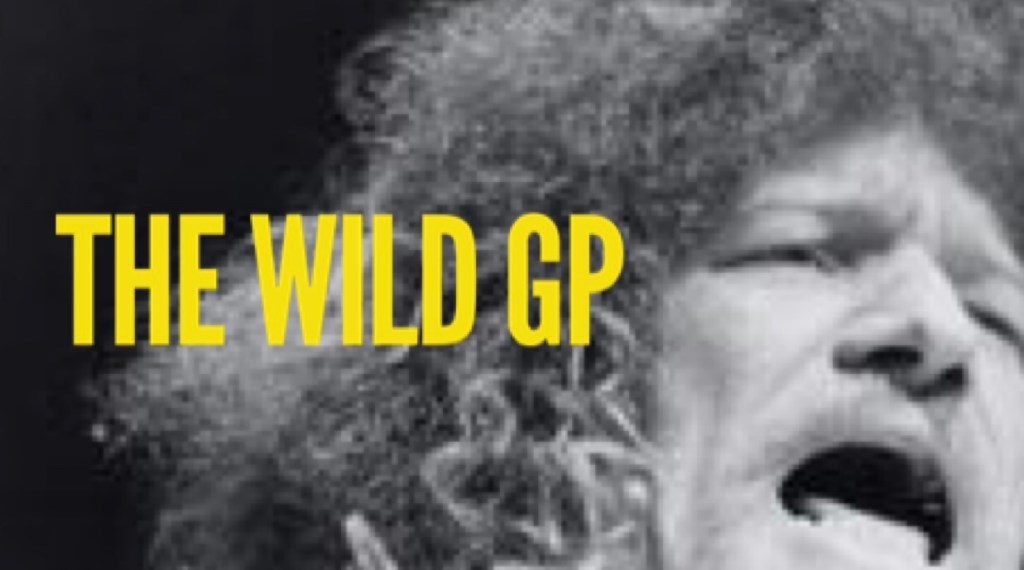
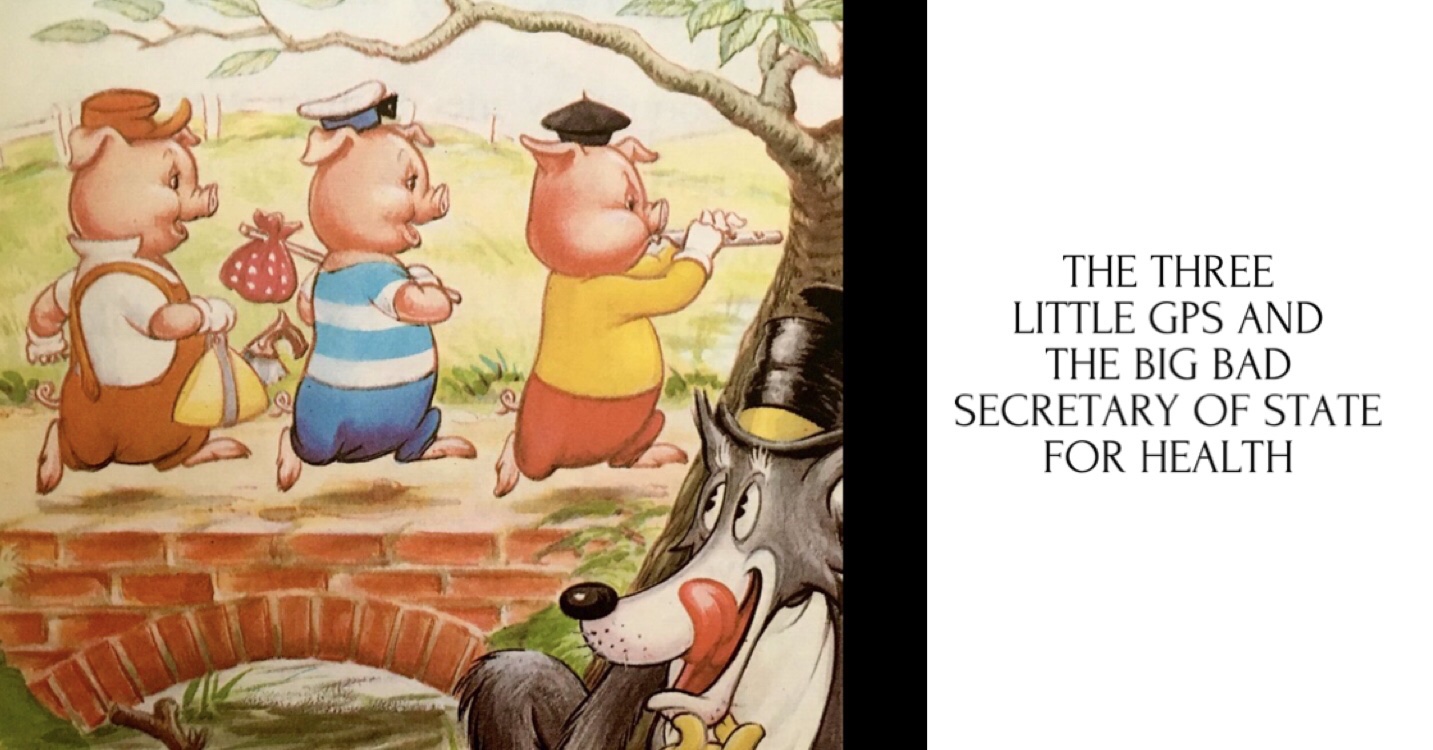




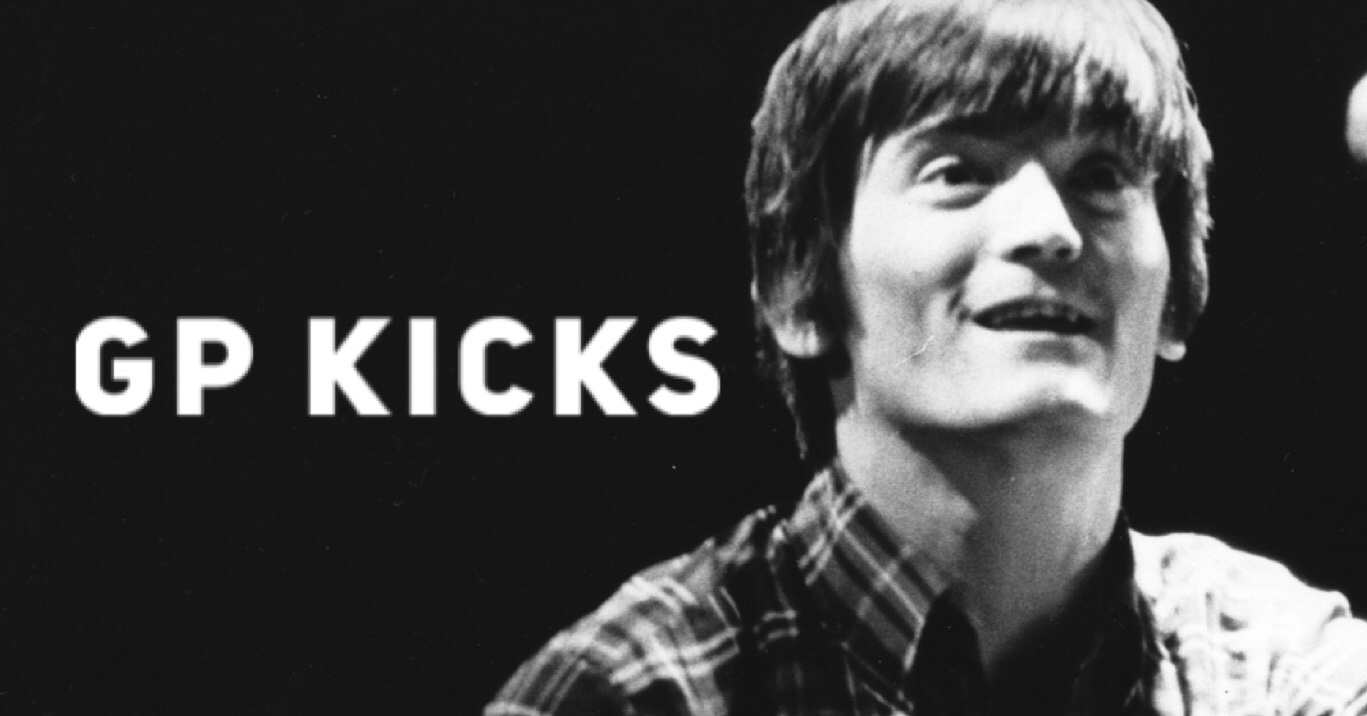




 Some musings