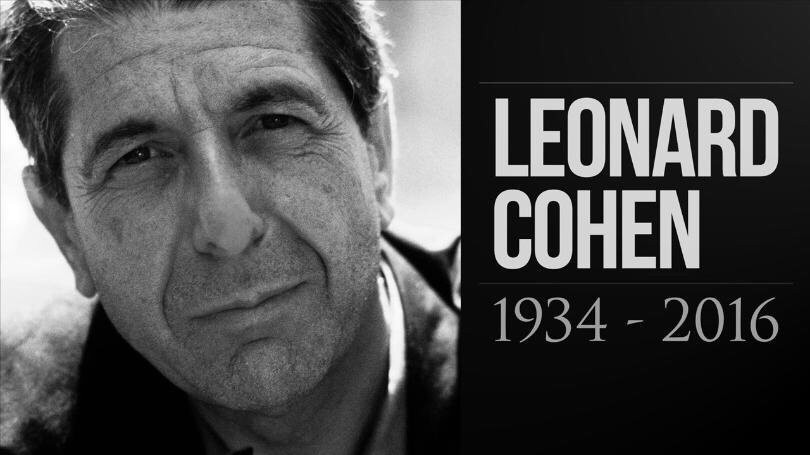
I have a confession to make. I like the music of Leonard Cohen and was saddened to hear this week of the announcement of his death at the age of 82 just three weeks after the release of what was his last album. I understand that he is not everybody’s cup of tea, it wasn’t without reason that he was known as ‘the godfather of gloom’. But for all that, he seemed to me, in his later years at least, a gentle person with a wry self-deprecating sense of humour who thought deeply about the big issues of life. I would have been interested to have met him and would certainly have liked to have heard him play live and see first-hand the obvious pleasure he experienced from the audience’s ironic cheer as he growled out the line ‘I was born like this, I had no choice, I was born with the gift of a golden voice.’
Born and raised in a Jewish family, Leonard Cohen evidently explored religious ideas throughout his life even spending several years at a Buddhist retreat in California where he eventually became a Buddhist monk in 1996. Many of his songs convey religious ideas and his own struggle to understand the nature of existence and though some of what he wrote, to my mind at least, falls very wide of the mark, sometimes his lyrics, often rich in Christian imagery, get things absolutely right.
One of my favourite songs is one called ‘Amen’ which includes the line: ‘Tell me again when the filth of butcher is washed by the blood of the lamb’. This powerfully brings home to me the idea of how the sacrifice of Christ’s death by crucifixion is enough to secure redemption even for the very people who nailed him to the cross. Elsewhere he sings: ‘There is no God in heaven, and there is no hell below, so says the great professor of all there is to know. But I’ve had the invitation, that a sinner can’t refuse, and it’s almost like salvation, it’s almost like the blues.’
I was interested to read in the coverage of his death, an answer Cohen gave some years previously in response to a question regarding the fact that much of his music is melancholic in tone. He said:
“We all love a sad song. Everybody has experienced the defeat of their lives. Nobody has a life that worked out the way they wanted it to. We all begin as the hero of our own dramas in centre stage and inevitably life moves us out of centre stage, defeats the hero, overturns the plot and the strategy and we’re left on the side-lines wondering why we no longer have a part – or want a part – in the whole…thing. Everybody’s experienced this, and when it’s presented to us sweetly, the feeling moves from heart to heart and we feel less isolated and we feel part of the great human chain which is really involved with the recognition of defeat”.
I like this quote as I think that it gets to a truth that is rarely expressed in these days of perpetual self-promotion. It confronts us with the view that making ourselves the hero of our life is sure to end in defeat, and that to make life all about us, is foolishness.
This is something that those of us who are Christians have known, or at least ought to have known, for a long time. And yet it is a truth that I all too often forget. Are we not all, perhaps, tempted to make our triumphs, or even our disasters, front page news imagining that what happens to us is of huge importance rather than realising that we are but minor characters in His story, the story in which he, Christ, is the hero. As John the Baptist said: ‘He must increase, but I must decrease’ [John 3:30].
There is in all of us, admittedly stronger in some than others, a desire to be important, to be newsworthy. The truth, though, is that few of us will ever make the headlines. Though occasionally someone of the stature of a William Wilberforce may live a life of historical significance, most of us will live ordinary lives each with its everyday ups and downs. This is, I believe, to be expected. A constant searching for the so called ‘wonderful plan’ God has for our lives can be, if we are not very careful, little more than a seeking to make a name for ourselves and risks leaving us thinking that when our lives are merely ‘ordinary’ that somehow we have missed out on what God had planned for us.
As Mike Horton writes:
‘Facing another day, with ordinary callings to ordinary people all around us is much more difficult than chasing my own dreams that I have envisioned for the grand story of my life’.
The truth is that God has told us what his ‘wonderful plan’ for each of our lives is and it is this – that we be transformed into the likeness of his son Jesus Christ ‘who, though he was in the form of God, did not count equality with God a thing to be grasped, but emptied himself, by taking the form of a servant, being born in the likeness of men. And being found in human form, he humbled himself by becoming obedient to the point of death, even death on a cross.’ [Philippians 2:6-8].
This is quite a calling and one that will see us having to give up being ‘the hero in our own drama’ that will surely end in our defeat. It will, of course, be a struggle, a struggle in which we will all too often fail. But before we get too introspective and constantly bewail our inadequacies, let’s remember that even our inadequacies fade into insignificance when we recall that the story of our lives has a hero who will never be defeated. Even our sinfulness, great though that sinfulness is, is far eclipsed by the greatness of the one who really is newsworthy. It is He, not us, who guarantees our salvation since we are promised that ‘he who began a good work in [us] will bring it to completion at the day of Jesus Christ.’
The lyrics of his final album clearly reflect Leonard Cohen’s awareness that he was approaching death. ‘Magnified, sanctified, be thy holy name. Vilified, crucified, in the human frame’ he sings and then adds ‘Hineni (a Hebrew word meaning ‘Here I am’) I’m ready my Lord’. The album also contains a song called ‘Treaty’ and it is a reprise of this track with which the album ends. Cohen’s last recorded words were therefore those that the song ends with:
‘I wish there was a treaty between your love and mine’.
These are heart achingly sad final words. I said I’d liked to have met Leonard Cohen, I said I’d like to have heard him sing live, but most of all I’d loved to have been able to tell him that there is a treaty, a covenant between God and his people, not signed by us, but secured by the blood of Christ.
Jesus, at the institution of the Lord’s supper, and referring to his imminent death on the cross said ‘this is my blood of the covenant, which is poured out for many for the forgiveness of sins’ [Matthew 26:28]. I really hope that Leonard Cohen understood and rejoiced in that when he died, I really hope he was one of the many. I really hope he was ready – if so I may yet have the pleasure of meeting him one day.
ADDENDUM – added November 7th 2020
Leonard Cohen died four years ago today. I wrote then on some of the words he had written during the course of his life and, in particular, those contained in what I imagined would be his final album, released as it was a few weeks before his death.
But last November a posthumous collection of new songs was released, one of which is called ‘The Goal’. It opens with words which seem particularly relevant today.
‘I can’t leave the house’.
But in penning that line, rather than foreseeing our heading into another lockdown, Cohen, was referring to his own failing health. The song continues to reflect on his frailty and failures and includes the lines
‘I sit in my chair
I look at the street
The neighbor returns
My smile of defeat.’
Some may think these lyrics as depressingly typical of Leonard Cohen but the song ends, perhaps, more optimistically. Echoing words from the final track on the album in which he urges us to listen, not to himself but to ‘the mind of God’, he leaves us with this final thought
‘No one to follow
And nothing to teach
Except that the goal
Falls short of the reach.’
What did he mean by that enigmatic last couplet. We must all of course decide for ourselves but I wonder if he is suggesting that too often we strive for something impossible and miss what we actually have, something we have been given which is more precious than we give ourselves time to realise.
This lockdown, despite our feelings of powerlessness, I hope we all may have the opportunity to uncover that ‘pearl of great price’. [Matthew 13:45-46]

 Some musings