Let me ask you a question. What’s the first thing you do each day? Clean your teeth, check your phone, or offer up a simple prayer.
But if you asked me that question, I’d say something rather different. Because the first thing I do each day…is go to bed.
In Genesis 1, after recording what God made on the first day of creation, we read that ‘there was evening and there was morning the first day’. [Genesis 1:5] And a similar statement is made at the end of each of the following five days of creation. This, together with the fact that the Jewish sabbath began at sunset – not sunrise – suggests that, in God’s ordering of things, the day begins with the night, not with the morning.
But what has all this got to do with Easter?
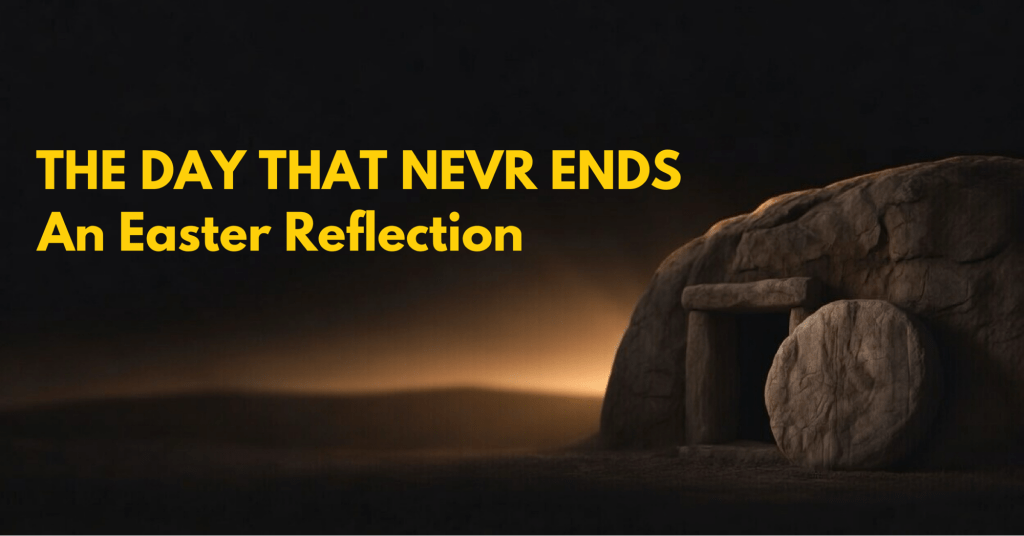
Well, simply this. If in God’s economy, day follows night, might not life follow death – meaning that, far from being surprising, the resurrection of Jesus that we celebrate this morning was only to be expected?
Which in one sense, of course, it was.
Because, as Peter proclaimed in his sermon at Pentecost, it was not possible for Jesus to stay dead. [Acts 2:24] On the contrary, as the sinless Son of God and everlasting Lord of life, the truly remarkable thing was that He died in the first place.
And so, sinless as He was, and with death therefore having no rightful claim on Him, He died for the sin of others.
Which is, perhaps, why, even in crucifixion, He did not simply succumb to death, but willingly yielded up His spirit and committed it into His Father’s hands. [Matthew 27:50]
But be that as it may, it’s not just the ordering of the day that hints at deeper realities. The whole of creation does too.
And so, just as winter gives way to spring, and the seemingly lifeless rhubarb plant in my garden is now pushing its way back up through the soil, so too did Jesus rise from the dead.
No wonder then that new life is so prevalent at Easter time.
That said, the resurrection to eternal life is not automatic. Whilst freely offered to all, salvation is only for those who gladly accept it as something they know they need, those who, seeing things as God does, recognise their wrongdoing, repent of their sin and put their faith in Jesus.
But having done so, with our sin fully atoned for, we can know, with absolute certainty, that we’ve been fully forgiven too. And so, with death no longer having any hold over us, we can anticipate a resurrection just like that of Jesus Christ himself.
For His being raised assures us that the sacrifice was sufficient.
For if it hadn’t been, Jesus would still be dead.
Jesus’ resurrection is then the receipt that proves the price was fully paid. It is our cast-iron guarantee that God’s just anger at our sin has been fully satisfied, that we have been completely reconciled to Him, and that we can now look forward to an eternity with Him as our Father, and we as His much-loved adopted children.
And just as the pattern of night followed by day speaks of rest before work, so too does the gospel reverse our natural inclinations.
Unlike all other religions, which put the onus on us to work our way towards heaven, the gospel of Jesus Christ invites us first to rest in His completed work. Only then, confident of our eternal future, do we go about the often painful process of sanctification, of becoming more and more like Jesus – a task that God, by His Holy Spirit, has promised to one day complete.
Similarly, no matter how difficult our lives might currently be, we can be confident of better days ahead. Because whilst weeping may tarry for the nighttime, joy really will come with the morning – just as it did on that first Easter Sunday.
How long, though, will this repeated cycle of night and day continue? How long will even our most joy-filled days keep coming to an end? How long can we expect sadness to keep on raising its perpetually unwelcome head?
Well, only for as long as night follows day.
Because here’s the thing: one day it won’t.
Back in Genesis 2, the seventh day was the day that God rested after the work of creation. Unlike the other six days there is no concluding statement that says, ‘and there was evening and there was morning – the seventh day.’ In one sense then, the seventh day never ended – pointing to the fact that those who find their rest in God will do so eternally.
And so we can look forward to the day when Christ returns, a day when a new heaven and a new earth will be established, and God, having restored His people to sinlessness, will once again be with them in the way that He was in the Garden of Eden.
And it will be a day of rest – of everlasting rest – on which night never falls. A day when God, whose glory then will light the skies, will wipe away our every tear and death will be no more.
That’s what the resurrection of Jesus Christ guarantees. That’s what gives us cause for hope. And that is why we celebrate Easter.
Related posts:
To read ‘Good Friday – Good for those who know they’re not’, click here
To read ‘A Warm Welcome Awaited: From Hosanna to Hallelujah’, click here
To read ‘Visions of Blue: Echoes of Grace’, click here
To read ‘Minding the Gap’, click here
To read ‘And not just because baked beans get in the way’, click here
To read ‘The Kindness We Don’t Needand the Truth We Do’, click here
To read ‘No Ifs or Buts’, click here
To read ‘Hope in the Ashes: Why Sin Remains But Does Not Reign’, click here
To read ‘Hope for the Guilty’, click here
To read ‘When our best isn’t good enough’, click here
To read ‘On Narcissism…an the Pot Calling the Kettle Black’, click here

 Some musings