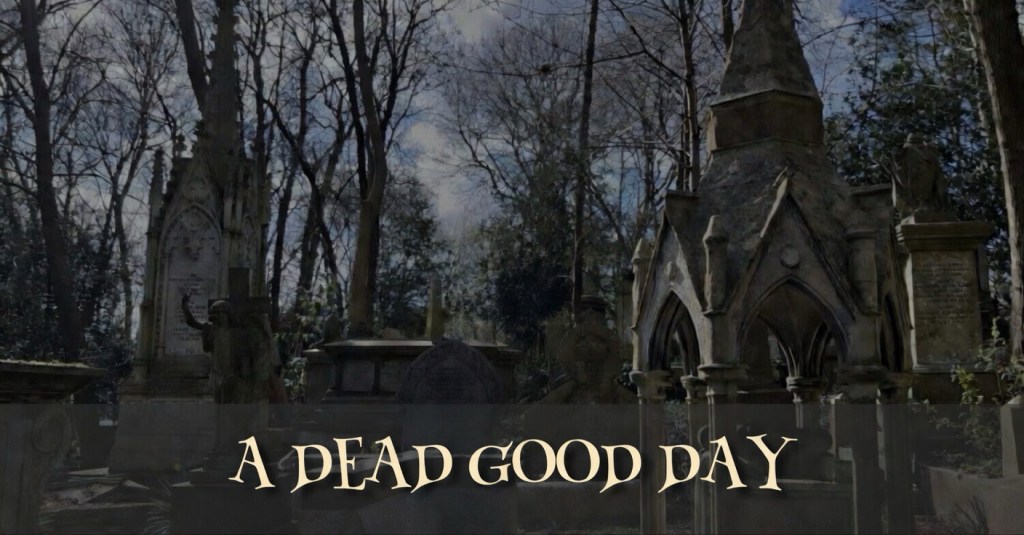
Last weekend I travelled to London and, of all the lively places in the capital that I could have visited, I opted for a tour of Highgate Cemetery – an undertaking that might have had grave consequences, given I was with my wife and the following day was Mothering Sunday.
But the atmosphere among those who gathered at the entrance of the cemetery, one of seven built in the 1830s to solve the problem of London’s overcrowded churchyards, was far from funereal. And as the stories of those in the tombs – to whom we were, in a sense, introduced – were brought vividly to life by our very able guide, my interest in death was instantly resurrected.
Among the more famous long-term inhabitants of Highgate was Douglas Adams, whose grave was marked by pens stuck into the ground by those wishing to say ‘so long’ and ‘thanks for all the finished novels’ he’d written. The gravestone of Michael Faraday, the ‘Father of Electricity,’ was a simple affair – a distinct contrast to that of Karl Marx, which included a larger-than-life representation of the long dead author of ‘Das Kapital’. And one of the most visited graves is that of the singer and philanthropist George Michael who lies alongside his mother and sister in a secluded area of the cemetery known as ‘Comfort Corner,’ and still commands such respect from local people that they won’t hear a bad word said against him.
And then there is Alexander Litvinenko, the former Russian spy who was assassinated in London in 2006 when polonium-210 was slipped into his cup of tea. The memorial that marks his grave contains a deliberately broken stone column that is meant to symbolise his untimely death – one that Litvinenko had long expected. Indeed, when he realised what had happened to him, he phoned the police and said he wanted to report a murder – his own – three full weeks before the poison took its inevitable effect.
Later we had pointed out to us the coffin of a once-eminent surgeon who, concerned about becoming the target of the grave robbers he might once have owed a debt to, had chosen to be laid to rest on the top shelf of the vault we were allowed to enter.
But, to me at least, the most intriguing of all was the final resting place of one who lay in a vault marked only by his name – one familiar to me, as it was the same as that of my uncle. This John Aird must have been wealthy, since his grave was in one of the most select parts of the cemetery. But of him I could discover nothing more – despite my extensive digging around in the hope of discovering more about his life. Not literally, you understand, as doing so, as well as being prohibited by law, drew unaccountably disapproving looks from our guide the moment I made even the most cursory attempt to unearth something of interest.
So while I learned about a once-famous bare-knuckle boxer and his devoted dog, a horse slaughterer who once boasted that he served by appointment to the royal family, and the desecration of tombs carried out by a mob following the imagined sighting of the Highgate Vampire in the 1970s, I failed even to discover the years in which my perhaps well-to-do ancestor lived.
Perhaps, I thought, as I wandered amidst the ivy-clad memorials, his reluctance to reveal the secrets of his past suggested an unholy preference for the darkness – one that hinted that, as that fearsome creature of the night, he might be, and evermore remain, undead!
And so, resigned to the fact that I’d never have a stake in his estate, when our time eventually came to an end, we made our exit through the cemetery gates, shuffled off to Hampstead Heath, and finally came to rest over a piece of cake in a bijou – or, dare I say it, fey – coffee shop just off Perrin Street.
And there, where the prices were mortifying, we drew down the curtain on what had been a dead good day.

 Some musings