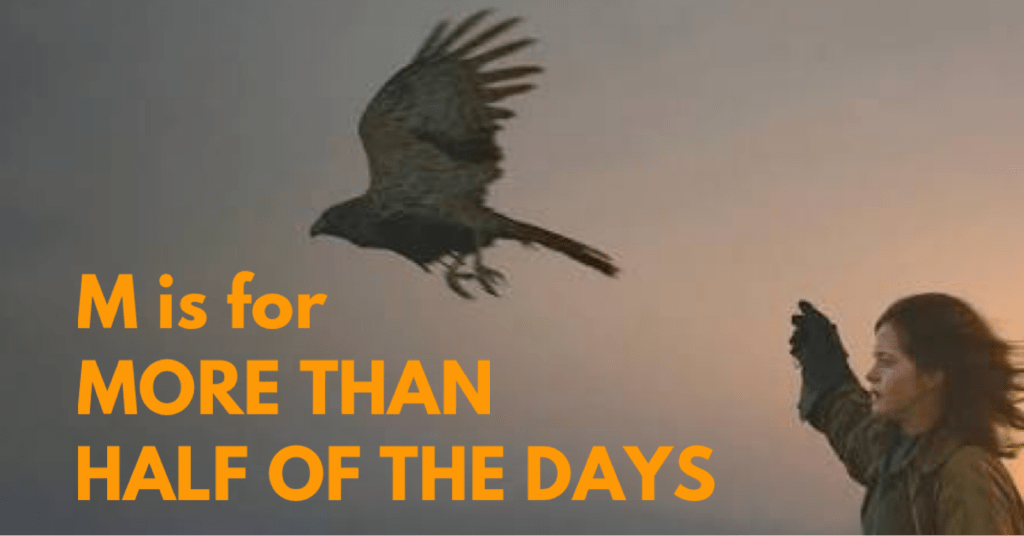
Yesterday I went to see ‘H is for Hawk’ – the recently released film starring the excellent Claire Foy. Whether I enjoyed it is perhaps questionable, but I am without doubt very glad I sat through it.
The film is based on real life and charts the grief of Helen MacDonald following the death of her photographer father, whom she at one point described as the only person who ever really understood her.
It comes across as an honest portrayal of the inevitable sadness experienced by those who love somebody that loved them every bit as much as they were loved. I for one appreciated the way the film didn’t manipulate the audience’s emotions so that, when the tears eventually came, they felt genuine rather than manufactured.
Two scenes in particular stood out for me.
The first is when Helen MacDonald gave a talk about the hawk that, having taken up falconry, has become the centre of her life. A member of the audience expressed disapproval that it is allowed to kill rabbits. She responded that to watch the hawk in action is to have an honest encounter with death – something that, all too aware of how impossible it has been for her to deny her own father’s passing, she maintains, is too often hidden from view.
When criticised further, that she is introducing death into the environment, she rightly points out that death was already there: that the rabbit has to die, just as the hawk will one day – and indeed each and every one of us as well.
Because death is not the exception – it is the inevitable rule.
As she said these words, I was reminded of the genealogy found in Genesis 5 that lists the descendants of Adam, through the line of Seth, all of whom, despite their very long lives, ultimately died.
Eight times the monotonous refrain is repeated: ‘… and he died … and he died … and he died.’
It’s a terrifying passage, reinforcing as it does how the story of all our lives will one day end. And not all follow what could even remotely be considered a good innings.
As a doctor I had patients who lost children during childbirth, in the first six months of their life as a result of cot death, and when only a little older, due to the congenital condition that they were born with. I have had patients lose both their parents before they were out of their teens. I have been first at a road traffic accident and seen a young person bleed to death in front of me. I have had to confirm the death of a child who’d taken their own life.
And then, of course, there were all the so-called ‘normal’ deaths as well – those less unexpected perhaps, but no less tragic for that.
Death then, is an everyday occurrence, and rather than imagining that, when unseen, it somehow no longer exists, we should recognise it as such – no matter how sad it may make us feel.
Which brings me to the second scene in the film that stood out for me. It was when MacDonald is seen consulting with her GP and is asked a series of questions supposedly designed to help diagnose depression. She is asked how often she struggles to concentrate, how often she fails to find anything enjoyable, and how often she fails to feel anything but a failure – and every time she gives the same sad answer: more than half of the days.
And so, despite her very valid suggestion that how she is feeling might just be a normal response to the difficulties she’s facing, she’s diagnosed as depressed – and thereby told that there is something wrong about her feeling the way she does.
And so it seems that, having first been encouraged to deny death, we are now being urged to deny the emotions that appropriately come with it. The sadness that is every bit as real as it is unwelcome.
So then, with death being universal, we shouldn’t be surprised that what happens to more than half of us will, in time, happen to us all — or that the sadness it brings is present on more than half of our days.
And though we may not enjoy the experience, perhaps we should be glad to sit through it with those who have no choice but to feel such sorrow.
Just as one day we may be glad to have someone sit through it with us.

 Some musings