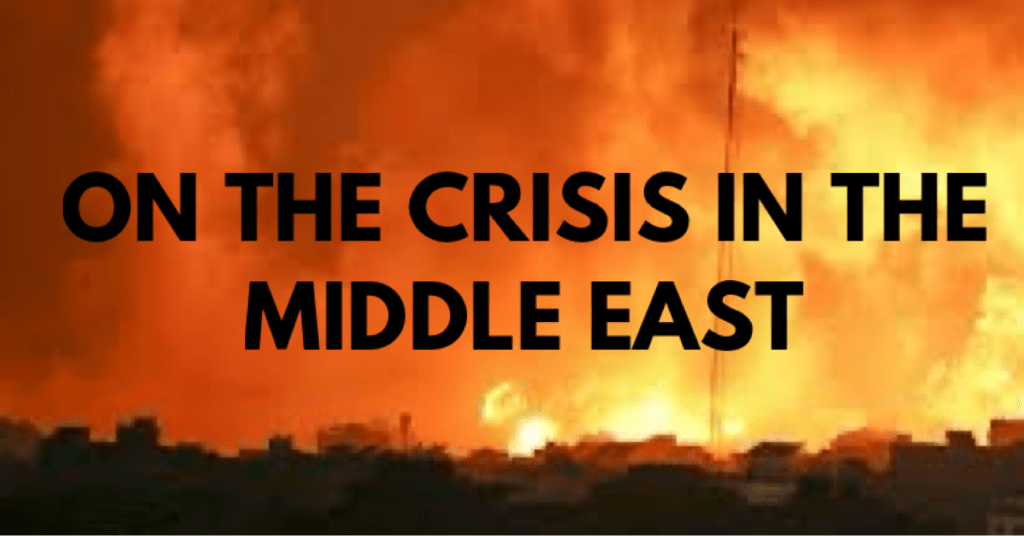
Yesterday I was asked to write something about the situation in the Middle East – the request coming from someone who, having presumably read some of my posts on Ukraine, felt that there were other conflicts in the world that are worthy of comment. And they’re right. Because whilst my work means that my focus has been on the war in Ukraine, that does not mean I am unconcerned about the events in Gaza.
Of course there may be those who, if they read what follows, will say the causes of the fighting in the Middle East are complex and that I clearly don’t fully understand the problems. All of which may be true. But though the matter is indeed a complicated one, there are some things which are easy to comprehend and some things are plain for us all to see. And first amongst these is the fact that the killing has got to stop.
So let me start by stating two things that really ought to go without saying. The first is that the attack on the Israeli people on October 7th 2023 was totally unjustified, no matter the perceived provocation.
And the second is this – any criticism of Israel on my part is no more antisemitic than my being a Christian is Islamophobic. On the contrary, it simply means that I profoundly disagree with the actions on both sides of the divide, something that you are free to do with my opinion without fear of me hating you as a result.
So with all that said, here’s why I am so deeply opposed to what Israel is now doing.
First of all is the fact that, as we all know, two wrongs don’t make a right. And if two wrongs don’t make a right, then neither do 62,000 wrongs – the current number of predominantly Palestinian civilians (40-50% of whom, as stated in UN reports, were women and children) who, according to Gaza’s Health Ministry, have been killed by Israeli action since that appalling and inexcusable Hamas attack of October 2023 which saw around 1200 people senselessly lose their lives, and another 251 taken hostage. Because whilst it’s undeniably true that Israel has a right to defend itself, that number, which is not all that higher than even the more conservative estimates of the death toll, is surely one that suggests that theirs has been a disproportionate response.
And it’s not as though those deaths are quick and painless executions. On the contrary, many of them are long drawn out affairs, the agony of those succumbing to starvation matched only by those who have to watch their children waste away in such inhuman and harrowing conditions.
And if Israel wants to avoid a charge of genocide, an accusation that the International Court of Justice has said is plausible, then it would undoubtedly be helpful if, instead of blocking aid convoys and destroying civilian hospitals, for example, they acted in ways that weren’t so easily interpreted as genocidal.
Because whilst the shooting of one person seeking food at a distribution site might conceivably be seen as a tragic accident, and the shooting of two can at best be viewed as indicative of gross negligence on the part of those providing security, when such tragic ‘accidents’ occur with monotonous and monstrous regularity then one can’t help but see it as perhaps the result of a policy decision.
Furthermore, if Israel is confident that it can defend itself against such claims, might it not help their cause if they allowed news agencies into the country so reporters could independently report on what the Israeli government presumably considers is acceptable behaviour.
Though why members of the press would want to risk being the target of yet more Israeli missiles is anyone’s guess. Because, given the at least 191 media workers who the Committee to Protect Journalists say have already been killed, some of whom having been targeted in Israeli attacks, it would suggest that that is exactly what they would be if, by reporting what they’d seen, they said something that the Israeli government would rather they’d kept forever to themselves.
And then there are those inevitable religious considerations which, whilst I understand will not be of interest to all, are nonetheless important because, irrespective of how true the claim is that religion is the cause of most of the world’s conflicts, it’s undoubtedly the case that distorted theology has sometimes been used to justify war – as we’re now seeing in the Middle East.
But as is always the case, those who blame God for their unrighteousness acts only ever compound their guilt.
So what are the religious considerations that I am referring to. Well, there are those, including some Christians, who support Israel’s actions on the basis of a belief that the disputed territory was promised to them by God.
But accepting that the question of land ownership is a highly emotive issues and important to all who contest borders, recognising that even within Christian circles the matter has long been debated, and respecting those who hold a different opinion to my own, it is my belief such a view comes as a result of misunderstanding what the Bible says and thus failing to distinguish between geographical Israel and spiritual Israel.
Because, though important, geographical Israel is less significant than spiritual Israel, which, as the apostle Paul, drawing on Old Testament passages, repeatedly points out is made up of only those who put their faith in Jesus. [Romans 9:6-8; Galatians 3:28-29, 6:15-16]
So then, with Christ more important than a piece of land, who you belong to is far more important than where you live, and it is those who are ‘in Christ’ that make up true Israel, and the land that believers are promised is not just a small area of land in the Middle East, but the whole of creation that will, when it is fully realised, be part of the Kingdom of God.
Which as well as explaining why Jesus himself said ‘blessed are the meek, for they will inherit the earth’ [Matthew 5:5], it also makes plain why we are to take the gospel to the very ends of the earth [Acts 1:8] so that those from every tribe and nation, including both Israelis and Palestinians, will one day be a part of it. [Revelation 7:9]
Furthermore the Kingdom of God is a kingdom that will not be brought in by violence. Let’s not make the same tragic mistake of the medieval crusaders who, hundreds of years ago, sought to impose Christianity on others by military means. Because far from being realised by force, the kingdom of God will be established by the proclamation of the gospel – a message of unparalleled love which speaks of one who, far from killing those who opposed him, was willing to die for them.
For that is what Jesus did. Because his death on the cross for us was an atoning sacrifice that secured the forgiveness of all those who repent of their sins – even the brutal atrocities that have been so much a part of day to day life in the Middle East. None of which is to say that Israel has no right to exist – only that it has no right to do so at the expense of Palestine.
But lest I be accused of making things unnecessarily complicated, let me finish with some simple, but no less essential theology – namely that to love your neighbour is not just something Jesus said. Because it is in fact an Old Testament command that therefore surely applies to Israel too.
And if they seek to justify their actions on the basis of being the people of God, then they should first take note of what He says and endeavour to act lovingly towards those they consider their enemies – the Palestinians who live alongside them.
Because, as I said at the outset, the killing must stop – a ceasefire must be agreed and a concerted effort must be made, on both sides, to find a solution to what is an age old problem and so ensure a just and lasting peace.
Related posts:
To read, “At Halloween – a nightmare in the Middle East’, click here.
To read, ‘The Lord is my portion’, click here.

 Some musings