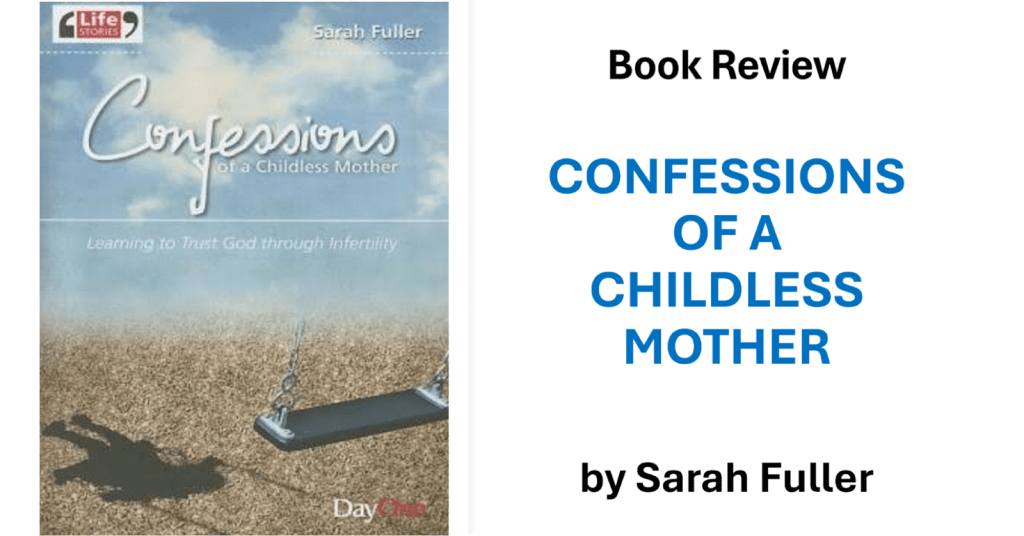
Some books aren’t written to simply amuse, but that doesn’t mean they can’t be benefitted from. Because books that reflect the sadness that is the experience of many are important and, what’s more, well worth the time spent reading them.
This is just such a book – one that gives an extremely honest account of one couple’s struggle with infertility, written at a time when the tears prompted by that condition continued to flow. As such it is a book that is not always easy to read, especially for those who may be tempted to believe in a health, wealth and prosperity gospel that promises only happy outcomes for those who profess faith in Christ. For the author is Sarah Fuller, a faithful Christian who, together with her pastor husband Nick, has prayed countless, earnest prayers that have not been answered in the way they both would have liked. As indeed have those of many others – like those, whose requests for a dear friends healing have seen them only get more ill and die, and those whose pleas for a family member’s circumstances to alter have seen them stubbornly remain unchanged.
Which is why it is a book that, whilst most beneficial to other believers who have also battled infertility, would nonetheless be hugely helpful to Christians experiencing prolonged sadness for any number of other reasons.
It begins with a factual account of how, for many years, Sarah and Nick sought to have a baby and tells of the hopes and subsequent disappointments that they experienced along the way. It is an emotional read and one that, on more than one occasion, moved me to tears. The book then proceeds to describe some of the associated difficulties that Sarah in particular encountered in regards to her spiritual struggles, emotional trauma and social anxiety.
There then follows a useful chapter covering some of the unhelpful responses to their condition that were made by some of their acquaintances, including those within the church. Because to be told to ‘Smile, Jesus loves you’ is rarely helpful to the one suffering, no matter how well meant the words may have been. For, as I suspect the ‘sorrowful yet always rejoicing’ apostle Paul also knew [2 Corinthians 6:10], it’s possible to be happy and sad at the same time, and it’s no more wrong to be sad about things that distress us, when there are things that also make us happy, than it is to be happy about things that bring us joy, when there are things that also make us sad.
And though it is gloriously true that ‘all things work together for good for those who love God and are called according to his purpose [Romans 2:28], it’s nonetheless appropriate to feel emotionally crushed by the unbearable lightness, and perpetually ‘momentary’ suffering that is, sometimes, the means that God lovingly uses to bring about that incomparably good outcome that awaits all those that are his – that is to say the eternal weight of glory that will, when it is eventually realised, prove worth every ounce of pain encountered along the way [2 Corinthians 4:17].
But whilst it is evident that the pain associated with remaining childless has been extreme, this book is not simply one woman’s tale of woe. Because despite what the author has gone through, half the book is given over to offering help to those who suffer similarly. Furthermore, the longest chapter in the book is, by some way, the one on finding specific help in God’s word. This is of considerable significance for, when we suffer in ways we do not understand, if we are to find any comfort, if we are to be revived that we might once again rejoice in God [Psalm 85:6], our words and our thoughts will not suffice. Instead we will need a word that transcends our sadness, a word that comes from outside of ourselves, a word from God that can speak truth into our situation and, in so doing, bring us hope.
And this is where the book may also be helpful to unbelievers, those who are seeking a reason for the hope that believers like Sarah and her husband continue to have in God [1 Peter 3:15] For many are the reasons that are highlighted, not least the assurance that God is in complete control of our lives, that he is both perfectly good and infinitely powerful, and that, as the judge of the whole earth, he always does what is right [Genesis 18:25]. And perhaps most wonderfully of all, we are also assured that God is our Heavenly Father, that we are his much loved children, and that he only wants what is for our best.
The book also tackles some of those Biblical passages that, if not fully understood, might lead one to believe that our suffering is a punishment from the Lord. But with a reminder of the gospel, that Christ suffered the penalty for all our sin, comes a realisation that such thoughts can be confidently dismissed. Rather trials are sent our way to develop in us the character of Jesus, which is, surely, God’s wonderful plan for all our lives – one that is so much more precious than simply our transient earthly happiness.
None of which is meant to suggest that a simple realisation of these things lessons the pain that we still experience in our trials. The book never descends into triteness or formulaic platitudes, – on the contrary, the fact that faith is often a battle is more than apparent, but it is good to be reminded that our suffering is not without purpose, our sorrow is not incompatible with joy and even the darkest night can be followed by the brightest day.
There are of course, no easy answers to our suffering, irrespective of its nature. And the author recognises that the reason for our sadness may never be fully ours to know. Even so, this is a book that will be helpful to many who find life a struggle, those who may be comforted by knowing that they are not alone and are prepared to find in scripture good reason to continue to hope in one who is sovereign over all, the one who really does know what is best, and the one who can be trusted in even the most desperate of situations.
Related posts:
To read ‘When Bad Things Happen’, click here
To read ‘Weeping with those who weep’, click here
To read ‘Still weeping with those who weep’, click here
To read ‘All’s Well that Ends Well’, click here
To read ‘on the FALLEN and the FELLED’, click here
To read ‘When our joy will be complete’, click here
To read ‘What becomes of the broken hearted? Sorrowful yet always rejoicing on Palm Sunday’, click here
To read ‘Why do bad things happen to good people? Sorrowful yet always rejoicing on Good Friday’, click here
To read ‘Was it not necessary that the Christ should suffer these things? Rejoicing, though temporarily sorrowful, on Easter Day’, click here.
To read ‘T.S. Eliot, Jesus and the Paradox of the Christian Life’, click here
To read “Luther and the global pandemic – on becoming a theologian of the cross”, click here
To read “Why do bad things happen to good people – a tentative suggestion”, click here
To read ‘Monsters’, click here
To read ‘On Sleeping like a Baby’, click here
To read ‘But this I know’, click here
To read ‘But this I call to mind, and therefore I have hope’, click here
To read “Hope comes from believing the promises of God”, click here
To read ‘The Promise Keeper’, click here
To read ‘Hearing the grass grow’, click here
To read ‘Because the world is not enough’, click here
To read ‘Do you hear the people sing?’, click here
To read “Suffering- A Personal View”, click here.
To read ‘Faith and Doubt’, click here
To read ‘Real Power’, click here
To read ‘Foolishness – Law and Gospel’, click here
To read, ‘But this I know’, click here
To read ‘Rest Assured’, click here
To read ‘The Resurrection – is it just rhubarb?’, click here
To read ‘One Day’, click here.
To read ‘General Practice – still a sweet sorrow’, click here

 Some musings