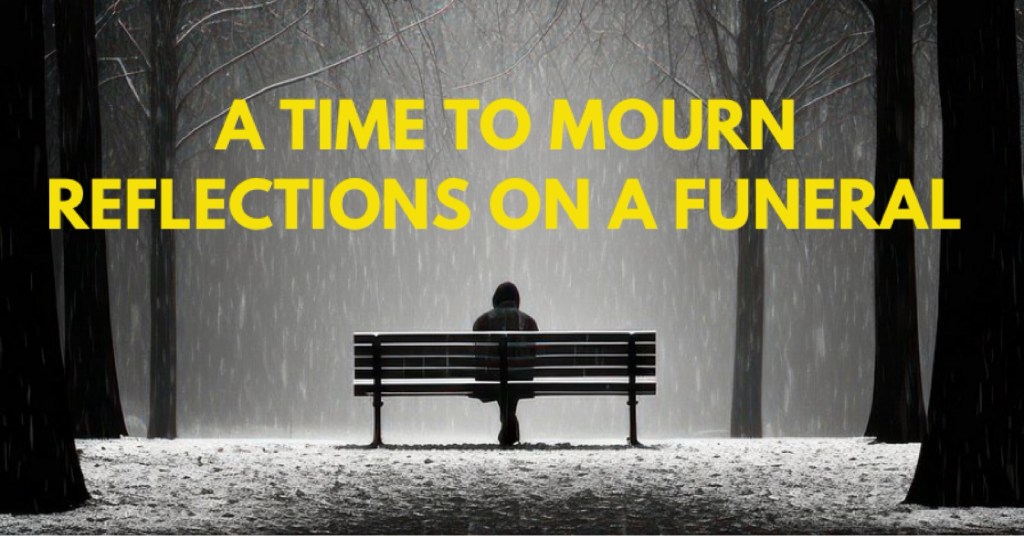
‘There is a time to weep, and a time to laugh, a time to mourn, and a time to dance’ [Ecclesiastes 3:4]
A while back I wrote about a wedding I’d recently attended. But given my own advancing years, these days, in any given week, I’m far more likely to find myself at a funeral. As was the case yesterday.
The man who had died was not somebody I can claim to have known well but, because of the few occasions when our paths had crossed and he had shown me great kindness, I consider myself blessed to have known him. And I was blessed by attending his funeral too.
But this was not because the service was in anyway a happy occasion – the very real tears of those who loved him most were testimony enough to that. And as the congregation that filled the parish church were reminded, death is not something we celebrate – it is a horrible intruder into God’s good creation, one whose unwelcome appearance rightly leads us to weep and mourn.
Even so, I was encouraged to hear again what I have long known to be true as the minister, taking 1 Thessalonians 4: 13-18 as his text, spoke of how the Bible often refers to those who have died as those who have fallen asleep. And I learnt that the word ‘cemetery’ comes from a Greek word meaning ‘sleeping place’ which, as was pointed out, is all highly significant – because sleep is something you wake up from.
That, to me, is a lovely thought.
But unlike so many other lovely thoughts, this is one that is so much more than wishful thinking. Because this ‘lovely thought’ is also a guaranteed reality, one that we can believe, not just because we want to, but because waking up from death has historical precedence.
By which I mean, it’s happened before.
Two thousand years ago Jesus rose from the dead and, because of this well attested fact, we can have absolute confidence that those who die ‘in Christ’ will also rise from the dead when he returns to earth, a day that, alongside those of his birth, death and resurrection, will surely complete the four most significant days in history.
As the service drew to an end, it was good to be able to recite the beautiful answer to the opening question of the Heidelberg Catechism – a question that asks us what is our comfort in life and death?
‘That I am not my own, but belong – body and soul, both in life and in death – to my faithful Saviour, Jesus Christ.
He has fully paid for all my sins with his precious blood, and has set me free from the tyranny of the devil.
He also watches over me in such a way that not a hair can fall from my head without the will of my Father in heaven; in fact, all things must work together for my salvation.
Because I belong to him, Christ, by his Holy Spirit, assures me of eternal life and makes me wholeheartedly willing form now on to live for him’
On leaving the church we walked through the graveyard – or should I say, dormitory – passing the grave where the one we had come to remember had been buried earlier in the day. A fellow mourner whispered ‘God bless you’, but I doubt his words would have been heard beneath the six feet of freshly dug earth where my erstwhile friend now lay. Even so, as I was walked on by, I thought of the day to come when he will here his name spoken and, as surely as a sleeping child wakes when called by a loving Father, he will rise again to life.
And this is my hope too – my sure and certain hope – that though the wages of sin is death, with my sin paid for on the cross, death has lost its sting. It has been swallowed up in victory and so the free gift of God is now eternal life in Christ Jesus my Lord.
And so, like D.L. Moody before me, let me say this – if one day you hear it announced that I have died – don’t believe a word of it – for I shall be more alive then, than I have ever been before.
The news of my death will have been greatly exaggerated.
Related blogs:
To read ‘A Time to Dance – Reflections on a Marriage’, click here
To read ‘On death – my first and last’, click here
To read ‘On my near Death Experience’, click here
To read ‘Three Times a Patient’, which includes a little more detail on two of my three near death experiences, click here
To read ‘Professor Ian Aird – a time to die’, click here
To read ‘On Finishing Well’, click here
To read a review of Dr Lucy Pollock’s first book. ‘The Book About Getting Older’ click here,
To read a review of Dr Lucy Pollock’s second book, ‘The Golden Rule’, click here
To read ‘On approaching one’s sell by date’, click here
To read ‘Bleak Practice’, a fictionalised version of ‘On approaching one’s sell by date’, click here
To read ‘At Halloween – O death where is thy sting’, click here
To read ‘Monsters’, click here
To read ‘Assisted Dying – we all need to be happier to help’, click here
To read ‘Health – it’ll be the death of us. Institutional arrogance in the Health Service’ click here
To read ‘What becomes of the broken hearted? Sorrowful yet always rejoicing on Palm Sunday’, click here
To read ‘Why do bad things happen to good people? Sorrowful yet always rejoicing on Good Friday’, click here
To read ‘Was it not necessary that the Christ should suffer these things? Rejoicing, though temporarily sorrowful, on Easter Day’, click here.
To read “Hope comes from believing the promises of God”, click here
To read ‘All’s Well That End’s Well’, click here
To read ‘T.S. Eliot, Jesus and the Paradox of the Christian Life’, click here
To read “Luther and the global pandemic – on becoming a theologian of the cross”, click here
To read “Suffering- A Personal View”, click here.
To read ‘Looking back to move confidently forward’, click here
To read ‘The Resurrection – is it just rhubarb?’, click here
To read ‘Faith and Doubt’, click here

 Some musings