As I walk this land of broken dreams
I have visions of many things
But happiness is just an illusion
Filled with sadness and confusion
So sang Jimmy Ruffin – back in 1967. But as he sings, and ponders, the fate of the broken hearted, he never once mentions the shedding of tears. Which suprised me at first – until I thought about it for a while and I remembered that not all the broken hearted can cry.
Over the years I was a GP, there were a number of patients who came to me because, despite their sadness, they were unable to cry. On such occasions I tried, and largely succeeded, in resisting the urge to recommend that they watch ‘Lassie Come Home’! This is not because of my doubting the film’s effectiveness in the treatment of Keratoconjunctivitis sicca (dry eye syndrome), but simply because, if my attempt at humour had produced the wry smile I’d desired, my patient would only be left even more incapable of producing the tears that they were hoping for!
Unlike my emotionally disadvantaged patients however, crying is something that comes all too easily to me these days. Maybe it’s because the optimism of youth has given way to the realism of late middle age that I feel the inherent sadness of this ‘vale of tears’ more keenly now, or perhaps it’s just that, as the years roll by, I’m becoming a sentimental old fool. Either way it seems to me that Abraham Lincoln was on to something when he said,
‘In this sad world of ours, sorrow comes to all; and to the young it comes with bitterest agony, because it takes them unawares. The older have learned to ever expect it.’
Leaving aside the reasons for my own sometimes melancholy mood, what is undeniable is that there is a lot of sadness about. And irrespective of its cause, be it the consequence of global events, some more local concern, or the personal difficulties experienced by a single person, the unhappiness is always felt at the individual level, and so, even for those whose own lives are devoid of difficulty, there remains the sadness of those whom they love, those whose broken hearts continue to break theirs.
What, I wonder, is to become of them?
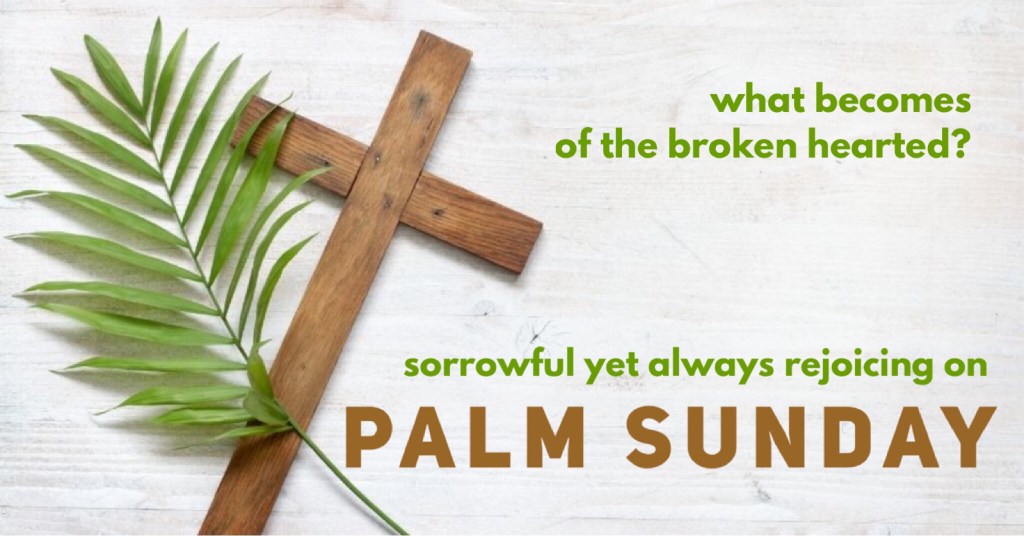
But what has all this got to do with Palm Sunday, the day we remember Jesus’ triumphant entry into Jerusalem. Well simply this – despite it being a day on which many took to the streets in jubilant celebration, Jesus, the one who was described by the prophet Isaiah as ‘a man of sorrows’ [Isaiah 53:3], saw fit to weep.
‘And when [Jesus] drew near and saw the city, he wept over it, saying, “Would that you, even you, had known on this day the things that make for peace! But now they are hidden from your eyes.’ [Luke 19:41-42]
So what was going on – why was Jesus weeping whilst so many were celebrating his arrival as the long expected Messiah. From the verses in Luke’s Gospel, the answer is surely tied up in the fact that those who were witnessing his arrival were somehow blind to what was really going on. And this was just as much the case for those who were welcoming him with joy, as it was for the religious types who were there demanding that Jesus rebuke his followers for hailing him as their King.
To take that latter group first, it is perhaps easy to see what they were missing, namely that Jesus ‘Truly…was the son of God’, which was exactly what one centurion recognised him to be when, five days later, he watched him die a long painful death whilst nailed to a cross.
Their failure to recognise him was all the more tragic given how Jesus had fulfilled the many Old Testament prophecies regarding the Messiah, prophecies with which, since they were their nation’s spiritual leaders, they should have been familiar. Not least amongst those prophecies was the one, the fulfilment of which, they were even then witnessing. Because Jesus’ humble arrival in Jerusalem on the back of a donkey, had been foretold hundreds of years previously by the prophet Zechariah.
‘Rejoice greatly, O daughter of Zion!
Shout aloud, O daughter of Jerusalem!
Behold, your king is coming to you;
righteous and having salvation is he,
humble and mounted on a donkey,
on a colt, the foal of a donkey.’
[Zechariah 9.9]
But what of the excited crowd who greeted Jesus with shouts of ‘Blessed is the King who comes in the name of the Lord!’? What were they missing? Well simply the nature of his kingship. They were expecting Jesus to lead them to victory over the Romans who at the time were occupying their city. But Jesus was not that kind of king for on that first Palm Sunday, like the many Passover lambs who would also have been arriving and would, like Jesus soon be slaughtered, Jesus entered Jerusalem as the Lamb of God, who would take away the sins of the world.
Yes, he was on the way to the throne but, but the throne to which he was heading was a heavenly throne. And the route he was taking would first have to take him to a cross where, having been ‘despised and rejected by men’, he would be ‘pierced for our transgressions’ and ‘crushed for our iniquities’. For, just as Isaiah had predicted centuries previously, it would be by carrying our sorrows and bearing our griefs, that Jesus’ chastisement would bring us peace. [Isaiah 53:3-5].
But the cheering masses were blind to the fact that it was through a display of apparent weakness that peace with God would be won.
And so Jesus wept.
Which is astonishing isn’t it? Think about it for a minute.
Despite these being the very people who had, and would reject him, despite them being the ones that would first bay for his blood as they shouted ‘Crucify, crucify him’ [Luke 23:21], and then undertake to drive those cruel nails through his hands and feet, Jesus still wept for them.
That the sovereign king of creation should weep such tender hearted tears of mercy for those who wished him dead is indeed astonishing. Furthermore they reveal Jesus to be a king like no other, one who, even in the final moments before his death, still prayed for his executioners with the words, ‘Father, forgive them, for they know not what they do’ [Luke 23:24].
I for one am glad that God is as tender hearted as he is almighty – it gives me confidence that, as well as being mighty to save, [Zephaniah 3:17], he is one who will not break a bruised reed or quench a faintly burning wick [Isaiah 42:3]. For as one who is desperately weak and oh so in need of rescue, that is exactly what I need him to be.
Not for nothing have some likened Jesus to those pictures we sometimes see of heavily armed soldiers carrying a tiny baby from the wreckage of a collapsed building. For that is what he’s like – only infinitely more so.
Of course Palm Sunday wasn’t the only time Jesus shed a tear. John 11:35, the shortest verse in the Bible, tells us that ‘Jesus wept’ at the graveside of his friend Lazarus, thereby making it plain, not only that Jesus really was ‘acquainted with grief’, but that our tears are also appropriate in such circumstances.
So then what does become of the broken hearted?
Is their only comfort to be found in seeing Jesus as a miserable messiah who knew what it was to be unhappy too? Not at all! Because Jesus is serious about our joy, and will do whatever it takes to bring us to his Father, the infinitely happy God ‘in whose presence there is fullness of joy’ and at whose right hand there are ‘pleasures forevermore’ [Psalm 16:11]
That’s why Jesus went to the cross, to reconcile us to God by paying there the penalty for all our sin. Enduring the cross rather than enjoying it, Jesus suffered there ‘for the joy that was set before him’ [Hebrews 12:2]. Weeping may indeed tarry for the night but, irrespective of how long or dark that night might be, we can sure that, because of Jesus’ death and subsequent resurrection, joy will come in the morning [Psalm 30:5].
And so the very real sorrow that we experience today needn’t stop us from simultaneously rejoicing in the anticipated joy of tomorrow. Though sorrowful, we can be always rejoicing. [2 Corinthians 6:10]
Which brings me to an incident recorded for us in Luke Chapter 8. On Palm Sunday Jesus wept whilst all around him were rejoicing, but here we read of those who, though appropriately sad, were told by Jesus not to weep.
Jairus, a ruler of the synagogue, had come to Jesus because his 12 year old daughter was close to death. He implored Jesus to come to his house hoping no doubt that Jesus would perform another of his miracles and restore the girl to health. But having been delayed on the way, news comes that the child has died. When he finally arrives, Jesus enters the house with Jairus, the child’s mother and three of his disciples. Everyone is weeping and mourning and it’s then that Jesus tells them not to weep, claiming that, despite evidence to the contrary, the girl is not dead but only sleeping.
Jesus’ words seem laughable and not a little insensitive given the circumstances – but he says them nonetheless. Had we been there we might have been tempted to suggest to Jesus that now might be a good time to ‘weep with those who weep’, something the Bible itself commends. [Romans 12:15].
But had we done so, Jesus would perhaps have reminded us of the words he’d previously said to Jairus when first he heard that his daughter had died: ‘Do not fear; only believe, and she will be well’.
But what exactly was Jesus asking Jairus to believe? Was Jesus advocating a view that is not infrequently heard today that if you somehow muster up sufficient belief in something you want to happen, that thing will magically materialise? I don’t think so. Rather I think Jesus was urging Jairus to believe something that was, and is, objectively true – that Jesus is God made man, that he is the one who has authority over death, the one who, having declared himself to be ‘the resurrection and the life’ [John 11:25], proved the truth of his claim by raising Lazarus from the dead.
Faith in such a one as Jesus is very well placed, as is clear from what happened next. Because Jesus then proceeded to take the girl by the hand and called to her saying, ‘Child, arise’. And as he did so, her spirit returned and she got up at once’ [Luke 8:54-55]
And what was true for Jairus is, I believe, true for us. We need not fear, confident that, if we believe in Jesus, ultimately, all will be well for us too
This is not to suggest that those with faith in Christ can expect a life of health, wealth and prosperity. Far from it – problems will undoubtedly remain. And for those who are persecuted for what they believe, their faith may make their life even harder. Even so, trusting in Jesus does nonetheless guarantee that even on the darkest of days and in the most desperate of situations there is hope, a certain hope, that God will one day keep his promise to wipe away every tear from our eyes and see to it that, as well as death then being a thing of the past, there will be neither mourning, nor crying, nor pain anymore. [Revelation 21:4].
What then becomes of the broken hearted? Let the psalmist tell you,
‘The LORD heals the broken hearted and binds up their wounds’ [Psalm 147:3].
And that is a hope in which we who believe can all rejoice – irrespective of whether, in our current sadness, the tears continue to flow or not.
Related blogs:
To read ‘Why do bad things happen to good people? Sorrowful yet always rejoicing in Good Friday’, click here.
To read ‘Was it not necessary that the Christ should suffer these things? Rejoicing though temporarily sorrowful on Easter Day’, click here.
To read “Suffering- A Personal View”, click here.
To read “Why do bad things happen to good people – a tentative suggestion”, click here
To read “Luther and the global pandemic – on becoming a theologian of the cross”, click here
To read ‘T.S. Eliot, Jesus and the Paradox of the Christian Life’, click here
To read ‘Real Power’, click here
To read ‘Foolishness – Law and Gospel’, click here
To read ‘The Promise Keeper’, click here
To read ‘The Rainbow’s End’, click here
To read ‘True Love?’, click here
To read “Hope comes from believing the promises of God”, click here
To read, ‘But this I know’, click here
To read ‘I’ll miss this when I’m gone – extended theological version’, click here
To read ‘On being confronted by the law’, click here
To read ‘The “Already” and the “Not Yet”’, click here
To read ‘The Sacrifice of Isaac – Law or Gospel?’, click here
To read ‘Rest Assured’, click here

 Some musings