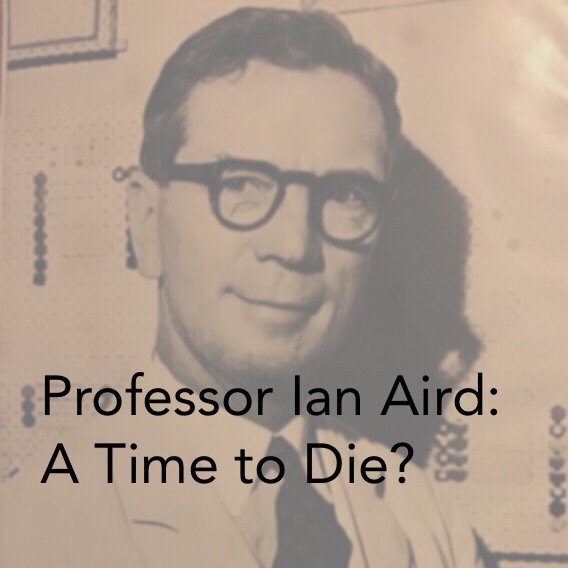
A while ago I came across Hugh McLeave’s biography of Professor Ian Aird entitled ‘A Time to Heal’. In it Aird is described as having been ‘a brilliant surgeon, an inspired teacher and one of the great medical personalities of his generation’. He was also, if I have my family tree correct, my grandfather’s cousin.
Born in 1905 in Edinburgh he attended George Watson’s College where school certificates record he never achieved anything less than ‘Excellent’ and where contemporaries described him as one who ‘could not help himself, being a perfectionist’. He subsequent studied medicine at Edinburgh University and embarked on a career which, in time, saw him rise to become Professor of Surgery at the Hammersmith Postgraduate Medical School. Here he became best known for separating Siamese twins, most notably the Nigerian pair of Boko and Tomu. Dying in 1962, five years before I was born, I never met him but photographs of him are strangely familiar as, in appearance, he bore a striking similarity to my Uncle John.
Few, despite his pioneering work, remember him today and I have only once in my own career come across anybody for whom his name meant anything. My first house job was in Bristol, working as part of a urological firm in Southmead Hospital. The consultant under whom I worked, Mr Roger Feneley, had himself studied from Aird’s Textbook of Surgery, and he took some delight in imagining he was nurturing ‘the young Aird’ on the way to becoming a fine surgeon in his own right. Disappointingly, I suspect, for Mr Feneley, I was in no way cut out for surgery and chose instead to become ‘just a GP’, a decision that led to an equally satisfying career.
That textbook of surgery was not the last thing that Ian Aird wrote. His final words were found in a notebook alongside a Bible opened in the page where the following words can be found:
‘To everything there is a season, and a time to every purpose under the heaven: a time to be born and a time to die’. [Ecclesiastes 3:1-2]
Having read them, Aird had proceeded to write, in a ‘bold and unequivocal hand’, a short statement.
‘To the Hammersmith Coroner: I have taken a fairly substantial dose of barbiturates. I have never taken a drug before in my life. I have passed my apogee. My skill is going and I am in deep despair. I find myself in unmitigated gloom. Although I am a sincere and practising Christian, I cannot continue. I have burnt myself out. There is too much to do. I cannot write my book again. My department has produced the electronic control of patients in operating theatres, done the first intra-cardiac operations, transplanted the first kidney homografts in Britain, shown the connection between blood groups and disease – and there has been no distinction given to us…Ian Aird’
McLeave, who knew Aird well, interpreted that final comment, not as an embittered comment at the lack of personal recognition, such was not his nature, but rather as a reflection of the struggles he’d long had in attracting funding for his work and the active discouragement he’d experienced from within the medical profession. The frustration that he was not achieving all that he could, together with his own excessively high standards that fuelled that frustration, culminated in producing the emotional distress with which he no longer felt able to cope.
The conclusion McLeave then drew was that ‘Had [Aird] taken a holiday, sought medical advice or resigned himself to living at a slower tempo, he might have lived – but he demanded nothing less than perfection in himself’.
Though I never knew Professor Aird, I recognise, both inside and outside of medicine, that same perfectionism that demands of individuals more than they are able to give and renders them both guilt ridden and unhappy. As expectations increase both from within and without, what Atul Gawande describes as our ‘inevitable fallibility’ leaves us imagining we are moral failures simply because of our inherent ordinariness.
We, and those with whom we live alongside, need to be kinder to one another, acknowledge our humanness, and stop insisting that we are more than we could ever become.
There are many factors that drive individuals to take their own life, and none but those who follow this drastic course can fully understand those reasons, if indeed they can ever understand them themselves, but amongst those factors lie the unhelpful and unrealistic demands and expectations put upon individuals by both themselves and others. Hannah Arendt had it right when she said ‘In order to go on living one must try to escape the death involved in perfectionism’
In life, Ian Aird was fond of quoting Shakespeare’s words spoken by Cardinal Wolsey in Henry VIII:
‘And, when I am forgotten, as I shall be, and sleep in dull cold marble, where no mention of me more must be heard of, say, I taught thee’
A fitting memorial for my long forgotten relative would be that he did indeed teach, and that we learnt, that perfectionism, and the demand for it, kills, just as it surely, at least partly, killed him.
And now three blogs which, in my mind at least, make up a trilogy on the subject of burnout:
To read ‘Somewhere over the Rainbow’, click here
To read ‘When the Jokes on You’, click here
To read ‘With great power…’, click here
Other related blogs:
To read ‘A sorrow shared’, click here
For more on being ‘only a GP’, click here
For more about Hannah Arendt, click here
To read ‘For when we can’t see why’, click here
To read ‘Health – it’ll be the death of us. Is there institutional arrogance in the NHS?’, click here
To read ‘Nikki Alexander – Dr Perfect?’, click here
To read ‘Assisted Dying – we all need to be happier to help’, click here
And finally, a couple of blogs reflecting my Christian worldview and offering perhaps a perfect solution to our imperfection,
To read ‘True Love’, click here
To read ‘Don’t forget to be ordinary, if you want to be happy’, click here

 Some musings
I have never been placed in such a life changing / defining position where a decisions I make literally makes the difference between life and death. I can only stand in the “out field” and in wonder and provide a spiritual “safety net”. In Northern Ireland, one of many events remember, following a bombing on the Falls Road, I was called to the RVH to minister to the survivors, at the operating theatre the surgeon invited me to offer prayers …but it didn’t end there as the family and I had to have an armed escort to go from intensive care to the hospital chapel, such was life then. My point is that in Hospital or in General practice it is initial decision that is vital, in General Practice to me it seems the luxury of time doesn’t exist as the fast flow of patients is never ending each one demanding a decision with its corresponding accountability! It’s the front-line of medicine, the gateway to every other discipline! The GP is an endangered species to be preserved at all cost! Apologies for the long comment!
LikeLiked by 2 people
What an interesting post. I cannot imagine the pressure especially when your work depends on the support and understanding of others. Technological advances have made medicine a more exacting but less human profession.
LikeLiked by 1 person
Sadly to say you’re right, medicine has indeed become less human, something which I reflected on here… https://peteaird.org/2021/02/25/on-not-remotely-caring/
LikeLiked by 1 person